The Tube

I’m sitting in a medical facility waiting room.  I’m not afraid of dying, but medical stuff terrifies me.  To calm me down, inane daytime television is on.  I may be one of the very few who brings a book to such places, but I can’t read with the insipid chatter going on.  This time, since I’m waiting for someone else, I brought my laptop.  Nevertheless, I can’t help but think of Ray Bradbury at times like this.  Many people think Fahrenheit 451 is about burning books.  Bradbury did write about burning books in his short stories, and it does happen in Fahrenheit 451, but that’s not what the book is about.  In interviews he said that he intended, as is pretty obvious from a straightforward reading of the text, to warn about the invasive nature of television.  It was, metaphorically, burning books.

Waiting rooms always bring that to mind.  Not only that, but it’s Valentine’s Day and all the talk shows are going on about how it’s “the day of love” (every day should be).  It’s not a day off work; I had to cash in a sick day to be here.  The word “holiday” keeps cropping up on the television, to which I have my back. Ever since leaving Nashotah House I haven’t watched television.  On our recent move to Pennsylvania our cable company didn’t offer a non-television option.  It was unthinkable.  We pay for something we don’t use.  Burning books.  I don’t have time for television.  I see shows that have proven their worth via DVD well after they’re off the air.  And that only when I can read or write no more in a day.  I guess I’m a Bradbury disciple.

Like any disciple, I have changed certain teachings of my leader.  Bradburyism is a religion objecting to ubiquitous television.  At the same time, I grew up watching the tube, and to this day I’ll stop just about anything to watch DVDs of The Twilight Zone.  Rod Serling, however, selected stories and teleplays that were well written.  This was a literate show.  Besides, my daily life often feels like the Twilight Zone.  Like Valentine’s Day in a waiting room.  The book beside me remains unopened.  It’s the same when I take the car to the garage, or go in for an oil change.  You can’t escape it, even though everyone else is paying attention to their phones.  How long until we learn to switch off?  Of course, medical waiting rooms are the places where I may need brainless distraction the most.
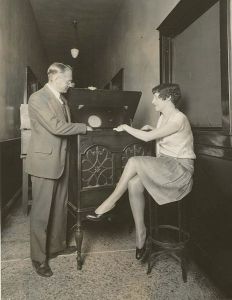
Photo credit: Smithsonian Institution


Religion, He Wrote

A friend recently sent me the New York Times obituary for Carol Serling, the wife of one of my heroes, Rod Serling.  Perhaps it’s a personal weakness, but I often wonder about the religion of my favorite writers.  More often than not I discover that they’re affiliated with tolerant faiths, sometimes unattached to any specific tradition.  Rod Serling grew up Jewish but became a Unitarian-Universalist by marriage, and—it doesn’t stretch the imagination—remained one by conviction.  I’ve read a bit about the UU tradition, and it is based primarily on values rather than beliefs.  In fact, the idea that religion is a matter of what you believe is only one way of defining it.  Historically one’s religion was a matter of what one did, not necessarily what she or he believed.

Authors that I read often deal with religious issues.  It’s important to confess that I don’t select fiction based on its having religious themes.  Anyone who’s read more than one or two of my posts will know my reading is eclectic and many of the books represented here have shown up because of wildly different circumstances.  Reading challenges, friends’ recommendations, and preparations for educational presentations are often driving forces.  In the fictional realm I’m drawn to the speculative, but also often to the catch-all category called “literary.”  Stories that feel authentic in either category have an element of religion in them.  Life portrayed without it doesn’t seem believable.  I’ve been re-reading some Ray Bradbury.  There’s often suggestive material there.

Raised a Baptist, Bradbury is often also claimed as a Unitarian-Universalist.  Apparently he didn’t like the label, but his behavior was more a selection of tenets that he found compelling from various religions.  All of this may sound strange in a context where “religion” is increasingly a dirty word.  (To be honest, it has been doing much to earn such a reputation.)  Still, it is a very deep part of being human.  Rod Serling’s stories advocated fair treatment of all people and often his sense of justice landed him in trouble with advertisers for The Twilight Zone.  Religions comfortable with maintaining prejudice, or turning a blind eye to lawbreaking in the name of false virtue would certainly not understand refusing to take money from questionable sources.  I suppose there’s a reason I enjoy the stories from the days when America still had a conscience.  The legacies of such writers, it is to be hoped, will outlast what passes for religion these days. 

Any other gods before me…


Significant Places

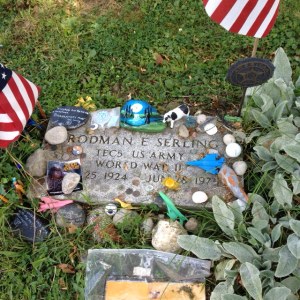
Upstate New York may not get the attention that the state’s largest city does, but it is a place of wonder.  One of those sources of significance is the unique blend of individuals who’ve impacted both American culture, and, in turn, my life, that called this region home.  It’s difficult to describe what I’m feeling as I’m standing next to Rod Serling’s grave.  This is a man who held a profound influence over my outlook by letting his imagination go where it would.  It’s more than the Twilight Zone—although its theme is one of the ringtones on my phone—it’s the sense that I somehow knew this man I never met.  It’s also the sense that his gravesite is so humble, in a rural area outside a small town, the kind that often featured in the stories he wrote and presented.  It’s the sense of connection.

As I young person I practiced writing short stories based on the mood set by the Twilight Zone, with a dash of Ray Bradbury thrown in.  From a small town myself, imagination was my means of enlarging my world.  We didn’t have the money to go many places but the magic box in our living room could take me to weird places alive with transcendence.  The results were beyond price and there was something deep and liberating here, even for a kid whose religion said it was all nonsense.  Even religion requires escaping sometimes.  I know the publishing world has moved beyond what was fashionable in the sixties and seventies, but that can’t dislodge the shard in my chest right now.  If there are spirits in cemeteries, they are here.

Some time ago I began, as I had time, uploading my photos of famous writers’ graves (along with those of other recognized names) on Pinterest.  On the way to Interlaken, I wondered aloud why nobody seemed to show an interest.  I find cemeteries peaceful places, and sacred spaces are those where people significant to us have been, in some form, at some time.  I know Rod Serling loved upstate New York.  It was his escape from the busy life of a writer whose cachet was marketable back in the days when anything seemed possible.  Retreats are those places we go to restore ourselves when work simply won’t allow creative people to have unstructured time.  I wasn’t expecting a huge mausoleum or towering monument here.  Others have found their way to this place nevertheless.  I am in a sacred place and the quiet here is kind of a prayer.


Belonging

You never know where you might find yourself, but wherever it is it’ll cost you some money.  Well, at least in this instance it did.  Nashotah House sent me packing just as we were thinking about college for our daughter.  It took several years to find any kind of full-time position again, and when university time began I had had a full salaried job for a total of one year of the last seven.  Not ideal, of course.  I remember sitting (again) in the financial aid office, explaining the situation and, as it often goes in higher education, receiving no mercy.  As much as I remember the conversation, I don’t recall a photographer in the room.   There must’ve been, though, since I recently showed up on the Binghamton University website.

I had, of course, applied for a job or two there.  When out of state tuition is riding on such a deal, however, I doubt there’s any way to get considered.  I actually like Binghamton University quite a lot.  I appreciate the fact that it doesn’t pour its money into a football team and that it has the reputation of being a “Public Ivy” school.  I even like the campus removed from city bounds—just like Nashotah House.  I did end up paying them quite a bit of lucre through the years, even as my own alma maters were asking alms.  Higher education is a funny world.  Standing somewhere between a money-making venture and a site of education for its own sake.  Many professors don’t realize just how privileged they are to have jobs like that.

Upstate New York, although I’ve never lived there, is one of my ancestral homes.  My grandfather and his family had lived in the area at least as far back as the 1770s.  I tried to convey that sense of connection in my application, many years ago now.  Academia doesn’t put much stock in the idea of belonging, I guess.  It has become far too businesslike for that.  Binghamton was also the town in which Rod Serling, one of my childhood heroes, grew up.  There seemed to be so many reasons to be in that area.  Eventually I settled for life in my own native Pennsylvania.  People sense, although academics less than others apparently, that they belong in a place.  And if you can’t actually be there, you can still spend your money in any location.  I’ve now got a picture to prove it.


The Zone

My youth—who am I kidding?—my life has been a search for father figures.  Since I grew up with television, many of them came from the tube.  The professor from Gilligan’s Island, Mr. Rogers, Barnabas Collins, and Rod Serling.  Serling was like the father I couldn’t remember in that he was always smoking.  But unlike my father, Serling had an imagination in sync with mine.  The Twilight Zone was in reruns by the time I caught up, but it gave me an odd kind of happiness.  The sort that you had as a kid after the bath was over and you were wrapped up snuggly and warm in a bathrobe, and you got to watch one of your favorite shows before going to bed.  I discovered Serling as a writer when I was in Junior High School.  He was right up there next to Ray Bradbury, in my book.

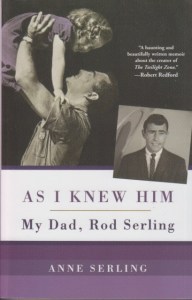
I have to admit to feeling anxious as I read Anne Serling’s As I Knew Him: My Dad, Rod Serling.  You see, she actually was his child and I’m afraid of learning too much about those I put on my personal pedestals.  Her book, however, didn’t disappoint.  Serling lived a writer’s life, something I’ve coveted since I was a kid.  If I couldn’t have a father, at least I could write about life as I saw it.  I still write fiction inspired by, among others, Rod Serling.  Spending much of my time in Binghamton and Ithaca for my own family reasons, I was only obliquely aware of how much I was traversing the region Serling considered home.  As I read his daughter’s autobiography—or is it a biography?  Who can tell the difference?—I was inexorably drawn in.  Fathers and daughters can be the best of friends.

Sometimes I wonder if those who know writers the best are their true fans.  I don’t mean groupies or the like, but rather those whose lives have been transformed by their words.  I’m reminded of Evermore, written by a relative of Edgar Allan Poe.  Family, it is true, see a side of a person that the reader does not.  But who are we, really?  Those of us who write may be saying more in our fiction than we care to admit even to those who know us well.  Rod Serling recognized dimensions well, I suspect.  A writer’s life requires sacrifice and keeping things hidden.  Anne Serling’s book is a gift to those who write, even if it is about someone else’s father.


On a Jet Plane

So I’m heading to England.  Not for pleasure—this is a business trip.  Long ago, back when I worked for Routledge, I discovered that I dislike business travel.  Unlike vacation planning where the possibilities spread out beautifully before you—for this is free time and you decide—business travel is, like Peter was told, “thou shalt stretch forth thy hands, and another shall gird thee, and carry thee whither thou wouldest not.”  Indeed.  Business travel is at the whim of the man, and you can’t really look forward to the sights, the relaxation, or even being given the choice of where to go.  You’re on assignment.  Or consignment, I can’t recall which.  The carefully honed routine with which you hold back the chaos of the world is blown apart.  It begins with the red eye.

You see, companies don’t like you to make your own travel plans.  You might chose a flight that’s pennies more expensive than some itinerary that routes you through Albuquerque at four a.m.  It’s not like you’ve got anything better to do, right?  And since you’re exempt, we’ll take your Sunday, gratis.  Where’s your team spirit?  As I’ve grown older, I’ve become a creature of habit.  The hour of the typical red eye is when I get up to write.  That can’t be done in an airport, or on a plane, where everyone can see you.  No, this is a private thing.  Everyone else must be asleep.  Most of them, preferably, in another house.  So I’m flying to London and catch a late-night bus to Oxford.

Part of my worry, dear readers, is you.  As this blog approaches its tenth birthday, I’ve been in the habit of posting daily for many years.  Mostly at the same time—weekends and commuting days are exceptions, of course—and when you’re changing time zones you might do well to have Rod Serling with you.  I can’t figure them out.  British hotels, also, do not offer wifi in their rooms unless the boss wants you to pay extra for it.  And considering the mandated flight behavior, that’s best just taken off the table.  So, as I prepare to leave before sunrise on one of the longest days of the year, I don’t know if or when I’ll get to post over the next few days.  I won’t even know what time it is.  Like pay toilets, charging for internet access ought to be criminal these days.  But opportunities to take money are everywhere.  And those of us who travel for business always rely on the kindness of capitalists.


Not-Quite-Normal Religion

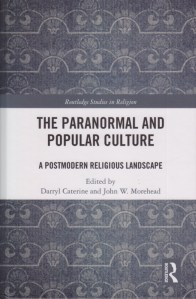
I’ve been thinking about categories quite a lot lately.  In a world connected by the internet, it seems that traditional categories don’t stretch far enough.  For example, I recently read The Paranormal and Popular Culture: A Postmodern Religious Landscape, edited by Darryl Caterine and John W. Morehead.  Published by Routledge, this is an academic study.  It contains some things, however, that many academics would find challenging.  I can’t summarize the entire book here since there are twenty very different essays included, but I can say this is a book that makes you think about categories.  Even the word “paranormal” means different things to different people.  To my way of thinking it has to tip the hat to Rod Serling and that place where fiction and fact begin to overlap.

That’s appropriate for this book: there are articles about what people perceive as factual encounters with all kinds of creatures and events, as well as studies of the decidedly fictional beings like Batman and zombies.  Our categories, in the modern world, tend to be inviolable.  Even scientists who handle Heisenberg know, however, that we are now in the postmodern world (as the subtitle indicates) and true objectivity is beyond the reach of all.  None of us stands outside the box looking in.  We’re all in the middle of it, and we look around ourselves trying to figure out what is real.  Another problematic category that, reality.  We don’t even understand what consciousness is yet, and how can we hope to know what is really real?  We all have dreams and some take them more seriously than others.

Reading books like this with an open mind is a truly po-mo experience.  After finishing more than one piece I found myself having to put the book down for a while at least so I’d have a hand free to scratch my head.  You see, we’ve been taught to laugh at those who believe in the paranormal.  It has been the only acceptable way that rationalists can deal with that which flies in the face of the system.  The internet, however, has put those isolated, ridiculed individuals into a community and the advent of reality TV (and what can be more real than what we see on the tube?) erodes the laughter factor little by little.  Plumbers can find ghosts but scientists can’t.  The average person relates more to the plumber, I think.  It all comes down to categories.  Making sense of them can, and will, impact our views of reality.


Bookish Dreams

Driving into upstate New York via interstate 81 you’ll find a remarkable rest stop.  To put this into context, I should say that my wife and I have driven from Maine to Washington (not on a single trip) and from Wisconsin to Louisiana and South Carolina.  We’ve laid down considerable mileage together, and never have we encountered such a nice rest stop.  Clean, modern, and featuring local goods for sale, it’s a loving homage to the southern tier, the New York outside the city.  One of the features of this unusual facility is a terrazzo floor fresco highlighting the various points of interest within a couple hours’ drive.  Mostly when we stop here we look toward Binghamton and Ithaca, the cities we most frequently visit.  We stop to use the restroom and then drive on.

When we stopped over the holidays, however, we lingered a little bit.  There’s a display on Mark Twain—he lived in Elmira, New York for a time—and there’s an in-ground plaque outside to Rod Serling.  I spent some time looking over the points of interest in the floor map when my wife pointed out a site listed as Hobart Book Village of the Catskills.  I couldn’t believe that I’d been in this building dozens of times but had never bothered to look that far east.  Curious, I did a web search once we reached out destination.  There is, it turns out, a village in upstate known for its main street of book stores.  What perhaps impressed me even more was that it was considered significant enough to be given a kind of “Hollywood star” treatment in what is an often overlooked part of the state.

Now I can’t say what my impressions of Hobart are.  I’ve never been there, having just learned of it on a recent roadtrip.  What I can say is that my world suddenly began to feel just a bit more friendly knowing that such a place exists.  We live in a country that could indeed use a bit more positive influence.  Some of my happiest memories involve bookstores.  Back in my teaching days we made regular autumnal literary weekend trips, visiting sites haunted by writers.  Often we’d find an independent bookstore near such sacred places.  To many, I realize, this would smack of nonsense, but to those ensconced in literary dreams, it created pleasant memories.  You feel something in the air as you stand near the house or grave of an author.  Places are made sacred by what transpires within them.  The writing of books shapes the very space-time around them.  At least it does for those who even find inspiration in an interstate rest stop.


Devolving Apes

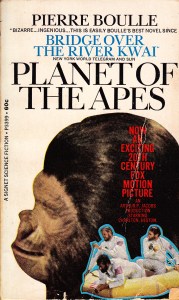
It would be difficult to overestimate the effect the movie Planet of the Apes had on me as a child. Raised a biblical literalist, evolution was, naturally enough, anathema to me. And yet here was a movie based on the idea that evolution had taken a different course. It was a transgressive film, but the screenplay had been written by Rod Serling, so well known for his trusted work on The Twilight Zone. I was utterly fascinated by it. Until the most recent iteration, I’d seen every sequel, spinoff, and reboot ever made. So important was this story line that as a child I found a copy of the book, in English, of course. Pierre Boulle told the story somewhat differently. Spying the book on my shelf after some four decades of my own evolution, I decided to read it again.

We all evolve. I noticed the improbabilities more this time through. The fact that, unlike the movie, humans wore no clothes at all must’ve scandalized my young eyes. I would’ve agreed, however, with Ulysse Mérou’s sentiments that humans were created in the image of God, not apes. In fact, there is an undercurrent of a somewhat conservative theological outlook here. Humans may experiment on animals, but when it’s reversed, it’s evil. In many ways, the cinematic version improves the story, but Boulle’s telling grows in intensity as the novel unfolds. Mérou develops a moral sense that includes the apes as well as human beings. The story, of course, is largely about prejudice and its evils. In that respect, it’s timeless.

As a child I realized that we lose something if we accept the fact of evolution. We lose that special feeling of having been intentionally created by a deity that made us God-shaped. Ironically, I also came to realize that those who rejected evolution often treated their fellow humans like animals. They held onto prejudices against other “races.” They castigated the poor for being lazy. They wish to remove healthcare from those made in the image of God. The contradictions and cruelties simply don’t comport with the Good Book they adore and ignore. Evolution, with the realities of nature impinging on our security, is far less dangerous than what biblical literalism has evolved to be. I can’t say why this book and its cinematic renditions became so deeply embedded in my young mind. But having read the book again, it’s pretty clear that the ideas have remained there, even as they have modified, with descent, over time.


A Kind of Contact

I find myself in Ithaca, New York. Places have a resonance with people, and this is one of those places I feel like I belong. The feeling may not be mutual, but that makes it no less real. At least on my part. Dominated by the presence of Cornell University, this town of waterfalls and free spirits represents everything I value. Education, creativity, and an easy familiarity with nature all have a place here. And Carl Sagan. No doubt astrophysics is far more sexy than religious studies. I didn’t watch Cosmos when it aired, but I knew of Sagan as its driving force. Before being daunted by the math, I had considered astronomy as a career; Denied tenure at Harvard, Sagan came to be associated with Cornell, to Ithaca’s enduring benefit. His house above Ithaca Falls is still pointed out by the locals.

Star status for academics, so I’m informed, is a mixed blessing. Accusations of being a popularizer are flung somewhat liberally at those who know how to explain things to non-specialists. Part of the ivory tower mystique is to remain inaccessible and impenetrable. Teaching, at the same time, is expected to open lost worlds to the curious. Sagan, like Bill Nye—another Cornell star—wasn’t afraid to take his knowledge to the streets. And such receptive streets there are in Ithaca. It’s a place a child of the sixties can feel at home. Looking for fossils in the many gorges, I’m reminded that the old and new are not so different in a universe billions of years old.

The sense of place, while scientifically dubious, is nevertheless real. Part of my ancestral heritage lies in upstate New York. My grandfather, while not a college man, took a couple of courses at what was then Cornell College to launch his teaching career. Following in grand-dad’s footsteps, my own teaching career (which, however, never included Cornell) didn’t last long. Yet somehow we both ended up passing through Ithaca. People on the street. Waiting to be enlightened by stars that shine brighter than my own. Life is a series of places. All, it turns out, are temporary. Rod Serling once said, ”Everyone has to have a hometown, Binghamton’s mine.” He left the nearby town, but he has remained there ever since. Places are that way. I’m in Ithaca right now, but the stark reality of New Jersey awaits at the end of the day.


I’m No Legend

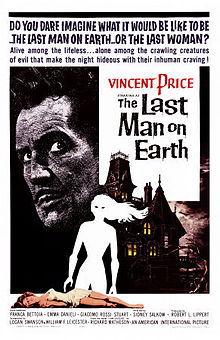
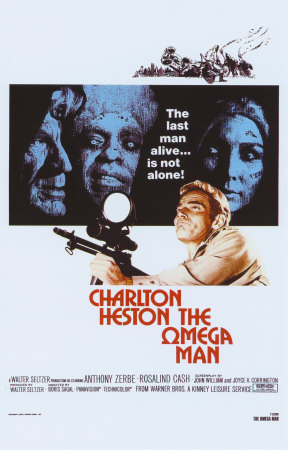
First there was The Last Man on Earth with that rare, disappointing performance by Vincent Price. Then there was The Omega Man, putting Charlton Heston into the role that fit him better than Moses. Finally, returning to the original title, I Am Legend featured Will Smith as Robert Neville. Having watched all three movies, I knew I should have read Richard Matheson’s short novel first. After all, it was a vampire story, and who doesn’t feel utterly alone once in a while? I finally decided to make an honest man of myself. It occurred to me as I started to read that I didn’t know how this story would end. All I had ever seen were cinematic treatments—and who writes anything serious about genre fiction? Still, I needed to know.

Last Man

Matheson was one of the writers who had caught Rod Serling’s attention on the Twilight Zone. Having read some of his short stories I could see why. Not knowing the ending, some of them can actually be scary. I Am Legend isn’t exactly frightening. It is, however, thought-provoking and sad. Matheson, a New Jersey native, wasn’t among the most literary of writers. Nevertheless, he conveys some deeply disturbing images of humanity in this particular novel. After all (spoiler alert!) Robert Neville is the evil one. He has been killing vampires with a cold calculation, no matter whether they are living or undead (good or bad). Who has a right to kill whom depends on your point of view.

The-Omega-Man-Poster

In I Am Legend, Matheson makes it clear that Neville, the last man alive, is an atheist. The problem, as it usually is, is theodicy. How could a god allow such a massive tragedy to strike not only himself, but the entire world? After the vampire virus had spread, Neville finds himself dragged into an evangelistic meeting by terrified survivors who had turned to religion to make sense of their tragedy. Neville escapes as quickly as he can. The movie versions tend to ignore this poignant aspect of the narrative. After all, the audience watching must sympathize with Neville or the whole draw of the movie is off. In a nation where atheists are trusted about as much as vampires, it seems that Matheson left us a parable as well as a legend.


Romney Wordsworth

TheTwilightZoneLogo

The Twilight Zone, one of my favorite fallbacks when I’m alone, doesn’t shy away from religion. I remember watching some of these moody tales in my childhood, already in reruns by the time I was old enough to appreciate them, and occasionally having my young mind shaken as a result. The frisson of having reality not being as it appeared kept me wanting to see more of Rod Serling’s universe, evaluating, re-evaluating, speculating. Often heavy with psychological realism, despite the obviously outlandish premises, these half-hour plays in black-and-white still have a strange power to alter a mood. I recently viewed the episode “The Obsolete Man,” which closed season two. Having been declared obsolete myself, more than once, I found this story particularly chilling. A totalitarian state declares what worthwhile occupations might be, and Romney Wordsworth, as a librarian, doesn’t hold one of them. With shades of both Orwell and Bradbury, Wordsworth is sentenced to death.

In startlingly strong language, Serling has Wordsworth declare that, despite the decision of the state, there is a God. He wants his death televised, to which the Chancellor is happy to acquiesce. Locking the Chancellor into his room where, Wordsworth reveals, a bomb is about to go off, he tests the steel of the state by accepting his fate. Wordsworth spends his last hour reading the Bible. The Chancellor sweats and chain smokes himself frantic, finally calling out, “In the name of God let me go!” Wordsworth, of course, does. Rod Serling was not known as a particularly religious man. Many of his characters are hard-bitten, tough-talking caricatures whose bravado masks a profound uncertainty about life. The writing may not be stellar, but the ideas are beyond the stars. Religion is very human.

Many of these Twilight Zone episodes I have never seen. Still, they do reveal a world of imagination that had a tremendous impact on Cold War America. Bomb shelters, revolutionaries, and invaders haunt the minds of not just those born in the fifties, but of every generation since. The state that protects us is the very one that breaks open our luggage to look at our unmentionables when we want to fly. To keep us safe from ourselves. A decade before Serling’s series, George Orwell was looking a quarter century ahead, calculating the trajectory. The good guys, it turns out, have the wherewithal to decide who is obsolete and what is subversive. And if you don’t see things their way, they’ll start talking impeachment or perhaps worse. Your next stop, the Twilight Zone.


Forbidden Zones

Dawn_of_the_Planet_of_the_Apes

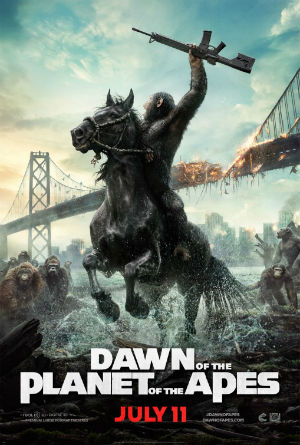
I grew up with talking apes. Well, I was actually about six when Planet of the Apes was released, but it quickly became one of my favorite movies. With a screenplay co-written by Rod Serling, and that very unorthodox conceit of evolution playing visibly on the surface, it was the forbidden fruit. Since, according to our fundamentalist doctrine 1) animals can’t speak, 2) evolution never occurred, and 3) the world was going to end long before 3978, we were not prevented from watching what was obviously fiction. And watch I did. There were spin-off cartoons, not to mention the following movie and television series. An unsuccessful reboot by Tim Burton was followed by Rupert Wyatt’s intelligent, if somewhat sentimental version. And I’ve seen them all. Finances being what they are, and, since my family does not share my enthusiasm for the apes, I’ll probably have to wait for the home-viewing release of Dawn of the Planet of the Apes to enjoy the latest offering.

In the meanwhile in a nearly glowing review in this week’s Time magazine, Richard Corliss has indeed whetted my appetite. The original series of Planet of the Apes movies had, like many films of the late sixties and early seventies, a strong, underlying social critique. Yes, one can see only so much of Charlton Heston’s bare chest, but there was something more going on here—something to which we needed to pay attention. The Burton version went for a parsimonious special effects extravaganza, but the storyline was devoid of much underlying reflection. Good ape, bad ape, all the way. Now, as we are moving into the third major incarnation of Pierre Boulle’s dark vision of our distant future, we see that the apes are maybe the real humans here. Maybe they were from the very beginning.

Perhaps because of its ability to slip beneath the Moral Majority radar in the guise of science fiction, the talking apes have been part of American culture for almost my entire life. The original movie introduced the idea of the Forbidden Zone, that region where the truth lay buried, waiting to be discovered. There was a not-so-subtle jab here at a world where politics was continually being revealed as just another human bid for power, and a Cold War was threatening our very existence. We survived and continued to evolve. Still, we find a kind of social catharsis in the apes, and I worry just a little bit at Corliss’s use of the word apocalypse. The apes have always been remarkably prescient. For some of us, they were more than mere entertainment. And so I’ll patiently wait until I can watch the apes alone in the privacy of my home, to learn what the future might hold.


Twilight Zones

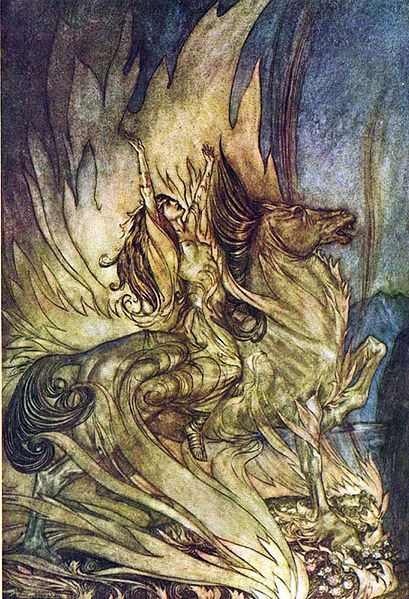
It was twilight last night when I drove into Binghamton. My thoughts naturally turned to The Twilight Zone since one of my childhood heroes, Rod Serling, had grown up here. Binghamton University was also the professional home of novelist John Gardner, of Grendel fame. Seeing the colorful leaves fading to the gray of a falling evening, I thought of how evocative a word “twilight” is. We are creatures with an in-born fear of the dark and twilight is our last hope of light before the night settles in. Maybe it was having just so recently read Grendel, but twilight and gods together brought “the twilight of the gods” to mind (it might have helped that a sudden thunderstorm broke out at the moment). When I first saw the word Götterdämmerung, in junior high school, I thought it must be a potent swear word, what with all those doubled letters and umlauts. My German teacher calmly explained that it was the fourth and final cycle of Richard Wagner’s opera, Der Ring des Nibelungen and it translated to Twilight of the Gods. It is itself a translation of the Norse word Ragnarök, with its single umlaut. Even though it wasn’t swearing, the concept sent a shiver through me anyhow.

I’ve never sat through a performance of The Ring, but I have heard the music with its famous Ride of the Valkyries. Based on Norse and Germanic mythologies, The Ring has deep roots in a pagan mythology where night plays a prominent role. Although J. R. R. Tolkien denied having been inspired by Wagner’s work (there was a certain political incorrectness to it, along about the early-to-mid-1940s), both four-part cycles draw on the Norse mythology that continues to fascinate us with movies like Thor and The Avengers. What impacted my young mind the most, however, was the very concept that the gods could be defeated. How was such a thing even possible? We were raised to believe good conquers evil. How can the gods—even pagan ones—lose? It was a world-distorting concept for someone yet to face high school.

Last night I was literally in the twilight zone. Having driven through the Endless Mountains region where autumn’s reds and yellows inspired me with just how colorful death can be (a European friend once confessed to me that driving along a wooded road in Pennsylvania his first autumn here he had to pull over and weep for the beauty), twilight was already on my mind. October fades into the twilight of the year. The mythologies of the northern races, the Norse and the Celts, seem almost obsessed with the ominous, growing darkness. There is a beauty to it, but also an abiding fear. Are the gods powerful enough? It was a question first raised when my eye fell on that striking word Götterdämmerung that somehow became a part of me.

409px-Ring63


Just Binghamton

I seem to find myself in Binghamton again. The town, while clearly economically depressed, still retains a bit of its 19th-Century charm with some beautifully restored downtown buildings and a sense of history. While too many store-fronts are still vacant and too little money exists to improve the area sufficiently, I happened upon a warm and cheerful independent bookstore—River Read—and that always gives me hope in such circumstances. Bookstores such as this are like seeing the first crocuses after a long, harsh winter. There is some life in this seemingly dead planet yet. Outside the bookstore stands a statue of Martin Luther King, Jr., backed by a sluggish river and yet more vacant windows. I think of justice and all that it means.

IMG_0969

My own hometown (not Binghamton) is virtually a ghost town. It is a feeling difficult to describe, visiting a place that served as your first secure setting in the world only to find it crumbling under an economy with so much wealth with so little reach. Where is the justice in that? Binghamton, near the founding location of IBM, ironically began suffering at the decline of the Cold War. Manufacturing has gone for pastures of a different kind of green, leaving a sometimes sad and forlorn city in its wake. Binghamton sheltered a young Rod Serling, a man who would give the world the Twilight Zone and its endless spinoffs. It is home to a first-rate university. And a wonderful bookstore.

While in River Read we heard some locals talking, in almost Springsteenian fashion, of local civic traditions that had disappeared. Times have changed. Cities like Binghamton don’t draw in the curious or those with liberal purse-strings. Endicott Johnson, the shoe manufacturer, developed a strong sense of welfare capitalism in the city last century—capitalism with a heart seems to have gone extinct these days. The idea that those with the means to create jobs and livelihoods should care for their employees would seem to be a matter of common sense. Instead, common cents have come to rule. Binghamton University is investing in the town, and a sense of cautious optimism dares to suggest itself. Justice is a matter of distribution rather than entitlement. And that’s why I’m standing out here under gray September skies, staring at the statue of Martin Luther King, Jr.