Celestial Happenings

Science fiction used to be the mainstay of my reading. Unlike a true fan, I was never exclusively devoted to it—my tastes are far too eclectic to be contained by any genre. Nevertheless, at a used book sale, on a whim, I picked up Frederik Pohl’s The Day the Martians Came. It had a cool looking spaceship on the cover, and I recognized his name from my childhood reading. I prepared myself for an adventure. Instead I found a disillusioned tale of humans and their foibles, many of them religious. Many tales, in fact. Indeed, I wasn’t surprised to find out that this was originally a set of discrete short stories later laced together into a novel. The point, it seems, would be appropriate to Qohelet. Human beings run around doing their pointless things and failing to communicate with one another. That much was true to life.

The Martians, who are more evolved and intelligent than humans, but who appear to be mere docile animals, are discovered near Christmas. Much is made of the fact that humans still celebrate Christmas on Mars. And, if you can cut through all of the snark, there’s also a message that we like to live out our prejudices whenever possible. So the humans, excited about Martians being transported back to earth, try to take advantage of each other any way they can. Some of the most complex of the stories involve religious leaders who dismiss science and assert mystical knowledge of these extraterrestrials. These leaders, of course, are only after the money of the gullible. They’re playing the popularity circuit, or running cults, and the clueless are drawn to them. And so the book isn’t really about Martians at all, but about human folly. Mainly religion.

Science fiction means different things to different people. In a used bookstore I noticed Neil Gaiman under science fiction. As much as I enjoy his work, I’d classify it as general literature instead. Genres are there to help us find related material. The name Frederik Pohl and the word “Martians” in the title suggest science fiction, but the book itself doesn’t really meet the criteria. At least for me. Perhaps it’s because we’ve landed rovers on Mars and are now talking about a human expedition. Mars has become somewhat less exotic. Religion, meanwhile, continues to churn and muddy the waters. Not always as cynical as the leaders seem to be in this book, nevertheless they are part of the discussion since once we get off this planet we’re going to have foreign deities with which to deal. Whether we respond with snark or science fiction is entirely up to us.


Found in Translation

embassytownTraduttore, traditore—“translators are traitors”—is an Italian saying invested with a great deal of truth. Anyone who’s worked with the proliferation of languages in the world knows the truth of the adage. What is said in one language can’t be stated precisely in another language with all the depth and texture of the original. China Miéville’s Embassytown is a sprawling novel that addresses the question of how cultures evolved on widely separated world can ever understand one another. I can’t possibly go into a detailed summary of the story—it took me about 30 pages to begin to understand what was going on—but the book drew me in nevertheless and left me happy to have expanded my conceptual world.

The reason that I’m bringing this novel up in a forum where religion lurks in the background is that Miéville explicitly brings religion into his story. It may be impossible to explain precisely how he does this without the detailed summary that I’ve already begged off giving, but it is nevertheless noteworthy that in any sufficiently complex world religion emerges. We tend to think that religion is something that evolved from the slime and now that we’ve bathed in the light of pure reason it will eventually be washed into the gutter of discarded concepts. History demonstrates repeatedly that such is not the case. Religion is resilient and, dare I say it, inevitable. Human beings—perhaps also other conscious beings—know that there is something outside ourselves. That’s the foot in the door for higher beings or forces or worlds. In a word, religions.

Fiction writers frequently appeal to religions for verisimilitude. Are imaginary worlds believable without religions? It’s a long stretch. Star Wars has characters calling belief in the force a religion. Star Trek, in any number of episodes, dealt with gods. Anathem was based on the monastic ideal. Science fiction has trouble when it leaves religion completely out of the picture. A non-deistic universe is nearly incomprehensible to the human mind. Even great scientists and other rationalists occasionally lapse into thoughts about luck, fate, or fortune. Embassytown doesn’t focus on religion throughout, of course. It may be a minor subplot. But translating an alien world with a language that can’t be understood into a fiction of English is facilitated by putting a religion into the general mix. This is a smart and complex world, but when you read it you’ll find it believable because a religion naturally emerges. And that, I say, is realism.


Stations, Everyone

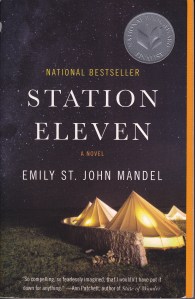
Station11There has been a movement, of late, among some sci-fi authors, to envision a more optimistic future. I have always been a fan of dystopias, myself. Perhaps it’s the working-class mentality backed up by being raised in poverty speaking, but sometimes I feel that collapse is more fair than progress. What passes for progress, anyway. Maybe I’m thinking this way because I just finished Emily St. John Mandel’s Station Eleven. This book has been on my radar for some time since it is one of the more hopeful dystopias out there. The story of a group among the very few who survive banding into a traveling troop of musicians and thespians is about the most hopeful outcome I can imagine. Not a day passes when I don’t feel the effacement of humanity that has been slowly taking place since I first became aware of the world. Sure, I do appreciate the strides made in medicine. Of this internet, which is the only place anyone ever really sees me, I’m less sanguine. It has its benefits, but even Mandel mentions the cell-phone zombies that are all too real and as omnipresent as an omnipotent deity used to be.

Station Eleven has, as many dystopias do, a religious sect that emerges after society collapses. This element of bleak futures is actually very accurate, I anticipate. We’re constantly being told by the “intellectuals” of the public variety that religion is for weak-minded dreamers with milquetoast aspirations for fantasy. The fact is the vast majority of people in the world are religious. The numbers are nowhere even near close. If a pandemic were to wipe out all but one percent (and hopefully it wouldn’t be the one percenters that survive) those who remain would, without doubt, turn to religion. People are easily led in this area of life. Mandel gives us The Prophet. His vision of the world is not helpful, but he has no trouble gathering a following. He’s also somewhat messianic: child of a single parent, raised in Israel, he comes to bring a sword to a nation already prostrate in the dust. This is powerful stuff.

Societies that try to rebuild themselves after traumas quite often rely on religion. This is hardly surprising as civilization itself began as religions coalesced into temples and their priesthoods. What is surprising is that so many intelligent people today can’t see just how important religion is to our species. As I suggested before, part of this is that religion defies simple definition. It’s easy to belittle “magical” thinking when it’s assumed religion has to do only with the supernatural. Religion, however, reaches into whatever we believe. Some ideas in modern cosmology, derived from physicists and their mathematics, can look sort of religious when viewed from a certain angle. As those who write dystopias know, religion is complex. It may lead to massive destruction. Chances are, however, that if there are any human beings left to crawl out of whatever pit we dig, they will do so with religious ideas in their heads. As usual, the writers have foreseen it.


High Castle Blade Runner

DivineMadnessGrowing up evangelical, one of the popular topics of conversation was crypto-christians. (My spellcheck insists that this is a lowercase expression.) Crypto-christians are people, generally famous people, who might be secretly “Christian.” You see, despite stereotypes most evangelicals really do want people to go to heaven. In fact, they tend to be obsessed with it. And besides, it can’t hurt to have a celeb backing your claims. One name that never came up in my circles was Philip K. Dick. I grew up reading science fiction. My reading patterns (which haven’t changed much) involved reading what I could find among used books at Goodwill. We were poor, and besides, there were no bookstores in our town. Like many people, I’m sure, I learned of Dick by watching Blade Runner. I occasionally heard others discussing the movie, but I hadn’t seen it myself and thus continued blithely unaware until I began teaching. I then read how Blade Runner is a possible Christian analogy, and curious, I read Do Androids Dream of Electric Sheep?

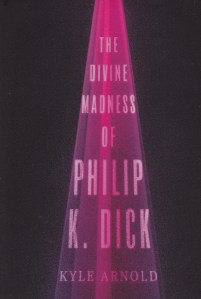
Since then Dick, who never made it big in his lifetime, has become a staple of the sci-fi diet. In The Divine Madness of Philip K. Dick Kyle Arnold explores the now famous 2-3-74 episode. Dick, in addition to being over-medicated, had mystical experiences. The “big one” took place beginning on the date implied in its title. This vision, while not orthodox by any standard, is clearly religious. Critics tend to think that Dick may have either faked it or that he underwent some kind of schizophrenic episode. Arnold, a clinical psychologist, has the chops to demonstrate that these latter explanations are off base. Dick had a legitimate visionary experience—something even neuroscientists can’t access because the experience is subjective and personal. It had a large impact on his life, but it did not make him mentally ill.

Arnold is not, as far as I can tell, a crypto-christian hunter. He is a psychologist attempting to understand a most complex and tormented writer of superior science fiction. What becomes clear, however, is that Dick was well-informed about Christianity. He imagined himself a secretive first-century Christian in an oppressive Roman Empire. This aspect of his life tends not to emerge in pop culture discussions—how Christian can you be and still be cool? Certainly Dick was not a conventional believer, but religious imagery and even actions became some of the most important moments of his life, according to his own recollections. Philip K. Dick was clearly a haunted man. And one of the specters haunting him was an often undiagnosed religion.


Gods and Giants

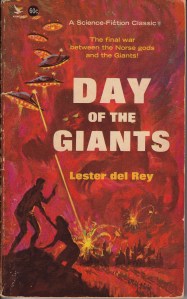
Day of the GiantsComing back to a book you first read as a tween, in the days before tweens even existed, can be a revelation. Lester del Rey’s Day of the Giants introduced me to Norse mythology as a kid, and, along with Thor comic books, was my Nordic Bible. The last time I read it was probably in the Ford administration. As part of a reading challenge I’m undertaking this year, I had to select a book I’d read before and, amazingly enough, I still had my copy. Reading the book as an adult, however, proved a very different experience from reading it as a child. For one thing, I noticed quite a bit more of the implicit theology of the story. Del Rey was no theologian, of course. This little book, however, makes a statement that is difficult to miss regarding the gods: they are victims of tradition.

It is probably not worth worrying about spoilers over half a century after a book was published, but I’ll try to be sensitive nevertheless. Leif Svensen, our protagonist, finds himself in Asgard on the eve of Ragnarok. All the familiar Norse gods are there: Thor, Loki, Odin, and kith and kin. As they prepare for the battle with the frost giants, who, in the mythology win the contest, the deities are decidedly subdued. They believe their fate is sealed by a prophecy of defeat. Leif, being a true American, gives them a rousing speech about overcoming the old ways. Gods, by nature, are conservative. They don’t have to bow to tradition—they are gods, after all. The deities are not swayed by the logic of a mere mortal, even after his apotheosis. Fate, it seems, trumps even gods.

I’m pretty sure that Lester del Rey wasn’t attempting to make any profound theological observation here. One can be an accidental theologian. Ideas of gods and what they must do can be a detriment to their own future. Even with the evidence of the failure of their own prophecy, the gods can see no way forward other than that they’ve recognized as fate. They are, without saying too much, out-maneuvered by human resourcefulness. A man tames his god, and it can become a man’s best friend. I wasn’t expecting such theological insight from a sci-fi book from my youth. Then again, you never know what may happen when you come back to a book after leaving it on the shelf for four decades.


Resurrecting Color

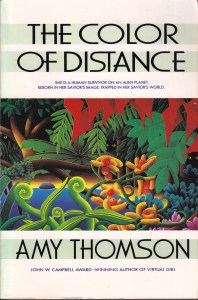
ColorOfDistanceIf you’re one of those people who’s attached to books, you know the frustration of someone who borrows a book and never gives it back. Many years ago I stopped lending out books for that very reason. I do, however, sometimes give them away. A friend recently reciprocated the gift of a book, giving me Amy Thomson’s novel, The Color of Distance. It is a profound story involving, as is common on this blog, themes of resurrection and transformation. A science fiction tale, it is set on another planet where something has gone wrong with an Earth survey team. The humans are dying on this alien world when one of them, Juna, is transformed by the alien into something like one of them. She comes back to life transformed. It wasn’t until I finished the book that I read the cover blurb that reads “Reborn in her savior’s image, trapped in her savior’s world.” Not a bad summary, capturing as it does the deep religious elements in the story.

The religious aspect, however, comes through most clearly in the environmental elements of the novel. Humans, somewhat optimistically, had set in place protocols not to interfere with alien life. So much we know from Star Trek’s prime directive. What makes this so interesting in the case of The Color of Distance is that Thomson knows that any contact is contamination. Two worlds cannot meet. They must collide. There is a gentleness, however, in her narrative. Juna, marooned (long before The Martian) on a foreign planet, has to learn to see things through alien eyes. And every little thing that humans have done has left a footprint on the planet. Protecting our own planet is a profoundly religious undertaking.

It is clear that Thomson has influenced later writers and stories. Not only does The Martian pick up on the stranded aspect, but Avatar clearly presents a world similar in many respects to the planet of the Tendu. The Color of Distance is a book not easily forgotten. The world into which the reader is drawn is indeed one of transformation and resurrection. I suppose spoilers aren’t an issue with a book two decades old, but I will satisfy myself merely with noting that another resurrection takes place as the story winds to its close. Deeply hopeful, and almost prophetic, this novel should be more widely read, for the sake of the world on which it arose.


Latter-Day Battlestars

Science fiction, when I was a child, constituted my fantasy life. I read such science fiction books as were available to a kid in a small town with no actual bookstore, and I watched what I could on a television with three or four channels. Star Trek and Twilight Zone were staples. As I got to high school there were more offerings, and one that I remember particularly liking was Battlestar Galactica. I was disappointed when the show ran only a few months. Something about looking for a home, being a scrappy, rag-tag fleet fighting against the odds appealed to me. Although I grew away from sci-fi as I went to college and studied more “serious” subjects, I never completely abandoned it. So the other day when I had reason to use the word “cylon” in something I was writing, I decided to do a little reading about the original series. I never did watch the reboot, as I was far too busy for television by then.

Battlestar_Galactica_1978_-_intro

I was surprised to learn that the original 1978 series was an exploration of Mormon theology. The show’s creator, Glen A. Larson, was a member of the Church of Jesus Christ of Latter-Day Saints and, not surprisingly, used his fiction to promote his religious ideals. After all, Orson Scott Card, of Ender’s Game fame, is also a Mormon and elements of its theology come through in his work. As a child I didn’t watch television for religion, but rather as form of escape. I wouldn’t have guessed, however, that I was escaping to Mormon theology. The Church of Jesus Christ of Latter-Day Saints is a bit more shy about telling outsiders its theology than many Christian bodies are. Mainstream Christianity, after all, is one of the main ingredients in our cultural soup. Any Methodist will be happy to tell you Wesley’s theology, if they happen to know it.

I haven’t watched television for over two decades. Very select shows we’ll watch on DVD, being the old-fashioned sort, but I missed the reincarnation of Battlestar Galactica in 2004. I’ve always had a soft spot for the originals when it comes to sci fi. The original Star Trek, the original Star Wars, and even that sleepy and terribly dated Space 1999. I suppose as a working-class child looking for an escape these shows had a kind of religious message. Although my religion taught a conventional Heaven and Hell, I wondered what was out there beyond even that, since the tri-partite universe was basically earth-bound. And science fiction offered to lead me to other worlds where things might be better. On the Enterprise we might whizz past the Galactica and wave, even if it was piloted by Mormons in space. And L. Ron Hubbard was known to me only as a writer of science fiction rather than the creator of a new religion.


Hello, I’m Not In

I recently received two “out of office” replies to my own “out of office” message. Being a fan of futility in all forms, this struck me as a great paradigm for the modern age. Email has made vacation superfluous, of course. I was actually out of town moving my daughter back to college, so email was not high on my list of priorities. When I’ve tried to leave work without putting on a message explaining that I’m not there (I tend to respond to emails quickly for an editor, so I’m told) I’ve been politely informed that it is rude not to let people know you’re away. Or computers. My non-message prompted a non-messages from other vacationers’ email accounts, and when I returned, I had to read them as well as the original email that had received my impersonal reply. Both had sent their replies, despite their out of office messages. This is indeed a brave new world.

It is a world where human interaction is optional, at best. Our industry grinds away making devices and services that people will buy with electronic money sent over a network that no one really controls. And we think nothing of it. Business has blinded us to how meaningless humanity has become. Business runs for business’s sake. Even so, we’re asked to check our email when we’re on vacation, in case something important comes up. I used to think vacation was important. It is the sop we’re thrown for working jobs that lack the visceral appeal of growing our own food and relying upon ourselves. Thoreau on the web.

Benjamin_D._Maxham_-_Henry_David_Thoreau_-_Restored

Science fiction is the great predictor of where we might go. Most of it is completely fiction, or course, but some manages to catch glimpses of the truth. Skynet, or even the Matrix or Hal, have sent messages to us. Machines that think are devices we don’t understand. We haven’t even defined consciousness to a level that satisfies anyone. We know it because we feel it. Oh, I’m not really an alarmist about all that. I do wonder, however, where we are headed when technology races ahead while the humanities are disparaged. All those who emulate Spock seem to have forgotten that his appeal is that he’s half human. We build our aliens to specification. And they now pass polite greetings when they speed past each other on the cyber-highway with no laws.


Human Race

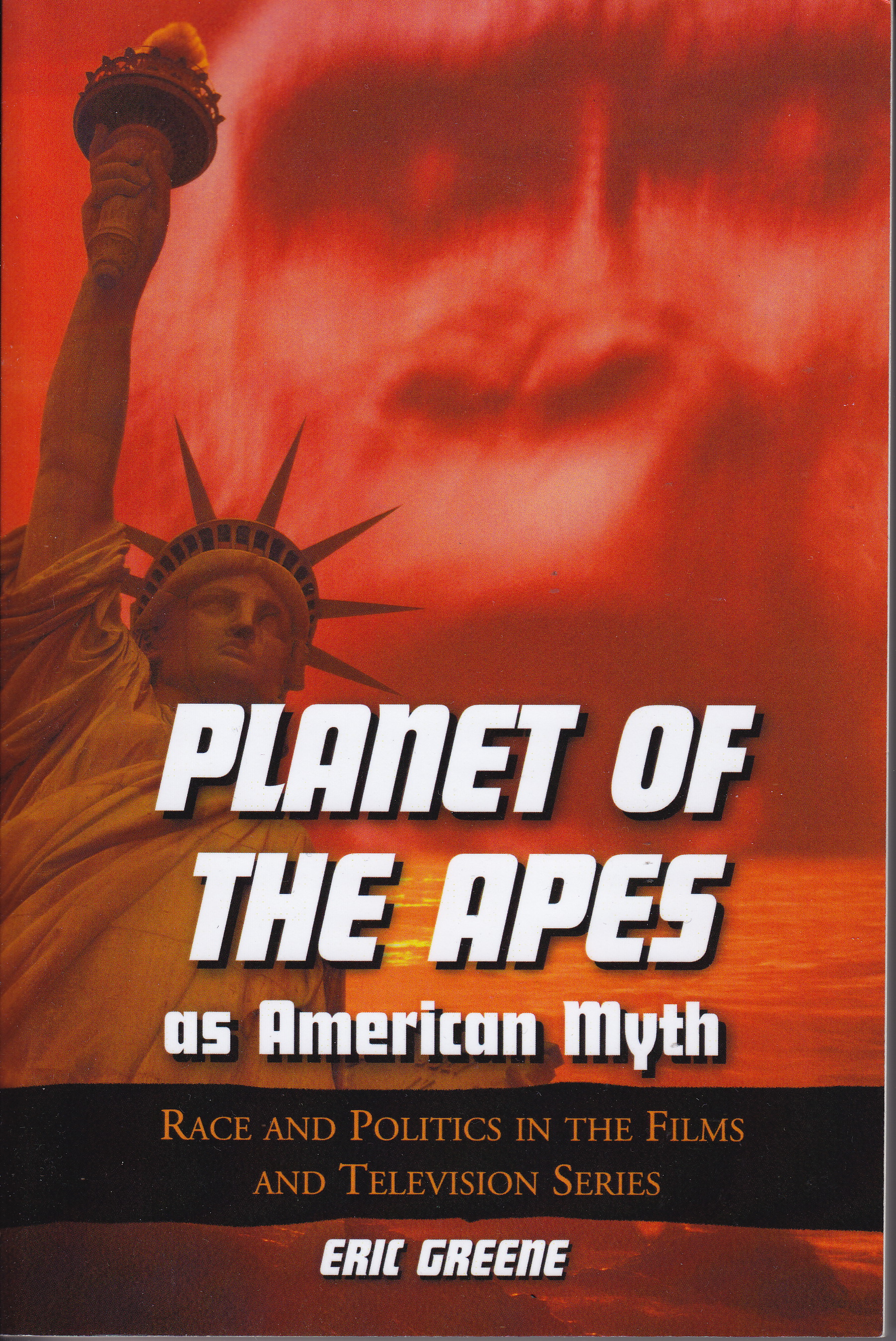
PlanetOfTheApesMythFor reasons no one fully understands, Planet of the Apes touched a deep level of responsiveness in American society. I have to admit to having fallen behind a bit; I need to see Dawn of the Planet of the Apes to be back up to speed, but nevertheless, I remember the television releases and airings of the originals, and even have gone through the entire series in the form of home theater offerings. One Saturday long ago on a visit home, I sat through a marathon of the entire five-movies sequence all in a day. It should be no surprise, then, that as soon as I saw Eric Greene’s Planet of the Apes as American Myth it went on my reading list. Race and Politics in the Films and Television Series, the subtitle read. I admit that I grew up in a conservative, but sheltered environment. Having friends who were African-American, although, admittedly, they were a small fraction of the demographic in my small town, I never realized that there was a problem. Not until I took history and social science classes in school. You have to learn things such as racial distrust.

Struck by Planet of the Apes when I first saw it, I had no idea that it was a racial tale. It makes sense now, in the light of Greene’s analysis. To a child fearing evolution as much as Hell itself, the movie was a kind of forbidden fruit, and by making it science fiction, there was no reason to suppose there was a message here. It was a powerful kind of captivity. I have watched the movie, and current adaptations, many times over. Greene does an excellent job of demonstrating that the movies came at a time of great racial distress. Civil rights, the Vietnam War, the fear of the Communist—xenophobia was perhaps at an all-time high when the apes invaded our planet. As the series goes on, the identifications become clearer and clearer.

But more than that, Greene pointed out some very obvious—in retrospect—religious symbolism in the movies. Some of it was so intentional that it was written into the script. Among the scenes from the life of Jesus, the movies borrow most heavily from Exodus. Moses figures abound. Even Charlton Heston, in his role as Taylor, was following up on the Ten Commandments. Holy families and sacrificial victims mark just about every stage of this dystopia, a world where trust is always far from any relationship with someone physically different. It’s about time that I watched Dawn of the Planet of the Apes. And after that, I need to go back to the beginning, and watch them all with renewed eyes. In the light of current events, also with the hope of a more just future.


The Reveal

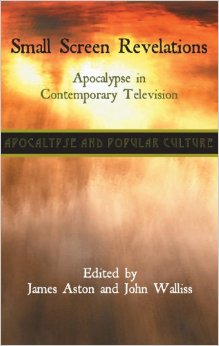
SmallScreenRevelationsThe end of the world as we know it is far more common than reason might suggest. As I’ve been researching the way the apocalypse is represented in popular culture, I’ve been impressed at just how prevalent it is. James Aston and John Walliss have brought together some intriguing essays on the topic in Small screen Revelations: Apocalypse in Contemporary Television. As one contributor notes, it is far more common to find the apocalypse in science fiction, horror, and fantasy programs, but it clearly visible in other genres as well. It is primarily an American phenomenon, although it may also be found elsewhere. It’s pretty hard to pin down the end of the world. On television it comes in both fiction and non-fiction varieties. The constant here is that we know it’s out there.

What I found most revelatory about the subject was a persistent question: why? Why are we so fascinated by the end of the world? I’m no sociologist, so I can’t give any kind of statistical answer. As the owner of a gut, however, I can offer a feeling. It seems to me that a culture of privilege ought to have a measure of guilt. While apocalyptic belief is most common among the poor (sorry, no statistics to back me up here) it also commonly occurs among the affluent as well. At the same time, we know that, as a society, we have far more than our share of the world’s goods. We have a massive military to make sure nobody else shares those goods. We must know, at some level, this is wrong.

At the same time, how can we give up what we’re so used to? An apocalypse wipes the slate clean. The essays in Small Screen Revelations offer more sophisticated theory than my simple observation, but academics have an obligation to muddy the waters. Considering the sheer number of shows cited: Buffy the Vampire Slayer, Battlestar Galactica, Lost, The Simpsons, Supernatural, Angel, The Walking Dead, Jericho, Doctor Who, Terminator: the Sarah Connor Chronicles, in addition to television news anchors and televangelists, the apocalypse is very easily found. So easily found, in fact, that one can become inured to what is supposed to be the ultimate end of everything. It’s related to what I’ve called elsewhere the crisis of superlatives. The fact that it’s television, however, provides a ready answer for what happens next. After the apocalypse we simply wait until the next season. After all, there’s a market for post-apocalyptic entertainment as well.


Book Culture

The book is not dead. Yesterday, on a warm, sunny spring day that veritably screamed “outdoors,” I found myself standing in line. I was at the Hunterdon County Libraries’ book sale. Having awoken in a panic a few weeks back gasping, “I missed the Bryn Mawr book sale!,” I made it a point to catch this one. You see, I read a lot of books on the bus. My job doesn’t pay very well, so I get inexpensive tomes where I can. And I wasn’t the only one in New Jersey sacrificing a rare, sunny weekend to look at books. I arrived twenty minutes before starting time and was well back in line. Although I seldom find items from my wish list, it always does me good to see so many people out for the purpose of literacy.

thumb_IMG_2160_1024

A book sale, like life, is like a box of chocolates. By far the majority of books here are publications vastly overprinted by excessively optimistic publishers. Of course, some people may buy books without the intent of keeping them, as difficult as that is for me to fathom. Since these are donations, it’s difficult to say much about how they reflect the taste of New Jersey readers. I couldn’t help but notice, however, as I wended my way to the religion table, that those who got there before me were racing through this particular table with a focus I can no longer muster, snapping up the gems, manically filling their bags. About the only other table where I saw that kind of passion was the science fiction section. I get overwhelmed in such environments. Too many titles, too close together, in only the loosest of orders (and sometimes very mis-categorized) can make for frustrated hunting. Nevertheless, I’m glad I marked my calendar.

The religion tables were mostly filled with predictable material that fails to challenge the intellect. Still, if it gets people reading, I have no cause for complaint. After about half an hour it was impossible to get through a single aisle without having to excuse myself a few times. Every subject, every category, had its readers. I was especially glad to see so many young people there. This may be the most hope for the future that I will see all year. Home with an aching shoulder and a supply to keep me going for forthcoming weeks, I notice the clouds drifting over what began as a glorious blue sky. No matter. If it rains, I will have plenty to do indoors. Resurrecting the mind from its slumbers is the most religious of all activities.


Pacific Rim

Pacific_Rim_FilmPoster

Pacific Rim is a movie that once again brings monsters and religion together in the cinema. Since I’m generally late seeing movies, I won’t worry too much about spoilers here, but in case you’re even later than me here’s the gist of it: giant monsters from outer space (properly an interplanetary portal) are emerging from the Pacific Ocean to take over the earth. These radioactive, dinosaur-like aliens are called Kaiju. Although they can be taken down with conventional weapons, the most effective fighting tool is the Jaeger, a colossal robot piloted by two humans acting as the two hemispheres of the brain. These humans must “drift”—share their brains—in order to control these massive machines in unison. Lots of action and destruction, of course, ensue. We later find out that dinosaurs were an earlier invasion of these same aliens, but that our environmental degradation has made the atmosphere much better for them, and this time they’re back for good.

The resistance is led by a mysterious marshal named Stacker Pentecost. Pentecost, of course, is the festival celebrating either the giving of the Torah (Jewish) or the giving of the Holy Spirit (Christian). In either case, it is a holiday celebrating God’s plan for humanity. As Pentecost leads his beleaguered and shrinking army of jaegers against the Kaiju, scientists Geiszler and Gottlieb disagree about how to conquer the beasts. Gottlieb swears, “Numbers are as close as we get to the handwriting of God,” while advocating the predictive elements based on the statistics of the attacks. Science and religion have come to an uneasy truce here. As Geiszler seeks a Kaiju brain to drift, he observes some of the masses in Tokyo praying to the fallen beasts. A blackmarket dealer in Kaiju remains explains that they believe the Kaiju have been sent by God. Pentecost unwittingly concurs when he declares it is time to end the apocalypse.

Pacific Rim, like most Guillermo del Toro films, is a complex movie. There is also more than a sprinkling of H. P. Lovecraft here. The worship of the Kaiju keyed me in to the fact that these were the old gods, come to earth, under the sea, from space. As the first category 5 Kaiju swims past the camera, I couldn’t help but think of Cthulhu. Although Kaiju is Japanese for “monster,” it even sounds like his sacred name. We fear that which is larger, stronger, and unknown to us. When that fear becomes reverence we are on the brink of worship, and our monsters have become our deities.


Jedi Night

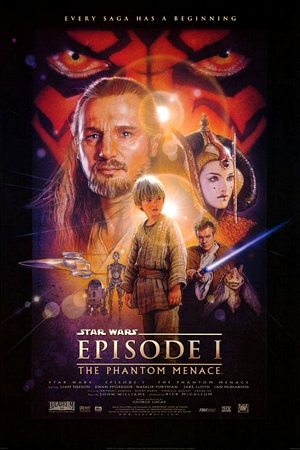
Star_Wars_Phantom_Menace_posterIt all began with that trailer. You know, the teaser for the new Star Wars movie. I was among those many small-town boys crowding into theaters in 1977 to have their small-town minds blown with a Luke Skywalker, somehow just like us, getting to go on a galactic adventure and conquering evil. It was a transformative experience. Later I was to learn that noted Jungian mythologist Joseph Campbell had advised on the story, helping to produce image after archetypal image that spoke to deep levels of viewers’ psyches. Hungrily we watched, as even through some missteps, the franchise grew to trilogy proportions, creating its own cultural memes (has “I am your father” ever been the same since?). Then somehow I missed The Phantom Menace, or episode one. It could be that work at the time (Nashotah House) was an epic struggle in its own right. With a small child and not sure about baby-sitting options, taking a night out to watch the prequel to a story that had already nicely resolved itself felt kind of pointless. We already knew how it ended. But that trailer. Now it seems, the story will continue.

So it was that my wife and I decided to catch up. Over the weekend we watched The Phantom Menace. Of course, I’d seen clips before. I’d also read the reviews that were less than complementary (Joseph Campbell had died in the meantime and George Lucas couldn’t seem to come up with archetypes on his own). I was curious, but not curious enough to rent the video (as people did in those days). So The Phantom Menace, cast from the same die as episode 4, also has a strong religious resonance. The Jedi (and already the religion of Jediism has begun to appear) filled the backstory with near invincibility, and all the aliens seemed somehow comic, yet we are told remarkably little about the Force. Perhaps episode 4 had said enough. When Darth Vader is introduced as a prescient boy, the audience (at least this audience) finds it hard to believe he is the result of a virgin birth. Indeed, Lucas throws us the midi-chlorians as a sop, but we know that when a woman gives birth with no male intervention we’re in messianic territory. And of course, non-Muppet Yoda tells us straight up that he may be the chosen one.

Introducing the Sith, who are the embodiment of the dark side of the force, we are treated to a devil in only a thin disguise. The red and black greasepaint warn us that when he removes his hood he will have horns. Although we’re not shown, I suspect he has cloven feet as well. So through the movie with its gratuitous cameos of creatures we already know from episode 4, we come to an end that is strangely familiar. We’re back where we started. The Jedi favor earth tones over white, however, and the Sith is neither all red nor all black. The evil of the galactic empire seems to be no more than the very real overtaxation of the poor. And yet for all my disappointment, there’s that trailer we all saw in December, and using my own version of the Force, I foresee an attack of clones in my future.


Foundation and Empire

Foundation_gnomeIn a childhood full of science fiction I’m sure I read much material that was too sophisticated for me. After all, I grew up in a working-class family where politics amounted to lambasting the incumbent because things still weren’t getting any better. Even the conservative super-hero Ronald Reagan was mostly remembered for the government-issue cheese we received for free. We called it “Reagan Cheese.” In that setting much of Isaac Asimov’s Foundation trilogy must have been far beyond me. Still, I dutifully plowed through all three volumes as any budding science-fiction nerd was expected to. It was a required piece of the curriculum along with Frank Herbert’s Dune. Heinlein’s Stranger in a Strange Land would have to wait until adulthood. I remember rooting for the cosmic empire—the symbol of law and order—unaware that similar systems would eventually find me as a fifty-something, educated man unemployable for years at a time. Science fiction doesn’t bestow the ability to see the future.

Then I read a recent issue of Books and Culture, the bi-monthly publication review by Christian Century. An article by Philip Jenkins, reviewing a book I’ve not read, started off with a reference to Asimov’s trilogy. Suddenly I found myself transported hundreds of miles and two-score years from Midtown Manhattan to rural western Pennsylvania in barely adequate housing, holding Foundation and Empire close to my face. Jenkins, a noted historian of religion, was pointing out that Asimov often drew from Gibbon’s Decline and Fall of the Roman Empire and based his character of the Mule—those of you who’ve read the trilogy remember him, I’m sure—on Mohammed. The thought had never occurred to me that the science-oriented mind of Asimov would ever delve into religion for inspiration. Still, with the little I recall of the story, it does seem to add up.

In fact, much of science fiction is deeply dependent on religion. Science fiction dares to dream of the future, and no matter how technical that future becomes, the religious are still there. Last century bold claims were made that we’d be living in the twilight years of religion by now. Mid-term elections fueled by religious fervor prove the pundits wrong yet again. Organized religion, fledgling or fully adult, is a political animal. Religion and politics are both about how we interact with one another as a society. It may seem that the concepts behind religious thought are unsubstantiated myths that transcend the mechanistic world in which we live. Even so, they continue to drive revolutions large and small. And somewhere in the attic I still have my copy of the Foundation trilogy ready to be seen by grown-up eyes. Or better yet, through the credulous eyes of a child.


The Force Re-Awakens

StarWarsMoviePoster1977In a galaxy long ago, in a galaxy far, far away… The year was 1977 and the Joseph Campbell-inspired Star Wars was like nothing we’d ever seen before. The film captured the essence of good versus evil in what, for the time, were realistic scenes in space. Many of us were in awe. Some worshipped. In fact, some six films later, an only quasi-ironic Star Wars religion does exist (Jediism) and its adherents must be buzzing after yesterday’s announcement that a new Star Wars movie will be released next year. What particularly caught my attention was the New York Times article on the event. Peppered with religious language, the trailer review (have we come to this?) by Dave Itzkoff plays on the fact that fans are nothing less than religious about the movies. I have to admit to falling a few movies behind. I’m a lapsed Jediist, I guess.

The new movie, The Force Awakens, will be directed by J. J. Abrams, and that seems to be a prophecy for a positive outcome. It also provides me with a goal; I need to see the episodes I, II, and III that I somehow missed early in the new millennium. Some see, to borrow Itzkoff’s language, the original trilogy as being canonical. The original novelizations—all of which I read as a teenager—were written by various guest writers with names like Glut and Kahn (the latter somewhat prescient for the upcoming Star Trek movies of the time), recording the sacred texts of the nascent religion. Rituals developed, light-sabers were purchased, and imagination became the vehicle for theology.

Behind it all, of course, is the force. This is a deity for a rationalist world. Even today we know that things don’t always turn out the way they should. Juries make the wrong decisions, computers still crash, even even two space shuttles—highly sophisticated though they were—failed and exploded during routine operations. Many find the white-bearded God untenable, but somewhere out there amid the comets and stars, there seems to be a moral force guiding us in the constant struggle of good versus evil. Heaven is still over our heads, although lost in the darkness of space. Less than 90 seconds of film footage have lit up the web with speculation, critique, and yes, reverence. We may have become the consummate secular society, but there is still always room for the force. Indeed, The Force Awakens may contain a not-so-subtle message for those who have ceased to believe that its personified form still exists.