The Big Chill

It’s cold. It may not be Alaska, or even Wisconsin, but I can’t feel my fingers and the temperature hasn’t risen above freezing all day. New Jersey doesn’t get the incredible chills we used to experience in Wisconsin, but I’ve been outside going on two hours and I really need some warmth. And it’s not just me. At least a couple hundred of us are out here and it’s not for the Super Bowl. It’s for justice. We’re rallying at the beautiful courthouse of Somerset County, in solidarity with our Muslim Americans, protesting the latest actions of our own government. Some of the people here are old enough to remember Hitler. Others are young enough that they have to be held. We are from countries all over the world. We are saying “No!” to the evil that is coming out of Washington.

img_3191

Those who voted for Trump out of a sense of fiscal conservatism were sorely misguided. This was a hostile takeover of what used to be a democracy by people who rely daily on alternative facts. Who make up massacres that never happened. Who claim that their personal billions have made them victims. Who believe that men have a God-given right to determine what women can do with their bodies. Who state that men who aren’t attracted to women or women to men are somehow deviant. Who openly mock the disabled. Who resist Black Lives Matter. Who can’t tell you one of the five pillars of Islam but can tell you that they’re all wrong. A government that’s over the people, despite the people, and against the people. Self-serving, self-enriching, and self-satisfied. A government where party has become more important than the welfare of the nation. A government that lost the popular vote by nearly three million, and those were only the ones who bothered to get out to vote. A government that lays its hand on the Bible and lies. That prays for itself, not for the good of its people.

That’s why I’m out here in the cold. I’m standing in a crowd that, like those who gather at airports, courthouses, and city streets, is saying “Enough!” The abuse of power is taking advantage of what you can “legally” claim without regard for the will of those you represent. Representative government fails when it fails to represent the people. We don’t want to be out here freezing our fingers, noses, and toes. We’d rather be comfortable and warm at home. As chilly as it may be in New Jersey tonight, it’s colder in the heart of this country and unless we the people do something, Hell itself is in real danger of freezing over.


Women and Men

I’m going to the Women’s March in Washington, DC next weekend. At an organizing meeting yesterday it occurred to me that someone might ask me why. Why would a white, male, straight, employed-with-health-insurance person bother to go through the disruption, effort, and hassle of getting to the capital to protest when I personally stand to lose little? That question has stayed with me and although I haven’t articulated an answer, I’ve never questioned the decision either. So why am I going to a women’s event?

I am a son, a husband, and a father. The son of a mother, the husband of a wife, and the father of a daughter. Having been largely raised by a woman on her own, I came to realize early on that all the good I experienced in life was because of the effort of one woman fiercely determined to help her boys get ahead in life. Without the help of a man.

I am married to a woman who has had to face prolonged periods of my unemployment because an institution run by men dismissed me for standing up for minorities. As I have struggled with my career since then, often she has earned the lioness’s share of our household income. When I couldn’t find full-time work we relied on her steadiness to provide our healthcare.

I am the father of a daughter. She is part of the future and I can’t sleep at night if I don’t do everything within my power to ensure that her world is better than mine. A world where women share completely equal rights with men. Get paid the same as men for the same work. Aren’t forced to be biological slaves because men often act without thought of consequences.

IMG_0969

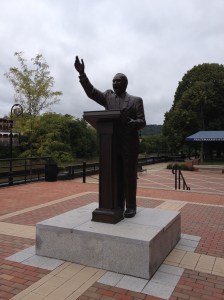
Today is Martin Luther King Day. I’m not an African American, but I believe the same truth applies. All human beings deserve equal rights. If those of us who personally stand to loose nothing do nothing one thing is certain—everyone loses. A friend implied, back in November, that this election was simply a matter of fiscal conservatism. That wasn’t the ticket on which the rails to electoral success were greased. It was a ticket of racial and gender superiority. A message of entitlement. Pulled by a locomotive of caucasian testosterone. Why am I going to Washington next weekend? Because I believe that the only way to be truly human is to recognize, respect, and resist any efforts to relinquish the rights of any person who calls this nation home.


So Long, Marianne

fullsizeoutput_122f“It’s a cold and it’s a broken Hallelujah.” Leonard Cohen has died. But can you blame him? This seems to be a week for losses. I came to appreciate Cohen’s work long after his best-known songs had been and gone. The interviews with and news stories about him that I’ve read convince me that he was an extraordinary man. Spiritual and sensual, he was a true contemplative. He strove to experience what it means to be human. I sometimes fear we’ve lost that as a goal. I see headlines proclaiming that we can now have chips implanted in our brains—we can become part computer. “You held on to me like I was a crucifix,” he once sang. Who believes in crucifixes anymore? Salvation doesn’t come from above. It comes from self-interest. From business and bank accounts. And that chip in my head.

My wife taught me the value of music therapy. When the forces of darkness gather, listening to music can help you through. Many artists have covered Leonard Cohen’s songs. So much so that some have forgotten who it was that wrote them. A true artist, I suspect, doesn’t mind. Those of us who delve in creativity know that we are more like receivers than gods. It takes worshipers to make a deity. The songs that Cohen wrote were messages to the world. Poetic and deeply personal, they are reminders that being human is okay. In fact, it’s what we’ve evolved to be. I have a feeling we’re going to be needing more poets in the days to come. Someone has to shine the shoes of those who work in Trump Tower. My mind is singing “Chelsea Hotel.” Everybody knows.

Cohen was a reminder that sacred and secular are not so far apart. In fact, they are often difficult to distinguish. There may be a problem when you discover that in seminary, but if you can put it into a song perhaps people will listen. Eras, it seems to me, ought to have anthems. F.D.R., one of the truly great Presidents of the century past, proposed “Happy Days Are Here Again.” I wonder what songs we’ll be associating with the presidency over the next four long years. Will there be any music at all? Far be it from me to proclaim any man a prophet, but can you listen to “First We Take Manhattan” and come to any other conclusion? Go to iTunes, or that chip in your head, and listen. You might just end up singing “Who by Fire” as well.


For the People

The complex of holidays that make up the transition from light to darkness represents a different mix, depending where you are. Life on the equator, for example, experiences no real variation in daylight hours and I would expect that equinoxes and solstices are relatively meaningless. Or at least less so than where darkness encroaches. For those of us in temperate zones the difference in day length can be quite dramatic and our holiday calendar guides us through it. Getting through the darkness. So this weekend, on Bonfire Night—also known as Guy Fawkes Night, or November 5—I watched V for Vendetta again. This isn’t actually an annual practice, but some years the need to remember the fifth of November is quite strong. This is one of those years. I can’t remember having ever been this anxious about a presidential election. Tomorrow we are voting on whether we want democracy to continue or if we want a dictator who can stir hate like no candidate I’ve ever seen. He even makes Ronald Reagan look tolerable.

I’ve posted on V for Vendetta before, so I need not go over the story. The theme, however, that governments are to serve the people is a message that bears repeating. Governments are to serve the people. We’ve come to a crises point in self-government. A vote for Trump instead of Hillary is saying “I give up, I want Big Brother to take over.” Perhaps the movie I should reference is 1984. Orwell may have got the year wrong, but the story right. Make people afraid, stir the pot of negativity and they will act in desperation. Reactionary governments quickly become dictatorships and that message, mean-spirited and full of ugliness, has been placed squarely in our faces.

The point of V for Vendetta, and the point on which the movie ends, is that V is each of us. We have the ability to make smart choices just as we have the ability to act out on irrational hatred. Who would’ve thought that election years would become days of such terror? I’ve always felt strongly about social justice, and I always vote with a conscience. I have never voted for a hate-monger or someone who believes the way to help the poor is to give the rich even more. There is a deep perversity here, a cultural psychosis. And the problem is we’re locked into four years of the result. For the sake of human decency and sanity, we all need to get out and vote. And I sincerely believe that pulling that lever is a choice for self destruction (Trump) or a future of new potential (Hillary). I just hope we’re smart enough to make the right choice.

img_3024


Thousand Words

I could easily spill a thousand words, but I have no picture. You see, as a tuition-paying parent I seldom carry cash—pin money is a luxury I just can’t afford. I saw the perfect photo-op, but had to walk on by. On my way to work I saw a homeless man in Manhattan. That’s not so rare. In fact, it’s distressingly common. This man had written a sign: “Give me $1 or I’ll vote for Trump.” It was followed by a tasteful laughing face emoticon. Old school. On paper. I would gladly have paid him a dollar to take a picture, but I had no money on me and I was left to remember and ponder the implications of a statement that struck me as rather profound.

boweryrm

It isn’t at all strange that the homeless have a sense of humor. There’s a deep, deep irony that pervades a nation where even those who follow all the rules end up finding themselves unemployable. Exploitation is the new capitalism. What surprises us is when these dehumanized economic units show they have feelings. I try to read the many signs the homeless write. They’re not so different from me. I’ve sat on the other side of the desk and been told that I’m just not quite what the employer wants. These affable commodities sit on their shelves, expiration dates passed, trying to raise a smile. Perhaps open a wallet. Their stories could be written down, but who would buy such a book? Nobody likes a downer.

The nature of the sign’s threat is worth considering. The dismal science tells us that it’s all about goods and products that change hands. One fervent disciple of this crooked system wants to be our president. He doesn’t pay any taxes, but he’s never had to live in a cardboard box like so much breakfast cereal. And this poor man in front of me is casting the most noteworthy threat that the disenfranchised can—he’ll vote for this travesty if we don’t pay him. The fine interplay of threat, extortion, fear, hopelessness, and humor tell me that I’m in the presence of a man who has a valuable contribution to make. More valuable than that which is being offered to us by the guy who’s been benefitting from our dimes for nearly two decades while giving nothing back. And if I had a single, or even a five, I’d be glad to exchange it for a photo to remind me of what a true American looks like.


Banned Truth

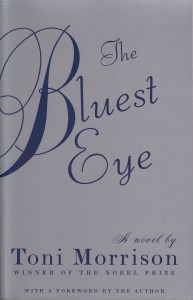
bluesteyeBanned Book Week is one of my favorite holidays. Don’t worry—you haven’t missed it—it occurs the final week of this month. I’m not very good, however, at guessing how long it will take me to finish a fiction book, so I start early, just in case. My banned book of choice this year was Toni Morrison’s The Bluest Eye. It’s not easy to read a novel which is so close to the truth. As any writer of fiction knows, just because something didn’t happen precisely as described doesn’t mean that it’s false. Indeed, fiction is often factual. It’s not easy to read because the “race”—a dubious distinction at best—to which I belong has often throughout history victimized others. While I’ve never knowingly participated in this criminal action—and despite what politicians might say, it is criminal—it’s never comforting to hear from the victim’s perspective. The Bluest Eye is about African American experience in the land of the free. At least in name.

What becomes clear from the beginning is that the families around which this story revolves are pushed to their limits. In an affluent society they are forced to live with less than their “white” neighbors have. Slavery may have ended, but the superiority mindset that permitted it in the first place hasn’t. I grew up in poverty but I didn’t have the added burden of being treated badly because of my “race.” Stories that remind us of that reality are never comfortable places to be. We’d rather think that since slavery ended prejudice went away with it. In reality, however, it is still here. Interestingly, the culture portrayed so vividly by Morrison is deeply biblical. Indeed, surveys of Bible reading in North America show that African Americans tend to actually read the foundational book more than their oppressors. The biblical worldview spills easily across the page.

Although the Bible made it onto the list of top ten banned books last year, The Bluest Eye was challenged because of its sexuality. That’s another defining aspect of the novel. It’s a frank exploration of the human condition. The protagonists are not only African American, they are also all female. Their perception of sexuality is, in many ways, inherently that of victims. Not that love doesn’t enter it, but rather that poverty often leads to a state where sexual gratification is held up as one of the few positives in a life that includes regular mistreatment, poor pay, and jail time. It isn’t an easy story to read. Morrison’s deft hand, however, prevents the story from becoming gloomy. It is like spending a sunny day knowing there’s something you shouldn’t see in the basement. Banned Book Week may be some time away yet, but it is always the right season to read about the truth.


Prophetic Shaman

Lewis EcstaticDon’t complain. So I’m told. Work with the system (i.e., the privileged), do your part, and most of all, don’t complain. What would Jeremiah do? Or any of the prophets? It seems to me that prophets had the job of calling out where society had gone wrong and doing so with a healthy dose of complaint. If you don’t call out evil, it only grows. Prophets come to mind because I’ve just finished reading I. M. Lewis’ Ecstatic Religion: A Study of Shamanism and Spirit Possession. Spirit possession is chic, at least in the horror movie industry, but if you get beyond the stereotypes, you soon learn that inspired, or ecstatic, religion is largely based on good possession. The gods can temporarily inhabit the shaman, and, as Lewis points out, there is often an element of the underprivileged being those who are visited by the gods. Interestingly enough, indigenous cultures that feature shamans—or shaman-like practitioners—accept the rebuke of the gods, even when it may be a thinly veiled attempt to right an obvious wrong.

Shamanism is a bit of a misnomer. Not really a religion, but a set of spiritual practices originating among the Tungus of Siberia, shamanism is now conveniently applied to native peoples around the world. In our love of easy classification, we like to say this belief is similar to that belief, so they must be a type of religion. In fact, however, “religion” is much more integrated into the daily lives of indigenous peoples and specific beliefs vary widely. Nevertheless, we understand possession and shamanism, and we apply them as categories to try to make sense of it all. Lewis does so with an anthropologist’s eye, finally in the last chapter addressing the psychological questions. It is often claimed, for instance, that shamanism is a form of mental illness. What seems clear to me is that shamans are responsible for preventing injustice from getting too far established.

And that brings me back to prophets. Prophets, particularly among those who study the Bible, are often seen as religious authorities. It seems to me that prophets, as opposed to priests, grew out of the untamed concern for justice typically exhibited by shamans. Priests are establishment religionists. They support the government and the government supports them. Temples are built. Religion is regularized. Prophets, however, can come from anywhere. They are liminal figures, complaining, in God’s name, when injustice appears. They don’t support the status quo just because it makes people comfortable. In other words, complaint is often the only way to make the divine will known. They are the heirs of the shamans. One thing that’s pretty obvious—whether you live in Siberia, Israel, or America—shamans are still sorely needed.


Being Humanity

KindnessOfStrangersWhat do you want to be when you grow up? The question kept recurring as I read The Kindness of Strangers. The name Kate Adie may be more familiar to readers from the UK than to those from the US. While spending three years and a bit in Scotland, my wife and I grew accustomed to hearing her name as a reporter with the BBC. I’ve just finished reading her memoir and it brought to mind several points that hit quite close to home. Apart from being engagingly written, her biographical essays highlight the difficulties women still face in much of the world. As a journalist, Adie traveled to many vexed locations where some expressed surprise that a woman would have such freedom as to run around with men, investigating, reporting, and being seen by many, many viewers. Meanwhile, those she sojourned among had to deal with oppressive regimes, low standards of social justice, and, not infrequently, the fear of rape. It is a poignant and at times maddening account. Men the world over seem to share a horrid, deeply ingrained and reinforced concept that women are somehow there to serve them. Here we are in the twenty-first century and we’re still struggling with basic biology.

If I might tear myself away from that particular observation for a moment, I also found Adie’s firsthand accounts of the atrocities she witnessed deeply troubling. In this day of Holocaust awareness and the belief in human dignity, it is distressing to see how cheap life is under many governments in the world. How humans can be so inhumane boggles the mind of those with any sense that we’ve somehow evolved. Often the hatred is based in differing religious outlooks, but often religion is only an excuse. The offending religions that are touted almost all teach the descent treatment of your fellow human beings. Sadly, nothing appears to have been learned from the all-too-intentional violence of the past century. The real issue, reading between the lines, is power, not faith. It is easy to have a scapegoat, and some analysts (not Adie, I would emphasize) like to suggest a simple solution by placing their hands on the head of religion and confessing the deadly sin of being human over it.

The book, I should add, is not all gloom. Adie is witty, sophisticated, and a charming writer. One of the positive takeaways I had from her life story is that the question “What do you want to be when you grow up?” is all wrong. Adie never wanted to be a journalist, but through a series of circumstances eventually found herself one. A much decorated and honored one, no less. This is a lesson for our time. The old stabilities of choosing a career and staying with it seem to have eroded from beneath us. It is increasingly difficult to plan ahead for an uncertain future. Adie is a fine example of how to adapt along the way. More than that—and men pay attention here—she’s an exceptional example of what it means to be human. This is what we should all strive to be when we grow up.


Rainbow Nation

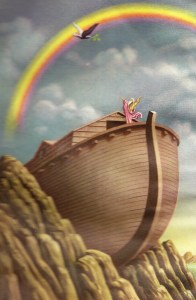
By now I suppose it’s old news that North Carolina has joined the wall of ignominy as the latest state to try to discriminate against gays. It seems our aging leadership just doesn’t get it that a large majority of people in the younger generation just don’t have a problem with accepting homosexuals for who they are. Laws are generally still made by old white men, though. One might be tempted to say “good ole boys.” They may make the claim that this is political, but as one astute editorial in the New Jersey Star-Ledger pointed out, this is about religion. The editorial, which ran on Saturday, notes that studies have shown that when people learn a law sequestered under “religious freedom” is actually discriminatory, the law loses support. The government by the people thing seems to be working backwards. What will it take for elected officials to realize that we are a rainbow nation? And rainbows, according to the Bible, are good.

MyFavoriteNoah

I’m always amazed at these attempts to turn the clock back. It is the season of “spring forward” is it not? Religions that have a problem with homosexuality also have an unscientific understanding of human sexuality as well. Not one person in the Bible had a clear idea of how conception worked. If they didn’t understand the facts of life, how can we expect to learn the life of facts from them? What amazes me most is that such views don’t take the whole picture into account. Intersex individuals—of whom there are many—demonstrate that easy definitions of gender are sure to be wrong. Even tying the concept of gender to sex seems to be misguided. And yet we pass laws the favor a first-century understanding of what it means to be human.

In the end what will change the minds of the corporations will not be their heads or their hearts. The decision will be made by their backsides where their wallets will be growing a bit lighter as corporations decide to take their facilities elsewhere. It’s a sad commentary on our society when justice isn’t enough to strike down a prejudicial law. It takes money to do that. It is a strange world indeed where it take lucre to lead to light.


Chilling Thoughts

GlaciersI don’t think much about glaciers. At least I didn’t. Now they keep me awake at night. Literally. I just finished Jorge Daniel Taillant’s Glaciers: The Politics of Ice. Never have these ice sheets ever seemed to have so much personality before. I don’t live near glaciers, but I have seen a couple. A number of years ago I visited Glacier National Park in Montana. It was summer and the one glacier that was right by the road (Highway to the Sun) was melting. It was the first glacier that I knowingly saw, and I went my usual way, not thinking any more about them. Taillant’s book, however, indicates why everyone should be concerned about ice sheets. Not only is global warming a reality, our ice caps are melting on what appears to be a runaway timetable and we are not likely able to reverse the process until the damage is done. Not only our ice caps endangered, but our glaciers as well.

Why should anyone care about glaciers? For purely selfish reasons, I might point out that they are crucial to supplying drinking water for much of the world. Looking at the globe, it seems there is plenty of water to go around. Only about 3 percent of all water on the planet is fresh water, however. And of that 3 percent about three quarters of it is locked up in glaciers. Glaciers are the only source of fresh water in dry climates during years of drought or excessive heat. Whatever water isn’t used as these ice giants melt flows into the ocean, becoming part of the salt water majority. When the glaciers are gone, they’re gone. They are part of the fine balance that makes life on earth possible. The politics enter the picture when Taillant reveals that large mining interests, particularly in South America, have been destroying glaciers to get at the gold underneath. They block legislation and provide disinformation, all in the name of wealth. When they destroy glaciers, they destroy future prospects for life in the regions they mine. It’s an issue of social justice.

On our little planet that seems so big, we don’t often stop to consider that we didn’t really show up here by accident. We evolved with the features that our planet gave us—notably water—and we have continued to thrive only in the presence of water. It has often been said that future wars will not be fought over petroleum, but water. We can live without oil. We can’t survive without water. And our industrial action is blithely wasting away the largest reserves of drinkable water on the planet. I don’t live near any glaciers. I’ve only seen one or two in my lifetime, but I now worry for their health. Their future is, in many respects, our future. And that makes me want to pour a glass of water and reflect.


Girl, Rising

It is perhaps unusual to stop and think about who you are. From the moment consciousness kicks in, our lives are a non-stop progression of stimuli and response and taking the time to stop and think what someone else must be feeling is, I sometimes fear, a dying art. Although I can’t accept the goddess hypothesis, purely on historical grounds, I am utterly at sympathy with it. I sensed that when Merlin Stone took the time to introduce herself to me at an American Academy of Religion and Society of Biblical Literature annual meeting some years back. She was one of the few who knew and appreciated my book on Asherah, and I in turn knew of her work both as a feminist and creative theological thinker. It was an honor to shake her hand. The heart of work such as that of Stone and Marija Gimbutas was that women deserve, and have always deserved, to be treated equally with men.

GirlRising

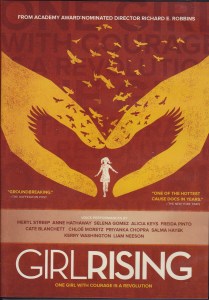
Watching Girl Rising, I was forcefully reminded of this once again. A 2013 documentary film telling the story of nine girls from “third world” countries, the movie is quite sobering. In many parts of the world women are still treated as property, although slavery has been considered a violation of human rights for well over a century. Hearing what young girls have to face in much of the world is heartrending. Hearing what certain unnamed presidential candidates have to say in this country is downright terrifying. Why is it that so many men never stop to consider what it would have been like for them, had they been born female? Would they have accepted that their lives would consist of lower pay and their healthcare would teeter in the balance every four years when a new crop of neo-cons puts the White House in its sights? And this is called the “first world.”

Having been raised by a woman who had, for many years, no support of a husband, I have been sensitive to the plight of women my entire life. I could see no reason that my mother shouldn’t be given the opportunity that other people had. Courageous, strong, and self-abnegating, she did what it took to raise her sons in a safe and loving environment. In my own experience of adulthood, full of struggles and turmoil as it has been, I wonder what life would have been like had I been a girl in similar circumstances. What if I had been born a girl in another country where my active mind would be grounds for beatings, or being shot? It is unconscionable. There may not have been an egalitarian society that centered on the worship of a goddess, but there is no reason we shouldn’t try to make such a peaceful, fair, and just society nevertheless. If only men would stop to think about how distorted a one-sided view of life inevitably becomes, perhaps the entire world would be able to claim to be “first.” It is only when women and men share rights that the world can start to be considered a just place.


Books of 2015

Screen Shot 2015-12-28 at 3.38.16 PM

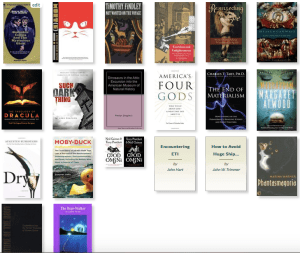
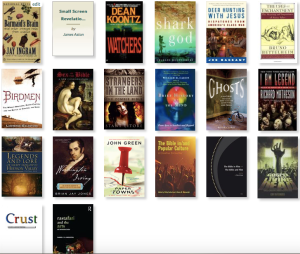
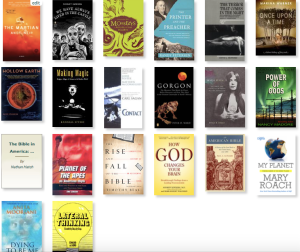
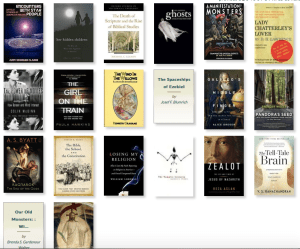
It’s the end of 2015 and looking at my records on Goodreads it looks like I read 100 books this year. That tends to be my goal mark, but after twelve months of reading I like to think back over which were the books that have made the biggest impact on me over the year. Joe Bageant’s Deer Hunting with Jesus remains on the most important list. It is joined by Andrew Newberg’s How God Changes Your Brain, Spencer Wells’ Pandora’s Seed, Alice Dreger’s Galileo’s Middle Finger, and Paul Levy’s Dispelling Wetiko. Bageant, Dreger, and Levy especially address some of the root causes of social ills and even make suggestions about how to address them. Newberg offers advice on how to improve brain functioning and Wells taps into the ever-important issue of care for our planet. I read some good academic titles as well: Diana Walsh Pasulka’s Heaven Can Wait, Darren J. N. Middleton’s Rastifari and the Arts, and Ronald Hutton’s The Triumph of the Moon.

Screen Shot 2015-12-28 at 3.37.33 PM

Being a religionist, books with supernatural themes are always of interest. Among these I found intriguing Michael Murphy’s The Future of the Body, David J. Hufford’s The Terror that Comes in the Night, Ardy Sixkiller Clarke’s Encounters with Star People, and Jeannie Banks Thomas’s Putting the Supernatural in Its Place. It seems important to have reasonable people address unconventional issues. These are related to books on monsters, noteworthy among which were: M. Jess Peacock’s Such a Dark Thing, Kim Paffenroth’s Gospel of the Living Dead, Brenda S. Gardenour Walter’s Our Old Monsters, and Lisa Morton’s Ghosts. Long ago I realized that I no longer needed to justify including monsters or the supernatural categorically with religion. They share too many roots to be separated out artificially.

Screen Shot 2015-12-28 at 3.36.54 PM

Finally, it was also a year of novels. Pride of place here goes to Robert Repino’s debut, Mort(e). I am compelled to mention Margaret Atwood’s MaddAddam, John Green’s Paper Towns, Shirley Jackson’s We Have Always Lived in the Castle, and Valerie Martin’s The Ghost of the Mary Celeste. Although I’m not much of a fantasy reader, Tod Davies’ The Lizard Princess has stayed with me since reading it. For any of these books you’ll find an individual blog post from this year. That’s not to say that other books I read weren’t good. Nearly every book I post on Goodreads has a write-up here. I tend to like most books I read, although I’m occasionally disappointed when a book does’t reach its full potential. 2015 was a rich year of reading and I’m looking forward to a very literate 2016.

Screen Shot 2015-12-28 at 3.35.38 PM


Matins

At a certain time of year, around November after the time change, early morning immigrants to Manhattan see the light. As they stumble out of the Port Authority Bus Terminal and head to the east, it is as if the sun is rising like a monster from the sea. In Midtown the streets run east-west and the avenues north-south. I trip out onto Eighth Avenue and have to make my way to Madison, and the entire walk is facing into the unrelenting sun. You might think at 7 a.m. this should be no great challenge, but then you would betray the fact that you don’t commute in early. Hundreds of people pour in a human stream out of the Port Authority and head in all directions, many of them east. The streets are crowded and you literally can’t see what’s in front of you. You are, in the words of a young Bruce Springsteen, “blinded by the light.” I’ve watched in fascination as this happens for the past four years now. It isn’t the much touted “Manhattanhenge,” but simply the angle of the sun at this latitude at this time of day. It may be fun for a few minutes, but then you realize how dangerous it might be.

IMG_2595

One of the most basic elements of religion is care for others. Indeed, some religions suggest that you should treat others as more important than yourself. When I was growing up I was taught to think of things from somebody else’s perspective: if you were in that position, would you want someone to do that to you? It’s a message I took to heart and to this day I can’t pass a homeless person without a backstab of guilt for not pulling out my wallet and dropping a dollar or two into their outstretched hands. Having been on the receiving end of a pink slip more than once, I can easily imagine being there. Seeing from another person’s perspective can be dangerous. Not considering that perspective can be even worse.

Those out and about at 7 a.m. are go-getters. Climbers. They get to work early. Some, no doubt, stay late as well. The person walking west has the sun at his or her back. The street in front of them is brilliantly illuminated but not blinding. How many times I’ve nearly collided with them because they don’t realize that those of us going east just can’t see. You have to step into the shadow of a banner or awning or streetlight post just to get a nanosecond of relief and make sure you’re not about to step into a hazard like an open freight door. The photo doesn’t do it justice because if it were truly to show what I see, you’d see nothing at all. Raised as I was I can’t help but think of the beast rising from the sea, and the woman clothed with the sun. And the homeless being awoken by beams far too bright after a night on the streets.


Forbidden Love

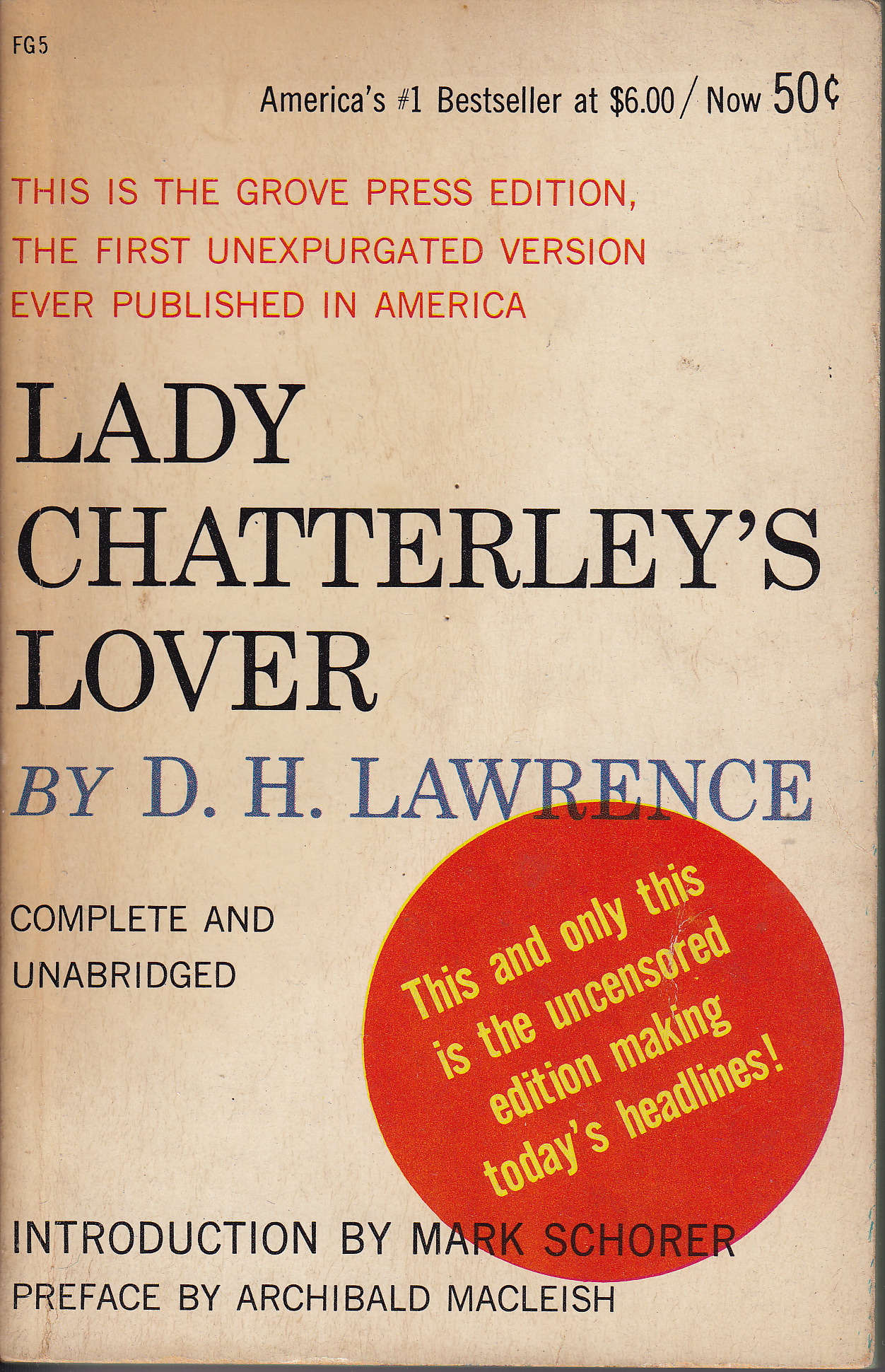
LadyChatterleyBanned Book Week is upon us. In that time of year when we begin to think of spooky, scary things, the prohibition of literature naturally comes to mind. Every year I try to read a banned or challenged book for the occasion. This year I went to perhaps the jugular vein of banned books, Lady Chatterley’s Lover, by D. H. Lawrence. Now, I’m not a romance reader, but I was curious about this sexually explicit novel that had been banned to the point of being outlawed and was now considered a classic. Lawrence’s last novel, it tells the tale of a woman escaping a loveless marriage with the help of lover below her social class. The steamy bits are tame by today’s standards, but Lawrence does use several words that are still rarely heard in the media due to their offensiveness. From my perspective the story was a bit too drawn out, and the fawning wasfs a bit over the top. What struck me even more, however, was the fact that this novel was largely about social justice. Not that Lawrence was an activist, but his concern for the poor and discarded of the industrial revolution is quite clear throughout the novel. The privileged having affairs within their class is acceptable. The scandal is that a titled lady falls for a common gamekeeper.

I haven’t read Fifty Shades of Grey, a franchise that has made even romance writers jealous. From the criticisms I hear, however, the concern is less the sex than it is the lack of literary value. I’m sure Fifty Shades of Grey is a banned book in some location. Still, the deeper concern for humanity that runs through Lady Chatterley’s Lover is part of its appeal. Several times I put the book down thinking, “this isn’t just surface stuff.” It is, baldly put, the search for redemption. Sir Clifford is an invalid who wants to control others. In an era when men laid claim to control of women’s sexuality this was no small demand. He also sees his coal miners as pieces in a larger game that is, it turns out, only to his own benefit.

Although the book ends with the lovers parted, and hoping for reunion, Lawrence’s final words turn toward economic oppression. Mellors (the gamekeeper) writes, “If you could only tell them that living and spending isn’t the same thing!… If only they were educated to live instead of earn and spend…” He defines Mammon as “wanting money and hating life.” No doubt, the book was a vehicle for Lawrence’s desire to see writing about sex to be part of literature and not pornography. Still, there is something deeper here. The story is more than carnality, although carnality is what brought it to fame. It is a banned book that proclaims liberty that, despite the license of contemporary society, is not really as free as it might seem. As banned book week unfolds, it is a moral obligation, I believe, to read those books that have threatened settled mindsets and raised the ire of censors. In so doing, we learn what it is to be human.


Galileo’s Tool

GalileoMiddleEarly in my academic career I got into trouble not because a Harvard professor hadn’t adequately checked his data, but because I had pointed out that a Harvard professor hadn’t adequately checked his data. You see, I was a naive realist. I believed academics were objective, factual sorts who looked for the truth no matter how uncomfortable it was. My honesty didn’t earn me many friends, and I still can’t mention this professor by name because I have seen grown men melt into tears at his name, due to their overwhelming loyalty. By contrast, a fellow Edinburgh student once told me that he disagreed with our mutual dissertation adviser, “on principle.” As the old saying goes, nullius in verba, take nobody’s word for it. Reading Alice Dreger’s Galileo’s Middle Finger: Heretics, Activists, and the Search for Justice in Science drove home a number of important points, one of the most memorable being that academics take real risks when they won’t fudge the facts to fit the establishment’s expectations.

Although this autobiographically revealing book is about as honest as a writer can be, it deals largely with issues of social justice in the context of those who “don’t fit.” Intersex individuals, especially, are treated before they can give consent and live their lives based on other people’s expectations of what their gender “should be.” Like most people I was raised thinking there were only two genders. Science has consistently demonstrated that “gender” is a construct that occurs along a continuum. Some species change gender in their lives. Some have such complicated reproductive techniques that far more than two genders are postulated to make sense of it all. And yet, when it comes to humans, we suppose that we’re either female or male. And religions consistently claim that any sex outside those parameters is evil. We are so naive.

Dreger focuses her attention much more widely in this important book. She shows how universities, constantly becoming more corporate, often don’t support research that challenges their investments, or “branding.” She demonstrates first-hand the character-assassination that academic snipers use so well on those who follow the evidence. She is living proof that education and activism should go together. Intricate and with bizarre loops and twists thrown in, her account of what some people will do to silence others, and get it peer reviewed, saddens me. I’ve always believed that education is the surest way to solve social ills. Education, however, is increasingly being purchased by special-interest groups that protect the establishment. The establishment may no longer be the church, but we need another Galileo, and soon.