Row Your Boat

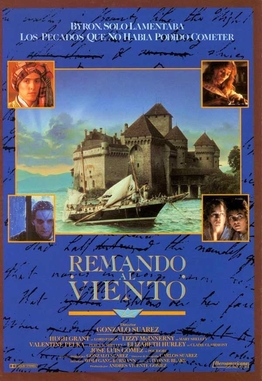
I’ve long wondered about what appear to be coincidences.  Specifically, about movies on the same topic that seem to come out at around the same time.  I saw Gothic about a year after it was released in 1986.  In 1988 two other versions of the Shelley-Godwin-Byron-Polidori-Clairmont meeting came out.  I’ve already written about Haunted Summer.  The third of these films was a Spanish production, Rowing with the Wind.  It is the most poetic of the three.  The dialogue is often poetic and it pulls out several historical details—some of which the other two films leave out.  Mary Godwin and Percy Shelley decide to elope, taking Claire Clairmont with them.  Lord Byron does not wish to see them.  He and John Polidori, his physician are out on a boat.  Boats play a large part in this movie.  Byron, played by Hugh Grant, soon comes to like Shelley.  Polidori’s role is underplayed and he dies by suicide before the party leaves Villa Diodati.

Mary Shelley’s monster, however, follows them.  Back in England it leads both Mary’s sister Fanny and Shelley’s wife Harriet to suicide.  Extending beyond the summer of 1816, the film follows the Shelleys and Clairmont to Italy.  They have their children with them.  When they come to Venice, they once again meet Byron, but Mary’s monster kills William Shelley (their son) and Allegra (Claire’s daughter).  Obviously, death is a major theme, along with boats.  (Historically, all of these people died, but not in such close time, but close enough to be tragic.)  The Shelleys stay with Edward Williams, a friend Percy met in Italy.  The monster then leads to Shelley’s death by drowning.  Byron’s death in Greece somewhat later is narrated by Mary but not shown.

The film is framed with a fictional arctic journey by Mary to pursue her monster.  Interestingly enough, no mention is made of Polidori’s story “The Vampyre.”  There’s not even any suggestion that he set out to write it.  Movies of this meeting often point out how the vampire and Frankenstein became famous because of it.  Rowing with the Wind is an arthouse movie rather than a studio blockbuster.  It isn’t a bad story.  It tries to tap into the sorrows of Mary, and again, historically she did suffer loss.  Her mother died shortly after she was born.  A child died before the first visit to Byron.  Percy’s first wife Harriet and Mary’s stepsister Fanny both died by suicide in 1816.  William died in Italy, as did her third child with Shelley.  Polidori poisoned himself.  Allegra died at five.  Shelley drowned in a storm at sea.  Byron died while trying to fight in Greece.  This film is a fitting tribute.


Still Haunted

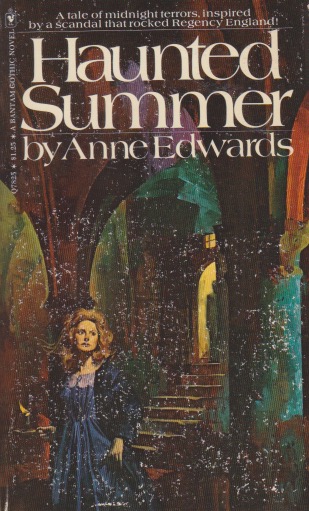
Having watched Haunted Summer, I was curious about the origin of the screenplay.  I’d read that the movie was based on a screen treatment by Anne Edwards, a screenwriter and novelist, but that it had been rejected.  Edwards then transformed her screenplay into a novel that was published in 1972, over a decade before the film came out.  It’s sometimes easy to forget that movies spend quite a long time in development.  For example, about four or five years ago it was announced that Lindsey Beer was going to write and direct a new Sleepy Hollow movie.  That was the proximate cause for my writing Sleepy Hollow as American Myth.  I wrote the book, found a publisher and then watched as sales only bumped along the bottom and still no Beer film appeared.  Timing isn’t always my strong suit.  In any case, I decided that it would be good to read Edwards’ book as a follow up to the film.

Marketed as a gothic novel, it came out in my beloved mass market paperback form.  It’s now not easy to find.  The story is well researched, but fictionalized, of course.  The five Regency Era creatives—Lord Byron, Percy Bysshe Shelley, Mary Godwin, John Polidori, and Claire Clairmont—had gathered near Lake Geneva in the summer of 1816 (the “haunted summer”).  Famously, the idea for Frankenstein came out of ghost stories they told each other to pass the time during a rainy summer.  Polidori’s story, “The Vampyre,” also traces its origins back to that night.  Edwards’ novel focuses on Mary, making her the narrator.  Since it is a novel some fictional elements are added to what happened that summer.  To me, the most obvious was moving the ghost stories from Villa Diodati to Castle Chillon.  This allows Edwards to introduce Ianthe, a tragic keeper of the castle.

The story focuses on Mary as a strong woman very much devoted to Percy Shelley and standing up to Lord Byron.  Her lack of regard for Polidori was a little jarring since, it seems, historically, she felt sorry for him.  In any case, other than the changes Edwards introduces, the plot largely follows what happened during that summer.  The climax of the book is Mary’s telling of the  basic story of Frankenstein in Chillon Castle.  I found the Author’s Note of particular interest; novelists are also researchers, even if not always treated as such.  The historical incident of this meeting drives my interest, and this largely overlooked novel is a piece of a larger puzzle.


Summers and Hauntings

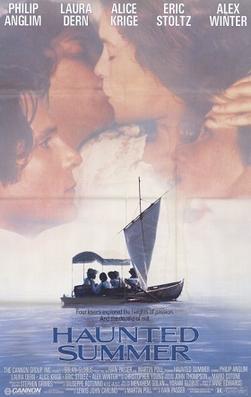
I’ve written before about that odd Ken Russell movie Gothic, one of my “old movies.” In case you missed it, the film is a fictional retelling of the gathering of Lord Byron, Percy Shelley, Mary Godwin, John William Polidori, and Claire Claremont in the summer of 1816.  They read ghost stories to pass the time and decided to try writing them.  Two famous stories came of it: Frankenstein and Polidori’s “The Vampyre,” a story that would go on to influence the genre.  I hadn’t realized, being generally the one invited to someone else’s choice of film, that two years following Gothic a movie called Haunted Summer was released.  Directed by Ivan Passer, it is a slow-paced romance that tells about the same meeting.  It’s somewhat more believable than Russell’s movie, but it has some oddities.  Perhaps the most telling is that it doesn’t mention the famous “contest” at all.

No doubt, one of the most compelling aspects of that summer meeting was the fact that a nineteen-year old Mary Godwin would go on to write one of the most influential fictional books of all time.  The influence of Frankenstein is visible in most unexpected places.  Internet personalities create “Franken” products by mixing together discrete products.  (For example, “Frankensoap” is when you cut up and blend different soaps.  You’ll actually find Frankensoaps in our bathrooms at the moment since that’s the way I handle soap scraps.  Soap never seems to go fully away before it becomes unusable.)  Frankenstein influenced everything from feminists to science fiction.  Not to mention horror.  Haunted Summer, however, although it has Polidori as a character, doesn’t mention his story at all.  It really focuses on the sexual tension between Byron and Mary Godwin.

Our imagination of that meeting of two famous writers and one soon-to-become famous one, often doesn’t make room for the fact that Shelley and Godwin were actually traveling with their infant son William—not shown in the movie.  (Mary had delivered a premature daughter the year before, who didn’t survive.)  I suppose putting a baby in the mix might, in Puritan America, dampen the romance implied in Haunted Summer.  Both that movie and Gothic make use of Henry Fuseli’s painting “The Nightmare.”  And although Haunted Summer isn’t a horror movie there are a few moments of fairly high tension—one when Godwin has her dream of the creature approaching her bed at Villa Diodati.  The story, however, had already been told by Ken Russell’s movie and Haunted Summer failed to make much of an impact.  That isn’t, however, quite the end of the story.