
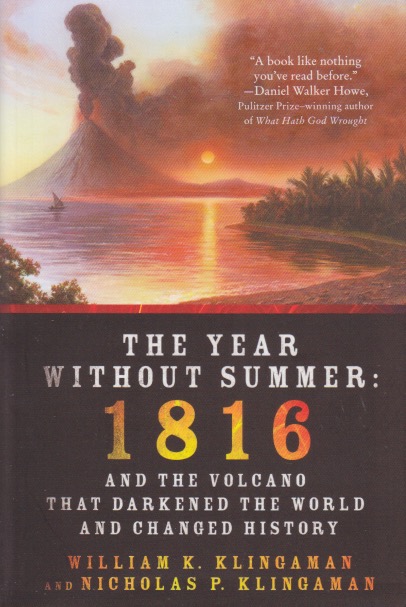
Daily readers may recognize the cover of this book. Some time back I posted on a misprinted book I’d received from Amazon. It was the first time I had to return something to the retail giant in exchange for the book I’d actually ordered. Although the volume itself doesn’t say, I suspect William K. and Nicholas P. Klingaman, the authors, are kin. (Some publishers make a big deal of such things.) Regardless, I was reading for content. It was strange reading this during a May when temperatures have generally been running about 1816-average levels below normal (mean temperatures can be deceiving). It was also a good reminder how erratic weather can be and how dependent we are upon it. So, basically, the volcano known as Tambora had a massive eruption—the largest during human recorded history—in 1815. The ash in the atmosphere contributed to a year (1816) with cold temperatures that in many places devastated agriculture and led to widespread starvation.
The Year Without Summer is an interesting book, even if overwritten (which could be a function of having two authors, each with a lot to say. One is a meteorologist and the other an historian. And historians, especially, tend to write long. That’s partially because so many interesting connections can be made. Certain things happened because precipitating events owed their existence to a volcano. There were several points, however, where I said to myself, wait, now, what does this have to do with the weather? All authors (including yours truly) are selective and tend to focus on what they find interesting. Detours are permitted.
The combination of meteorology and history was very interesting in its own right. The weather is something we talk and perhaps think a lot about, but to which we tend not to ascribe too much ultimate importance. The many, many pages of loss, despair, and death that make up this book should belie that understanding. The weather is vitally important for our entire way of life. We often take food for granted, but it’s anything but. Many of those who starved to death in 1816 did so because they couldn’t afford food. It was sometimes available, but at princely prices. Many otherwise law-abiding citizens opted for riots and many governments didn’t see it as their responsibility to care for the people they governed (that still happens in capitalism). This book, a bit overwritten, is nevertheless full of interesting information and creates some weighty thoughts. If a Tambora-level eruption were to take place today, we’d see capitalism on display with all of its very ugly teeth.

