Tambora Crisis

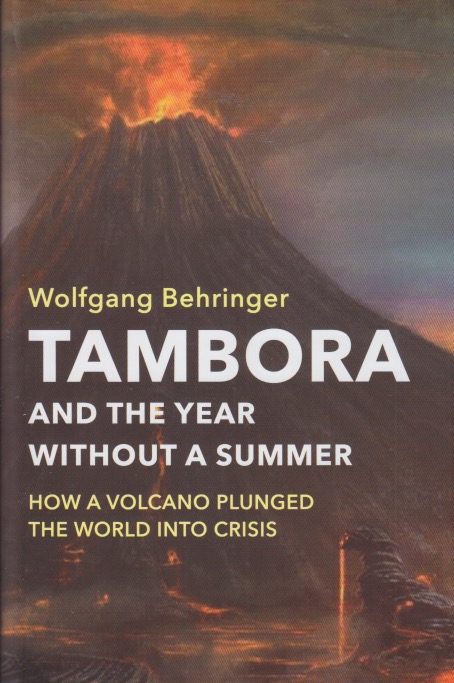
The name Wolfgang Behringer was familiar to me from his book Witches and Witch-Hunts, which I read several years back.  I’ve been interested in volcanoes lately, and Tambora in particular.  So when I saw his Tambora and the Year without a Summer I decided to indulge.  What Behringer attempts here, as indicated by his subtitle, How a Volcano Plunged the World into Crisis, is a massive undertaking.  The result is a rather rambling history that covers many of the troubles of the early nineteenth century, which, ultimately, were influenced by the crisis triggered by Tambora.  For context, the eruption of Tambora in 1815, in what is now Indonesia, was the largest volcanic eruption in recorded history.  It famously led to “the year without a summer” in many parts of the world, but, as the book points out, the effects were uneven.  Western Europe was cold and wet.  North America was cold and dry.  Both of these situations led to famines and many people died.

Nature doesn’t play favorites, though. Weather is variable, and local.  Eastern Europe, and Russia, experienced nearly ideal conditions for agriculture.  There was enough food to go around, but what was lacking was the infrastructure.  Western Europe was still putting itself together after the disruption of Napoleon and his wars.  The Americans were still recovering from fighting off the British.  And, being German, Behringer spends a lot of time explaining what was happening in Germany.  Reading this kind of spurred me onto a little genealogy kick, since much of what he describes took place in the regions where my mother’s ancestors were from.  That’s why I try to read widely—it has a Gumpian outcome, sometimes.  

The inherent problem with a global history is that the world is simply too big, and human history too long and voluminous, to fit it all into one place.  There were no doubt many crises caused by the atmospheric changes to which Tambora contributed.  There were also many innovations.  Behringer makes a good case that the Tambora crisis led to the development of meteorology as we know it.  The regular and meticulous keeping of weather records began around then.  Savings banks also emerged.  As always, those who suffered the most from the famine were those who couldn’t afford food.  In response, governments encouraged people to save up for a rainy day (or year).  And the early development of life insurance, again to help people weather financial difficulties with the death of a wage earner, began.  More about the crisis than the volcano itself, this is nevertheless, a chilling examination of how one crisis can change history.


Moving Mountains

VolcanoWeatherJust 200 years ago, there was a “year without a summer.”  Well, that’s an exaggeration, but the name has stuck and is familiar to those of us with an undue interest in weather.  Although the coldness of that summer was far from universal, frosts came in New England in June, July, and August, killing off the staple corn crop for much of the region.  Snow fell even later than it usually does in the northeast, including a measurable fall in July.  My interest in this particular cooling episode was spurned by reading about the eruption of Krakatoa in 1883.  The connection?  Mount Tambora, a relative neighbor of Krakatoa, erupted in 1815 with an ejected debris volume of about ten times that of its later colleague.  The dust cloud from Tambora has long been a culprit for the dismal summer the following year.  Henry and Elizabeth Stommel researched and wrote a little book on this event entitled, Volcano Weather: The Story of 1816, the Year Without a Summer.  Although the book shows its age (it was written in the early 1980s), it remains a fascinating exploration of the many things that weather can do.  And has done.  Two of my favorites from this book were Napoleon’s adventures and the writing of Frankenstein by Mary Shelley during a rainy summer in Switzerland.
 
I should note, however, that the Stommels do not declare that Tambora was the reason for the year without a summer.  They tend to think the volcano had something to do with it, but the weather, that most protean of phenomena, can be impacted by the very small as well as the very large.  In fact, their description of the eruption includes the recognition that locals felt volcanic eruptions to be normal acts of the gods.  Many island cultures recognize the divine power of the molten earth.  The weather getting out of whack, we can be sure, leads to much prayer even today, thousands of miles from any eruption.  Something that hasn’t changed since the 1980s is that natural phenomena—especially powerful ones—evoke the divine.  Huge, impressive volcanoes, or even the very immensity and complexity of the atmosphere, suggest something we can’t comprehend.  Global warming will soon, however, bring this point home.
 

One of my takeaways from this book is the fact that the weather’s lack of uniformity emphasizes just how little we know.  The year without a summer mainly affected the northern hemisphere, and that only piecemeal.  Parts of northern Europe and North America felt it more intensely than other places.  It was not “the coldest year ever” and anyhow, is it even possible to know whether the coldest year would feel unnecessarily chilly where you are?  I’m pretty sure it’s snowing in some part of the world right now.  Human arrogance when it comes to global warming can be put into perspective by such acts of nature as Tambora.  From a human perspective, we live on a time bomb.  Volcanoes care not a whit for our bidding and wishes and dreams.  They can impact climate more instantly than our trite human efforts and thinking we alone are gods. To prepare for the future sometimes we need to look two centuries back.


The End of the World as We Know It

Well, that may be a bit dramatic, but my whole family is scratching its collective head over the news that our time on this planet has been foreshortened by the Chilean earthquake. Yes, scientists from NASA announced yesterday that Saturday’s 8.8 magnitude earthquake actually shook the earth three inches off its axis and has led to a loss of 1.26 milliseconds of time. Even for the gods this seems to be playing against the rules!

I wonder what the Fundamentalists are thinking about it? I do know that some extremely conservative types mess with time when trying to explain how the 4.5 billion-year-old world could have been manufactured in just 6 days — they call it the “day-age theory.” Or that the globe stopped spinning for 24 hours to give Joshua and his invaders more time to kill the Canaanites. I’ve even had students tell me that this latter case was scientifically proven. Time, however, ticks on despite our concerns with it.

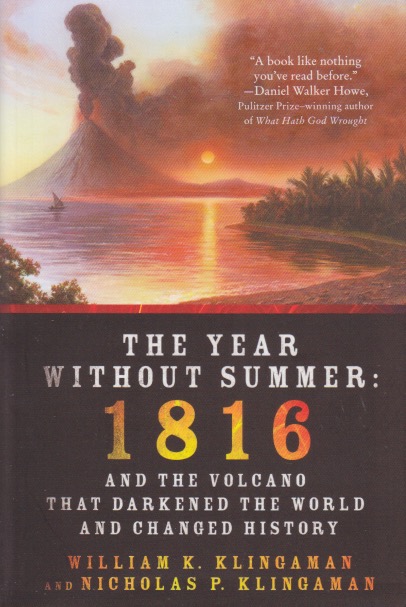
It was my daughter who suggested the title for this post. After she said it, however, she noted, “Well, actually the world as we know it ended with the earthquake.” The world as we knew it. Radical changes have taken place with stunning rapidity on this old globe we call home, and some days the whole world changes. In 1815 the eruption of Mount Tambora led to the “year without a summer.” Wayward space rocks sometimes wipe out over 90 percent of all species on the planet. We live in a constantly changing environment. And it is my hunch that when that final disaster comes, those who’ve spent all their energy climbing the money mountain in the company of financial wizards, bank presidents, insurance profiteers, and oil company gods will come running to those who’ve spent their lives learning about religion seeking comfort in the face of the inevitable. We know we live in a temporary world; the wise spend their time contemplating the implications of that fact.

A little more to the left...