Head of STEAM

The market producing doctorates in the humanities is showing no signs of slowing down. The fact is we’re all human, and many of us aren’t very technically inclined, unless we have to be. There are fewer and fewer jobs for these bright students who graduate with doctorates in the humanities, but the plight of the “privileged” is no concern to wider society. Let the eggheads figure it out. At the same time, wisdom in the job market is that careers in Science, Technology, Engineering, and Math (STEM subjects) are growing and showing the most promise for future careers. The pace of technological change is so rapid that yes, obsolescence for new devices is six months or less. My iPhone 4 is a dinosaur, although when I first held it some three years ago it was so advanced that I was afraid of it. A moment’s reflection will reveal that the most advanced technology is already in use in the military since staying ahead of the enemy is always the bottom line.

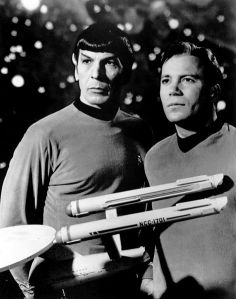
This situation has led to some concern, and not just among those of us in the humanities. Some in the world of STEM are saying that quality of life suffers. To indulge a stereotype, try to imagine geeks without Star Trek. We know that Star Trek was as much fantasy as science fiction. My iPhone makes a communicator look just plain silly. Star Trek is, however, creative indulgence. While many would hesitate to raise it to the status of “art” it is part of the Arts: fine arts, literature, film, music, and some television. The stories it tells are the stories of human beings (and one alien) struggling against often more advanced civilizations. In the end, humanity always wins. If we exit the stereotype, scientists are often musicians and writers as well. Some become novelists or consultants on box-office busters. We are more than meat machines.

Recently voices have been heard suggesting that STEM should be STEAM. The Arts have an integral role to play in the scientific and technological fields. Even some numbers are imaginary. The basis for developing imagination is the Arts. Although we could have made it to this point in our development without Star Trek, the fact is that many of us growing up with it, as well as the more silly, but also influential Lost in Space, and what we now know is a most assured cash cow, Star Wars, know that these shows helped shaped the present we inhabit. Arts give us visions. There continue to be those who castigate the Arts as “soft” and “weak” and tangential to the cold hard facts. But they are wrong. Humans can’t survive without a source of warmth and energy. And the first great engines of advancing civilization still have much to teach us, for those engines ran on steam.


Who’s Driving?

Technology has been kind to civilization. At least in some aspects. I often think how easy communication has become. When I was just starting out in the professional world, email was new and not trusted by some academics, and now if you can’t be reached by email you’re not a real professor. Professors are the ones, at least in some sectors, who write books. They share ideas—sometimes quite intricate and entangled—using the delimiters of language that has developed to serve communication. Technology, however, has reached a point where it limits what can be said. I have heard experts say that authors must learn to write in XML, a mark-up language that doesn’t recognize things like pages, or even such simple prepositions as “above” or “below.” We must get away, they say, from outmoded ways of thinking. Or think about this blog. When I list tags, they are “comma separated values” (CSV, but not the pharmaceutical kind). If a book title has commas, it is broken up into separate units, some of them nonsensical as tags. They are, however, what the brave new language demands.

Language is how we express what we mean. Since meaning is often of our own making, it seems that language should allow us to formulate our thoughts, commas and all. We take this incredible tool of language and degrade it in our constant drive to find bigger and better superlatives. Lately I’ve noticed the trend toward calling recognized experts in a field “gods.” I wonder what we will do when that gets old and threadbare. What trumps a god? A Titan, perhaps? Do those who call other human beings “gods” ever stop to think through the implications? The comma represents a pause. I recommend a comma or two before using up the highest superlative the language can support.

Idle worship

Idle worship

As someone who spends a great deal of time writing, as well as reading what others write, I think it is time to push back at those who would limit language. H. P. Lovecraft often utilized intentionally unpronounceable names for his “gods.” Cthulhu has become the best recognized among them in popular culture, but here is a case of a writer having the last laugh from beyond the grave. While those who declare “there is no such thing as a page number” insist that writers hyperlink themselves, those who make their very cosmos what it is do so by breaking the rules. And they did so without having had to become gods.


Upgrade Downgrade

I don’t have to have the latest toys. In fact, I am happy to stay with what I have as long as it works. I’ve been a frugal lad all my life. The increasing demands of technology worry me. Nobody has to tell me that I keep odd hours. Waking up between 3:00 and 3:30 is hardly normal. Since I post on this blog before I go to work, I get up and turn on the computer, ready to write. As I learned three laptops ago, if you don’t keep your updates updated, you soon find yourself unable to do anything on the web. With my last laptop, whenever an update notice came, I immediately acquiesced. “What humble work I have to do, sir, pales in comparison to your mighty plans.” Now updates begin automatically. Most often I have no say in the matter. In fact, the first thing I saw when I started up my most recent computer was a message saying that a software update was ready to install. So what does all this have to do with my insomniac habits?

2015-11-07 18.47.57

Computer companies assume nobody is getting up and working at 3 a.m. While we’re sleeping our computers are making their electronic deals and sending out their electronic handshakes. We mortals need our slumber. I don’t even know what half this software on my computer does. I know that if it’s out of date, problems are sure to arise. So when I awake to find my computer’s too busy to accommodate me, I wonder how to post on my blog. Some updates politely run in the background, but others necessitate that I turn off the software I actually know how to use until it’s done updating. By the time it’s finished, I’ve forgotten what I was going to write. The computer now determines what might be expressed. When something goes wrong, we’re forced to learn its language. We’re in its country now. Technology is its national language, by law.

Once I was told that travel faster than the speed of light was impossible because of navigation. If you can’t see what’s in front of you because you’re traveling as fast as anything can, how do you know you won’t run into a planet, comet, or software update? You have no means of getting feedback in time to react. It strikes me that we’re already traveling well beyond the speed of light. I grew up writing without a typewriter. I wrote stories and articles on paper with lines, using a pen or pencil. Now I rely on my devices to store my ideas, but they’ve got other plans. I have to wait until they’re done to do my work. Of course, we must conform. At 3:30, human, you should be in bed. My advice to you, dear reader, is this: don’t wake your machine at the witching hour. You might not like what you find.


What I Meant to Say

XML. CSS.  Abstracting.  Separating content and meaning.  Sounds kind of scary to me.  As a would-be writer, plodding my way through what used to be the humanities, I’m sometimes frightened when I hear techies talk about where publishing “has to go” to remain “competitive.”  Since technology drives industry these days, we all need to bow before the image with a head of gold.  What you write on the page has to be edited to make it say what you meant it to say.  Then the meaning has to be excised and converted into XML, because that’s the way ebooks like it.  Page numbers are an artifact, and if your device can’t find the phrase you half remember, don’t go looking for an index.  You see, XML files don’t have pages—they’re just an illusion caused by the limited size of paper.  The meaning lies in the stripped, naked, and shivering content.  Or meaning.  Or something.
 
So goes the brave new world of publishing.  We live in the days of inferred information and bowdlerization in inscrutable acrostics.  I’ve actually heard techies say, “we need to teach authors to produce what we need.”  Have you ever seen a dog wag so fast?  Or a tale hold so perfectly still?  What do I mean?  Ask an expert.
 
IMG_2359

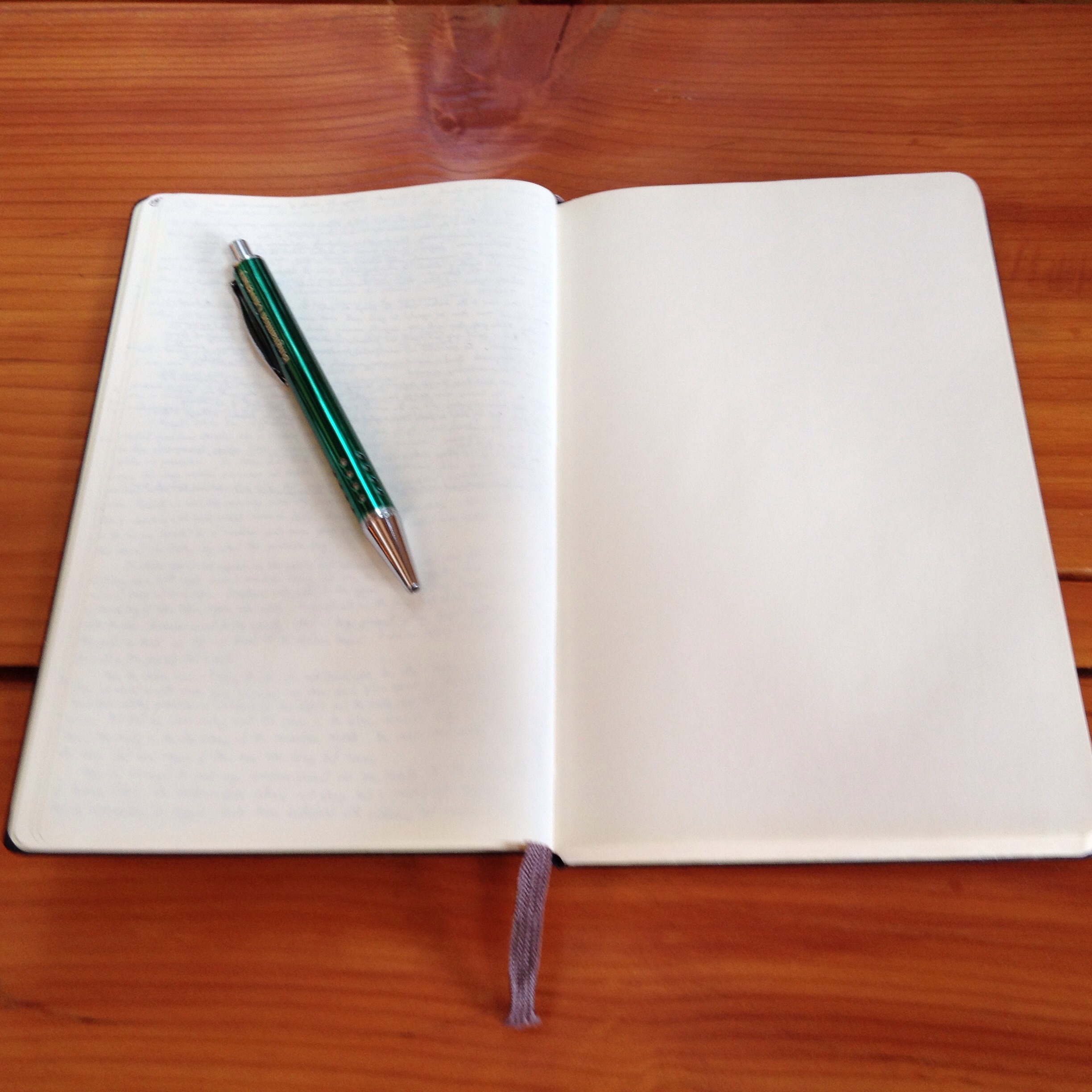
The blank page of actual paper used to terrorize many a student.  There are few things so transcendent to me as a new, unused Moleskine.  The very blankness of the pages is like unto the whiteness of Heaven.  This is a place where thoughts can roam free, and I can feel the thoughts coursing from my brain to my fingers as the pen traces paths never before seen.  As this blog attests, my writing does not draw the countless masses.  The vast majority of it written on paper will never be seen by another human being.  Thoughts are captured there, mid-flight.  They’ve never been tamed or tagged or abstracted from their meaning.  In the mind of some, I must suppose, that means they really mean nothing.  When I hold them, however, which I can never do with an XML file, I know that some things are simply too important to convert to what someone else declares they must be.


Hello, I’m Not In

I recently received two “out of office” replies to my own “out of office” message. Being a fan of futility in all forms, this struck me as a great paradigm for the modern age. Email has made vacation superfluous, of course. I was actually out of town moving my daughter back to college, so email was not high on my list of priorities. When I’ve tried to leave work without putting on a message explaining that I’m not there (I tend to respond to emails quickly for an editor, so I’m told) I’ve been politely informed that it is rude not to let people know you’re away. Or computers. My non-message prompted a non-messages from other vacationers’ email accounts, and when I returned, I had to read them as well as the original email that had received my impersonal reply. Both had sent their replies, despite their out of office messages. This is indeed a brave new world.

It is a world where human interaction is optional, at best. Our industry grinds away making devices and services that people will buy with electronic money sent over a network that no one really controls. And we think nothing of it. Business has blinded us to how meaningless humanity has become. Business runs for business’s sake. Even so, we’re asked to check our email when we’re on vacation, in case something important comes up. I used to think vacation was important. It is the sop we’re thrown for working jobs that lack the visceral appeal of growing our own food and relying upon ourselves. Thoreau on the web.

Benjamin_D._Maxham_-_Henry_David_Thoreau_-_Restored

Science fiction is the great predictor of where we might go. Most of it is completely fiction, or course, but some manages to catch glimpses of the truth. Skynet, or even the Matrix or Hal, have sent messages to us. Machines that think are devices we don’t understand. We haven’t even defined consciousness to a level that satisfies anyone. We know it because we feel it. Oh, I’m not really an alarmist about all that. I do wonder, however, where we are headed when technology races ahead while the humanities are disparaged. All those who emulate Spock seem to have forgotten that his appeal is that he’s half human. We build our aliens to specification. And they now pass polite greetings when they speed past each other on the cyber-highway with no laws.


DOA

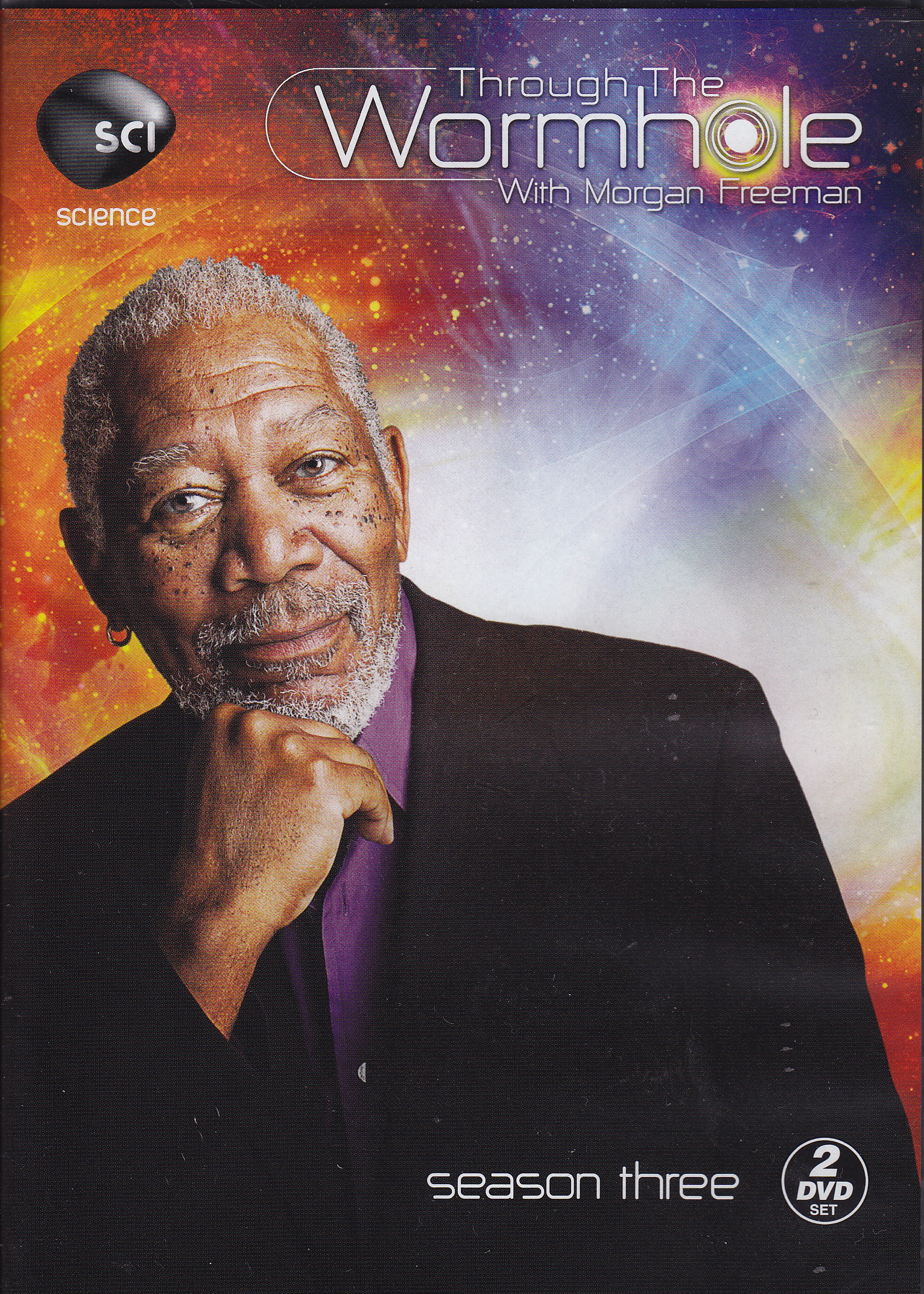
Wormhole3Perhaps it’s just me, but the third season of Through the Wormhole has taken a dramatically metaphysical turn. I always run behind the time when it comes to media; I know that the season is long passed. I started watching Through the Wormhole shortly after the first season became available on DVD. Science has always been an abiding interest of mine, and I face it as someone raised religious and wondering whence lies the truth. (“Through the wormhole,” for the record, is where it might be found according to Morgan Freeman in the opening voiceover.) The third season, through which I’m currently making my way, has begun to raise disturbing questions about life and mortality that start to highlight some of the more Frankensteinian aspects to human curiosity. I recently watched the episode “Can We Resurrect the Dead?”

In the world with which I am familiar, resurrection has always been a religious issue. I grew up with a strong notion of the afterlife, and it was suggested to me that survival beyond death was assured. But the resurrection that various scientists are now exploring is of a different order. For those who can afford the increasingly astronomical costs of top medical care, resurrection is not such an unusual thing. Only, when your body is resuscitated, you wake up the the same weary body that just died. So some of the scientists interviewed suggest that if we can reverse the death “mechanism” that is apparently built into our own mitochondria, we might be able to bring back the dead. Even more bizarre are those called “life loggers” who wear devices to record their experiences in life so that they can be uploaded and preserved. A consciousness digitized and stored on a hard drive heaven for all eternity. Meanwhile a scientist smoking a cigarette in Japan shows us a robot straight from the uncanny valley that looks almost like him and is sent to do some of his lectures in his place.

Maybe it’s just me, but it seems that resurrection used to be somewhat simpler. It was a matter of following the right doctrine and living a life worthy of being continued after this one ends. Now it is a matter of peering through a microscope, or trying to capture on mere devices the multitude of experiences that flood us daily, making us human. Can our future, digital selves really experience human emotion? All those pictures taken while riding a bike—will they convey the effort of balance learned as a child, the sensation of a self-generated breeze on my face, the wonderful weary sensation in my legs upon stepping off? What of that hint of lilac in the air that I picked up momentarily on the wind? Will eternal life, missing the actual life be worth it? I think Victor Frankenstein discovered the answer to that almost two centuries ago.


Mind the Gap

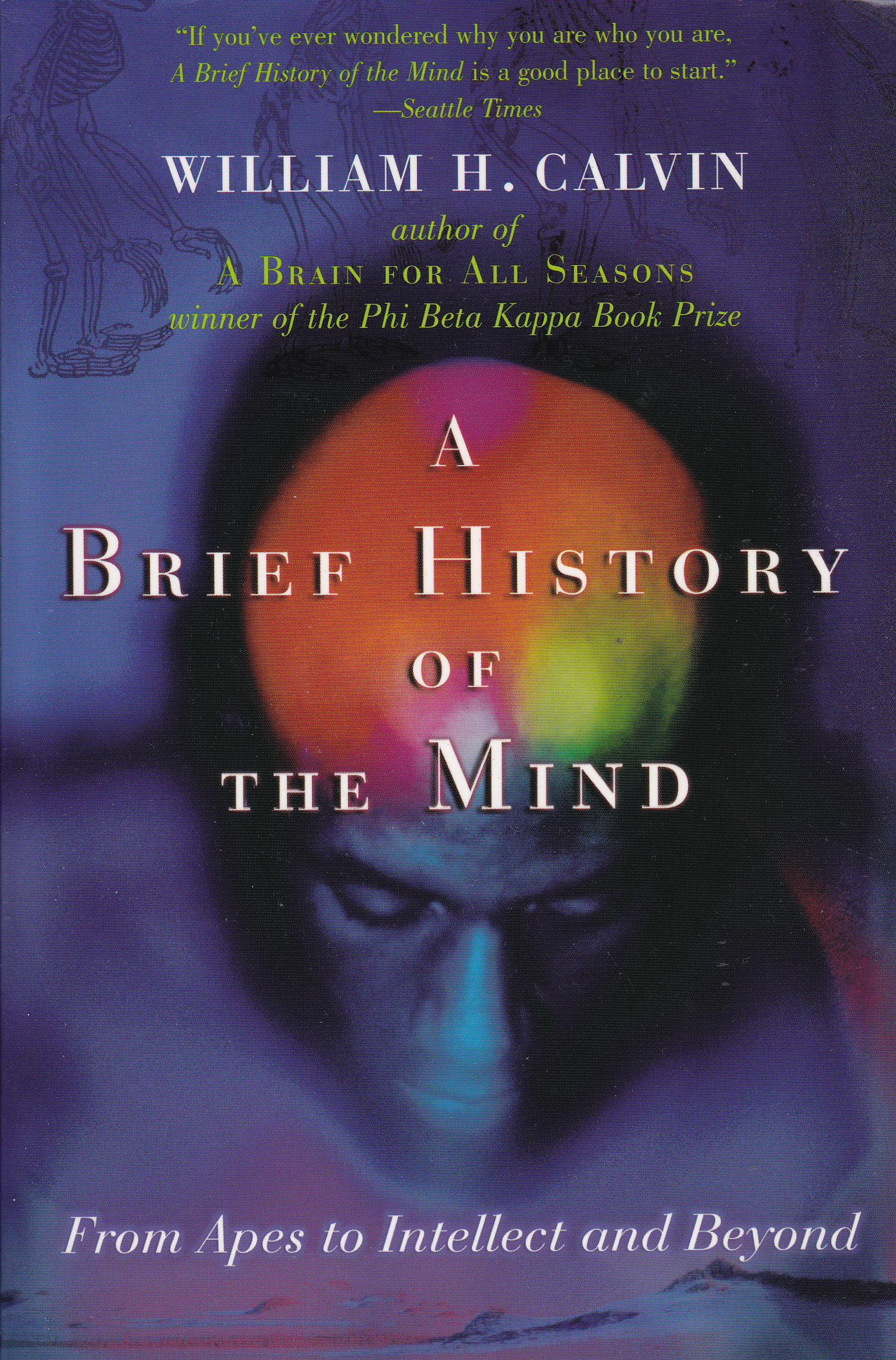
HistoryOfMindThere’s something on my mind. I guess that’s the normal state of a conscious being. William H. Calvin’s A Brief History of the Mind might clarify that a bit. Although I have trouble accepting Calvin’s belief that mind is the same as brain, he does allow, in this wonderful little book, for a somewhat more expansive view. Subtitled From Apes to Intellect and Beyond, the story is more than just a survey of archaeological finds and their physiological counterparts. This is a story. It is a story of how we developed minds. Calvin approaches the topic with the realization that others will have different stories, and that future discoveries (some of which may have already been made in the decade since the book was written) may change it a bit. The book ranges from the quasi-technical (at least from the perspective of sitting on a bus) to the amusing, but always keeping in sight of the fact that this is of human interest.

Particularly compelling is Calvin’s consideration that we may have, at least from our modern perspective, gotten ahead of ourselves a time or two. In discussing the migration of hominids from Africa, he makes the brilliant point that perhaps we weren’t quite ready for that adjustment at that time. We seem to have perhaps driven other hominids to extinction. Our technology might have been outracing our conceptual knowledge of how to handle it. When he returns to this theme later in the story, the results are even a little frightening. We do sometimes get to the point where we can do things that we shouldn’t do. Before our minds have realized the full implications. Atomic bombs, anyone?

Unlike many scientists who believe in materialism, Calvin does not ridicule religion. He notes that it can be taken too literally, but does not suggest we are fools for believing. In fact, he discusses a couple of sects that have turned dangerous over time. He shows how they acted logically, following their thought process in an orderly, if clearly wrong, direction. Some would use this as a cudgel to bash religion in general. Instead, Calvin seems to suggest that we might learn from all of this. Minds, while impressive, are not perfect. Logic can have its flaws. We can, despite the tragedy, learn valuable things about how the mind works. This is an open-ended story; the future of mind is being constantly disclosed. If there is a future for us, we can perhaps prepare a bit better by understanding what’s on our minds.


Christian Computing

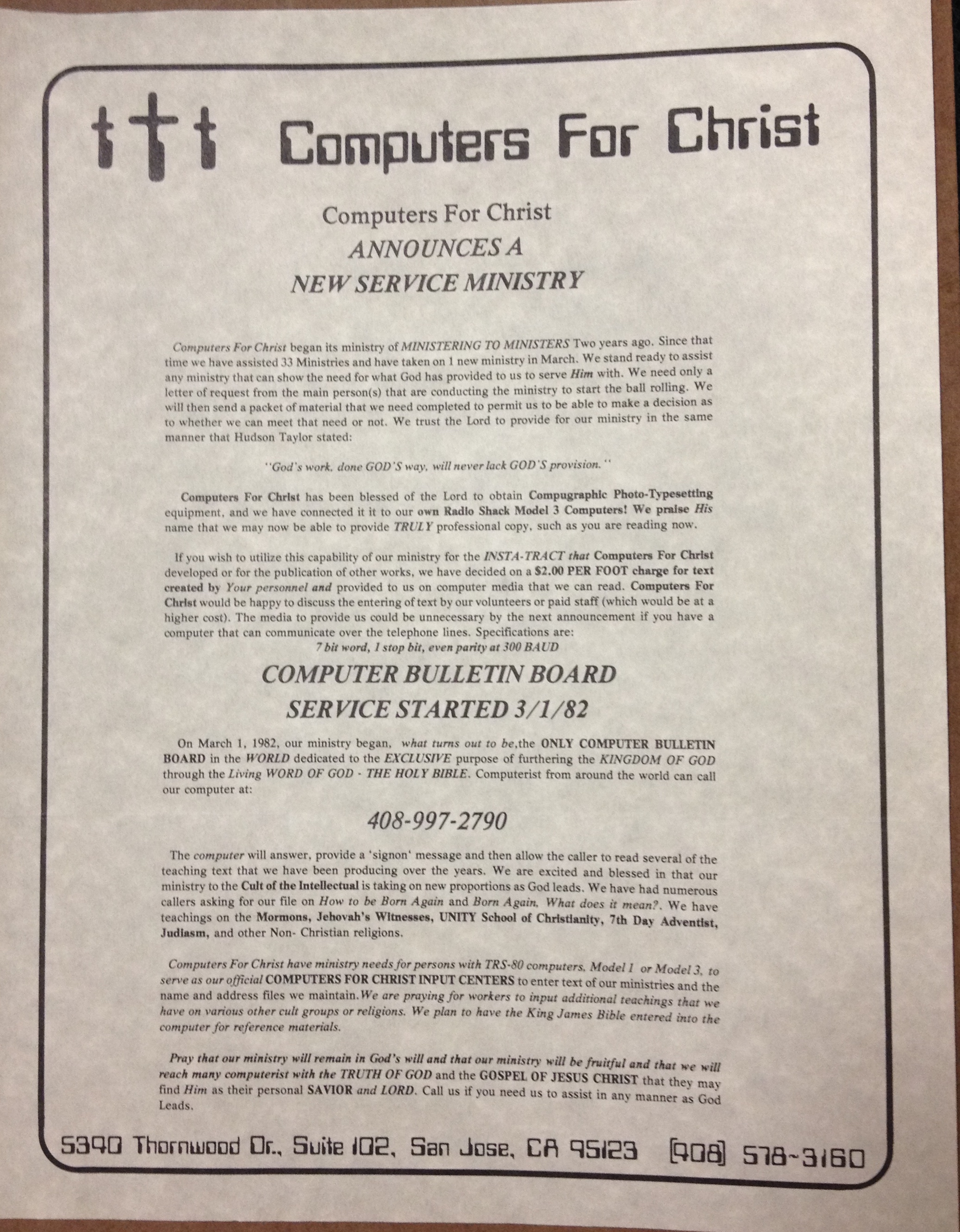
Science and religion are often portrayed as fighting like dogs and cats. Both claim superiority and a comprehensive worldview that should make sense of everything. With reality television probing deep into the lives of rural folk who still hold to the old ways, it is easy to think that religion is awkward and backward and an embarrassment to the technologically sophisticated. In electrons we trust. As with most simplistic views, however, this dichotomy is overly dramatized. I recently found a flier for Computers for Christ. I didn’t have time to read it carefully, but the space-age font immediately told me that this was vintage 70s or 80s, back when computers were still so new that most of us had never seen an actual exemplar and we had to guess what the future might hold. Would these things catch on or not? A little closer reading revealed the date of 1982, back when I was a college freshman. I had, by that point in my life, never knowingly glimpsed a computer.

IMG_1644

Sitting here with a computer on my lap, and another in my pocket, I wondered what ever happened to Computers for Christ with its space-age crosses and early embracement of technology. I didn’t find anything that really matches it with a half-hearted web search, but it did make me realize that some enterprising Evangelicals had latched onto computers long before I ever did. I recall making a pact with a couple of friends my senior year in college that we’d never give in and use computers. Since I can’t find them online, my guess is that they kept their end of the deal. As usual, I caved. By 1985 computers had found their way even to Grove City College. A strange thing called a “server” allowed people to access it via multiple “terminals.” The computer science professor wore a large cross around his neck. I would go on to seminary and graduate with a second degree not ever having used such a device.

Dogs and cats are both mammals, and neither regularly preys upon the other for food. Although Computers for Christ may no longer exist, the internet has been fully exploited by some of the religious. Jesus was an early meme. I remember when “the winking Jesus” was all the rage since an image on screen was actually animated! The savior virtually moved an eyelid! Now we can find Jesus doing everything from walking on water to riding on dinosaurs. The son of God has adapted to life on the web quite well, and often with a sense of humor. There are those who would argue that this is a travesty of true faith. There are others who would argue that it is a silly use of serious technology. I grew up with both dogs and cats and learned that when domesticated together they seldom fight. As I file away this aging paper, I wonder how the world might change if people behaved so sensibly.


Non-Fiction Steampunk

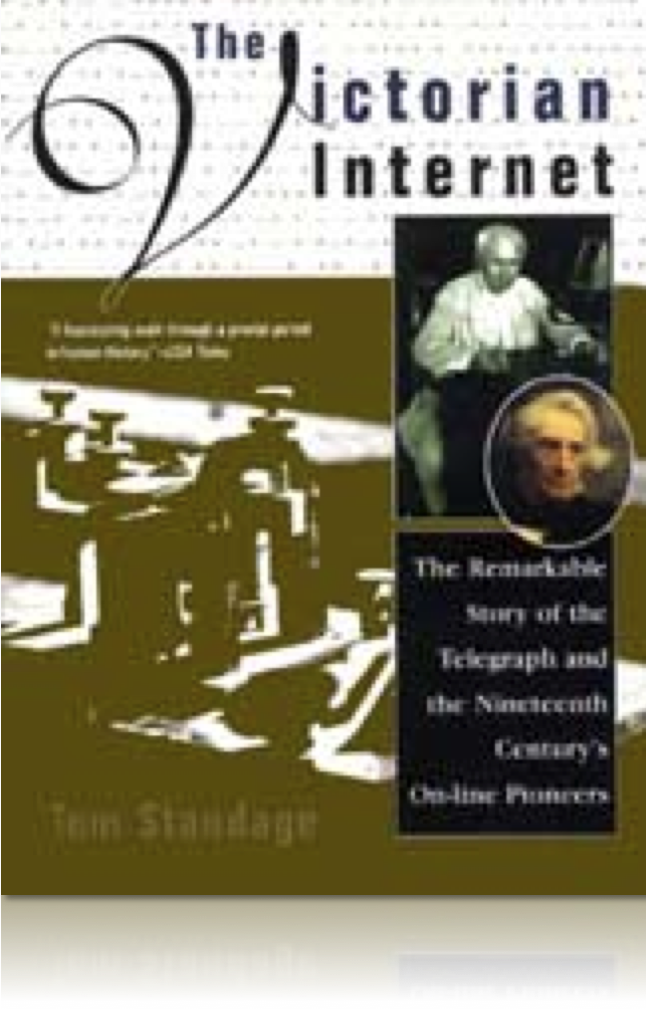
TheVictorianInternetThe histories of Tom Standage approach familiar things from unfamiliar angles. Being interested in Steampunk, and a daily user of the internet who has trouble recalling what life was like before then, I found The Victorian Internet fascinating. Subtitled The Remarkable Story of the Telegraph and the Nineteenth Century’s On-line Pioneers, the story of the wiring of the world did resonate in any almost eerie way to the early days of the world-wide web. Despite my disclaimer, I do recall those days clearly when the only way someone could get in touch with you immediately was the telephone, and you had to be at home for it to work. Prior to the telegraph, news traveled even slower and you could go months without hearing from those closest to you, if they happened to be away. Samuel F. B. Morse knew that first-hand, as Standage tells it. His wife died while he was out of town, and although he rushed back right away upon hearing, she had been buried before he reached her. Such was life when news arrived only by letter. Morse was among those who invented the telegraph, a device that made the world realize that yes, it was possible to send information to distant places almost instantly. It soon become a wired world.

Standage is also more circumspect than some writers who declare, with breathless awe, that some new device will cure the world’s ills. Showing how the telegraph generated much the same hyperbole as the internet (that peace would reign now that people could communicate instantly, that technology had brought a miraculous rapprochement, etc.) he notes that people remained people. Wars continued—intensified, in fact, into World War One where technology was devoted to destruction. People had always been able to kill each other. Now they could do it faster, and in more hideous ways. Still, there’s no denying that once the idea of instant communication caught on that we would continue to develop it rapidly. You never need be away from a network that covers much of the developed world and you can talk on your phone from deep under the Hudson River to the top of the Empire State Building. You can order a pizza from anywhere.

Ironically, Morse dedicated part of his earnings to endow a lectureship concerning how science related to the Bible. It was clear that technology had achieved the impossible (okay, well, the improbable) and yet, Victorian society still relied on the truths contained in Scripture. The telegraph, which began with the words, “What hath God wrought,” ended with the attempt to figure out how the Bible fit into all this. Just because humans had crossed the great barriers of oceans with electric cables didn’t mean the Almighty was out of a job. Even today God can be found on the internet. Along with many other choices of distraction and business. God is not so much dead as commodified. The difference between Morse’s day and ours was that then they knew that the Bible impacted daily life. It continues to do so today, but we’ve become too sophisticated to give it much of a nod. We might be well served, however, to look back once in a while as well as to look forward. We might be surprised at how little things have changed.


Empire State

Hegemony is a funny word. In studies of antiquity it is commonly found since it denotes the “Leadership or dominance, especially by one country or social group over others,” according to the Oxford English Dictionary. Today it has a vaguely imperialist taint, although it doesn’t necessarily require that one nation actually pillage another’s wealth or resources. The idea that people are, and should be, free is pretty much assumed in developed nations. Or so at least our rhetoric dictates. The word hegemony came to mind, however, as I saw an interview with a corporate leader. He was discussing how his company had budgeted for technology development on an increasing scale, to catch up with current developments, and then leveled the tech expenses off after that so that the business could move into its prime objectives. The reality was vastly different, however. Each year’s budget saw increasing technology costs and it shows no signs of slowing down. Every industry, it seems, will have to keep devoting larger and larger shares of its budget to technology. Hegemony.

It’s not that any one company is solely responsible for our obeisance to technology, so this hegemony has no head. It is the idea of progress gone wild. Last year as I set out for the American Academy of Religion and Society of Biblical Literature annual meeting, a notice popped up on my laptop that a software upgrade was available. Since I file that I required was no longer accessible unless I updated, I clicked through all the agreements and provisos that I can’t understand and began the upgrade. Download and installation time measured in hours rather than minutes and I soon had to interrupt the process to get to the conference. This had consequences that nearly led me to becoming utterly lost in a part of Baltimore I’d been warned to avoid. The gods of technology demand their due. Now, less than a year later, I can’t access certain files unless I upgrade again.

Don’t get me wrong—I’m not a complete Luddite. I enjoy the instant gratification of finding information in seconds through a web search, but I’m not always sure that I can believe what I read. Technology means photos can be manipulated, sounds can be fabricated, facts can be created, all with no basis in reality. I used to have students ask me if such-and-such a fact they’d read online was true. Facts, it appears, are now negotiable. Nobody’s really in charge, it seems. Instead we are lead by the vague idea of progress, a new god with technology as its prophet. Even now I know people who think they never use computers but they drive without realizing their car is full of them, and turn on the television not realizing that the tech is no longer chip-free. Meanwhile those in the technology industry seem to have plenty of extra cash around, while those of us in the humanities ponder whether the ancient hegemonies have really changed at all. Let me look that up on the internet, once this upgrade is through.

600px-Astronaut-EVA


The Joy of Tech

In the age of Steampunk, New Jersey is among the world capitals. Indeed, today is the second day that the International Steampunk City will be inhabited in Speedwell, home of the telegraph. For yours truly, Steampunk is an escape. Alternate realities often look better than the pedestrian one we’ve inherited, so we like to look at the world through steamy lenses and imagine how it might have turned out differently. New Jersey, in the spring, also hosts the Steampunk World’s Fair. Perhaps we have more pressures to escape here in the Garden State. Imagination is certainly in no short supply. I attended the International Steampunk City last year and decided that I’d like to be a part of it. Knowing a thing or two about ancient technology, I thought I might share a bit with the Steampunk crowd. What is Steampunk without tech? Some ancient technology, although not very well known, is perhaps of even greater influence than we might imagine.

One of the connections that is easily misplaced in this era of purely scientific advance, is that technology was devised in the service of religion. At least in the early days. The greatest architectural achievements came under the aegis of temple building. Domes, arches, and eventually flying buttresses that could hold tons of stone high over your head—these were to please the gods. We can’t imagine Stonehenge as anything other than a capitalist venture these days, a way of drawing in the money. Of course, ancient builders knew of the financial benefits as well; temples were often the equivalent of ancient banks. Still, beneath all the pride of accomplishment there was the belief that the gods were somehow pleased with our innovation. Perhaps we’ve just done away with the convenient myth. Steampunk often has a religious underpinning. Many of the stories I’ve read touch on our ancient mythologies. Only, in fantasy, there are different possible permutations.

We sometimes think that technology is a modern phenomenon. Actually, it is quite ancient, as far as human culture goes. The first “computer” was invented around about the first century. Since it didn’t have an obvious benefit to the control of the masses, however, no technological revolution took place. The steam engine was, in nascent stages, invented also in ancient times. Until we learned, however, that it could be enslaved to make certain industrialists rich, we had no need for it beyond a diverting toy. Technology does not take hold without a deeper purpose. Every now and again I get a little paranoid knowing that I carry a telephone that knows my exact location at all times. As if I were important enough for anyone to care. Then the feeling passes and I open my iBooks app and turn to my latest Steampunk novel. I am a slave. I wonder what innovations there will be at International Steampunk City this year that might change the world. Only the imagination will limit the possibilities.

DSCN4341


Cuneiform Lover

I’m busy. Too busy most of the time. You see, I used to be able to keep my mental files neatly in order. Recall was swift and efficient. I suppose that was back when I was doing the job for which I’d been preparing my entire life. Then a midlife, unexpected career change shifted things a bit. That mental file that you always kept here has now been shunted over to there. I suppose I always knew this was coming, and that’s why I started writing things down. Of course, this led to stacks of papers and a whole series of notebooks that follow varying forms of logic. “Commonplace books” as they used to be called. Then computers. I never used a computer until after my master’s degree. My wife showed me how. And then writing ideas down became pretty easy—who could ever afford more than one personal computer? And since they were as heavy as a small television (cathode-ray tube variety, of course), you always knew where you’d find it. Then laptops. iPads. iPhones. Something called “the Cloud.” A computer on my person at all times and I still can’t find that ruddy file, and has anybody seen my phone?

I wrote an important (for me) paper back in 2012. Just two years ago. I remembered vividly typing it on my laptop, working on it for weeks. Recently I wondered where I put it. I searched my laptop. Not there. I must have backed it up. Checked my backup files, on CD. Not there. Where did I put the thing? Although a Luddite at heart, I don’t delete old files. Please, tell me I didn’t do something like back it up on a floppy disk! I can barely remember when we used those. No, no, it was much more recent than that. Was it on this laptop or the one before? Maybe I stored it on the hard disk of the antiquated one. When you get a new computer (or at least when I do) it is such a rare occasion that you don’t bother backing up every single little loose file on your old machine—there’s too much shiny new stuff to admire. But the file wasn’t there. Finally I attached a terabyte backup, admittedly overkill for someone of my limited mental ability, and searched. Although the icon said it was on the terabyte drive, the file was actually on the Cloud, and since I hadn’t updated my software in a while, I was denied access.

I learned to write with fallible pencil on cheap, lined tablet paper. Back when tablets were paper. Our ancient ancestors started the process by writing on clay. For some five thousand years this pressing stylus unto substrate method worked fine. All of scared writ was scrivener-mediated that way. When computers were new you stored your files on floppies. At least you knew where they were. Now dialogue boxes ask me questions in a language more obscure than Sumerian and quickly shuttle my files off to I-don’t-know-where, assuring me that I’ll be able to get them back. Honestly. As long as I remember to upgrade my system, which will, of course, require periodic outlays of substantial sums of money. You can choose not to pay, but your documents are with us. I’ve still got some clay here, and a sharpened flint taken to a twig will make a stylus, old school. And clay tablets have been known to last for millennia.

DSCN1816


The Cost of Being Human

In last week’s Time magazine Joel Stein’s “The Awesome Column,” a humorous endnote for somber weekly news, spoke to me. Although Stein writes as light relief, when he addresses humanities education I have to sit up and take notice. Like being in class all over again. Although Stein is trying to be funny, I find the decline in the humanities to be no laughing matter. I don’t think Stein does either. As an uncle once said to a relative recovering from cancer—you might as well laugh about being bald, what else can you do? The humanities are so called because they are what makes us human. Perhaps it is no coincidence that Stein addresses this in the issue following that which commemorates Robin Williams. As I’ve written before, I don’t consider myself a Williams fan, but I can’t help but associate him with what I consider his best movie, Dead Poets Society. The humanities are what we live for.

I’m a little too nearsighted to claim to see the future clearly, but Stein makes the accurate assertion that our great ideas have tended to come from our humanities dreamers. Presidents and Popes, he notes, have not been drawn from the sciences, but from the arts. Herein, I suspect, many would suggest lies the problem. We are a schizophrenic society (with apologies to those who believe schizophrenic is a slur word). Who wants a warm puppy on your lap when you can have a warm laptop instead? Indeed, you can carry your computer under your arm, in your pocket or purse, or even around your wrist. Instant access to the internet and every other wired person all the time. Isn’t that what we really wanted? But then we come out of the movie theater complaining that the show was poorly written, if technologically flawless. We have just walked out of John Keating’s classroom, methinks.

Is this worth more than just money?

Is this worth more than just money?

“We live in a time,” Stein opines, “when smart people want to discuss only politics, technology, and economics.” Truth be told, the deeper you look behind any of these topics the more boring they become. Politics? Everyone wants to rule everyone else, what’s new there? Technology? Electrons dance better in some substrates, and if we can only get this confusing formula right… Economics? I want what you have, so why don’t we trade? How banal! Anyone who’s ever lost him or herself in a novel, a movie, or a song (even, dare I say, a prayer?) knows that transcendence trumps technology every time. As the weather begins its long decline into a bleak and icy winter, I’ll be sitting here with my laptop on my lap, but I can guarantee that this is one place where I can fully agree with the departed Charles Schultz. Happiness would actually be a warm puppy.


Best Nowledge

Back in the day when paper books ruled, New York City used to be known as the publishing capital of the country. Even though many publishers still call New York home, a depressing lack of interest pervades the city that never sleeps (sounds like it could use a good book). Although I’m no fan of Barnes and Noble, it is just about the last presence left of the brick-and-mortar-style bookstore. When news arrived this week that one of the large New York branches of B&N was closing, a sense of despair settled in. I love my indie bookshops. I literally went into mourning when Borders shut down, even now the sight of a vacant Borders can make me weep. A walk though any trendy mall will reveal no books to be found, and I go home perhaps fashionably dressed and smelling vaguely of perfume but sad nonetheless. Perhaps it is because the book is/was the culmination of one of the most important technologies of all time: writing.

Technology, as we think of it today, is largely electronic. Circuit-boards, nano-chips, embedded in sealed cases constructed in sterile rooms where the humans are more protectively suited than a surgeon. Isaac Newton once famously noted that if he’d seen further than others it was because he’d stood on the shoulders of giants. One of those unnamed giants invented writing. Dragging a stick through clay would probably be considered decidedly low tech these days, but the person who realized that a crude scribble of an ox-head with dots next to it might indicate how many cattle you were selling was a giant. We have no idea who the scribes were who wrote down the first narrative stories of gods and heroes, but the process resulted in a still largely anonymous Bible that is used to decide public policy even today.

There’s no doubt that books take up space that electronic gizmos don’t. Storage has been an issue for libraries constructed before publishing became a major, competitive industry. But electronic books have their problems too. With the ease of self-publishing, you never know who is really an expert without researching the author. Often on Amazon I find an intriguing title only to see that it has been produced by any number of self-publishing software platforms that indicate only the author’s own word for his or her expertise. I wonder what happens when people who don’t know to assess information in that way take anecdote for fact. Where are the shoulders of giants? Perhaps I’m just old-fashioned, but the world without bookstores looks a lot like the stone age to me.

Alas, Babylon!  (Photo credit: Lovelac7, Wiki Commons)

Alas, Babylon! (Photo credit: Lovelac7, Wiki Commons)


When (Nearly) Everything Changed

WhenEverythingChangedMy wife and I just finished reading When Everything Changed: The Amazing Journey of American Women from 1960 to the Present, by Gail Collins. (In the spirit of the book, I wash the dishes while my wife reads to me.) Although Collins does not dwell on the religious motivations in “traditional” women’s roles, I couldn’t help pondering how religions, rather than encouraging equal rights, have often acquiesced to the unfair treatment of women as a matter of principle. That principle is often abstract and theological. More often than not it is also mythical. As society changed to allow a greater measure of equality in social roles for the sexes, religious leaders held back, concerned more about doctrine than people. This is perhaps the most disheartening aspect of religious belief—as a human phenomenon it too easily loses sight of humanity.

Historically, of course, the roles of the sexes were tied to reproductive necessities. Women with nursing children (and startling low mortality rates) could not do the heavy work required in the agricultural societies of antiquity. I am aware that this is over-simplifying—it seems clear, however, from the materials left to us from the earliest literate cultures that a basic biological divide determined appropriate roles. Not only were women victims of high mortality rates due to difficult childbirth, but infant mortality was also high. In such circumstances it was important to guard those who survived from the potentially dangerous work of protecting flocks and tilling fields. And this was the time when the ancestors of our religions emerged. Technology improved survival rates and quality of life, but religious dogma is very slow to evolve. Some dogmas still don’t even accept the idea of evolution.

Back to When Everything Changed. Yes, bottles and birth control gave a new freedom to women. Day-care and daddy involvement also helped. And yet, not everything changed. Seeing the progress, religions tended to cry “foul!” and insist that, for women anyway, nothing had really changed. No doubt Collins is correct about a large swath of life in the secular sector. Most jobs are open to both sexes, and issues of fairness, although still lagging, are starting to be addressed. Many major religious bodies, however, still hold women in a subordinate role. Basing their reasoning on theologies long outdated, they insist than nothing has really changed at all. If only the wisdom of women and their experience were taken seriously many religions would have changed for the better as well. Only when that happens will we be able to consider that, in Collins’ hopeful words, everything will have changed.