Nightmare Behind Holidays

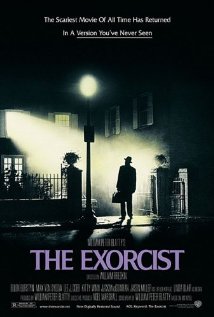
Among the first mythical creatures to go extinct when the early rays of the Enlightenment began to filter through the blinds of superstitious antiquity, were demons. It was recognized that the activities attributed to demonic possession closely resembled epilepsy and psychological illness and that Occam’s Razor would remove any unseen entities with its no-nonsense straight-edge in one deft pass. And yet they remain. Among the ghost hunting crowd, demons have been recategorized from fallen angels to entities that have never been human. Their reality is assumed, and results of investigations, not surprisingly, support that assumption. It was, however, a Dirt Devil advertisement that created a desire to watch The Exorcist now when darkness comes early and the leaves have fallen from the naked branches and a chill has permeated the air.

As I watched the still disturbing film, I realized that I had also watched the Exorcism of Emily Rose and The Last Exorcism within the past few months as well. I am no fan of demon movies; even with no demonic forces out there, inevitably young women are tormented by what ultimately turns out to be a male establishment. My threshold for watching the suffering of others, even if only acted, is minimal. Movie makers—and often horror writers—know and exploit this, bringing us to face the real demons, the shadowy regions of our own minds. The Exorcist is particularly effective in this since it is Fr. Karras’s demon that ultimately wins out. Having never read the novel, I’m not sure whose idea it was to make the demon Pazuzu, but once again the origins of demons does not fit modern media’s expectations.

Pazuzu was a Mesopotamian “demon.” Akkadian doesn’t have a proper word for what the Judeo-Christian tradition would introduce as a fallen angel. Demons were simply a way of explaining profound misfortunes such as droughts, pestilence, or the Bush administration. Eventually such misfortunes became personified and took on the ability to possess a human being. Here is where psychology and neurology have come to banish demons. Part of the terror of The Exorcist is that such scientific explanations are laid flat in the face of real supernatural power. The lessons of over-consumerism, as evidenced in Black Friday eclipsing Thanksgiving for many (the lines were formed in many locations well before midnight, cutting into family time in order to get first crack at the bargains) show the demon more clearly. Holidays are measured in importance by the amount of money spent. Perhaps it is no wonder that Halloween’s demons have lingered through November and even to the end of the year.


Demonic Beginnings

A friend recently asked me what seemed like an innocuous question: what is the origin of demons. I typed out an answer on the basis of my outdated reading on the subject only to realize that this is a very complex question indeed. While teaching my Ancient Near Eastern religions class over the past three years I regularly told students that there is no regular word for “demon” in Akkadian, the language of ancient Mesopotamia. Mesopotamian religion was the dominant system of belief in sheer size of area and antiquity in the Ancient Near East. There are characters recognized as demons: Pazuzu of The Exorcist fame among them. Their origin, however, is murky. In Mesopotamia demons are generally a mix of human and animal components supposed in some way to be responsible for misfortune. They are not evil, but they carry out the punishments decreed by the gods. In the first millennium BCE demons were understood to inhabit the Underworld, paving the way for Hell, once Zoroastrianism contributed the necessary duality for the region.

The Hebrew Bible contains no uncontested word for “demon” either. The words generally translated that way do not indicate evil spirits in the sense that the Christian Scriptures seem to depict them. In the Hebrew Bible they appear to be associated with the worship of “false gods” and the inhabitants of deserts and wastelands. In neither the Mesopotamian nor Israelite concepts do demons appear to “possess” people. By the time of Christianity, with its Zoroastrian-fueled dualism, we have an anti-God (the devil) and his anti-angelic minions (demons). One purpose here seems to have been to clear the monotheistic God of charges of originating evil. If there is only one God where does evil come from? Better to posit a devil than take that one where logic leads.

Back in the days when I was still in school, demons were regularly cast as the explanation for various mental illnesses and epilepsy. In a society that had trouble understanding the sudden onset of an epileptic fit or a sane individual growing insane, such misfortunes could appear supernatural. In a supernatural realm where evil is mediated by the devil, demons naturally volunteer for their old role as purveyors of divine punishment. Eventually the mythology of a revolt in the world of the gods emerged, probably based on the dualistic outlook of Zoroastrianism, and we soon have verses referring to the king of “Babylon” being reinterpreted as literal episodes on a spiritual plane. Once Jesus utilized this language to describe the suffering souls of his day, it became heresy to think of demons in any other way than as physically, or at least spiritually, real. In the modern day they are still with us as “spiritual entities that have never been human” according to Ghost Hunters. They do, however, resemble people in significant ways more than they resemble their mythic forebears. Where do they come from? The dark recesses of the human psyche. Their mythic origins, however, remain obscure.


Parsing an Exorcism

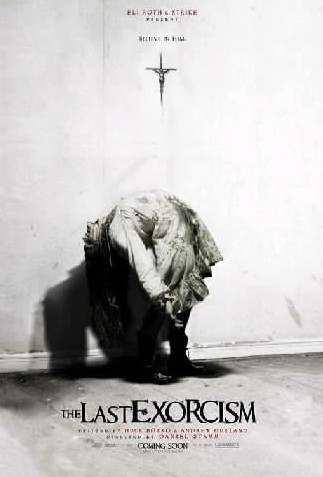
The latest in my spate of scary movie viewings is The Last Exorcism. The press when it was released last year made claims of extreme fright, but my impression was that I’d seen it all before. The “found footage” fantasy is difficult to maintain—although the camera work in the film is good—and the premise of demonic possession is frightening if the viewer is a believer. The hook for this movie, however, is that the exorcist himself doesn’t believe and becomes a victim of his own unbelief. The pattern overall follows The Exorcist, but without the creepy soundtrack and staged lighting effects, The Last Exorcism relies heavily on the viewer’s willingness to believe. The demonic possession is presented as extreme contortionism and self-destructive behavior, as well as the uncharacteristic violence by the victim. When Nell Sweetzer gives birth to a demonic child, a la Rosemary’s Baby, the role of good Christian gone occult feels a little hackneyed.

I’ve tried to analyze what scares so many people with movies of demonic possession. The core fears seem to come down to two: belief in the reality of demonic possession and the fear of being out of control. Historically the concept of possession was originally relegated to the gods with demon possession apparently arising as a pre-scientific attempt to explain epilepsy. The fact that most Christian denominations no longer recognize physical demon possession (a fact exploited by The Last Exorcism) makes it more frightening still. For a generation of media-saturated viewers convinced that cover-ups are common the credibility of the church, struggling with its own metaphorical demons, is suspect. Perhaps demons are out there—a common enough assertion on the reality show Ghost Hunters—and the church has lost control over them. When Jason and Grant explain what demons are, however, they are pretty far afield from Legion being cast into a herd of swine.

If the Internet is any kind of reliable measure of people’s fears, zombies and demons appear to be nearly on a level when it comes to belief. Both are supernatural and neither stretches credulity to the point of humans growing fangs or matted fur. Both participate in the idea that there is more to be feared beyond death. Both fail in the court of science. The Exorcism of Emily Rose raised the ambivalence of demonic possession to the level of the courtroom. One thing I learned on jury duty last week is that the truth is measured on the basis of the judgment of a quorum of rational individuals. The implications of this are frightening indeed: those who accept the reality of non-physical monsters (the jury is still out on ghosts) are fully capable, in a legal setting, of deciding the truth of the matter. The only corrective to witch-hunts and state-sponsored exorcisms would seem to be education. Today education comes via the media where zombies and demons freely roam.


Silver Scream

Only within the last couple of decades have movies begun to be taken seriously as expressions of the Zeitgeist. An art form not even 150 years old, commercial movies have been seen primarily as an entrepreneurial exercise—money-making ventures with little serious thought. Now students of society recognize that where our wallets are, there our hearts are also. Even in the depths of recession the entertainment industry maintained its draw. The unemployed could at least watch movies cheaply at home. Yesterday’s newspaper contained an insightful entertainment piece on horror movies by film critic Stephen Whitty. Noting that the film industry began when the Production Code largely mirrored pre-1950’s American cultural values, Whitty observes that clergy were left out of movies, or when they appeared they were strong role-model characters. Then, beginning with The Exorcist, the demonic became a huge theme in movies. As Whitty concludes, “Certainly it’s partly a reflection of a growing fundamentalism” that indicates why such movies are now so popular. Many Americans believe in angels and demons and turn to them to explain the serendipitous or contretemps.

Scary, but not necessary.

Social attitudes help to explain what we see on the big screen. Almost from the beginning religious leaders have castigated the entertainment industry as an unholy counterpart to sanctified living. Theater was earthy and evil, movies immoral, and even the desire to be entertained took away from the struggle for salvation. Ironically, however, movies tend to reflect conservative values. At least when it comes to demons. In the current glut of demonic films—which most Americans rate as the scariest kind of horror movie—the church-sanctioned hero is often the only effective tool against evil. A mythology of a Manichean dimension reigns: good struggles against evil and good will prevail. Unfortunately, this Hollywood scenario falls on the side of simplistic solutions to complex problems. Evil is our own doing—we need no demons to tell us how to be bad. Likewise, help often fails to come from on high.

Over the weekend I watched Dogma once again. Severely criticized as immoral and trashy, the overall message is, however, one of faith and hope. No fundamentalist, Kevin Smith certainly takes his pot-shots at Christianity, particularly Roman Catholicism, but in the end God and angels are real, and demons are defeated. Yes, this comedy is intended to be entertainment, but the audience that views it probably agrees with its core values. As Whitty demonstrates, the past decade has flooded the market with Hell-born foes, and there seems to be no imminent slacking of the pace. People are afraid. Our efforts at free-market Heaven have turned out to benefit too few while too many are still without work or adequate security. No, we need no demons to instruct us in the ways of evil. We are fully capable of initiating our own.


Zoroastrian Odyssey

Clinton's Red Mill

Clinton’s Red Mill is a popular New Jersey attraction, but numerous reports of paranormal activity have thrown an additional lifeline to the museum in the form of much-needed revenue in the form of seasonal ghost tours. Last year about this time my family and I participated in one. Touring the old grounds at night can certainly lead to spooky experiences, even for those of us who sit on the fence about ghosts. We discovered that The Atlantic Paranormal Society, the “TAPS” of Ghost Hunters fame, had investigated the Mill the previous year. We watched several episodes of the popular show, and for a lark, my wife bought me a subscription to TAPS Paramagazine for my birthday. All in good fun. I always thumb through when it arrives, but it is hard to take much of it seriously.

The last issue (volume vi, issue 2), however, contained an article about Demonology. Now, I thought I had graduated from The Exorcist and the Exorcism of Emily Rose to a healthy skepticism, but I could not resist reading this article. The first statement declares, “A demon is a fallen Angel that rebelled against God along with Satan, refusing to be humble before, and serve, God” (Adam Blai). While I never make light of things I don’t understand, I did consider the fact that the concept of demons, which derives from a Judeo-Christian mythology, presupposes a mythic war between the powers of good and evil. At the same time, I have been reading up on the Zoroastrians, one of the oldest continuously practiced religions in the world. There can be no serious doubt that the Judeo-Christian tradition borrowed the concept of the demonic from their Iranian neighbors of the ancient Persian Empire.

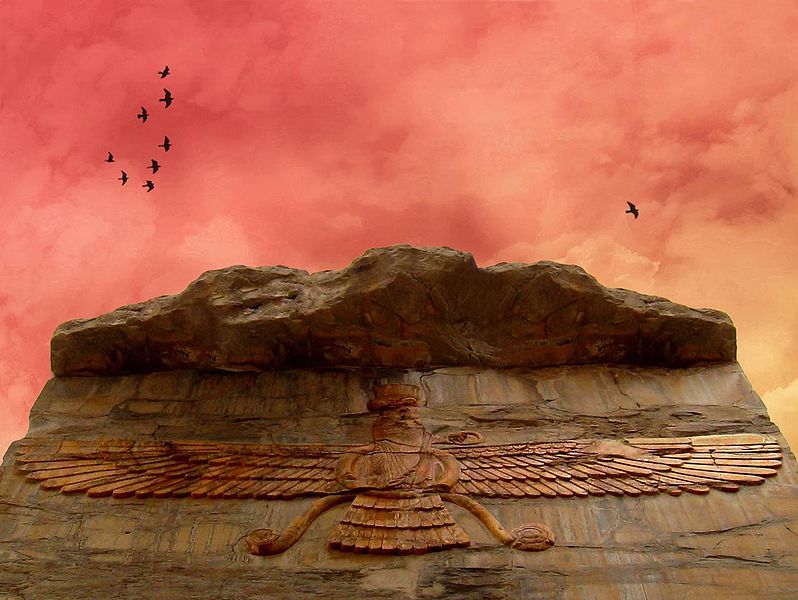
A Zoroastrian fravashi

The implications of the Zoroastrian connection are profound. If the ancient sage and Afghani priest Zarathustra was correct about the dualistic conflict of good and evil, was he not also right about Mithra and the Amesha Spentas as well? Zoroastrianism gave the Judeo-Christian tradition its base concept of Heaven and Hell, but the divinity of fire they did not accept. By picking and choosing what fit best into its experience, Judaism developed into a religion that allowed for Christian demons and angels and all the invisible hosts of the ethereal realms. Today many Christians accept demons as literal beings (less so jinns, although Clash of the Titans (2010) allowed for them). What does this say about the remainder of Zoroastrianism? Perhaps Ghost Hunters should begin with the Gathas and move on to the Avesta? As for me, I’ll be over here, sitting on the fence.