Unwritten

It has been clear to me for some time now that I won’t live long enough to finish all the books I’m writing in my head.  A good number of them have a head start on my hard disc, but as Morpheus says, “Time is always against us.”  The largest culprit in the 9-2-5 job.  Eight hours is a huge amount of time to devote each day, no matter how you slice it.  Since eight hours are required for sleep, or trying to sleep, that means work is half of each day’s waking hours.  The other half includes things like making meals, washing clothes, family time, paying bills, running the vacuum, exercising because you sit in front of a screen all day, and, of course, yard work.  Plants don’t have the same constraints that humans do and can get to the business of growing larger 24/7, as long as the weather cooperates.

Some days I grow reflective about this.  My daughter often asks why I don’t draw or paint more.  I love doing both.  The answer is time.  Even weekends are eaten up with shopping for the food you need to get through the week, and yes, the yard was bigger than I realized, and the house needed more repair work than anticipated.  You see, writing well requires a lot of practice.  And even more reading.  Any successful writer (which I am not yet) will tell you that reading is essential.  I do read a lot.  A friend recently sent me an article about a writer whose heirs calculated he’d read at least 4,000 books.  I know that I’ve read about 1,200 since 2013.  I also know that I can’t count them all before that time.  I went through our living room shelves and counted 500 I’d read there, and that’s only one room.  

Ironically, as a professor reading time is limited.  Unless you have a research only post.  I read a lot as a kid and a ton as a student.  When I started teaching I had less time, except on semester breaks and I tried to read as many books as possible during those interludes.  Then the 9-2-5 began.  My current pace of reading began when trying to live as an adjunct between Rutgers and Montclair State.  Montclair was a 70-mile drive, so between classes I started reading voraciously.  Ironically, the commute to my 9-2-5 spurred me to start writing books again.  By then I was practically fifty.  Since my nonfiction books take about five years to write, well, the math’s not in my favor.  Time to stop my musing, because the 9-2-5 begins shortly.


Professionalism

We’re all tightly packed together here on the internet.  Social media is a fuzzy category and now includes such platforms as LinkedIn, which I think of mainly as a place to hang your shingle while looking for a job.  I chose, many years ago, to make myself available online.  This sometimes leads to a strange familiarity.  It isn’t unusual for me to have an author hopeful to contact me through my personal email or through LinkedIn, especially, to try to push their project.  (Such people have not read this blog deeply.)  One thing acquisitions editors crave most highly is professionalism.  Being accosted on LinkedIn, or in your personal email, is not the way to win an editor’s favor.  Some of us have lives outside of work.  Some of us write books of our own and don’t blast them out to all of our contacts on LinkedIn.  Professionalism.

It’s tough, I know.  You want to promote your book.  (I certainly do.)  It seems strange to say that blogging is old-fashioned, but it is.  (Things change so fast around here.)  But you could start a blog.  Or better yet, a podcast.  Or a YouTube channel.  You can blast all you want through X, Bluesky, Facebook, Tumblr, or Instagram.  I admit to being old fashioned, but LinkedIn is for professional networking, not doing quotidian business.  It may surprise some denizens of this web world that some publishers don’t permit official business through social media.  Email (I know, the dark ages!) is still the medium preferred.  Work email, not personal accounts.  Some authors (believe it or not) still try to snail mail things in.  Publishing is odd in that many people, and I count my younger self among them, suppose you can just do it without learning how it works.  Most editors, I suspect, would be glad to say a word or two about professionalism.

Photo by Ben Rosett on Unsplash

Professionalism is what makes a commute to the office on a crowded NYC subway train possible.  We all know what’s permissible in this crowded situation.  We know to wait until someone checks in at work before asking them about a project we have in mind.  (If you’re friends with an editor that’s different, but you need to get to know us first.)  When I started this blog I was “making a living” as an adjunct professor.  I was hanging out my shingle.  I also started a LinkedIn account.  Then I started writing nonfiction books again.  Since those days I’ve been trying to figure out the best way to promote them.  Professionally done, if at all possible.


Banning Books

For many years I’ve celebrated Banned Books Week by reading a banned book.  What with Republicans wanting only white, hetero, history-denying titles approved, I’m pretty sure that most books I read are banned somewhere.  Banned books, of course, see sales bumps and benefit the publisher and author.  So instead of reading a noted banned book, this year I’ll hang out my shingle here with but shallow hopes that it will be read.  I’m pretty sure, any agents out there, that at least one of my novels would be a banned book.  Maybe all of them.  You see, in my fiction I’m not the mild-mannered, inoffensive person who blogs here everyday for free.  There’s a reason that I keep my pen name secret.  I’m pretty sure that most people who know me would be surprised, if not shocked, by what appears in my fiction.

Writing, you see, is where we express the ideas in our heads.  I may seem to yak about everything on this blog, but in reality, I’m quite guarded.  Many of the horror movies I discuss, for instance, have ideas or scenes that I simply leave unaddressed.  I’m trying not to offend anyone here.  (A friend of mine who does publish fiction mentioned recently that a significant other in her family suggested that her writing wasn’t controversial enough to be picked up by publishers.  I think there could be something to that.)  While my mother was alive, I took special care that she wouldn’t discover any of my fiction.  Now that she’s gone these two years, I still protect her name with my own nom de guerre.  I really don’t want to hurt anybody.  I do, however, need to express myself.

Some of my fiction is horror.  Some is just plain weird.  The novels are well written, I think, and I’m open to editing.  (Agents, I am an editor—I know how this game works!)  As long as we’re stuck in a morass of banning books, why not look at a writer who’s more controversial than you might believe?  I’ve been writing daily for going on half-a-century now.  Think about that.  Think about the sheer number of controversial thoughts one might have in that amount of time!  Add graphomania to the recipe, with just a squeeze of talent and you’ve got banned books to last a lifetime!  I’m not sure any of the books I’m currently reading (five actively, at this point) formally appear on a  banned list.  But if you want to find one that almost certainly will be, well, my shingle’s out there if you care to take a look.

A banned book, in some districts

The Season

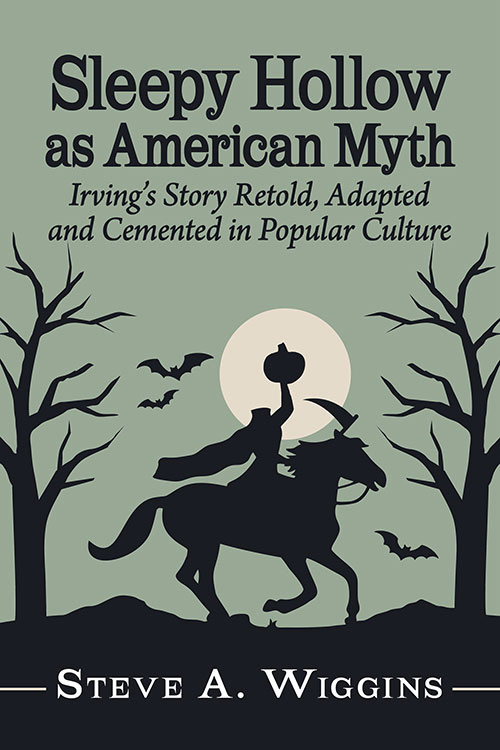
I learned about the Horror Writers Association years ago, shortly after I started publishing horror stories in 2009.  I couldn’t join because you had to have earned at least $30 from a publication.  I took this to mean a fictional one and I never made it beyond that benchmark until this year.  (It’s possible I misunderstood and could’ve joined for Holy Horror and beyond.  I think the point is they want to know you’re serious.)  In any case, these folks may be my tribe.  During the month of October the website has a set of free blog posts available to the public.  Mine—located here—dropped yesterday.  It deals with nonfiction, of course, since I’m still not finding much traction in getting novels published.  One of the weird things about book publishing is that you don’t know, unless you’re already successful, how well your sales are going until after about six months or so.  Sleepy Hollow as American Myth may be flopping for all I know. 

I’ve tried to promote this one as much as I can.  I contacted bookstores and libraries in Sleepy Hollow itself.  I had bookmarks printed and put them in local libraries and bookstores.  I arranged a discussion at the upcoming Easton Book Festival.  I told my local writers’ group about it.  Posted on a Halloween Facebook group.  All of this is tricky rather than treaty when a book is priced near $40.  That’s quite a trick, I know.  As Halloween approaches I keep seeing memes and posts about the Headless Horseman.  But I’m not sure if anyone’s finding my book or not.  It’s an anxious period when you write.

Working in publishing for nearly two decades now, I’m starting to realize that there are two ways to relevancy.  One is to be hired by an institution with name recognition—that automatically makes you an expert and everyone want to know what you think.  They’ll even pay you for it.  The second way is to write a book that sells well.  That one’s a bit of a catch-22, however.  To get published these days you need to already have a following.  I suppose that’s what the internet is for.  The best forums at the moment seem to be YouTube and TikTok, but there’s more much traffic there than on a Los Angeles freeway during rush hour.  I’m not sure if many people read the Horror Writers Association Halloween Haunts blog posts.  These folks, however, seem to look at this from a similar perspective.  Maybe a few of them will buy Sleepy Hollow as American Myth.  ’Tis the season.


Dark Pliny

My current dark academia kick has me looking at the Classics again.  I taught Greek Mythology for three semesters as an adjunct at Montclair State University.  In the course of my New Testament studies I’m sure I encountered some of the classical Greco-Roman writers, but being focused on the Bible at the time, I never really followed through.  Then my doctorate got me interested in even earlier classics.  In any case, I’ve been trying to self-educate myself about Pliny the Younger.  To be honest, this is because he wrote one of the most famous Roman ghost stories.  Pliny wasn’t some guy into woo-woo subjects.  He was a magistrate and a lawyer and a noted orator.  His most famous work is the collection of his letters.  One of those letters tells his ghost stories.  Others describe Mount Vesuvius’ eruptions.  So, Pliny.

Image credit: Daderot, Angelica Kauffmann’s Pliny the Younger and his Mother at Misenum, 79 A.D. (detail), public domain via Wikimedia Commons

My fully-loaded bookshelves don’t have any Pliny.  I’m sure he’s mentioned in many of the books on these shelves, but I don’t have a copy of his letters.  I used BookFinder.com to search for used copies only to discover that the Loeb Classical Library divides his letters into three volumes, which feels like too much for casual reading.  Then I realized that most editions are edited, leaving out some of the, I suspect, less interesting missives.  Even as an editor, I don’t trust editors.  What if they left out the ghost stories because, well, serious scholars pay no attention to such things?  I discovered that Penguin Classics has an edition and from what I can tell, it seems to be complete.  I mark books that I want to remember on Amazon because they have pages even for the obscure stuff.  I try to buy the actual books from Bookshop.org.

What makes all of this noteworthy is that as I was on the Amazon page I noticed that you can “follow the author”—Pliny the Younger himself!  He must be a ghost by now.  So what the heck?  I clicked “Follow.”  I’m not in the habit of following authors on Amazon; I find my books in many different ways and most authors I know don’t like to talk about their writing, so why add another social media commitment?  I’m hoping that Pliny will be more willing to chat about writing.  He may be dead, but I’m not a prejudicial sort of individual.  I won’t hold it against him.  Who knows, maybe in addition to ghosts, I’ll learn something about Vesuvius?  And if he ghosts me, well, at least he’s a professional.


Nostalgic Shadows

Nostalgia is a funny thing.  Although it can strike at any age, somehow after the half-century mark it’s particularly easy to get swept into it.  As I written about many, many times, I was drawn into the Marilyn Ross Dark Shadows novels as a tween.  In my mid-to-late forties, when the internet made it possible, I started to collect all the volumes from 1 through 32.  It took several years.  I had to find them via BookFinder.com and our level of income didn’t support buying more than one every few months.  Then in 2022, having difficulty locating the last of the original series, I found a seller on eBay offering up the whole set.  The price for that set was less than the least expensive final volume I could find.  I did what any nostalgic guy would do.

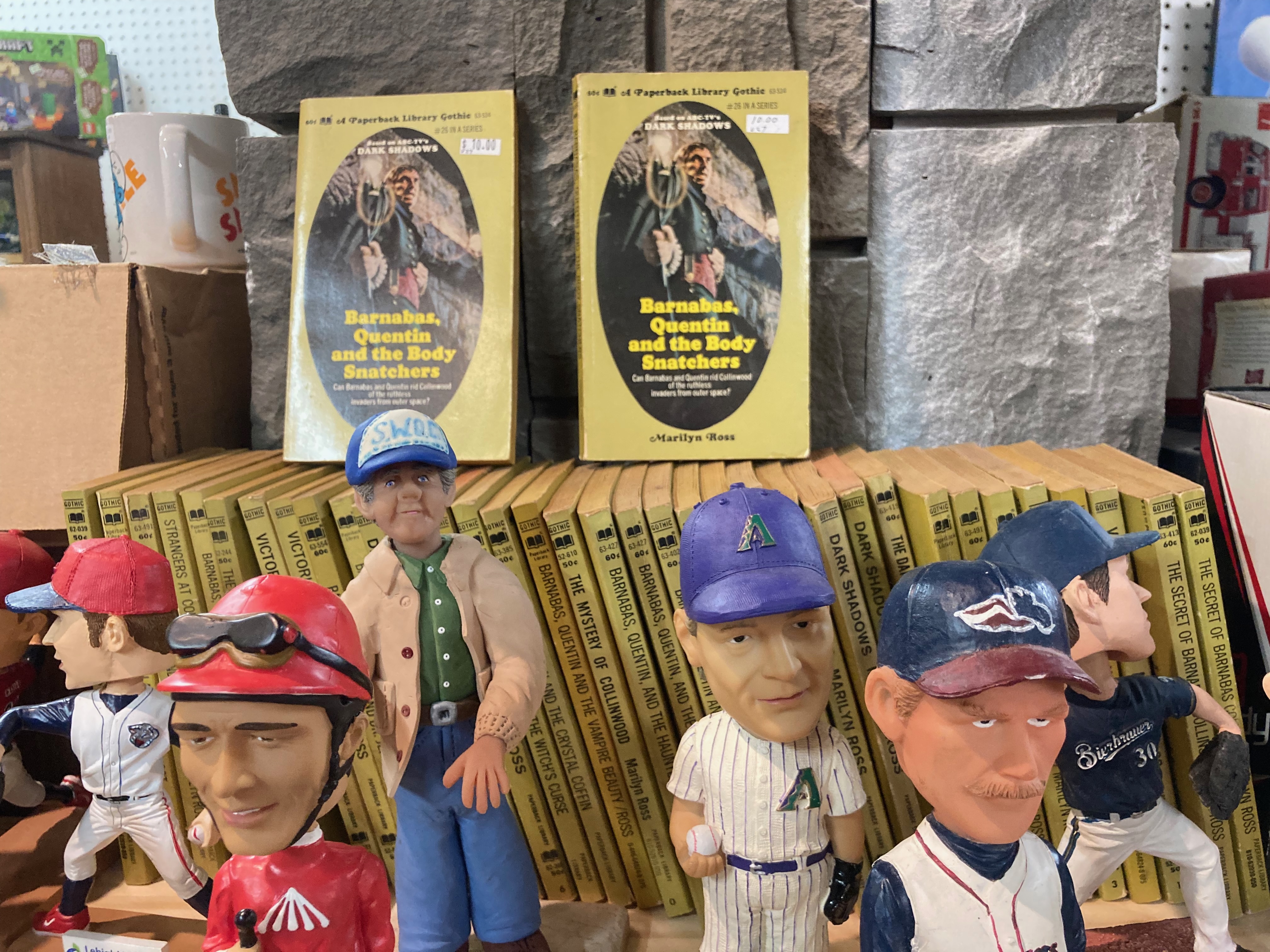
We don’t really buy antiques, but I’d been looking for an office desk (this was before the scam).  I’d been using a craft table for a desk for years and it seemed that I really needed something with a better organizational range.  This led me to stop into a local antique shop.  They ended up not having much furniture, but they did have aisles of nostalgia.  A few weeks later when it was too hot and humid to be outdoors, I revisited the shop.  This time, relieved of the burden of seeking a desk, I was able to browse at leisure.  It’s like going to a museum but not having to pay admission.  I turned a corner and I saw something I’d never seen before.  A collection of Marilyn Ross Dark Shadows books.

It wasn’t a full set, but I had, prior to finishing my own collection, never seen more than one or two together in any single place.  As a child I’d buy them at Goodwill.  As an adult, on BookFinder.  All those years in-between, I always looked for them when visiting used bookstores.  I visit said shops whenever possible.  In decades of looking I’d only found one in the wild once or twice, and always by its lonesome.  This was a completely new experience for me.  It was also quite odd to be seeing them and not having any need to buy them.  I have a full set.  The nostalgia was almost overpowering.  I couldn’t help but think of how even a few years ago I’d been pawing through to see if there were any I hadn’t yet found.  All for reliving a bit of my childhood.


Secrets

It’s a mystery.  All parents do it and even when you’re a parent yourself you’re surprised to find your parents doing it to you.  Keeping secrets, that is.  Parents have their secret lives that they don’t tell their children, and when we’re given a glimpse into that life sometimes we’re shocked.  My mother kept a diary.  Not religiously, and not for much of her life.  I inherited one volume, and I’m afraid to read it.  I tend to be an honest guy.  I try to answer my daughter’s questions with complete openness.  There are, however, some things I won’t talk about.  My secrets.  And despite the fact that I reveal something of myself daily on this blog, I do have many parts of my life that remain unrevealed.  Those of us who write sometimes don’t want everything we put down to be read.  Or maybe we do.

I used to keep a diary.  It was partially to remind me but also, in part, to explain myself.  It’s quite personal and I lost maybe two or three volumes of it years ago.  I stopped keeping it after I got married.  I guess I figured a Ph.D. and publication record would do the job for me.  Probably those missing volumes were with stuff left at home that Mom unwittingly threw away, like our old baseball cards from the early seventies.  Some of my stuff got damaged by water, foreshadowing what’d happen when we moved.  Perhaps they were thrown away then.  They had secrets, I’m sure.  Our private lives are a mystery to others.  That’s one reason that I try to be kind whenever possible.  We don’t know the burdens that others carry.  Why add to them by a sharp reply?  Even typing this, I’m not sure it will end up on the blog or not.  Other pieces haven’t.  Secrets.

Photo by Yogesh Pedamkar on Unsplash

Some intelligent animals try to hide things.  Corvids, for example, look around to see who else is there before hiding food.  I once saw a doe giving birth.  She was in a secluded glen in the early morning and I just happened to be jogging quietly by.  I’ve started multiple autobiographies.  I’m not sure anyone has an interest in reading them, but I have hope.  Despite my secrets, most of which I keep out of the autobiographical musings, I know I have a story to tell.  That’s why I keep at this blog, day after day, year after year.  It brings no money and has only a few followers, but it’s a chance to tell my story.  Even if I keep the secrets closely guarded.


Fragments Etc.

I’ve never counted, but there’s well over a hundred of them.  And a notebook with at least a thousand more.  What have I got in such abundance?  Ideas for stories that remain unfinished.  I’m not exaggerating or inflating numbers, I assure you.  I’ve been writing short stories for a half-century now, many, no, most unfinished.  Thirty-three have been published.  I was reminded of this recently while reading a nonfiction book that suddenly gave me the ending for a story I’d started many months before.  Perhaps even a couple of years.  I started searching through my electronic files for it and couldn’t find it.  Why?  There were too many stories started with frustratingly short titles (my bad).  To find the culprit, I would need to open each one and remind myself what was inside.

A few months ago, I printed out copies of all eight of my unpublished novels.  I also printed out copies of all my published stories as well.  I never got around to the unfinished majority.  I have a feeling that if I printed them I’d find what I was looking for more easily.  This, even with the ease of electronic life, will be quite an undertaking.  I think it may be a necessary one.  Although I’m hardly well known—I’m an obscure, private intellectual, after all—I do have many fiction ideas.  The stories generally come to me with an impression.  The start of an intriguing tale, for instance, or the end of one.  I then begin writing and either write myself into a corner or I scribble until I realize that I don’t know what happens next.  The story sits, unfinished.  Now and again, however, the missing piece is found.  I try to find the story so I can complete it to send out for several rejections.  Such is the writing life.

Now, if I could do this for more than the paltry time allotted to personal pursuits, courtesy of capitalism, I’m confident that I’d have far more than thirty-something stories published.  At current count I have seventeen stories ready to send out to literary magazines, several of them already rejected a time or two.  Another twenty finished and nearly ready to send out.  And forty just finished, but requiring a bit of spit and polish.  And these aren’t the fragments.  Don’t get me started on the nearing 6,000 posts on this blog.  Is it any wonder I can’t find anything?  I grabbed my notebook of a thousand fragments and jotted a physical note of how that particular story ends, in case I ever find it again.


Knock-on

When you’re the victim of a scam, the loss of all your money is only the beginning of your problems.  Scammers take away the simple pleasures you’ve afforded yourself.  Your mental security.  Your very sense of balance.  If you have to close your bank account, you’ll need to telephone (sometimes repeatedly) any company with which you have autopay.  You’ll receive threatening notices in the mail that make the rise in your blood pressure audible.   It should come as no surprise to my readers that I’m a Neo-Luddite.  I’m not sure the internet is a good thing and technology has made much of life more difficult.  At the same time, I’m conflicted because I know we have it easier than the vast majority of humans who’ve ever lived.  But still.  

The scammers took control of my laptop, which is not a spring chicken.  I had to have this old rooster scrubbed, which meant all the little fixes that allowed my device to use a very old printer and scanner were also scrubbed.  Now, visiting the websites of the printer and scanner makers, they no longer provide drivers for such ancient devices, so not only do these scamming parasites leave you with muzak earworms but with now useless electronics that have to be replaced.  And no money to do it.  We’ve managed to live for nearing two decades without having to buy a new printer or scanner.  Both work fine.  Now they’re useless because their makers no longer supply drivers and I’m once-burnt-thrice-shy about shady websites that tell you to download such things.  Meanwhile some undeserving soul is using my money to fund an operation to scam even more people out of their legitimately earned money. 

Please pardon my vitriol. Perhaps it’s my fault for thinking the best of people.  I try not to classify anyone as evil, but it’s getting more difficult not to.  After an identity theft there’s a ton of paperwork; things need to be scanned and printed.  Only, oh, yeah, I can’t do that anymore.   I’m very well aware that others have bad circumstances too.  Even worse.  I’m trying to recall Viktor Frankl’s maxim of finding meaning in suffering.  I’m attempting, very hard, to apply it now.  Thank you, dear readers, for being my therapists for this short while.  I do hope that I provide enough provocative content, not focused on my woes, that will reward your reading.  Okay, I’m done venting now.  Back to the usual kind of horror that occupies this blog.  Tomorrow’s post will be about an actual horror film.  I wouldn’t scam you.


Being a Fan

Fandom is a weird thing with me.  Having wide-ranging interests, coupled with an at times obsessive personality, my likes are intense but fall short of the kind of fan who purchases everything associated with their fascination.  A friend kindly sent me the Dark Shadows Almanac, edited by Kathryn Leigh Scott and Jim Pierson.  I try my best to read books friends  send me, and working my way through the Almanac, I realized just how far short of real fandom I fall.  Dark Shadows was likely my gateway to horror.  Watching it after school is one of my early memories.  But I was quite young at the time and beyond Barnabas, Quentin, the wonderfully gothic house, and the opening music and waves crashing into the rocks, specifics didn’t last.  Dark Shadows was one of the earliest fan-congregating shows.  Before Comic-Con, there were Dark Shadows conferences.  Kids eagerly bought all things Barnabas related.

I was about seven when the show hit its zenith.  I do remember watching it, and the wonderful, creepy feeling it gave me.  As a child I couldn’t have named any of the actors.  A lot was happening in my life at the time.  My mother was divorcing my alcoholic father.  My grandmother, who lived with us, lay bed-ridden and dying in what had been our dining room.  We lived in a run-down old apartment with very little money.  Heavy stuff for a kid.  And television also offered funny shows in the evening.  And Saturday morning cartoons (which included, yes, Scooby-Doo). I’ve always been amazed at just how much stuff there is in the world and I yearn to understand it deeply.  It was probably pretty much fore-ordained that I would try to be a professor.

Reading the Almanac not only reinforced how influential the series was, it also made me aware of just how complicated producing a television show is.  Many, many people are involved, specialists in artistic and technical fields.  Most of them make modest livings with, if they’re lucky, mentions in the credits.  The stars we know.  I think, for me, Barnabas Collins was a father stand-in.  What I noticed, even as a child, was that he was sad.  A certain type of person is drawn to sad individuals.  I always want to cheer them up because I know how it feels.  This is the part of me that wanted to be a minister.  I tried that a number of times but it never worked out either.  Reading an almanac like this isn’t really a deep intellectual exercise, but it is a learning experience.  And one of the things we might learn about is ourselves, whether a true fanatic or not.


Missing Books

I’ve written before about what we call “the flood.”  Just over seven years ago, we moved into our house.  The movers, complaining every inch of the way, lamented the number of boxes and the lateness of the hour.  Since their truck was just outside our garage, we told them that they could stack about 100 of the boxes in there and we’d haul them to the house ourselves.  This they did.  Torrential rains came a day or two later but being new to the house we didn’t realize the garage flooded in heavy rain.  Many, many books were ruined.  I started a list but haven’t had the time or heart to finish it.  Insurance didn’t cover it and most of the books were never replaced.  That’s not what I’m writing about, though.  I am writing about other missing books.  Often associated with moving.  And perhaps proof of an alternate universe.

I’ve moved a lot in my life, and if you know anything at all about me you know that I’m careful with books.  I never leave any behind.  And yet… yet some manage to disappear.  The first one I recall was my personally annotated copy of Nietzsche’s Thus Spake Zarathustra.  It disappeared between Boston and Ann Arbor, Michigan, when, no exaggeration, all of my worldly goods fit into the back of a rental car.  I unpacked, wondering where it’d gone.  Then moving back to the United States from Edinburgh, our annotated copy of Historic Scotland, the booklet describing all their sites, in which we’d written notes from when we visited, was gone.  Moving from Somerville, New Jersey to our current house, Godwired, by Rachel Wagner, disappeared.  Also, a new translation of The Odyssey that I’d received at work.

Now on this latest move there was nothing left in our Somerville apartment.  And despite the griping movers, there were no boxes left in the truck.  Every box has been opened and sorted and yet, Godwired and The Odyssey aren’t here.  The other day I was looking for Wilkie Collins’ The Woman in White.  I’m pretty sure it was lost in the flood (but it’s not on my list).  I distinctly remember buying it at a used bookstore to replace the one I purchased at Watchung Booksellers in New Jersey.  And it is not here.  I keep careful track of my books, and if one goes missing it’s like the parable of the lost sheep.  I can’t rest until I find it.  None of this helps me if there is an alternate universe that’s sucking select books every now and again.  If so, I’m sure it’s got one of the most amazing libraries in the multiverse.


Ancient Asherah

It seems like ancient history.  Actually, it is ancient history.  Ancient history with a new angle.  A Reassessment of Asherah is finally available in paperback.  Although my research has moved in a different direction, an author cares for all of their books and Asherah is my firstborn.  My doctoral dissertation originally, what separates it from many proposals I now see as an editor, is that it has a broad topic and some native sense of writing.  I have always eschewed technical jargon.  Academese obfuscates.  And is boring to read.  In any case, being young and naive, at the instruction of one of my doctoral supervisors, I sent it to the distinguished series AOAT (Alter Orient und Altes Testament), published in Germany.  It came out as an expensive hardcover and sold through its only print run.

Years later, evicted from academia, I found a foothold in publishing at Gorgias Press.  The owner of the press did something that even Eisenbrauns couldn’t, he talked what was then Ugarit Verlag into granting Gorgias the rights to republish my out-of-print book.  But he decided to do it in hardcover, so it was still too expensive for most potential readers.  Also, to make this a proper second edition, I added all of the articles I’d written about Asherah as well as the original text of the AOAT version.  If I recall correctly, it sold pretty well for Gorgias.  I moved on to other things.  Weathering the Psalms had been written before my career malfunction, but publishing that made me realize I could still write expensive books with low sales.

Four books further along, all on aspects of horror, a friend did the impossible.  He talked Gorgias Press into publishing a paperback of A Reassessment of Asherah, without my prompting.  For the first time in the thirty-plus years that the book has been available, it is now “individually priced.”  Please keep in mind, though, before emptying out your bank account, that “individually priced” here is still in the academic realm.  It seems the minimum price for books in this category is around $40, which is a bit steep for most of us.  But still, it is a new thing in the academic world.  I do hope that someone more persuasive than me might talk to Bloomsbury about a paperback of Nightmares with the Bible.  That has been, as far as I can tell, the poorest performing of all my expensive books.  It’s also the one that, I suspect, would have some individual readers.


An Explanation

Those of you who read daily might’ve noticed Friday, Saturday, and Sunday went by with no posts.  You may also remember I recently wrote about Job months.  There are also Job years.  This is an embarrassing and vulnerable thing to write, but my wife and I have been scammed for almost all of the money we had.  My computer had to be scrubbed (thus the silence of Job) and the last three days have been filled with filing incident reports, trying to remember what’s on autopay, and visiting the police and banks, making endless phone calls.  I have been a little distracted.  As my regular readers know, writing is therapy for me and I beg your indulgence as this blog, which has been pretty much daily for over fifteen years, might become a bit more sporadic.

I’m never been a great fan of the capitalistic system, but born into it, I have a general idea how it works.  One of the most difficult parts for me is when I think, “We’ll just…” and then realizing that we no longer have the financial safety net to do what ever “just” might’ve been.  This is not a welcome thing at 63.  I grew up poor, so I know what this feels like.  Retirement I don’t know what feels like, and it’s pretty clear that I never will now.  My books don’t sell well enough to provide more than an occasional book purchase of my own now and again.  That, of course, has been curtailed.

I do not understand the criminal mind.  I cannot comprehend how someone would knowingly target those of us who are aging and try to take everything we have.  At least one of the scammers was a young man.  My hope for him is that he may grow old and may, through some miracle, come to regret what he has spent his young life doing to complete strangers and try to help others instead.  I have my doubts that this will happen.  In any case, I know I have a couple of regular readers and I owe you an explanation.  Posts may become more regular again—I sincerely hope they will.  I do have some written in reserve.  But please know, as you read them, that they came from a different time and place.

Photo by K. Mitch Hodge on Unsplash

Existential Searching

Maybe you too have noticed that the internet—more specifically search engines—water everything down.  I search for a lot of weird stuff, and when I type in specifically worded search terms and phrases, Ecosia (which I tend to use first) and Google both try to second-guess what I’m looking for.  Also, they try to sell me things I don’t want along the way.  It’s no surprise that the web was commercialized (what isn’t?) but it does make it difficult to find obscure things.  I don’t pretend to know how search algorithms work.  What I do know is that they make finding precisely what you’re looking for difficult to find.  Even when you add more and more precise words to the search bar.  Tech companies think they know what you want better than you do.  In this day of people stopping at the AI summary at the page top, I still find myself going down multiple pages, still often not finding what I was asking about.

I’m old enough to be a curmudgeon, but I do recall when the web was still new finding a straightforward answer was easier.  Of course, there are over 50 billion web pages out there.  Although we hear about billionaires all the time on the news, I don’t think any of us can really conceive a number that high.  Or sort through them, looking for that needle in a haystack, from Pluto.  That’s why I use oddly specific search terms when letting the web know what I want.  The search engines, however, ignore the unusual words, which bear the heart of what I seek.  They wash it out.  “Oh, he must want to buy breakfast cereal,” it seems to reason.  “Or a new car.”

Our tech overlords seem to have their own ideas of what we should be searching for.  As a wanderer with a penchant towards paper books and mysticism, I suspect they really have no idea what I’m trying to do.  Mainly it is to find exactly what I’m typing in.  They often ask me “did you mean…?”  No.  I meant what I asked and if it doesn’t exist on the worldwide web maybe it’s time I wrote a post about it.  It may take the web-crawlers and spiders quite some time to find it, I know.  50 billion is a lot of pages to keep track of.  Some of my unusual posts here are because I can’t find the answer online.  If your search engine scrubs obscure sites, however, you might just find it here.


Name Your State

My grandfather’s name was Homer.  I’ve often wondered about that since he was from a long line of uneducated farmers.  Since he was born in Bath, New York, and since I’ve poked around upstate for genealogical purposes, I noticed that there were several place names derived from the classics, including Homer.  I suspect that’s where his name came from.  His ancestors had biblical names.  This got me to wondering about the many upstate classics town names of Utica, Syracuse, Ithaca, Corfu, Palmyra, and more.  A little (very little) research led me to Robert Harpur.  Harpur was a one-time clerk in the New York State Surveyor General’s office, and he assigned names to several towns, using classical sources.  I haven’t found a comprehensive list, but all of this makes me homesick for upstate, a place I’ve never lived.

My Homer

My mother’s paternal line had deep roots in New York state.  Nobody in the family went to college, although my grandfather did take a couple of courses at Cornell to qualify as a country teacher.  Then, many years later, my daughter moved to Ithaca.  We spent many fine weekends there and would’ve moved there had we been able to afford it.  It was a kind of homecoming.  But the connections have a way of wending their way around, as they often do.  Robert Harpur settled in Binghamton, New York.  Harpur College, now Binghamton University, State University of New York, was named after him.  Not aware of any of this, my daughter attended Binghamton University.  (There was even a picture of me on their website for a while, a photo snapped by someone as I sat in the financial aid office one parents’ weekend, begging for more money.)  I have no way of proving this, but it seems that Harpur’s interest in the classics may have led to my grandfather’s unusual Christian name.

Here’s where it gets interesting.  Homer had a sister named Helen.  Of Troy?  (There’s also a Troy, New York.)  Perhaps a family name?  My records don’t really answer that for me.  And they had a brother named Ira.  Ira is a biblical name, but it also may be a variant of the name Hera, the wife of Zeus.  This had nothing to do with my writing my dissertation on Asherah, who is perhaps the namesake of Hera, or at least it has been proposed.  I doubt my ancestors would’ve named a son after a Greek goddess (the family was of Teutonic origins).  Or maybe great-grandpa Adam was more educated than he let on and had read the Iliad?  If only I could afford to get back to Ithaca I might just go on an odyssey of my own.