Let Me Explain

One of the reasons, I believe, that people said I was such a good teacher is that I explain things.  Clearly and thoroughly.  Living in a nation that has never really valued teachers, I have come to understand just how rare clear and thorough explanations are.  In April, within one week, we had two urgent household repairs that both required financing.  Even though I experienced sticker shock both times, I listened carefully as this was explained.  Both times it was explained poorly and I had to put multiple calls in to each of the lenders after the fact.  I can’t tell you what this does to my blood pressure, but I can say I’m glad I had Cheerios for breakfast.  One of the services wasn’t even performed in the way that it was explained.  In any case, I wrote all the more detailed explanations down.  I learned that companies don’t send you any verification that you’ve paid off a loan anymore.  At least we haven’t received one.

I was doing okay with this.  Blood pressure back to normal.  Then I received a letter from the IRS.  This always raises blood pressure, even before opening the envelope.  In my experience, it’s never good news.  In this case it was an identity verification request.  Okay, that I can handle.  But then I found something unexpected on our 1040.  You never want to find something unexpected there!  We’d paid a professional to do our taxes for us, and all we had to do was sign on the dotted line (actually, sign the screen with your finger).  I ticked taxes off my to do list back in March.  Here it was May and I was finding an irregularity on my professionally filed taxes.  I called the vendor.  I soon learned that how this was being handled simply hadn’t been clearly explained in the office.

I hope that I’m a reasonably intelligent Homo sapiens; I can tie my own shoes and I can figure out how to get to Manhattan on fairly short notice, from two states away.  What is obvious to me is that many people of my species are not good at explaining things clearly and thoroughly.  I’ve worked for employers who’d rather see costly inefficiencies remain in place for years rather than hire a trainer who can explain things clearly.  I’ve left more than one HR office more confused than I walked in.  Why is it that we eschew good explanations about things like financing and taxing?  Last year I was scammed by a guy who, despite his moral deficiencies, explained things clearly and thoroughly.  He was lying through his teeth, but he could and did explain things.  What I’m wondering is why legitimate businesses can’t do the same, only with the truth.


Going Some Place?

I recently had to drive to the Philadelphia Airport to drop off/pick up some folks.  Here in the Lehigh Valley I’m roughly an hour north of the city of brotherly love.  Like most sentient drivers, I’ve come to rely on GPS navigation.  Dropping off my parties turned into a nightmare of congestion.  The GPS solidly insisted that the turnpike, 476, was the “fastest” way.  One thing AI doesn’t understand is how people behave.  The flight required dropping off a couple hours before that known as “rush.”  476, once yet get near Philly has several pain points where traffic merges on from several ramps onto an already crawling stream of traffic.  That’s human behavior—never considering that the “longer time” route might actually be quicker.  Or at least a touch easier on the blood pressure.  Of these thousands and thousands of people, relatively few were going to the airport.  Once I got home from a journey that Al told me would be two-and-a-half hours, round trip (which was actually three-and-a-half), I began looking for alternate routes for pick up.

Pulling up the usual map app on my laptop, the only route shown was the turnpike, clearly not designed for this volume of traffic.  Not being native to Philadelphia, I don’t know my way around very well.  Then I began to lose trust in Al.  Interstate 95 also goes right by the airport.  I force-dragged the route over that way.  The estimate? Maybe fifteen minutes longer than the turnpike.  AI doesn’t understand that people who know the turnpike is a bad idea at this time of day will take it anyway.  It is the “fastest” way to where you’re going.  And who wants to waste time?

Me, I’d rather not shave off so many years of my life.  I’m not so foolish as to suppose I-95 would be much better, but with the “real-time” facts added in, it might very well save some time, and gray hairs, to go the somewhat longer, slower route.  Al didn’t even want to tell me that was an option.  Who could possibly want to go on at a slower pace, for mental health reasons?  Even en route it will try to reroute you back onto “the fastest” way that it clearly misunderstands.  I remember driving in Newark, Seattle, Boston, Chicago, Milwaukee, Pittsburgh, and, briefly, New York City.  Those who write algorithms are missing something basic.  Human psychology plays into this in a major way.  Al is not human nor does it “think.”  It calculates.  As for me, I calculate that the slower way may just be what the doctor ordered.


Rocky Ground

When I begin to lose my sense of wonder, the natural world grounds me.  I’ve been an amateur rockhound for many years and I sometimes wonder if it’s because I grew up poor.  The idea that you can just pick up something valuable on the ground has a treasure-hunting aspect to it.  Movers, I’ve discovered, dislike rock collectors.  My collection is quite small, and most of it not on display.  The danger is that I’ll be wanting to pick up more interesting rocks.  Like much of nature, rocks are amazing if you look closely at them.  And when the mania hits, it takes all my attention.  We all know that gemstones tend to be small, but perhaps it’s the fact that they look very little like their finished state in the wild makes them intriguing.

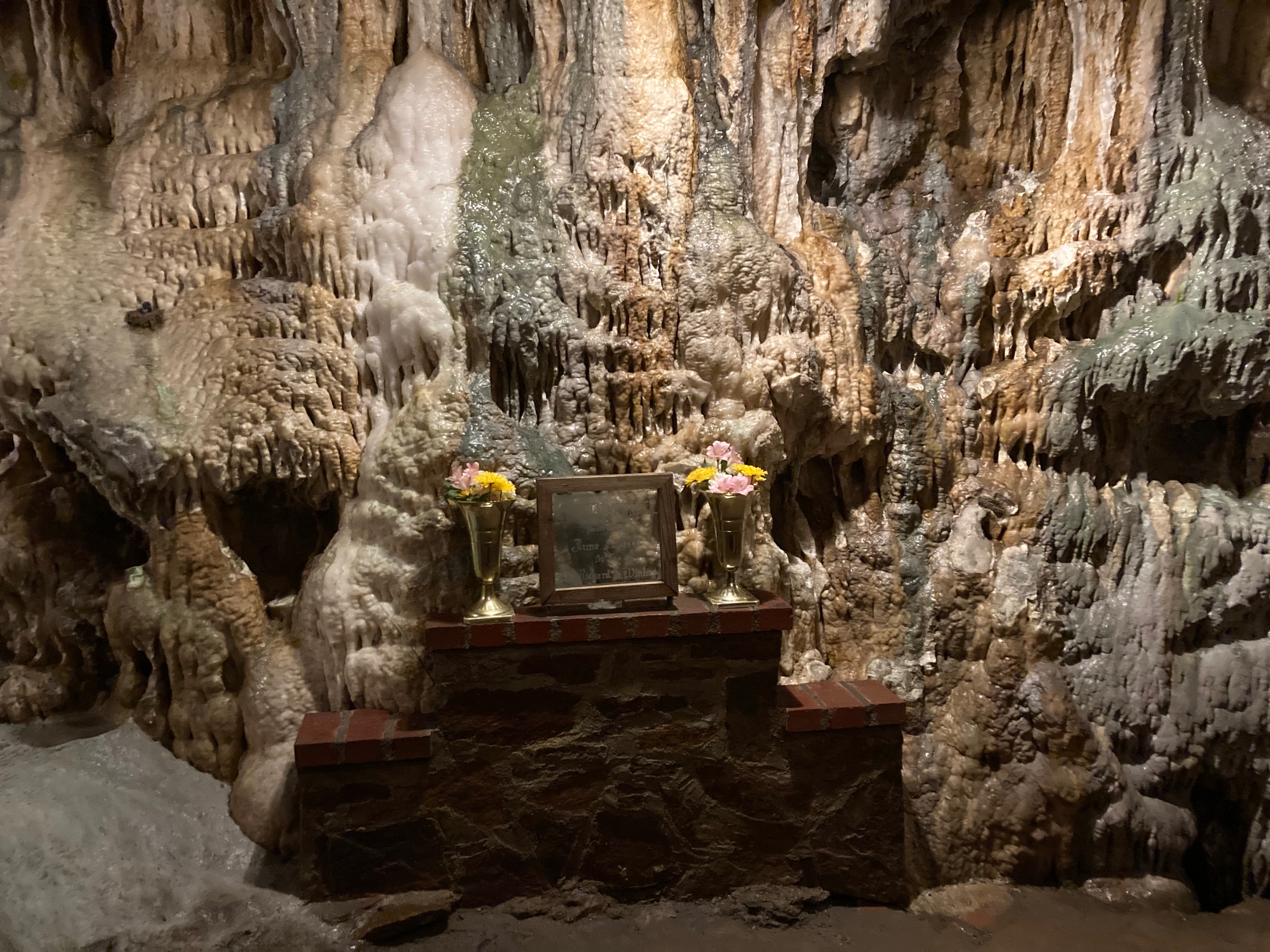
This interest was recently rekindled by a visit to the Lehigh Valley’s local cave, The Lost River Canyon.  As with most local attractions, it takes some time to get around to them.  We decided to go during the recent heat wave since caves maintain a constant temperature, generally in the fifties, and during the height of the wave the outside air temperature was double that of the cave thermometer.  Caves often have rock shops associated with them because being in a cave will trigger the rock-hounding gene.  And I suspect I’m not the only one to whom this happens.  Like many preserved caves, Lost River Canyon was an accidental discovery and was later purchased by a family that has been running it as a tourist attraction ever since.  I left inspired to find my rock tumbler and get it rolling again.

It’s difficult to say when or how such obsessions originate.  When my daughter was really into dinosaurs I started looking into geology.  The next thing I knew I was a member of the Wisconsin Geological Society and was going on field trips to collect.  When I lost my job at Nashotah House I seriously considered enrolling in a geology degree program, put off by the fact that calculus and chemistry were pre-requisites.  I was a hopeless humanities major and advanced math just doesn’t psit well in my psyche.  Part of me wonders if the fascination doesn’t go back to Genesis.  Geology was the science that tolled the death knell for any kind of literal six-day creation.  When this rock madness hits other interests can, if I’m not careful, be shunted aside.  It’s important to feel grounded.


Siesta

“Lazy” isn’t an adjective that most people who know me would apply.  I tend to be fidgety and can’t really sit still at work.  I have a body and I want to move it.  I have an active mind and I need to keep it stimulated.  The recent heatwave over the long Fourth of July weekend, though, enforced laziness.  We don’t have central air conditioning.  Some kind family members bought us a couple floor units for our bedrooms so sleep is technically possible when our bedroom nears 100 degrees in the late afternoon.  But during such sweltering conditions, we spend the day trying to move as little as possible.  Even stepping into a cold shower is difficult when the pipes have warmed up so that tepid is the best you can hope for.  I’ve got a lot of writing projects going, but quality work is difficult to do when the air is so hot.

I see the wisdom of the siesta.  When I volunteered on the archaeological dig at Tel Dor back in 1987, the digging ceased around noon.  Afternoons were too hot for physical labor.  Most people napped.  In hot climates around the world the siesta is necessary as well as practical.  Late capitalism assumes everyone’s in air conditioned offices and has abolished the idea.  It’s the kind of enforced laziness, however, that descended on me during the heat wave.  I’d be reading my book or watching a movie when I’d wake up to find the story quite different from what’d been filtering through my mind.  Or the movie having something going on that seemed to have no precedent.  It was okay for a day or two, but I started to grow restless.  There’s still lots of stuff to get done.

Weather extremes, meteorologists tell us, will only continue because we refuse to curb carbon emissions.  I do remember hot summers from when I was a kid, but the thermometer climbing up into high fever range for days at a time never happened.  Given my age, one thought that recurred during life under the heat dome was that perhaps this is what retirement (not in the cards) must be like.  Retired friends tell me that they’re busier than when they worked, but I do have to wonder if the timing is a bit more open.  The 9-2-5 relaxed a bit more.  It’s not that I’m lazy, but sitting in front of a computer all day earning money for someone else means the siesta’s not permitted.  And when it’s so hot out, it should be.  Otherwise fevered decisions follow.

Photo by Florian Siedl on Unsplash

Scary Scripture

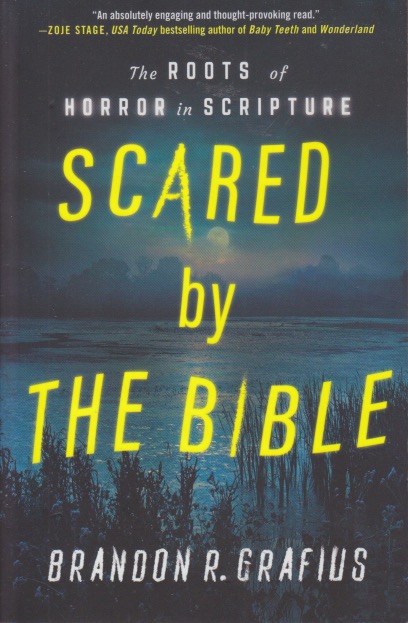
The question’s not as simple as whether chocolate and peanut butter go together.  What is it with horror and the Bible?  A number of us have explored that question in book form, but probably the most prolific is Brandon R. Grafius.  His Scared by the Bible is a mapping through terrain that will feel foreign to some: if you live for the beach in summer, why would you fly to Antarctica to visit the South Pole instead?  Part of the reason is clearly that the Bible isn’t the rainbow-and-unicorn book that it’s often made out to be.  Some parts—not a few—are pretty scary.  That’s Grafius’ entry point into how horror and the Bible are surprisingly compatible.  Interestingly, we had similar starts down this path.  A Bible given to us by a grandmother when we were a child, and the determination to read it.  My world was a bit more hellfire and brimstone than Grafius’ but we’ve ended up near the same place.

Often I thought, as I was reading it, “Are people going to get both these references?” (i.e., both the biblical story and the horror movie being cited).  After all, many Christian denominations still teach that horror is not helpful at best, and satanic at worst.  I just wonder how many of us there are who never found watching horror a spiritual problem.  I grew up thinking about death a lot.  Part of this was because Evangelical children’s literature raised the question of where would you spend eternity if you died today.  Seriously, some of the stories I read, along with Dick and Jane, still scare me today.  Religion often uses fear for its own purposes.  So does the Bible.  Grafius comes down to this at the end, asking if it’s intentional on the Bible’s part.

It seems to me that this is an important question to explore.  Religion has been weaponized through fear since at least the Reagan years.  More recently it has been aimed specifically at us “evil” liberals and our “culture of death” even as conservatives rain bombs on Iran.  We desperately need to understand religion’s now very intentional use of fear to retain power.  People are afraid.  They have reason to be.  Generally it’s not the emotional issues politicians hand-pick to garner votes.  Yes, the Bible is a source of fear.  Horror films are often also a source of scary thoughts.  They do have a lot in common.  We just need someone to come along with an open jar of peanut butter to run into someone eating a chocolate bar.


250 Years

America doesn’t seem to be in a partying mood.  With more than the usual inanity coming from Foggy Bottom, and hot air being added to this heat dome, well, it might just be best to keep it simple.  Algae will grow, no matter what the self-appointed-divine say.  I remember a half century ago.  America seemed optimistic at its bicentennial.  Nixon was safely gone and Reagan hadn’t reared his fanged head yet.  It seemed like the country had a future.  These days, with more than regressive rhetoric, when emails from the Social Security Administration go out of their way to say how great Trump is, well, I think I’ll just stay home and watch a horror movie.  It’s less traumatic.

For me, as a kid, the Fourth of July was all about sparklers, black snakes, smoke bombs, and staying up late for fireworks.  Black snakes were these black discs about the size of a button coin battery that you lit with a match and the ash would fizz out the top into a “snake.”  It was an ephemeral thrill.  What we called “smoke bombs” were small colorful spheres that gushed colored smoke when you lit them.  We never played with anything explosive, but even the thought of these simple pleasures still brings a smile.  I haven’t seen anything like these trinkets (except sparklers) for many decades now.  I see from YouTube that they’re still being sold.  Almost as if the past fifty years never happened.  And staying up late to see fireworks only means being excessively sleepy at work on Monday morning.

I won’t be around for the tricentennial, presuming we survive what the Republican Party has up its sleeves.  I do hope things are more optimistic then.  I’ve been around long enough to notice the distinct difference in national outlook a mere fifty years can make.  I was born less than twenty years after the Second World War when everyone knew fascists were an evil to be avoided.  In just the last decade that has done a 180.  And we see what it’s like.  Our grocery bills are double what they were before our fearless leader took his post, claiming to make things better.  If I’m to believe the propaganda from the Social Security Administration things would be just rosy, could I afford to retire.  So our social experiment in democracy seems to have lasted only about two-hundred and fifty years.  Hopefully in another fifty what’s left of the United States will have come back to its senses or will have come up with something better than we have today.


Fictional Dreams

It’s difficult to be discreet when you feel like shouting.  My first novel has been accepted for publication.  Since my fiction is published under a pseudonym I can’t tell you the title, but I’m very excited.  Chuffed, even.  It’s no secret that I’ve been publishing short fiction for years.  Even this novel was initially finished when I was in my forties.  Publishing is a slow business.  Although I could interest no agents (not for lack of trying), a couple said it was good.  Another publisher had decided, after accepting it, to pass on it anyway.  Mostly I’ve tried small, independent publishers.  Editors, however, are people with personal tastes and aligning your vision with theirs is half the trick.  If not three-quarters.

I’ve avoided self-publishing not because of the stigma—traditional publishing is devilishly hard to break into—but because of the effort involved.  Yes, you can price your books in the affordable range, but you have to arrange for printing and design.  Distribution can be a nightmare.  Also, it’s difficult to do with a nom de guerre.  Pen names are about as early as fiction writing itself, and unless you’re a major name, the title’s more likely to sell your book than your name is.  As more than one editor has told me, “It’s the writing that counts.”  Using a pseudonym comes naturally enough when you have a professional standing in a “serious” business.  Somehow we tend to think fiction writers can’t be serious people.  If they are they may have trouble finding a publisher.

Recently I’ve spoken to a couple of people who’d like to get published as a way of making money.  I try not to discourage such folk, but it’s important to keep in mind that making significant money from publishing is very rare.  You need to keep your day job.  I certainly wouldn’t complain if most royalties checks were actually over thirty dollars (which is very seldom, and since royalties come maybe once or twice a year, don’t base your mortgage on your wordsmithing).  Those of us who persist in writing tend to do so because we have no choice.  I can’t not write.  The forthcoming novel is, I think, fairly well written.  Some of the stories I had published, in retrospect, weren’t.  (Others very much were.)  At the time they seemed pretty good.  Although written over a decade ago, this novel seems to have held up over time.  At least I hope it has.  When it comes out it’ll be mixed in here amid the other books I discuss, I expect.  If I don’t end up shouting too loud, and spilling the beans, first.


Survival Writing

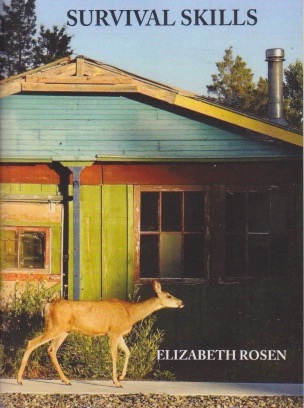
Word of mouth tends to be remote these days.  I suspect local readers of this blog are quite few.  I work remotely and, like many Americans, have trouble getting to know people in the town where I live.  Still, I use this blog instead of my mouth.  Elizabeth Rosen used to write for Nickelodeon, which I find highly impressive.  As someone who has found venues to publish my fiction as common as oases in the Sahara, anyone who’s made a few bucks off their work makes me want to stand up and salute as if a general just walked into the room.  I just read Rosen’s chapbook Survival Skills and thought I’d talk about it.  (As an aside, I always thought “chapbook” referred to chapters, which confused me because most books have chapters.  The term probably derives from “chapman,” a kind of traveling salesperson who used to include these kinds of small books among the wares they sold.)

The seven stories in Survival Skills are short—Rosen tends toward flash fiction.  I’m impressed with how effective she is at it.  I’ve tried to write flash fiction and have found I need more narrative space that it allows.  Chapbooks are easily read in an hour or so, if you’re the kind to rush through things, but these tales left me thoughtful.  You get a sense from these brief accounts that people often do nasty things to one another, or to animals, and that sometimes we really should stop and think about what we’re doing.  At other times we have to realize that we’re animals too.  We forget that at our own peril.

As much as I like reading short stories, books of such are always difficult to summarize.  Going through Survival Skills, the stories do seem organically connected.  This is something that has prevented me from trying too hard to publish collections of my stories.  Like my mind, they’re all over the place.  I’ve attempted, from time to time, to approach my short story writing thematically but it has only resulted in a few tales of each subject.  I’d never considered a chapbook approach.  Even Edgar Allan Poe made his mark in the literary world with short stories.  Washington Irving published his Sketch Book in fascicles.  Publishing exists in many forms for those with stories to tell.  I’m glad to have found Rosen’s little book.  It has spurred me on to reading more short stories, which I should be doing as a matter of course.


Life’s Work

It’s official.  I’ve now worked as an editor longer than I was a professor.  The latter was my chosen vocation, the former my fall-back.  I feel like I’ve tipped over a precipice.  As I’ve written before, I still think like a professor and would welcome back life in the classroom.  This came home to me in a major why when I realized that in my current position, in less than a month’s time, there will be only five people remaining in my starting department who were at my employer before I was.  At least twenty editors who were there when I started have left, most of them younger than me.  This was a world-rattling revelation.  You can’t choose your destiny.  You can do everything possible to make your plans happen, but change is constant and you have to make do.  None of this changes my mind, however.  A life has a calling, fulfilled or not.

I’m very grateful for all that I’ve learned about publishing, even if there’s still so much to learn.  As a young person I knew that writing would be part of my life.  I didn’t know what form it would take, and I guess I still don’t.  I’ve been getting positive signals from a publisher about a novel I completed thirteen years ago.  I’m doing my last set of edits on a very different novel that I finished initially last year.  I’ve made good progress on my seventh nonfiction book.  And there are many shorter projects in hand as well.

I was reading a book the other day where I was cited.  This got me to thinking about the concept of “life’s work.”  For some of us that’s measured in words.  I have no idea how many academic books cite me.  There’s software to measure such things, but it doesn’t capture every publication and I’m not that deluded that I’d spend much time checking on it.  Still, I do wonder if my life’s work (which is generally measured in written form) has made any difference at all.  I post thoughts here daily and they cover disparate topics.  (I had a record five “likes” recently for a post on the Bible.  Sometimes posts on monsters near that record.  Just sayin’.)  Academics tend not to cite blogs.  This one is, believe it or not, research-based.  That’s why I’m working on a bibliography.  When I’m dead and gone, and the auto-renew on this blog runs out, a good chunk of my life’s work will be archived away somewhere until electronic media cease to exist.  But one thing seems certain, most of the mentions I will have in print will be in the form of acknowledgements from having been an editor.


Novelization

I watched the sci-fi horror film Splice a few years ago.  Long enough that I don’t recall many details.  When Claire Donner, a friend of mine from Miskatonic Institute of Horror Studies, told me she’d written a novelization of Splice, I knew I had to read it.  If you’ve seen the movie then you know the story.  If you haven’t, you can read it in her book.  I don’t often read novelizations—I read the one for Tim Burton’s Sleepy Hollow, and as a young person read the original three Star Wars novelizations.  Such books really only apply to movies not already based on a novel, of course.  They give the reader a path into the inner lives of the characters.  Naturally, now I have to watch Splice again to see it through Donner’s lens.  The basic idea, if you want some encouragement, is that a couple of scientists add some human DNA into a gene-spliced animal being lab grown for enzymes to fight disease.

In the rawest sense, this is the story of Frankenstein for a more technological crowd.  Like Frankenstein, it is a sad story.  And like said sad story, it involves reproduction without two human parents.  The real builder this time, however, is Elsa and Donner gives considerable development to her motivations and thought process.  (I’m very curious to know if I can see that in the movie or not.)  Clive, her partner, isn’t aware of the source of the human DNA.  The spliced creature grows into the passably human Dren, who finds herself asking the questions Frankenstein’s creature asked about his own existence.  Like said creature, Dren has to be hidden away, and controlled.  At the same time, she is evolutionarily superior to her maker.  There’s a lot to see here, folks!

Having written a fair bit of fiction in my time, I do wonder what it might be like to do a novelization.  I suspect most of us, if a movie is well made, decide on the motivations of characters but how often do we delve into their inner lives?  I’m not sure that I do that most of the time.  When I write fiction I do it all the time.  I want to know my characters and why they are the way they are.  Sometimes they remain mysteries to me, but that doesn’t prevent me from trying.  This novelization is deftly done, and approved by the screenwriter/director.  And the deep motivations make the scenario plausible.  If you haven’t seen Splice you might enjoy doing so.  And then read the novel.  Or the other way around.


Forever Young

It’s strange.  People my age (and younger) are retiring.  It’s strange because in my head I’m still a teenager.  The mirror lies to me when I glance at it.  I’m not a guy old enough to have colleagues I’ve known for thirty years retiring.  Not me.  This hit me kind of suddenly at work.  One of the things an editor has to do is arrange for peer reviews.  One of my usual sources for reviewers has been showing names I don’t recognize, as of late.  Look, I was never some super-professor, but I knew quite a few of those who worked in biblical studies.  The same names would come around year after year at conferences.  They would age, but I would not.  I was still the same guy, teaching at Nashotah House, publishing articles, chatting with friends.  Where have they gone?

I recently saw a survey to which some colleagues I know and trust had responded.  They listed themselves as “late career.”  How is that possible?  I still work 9-2-5 and likely will until I die.  Who are these young people taking their places at the table?  Our minds, it seems, are as Bob Dylan termed it, forever young.  We remember, however imperfectly, our younger selves as we discover our lives entangled in work and other complications, and our bodies aging.  Me, I’m still trying to get through each day, just like I was in college.  Just like I was in high school.  Awaiting some ill defined destination where I might be able to relax for a while.  Like I could when I was young.  Before capitalism got its hooks in me.  Before AI.

Consciousness is a strange thing.  Our thought processes are formed by early experiences in our lives and we spend most of the rest of our time on earth reacting to them.  Our brains evolved to help us survive.  We do this communally (which is why Trumpism, tearing communities apart, is so dangerous).  I couldn’t survive with my desk job if many people—most of them younger than me these days—didn’t contribute to this experiment we call society.  I sometimes see people born the same year that I was and think, “they’re old.”  Why doesn’t that apply to me?  It’s not that I want to feel old, but rather that I’m still looking for the things I was seeking as a young person.  Financial security, books, love and acceptance.  And trying to avoid tedious tasks—there do seem to be more and more of those as you age.  I’ll have to ask some people who are old if that’s true.


Shocking Development

With life being lived on the internet, electricity is now as important as food and shelter.  We bought our house going on eight years ago.  The former owner claimed to be an electrician and, based on his mail that we’re still receiving, has his own electrical business.  First-time buyers, we didn’t know to be skeptical.  It didn’t help that the home inspector we’d hired bowed out a week in advance of closing and we had to hire someone with no recommendation on the fly.  He said nothing about the electrical box (and many other flaws that should’ve been spotted and reported).  We started having some electrical issues soon after moving in.  We found a local electrician (not the former owner) who was friendly and once saved us by returning to the house as night was falling and hooking up the power so we could have heat (this was in a November).

Before picture

When the power went out completely in April, and the electric company said there were no issues on their end, we decided we’d better have the whole system checked out.  We hired from a larger, regional company.  These guys were good.  After being here for only half an hour they’d found the problem, and it was a big one.  The mast, or conduit, on the side of the house hadn’t been properly installed.  Water had been seeping into the breaker box and several of the breakers had rusted.  The repair cost was mighty, but it would be done correctly.  This led to a chilly April day without heat, but they did supply a line that let us work by powering the router, and kept the fridge cold.  They were here for ten hours.  For the first time since moving in, we have an uncompromised electrical system.

What makes all of this so strange is that we had been trusting of the seller that he knew what he was doing electrically.  As laypeople, we had no way to assess this, and the inspector apparently didn’t as well.  The good electricians (the most recent) suggested that our former electrician was afraid to tell us the real cost of doing the job right, and had decided to cut corners.  He may have been acting out of kindness.  Or he may not have been able to see the problem from a larger view.  So we’re poorer, but wiser.  And we have power.  As long as the electric company can be trusted to keep up its end of the deal, we shouldn’t run into internet access problems.  And that’s life itself.


Facing Identity Crisis

It was one of those periods when time fails to work properly to keep major events spaced out.  We had three major economic events hit us simultaneously and unexpectedly.  Two of them required financing and yet a third involved the government and trying to get our taxes filed.  In any case, I tend to need chronological space to keep these things discrete and make sure I can pay them.  After all of this was done I realized that “secure” information is being collected by all kinds of places these days.  The thing that really got me was that two of them, including the federal government, involved facial recognition software.  In order to confirm my identity I had to hold up my phone and smile pretty for the camera.  Since I can’t speak for the experience of others, I had to wonder if maybe this was because I filed a report of a major scam last year.

I don’t trust AI at all (sorry Al), and governments that collect facial recognition data scare me.  I couldn’t complete my taxes without doing it, though.  A few years ago when I was volunteering for an organization (I can’t recall which one) I had to have my fingerprints put on record.  I thought that was pretty invasive.  I’ve never committed a crime (at least that I’m aware of) and I’ve never been arrested.  Having your fingerprints on record, and your face imprinted in databases certainly makes it feel like it.  Especially since doppelgängers do exist.  On my first visit to Kentucky in the 1980s to help a friend move, the local people all insisted that I was John’s son, a spitting image.  Would Al know the difference?

Once, at Nashotah House, during an accrediting team visit, I was struck by the fact that one of the assessors was a near-perfect doppelgänger of myself.  So much so that when I showed my young daughter a picture I found of him on the nascent web and asked her “Who’s that?” she replied without hesitation “Daddy.”  The facial recognition capacity of kids is pretty keen.  I don’t put a ton of trust in technology.  Of course, the software is probably measuring things like pore depth and nostril hairs.  In neither case did I have the chance to comb my hair and make sure nothing green was stuck in my teeth.  Besides, my face is in a number of spots on this blog.  It doesn’t get as many hits as our finances took in that period when time broke down, but I guess my face is now officially recognized.


Things Lost

Here’s an honest question, and if anyone can answer, please do. Why is it that software can’t keep track of the latest version of anything? Let me put some legs on that. I recently backed up my files to “the Cloud.” When I went to open one of them, the version that was backed up was several months old, not the one I’d worked on (and backed up) that very day.  I looked on my back-up hard drive, likewise backed up that day.  Both only showed files from several months ago.  This was for an app that doesn’t even have a “save” option because it saves automatically.  How can this happen?  I’m having trouble understanding.  Do I leave my files open too long?  (It takes quite some time to write a book.)

Then someone in my family used my laptop for a minute and closed my browser with all my tabs open.  No problem.  I went to “restore all tabs from last session.”  The tabs that appeared were over a month old.  No record anywhere of the tabs I’d kept open as reminders more recently.  What is it about software that makes this so very hard to do?  My laptop’s losing data like a sieve.  To make matters interesting, in a different context after all this, someone had moved and renamed a folder I’d created on a shared drive.  They didn’t bother telling me this, so to all appearances, the folder had been deleted.  I even did a windows search, and nothing showed up with the folder name at all.  I had to get IT involved.  While they were investigating someone finally (at my prompting) admitted that the file had been moved and renamed.  This, on top of my losing my own data at home was a lot for a single day.  (Of course, even bigger issues were about to show up that I had no idea were coming.  Expensive issues.)

Whatever my mental condition is (I don’t have an official label for it), I tend to get overwhelmed when I can’t find something.  My memory isn’t that of a thirty-year-old but I have excellent recall as to where I store important things (like my writing).  Not being able to find it drives me frantic.  I’m not wealthy and the only real asset I have is my mind and I write things down so that thoughts that mind has won’t get lost.  The Cloud seems pretty good at doing that for me.  I’m a believer in backing things up.  Data loss can be devastating.  I just wish I knew how to avoid it.

Photo by Markus Spiske on Unsplash

Access Denied

We like to pride ourselves on our levels of knowledge obtained.  But access to it is limited to the club.  I’ve run into this several times since being booted from academia.  I still research and write books.  They sell like academic books (not well), but I am blocked from academic resources.  I was attempting to access an article in a book from an academic press, named here nevermore, only to find every path blocked.  I had to verify that I was human a time or two, but being human isn’t enough.  You need to be a wealthy human.  I went to Academia.edu.  The author hadn’t posted the chapter.  It was posted on Research Gate, but to request a PDF I had to have an institutional email, which I do not.  I tried Internet Archive, which has saved me many times.  They didn’t have a full view and the link to the book told me I could purchase for a mere $150.

I know other academic presses that do this.  Limit the knowledge to those in institutions that can pay such high fees.  Academia is becoming more and more privileged all the time.  I get it.  You can’t just give the stuff away.  Whenever possible I post my articles for free on Academia.  I wrote them to be read, not to be tucked away and inaccessible as the world made love to the electronic revolution.  Not all scholars think that way.  And academic presses charge prices that can only be described as exploitative.  It’s as if they think we’re all paid like professors are.  Privileged.  And this pains me.  As a former professor I know that not all academics are paid well.  We’re in it for the knowledge.  But once you lose that academic email, it’s access denied for you.

Sadly, I’m not the only one in this category.  There’s an entire generation of us who’ve been thrown from the ivory tower.  Here’s the thing: your curiosity doesn’t die just because you’re not called “Professor” any more.  Maybe this is why I enjoy dark academia so much.  The truth is that there is something very wrong with our higher educational system.  University presses, stressed to make money when everyone just asks some AI that was never human and has no knowledge for an answer to a difficult question.  There used to be a way to find that answer through the hard work of research.  And when you were done you had the pride of accomplishment.  Now all that we have is access denied.