
The world of religious studies is full of surprises. Since people are forever seeking new forms of fulfillment, the endless variety of religions itself comes as no surprise, but the results of religious experimentation sometimes lead into uncharted waters. One of my students at Rutgers recently pointed me to a new religion called Natib Qadish, “the sacred path” in potentially vocalized Ugaritic. (Ugaritic, like most ancient Semitic languages, was written without vowels. Some modern scholars, basing their reconstructions on likely vocalizations known from other Semitic tongues, have tried to give voice to this dead language.) I have no idea how large a following this religion has, but it does maintain a substantial website explaining its core beliefs — the modern worship of the Ugaritic/Canaanite gods.
Unsatisfied with the tradition monotheism that eventually drowned out polytheistic voices in western religions, followers of these reconstructed religions are looking back to something more ancient, more primal, and perhaps, more human. What strikes me as odd concerning all of this is that religions such as Natib Qadish are based on extremely fragmentary understandings of ancient religions. We have perhaps a 101-level understanding of Ugaritic religion; some parts are very well attested, but there are huge lacunae that confuse the overall aspect. As I tell my students, ancient religion was based less on belief than it was on practice. Belief-centered religion is a relative newcomer on the historic scene. Ancients inherited their “religions” without question, based on where they were born. Tess Dawson, the founder of Natib Qadish, writes: “I have yet to find any word that means ‘religion’ in any of the ancient texts.” I would argue that it is because the concept of religion itself is a modern one.
Humans seem to have believed in gods from very early times. If gods are there, they must be placated. This is not religion; it is commonsense. Not to placate gods is to invite disaster. In Ugarit these gods included Hadad (Baal), El, Asherah, and Anat, among a host of others. These were the gods people “discovered” as they tried to fumble their way through a difficult existence. And gods like to eat meat, they learned. Sacrifice was born. What is a feast without ceremony? Ritual must emerge. I know this is overly simplistic, but belief doesn’t really enter into this scenario until late in the game. Heterodox belief was normative until Christianity assigned eternal consequences to correct belief, and now we are free to believe whatever we will.
As far as I can tell, Natib Qadish does not actually involve animal sacrifice to the gods (although it is based in Chicago, long known for its slaughterhouses). Like many modern Christians, the followers of this religion wish to reach back to a more pure form of ancient belief. It is an exercise in futility, however, in many respects. The framework has changed beyond recognition and we have no way of knowing what any ancient god would require of us in an internet age.
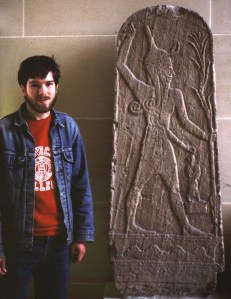
A young Dr. Wiggins meets Hadad in Paris
 Steve A. Wiggins
9 thoughts on “Neo-Canaanites”