
One of the entrenched ironies of human mentality is that reason will not suffice to change religious views. Many studies have repeated demonstrated that faith is impervious to logic, and this has appeared with Ektachrome clarity in the case of Warren Jeffs. Rev. Jeffs, the leader of the Fundamentalist Church of Jesus Christ of Latter-Day Saints, has painted himself into a mental corner that makes the logic of legal proceedings appear as slapping the idiot. Logic and faith do not connect. Any Christian who has read the letter to the Hebrews should know that. Nevertheless, Rev. Jeffs, having illogically dismissed his team of lawyers, has been attempting a divine defense to justify his alleged sexual abuse of minors. He remained silent during his opening statement, despite judicial advice that such a tactic might harm his case. Breaking silence yesterday with a nearly hour-long sermon, faith responded to logic and was found wanting.
Society at large fails to consider that studies of religion have been carried out from multiple angles over many decades. We have erudite studies of the philosophy of religion, the psychology of religion, the anthropology of religion, and the sociology of religion. They all point to the human origins of this phenomenon, often demonstrating that a basic disconnect remains when religious belief is brought into the harsh light of logic. Neurologists and biologists have explored the utility of religion as a survival tactic, and evolution seems to have blessed it. Yet trial lawyers, judges, law enforcement officials, and politicians—often themselves religious individuals—are charged with apprehending and convicting others who simply take their religion to extremes. Religions make untenable demands on adherents. God has a poor record of turning up in the courtroom. His divine statements are absent from the stenographer’s tape.
Not knowing the details, it is difficult to find much sympathy for Rev. Jeffs, should he be found guilty. Yet at the same time, his interpretation of religion differs only in a matter of degree from other religious sexual ordinances. Is it normal for a clergyman to live a lifetime of enforced celibacy? Although signing on the dotted line may indicate a tacit agreement with church policy, what young man can clearly anticipate the pressures of decades fighting biology and psychology? Yet the practice is perfectly legal. Until the nearly inevitable inappropriate results squirm out. Public rancor runs high, as it should, against child molesters. The children are innocent victims. The perpetrators, however, believe themselves to be following divine dictates. It would seem that much suffering would be ended if God would go on the record here, so that we might have solid evidence with which to judge the case. If it please the court.
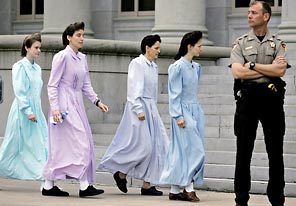
Photo credit: Tony Gutierrez, AP, from The Seattle Times
 Steve A. Wiggins