God’s Country Club

Last week CNN’s religion Belief Blog reported on the five most and least religious colleges in the United States, according to Princeton Review (not affiliated with Princeton University). Having attended one of the five most religious colleges on the list (Grove City College, but whether it is number one or five is difficult to determine), I took an interest in the overarching question: how do you determine if a college is religious? The author of the survey indicated that it was through student interviews concerning whether they perceived other students as religious or not. And that’s where the bone of contention pokes through—who determines what is religious behavior? Are students able to determine who is religious or who acts religious? Does religious mean Christian in this context, or religious in any tradition?
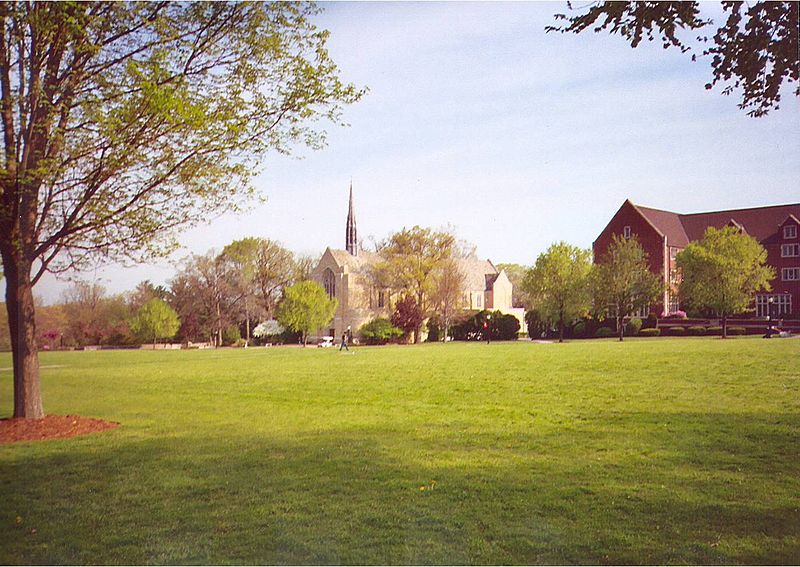
Grove City College, God's Country Club

My years at Grove City left little doubt that the school itself was proudly religious. An evangelical bastion against many forms of critical thought, plenty of indoctrination took place in those hallowed halls. A few religion professors (I was even then over-zealous to learn as much as I could about this field), while personally faithful, asked serious questions that many self-righteous classmates blithely ignored. From glancing through alumni magazines, they seem to be the successful ones. Those who asked the hard questions seriously were ostracized; now they are lost in obscurity. Is this true religion? The Princeton Review is concerned with providing potential students with accurate data about their collegiate choices, but I wonder if the religiosity proffered is anything more than denominational branding.

Three of the four other most religious schools might bear this out: Brigham Young, Thomas Aquinas College, and Wheaton College. Hillsdale College, the final member of the most religious fraternity, is the exception. A liberal arts school, formerly Baptist but currently independent, it fits somewhat uneasily next to the Mormon, Catholic, and Reformed natures of the other four schools. While I can’t speak for the other colleges, at Grove City there was definitely a coercive peer pressure to behave like everybody else—to be religious, i.e., evangelical Christian. With required attendance at chapel and required courses in religion, the ethos was heavily impressed. Were other students truly religious? That depends on the measure that is used. Many have gone on to be entrepreneurs declaring free market economics in the name of the kingdom of heaven. If that is a measure of true religiosity, all hope is lost indeed.

6 thoughts on “God’s Country Club

  1. A few years back I was lecturing at an private rel. school in MI, and was very surprised to see the mix there in the dept. Prof from Bob Jones Univ alongside profs from very liberal state universities. As we were only there one night I left wondering how the two groups could communicate with one another. In fact, my colleague and I were invited out to dinner that evening with two prof. from the dept and when we ordered a bottle of wine for the table, they refused to have a glass. Told us that according to the rules of getting a job there one had to sign something which forbid drinking any alcoholic beverage in public or at home. Seems that when jobs are hard to find nowadays, this is where it leads. Left feeling sorry for the two highly educated profs. who found a position there.

    Like

    • Steve Wiggins

      This is not an unusual scenario in the United States. Grove City College was a dry (alcohol-free) campus in a dry town. Another college nearby had explicit rules against alcohol, tobacco, and dancing both on campus and off campus. Students caught dancing by faculty, even if off campus, could be expelled. In this economic climate, many people agree to strictures they don’t believe simply to receive a pay check.

      Like

  2. John G.

    On a similar note, try professorship at one of my faith tradition’s (southern Church of Christ) epicenters of “education.” While some schools have relaxed their faculty requirements, many still hold that you MUST be a member of the Church of Christ, EtOH free, dance-free, etc. Of course, when you’re a private institution, with a board that models religious uniformity, you pretty much have the right to demand what you will of your faculty and staff. Your alumni, however, well, they may feel differently. . .just type in David Lipscomb Groups on Facebook. Many of us who thought ourselves religious at those institutuions have swung the other way since that time, some full-circle, others continue to spin. I’ll say this for those institutions. . .it is very nice and comforting when you can offer all the answers to life and humanity’s deepest questions.

    Like

    • Steve Wiggins

      Well said, John! I also taught at a very strict institution (alcohol, tobacco, and dancing were approved, but many other human behaviors were not). My experience is the same, those of us who felt it was right at the time eventually grew up. Perhaps there is some slight hope for the future after all!

      Like

  3. As a new reader of your blog I am fascinated by your observations and your questions. I’m really glad I found it. Like you, I think religion is mostly a bad thing. Unlike you, I do not think that being religious is synonymous with being an evangelical Christian, an orthodox Jew or even a fanatical Moslem. I think religion is what’s left over when faith is taken out of anyone’s relationship with their god. But keep up the good work. I’m looking forward to being a fan.

    Like

    • Steve Wiggins

      Welcome to the blog, Jane. Read on a little more and you will find that my definition of religion is a bit more complex than it may seem in individual posts. My goal is to raise more questions than to give answers. I will look forward to hearing your responses as you explore a little further!

      Like

Leave a reply to Steve Wiggins Cancel reply

This site uses Akismet to reduce spam. Learn how your comment data is processed.