
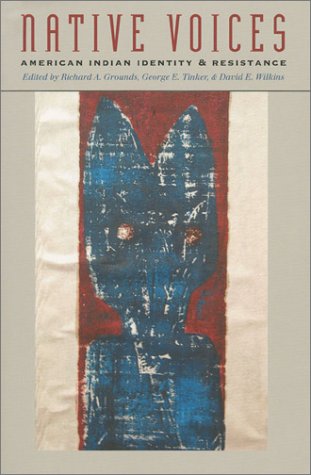
Recall a time when you did something bad. We have all done it now and again. Even the memory possesses the power to churn the stomach and lower the brow. I just finished reading Native Voices: American Indian Identity and Resistance, edited by Richard A. Grounds, George E. Tinker, and David E. Wilkins. The essays in this volume are about Native Americans by Native Americans. Many of us are taught to believe that the United States government had found some way to deal peacefully, after some bloody battles, with those hostile to the arrival of Europeans, but the truth is much sadder and more sordid. While some may say the essays in this book dismiss academic standards, I have been on the receiving end of academic standards enough to know that even highly educated people can sometimes only cower and the reality is how you feel. That is what comes through every page of this book: what it feels like to be misrepresented, demonized, caricatured, forgotten. European colonizers stole what they could in the name of Christianity and left a legacy of tears.
I nevertheless learned a great deal from this book. Here, I came to understand, not everyone agrees with the standards that Euro-Americans use to measure the world. Nowhere is this clearer than in the Native American critique of science. Those of us trained in this method feel a knee-jerk reaction when it is questioned, but those willing to consider, to ponder, will realize that a scientific worldview is a culturally conditioned form of interpretation. Other forms exist, although they have frequently been silenced. There is more than one way of knowing. In many Native American religious traditions the land itself is sacred. Being removed from tribal lands was tantamount to being separated from tribal divinity. We might be better able to dismiss it all as ancient history were it not for the fact that the oppression continues to this day.
Comparison with another oppressed religion came to mind. Ancient Israel is understood only imperfectly, but we know that the land was crucial to Israel’s sense of identity. We should, as heirs of the Judeo-Christian tradition, be sympathetic to Indigenous American sensitivity to the bond between land and religion. In the former case, the United States supported the re-formation of Israel in the 1940s. We still keep our own indigenous people out of sight and use their land with impunity. Reading Native Voices raises some very troubling specters indeed. The colonizing religion here was Christianity, a religion that says it is more blessed to give, but is more than willing to take. And to invent a tortured theological justification for the action; it’s manifest destiny—whatcha gonna do? It is time we confront what was done to the people who were here first. I have no solution, but reading Native Voices is an appropriate way to start the discussion.
 Steve A. Wiggins
2 thoughts on “Alternate Reality”