
Rhetoric is dying a slow, painful death. In this world where literalism reigns, the use of words to elicit an illicit truth deeper than the factual is no longer recognized. We see it both in the humorless antics of the New Atheists and in the ravings of the Fundamentalists. Writers have always known—serious writers at least—that truth is so much more than an objective ticking off of what really happened. The post-modernists may seem insufferable at times, but they have taught us that true objectivity is false, a mythic holdover from imperialistic thought processes that believed here, in this single mind, bias does not exist. We all have biases. Except me, of course. Rhetoric again.
I do not get many comments on this blog. Usually it takes someone to disagree with my ramblings to gussy up the energy to dispute what I write. I try not to distort facts, but facts are rare commodities these days. George Orwell is not really dead, I mused as I stood by his gravestone in Sutton Courtenay. Should someone deny that I was there how should I prove it in this day of Photoshop and pixelated truth? And that wasn’t even his real name.
When I regularly taught, students would ask me what I believed. What I believe, I would respond, is not important. I am teaching a subject, a field of study. When is the last time you asked your chemistry professor what she believed? Would it matter? Of course, thoughts, I’m told, are only chemical reactions that lead to electrical charges. Miniature storms inside our skulls. Literally. Rhetoric folds its hands across its metaphorical chest and lays quietly, awaiting the pall.
Socrates had his method. He ended up an enemy of the state. Jesus told parables. He also ended up an enemy of the state. Rhetoric, make no mistake, is a dangerous game to play. The hearer, or the reader, hears or reads what s/he wants to hear or read. And in a literal world, people would rather not have to read too deeply, for truth, it is believed, lies plainly upon the surface. There used to be a word for such a surface reading, but should I write it here I would be guilty of using rhetoric. And rhetoric awaits the delivery of the flowers but few are the black-garbed mourners. It is best not to disturb the dead.
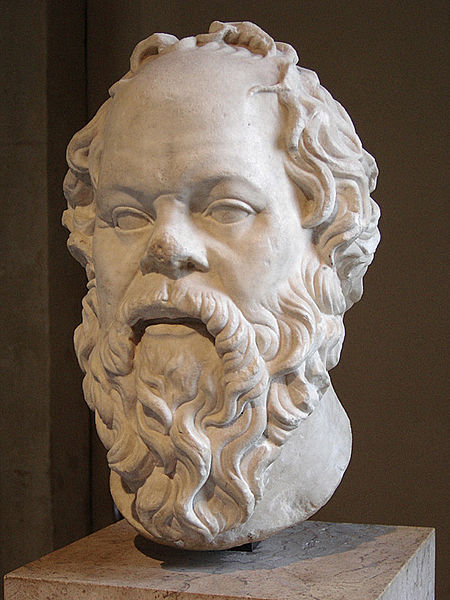
Photo credit: Eric Gaba, Wikicommons
 Steve A. Wiggins
5 thoughts on “Hemlock and Crucifixion”