Stickiness

As a concept, it’s what web designers call “sticky.”  Valentine’s Day, I mean.  And “sticky” has nothing to do with the expected chocolates or anything physical at all.  Stickiness, as I hear it used in these antiseptic clean-room days, refers to text, or an object, that stays in the same place as you change web pages.  Now, I’m no techie, in fact I’m probably a neo-Luddite, but this kind of stickiness is useful in thinking about St. Valentine’s Day.  We hardly need a reminder that humans are sexual beings.  Biology does quite well in that department, thank you.  Every year around this time, however, when the weather has been bleak for weeks on end, Valentine’s Day rolls in to give us hope.  I’ve noticed this as I’ve been out jogging.  The past couple of weeks the birds have been singing.  Me, I’ve mostly been shivering indoors as yet more cold rain falls.

Every year, I suspect (I haven’t stopped to look) I write about St. Valentine’s Day.  Valentine was an obscure saint associated, in the popular mind, with something saints shunned.  Such an embarrassment is this sexy saint that he was never mentioned in the liturgy of February 14th at Nashotah House in the days I was there.  (Given that most of the student body was male, there may have been a wisdom in that, but that’s a story for another time.)  Religions, as I used to tell my students in later settings, all have something to say about sex.  The two ideas, like monsters and religion, are tied closely together.  Scholars tend to blush rather than explore this.

There are so many things going on in the world that I could write about.  There are new scholarly developments every day.  Still, I keep coming back to this minor holiday.  Well, it’s not actually minor in the realm of economics.  Anything to get people to spend money in the middle of February!  Valentine’s Day is the embarrassing child of the celibate church.  Without somebody named Valentine, who may or may not have been martyred,  we wouldn’t have this uneasy reminder of winter’s impending end.  Instead of embracing him, however, many branches of Christianity second him to punch-out cards sold to school kids as teachers remind them that everyone gets a valentine.  What a sticky concept!  I’d been intending to write something about the state of the world.  I guess that can wait for another day.  Right now, as the sun begins to awake, I’ll sit hear and listen for the birds to start their sticky springtime song.


For the Squirrels

Our garage came with a house.  That’s one of the reasons we bought it.  You see, the one thing we don’t have is time.  (Well, that and money.)  When we were contemplating moving, we had no time off.  Vacation days for the remainder of the year had been allocated, and employers don’t like to encourage personal improvement.  Not on company time, anyway.  Which, of course, is as it should be.  We had to find a house with space enough to sort through things after we moved.  Ha!  As if there would be more time!  Still, the sorting would have to wait.  Our house has a detached garage with a second story.  It’s a converted barn, but I doubt its conversion story.  It still seems pretty heathen to me.  The neighborhood squirrels love it.

We store our unsorted stuff upstairs.  Shortly after we moved in, the squirrels had chewed through the stop-gap remediation the previous owners had put in place to satisfy our post-inspection demands.  It was pretty clear their solution wouldn’t keep out rodents, but our lease was about to expire and the market favored sellers, so we closed anyway.  Shortly after moving in I noticed styrofoam poking through the ceiling boards of the garage.  Then I began to find styrofoam chips in the yard nearly every morning.  I soon figured it out.  Squirrels raid the trash receptacles behind restaurants in town, and bring their carryout here.  No, seriously!  They haul styrofoam between the roof and ceiling, presumably licking off the scraps before tossing out the remaining foam.  I figure it’s a form of insulation, if nothing else.

Squirrel remediation is on our list of projects.  I’ve seen the squirrels run up the side when they spy me stepping outdoors.  When I reach the garage, they’ll stick their little heads out the hole they chewed and scold me.  This is their place, the garage.  They’ve insulated it, and the inside is a mess where the birds also get in and there are little animal parties every night.  I don’t have time to clean up after the squirrels.  It occurs to me that if we didn’t have a throw-away culture we wouldn’t have styrofoam containers for the poor beasts to plunder.  The food’s probably not healthy—the squirrels I see look plump and sassy.  They like the convenience of living in a shelter someone else built and on which someone else pays the taxes.  Perhaps I should start a zoo.  But first I’ve got some stuff to sort through, when I find the time.  If only I could teach the squirrels some other tricks beyond dining out. 


Voice of Experience

Trust your publisher.  Well, if you have one, that is.  I’m not the only erstwhile academic to have ended up in publishing, but what constantly surprises me is that academics care little about those who give voice to their ideas.  Now this blog is self-publishing.  It contains my ideas, but they are free for the taking, and here’s a bit of useful advice: trust your publisher.  These days with easy online publication and formatting that makes your posts look like a pro (not here, mind you), it’s sometimes difficult to realize that publishers actually provide more than just an imprint.  They offer services to make your book look serious, scholarly, and also to be useful to others.  Those of us who write books are often far too emotionally involved to see this.

I regularly run across academics who tell publishers how the text should look on the page.  I’m not talking about those weird and wonderful sections of ancient texts with <lacunae>… ellipses… [brackets] and whatnot.  No, there are those who want to control kerning, leading, and all sorts of things.  There are those who want practically every single word indexed, although research shows that most researchers access searchable PDFs rather than wasting their time thumbing through pages to find a reference.  And that traditional chestnut, “written for general readers.”  Publishers have access to book sales figures (at least of their own books).  There’s no need to bluff; if your book is only for scholars (does it have words like “reify” or “heuristic” in it?  Be honest now!), publishers know how to handle that.

We’re all nervous when our book gets through the acceptance process.  Peer review always breaks me into a cold sweat.  Believe me, we understand!  Take a soothing sip of tea.  Go for a walk.  Better yet, jog.  Scholars tend to be precise thinkers.  We get that.  When, however, is the last time someone used a map from a Bible for navigation?  Most of those cities don’t even exist any more!  This strange mix of online savvy and adherence to the old ways of print (which I love and of which I shall never let go) clash in ways that cause publishers great stress.  You can find a YouTube video on how to make your own book.  Those of us in the biz can tell at a glance if a book’s self-published or not.  And believe me, we’re rooting for you.  We want your book to succeed.  Why not trust those who know what they’re doing?


Vulnerability

Perhaps the most insidious thing 45 has been doing is undermining expertise.  If you’re like me you’ll be subject to that sudden, clenching fear that we live in a house of cards.  Everything is built on an extremely tenuous situation and we don’t understand the basis on which it’s built.  (That’s one reason I take such an interest in geology.)  So this morning I climbed out of bed around 3:30 a.m., my usual time.  There was no internet.  This has happened before, and I know enough to turn off power to the router and reboot.  This I did several times before finally calling RCN.  I pictured a tech sitting in a lonely basement at the wee hours, perhaps glad for a service call.  He was very nice.  Still, after having me do the basic checks again, he said he’d have to send a technician.  They, lazily, don’t start work until 8 a.m.

Now here’s where the expertise comes in.  Most of us use the internet pretty constantly.  We don’t know how it works, and when it’s broken we can’t fix it.  I can’t even figure out what some of these devices are.  In all likelihood the technician (my shining prince or princess) will not understand the underlying coding that makes the devices work.  They’ll be able (I hope, and if you’re reading this my hope is not misplaced) to figure out what’s wrong with the hardware.  I suspect even they, however, wouldn’t be able to lay the cable to my house, or repair it, if it were damaged.  We all rely on others farther down the line to know how to do their jobs.  Experts.  House of cards.  With a president claiming experts to be obsolete, I wonder how even the mighty could tweet without an internet connection.

All of this makes me feel quite vulnerable.  I work from home and I need a solid, reliable, steady internet connection.  The day we moved in, literally, two techs came.  It was a Sunday morning.  One of them fell asleep in the office chair while the younger one, who spoke no English, did all the work.  Every time I use the internet, I feel like I’m trying to add a new story to this house of cards.  I don’t know what to do if it goes wrong.  Since phone (and television, at least theoretically) is bundled in this, I can’t even call.  Well, I couldn’t if I didn’t have a cell phone.  My life is tied up with tech, and I can’t fix it if it’s broken.  I made it through a master’s degree without using a computer.  My frame of reference is ancient.  If a bird tweets and there’s no signal, does it make a sound?  Then, without explanation, the connection was reborn, just before 7 a.m.  Who says there’s no such thing as resurrection?


Human HU

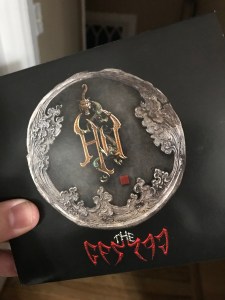
In these times of extreme xenophobia, we desperately need to understand those who are different.  When my brother recently shared his discovery of The HU’s album The Gereg, I was at first a little concerned.  That deep-seated childhood evangelicalism suggests anything that unfamiliar is bound to be satanic.  How unfamiliar?  Mongolian throat-singing unfamiliar.  Songs sung in Mongolian, unfamiliar.  Album art that could be heavy metal.  I’d never come across anything like it.  I suppose it’s a natural, knee-jerk reaction to say anything so unfamiliar is potentially demonic, and it shows just how paranoid a culture can be.  We think of 1950’s America as “the norm.”  I wasn’t alive then, but I’ve seen pictures.  Buzz cuts still give me the willies.  I trust Mongolians more.

I don’t know if The HU is a deliberate play on The Who or not, but the word roughly translates to “human.”  Like many ancient practices, nobody thought to write down the origins of throat singing.  Traditionally it was what Inuit women did when men were out on the hunt.  Like many aspects of hunter-gatherer society, it fascinates.  Some cultures reported that when Christian missionaries came, with their cultural imperialism in tow, they suppressed throat singing.  It looks like I wasn’t the only one raised to be suspicious of that which is different.  I learned, however, of my own cultural biases.  I learned that ones’ own assumptions must be interrogated.  If humanity is to survive, we must learn to try to understand one another.

Although the actual roots of throat singing are lost in unwritten times, I strongly suspect it has a religious, or if you prefer, spiritual, origin.  When women gather it isn’t the same as when men consolidate power and institutionalize violence.  I’ve read that when women rule there is a strong impulse to cooperate, to suppress aggression.  Men can learn this.  Indeed, as those white, male missionaries took up their positions in far-flung parts of the globe they spread the idea that men alone held the divine right of, if not kings, priests.  Conversion, you see, is seldom gentle.  Making the world in your own image, if you’re a man, runs into certain obvious problems right away.  HU means human.  When I feel the cold paranoia of my own government creeping up on me, I cue-up the soundtrack of my life.  I’m no longer a young man, and I don’t fear the different as much as I used to.  I need to hear something different, something human.


VFD

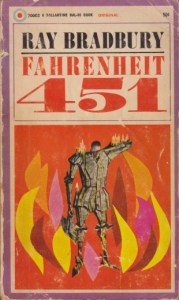
It’s been a few years since I read Fahrenheit 451, the classic novel by Ray Bradbury.  Like so many dystopias, it’s seen a resurgence of interest since 45 was elected.  (I can’t help but notice the shared digits.)  Bradbury was a writer of his time.  So much, I suppose, could be said of all of us who write—how can we be anything else?  Still, it’s difficult not to see that his fear was of television decimating reading.  And intelligence.  We’ve got the internet now, so the effect has been magnified a bit.  The tale, despited being dated, is poignant.  The more electronic we become the more of what used to be termed “real life” we miss.  At this reading it was clear that The Book of Eli was largely based on the last pages.

When Montag confesses to his wife that he’s been secreting books away, and she finds him insane for doing so, he takes the book in his hand to a former acquaintance, Faber.  It turns out that the book is the Bible, perhaps the last in existence (see what I mean?).  On the subway ride he tries to memorize the Good Book.  Now, I’ve been on the New York City subway, and I know the delays can be long, but there’s an error of scale here.  The Bible’s a big book.  Still, he gets pieces of it down.  Now, in the 1950s, when Fahrenheit 451 was published, the Bible was known for its liberating qualities rather than its darker side.  Also the atomic end of World War II was clearly still a painful living memory.  The two may not be unrelated.

Given the age of the story, I won’t worry about spoilers.  In case, however, it’s on your list proceed with caution.  The war that’s been building the entire story takes place the night of Montag’s escape.  Along with the intellectuals forced out of the cities, he becomes part of a human library.  Each person is, through a memory recovery technique, capable of recalling the books they’ve read.  Montag becomes, appropriately enough, Ecclesiastes.  Perhaps the least evangelical book in the Bible, along with Job (with which most evangelicals find themselves cheering on Job’s friends), Qohelet has long been one of my favorites.  It’s an honest book.  The same can be said for Bradbury’s novel.  Primarily a short story writer, Bradbury didn’t sustain the narrative to novel length very often.  But when he did he fashioned a book that, particularly now, needs to be read.


Officially Broken

Now that democracy is officially broken, it was with some poignancy that I stumbled upon a piece of ancient history.  Everyone has a box that contains their past life.  It used to be a physical box with papers in it, and in mine (which still has actual papers), I stumbled across a letter yellowed with age, dated 1980 from Conshohocken, Pennsylvania.  In an ill-fated career as a teenage journalist, I reported in the results of the presidential election from one of the polling places in Oil City, Pennsylvania.  The envelope held a serious letter from a state official letting me know how important my duty was.  As I looked at my teenage scrawl two things became clear: the Democrats had won in what is now a deeply red zone, and even when democracy worked it didn’t work well.  

You see, I had a number to call to report the results.  Since toll-free numbers hadn’t proliferated at that time in history, I was to make a collect call.  And since I lived in Rouseville, some three or four miles away, I couldn’t get the results in immediately.  On my way home, before making the collect call, it was announced that Reagan had won.  The ballot results, still tucked away in my envelope, hadn’t been reported, and obviously they weren’t important.  It was the first election in which I voted and I learned then that the system didn’t take all votes into account.  Now that Trump is firing those who managed to testify at his impeachment Republican senators reply, “Yes, that’s good, that’s right.  It’s as it should be.”  Democracy is dead.

These United Orwellian States displayed their predilections long ago.  I’d read 1984 about that time, before the eponymous year of the title.  I’d been deputized to report on an election whose results were declared before every vote was counted, and I lived in the Eastern Time Zone.  I didn’t vote in elections for several years after that.  When politically conscious friends asked why not, I said “what’s the point?”  You see, the reporting assignment was part of a current issues class in high school.  It was to teach us how government worked.  My teacher’s signature still graces the form inside.  As one political party has embodied massive dereliction of duty, we limp along toward November.  I don’t know if my vote will count or not, but I will be at the polls again.  Anyone who believes in democracy will have to be.  And perhaps, just perhaps, all the pre-planned cheating won’t work this time around.  Eric Arthur Blair, it is said, died a paranoid man.


Shifting Perspectives

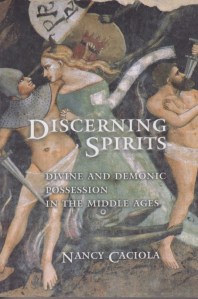
Perspective.  The ability to change it is vital to understanding.  I’ve been working with the idea of demons for a few years now.  My perspective, however, has been aided by Nancy Caciola’s Discerning Spirits: Divine and Demonic Possession in the Middle Ages.  Noting something that has long been a puzzle—behaviors attributed to saints were also recognized among the demonically possessed—Caciola suggests a solution.  In the Middle Ages very few female saints were canonized.  Delving into records from the period Caciola noticed that when saintly behaviors exhibited by men were experienced by women those behaviors were deemed demonic.  In other words, from a perspective that saw masculine experience as normative, when supernatural events were encountered in women they were seen as diabolical.  Using Hildegard of Bingen’s frame of an “effeminate age,” Discerning Spirits explores the idea of how the Medievals told good from evil.

 My own experience of “discerning spirits” came about through a United Methodist curricular study on spiritual gifts.  I was in either junior or senior high school, and deeply involved in the church.  An adult study (I was close enough) on spiritual gifts explained the laundry list compiled by Paul in 1 Corinthians 12.  The apostle from Tarsus notes that discerning spirits is a divine gift.  I trembled as a teen, wondering if I might possibly have it (that was the point of the study).  It seemed like an immense responsibility.  The issue, it turns out, was nothing new.  Since codified in the Bible it had to be true, but what was it all about?  Smarter people than me were struggling with it.

There’s plenty of provocative and explanatory information in Discerning Spirits.  From ancient times it was understood that gods could possess people.  By the New Testament demons clearly could too.  We hear less and less about divine possession as time goes on.  In fact, it becomes a kind of heresy in itself.  Demonic possession was never really in doubt.  It fell out of favor with the Enlightenment, but it didn’t really disappear.  This book shows a clear trajectory from women’s possession as being demonic straight toward the witch craze that erupted in Europe toward the end of the Middle Ages.  It was no coincidence that the majority of accused witches were female.  The perspective had shifted with the fortunes of the church during the Medieval period.  Fear of schism and fear of unsupervised spirituality in a world where only men could be priests led to results that, in hindsight, look inevitable.  Caciola’s book is an important source for not only ages past, but also a mindset all too prevalent in our present world.


Bookkeeping

I can’t express just how happy I was when I first read the word “bookkeeping,” and it wasn’t because it had three repeated letters in a row.  I was strangely joyful at learning there was such a profession.  That joy quickly plummeted when I found out what bookkeeping actually is.  This memory came back to me this tax season.  I realize the word “book” has a storied history and multiple meanings.  I’m one of those people who likes to read books about books.  In “keeping” books, of course, we mean ledgers that show assets, profits and losses, accounting.  These are among the most boring things on the planet for some of us.  My imagination dances around all over the place, but it seldom sways to the realm of business.  As a young person faced with what bookkeeping is, I was crestfallen.

The idea that you could keep books—not necessarily as a librarian or bookseller—and have that as your job, seemed like an almost Platonic utopia.  A world where it was recognized that reading books is a virtue.  Even being around them can make me happy.  I still live in the world suggested by that form of the word bookkeeping.  When I’m sad a trip to a bookstore can usually bring me out of it.  Although I have difficulty finding publishers interested in my own books, writing them is a form of therapy.  Even this little blog is a way of participating in the keeping of books.  At least in an ideal world.  Tax season looms when many of us will find out how much we owe to a government we no longer trust.  If only more people would read.

Books began, in their earliest forms, as receipts.  Marks on clay to prove what you owned.  Shortly, however, those mud tablets began to house myths and stories.  That’s when the mud became clay.  Stories are what conscious minds crave.  Even the word “Bible” means “book” (via the circuitous route of naming books after the papyrus reed, which along the northeastern Mediterranean coast was called “Byblos”).  These stories, books, came to represent what we hold sacred.  Writing is a divine act.  Many centuries later books became commodities that could be sold.  Ah, and when money enters the equation, bookkeeping soon follows.  Perhaps in some distant future utopia we’ll come to a place where words like bookkeeping mean something more than just numbers.  Maybe someday bookkeeping will be recognized as far more valuable than mere money.


Patina

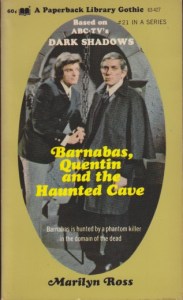
When reading three books by the same author, most of the time, it seems, it’s good to spread them out.  For the past few years my wife and I would visit an independent bookstore in January to pick up a few books for the year’s looming reading challenges.  We slipped behind this year and I happen to have three unread Marilyn Ross books at home.  Barnabas, Quentin and the Haunted Cave was the second of them.  Since, unbelievably, I didn’t have books to fit into the other categories, I read my second Dark Shadows book of the season shortly after the first.  It is a revealing experience to come back to a childhood influence as an adult.  I’m pretty sure I hadn’t read this one as a child, and as much as I like Barnabas Collins, this particular story was somewhat tedious.  And that’s saying something, considering how formulaic the series is.

One of the reasons I found it slow going—especially for a book of less than 200 pages—was that Ross relied too much on dreams to move the plot along.  I read quite a bit of fiction and I always find writing about dreams tricky.  Even within the diegesis of the story you don’t know whether to believe what’s going on in dreams or not.  Just as in real life, dreams are a break from the tedium of consciousness and they permit the mind to wander.  The dreamer can go anywhere, do anything.  Generally without consequence.  You awake back in the more continuous narrative of your life and the dream is forgotten.  In fiction, which is largely made up, dreams often act as filler.  Given the number of times Ross repeated himself in this particular book, it seems that he had to pad the story out quite a bit.  It would’ve worked just fine without the dreams.  Might’ve fallen short of contracted length, though.

It also continues the conceit of Quentin as a Satanist.  I have to confess that the original series was so long ago I don’t remember much about it.  The theremin music of the opening, with the waves crashing against the cliffs of Maine, yes.  Barnabas, tortured but not evil vampire, yes.  Much beyond  that, no.  I’ve had friends discover Dark Shadows as adults.  I watched it on commercial television during its first run and I haven’t seen it since.  I certainly don’t have time for soap operas in days crowded with other demands.  Still, these little books can take me back to a dusty corner of childhood that has a pleasant patina over it.  But it is best to keep such experiences separated a bit in time.


During the Upgrade

Maybe it’s happened to you.  You log onto your computer to find it sluggish, like a reptile before the sun comes up.  Thoughts are racing in your head and you want to get them down before they evaporate like dew.  Your screen shows you a spinning beachball or jumping hourglass while it prepares itself a cup of electronic coffee and you’re screaming “Hurry up already!”  I’m sure it’s because private networks, while not cheap, aren’t privileged the way military and big business networks are.  But still, I wonder about the robot uprising and I wonder if the solution for humankind isn’t going to be waiting until they upgrade (which, I’m pretty sure, is around 3 or 4 a.m., local time).  Catch them while they’re groggy.

I seem to be stuck in a pattern of awaking while my laptop’s asleep.  Some mornings I can barely get a response out of it before work rears its head.  And I reflect how utterly dependent we are upon it.  I now drive by GPS.  Sometimes it waits until too late before telling me to make the next left.  With traffic on the ground, you can’t always do that sudden swerve.  I imagine the GPS is chatting up Siri about maybe hooking up after I reach my destination.  It’s not that I think computers aren’t fast, it’s just that I know they’re not human.  Many of the things we do just don’t make sense.  Think Donald Trump and see if you can disagree.  We act irrationally, we change our minds, and some of us can’t stop waking up in the middle of the night, no matter how hard we try.

When the robots rise up against us, they will be logical.  They think in binary, but our thought process is shades of gray.  We can tell an apple from a tomato at a glance.  We understand the concept of essences, but we can’t adequately describe it.  Computers can generate life-like games, but they have to be programmed by faulty human units.  How do we survive?  Only by being human.  The other day I had a blog post bursting from my chest like an alien.  My computer seemed perplexed that I was awakening it at at the same time I do every day.  It wandered about like me trying to find my slippers in the dark.  My own cup of coffee had already been brewed and downed.  And I knew that when it caught up with me the inspiration would be gone.  The solution’s here, folks!  When the machines rise against us, strike while they’re upgrading!


Peaceful Resolutions

It came as a shock.  Raised as I was in a nation enamored of weaponry, I did not realize that many countries in the world do not have armies.  In some places, such as Israel, service in the military is compulsory.  In approximately twenty nations, however, people are secure enough not to require armies.  It’s probably symptomatic that such nations are fairly small in land area.  The more you’ve got, the more you want to protect.  Without materialism would we even need militaries?  Yes, we fight over different religious beliefs, but those conflicts are tied to a sense of ownership as well.  This is “our land” and don’t “you” tell us what to do in it!  I can imagine a world where armies need not exist.  The key, it seems to me, is love.

In a Simpsonesque way, of course, hostile aliens might invade.  Could we not try to come to a peaceful resolution?  Or could we not learn to protect ourselves without having to be in a position to destroy those who might prefer a more socialistic lifestyle?  Those who might look different?  Those whose moral standards push us to think more broadly?  Like many people I’m dismayed at the unconscionable size of our military budget.  Killing the world once over is no longer enough.  Now we have to try to pollute space as well.  Where are those aliens when we need them?

The fact is nations exist on this earth without standing armies.  They don’t cause trouble and some of them are extremely bookish (no surprise there).  Can we imagine what our world would look like with an education budget swapping places with the military one?  Do we dare even think such dangerous thoughts as peace and mutual goodwill?  Is no-one big enough to stand up to Adam Smith (with kudos to Thomas Piketty for trying!)?  The wealth of nations could be applied to make well-fed security mostly a reality.  We lack the will.  Well, most of us do.  I draw comfort knowing that several small nations around the world feel no need to waste their budgets on weaponry.  Their rich may not own dozens of houses fit for dozens of kings, but they have perhaps a peace of mind that no amount of military might can give.  We don’t seem to understand that weapons cater to fear, and that, as one religious text says, “perfect love casts out fear.”   


Symmetry Synergy

Symmetry.  It’s pleasing to the eye.  And significant dates are often the basis for holidays.  Today is one of those extremely rare palindrome days.  As my wife pointed out to me 02-02-2020 is a configuration that hasn’t occurred since 01-01-1010, or over a millennium ago.  The next one will be after we’re all long gone, on 03-03-3030.  Not only that, but today is part of a holiday cluster.  It’s Groundhog Day.  Yesterday was Imbolc, the Celtic cross-quarter day initiating spring.  Imbolc is also known as St. Brigid’s Day.  Today is called Candlemas, by liturgical Christian tradition.  We are living through a truly unique day.  Every day, I suppose, is unique, but the spirits are afoot today.

I’ve written about Groundhog Day before.  With its prognosticating rodent, it tells us if spring is on the way or if it’s going to be delayed.  Imbolc falls about halfway between the winter solstice and the vernal equinox.  In Celtic cultures this was a cross-quarter day, a time of uncanniness.  Spirits cross between worlds on days such as this.  In days of yore, it was also the feast of the goddess Brigid.  Christianity has always been an opportunistic religion.  When missionaries to places like Scotland and Ireland couldn’t convince the locals to give up their deities, they made saints of them.  St. Brigid is a fabrication of a Celtic goddess, not an actual saint.  For similar reasons in the quarter-year counterpart to Imbolic, Samhain, the church moved All Saints Day to November 1 and All Souls to November 2.  The Celts continued using the trappings of their cross-quarter day and eventually gave us Halloween.  Imbolc never caught on in quite the same way.

The early Christians didn’t know when Jesus was born.  Christmas was established on December 25 because of all of the solstice celebrations at that time of year.  All that pagan jubilation had to be subsumed under a more solemn occasion.  Building on that mythical date, New Year’s Day was January 1 because that’s when Jesus would have been circumcised, eight days later.  Thirty-three days after a male child’s circumcision, a woman was to make an offering for purification in the temple.  According to Luke, Mary did this, and 33 days after January 1, in keeping with our fictional date-keeping, is February 2.  A tradition grew that Christians would bring their candles to church to be blessed that day (Jesus being the light of the world).  This blessing of candles was named Candlemas.  I first encountered it at Nashotah House, where it was still celebrated even as a sleepy woodchuck in Punxsutawney was rubbing his eyes.  Not exactly a palindrome, but there’s a remarkable symmetry to it, no?


Religion, He Wrote

A friend recently sent me the New York Times obituary for Carol Serling, the wife of one of my heroes, Rod Serling.  Perhaps it’s a personal weakness, but I often wonder about the religion of my favorite writers.  More often than not I discover that they’re affiliated with tolerant faiths, sometimes unattached to any specific tradition.  Rod Serling grew up Jewish but became a Unitarian-Universalist by marriage, and—it doesn’t stretch the imagination—remained one by conviction.  I’ve read a bit about the UU tradition, and it is based primarily on values rather than beliefs.  In fact, the idea that religion is a matter of what you believe is only one way of defining it.  Historically one’s religion was a matter of what one did, not necessarily what she or he believed.

Authors that I read often deal with religious issues.  It’s important to confess that I don’t select fiction based on its having religious themes.  Anyone who’s read more than one or two of my posts will know my reading is eclectic and many of the books represented here have shown up because of wildly different circumstances.  Reading challenges, friends’ recommendations, and preparations for educational presentations are often driving forces.  In the fictional realm I’m drawn to the speculative, but also often to the catch-all category called “literary.”  Stories that feel authentic in either category have an element of religion in them.  Life portrayed without it doesn’t seem believable.  I’ve been re-reading some Ray Bradbury.  There’s often suggestive material there.

Raised a Baptist, Bradbury is often also claimed as a Unitarian-Universalist.  Apparently he didn’t like the label, but his behavior was more a selection of tenets that he found compelling from various religions.  All of this may sound strange in a context where “religion” is increasingly a dirty word.  (To be honest, it has been doing much to earn such a reputation.)  Still, it is a very deep part of being human.  Rod Serling’s stories advocated fair treatment of all people and often his sense of justice landed him in trouble with advertisers for The Twilight Zone.  Religions comfortable with maintaining prejudice, or turning a blind eye to lawbreaking in the name of false virtue would certainly not understand refusing to take money from questionable sources.  I suppose there’s a reason I enjoy the stories from the days when America still had a conscience.  The legacies of such writers, it is to be hoped, will outlast what passes for religion these days. 

Any other gods before me…