White Whales

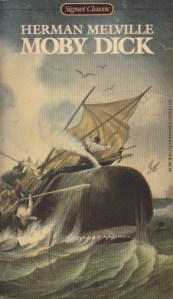
Every once in a while I return to Moby Dick.  I’m not sure why exactly Melville’s classic has such a hold on me.  Perhaps because I first read it while living in Boston.  For a land lubber like myself being so near the ocean was a kind of epiphany.  I read the novel as part of a course on wisdom literature in the Bible.  Harrell Beck, who was an influential person in my life, insisted that if wisdom themes were truly wisdom they would be found outside the Good Book.  We were assigned a list of modern novels from which to choose and I selected Moby Dick.  The thing that immediately struck me about the novel was just how biblical it is.  Ahab and Ishmael aside, the many references to Jonah and Job and incidental asides referencing scripture made this an intense reading experience.

I started reading it for the fifth or sixth time just before the pandemic became a crisis.  It is a large book and I didn’t want to rush through it.  I tried to pause and appreciate it this time around and I noticed just how remarkable it was that a man who made much of his life as a laborer, without any higher education, was so incredibly literate.  Classical references that I had to look up, and citation of sources blend together in a story that is compelling as it is unsettling.  Long explanations and descriptions are part of the tale, and the soliloquies are so philosophical that you have to sit back in a reverie after reading them.  I’ve read many novels in my life, but no others like Moby Dick.

As metaphorical stories go, the book is remarkably natural.  The descriptions of whales are as scientific in their own way as they are literary.  For an author with no scientific training this too is remarkable.  Indeed, a good part of the draw of Moby Dick is Herman Melville himself.  Although I have gathered a few degrees over the years, in my mind I am, like Melville, unlettered.  I’m sure he would’ve understood.  The fiction I write, although in a very different style, is a tip of the hat to him.  Friends used to tell me that nobody writes like that any more and that no publishers would show an interest.  The latter has proven to be true, and so much more’s the pity.  We could use more novels like Moby Dick.  And were my days not even fuller during the pandemic, I might even have a few moment to pursue my own white whales.


Tent Pegs

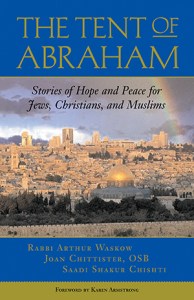
Among the many things that have happened during the pandemic to fill my time, I was invited to join a virtual book discussion group.  While the idea of reading groups has always appealed to me, there’s always the matter of who gets to choose the book.  I’m well aware from both what I post here on this blog and from my Goodreads account, that my reading tastes are eccentric.  I’m also very aware of how little time life really encompasses and I try to make it count.  Work takes up much of it, and beyond that biological necessities such as sleep, and household chores also weigh in.  All of which is to say I didn’t choose The Tent of Abraham to read.  It chose me.

The subtitle—Stories of Hope and Peace for Jews, Christians, and Muslims—pretty much describes what the book is.  Authored and edited by Joan Chittister, Murshid Saadi Shakur Chishti, and Arthur Waskow, the book focuses on the story of Abraham that ties the three monotheistic traditions together.  It is an exercise in creative exegesis, and sometimes eisegesis.  Given the point of the book, eisegesis is okay here, perhaps even necessary.  The reason for much war and hatred is the credulous, literal belief in our founding myths.  Abraham isn’t an historically attested character.  The stories told about him in ancient religious texts differ.  And although he doesn’t always come across sympathetically, he is always seen as a friend of God.  We’re not ever given a satisfying reason for that friendship, it just is.  Abraham is kind of a scary guy, as some of these stories make clear.  He’s not above abandoning his lover and child in the wilderness.  Nor attempting to murder his only remaining son.  Or passing his wife off as his sister to save his own skin.

Interspersed with these tales of imagination and horror, are scriptural versions (and by scriptural I mean biblical and those from the Quran and Hadiths), as well as real life stories of death in the Middle East conflict.  These are difficult stories to read.  Much of the violence between faiths comes down to conflicting claims of ownership.  As the book makes clear, if people resolve to celebrate difference rather than to distrust the other we can all live together in peace.  The only thing lacking to make this happen is the will.  Unfortunately, the conflict draws its energy from religious beliefs, or, more precisely, politics using religion to get its ends.  And for that one doesn’t have to travel all the way to the Middle East.


Honey and Wine

Academic writing tends to be limiting.  Don’t get me wrong, I still enjoy reading a well-crafted academic work, but when facing a new one I always experience that sinking feeling that this will be difficult work.  That doesn’t stop me from getting a little thrill when something academic I’ve written appears.  Pickwick, an imprint of Wipf & Stock, recently released the cover of Some Wine and Honey for Simon, the Festschrift for Simon Parker to which I’ve contributed.  As I’ve written elsewhere, this was an orphaned article that required some polishing up to be able to submit.  Thinking back on it, I reflect on how much has changed since then.  How I’ve left the land of Festschriften.  How my own research has changed.

Research, traditionally wrought, requires an academic library and lots of time.  You need to be able to spend your hours requesting books and articles that you can’t afford—really publishers?  $40 to purchase twenty pages that I won’t even enjoy reading?  Access to JSTOR will cost you if you don’t have a university post.  Now I trawl Academia.edu hoping to catch what I need in my net.  Sometimes it works.  Other times you bring up a coelacanth.  That’s the way of research outside the academy.  Also, I find myself reading books that appeal to me rather than strictly books on topic.  Many of them aren’t academic, but they are informative.  Part of research, it seems to me, is learning to access sources you wouldn’t normally find.  There’s the element of discovery.

Monsters appealed to me as a research area since there hadn’t been much written on them academically and I’d read most of what had.  The field is starting to take off now, which means  high-priced monographs and inaccessible research.  Working in publishing I think I understand the mindset—employees are expensive, especially in the United States.  They require salaries so they can live, and medical coverage so they can continue to live.  And most books sell so few copies that they really aren’t profitable.  But I like to think people would read about monsters, if they were priced down around the level of the demographic that appreciates them.  So one of my academic articles is about to be released to the world along with some wine and honey.  I’m still trying to sort out how to contribute from the margins.  And I hope Simon, who was always kind to me, appreciates the effort to honor a scholar and a gentleman.


Is It Real?

I’ve been reading an ebook and I feel lost.  I resorted to the ebook because I was invited to join an informal virtual bookclub.  Book discussion group may be a more accurate description.  Since I don’t see many people this seemed like a good idea.  Although I often take recommendations, reading a book someone else chose is kind of an infringement on my already crowded “to read” list, but connection is connection.  The problem was I couldn’t get a physical copy of the book delivered before the first meeting.  I struggled with whether or not to buy the ebook for hours.  I just can’t get over the feeling that I’m paying for something that can disappear at the next upgrade and all my effort in reading it will have been lost.  I’m a book keeper.  (Not a bookkeeper.)

After a morning of angst, I finally clicked on “buy.”  I’ve been reading the book but I’m finding it disorienting.  When I read an actual book, I quite often take a look at the physical object and assess it as I’m reading.  Appraise it.  Who is the author again?  Who published it?  When?  In the ebook world that information is obviously available, but it’s not where I expect to find it.  And there’s the matter of pages.  I measure my progress of book reading by the location of my physical bookmarks.  I can tell at a glance to the top of the book how my progress is.  A slider bar just doesn’t do it.  I click out of it and check on Amazon.  How many pages does this book actually have?  Why does my e-version have a different number?  Won’t that confuse the discussion?

I don’t feel so guilty about marking up an ebook, I’m finding.  Highlighting in a print book always annoys me—I don’t want some previous owner telling me what I should remember.  This ebook won’t get passed on to anyone else (that’s the genius of the business model—the ebook isn’t available for resale, which more durable, actual books are).  As I’m doing this I recollect that I’ve only ever read two ebooks before, both fiction.  They didn’t make much of an impact because it was only in writing this post that I remembered them at all.  The world of the coronavirus has taken its toll, I guess.  I’m reading an ebook and I can’t wait to finish so I can get my hands on the real thing again.


More than Sand

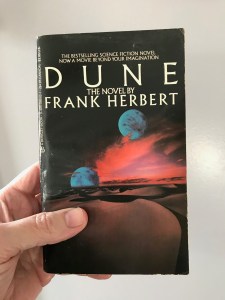
My sci-fi roots may be showing, but when John W. Morehouse posted a story on TheoFantastique’s Facebook page about Dune, I had to follow up.  The story was from Wired magazine, and the title asks “Should There Be a Religion Based on ‘Dune’?  Although I grew up on Poe, science fiction was my favorite genre as a kid.  Frank Herbert’s classic was published when I was only three, but it was experiencing a resurgence before the movie came out.  Dune was  complex world building.  It was immersive, and compelling.  The movie, I felt, didn’t do it justice.  I’m not surprised that people are now wondering if it shouldn’t become a religion.  Other sci-fi-based religions do exist.  Star Wars and Avatar have both developed fan bases that consider the films their religion.

Movies have a way of becoming part of our reality.  The other day I was reflecting on how much my frame of reference for life is based on movies.  I quote from them frequently.  I draw wisdom, and sometimes just plain inanity from them.  But I remember them.  I spend a lot more time reading than I do watching movies.  If a book is engaging I’ll remember it well, but it isn’t unusual to forget—although I hope it’s still there somewhere in deep storage—a book that failed to make much of an impact.  I suppose that’s true of movies too, but I recall my first viewing of The Jungle Book in theaters.  How those hypnotic snake eyes scared me!  And there was a film whose title I can’t recall, but I remember it was vignettes of Hans Christian Andersen stories, I believe.  One was called “The Tinderbox.”  I still remember it well although I was probably about five when I saw it and I never watched it again.

This staying power of movies suggests their religious potential.  People today, I suspect, are less concerned with the antiquity or bona fides of a religion than they are with the practical issue of whether or not it works for them.  Does it bring them near some sense of transcendence?  While the Wired article doesn’t seriously suggest a religion based on Dune, I sometimes ponder how the wisdom of ancient religions is often entombed in forms and structures that “true believers” mistake for the actual essence of the religion itself.  Sci-fi based religions reach for the newly created realms of transcendence.  They are filled with wonder.  But it will only be a matter of time before that awe fades into arguments about which canonical version is literally true.  It’s happened before.


Really Celebrate

It’s a dilemma.  How do we celebrate Mother’s Day during a lockdown?  The COVID-19 pandemic has changed a lot of things.  Given that it was snowing around here yesterday (not to be blamed on the virus), even May doesn’t seem very cooperative this year.  On Friday night I made an emergency trip to Target for essentials.  One of my ulterior motives was to purchase a Mother’s Day card for my wife.  Given the lack of social distancing at the card rack, I wasn’t the only one who had this in mind.  The remainder of the store had shelves of daily necessities picked clean.  How to celebrate moms during a pandemic?  I guess by trying to stay alive.

Those of us far from childhood homes can’t visit our mothers.  Even if we could we couldn’t take them out for dinner.  If we send flowers we can’t send gloves to protect their fingers—the stores are out of those.  If we send flowers to plant we have to send plastic to cover them too, having had four nights with freeze warnings in a row.  Talking to my Mom yesterday she recollected the year that it snowed on Memorial Day.  I shouldn’t complain.  Mom would rather I didn’t.

Perhaps the best we can do for Mother’s Day is to start treating all women better.  One commemorative day a year doesn’t make up for a lifetime of second-class citizenship.  Our mothers are the reason all of us are here.  Isn’t that reason enough to see we’re all part of a single family?  Women put up with a lot to take care of us.  Even so we deny them an amendment granting them equal rights.  Politicians are saying “Happy Mother’s Day” even as they continue to withhold basic human rights from women.  We could celebrate Mother’s Day by putting our sentiments into action, transforming daily life into equal pay and equal protections.

There’s a pandemic outside.  There’s some snow out there too.  But there’s a warmth inside and for that we have our mothers to thank.  If we really mean it when we send our mothers cards and flowers, if we really mean it when we call, if we really mean it when we give her a hug, we’ll show it by our actions every other day of the year.  We need to be sincere when we say it, or don’t say it at all.  Happy Mother’s Day!


Open a Book

With all the talk of premature “reopening” one development does seem to bring cheery news.  Germany and Italy, it is reported, are considering experimenting with opening bookstores.  Bookstores, at least in the United States, tend not to be crowded except around the winter holidays.  More importantly, they are places to go to find printed knowledge—not the internet knowledge that shifts by the second.  This cheers me because it shows that people still trust books.  With all the talk of going digital, which is okay, we sometimes forget that the human experience of reading has, for the last several centuries, been book based.  I’m as guilty as the next guy for looking trivial stuff up on the internet.  I always feel uncertain, however, if I don’t check it against a book.

Nielsen, the people who used to bring you television ratings, also track books at point of sales.  One of their findings is that books have remained solid sellers throughout the pandemic.  Granted, a lot of them are children’s books—it’s one way to entertain the stay-at-home kids—but several categories have fared well.  Books on staying in shape, and survival, and how to do things we used to know how to do (planting a garden, or making bread) have boomed.  I suspect people have felt some comfort in reading.  Books are reassuring.  They’re a sign of normalcy.  Having said all that, I’m not sure I’m ready to go back into a physical bookstore just yet.  Infection rates have slowed down around here, but they’re still high.  And other people who miss bookstores as much as I do might form a crowd.

Bookshop.org has arisen to give back to independent bookstores.  Yes, the prices aren’t what you’ll find on Amazon, and yes, you’ll pay for shipping, but they support your local indies.  This doesn’t seem to be a bad idea during a crisis.  One of the more charming aspects of the Lehigh Valley is the number of bookstores in the area.  I am looking forward to an “all clear” when we can emerge like post-apocalyptic survivors and stand blinking in the sun.  In my vision of that day, there will be birds singing and trees leafed out.  The air will be clean.  We’ll stare at our neighbors, assured that if we accidentally brush against them, or stand too close in line, we won’t do so at the risk of exposure.  I’ll stand there for some time acclimating to the new reality.  And then I’ll head for a bookstore.


Leg Up

It’s amazing how often J. D. Vance’s Hillbilly Elegy comes up in conversation.  The book struck a nerve.  Reading it wasn’t easy because there were so many shades of my own childhood that I felt uncomfortable at several points.  Not from the same circumstances as Vance (his family seems to have been better off than mine, from the descriptions), I was more a hillwilliam (shoutout to the author of Verbomania for the portmanteau) than a hillbilly.  We weren’t educated people, but my mother’s family wasn’t as poor as the one she married into.  We were socially mobile alright, but in the wrong direction.  Anyone who hasn’t come home from school to find carp swimming in the bathtub simply can’t understand.  The way of the poor is inscrutable, but something Vance gets spot on—it is almost impossible to improve yourself without a leg up.

The chapter where this really hit me was as he was describing how easy his life was after being admitted to Yale Law School.  He made connections and learned to work them.  That part never came in my case.  Like Vance I grew up without a father.  Unlike him, I didn’t have grandparents to come to the rescue.  It’s a long story, but when I left home my life became a search for a father figure only to discover than nobody really wants to help somebody else’s kid.  Although I was accepted into the high profile schools, I had no one to coach me to go there.  Even now people barely recognize Edinburgh for the wonder that it is.  It didn’t connect me the way Yale Law apparently does.  My career has been in freefall a time or two because of this lack.  As Vance explicitly notes, when you grow up poor you don’t have the training or family experience to know what to do.

Many people, I realize, are much worse off than I was growing up.  What Hillbilly Elegy, written by a Republican, shows is that the government simply does not care for the poor.  In what used to be the wealthiest nation on earth there is a tremendous amount of poverty.  Vance has a keen analysis of what the abnormal psychology of want does to people.  I grew up more of a Pennsylvania redneck than a full-blooded hillbilly, but many of the same lessons apply.  While some of us can muster the willpower to escape, we know we are in the minority.  We learn as adults that others don’t share our concern for those who struggle daily to get by.  This is an important elegy, and if only it were read seriously by those able to make policy there might be some glimmer of light in these dark hills.  The right leg up can do wonders.


Resurrectionists

“Resurrectionists” was the name given to those who supplied the black market for human bodies when medical science had scant access, back in the eighteenth and nineteenth centuries.  They’d rob graves, and sometimes kill their own victims, for the money medical schools paid for cadavers.  It’s just business, some would say, I suppose.  It was illegal, however, and carried its own death penalty at times, if a resurrectionist were caught.  I was surprised to learn that somehow the United States has learned to do large scale resurrection.  Clergy, hang up your stoles—the government’s got it covered!  I discovered this in the most unlikely of places, the World Health Organization’s daily situation reports.

Like many people I wonder when COVID the 19th’s reign of terror will end.  I don’t trust anything that comes out of the White House, so I look to WHO.  The daily situation reports give the recorded number of cases of the virus, which, despite progress, keep going up.  The US, as always, is the world leader.  In addition to giving the number of cases, the website also records the numbers of deaths.  This is a sad and sobering statistic.  Additionally, it informs reader of how many new cases and how many new deaths have been recorded in the last 24 hours.  Here’s where I learned of our godly ability.  On Tuesday the number of new deaths in the United States was -1696.  This represents a mass resurrection indeed.  If only we’d share the knowledge with the rest of the world.

Here’s the insidious nature of statistics and governments who abuse them.  Stalin famously noted that one death was a tragedy but a million deaths are a statistic.  The US isn’t the only nation to play with the numbers—we’re all just statistics after all—but it is a matter of record that the Trump administration wouldn’t let the Diamond Princess land, although in American waters, because it didn’t want those cases listed as part of our stats.  So it still stands.  They are listed, of all the nations of the world, as “Other.”  Lest there be any doubt, the Tuesday WHO situation report ended with a note that American authorities “retro-adjusted” the figures.  You’d think that we’d want to announce with trumpet blast that we’d figured a way of retro-adjusting 1696 deaths.  For those of us listed as non-essential employees this is perhaps meant as a ray of hope.  Our work may be just icing, and we may be a single digit in our uncaring government’s eyes, but we can be brought back from the dead by political fiat.


Religion’s Trickster

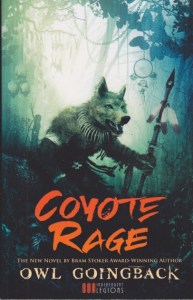
I’m not sure I’ve read any fiction by Native American writers before.  Owl Goingback has established a reputation among horror writers for his blending of Indian concepts and the horror genre.  Coyote Rage is a novel that blends worlds.  Coyote is, of course, a trickster figure.  Upset with human abuse of the world and our indiscriminate killing of animals, he decides to wipe out the human race.  Since all animals, including humans, plead their causes in the council in Galun’lati, the original world, he decides to take humans out by killing their last representative on the council, an elderly Native American in a nursing home.  The fact that his victim has a daughter unaware of her heritage, means that Coyote has two people to hunt.  As a shapeshifter able to travel between worlds, Coyote is a formidable enemy.

I don’t want to put any spoilers here, but it is worth considering the spiritual aspects of the story and how they blend so well into horror.  I’ve commented before on how religion plays into the genre.  Here is yet another example.  Galun’lati is presented as reality.  Not only do the animals talk there, it is a place that has its own dangers.  It’s a forest world, appropriate to Native American experience and context.  It’s very much a natural, supernatural world.  The novel splits its time between Galun’lati and the New World—this world—as humans try to prevent their own extinction while most people have no idea there’s even any threat.  Oblivious, we carry on.   Religion can play into horror that way.  While there are plenty of examples of purely secular horror, in my experience tales that have supernatural sources of threat are the scariest.

It may come back to the issue of ultimate concern.  When our spiritual wellbeing is taken into account, we often approach it with some trepidation.  The physical world feels so real and occupies much of our time.  If, however, we need to add spiritual concerns on top of everything else, it can become overwhelming.  What if physical threats, such as the coronavirus, and any other of a myriad of dangers, are only part of the picture?  What if there is another entire world in which we also have a stake?  If that world is beyond normal perception, we must rely on those who understand it.  Much effective horror knows to tap into this area of natural uncertainty.  Owl Goingback uses it remarkably well in crafting a horror tale that makes you think.


Buzzy Headed

If you’re like me, and I sincerely hope you’re not, you spent your childhood worrying about killer bees.  You see, I was stung a lot as a child, having stepped on a yellow-jacket nest hidden in an old tree stump.  That event was one of the most formative of my life.  Oh, I act brave, shooing wasps and carpenter bees away, but that’s all a front.  I was repairing a piece of furniture out in the garage over the weekend and a big old bee got in and started buzzing around.  It drove me to distraction.  I once had a bee land on my back and sting me for no apparent reason.  Alone in the garage I had no one to watch my back.  I decided to do some repairs back in the house instead.  Let it have the garage.

During this pandemic, then, the last thing I needed to hear was that “murder hornets” have made it to the United States.  And Republicans are bad enough!  The murder hornet is responsible for double-digit deaths in its native land, and now my childhood nightmares of killer bees have reemerged.  We had a warming trend over the weekend.  There were so many wasps and bees around outside that I could even hear their buzzing with the windows safely closed.  Insects are the future, of course.  They adapt better and more quickly than we do, and there are many, many more of them.  The Bible often uses insects as vehicles of divine wrath.  No wonder horror movies often make use of them!

Image credit: SecretDisc, via Wikimedia Commons

More rational minds soothe us, saying that murder hornets seldom attack people or pets.  If provoked, however, they can do so fatally.  Perhaps it’s the anger of stinging insects that bothers me the most.  The yellow-jackets that attacked me certainly seemed angry.  My stepping on their home was an innocent accident.  It was also a learning experience.  I don’t step on old stumps any more.  I haven’t since the incident.  Such early traumas can stay with you all your life, and the buzzing co-inhabitants of the earth, I have to remind myself, have as much right to be here as we do.  In cases like killer bees, we invented them.  When we play Doctor Frankenstein nature responds in kind.  The monster was angry.  Bees, wasps, and hornets may be intelligent but they can’t reason out the motives of bumbling humans who accidentally disturb them.  And now a bigger variety has moved in.  It’s probably best to keep calm and not get anybody angry.


Divided by Eight

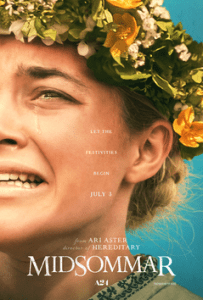
Analogies are useful, but never precise.  When Midsommar came out last year, people were saying “It’s like Wicker Man.”  It’s a good analogy, but not precise.  The plots have quite a bit in common and both are part of the genre that we might call intellectual horror.  Midsommar is a slow burn where you know from the beginning that something’s not right, and you can’t quite figure out what.  I’ll try not to give away too much, in case, like me, you’re late in seeing it.  It involves a group in Sweden, the Hårga, who celebrate a Midsummer ritual every 90 years.  A group of five graduate students—and the writers of the movie actually do know what grad school is like—go to study the ritual.  In central Sweden, far enough north that it’s never really night, they discover a pleasant group of white-garbed believers who use a combination of drugs, sleep deprivation, and folk magic to get the pawns into place.

What fascinates here is just how a fictional religion, with some basis in reality, becomes the vehicle for horror.  The deaths of three of the students are all in the service of a belief system that involves runes, fertility rites, scriptures, and ritual suicide.  It’s self-aware enough that one of the students compares it to Waco early on.  If there were no exotic religion here, there would be no horror.  Tragedy, yes, but horror, no.  The entire energy of the genre draws from four of the students (the fifth is from the community in Sweden) not knowing what is going on.  The village of the Hårga is isolated, and there is no law to keep them within the bounds of secular behavior.  By the end of the film you feel that secular is much safer than religious.

Midsommar foreshadows much of the horror in the illustrations that the community readily supplies.  Paintings show what is coming although the viewers, like the students, don’t know what they’re seeing at the time.  Some of the horror is based on shock, but the director doesn’t stoop to startle scares.  Well, maybe once.  This is horror that you can see coming and you’re fully aware that it’s because the white-robed ones truly believe.  The ending is similar to Wicker Man and the message is much the same.  Religion, when taken too seriously, leads to the sacrifice of those deemed outsiders.  And you don’t have to go to Sweden to find it.


Seeking Reality

I spend a lot of time struggling to figure out the fundamental basis of reality.  I’m hampered in this by a brain that was evolved—optimized—to help me survive in my environment, not to penetrate the depths of what’s really real.  That’s why I began studying religion in the first place.  The connection was organic.  Raised as a fundamentalist daily reminded that an eternal hell of torment awaited, it made sense to study the antidote (the Bible) as much as possible.  When I prepared for college, which wasn’t the plan at the beginning, I could think of no other major beyond religion.  In Paul Tillich’s nomenclature, it’s all about ultimate concerns.  I didn’t accept the very evolution that had made me this way.  That required thinking through.  

Attending a liberal arts college wasn’t really a conscious decision.  Nobody in my family had been to college and I didn’t know the difference between a research university and a stand-alone liberal arts institution.  Somebody has to teach you these things.  Religion, I found out, is a pretty good way to work toward perceptions of reality.  These days the award for that goes to philosophy, but the two fields are closely related, as much as philosophers socially distance themselves from theologians.  They’re both seeking the same thing, really.  Public perceptions of theology, however, trail after televangelists and their ilk, leading a wrong impression in the minds of the masses.  Even professors are prone to accept this facile supposition.  Seeking reality doesn’t mean you won’t get laughed at along the way.

Although there have been some among religious leaders who claim to have found the answer, the rest of us continue to struggle.  The more I read both of science and of religion the more complex it all seems to grow.  And of course human agendas require the keeping of secrets.  Knowledge that is for employees only because they kind of have to know.  The price on the sticker represents a mark-up that could be cut down.  What is this item really worth?  So it goes with the search for reality.  There’s no end to the searching.  Even after Siddhārtha Gautama was enlightened, he continued to have to work at it.  Christianity used to teach that love was the point of it all.  That message seems to have changed with the arrival of the messiah known as Trump.  Those of us who can’t stop searching even if we find can’t help but wonder if there isn’t something more worthy on which to spend our time.


Koyaanisqatsi

I recently saw Koyaanisqatsi for the first time.  This was initially prompted from an excellent blog post over on Verbomania, suggesting words to describe our current crisis.  I had never heard of the movie before.  In case you’re in that same jolly boat, Koyaanisqatsi is a feature-length film from 1982 with no plot and no spoken lines.  A score by Philip Glass underlies, and sometimes dominates, images of an earth beautiful in desolation (the Badlands, Monument Valley, Grand Canyon) juxtaposed with technology.  The images are fascinating and disturbing.  The title translates to something like “life out of balance” and the images of sausages being mass produced cross-cut with humans being lifted by escalators speaks volumes.  The long, slow footage of 747s on the ground was enough to make me wonder if they really can fly.

Frenetic is perhaps the word that best captures images of life in the early 1980s.  The images of Grand Central during rush hour show just how like ants we are.  On the other hand, some of the scenes of people waiting for trains show a high percentage of them reading—we have perhaps lost ground in the last four decades.  The mechanized, technologized way of life has perhaps made us something less than we could be.  There are people in the movie, but not many of them look happy.   Back when I commuted into New York I can’t think of any reason I would’ve been smiling on my way too or from work.  Crowded streets, often smelling bad.  Harried and harassed even before I reached the revolving door to my building.  I watched the movie that was a slice of my life and wondered if so much of my time commuting couldn’t have been better spent.

Of course, I did read on the bus.  On average I was able to finish about forty books more per year than I do now.  Even home owning participates in koyaanisqatsi.  It’s spring during an epidemic.  Cold, yet rainy, the grass continues to grow and there’s no sunny time off work to mow it.  It’s now May and it feels like we haven’t moved since March.  Watching Koyaanisqatsi during the pandemic was itself a haunting experience.  All those crowds.  So many people bunched so closely together.  I don’t miss the crowds.  The cross-cut images of computer chips and city layouts made me wonder just what it’s all about.  The SARS-CoV-2 reality has plunged me into a philosophical mood.  I’m hoping when the crisis is over we might strive for a better sense of balance.


Cross Quarters

Happy Beltane!  We could use a holiday right about now.  For those of us who are under the spell of intelligent horror, May Day brings The Wicker Man to mind.  Not the remake, please!  I first saw it about a decade ago—my career history has made watching horror an obvious coping mechanism—and I was struck by the comments that the film was a cautionary tale.  One of the problems with being raised as a Fundamentalist is that you tend to take things literally and I supposed that the cautionary tale was against Celtic paganism.  The Wicker Man is about the celebration of Beltane on a remote Hebridean island, and it was only as I watched it a few more times and reflected on it that I came to realize the caution was about those who took their religion too seriously, pagan or not.

Photo credit: Stub Mandrel, via Wikimedia Commons

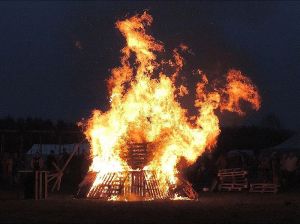
Lord Summerisle, after all, admits that his religion was more or less an invention of his grandfather.  More of a revival than an invention, actually.  In other words, he knows where the religion came from, and he has a scientific understanding of the soil and how and why crops fail.  That doesn’t prevent him from presiding over May Day celebrations to bring fertility back to the land.  The people, as often is the case with religions, simply follow the leader.  Of course, Beltane is a cross-quarter day welcoming spring.  It is celebrated in Celtic countries with bon fires and obviously those fires are to encourage the returning of the sun after a long winter.  The days are lengthening now.  I can go jogging before work.  The light is returning.

Capitalism, which is showing its weak side now, doesn’t approve of too many holidays.  Like Scrooge they think days off with pay are picking the pockets of the rich.  The government stimulus packages show just how deeply that is believed in this country.  Celts we are not.  So as I watch the wheel of the year slowly turning, and see politicians aching to remove restrictions so that money can flow along with the virus, I think that cautionary tales are not misplaced.  The love of money can be a religion just as surely as the devotion to a fictional deity.  Herein is the beauty of The Wicker Man.  Beltane is upon us.  As we broadcast our May Day it could be wise to think of the lessons we might learn, if only we’d consider classic cautionary tales.