Come Salem Away

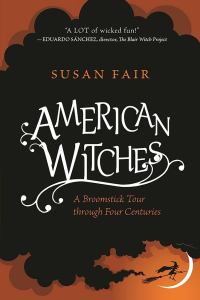
It’s the season.  Here in the fast waning days of September we can already taste October and thoughts turn toward ghosties and ghoulies and their kin.  Susan Fair’s American Witches: A Broomstick Tour through Four Centuries is, as any book in the nation of Salem, a mere skeleton crew of a long and feared tradition.  As is true of most things in the last two years, this book takes on a poignancy that was perhaps unintentional since it was written for fun.  It is a somewhat uncanny combination as it is—witch accusations often led to (and perhaps lead to, far from official eyes) someone dying.  We fear witches.  Fair reaches back pretty far, going even to the point of discussing those (generally women) hanged on ships on their way to America because their shipmates thought them witches.

Salem so dominates our witch consciousness that we sometimes forget these other episodes.  Fair explores, along with snarky asides, many early cases outside Salem.  In fact, the sad chapter in our history where hearsay became fact—one can’t help but think of “fake news”—the mass, “legal” murders carried out in Salem, is part of a larger pattern.  Not surprisingly women feature as the victims in this unholy web of fear and piety.  The combination is a dangerous one and otherwise rational people sanction evil rather than confront what is a mere perception of evil.  Fair moves on, however, to discuss other witchcraft scenarios—the witches (fortune tellers) of New York, the murder of a “witch” in Booger Hole, West Virginia (did I mention there was snark?), and the hex murder of York, Pennsylvania.  All of these represent an underlying fear that won’t go away.

This breezy tour ends near the author’s hometown outside Burkittsville, Maryland.  Although it is widely known that The Blair Witch Project was fiction from start to finish, this tiny town has been beset by those who refuse to accept that reality.  Such credulousness should stand as a warning to a country even capable of electing someone like Trump.  We are a suggestible nation with many people incapable of independent thought.  We are natural believers.  At the same time we’re a people that sees no value in studying religion even as it destroys us.  It’s like that embarrassing relative we never talk about.  But people still come to Burkittsville nevertheless.  Fair’s book was written before the election that showed who we really are.  Although the writing is charming, it’s hard to laugh about the subject these days.  We have forgotten Salem and all it taught us.

Riveting

The days of angry white men backlash are hopefully numbered.  One thing this strange phenomenon of privileged males feeling under threat has brought to the surface is the long struggle of women for the basic acknowledgment of human equality.  Ironically, it took a horrible war to move the cause forward.  Rosie the Riveter became a fixture during World War Two, blazing the message that women could do the tough jobs men had always done, now that males were off trying to kill one another overseas.  These images of Rosie have found new life in the era of Trumpism that has objectified women in the crudest possible ways, because it’s, well, monkey-see monkey-do in the world of politics.  Just consider Brett Kavanaugh and try to challenge the point.

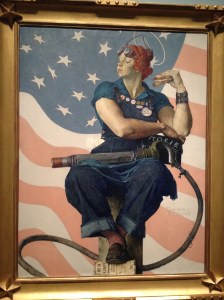
One of the more famous portraits of Rosie, back when Fascism was an evil thing, is that painted by Norman Rockwell.  A pugnacious Rosie eats her lunch with her feet on Main Kampf and her riveting gun in her lap.  (These days she would need to have her feet on an elephant rampant.)  Something about this painting always bothered me.  I could never put my finger on it.  It certainly wasn’t the confident look on Rosie’s face—she’d earned that and deserved it long before it became a reality.  Even the patriotism at that time was tasteful.  No, it was her posture.  There was something uncanny about it.  Then I learned that Rockwell had consciously copied Michelangelo’s Isaiah from the Sistine Chapel ceiling.

Isaiah, according to that famous rendition (Isaiah has never been a popular subject for paintings, for some reason), has his head turned at that peculiar angle because an angel is whispering in his ear.  Instead of a riveting gun, he’s packing a nascent Good Book, but he is receiving a direct message from on high.  I like to think it might be “The Spirit of the Lord is upon me, because he hath anointed me to preach the gospel to the poor; he hath sent me to heal the brokenhearted, to preach deliverance to the captives, and recovering of sight to the blind, to set at liberty them that are bruised, to preach the acceptable year of the Lord,” but then I’ve always been a dreamer.  Rosie, in Rockwell’s rendition, is prophetic.  She is proclaiming an equality which, inexplicably, coming up on a century later, is still unrealized.  Why?  The angry white man only recognizes God made in his own image.


Virgin-Haunted World

One of the most frequent accusations of “idolatry” I heard as a child was leveled at Roman Catholic devotion to the virgin Mary.  Lessons learned during childhood are difficult to displace, especially when they concern your eternal destination.  I overcame this particular objection, a bit, during my sojourn among the Episcopalians, but I have to confess I never felt right praying to Mary.  In my Protestant-steeped mind, there were two classes of entities involved: gods (of which, properly, there was only one) and human beings.  Only the former received prayers.  The rest of us simply had to contend with non-supernatural powers and do the best we could.  Still, I met many believers devoted to Mary, and honestly, some accounts of Marian apparitions are pretty impressive.

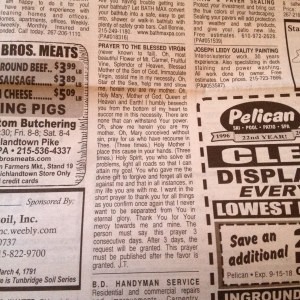
A local source for inexpensive advertising in our area is essentially a weekly set of want ads.  For a small fee you can advertise just about anything you want to buy or have to sell.  Spiritual or physical.  A few weeks ago, someone ran a magnanimous piece on a prayer to the virgin never known to fail.  The words of the prayer were printed, along with the instructions, for nothing is quite as simple as “ask and you shall receive.”  The prayer must be recited thrice, and thanksgiving publicly proclaimed.  A number of questions occurred to me, regarding not only this, but all prayers for divine action.  One is the rather simple query of how you can know if a prayer has never failed.  I suspect this is known by faith alone.

There are any number of things most of us would like to change about our lives, and the larger issue of prayer is the daisy-chaining of causality.  One change causes another, causes another, and often that for which we pray will impact another person in a negative way.  This is the classic “contradictory prayer” conundrum—one person prays for sunny skies while another prays for rain.  Neither is evil, both have their reasons, perhaps equally important.  (The weekday is a workday for many, and that’s non-negotiable in a capitalist society, so I suspect prayers for sunny skies tend to be weekend prayers, but still…)  The prayer never known to fail is either a rock or a hard place.  It’s that certitude that does it.  I don’t begrudge anyone a prayer that works.  Faith alone can test the results.  And although we could use a little less rain around here, we could all benefit from a little more faith, I suspect.  And for that there’s no fee.


Forgotten Bible Verses

Bible believers are basking in the headlines these days.  What with Mr. “Meet My Genitals” gunning for the Supreme Court and displacing them for a few days, they must be getting anxious for more sonburn in the limelight.  If only they didn’t have the Good Book standing in the way.  As I was reading my Bible the other day, I was reminded of this little gem, “the love of money is the root of all evil.”  Now, liberals like myself know that Paul of Tarsus didn’t write 1 Timothy, but Bible-believers know he did.  So much the worse for them.  They elected a president who stands for nothing so much as the love of money, and the swamp has become quite a root of evil.  Senate Republicans, after hearing a second credible sexual assault allegation against their boy for the black bench responded by trying to rush through a vote before the news got out.  And this reminded me of the forgotten prophets.

“What doth the Lord require of thee, but to do justly, and to love mercy, and to walk humbly with thy God?”  Well, you see, Mr. Micah, we know we’re heading to defeat in the midterms, so we’ve got to railroad through as many of our personal agendas as we can.  Don’t you know, o Lord, that this is a lifetime appointment?  And really, what does justice have to do with it?  Sure, he gropes and demeans women, but you’re a dude, right?  I bet you did the same when you were in high school and college.  And the money thing?  We’re only trying to help the economy because, well, wealth trickles down.  Who said anything like it’s the root of all evil?  “Hate the evil, and love the good, and establish judgment in the gate.”  Now, don’t go quoting Mr. Amos to me.  Next thing I know you’ll be telling me to let justice to run down like waters, and righteousness like a mighty stream.

Forgotten Bible verses, in the new Evangelicalism, seem to be cropping up on the black market.  You might think we should turn back to the start of the Good Book and read from the beginning.  There the GOP will find its solace until they come to the 27th verse, “So God created man in his own image, in the image of God created he him; male and female created he them.”  That semicolon says a lot; they will claim.  Man is the image of God, and he had a son.  Just don’t listen too closely to what that son says, particularly when he makes remarks like “whosoever looketh on a woman to lust after her hath committed adultery with her already in his heart.”  Young men like to drink and grope.  When they grow old they then like to be Supreme Court justices.  What’s that?  One more short verse?  “Jesus wept.”


Southern Turn

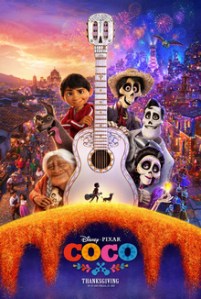
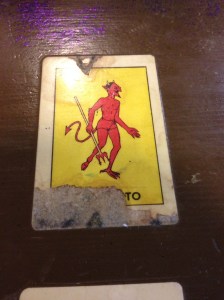
In America’s ever roving commercial eye, Día de Muertos has become an extension of Halloween.  Retailers have realized that people will spend a lot on their fear, and the autumnal holidays delve into that primal territory.  Since the Day of the Dead, being a mix of indigenous Mexican religions and the Catholic celebration of All Souls’ Day, comes two days after Halloween why not blur them together with greenbacks?  So capitalist thinking goes.  While certainly not free of monied interests, the Disney/Pixar movie Coco has the virtue of addressing Día de Muertos as the separate holiday that it is.  A form of ancestor worship—a religion extremely common around the world—the thought-world of the film shares in common with Tim Burton’s Corpse Bride this idea that the afterlife is colorful, if not joyous.

I realize I’m jumping the gun here, but I just saw Coco for the first time over the weekend.  Not just a culturally sensitive treatment of an indigenous holiday, it is also a celebration of music.  In a very real sense, music is life in the film, and even the dead continue to thrive in its presence.  Again, the connection with Corpse Bride suggests itself.  The key difference, from a religionist’s point of view, is that Coco is based on, to an extent, actual religious traditions.  An irony of this is that, together with the worship of Santa Muerte, the focus on death sometimes makes the Catholic Church nervous.  Focus should be on resurrection, not death.  But what if death isn’t seen as evil?  Where is thy sting?  This can be a real challenge when your organization is offering escape from death.

The fear of death is natural enough.  It’s the ultimate unknown.  It fuels both religion and horror.  In that sense films like Coco that show a joyful aspect of the hereafter do an end-run around traditions that base their wares on ways to avoid the consequences of death.  Hell becomes a threat to be avoided—the forgotten dead in Coco face annihilation, a fate that Héctor notes comes to everyone eventually.  Eternal torment isn’t in the picture.  I have to wonder if this view doesn’t present a form of salvation that is unwelcome among rival religions.  Although Catholics don’t have the hostility toward Halloween that many Evangelicals display, there is a challenge of rival faiths here.  Stores have already begun offering this year’s Halloween wares, and increasingly among them are Day of the Dead decorations.  The holidays are quite distinct, although related, and movies like Coco suggest what we fear may be more a matter of perspective than of the decree of an angry deity.


Binaries

Inside, outside, upside-down.  The more life moves toward binary code—what isn’t computerized these days?—the more scholars are moving away from simple binaries.  Just when I thought I was getting used to this sacred/profane divide, academics are scrapping it for more nuanced paradigms not based on any assumptions of presumed deities and their projected wishes.  Nothing as simple as “either/or” could justify all these salaries for stuff you can just look up on the internet, after all.  Still, binaries are a very human way of looking at the world.  Light and dark doesn’t mean there aren’t all the shades in between.  And the very basic difference between inside and outside may be far more helpful than it might appear.

Being inside a religious tradition—really being inside—creates a pattern of thinking that frames all of one’s experience of life.  While reading about the Book of Mormon recently this became clear to me.  Looking at it from the outside is something those on the inside have great trouble doing.  The same is true of various Eastern Orthodox Christian traditions, or Evangelicalism.  Those living on the inside of tightly constrained ways of thinking—believing—can’t see what it looks like from the outside.  I suspect that not all religions traditions fall into such ways of thinking; there are shades here.  “Mainstream” Christianities, for example, tend to blend at the edges and those inside might have an idea of how those on the outside view them.  Lutherans know the jokes about their outlooks and can even tell them.  Methodists and Presbyterians too.  They tend to conform a bit to expectations and  tend not to be extremist about things.  Being mainstream will do that to you.

It is unusual for a person to change religious traditions.  Those who do can see their former tradition from the outside—whether mainstream of not—with a kind of objectivity that frightens true believers.  Most religions have some tenets that look a bit unbelievable when viewed from outside.  Once seen from that perspective, however, there’s no unseeing it.  I grew up Fundamentalist.  After some time in the mainstream Methodist tradition I could see Fundamentalism from the outside.  When I eventually joined the Episcopal Church I had been viewing it from the outside my entire life up to that point.  Looking at faith traditions inside out offers perspectives otherwise not to be had.  Nobody wants to believe the wrong religion.  Perhaps that’s why it’s so difficult to look at your own from the outside.  You have to be willing to accept shades of gray, even if looking at it in a binary way.


Jericho’s Folly

The sound was compellingly familiar although it had been years since I’d heard it.  We were visiting the Quakertown farmer’s market for the first time—this weekend event is widely advertised and we were curious.  Part fresh produce, but mostly flea market, it was a tribute to my generation.  You could find stuff from my childhood years here, making it a species of time travel.  We stepped out of the car on a gray morning when I heard it.  I was drawn to it.  I’m at the age where I recognize things before I can name them.  “Where are you going?” my wife asked.  “Toward Pink Floyd,” I replied.  Music has a way of doing that to you.  It took another minute for me to place the song.  It was from the album The Wall.

After we returned home I had to hear it again, uninterrupted by the distractions of a flea market to new home owners.  It was a frightening experience in the age of Trump.  Although they’d never been my favorite band, I had a long history with Pink Floyd.  My older brother used to listen to them, and when I was working as a church intern (yes, there is such a thing) while in college, the kids in a family I was staying with took me to see The Wall on laser disc—an affluent family in the neighborhood had just bought a player, and I was curious both about the technology and the film.  The Wall is one of those concept albums that requires attention—you kind of need to listen to the whole thing.  The accusations against those who are different being sent “up against the wall” chilled me with thoughts of Trump and American fascism.  I can only listen to the album within prescribed headspace.

Even those who’ve never been sent to boarding school can imagine how it lends itself to abuses and horror.  At Nashotah House the album was almost as frequently cited as Hotel California.  When the religious isolate themselves odd things begin to happen.  On one of the occasions when I was left home alone in our New Jersey apartment, I pulled out my DVD of The Wall and began to watch it.  As the years melted away, I suddenly felt young and intensely vulnerable.  The visuals, like a little pin-prick, were jabbing at nerves a little too close to the surface.  I had to turn it off and watch a horror film instead.  It’s even scarier to listen to the album when democracy has failed its constituents.  The wall, after all, is a most protean of metaphors.


Look Both Ways

One of the things I miss the most about my teaching career is learning from the young.  While some professors in my experience believed the learning only went one way, I always found a kind of reciprocity in it.  I passed on what I learned from taking classes and having my face in a book all the time, and they taught me about popular culture.  Academics don’t get out much, you see.  It’s a basic issue of time—we all have a limited amount of it and research, if done right, takes an incredible chunk.  In fact, when hot on the trail of an idea, it’s difficult to think of anything else.  Pop culture, on the other hand, is what the majority of people share.  Now it’s largely mediated by the internet, a place that some academics get bored.

Speaking to a young person recently, I was initially surprised when he said that his generation was more interested in the Devil than in God.  Parents have always been concerned that their children not go astray, but this was, it seemed to me, more of an intellectual curiosity than any kind of devotion.  God, he averred, was thought of as aloof, pious, self-righteous; in a word, Evangelical.  The internet can be downright ecclesiastical in its affirmation that our inclinations can be what used to be called “sinful.”  Not that these things are always bad, but they are the kinds of things we’re taught to feel guilty about.  The divine response?  Anger.  Displeasure.  Shaming.  Young people, my interlocutor thought, found the Devil more understanding.

Perhaps this is the ultimate result of Evangelical thinking.  We’re watching in real time as the party of Jesus is becoming the party of intolerance for anyone different than ourselves.  Rather than turning the other cheek, it’s fire when ready.  Eager to retain the “brand” of “Christianity,” they slap the secular label on any outlook different than their own, although their own faith is without form and void.  It used to be that this was the realm of the Devil.  This sheds a different perspective on what my young colleague was saying.  Instead of bringing people to God, the Evangelical movement is driving them away.  Traditionally, the Devil was after the destruction of human souls.  That seems to be one of the new values of the right wing of the church.  There’s quite a bit to think about in this observation by this young one.  I’m glad to know that traffic still moves both directions on this street.


Museum Haven

At various points of my career I’ve applied for museum curator positions.  Since those who actually land those jobs have degrees in museum studies, I’ve never gotten as far as an interview.  Still, I like to think I’d be good at it.  I spend time in museums and I’ve been told I have an okay eye for design.  And I recently read that museums are educational institutions.  That makes sense since people tend to be visual learners.  (This is something I took into account in my classes as well, illustrating lectures to make a point.  The traditional academic feels that pictures are somehow “soft” learning as opposed to the harsh realities of text and word-based instruction, but I beg to differ.)  We see things and they stick with us.

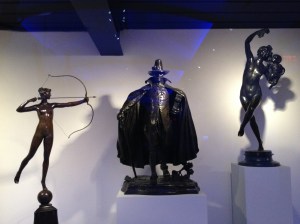
On a visit to the New York Historical Society museum I once looked at their somewhat abbreviated sculpture collection.  This isn’t the Met, after all.  One of the tricks I’ve learned about museum displays is that some curators place subtle humor in their framing of objects.  For example, my gaze was drawn to a figure of a pilgrim.  A stern-looking fellow, he’s captured in full stride, massive Bible tucked under his arm, determined frown on his face.  This is a man trying to create Heaven on earth, dour though it may be.  Taking a step back, my camera found a smile in this image.  On either side of this angry Christian were two naked women: one was apparently Artemis with her bow, the other perhaps a Muse.  The lines of the display draw attention to this juxtaposition.  There’s some humor here, intentional or not.

This also takes me back to yesterday’s post about Heaven.  Perceptions of what it is differ.  There’s a mindset like the pilgrim that sees a life of suffering being rewarded in the hereafter with endless bliss.  I do have to wonder whether too much hardship down here might not make one forget how to enjoy oneself.   It’s difficult to picture a Puritan in rapture.  It’s as if the journey—the hard road—is the real source of enjoyment here.  Each of us, I suppose, has her or his own view of Heaven.  Mine’s kind of like a library with all the time in the world without end to read.  Others, I suspect, would find paradise as a garden.  Yet others would see Heaven as a kind of museum, but it would be one where laughing out loud was okay, for the Curator definitely has a sense of humor.


Patriarchal Faith

One of the dynamics we see in present-day America is the worship of belief itself.  This is nothing new since faith is the “substance of things hoped for, the evidence of things not seen.”  It’s hard to trust in what you can’t see.  Trusting in trust may be tautological, but it’s also a natural development for something that evades proof.  If it goes too far, however, such religion becomes an idol.  Its teachings become secondary to its very existence.  Its rules, no matter how contradictory, must all be followed.  And those who believe are encouraged not to think too deeply about it since, if they did, this inherent inconsistency would be obvious.  The knee-jerk reaction of “the Bible says” is one such defensive measure.  I saw this all the time while teaching in seminary.

The other day I heard the melody of “Faith of Our Fathers” playing on the local church bells.  Interestingly, this is a Catholic hymn adopted by Protestants.  It’s kind of an anthem to this idea of worshipping the faith rather than the deity to which it points.  Consider the chorus: “Faith of our fathers, holy faith!/We will be true to thee til death.”  Originally a celebration of martyrs—those who found the courage to die in their steadfast belief—the hymn survives into an era when the perils besetting what used to be Christianity are less political and more scientific.  We live in a universe compellingly explained by science while politics has appropriated religion and counts on it to keep worshipping faith as an entity, regardless of distorted beliefs.  The hymn plays on.

Many public intellectuals are wondering about how evangelical Christianity could so easily divest itself of Jesus’ teachings and accept Trumpism.  Some have already begun to suggest that Trumpism is a “cult.”  (Religionists would say the proper term is “New Religious Movement,” since we no longer judge religions, no matter what forms of mind control they might prefer.)  The problem with experts on religion is that anyone can claim that sobriquet, bona fides or no.  Some of us have documented decades of official study of the phenomenon—those who paid attention in seminary and continued to pay for many years for a doctorate in this elusive field—but we’re are easily outshouted by those who take the words of this hymn literally, as they were meant to be taken.  Martyrdom comes in many varieties.  As I listen to the bells, I consider the implications.


Quaker States

Religions have always fascinated me.  Having grown up in one that was self-assured that it alone was right, I didn’t have much opportunity, as a child, to look closely at others.  I had to assume that other religions took their beliefs just as seriously as we did, but that they were dead wrong.  Majoring in religion requires a bit more broadmindedness.  We looked, as objectively as possible, at other traditions.  Still, Grove City College is unapologetically evangelical, so some professors weren’t shy about stating this or that belief was just plain wrong.  Things improved from then on, academically speaking.  By the time of my doctorate, and as an Episcopalian, I learned to distance myself a bit; dispassionate was the only way to be in the face of sometimes conflicting accounts.

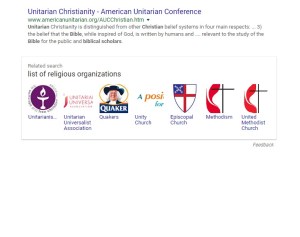
The other day, following my natural curiosity, I was researching Unitarian Universalists.  Having a strong biblical background, I was curious about this denomination that represents Scriptures quite differently.  The Google metrics brought up a page with logos of various traditions: the Unitarian one I recognized, as I did the Episcopal and United Methodist Churches, having been a member of both.  Then I noticed the symbol used for the Quakers: the Quaker oats man.  I was inclined to laugh and be horrified simultaneously.  The “Quaker” Oats symbol is a commercial mock-up, and had Google read Wikipedia it would’ve known that the company has nothing to do with the faith.  Capitalizing (literally) on the reputation of Quakers for purity, the company used William Penn as a model for a guy who wouldn’t cheat you.

Now that I live in the Quaker State (again), I’ve grown curious about the Society of Friends.  This is particularly so since they are one of the few Christian groups to have been expropriated by the commercial world.  Who’s ever heard of Presbyterian laundry detergent?  Well, with the exception of hospitals and caregiving institutions, which are happy to take the name of a denomination, religion is hardly a trusted commodity these days in these parts.  The Quakers do have a symbol—two superimposed, four-pointed stars.  Metrics, however, are based on search frequencies, I suspect.  As far as religious denominations go, the Society of Friends isn’t massive.  Far more people search for Quaker Oats than the actual religion whose name the company borrowed.  Such is life in these United States—the ultimate corporate venture.  Now a wholly owned subsidiary of The Trump Organization.


Holy NRA

A religious nation in love with guns leads to some strange juxtapositions.  In a home goods store that I won’t name—hey, you can have fun trying to find it!—we came across just such an oddity.  Appropriately for a franchise near Bethlehem, there was a framed painting of the holy family: Mary, Jesus, and Joseph, halos and all.  Completely surrounding the Prince of Peace and company were framed replicas of guns.  I’m sorry to state that the holy family, notwithstanding divinity, was sadly outgunned.  There’s only one such family, but of the making of firearms there is no end, and much shooting wearies the body.  Of all the weirdness that has plagued Christianity, this love of guns among the evangelical followers of the Prince of Peace has to rank near the top.

Believe me, I know what it is to be afraid.  I grew up with more than my share of phobias, and since buying a house different ones from my childhood set have come to light.  People want to feel safe, and the gun industry has successfully spread the message that a firearm or two will do the trick.  Often it backfires.  Those meant to be protected are killed in an accidental discharge or a domestic dispute turns deadly.  The real drawing power of guns, I think, is the sense of power.  The message in our society is that God wants you to protect your property.  That doesn’t mean that the government can’t take it away, but hey, at least you’ve got a gun, right?

I’ve always felt that ownership was a strange concept.  I look out the window and see the birds perching on “my” roof.  I see the squirrels digging in “my” yard.  I see the rain soaking “my” investment.  In what sense do I own this house?  Am I not just borrowing it long enough to live here while I’m alive?  We met one of the former owners.  Who lived here before him I don’t know.  I have no idea who built the house.  Besides, the money to purchase it came from a bank, and if I don’t pay my mortgage, the real “owners” will step forward and sell it to the highest bidder.  I own no guns.  They’re dangerous and costly and would I ever find peace after shooting anyone?  I look at the holy family.  Joseph and young Jesus have firearms aimed at their heads.  If the holy family isn’t safe, what hope do the rest of us have?


Horrible Delays

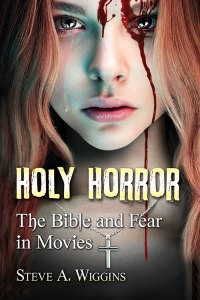
It’s not that the delay is actually horrible.  Horror movies, after all, come into their own with the darkening days of fall.  Nevertheless it occurred to me that now August is about to exit stage left, some may be wondering where Holy Horror is.  After all, the website originally said “August.”  The truth is nobody really understands the mysteries of the publishing industry.  Like so many human enterprises, it is larger than any single person can control or even comprehend.  I work in publishing, but if I were to subdivide that I’d have to say I work in academic publishing.  Further subdivided, non-textbook academic publishing.  Even further, humanities non-textbook academic publishing.  Even even further, religion—you get the picture.  I only know the presses I know.

It suits me fine if Holy Horror gets an autumn release.  I don’t know, however, when that might be.  I haven’t seen the proofs yet, so it’s hard to guess.  Appropriate in its own way for horror.  The genre deals with the unexpected.  Things happen that the protagonists didn’t see coming.  In that respect, it’s quite a bit like life.  My work on Nightmares with the Bible is well underway.  When you don’t have an academic post your research style necessarily changes, but I’m pleased to find that books can still be written even with the prison walls of nine-to-five surrounding one.  It may be a bit like Frankenstein’s monster (happy birthday, by the way!), but it will get there eventually.

Of my published books so far, Holy Horror was the most fun to write.  It wasn’t intended as an academic book, but without an internet platform you won’t get an agent, so academic it is.  It’s quite readable, believe me.  I sometimes felt like Victor Frankenstein in the process.  Pulling bits and pieces from here and there, sewing them together with personal experience and many hours watching movies in the dark, it was horrorshow, if you’ll pardon my Nadsat.  We’re all droogs, here, right?  I do hope Holy Horror gets published this year.  Frankenstein hit the shelves two centuries ago in 1818.  Horror has been maturing ever since.  So, there’s been a delay.  Frankenstein wasn’t stitched up in a day, as they say.  And like that creature, once the creator is done with it, she or he loses control.  It takes on a life of its own.  We’ll have to wait to see what’s lurking in the darkening days ahead.


Stand-in Line

Pop culture borrows from religion without knowing it.  Or maybe it’s just that religion has become so irrelevant that people no longer care.  Whichever may be the case, those who contribute to pop culture have a rich treasury from which to take withdrawals.  This occurred to me while waiting for a bus into New York.  Many people don’t want to stand in line (who does, really?).  In the Park-n-Ride subculture, you may leave an avatar in your place.  It’s probably not called an avatar, but since there’s nobody here to ask, I’m going to use the pop culture name.  You put your bag on the pavement, marking your place and then go sit in your car.  Since I’m going to be sitting in a big car for the next two hours, I prefer to stand outside.

The idea of an avatar is mediated to most people through either computer language or the movie.  I first encountered the term in the former sense in Neal Stephenson’s Snow Crash.  I was an internet neophyte and had trouble conceiving a virtual world in those days.  Some time later came the latter.  James Cameron’s film embodied the idea—linked through software, the tired hardware of physical bodies could be given new life.  In some senses it was an even better life.  Now everyone knows what an avatar is.  Perhaps except that the idea is native to Hinduism.

Hinduism was never an organized, intentional religion such as Christianity.  It is rather a wide array of traditional beliefs that, in the light of missionary activity, had to be given a name.  There are many gods in Hinduism, and when a deity descends to earth s/he appears in a form recognizable to humans—an avatar.  Not being an Indologist, my understanding of the concept is very basic, but it’s enough to know that this religious idea found a role in pop culture first through computer representations of human beings.  We had flattered ourselves with being gods, since we had created a virtual world.  A world we couldn’t physically enter.  Avatars were, therefore, how we wanted others to experience us.  Snow Crash is peopled with all kinds of representations.  The internet today, nearly 30 years on, has many more.  After all, there are many gods.

I glance at my watch.  The bus should be here any minute now.  When it enters the lot I’ll see the deities behind these canvas and leather avatars.  They’ll be less impressive than I’ve imagined them, I’m sure.  And although we’ve created virtual reality, I still have to get on a physical bus to go to virtual work.


The Persistence of Unity

I came across some Ray Bradbury books while unpacking.  I recently learned that Ray Bradbury was a Unitarian.  Now, the religion of a writer is only ever an ancillary bit of information, yet for someone of my combination of interests, it’s compelling intelligence.  Having grown up reading Bradbury, my own fiction often comes out seeming like an imitation of his.  I discovered him the way I found most of my early, influential writers—through Goodwill.  Living in a town with no bookstores, Goodwill was a great venue for walking out with a good handful of books for under a buck.  Since Mom was there looking for “practical” stuff, I hovered over the book tables and discovered a new world.  Then I grew up.

Embarrassed by my childish interests, I gave away or sold most of my Bradbury books after college.  I was more sophisticated than that now.  I read Greek and was soon to learn Hebrew.  Books were meant to have footnotes, and lots of them.  Who wants to be seen with Bradbury on their shelves?  But the indiscretion of youth does come back to haunt one.  About two decades later I began to yearn for something missing from my life.  Perhaps like a good Unitarian I wasn’t exactly sure what it was, but I knew it was lacking.  Then my daughter was assigned Fahrenheit 451 for school reading.  I tried to read whatever she was assigned, and once I did memories of Bradbury flooded back.  I no longer had his books, but that could be remedied.

Occasionally I’m criticized for having too much in the way of books.  I’m sometimes asked if I will ever read some of them again.  The answer is how should I know?  I jettisoned Ray Bradbury with Episcopal pretention, only to find that behind the ceremonial there was a more unified version of things waiting.  A continuity with my younger self.  A lust for imagination.  A desire to remember what it was like to walk on Venus.  Or to see a man presciently covered with tattoos.  Or simply to thrill at the idea of October.  I began to acquire the old books again.  The newer editions lacked the visual resonance of the old, but the essence was still there.  Orthodoxy, I discovered, often isn’t true to life.  What’s true is what we discover early on.  Sophistication isn’t all it’s cracked up to be.  And yes, I may well just read that again after all.