For the Squirrels

Our garage came with a house.  That’s one of the reasons we bought it.  You see, the one thing we don’t have is time.  (Well, that and money.)  When we were contemplating moving, we had no time off.  Vacation days for the remainder of the year had been allocated, and employers don’t like to encourage personal improvement.  Not on company time, anyway.  Which, of course, is as it should be.  We had to find a house with space enough to sort through things after we moved.  Ha!  As if there would be more time!  Still, the sorting would have to wait.  Our house has a detached garage with a second story.  It’s a converted barn, but I doubt its conversion story.  It still seems pretty heathen to me.  The neighborhood squirrels love it.

We store our unsorted stuff upstairs.  Shortly after we moved in, the squirrels had chewed through the stop-gap remediation the previous owners had put in place to satisfy our post-inspection demands.  It was pretty clear their solution wouldn’t keep out rodents, but our lease was about to expire and the market favored sellers, so we closed anyway.  Shortly after moving in I noticed styrofoam poking through the ceiling boards of the garage.  Then I began to find styrofoam chips in the yard nearly every morning.  I soon figured it out.  Squirrels raid the trash receptacles behind restaurants in town, and bring their carryout here.  No, seriously!  They haul styrofoam between the roof and ceiling, presumably licking off the scraps before tossing out the remaining foam.  I figure it’s a form of insulation, if nothing else.

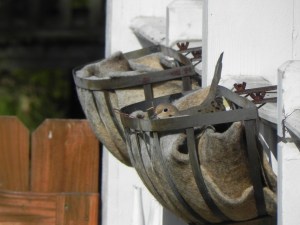
Squirrel remediation is on our list of projects.  I’ve seen the squirrels run up the side when they spy me stepping outdoors.  When I reach the garage, they’ll stick their little heads out the hole they chewed and scold me.  This is their place, the garage.  They’ve insulated it, and the inside is a mess where the birds also get in and there are little animal parties every night.  I don’t have time to clean up after the squirrels.  It occurs to me that if we didn’t have a throw-away culture we wouldn’t have styrofoam containers for the poor beasts to plunder.  The food’s probably not healthy—the squirrels I see look plump and sassy.  They like the convenience of living in a shelter someone else built and on which someone else pays the taxes.  Perhaps I should start a zoo.  But first I’ve got some stuff to sort through, when I find the time.  If only I could teach the squirrels some other tricks beyond dining out. 


Symmetry Synergy

Symmetry.  It’s pleasing to the eye.  And significant dates are often the basis for holidays.  Today is one of those extremely rare palindrome days.  As my wife pointed out to me 02-02-2020 is a configuration that hasn’t occurred since 01-01-1010, or over a millennium ago.  The next one will be after we’re all long gone, on 03-03-3030.  Not only that, but today is part of a holiday cluster.  It’s Groundhog Day.  Yesterday was Imbolc, the Celtic cross-quarter day initiating spring.  Imbolc is also known as St. Brigid’s Day.  Today is called Candlemas, by liturgical Christian tradition.  We are living through a truly unique day.  Every day, I suppose, is unique, but the spirits are afoot today.

I’ve written about Groundhog Day before.  With its prognosticating rodent, it tells us if spring is on the way or if it’s going to be delayed.  Imbolc falls about halfway between the winter solstice and the vernal equinox.  In Celtic cultures this was a cross-quarter day, a time of uncanniness.  Spirits cross between worlds on days such as this.  In days of yore, it was also the feast of the goddess Brigid.  Christianity has always been an opportunistic religion.  When missionaries to places like Scotland and Ireland couldn’t convince the locals to give up their deities, they made saints of them.  St. Brigid is a fabrication of a Celtic goddess, not an actual saint.  For similar reasons in the quarter-year counterpart to Imbolic, Samhain, the church moved All Saints Day to November 1 and All Souls to November 2.  The Celts continued using the trappings of their cross-quarter day and eventually gave us Halloween.  Imbolc never caught on in quite the same way.

The early Christians didn’t know when Jesus was born.  Christmas was established on December 25 because of all of the solstice celebrations at that time of year.  All that pagan jubilation had to be subsumed under a more solemn occasion.  Building on that mythical date, New Year’s Day was January 1 because that’s when Jesus would have been circumcised, eight days later.  Thirty-three days after a male child’s circumcision, a woman was to make an offering for purification in the temple.  According to Luke, Mary did this, and 33 days after January 1, in keeping with our fictional date-keeping, is February 2.  A tradition grew that Christians would bring their candles to church to be blessed that day (Jesus being the light of the world).  This blessing of candles was named Candlemas.  I first encountered it at Nashotah House, where it was still celebrated even as a sleepy woodchuck in Punxsutawney was rubbing his eyes.  Not exactly a palindrome, but there’s a remarkable symmetry to it, no?


The Reading Bug

With the sunshine coming in my office can feel pleasantly warm in winter.  I chose this location not because of its southern exposure, but because it is a small room and it’s a good place for books.  Although it’s January, the sun brought a shield bug to life the other day.  At first I didn’t know what it was.  I’d hear a loud buzzing followed by a rather obvious crash, but I saw no insect.  Since we had a string of sunny days it kept reawakening in the mornings, warmed by sunlight on my windowsill and spent the days climbing on and sometimes attempting to fly through the glass.  I identified the beetle quickly once I saw it.  As I watched the poor creature’s progress (or lack thereof), I was sorry that I couldn’t release it outside.  It was still quite cold out, and I didn’t think it would survive.

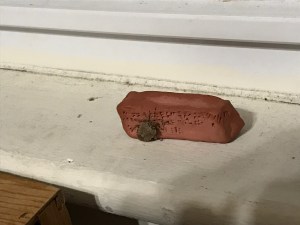
Spending long hours in the same room with my perplexed insect friend, I came to ponder what its experience of life was like.  I’m no Franz Kafka or Thomas Nagel, but I had to wonder when it chose to spend the night on a clay replica I had made of an Ugaritic abecedary.  I’d made this clay model when I was teaching, and I used it as one of several visual aids to help students understand how writing had developed.  (I had even ordered authentic papyrus to pass around, and the single sheet of vellum cost more than an entire book in those days.)  My doctoral work largely focused on Ugarit, and in the 1990s it looked like that sub-specialization might be on the ascendant.  We often live to have our mistakes rubbed in our faces.  But why had the shield bug picked this very spot to roost?  It looked as if it were trying to learn to read cuneiform.  It needn’t bother.

Although I habitually awake quite early, it isn’t easy getting out of bed.  Especially in a cold house during winter.  My entomological friend, of course, had to wait for the sun itself to come back to life.  Night on the windowsill can’t be comfortable, especially when the radiator is under the other window in the room.  No matter how much I try, I’ll never know if I’ve succeeded in understanding the experience of that bug.  How it is enslaved to the sun, and how it keeps on climbing, even after it falls, raising a tiny geyser of dust.  How it flies full speed into a barrier it cannot see, and then tries again.  I may not be able to understand this beetle sleeping on my Ugaritic alphabet, but I do think there’s something here to learn.


Cave Monsters

A story in Discover back in December discusses cave drawings from Indonesia.  Dating back almost 40,000 years before the creation of the world, these cave paintings represent the oldest yet discovered.  The interesting thing about such cave art is the representation of figures—both human and animal—that are instantly recognizable.  Scientists studying the art are able to identify likely species, but, as John Morehead pointed out on his Theofantastique Facebook post, there are also fantastical beasts.  We might call them monsters.  It’s interesting to see how scientific writers shift from their awe at life-like illustration to a nearly palpable embarrassment when the creatures become mythical.  Indeed, the article itself suggests such figures point to a very early sense of either fiction or spirituality.  The monstrous and religion have long trod parallel paths and we are only now beginning to explore the implications.

Monsters are beings over which we have no control.  They don’t abide by human rules and often the only recourse against them is religious.  When monsters come knocking, it’s often wise to drop to your knees.  Or at least reach for your crucifix.  Many rationalists like to claim that human civilization developed without religion.  The discoveries at sites such as Göbekli Tepe gainsay that assessment, indicating that humans first gathered for religious reasons and agriculture and all the rest followed from that.  Perhaps they came together for fear of monsters?  That’s only a guess, but I recall the defensive tower of Jericho.  The archaeologist lecturing us as we stood by this neolithic structure asked “What were they afraid of?”  He never answered that question.

Bringing monsters into the discussion isn’t an attempt to make light of these significant discoveries.  Rather, we need to learn to appreciate the fact that monsters are serious business.  Religion, whether or not literally true, is important.  Civilization has been running the opposite direction for some time now.  When surveys emerge demonstrating that the vast majority of the world’s population is still religious, analysts frown.  It does make me wonder, however, if nature itself programs us this way.  To other sentient creatures who experience us as predators, humans must look monstrous.  We come in a variety of colors and textures (clothing), we smell of deodorant, shampoo, soap, aftershave, or none of the above.  We emit strange sounds (our music).  Are we not the monsters of the natural world?  And should animals develop religion, would we not be one of the causes?  It’s just a guess, but I need to sit in my cave and think about it for a while.


Veg Out

It came to me vividly when I heard a speaker self-deferentially say he was crazy.  This was, I suspect, a way of defusing the fact that when vegans speak others often think they’re being judgmental or preachy.  I’m pretty sure this speaker wasn’t, and I try my best not to be.  It can be difficult when you’re passionate about something.  At the event, which included several people in age brackets more advanced than even mine, the question of “why” was predictably raised.  Apart from the rampant cruelty of industrial farming—some states even have laws preventing people from knowing what actually goes on in such places—there are other considerations.  One of them involves Greta Thunberg, Time magazine’s person of the year.

Global warming is no joke, no matter how much the Republican Church laughs it off.  Greta Thunberg has become the face of a generation with a conscience, but one fact few wish to know is that industrial farming is by far the largest environmental threat to our planet.  The amount of pollution it causes is staggering.  The rain forests are being cleared for grazing land because people will buy beef.  The largest methane emissions come from farms, not factories.  Our lifestyle of eating animals on an industrial scale is one of the many hidden costs to the modern way of living.  Or of dying.   There are doubters, to be sure.  It’s pretty clear, however, that the agriculture business is massive and it is just as powerful as the other great offender—the petroleum industry.

Making facts known isn’t being judgmental.  People’s eating choices are up to them.  I’ve only been a vegan for about two years now and I sometimes can’t comply with my own ethical standards when I go out to eat.  Or when other people give food.  Many places have no concept of dining without animal products.  I’m not trying to make everyone else accept my standards; I have beliefs about animals that are based both on personal experience and lots of reading about faunal consciousness.  I fully accept that many others don’t agree.  What I do hope, however, is that people like the speaker I recently heard will not have to jokingly call themselves crazy because they’re vegan.  The narrative must change.  We must be willing to look at the way we live on this planet, and accept the fact that just because major polluting industries hide behind large, brown cow eyes doesn’t mean we shouldn’t question what they feed us.  We need to look at our plates and count the cost.


Why not try Veg Out, Bethlehem’s new vegan restaurant, if you’re in the Valley?


Mad Dog

Like those who write long books, those who write very many books ask for some level of commitment from their fans.  I’m sure I’m not alone in wishing I had more time to read.  I tend to be driven to Stephen King’s novels by the movies made around them, and there’s nothing wrong with that I suppose.  I decided I wanted to read Cujo some years back when I was on a werewolf kick.  I knew it wasn’t a werewolf story, yet as one who suffers from cynophobia even a large household pet will do.  I didn’t know the story in advance, and I had no idea how it ended.  It’s good to read novels like that sometimes.

I took it with me to San Diego and read most of it on the plane, finishing it somewhere over the mountain west.  It is a bleak story, one of King’s more drawn-out and wrenching tales.  It’s made more so by the fact that it could happen, at least in the main storyline.  Or could have happened.  Maybe I waited too long to read it, but I kept thinking as I was going through—today we have cell phones.  A large part of this story unfolds because of Donna Trenton’s inability to contact anyone while a rabid dog keeps her trapped in her car during a record-breaking heat wave in Maine.  I suspect it’s kind of a story about redemption, but I really need some time to think about it before rushing to such conclusions.  There’s not much you can really consider religious in this particular tale, and perhaps it’s because Cujo is a very natural kind of monster.

I saw my first rabid dog when I was maybe five.  My brothers and I reported a dog acting strange to our mother, after which she kept us in the house.  That wasn’t the origin, I don’t think, of my cynophobia.  Two of my brothers were bitten by a family dog when I was little, and I was once chased by a dog about as big as I was, certain that it was going to eat me.  At the same time, we had dogs as pets, and apart from the one that liked to bite, they never gave cause for fear.  Cujo tapped into those memories and made me reflect on what it means to befriend wolves.  It won’t be my favorite King novel, but it did help to pass the time from coast to coast.


J L Seagull

Perhaps it has happened to you as well.  At some undisclosed period life became so busy that you felt as if—in a good southern California metaphor—you were riding on a huge wave and you couldn’t get off.  Back in my teaching days I had time to plan my trips to AAR/SBL and fit in some human activities as well as maybe even getting around to see the outside once in a while.  It’s great to run into so many people from every stage of my academic life—toddlerhood at Grove City College through my current doddering editorship—but I can’t help having the feeling that I’m popular now because I’m thought to have something others want.  The keys to the kingdom.  A possibility of getting published.

Those of you who read my daily reflections know that I’m glad to share publishing knowledge.  I encourage academic authors to learn a bit about the publishing industry.  It’s rapidly changing and when you have an inside track (here is the real added value) you need to look beyond your current book project to see what goes on behind the veil.  Widen the focus.  There’s a whole world out there!  My glimpses out the hotel window inform me that there’s an entire bay to be explored.  I watched seals or sea lions (it’s hard to tell from this distance) playing in the water as the sun rose.  Then a seagull flew up and landed inches from my face on the windowsill of my room.  It stayed for nearly a minute, looking me over as I looked it over.  Noticing the tiny white feathers that formed a W on the edges of its beak.  Its Silly Putty pink feet with small black nails.  The emerging red patch on the underside of its bill.  It took a step off the ledge, spread its wings and looked elsewhere for a snack.  I soon learned why.  A second later a larger gull landed in its place.  We too regarded one another curiously.  Had the glass not been there, we could’ve easily touched.  It also lept off to be replaced by an even larger, more mature gull.  None of the three were in any hurry to get away, but when they realized I couldn’t give them what they wanted, they left.

I’m a great fan of metaphor.  Academic writing, unfortunately, doesn’t encourage the craft of utilizing it (neither does it often encourage being coherent).  Later this morning—it will be early afternoon back home—I have to rush to the airport to catch a hopeful tailwind back east.  Someone else will check into my room.  If, perchance they sit by the window with the curtain drawn before dawn, the gulls will visit.  And maybe a lesson will be taken away.


Yeti Again Again

I wish I had more time for reading short stories.  I grew up on them since, like many young boys I lacked the attention span for entire novels.  Many collections of short stories sit on my shelves, but I’ve been drawn into the world of extended stories, perhaps because so much of reality bears escaping from these days.  In any case, I find myself neglecting short story collections.  I have a friend (and I tend not to name friends on this blog without their express permission—you might not want to be associated with Sects and Violence!) named Marvin who writes short stories.  This past week his tale called “Meh Teh” appeared in The Colored Lens.  Marvin often uses paranormal subjects for his speculative fiction.

“Meh-Teh” is a Himalayan term for “yeti.”  Since we jealously guard our positions as the biggest apes on this planet, science doesn’t admit yetis to the realm of zoology without the “crypto” qualifier in front.  Still, people from around the world are familiar with the concept of the abominable snowman.  Maybe because I grew up watching animated Christmas specials, I knew from early days that a mythical, white ape lived in the mountains, and that he needed a visit to the dentist.  The yeti has even become a pop culture export from Nepal, since those who know little else about that mountainous region know that strange footprints are found in the snow there.  Apes, however, like to dominate so we tend to drive other apes to extinction.  Still, they had to be there on the ark, along with all other cryptids.

I recall an episode of Leonard Nimoy’s In Search of that dealt with yetis.  Or was it a Sun Pictures presentation about Noah’s Ark?  I just remember the dramatic earthquake scene where either the skullcap of a yeti or a piece of the true ark was buried, lost forever under the rubble.  Yeti is also a brand name for an outdoor goods company based, ironically, in Austin.  This fantastical ape has become a spokesperson, or spokesape, for the great outdoors.  All of this is a long way from the story Marvin spins about the great ape.  As is typical of his fiction, religion plays a part.  I really should make more time for reading short stories.  In a world daily more demanding of time, that sounds like a solid investment.  And free time is more rare than most cryptid sightings these days.


The God Test

Humans don’t mean to be cruel, I’m pretty sure, when they test animals for intelligence.  We’re a curious lot, perhaps a bit too self-absorbed, but we want to know how other animals are like us.  Of course, we reserve actual thinking for ourselves, given how well we’ve managed to conserve our only environment, but we grant some special spark to our biological kin.  So we devise tests for them.  Since we can’t get beyond human experience, many of these tests are devised for creatures like us.  When animals fail our superiority is reconfirmed.  Then it’s back to the lab.  I’ve got to wonder how it feels to the subject of the experiment (or is it object?).  Some being that has mastered the art of capturing you, perhaps with the aid of alien technology, is trying to get you to understand something that’s only clear from its (the captor’s) viewpoint.  You need to suss out that viewpoint and solve the puzzle in the same way.

This makes me think of many forms of religion.  We’re born to a lower species (human) as the experimental subjects of gods, or a God, who watch(es) to see how we figure things out.  There’s a right answer, of course, but we’re only given hints as to what it is.  We’re given toys to play with—some of them dangerous—and we’re allowed to select clowns and buffoons to lead us.  We can kill off unthinkable numbers of our own kind and the only clue that we’ve succeeded is some tasty treat at the end.  Of course, we have to assume that the intelligence governing this whole farce is much greater than our own.  Doesn’t feel so good, does it?

Holism is the ability to see a continuity in all of nature.  And nature doesn’t just mean this warm globe on which we find ourselves.  It’s vast and mysterious and some parts of it are very cold and others very hot.  There are places we cannot go, and others that seem inevitable, given the choices.  Like the victims of bullies we don’t think about the larger system, but seek to impose our wills on those who see things differently than we do.  Some tote guns while others pack books.  All of us will shoo away insects that buzz too close.  Most of the animals “beneath” us will simply eat them.  Is this all a game?  Or is it some kind of experiment where we have to guess the answer, but with only a fraction of the information required?


Fly Away

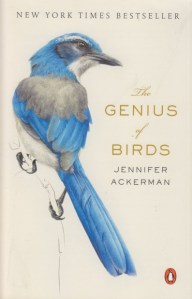
Humans can be quite likable, but we have some nasty traits.  One is that we tend to think of ourselves as the only intelligent beings on the planet.  The funny thing about evolution is that it gave us both big brains and opposable thumbs—a winning combination to destroy the planet.  (Just look at Washington, DC and try to disagree.)  Jennifer Ackerman’s The Genius of Birds is poignant in this context.  Page after page of nearly unbelievable displays of intelligence among birds demonstrates that we are hardly alone on the smarts scale.  Birds make and use tools, have better memories than most of us do, and can solve problems that I even have trouble following.  We tend to take birds for granted because they seem to flit everywhere, but the book ends soberly by noting how global warming is driving many species to extinction.

Homo sapiens (I’ll leave out the questionable and redundant second sapiens) like to think we’ve got it all figured out.  We tend to forget that we too evolved for our environment—we adapt well, which has allowed us to change our environment and adapt to it (again, opposable thumbs).  Many scientists therefore conclude that we are the most intelligent beings in existence.  Ironically they make such assertions when it’s clear that other species can perceive things we can’t.  Ackerman’s chapter on migration states what we well know—migrating birds can sense the earth’s magnetic field, something beyond the ability of humans.  We lack the correct organ or bulb or lobe to pick up that signal.  And yet we think we can rule out other forms of intelligence when we don’t even know all the forms of possible sensory input.  We could learn a lot from looking at birds, including a little humility.

The Genius of Birds explores several different kinds of intelligence.  What becomes clear is that birds, like people, have minds.  Like human beings they come on a scale of intellectual ability that doesn’t suggest only one kind is necessary.  For our large brains we can’t seem to get it through our thick skulls that we need biodiversity.  We need other species to fill other niches and our own remarkable ability to thrive has only been because we are part of a tremendous, interconnected net encompassing all of life.  Other species have contributed to our evolution as we clearly do to theirs.  When we end up thinking that we alone are smart and our own prosperity alone matters we are sawing away at the branch on which we sit.  Further up the birds look at us and wonder if we really know what we’re doing.


Mouse Trap

The other day a friend asked me about theodicy.  Not in so many words, of course, but the question was distinctly familiar: why would an all-good, all-powerful deity let good people suffer?  My response, hurried as it had to be, coming as it did on a work day, was that this was the classic question that had led to the dismissal of much belief among those raised in the Christian tradition.  It is, if you will, the Achilles heel of the non-biblical unofficial trinity of omnipotence, omniscience, and omnipresence.  The answer typically given is that people have only a limited view and, given that we can’t see the whole picture we’re in no position to judge a being who can.  That got me thinking about the whole picture itself, and whether there is such a thing already in place.

As a young person learning to think theologically, I had to spend hours discussing with peers and teachers what this might mean.  Time, they would assure us, does not affect God.  The Almighty stands (metaphorically) outside of time and therefore understands how all of this will come out.  And the final result will be good.  The orthodox would then chime in that an eternal Hell was necessary to punish sins that, in comparison, lasted only a short time, comparatively.  This would raise the question of justice again, and whether or not we were all marionettes in a puppet-show that really excluded free will.  You see, the other answer to the question of theodicy is that if humans have free will a deity can’t force us to do good.  Humans, they reason are responsible for making the good suffer.

With the weather turning cooler, we caught a mouse the other day.  Decades ago I opted for a humane trap since it seems unspeakably arrogant of me to kill another sentient being who’s simply trying to find food and stay warm.  From the perspective of that mouse, I must seem terrifying.  I’ve caught it in a metal trap.  I’m a hundred times its size.  It has no idea what I’m thinking.  When I catch mice I try to talk to them reassuringly.  It’s got to be disorienting to find yourself going from “o wow, peanut butter!” to “I can’t get out.”  If that mouse is thinking of a higher power I know that I can’t see much of the larger picture.  My view is local, compared to that of larger intellects than mine.  Still, I don’t want that mouse to suffer for being what it is.  I didn’t create it, but I do want to set it free to let it find its place in both space and time.


Burger Impossible

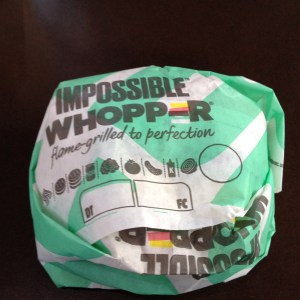
On the way home from Ithaca, we’ve learned the hard way to avoid I-80 through the Poconos on a holiday weekend.  Past experience indicates that about 80 percent of the population of New Jersey (to be fair, a percentage of that may be those from New York City) tries to squeeze through the Delaware Water Gap at just about dinner-time the day before work starts again.  There is a longer alternate route, I-476, the turnpike, which you catch north of Scranton and exit in Allentown.  The only issue with this plan is that, unless you want to exit the turnpike to try to find food in rural Pennsylvania, there’s only one travel plaza between our entrance and exit.  It’s a nice enough stopping point, but for a vegan on the road options are limited.  As we pulled in we noticed there was a Burger King.  Would they have the much touted “impossible burger”?

It turns out that they did.  Having last had a whopper well over two decades ago, mouth memory may have faded a bit, but I can honestly say this was like the whopper I remembered.  If you hold the cheese and mayo, you have a vegan version.  This discovery made me strangely happy.  For years at remote locations (and some urban) we’ve stopped when the only other options are meat based and had the BK veggie burger.  It’s not too bad most of the time, but if you want to think you’re eating meat while not contributing to the massive environmental degradation of industrial farming, the impossible burger seems like a reasonable option.  This is one area of technology that I’m glad seems to be catching up with ethics.

I often ponder how much our western point-of-view is based on the Bible.  Our reluctance to include animals in our ethics is another example of how the hard line between species has been applied.  Even scientists are susceptible to worldview bias.  When we realize we’re all part of a continuum of biological relatedness, it’s a lot more difficult to argue for our special place in the divine eye.  At the same time, insisting one’s ethics be applied to all is a form of fascism.  I’m just glad my conscience can be assuaged with some plant-based food options.  After all, I’ve been on the road for a few hours and I’m sitting here happy to be eating at Burger King.  It’s a matter of perspective.


Meatings

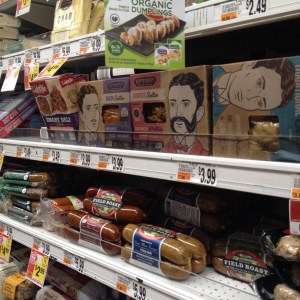
It was almost a little too real.  As I looked at the fake blood—this wasn’t a horror movie—I had a hard time accepting this wasn’t the real thing.  I mean Beyond Meat’s vegetable-based sausage.  My daughter recently sent me a captivating article about artificial meat.  Unlike many paeans to its virtues by fellow vegetarians and vegans, this was written by an omnivore who unabashedly stated that we’ve reached the point where synthetic meat has surpassed the real thing in flavor and the eating experience.  The piece on Outside made me glad.  Feedlots, apart from being the largest industrial polluters in this country, are a horror film based on a true story.  The way we treat “food animals” violates just about every ethical stance in the book, and it’s a big book.  We do it for profit, of course.  Now that artificial meat is turning a substantial profit, those who slaughter are starting to pay attention.

I recently ate at a local restaurant where our waiter recommended the cauliflower burger.  The thought wasn’t appealing.  Don’t get me wrong, I do like cauliflower.  I prefer it raw, however, since cooking brings out its more cruciferous qualities.  In any case, our server said, “It’s new on the menu.  We offered it once before and so many people requested it that we’ve made it a regular item.”  Now we don’t exactly live in a hippie haven here.  Still, enough people are asking for alternatives that we’re discovering it pretty easy to find plant-based protein in some pretty remarkable places.  It put me in mind of my most challenging course in college: biomedical ethics.

A class that asked, and then pressed on very sensitive questions, biomedical ethics required a term paper.  I wrote mine on animal testing.  This was back in the 1980s, and technology has moved on since then.  Even back in those dark ages of Reaganomics, artificial tissue was being lab grown, eliminating the need for animal testing on many products.  Now we’re reaching the point where the same may apply to comestibles.  I’ve long used vegetarian alternatives (now vegan ones) and they’ve increasingly improved.  When I had the most recent alternative, however, I couldn’t believe it wasn’t meat.  It was too real.  I’m not morally opposed to verisimilitude, I assure you.  The closer they get to the real thing, the better it is for the animals who’ll never need to be born to be killed by us.  It’s just I find the fake blood upsetting, and I’m happy to be reminded that this is only a simulacrum after all.


Funny Business

Do animals laugh?  The question sounds innocuous enough, and when my wife played me a RadioLab episode on that very question, the conclusion, although cautious, was that at least rats and chimpanzees do.  This is an instance in which the very question strikes me as terribly speciesist.  Despite the fact that evolution suggests otherwise, Homo sapiens are constantly seeking that fabled northwest passage that will separate us from animals once and for all.  One by one, over the decades, the defining traits have fallen aside.  Animals make and use tools, they build dwellings with ornaments, they solve puzzles, they communicate, and they laugh.  Were we not so obsessed with our own greatness (and consider whom we’ve elected over the past few years!) we might easily recognize that we have evolved to be what we are.

Perhaps it’s because we wish to retain our right to exploit animals.  After all, eating animals is big business and it’s harder to eat someone who’s not so very different from you.  In our culture certain animals are taboo for fodder: dogs, cats, and horses, for example.  This isn’t universally the case, and knowing that animals laugh might just make it a little worse.  We like to think animals “react” using “instinct” rather than respond with genuine emotion.  Until we fuss and fawn over Rover, and accept his affection as genuine.  Consciousness can be quite a burden to bear.  Funny, isn’t it?

We accept evolution up to a point.  Is it any wonder then that creationists still are a force with which to contend?  Often we fail to recognize that science, as it has developed in the western hemisphere, gestated in a largely Christian context.  The reason for drawing a hard line between animals and humans is ultimately, in this setting, biblical.  We’ve moved beyond the idea of God creating each separate species one-by-one, but we haven’t gotten beyond the literal truth of Adam naming and dominating them.  If we don’t consider the biblical origins of these ideas they continue unchallenged, even into the laboratories and sterile rooms of today.  It makes us a bit uncomfortable to consider just how influenced we still are by the Good Book.  At the same time we consider its meta view on the biological world, even as the evidence continues to pile up that little, if anything, really separates us from our faunal kin.  Try explaining that to the rats.  That sound you can’t hear without special equipment, by the way, is their laughing.


A Decade

Please pardon my being sentimental, but today marks one decade of blogging on Sects and Violence in the Ancient World.  I realized, thinking this over, that I used to make some interesting, perhaps even quotable statements back then.  Why not, I thought, farm those older posts to celebrate what I was thinking when I was a tenth-of-a-century younger?  So for today’s post, I’m presenting some quotable quotes from July 2009, starting with one of the zingers from my very first post.  For convenience, I’ve even provided the links to the posts so you can see them in context, if your July has somehow not filled itself up already.

Sects and Violence in the Ancient World, by the way, was the name given when one of my nieces thrust a recorder in my face and asked me what I would call a blog, if I had one.  She subsequently set this site up for me.  One aspect of the title may not have been evident: it’s a quasi-anagram for my initials.  It has been, from the beginning, mostly metaphorical.  Without further ado, then, a few of my favorite lines from a decade long gone:

“He had a sidekick called Cypher (sold separately), and arch-enemies with such names as Primordious Drool and Wacky Protestor. I marveled at the missed opportunity here — they could have called them Text Critic and Doctor Mentary Hypothesis!” First post: Bible Guy, July 12, 2009. <https://steveawiggins.com/2009/07/12/bible-guy/>

“Technology has outstripped reality.” Asherah Begins, July 13, 2009 <https://steveawiggins.com/2009/07/13/asherah-begins/>

“Black and white are not in the palette of serious religious studies.”  God is Great (not)?, July 14, 2009 <https://steveawiggins.com/2009/07/14/god-is-great-not/>

“When he [Aqhat] refuses to release it to the goddess he is unfortunately pecked to death in a hitchcockian demise by a swarm of buzzards with attitudes.” Sects and Violence, July 15, 2009 <https://steveawiggins.com/2009/07/15/sects-and-violence/>

“Indeed, one may think of them [religion and monsters] as fellow ventricles in the anatomy of fear.” Vampires, Mummies and the Holy Ghost, July 16, 2009 <https://steveawiggins.com/2009/07/16/vampires-mummies-and-the-holy-ghost/>

“Better to consider it [weather] human than to face unfeeling nature.” Changing Faces of the Divine, July 18, 2009 <https://steveawiggins.com/2009/07/18/changing-faces-of-the-divine/>

“As the gods are drinking themselves senseless (how else can the latest Bush administration be explained?)…” Drunken Moonshine, July 20, 2009 <https://steveawiggins.com/2009/07/20/drunken-moonshine/>

“As usual, we kill off what we don’t comprehend.” Not Lion, July 22, 2009 <https://steveawiggins.com/2009/07/22/not-lion/>

“A bonobo was recently documented as uttering the word ‘yes’ to a keeper’s question, officially making her more articulate than some clergy I’ve known. Even today there are churches that still call their leaders Primates!” Religious Origins, July 23, 2009 <https://steveawiggins.com/2009/07/23/religious-origins/>

“I never used a computer regularly until I began my Ph.D., and then it was only a glorified typewriter, qwerty on steroids.” Who We Were, July 27, 2009 <https://steveawiggins.com/2009/07/27/who-we-were/>

“I grew up in a blue-collar household where paying ladies for favors was itself considered a sin.” Yes, Mammon, July 28, 2009 <https://steveawiggins.com/2009/07/28/yes-mammon/>

Where do you suppose we’ll be a decade from now?