Identified or Not

Okay, so this will require some explanation.  It came about like this: I was in a used bookstore.  (This in itself requires no explanation, of course.)  I noticed a slim book, cover out, called A Pocket Guide to UFO’s and ETs: A biblical and cultural exploration of aliens.  Biblical?  I picked it up only to discover it was from Answers in Genesis.  Please note: I do not buy books or paraphernalia of Fundamentalist groups unless I can get it used.  I don’t want to support this particular weirdness in any way.  Well, the money for this used book was going to support a used bookstore and not a religious aberration, so I figured it would be good to see what the Fundies have to say about a topic that seems to have started to engage public interest again.

The book begins by helpfully pointing out that if there’s life on other planets the Bible doesn’t mention it.  And since the only way it could’ve got there is by evolution—for surely the Almighty would’ve said something about it in his book, if he’d invented it—the whole idea is a non-starter.  Evolution, as everyone knows, is a satanic idea meant primarily to challenge the Bible and secondarily explain the diversity of life forms on earth.  And since earth is the only planet the Bible recognizes, it is the only one with life.  So, UFOs, it stands to reason don’t exist.  Well, that’s not quite fair.  They do exist but most can be explained away and those that can’t may well be demonic.  Since there can be no aliens, and since some sightings can’t be otherwise explained, then demons—which the Bible does mention—must be responsible.  They (demons) can also explain why other world religions exist.

There’s plenty in here to offend just about everyone apart from the Answers in Genesis crowd.  The screed spends quite a bit of time knocking down ancient astronaut ideas, and taking Erich von Däniken to task.  Science is useful in explaining how pyramids were built, but not in how the rock used to build them was formed (it takes far too long to make limestone the old fashioned way; God simply used a variety of different rock types to make the one inhabited planet more interesting geologically).  And those UFO religions?  Inspired by demons, no doubt.  In fact, even reading a little book like this could lead you to become interested in the subject, so be careful!  In fact, the safest thing of all (and I’ve only got your well-being in mind) is to leave it on the shelf.


Adversaries

Satan isn’t who we think he is.  Inheriting a tradition from across centuries, it can be easily supposed that modern ideas help to explain the reality of that tradition.  Sorry, let me try this with more specificity.  The character of “Satan” does not occur in the Hebrew Bible.  By the time of the Gospels, however, he’s there.  We tend to use modern ideas of Satan to understand the enigmatic person of “the satan” in the Hebrew Bible.  Peggy L. Day explored this idea decades ago in her revised Harvard dissertation, An Adversary in Heaven: śāṭān in the Hebrew Bible.  Reading this took me back to those heady days when I consumed Harvard Semitic Monographs like breakfast cereal.  To those of us not from Harvard we pretty much knew what to expect, but we read anyway.  Scholars are like that.

In any case, Day here explores what is sometimes surprising to those who read the Devil back into the Hebrew Bible: the satan is mentioned in only four passages and in none of them is he “Satan.”  In Numbers the satan is identified as a good angel sent to knock Balaam off his ass.  In the book of Job the satan is a member of the divine council and he does his job by accusing Job.  Day shows, by the way, that his accusation is really against God and not the mere human sufferer.  Her outlook on Job is still amazing after all these years.  After Job, the satan appears in the short book of Zechariah to accuse Joshua the high priest of the restoration era.  He’s no Devil here either.  The final reference comes in Chronicles where instead of God tempting David to take a census a satan does.  By this time the reader already knows a satan is an accuser and need not be superhuman.

This monograph raises the perennial issue of how to understand ancient texts without chaffing under the weight of tradition.  The character of the Devil developed over many centuries and, when he appeared, he was only one of many iterations.  The New Testament made Satan “biblical” and later readers tried to explain the Devil (who came from Zoroastrian mythology) as part of the Christian divine economy.  In Judaism he went on to play a much lesser role.  Once Christian writers established this character, he was read back into the Bible, even where the original writers didn’t see him.  Day isn’t the first to have noticed this, but she handles it very well and her book is still thought-provoking after all these years.


Leggo My Lego

Given my proclivity to seek the profound in what is often considered the banal, I have been mulling over The Lego Movie.  Before you cast the first brick, yes, I know this movie is five years old and I know that it has sophisticated intertextuality with other movies and sly humor.  I use banal in the sense that Legos are, quite literally, plastic and they don’t work well in conveying the human form.  Our overactive psyches help here, and we give the characters their necessary humanity, but this is a movie for kids, even with its Trump-like President Business forecast some two years before the last election.  With all of that being said, and the word “forecast” already being used, my “Bible radar” zeroed in on the prophet in the movie, Vitruvius.

Vitruvius is based on a combination of Tiresias, the blind prophet, and any number of biblical characters who forecast the future.  Dressed like Moses, but named after a Roman author and architect, Vitruvius utters the prophecy at the beginning of the film and returns as a character that combines Obi-Wan Kenobi and the prophet Samuel.  (I said there was sophisticated intertextuality.)  Whether any of this is intentional is difficult to say—well the Obi-Wan part is pretty obvious—but it plays into the common view of prophets.  One of the points I make in Holy Horror (which deals with a different genre of movie) is that people understand biblical ideas through the lens of pop culture.  Prophets, through that lens, tell the future.  In the Bible itself they don’t do that very much, but since the New Testament reads itself into the Hebrew Bible (more intertextuality) the idea became pretty fixed that prophets told the future all day long.

Ironically, Vitruvius—a name that sounds like “virtue”—was famous for describing perfect proportions.  Indeed, Leonardo da Vinci’s “Vitruvian Man” sketch is based on this idea.  As ideas go, this is a false one against which many of us struggle our entire lives.  There is no perfect, Platonic human body.  Yes, certain people are attractive, but genetics and circumstances make us who we are.  And some of us grew up without Legos, but despite that deficiency we came to know the product.  The Lego characters aren’t in any sense of Vitruvian proportions.  Witty and intertextual, they’re made of plastic and they encourage us to buy for our children.  And one wonders whether Vitruvius is a prophet or a hidden symbol of that word’s homonym.  Let the building begin.


Q

If you haven’t spent much of your precious time attending to theories of how the gospels were written, you might not be familiar with the dilemma I’m about to describe.  A brief primer: Matthew, Mark, Luke, and John were not eyewitnesses of the events described in their gospels.  In fact, each of these books is anonymous—the titles were only added on later.  Despite their New Testament order, Mark was written first and Matthew and Luke borrowed from it rather extensively.  Mark is the shortest gospel and Matthew and Luke also share material that’s not in Mark.  Since John was written much later (and doesn’t have these common stories), scholars proposed many years ago that Matthew and Luke used a source—in German Quelle—that no longer exists.  This is called “the two-source hypothesis.”  As scholars are inordinately fond of abbreviations, Quelle is known as simply Q.  Other than in explanations like this you’ll never see it referred to by its full name.

So here’s the dilemma: many websites don’t allow for a single-letter search.  If you’re wanting to learn about Q, and you know no scholar worth their s (by which I mean salt, of course) who will spell it out, how do you search for it?  The same might be said for J, E, D, and P, who, along with R, put together the Pentateuch, but at least there you can search for phrases involving more than one letter.  You see, scholars existed before the internet and its search parameters.  Books and articles used to be written on paper, and the former had indexes, so looking up your sources—single letter or not—was fairly easily.  With electronic searching, it has become more difficult.  That’s not to say that single-letter searches can’t be coded—they can—but apart from biblical scholars and their alphabet soup of sources, apparently most people don’t want single-letter options.

This is the trouble with specializing in ancient things.  The internet was originally designed for academic and military purposes—serious stuff.  But then, like everything else in the world it became commodified.  Like a once pristine countryside it has billboards plastered everywhere after one’s Gelt.  (Scholars also like to throw in random foreign words to show how smart they are.)  And when it comes to searches, why enable atomistic, single-letter searching when it won’t end up in the sale of something?  In any case, my search did not end successfully.  I eventually gave up.  And in the light of the ever-shining internet, I’ve opted for the one-source hypothesis.

It must be in here somewhere…


Evil Origins

I remember well the eerie, uncanny feeling I had as a child reading Genesis 6.1-4.  This wasn’t a story we heard in Sunday School, and it wasn’t in any children’s Bible or Arch Books.  It was mysterious and strange, and not understanding what sex was made it even weirder.  The sons of God, or perhaps angels, came down from Heaven to mate with human women.  Although not stated directly, their offspring seem to have been giants.  Abruptly the story ends.  Archie T. Wright was clearly fascinated by this story as well.  His book, The Origin of Evil Spirits: The Reception of Genesis 6:1-4 in Early Jewish Literature, isn’t so much about demons as it is about the influence of this very brief, extremely odd story.

As a young person I knew about the book 1 Enoch.  Living in a rural town with no bookstore and no library (there was one in the town three miles away, but I didn’t drive and out-of-towners had to pay for a card), I had no way to read it.  Wright writes quite a bit about it here.  (In case you’re wondering, yes, in subsequent years I did read it.)  His history of transmission is a little suspect, but he explores the impact of these four brief verses on what can perhaps best be described as a diegesis.  This universe includes Watchers (the first part of 1 Enoch is called The Book of the Watchers), archangels, angels, evil spirits, giants, and demons.  Later Judaism moved away from this world, while early Christianity grew fascinated with it.  The mythology that emerged from it is sprawling and quite bizarre.  All encapsulated in a few verses before the flood.

Wright’s book is academic; it’s a revised dissertation.  Still, it’s a source more credible than a lot of what you find on the internet.  This particular biblical episode is an example of what happens when you don’t explain enough.  Granted, the writer likely had no idea that this brief account—shorter than a blog post—would eventually make it into a book that some people would consider from the anthropomorphic mouth of God himself, but because of this brevity questions, like angels, hung in the air.  As Wright shows, these verses were incorporated into ways of explaining the existence of evil in the world.  It was known by many names, and even took on personification in the form of Satan and his ilk.  This is a world of the unexpected, and it readily took me back to a childhood of wonder concerning the inexplicable passages in the Good Book.


Fear of Religions

There’s a narrative of fear in Christianity that seems to have been absent at the beginning.  This is evident when driving the highways of America where you’ll see billboards (which are meant for selling things) advertising the truth of a kind of biblical Fundamentalism.  On my recent trip across Pennsylvania this fear stood out in some rather obvious ways.  And it doesn’t reflect the Christianity reflected in the Good Book.  Stop and think about it: although the persecution of early believers was probably never as widespread as the usual narrative says it was, the writings we have describe facing persecution with joy.  Believing that they would be delivered, the oppressed welcomed the opportunity to prove their faith.  The Chick tracts I read as a child, however, focused intently on how scary the future persecution would be.  Fear, not joy, was the motivation for belief.

As we stopped in a turnpike rest area, we noticed a kiosk of Christian books amid snacks both salty and sweet.  The only other reading material available had to do with tourist attractions and finding directions.  It was, upon retrospect, odd.  Pondering this I recalled the narrative I heard repeatedly in my youth—a time was coming when it would be illegal to be Christian.  There would be persecution and the only proper response was a faith borne of fear.  This was not a religion of love thy neighbor.  No, this was a religion of armed survival based not on turning the other cheek, but on asserting itself with a show of firepower.  This kind of weaponized evangelicalism has taken over the narrative of Christianity.  Paul of Tarsus, knowing he would likely be executed, wrote of his joy from prison.  In the land of plenty we tremble.

The more cynical side of my experience suggests that politicians—who have learned that fear gets them elected—found in this form of Christianity a convenient set of sheep without a shepherd.  There’s fear in these billboards.  Fear that another religion may take over.  Or that secularism may make cherished beliefs illegal.  This isn’t cause for celebration, as the sermon on the mount proclaims it should be, but rather a call to arms.  In this country we have more than enough.  Among those left out, however, this fear grows just as rapidly as among those who fear they may lose the abundance they have.  They try to convert the weary traveler whose eye is drawn to the billboard.  And even those who stop for a drink of cold water which, the Bible suggests, should be freely given.


Thunder Towers

It sounded like brontide.  The Martin Tower, the tallest in the Lehigh Valley and once corporate center for Bethlehem Steel came down yesterday morning.  Completed only in 1972, the following decade saw the collapse of the steel industry, and the building has sat vacant a dozen years.  Now it’s gone.  The reasons the building could no longer stand are many and I won’t try to explain them as if I understood.  The fall of the tower, however, put me in mind of human folly and the belief that corporate profits will only ever grow.  Capitalism is built on a set of myths that the wealthy truly believe—I suspect many others do too, otherwise the system couldn’t possibly last.  Adam Smith may have been right academically, but in reality humans are greedy, venal, and shortsighted.   At least those who “rise to the top” are.

We didn’t move to the Valley for the steel.  Having settled in New Jersey just about when the Martin Tower was abandoned, like many other displaced academics I was looking for a job.  There were cities in the Midwest—we weren’t far from Milwaukee or Madison—but there was no work.  If you’re “overeducated” your best bet is to settle near a huge metropolitan area, as closely as you can afford to.  Then hang out your shingle.  Capitalism, however, has made New Jersey affordable only for the excessively wealthy.  Besides, I was born within the imaginary lines that we call the Commonwealth of Pennsylvania.  In fact, when I got my license transferred last year the computer asked me if I still lived in Venango County, where I was born.

I didn’t see the tower come down.  It’s not visible from my house, but it was always right there when I drove to Lowes to pick up some necessary hardware to survive in this area.  (Weed-whacker and lawnmower—reel variety.)  My mythology of towers always takes me back to Babel.  In the biblical worldview towers were a sign of arrogance.  God seemed to think they were trying to invade divine turf, and so he made it so we could no longer understand one another.  There hasn’t been a moment’s peace since.  We build towers tall to show what we can do.  We don’t really need an angry deity to come down and confuse our language any more.  We’ve got capitalists and their excess money to lead the way.  The sound of thunder roared and I divined just where such leadership will guide us.


A Nightmare or Two

Some books are complex enough to require a slow reading.  Alan E. Bernstein’s The Formation of Hell: Death and Retribution in the Ancient and Early Christian Worlds is such a book.  For those of us raised in a faith primarily geared toward avoiding Hell, the concept becomes a lifelong nightmare.  It doesn’t help that, depending on your clergy you’re taught different, sure-fire ways of achieving that avoidance.  Often it hinges on “believing” the “right” thing.  Fundamentalists tend not to call it “doctrine” since that sounds rather Catholic, but the idea’s the same; it’s a tenet of faith.  As Bernstein shows, however, Hell is an idea that developed over a very long time with several different views of what happens after death.  There’s no single, linear progression, but rather a conglomeration of ideas from a variety of sources.

No single volume can cover all the background to Hell.  Bernstein focuses on Egypt for the early material, as well as Babylonia.  These early civilizations demonstrate that people have always wondered what comes next, and what happens to those who oppress others—the bullies of this life who don’t deserve the same eternal rest as the rest.  Usually some form of punishment awaits, but not always.  In the Hebrew Bible one of the great issues was the fact that everyone goes to Sheol, good and bad alike.  As in classical Greece and Rome (on which Bernstein spends a great number of pages) the concept of the netherworld is gloomy, but not torture.  Except in exceptional cases, of course.  The Greeks had Tartarus as a place for those who dissed the divine.

Even early Christianity didn’t have a uniform view of it.  The New Testament is decidedly divided on the topic.  Revelation seems to be the last word, but it’s not.  Later thinkers such as Origen and Augustine (who came to different conclusions) weighed in.  Catholic Christianity lavished great love on the latter and Augustinian views became disproportionately influential.  Reading his lack of compassion can cause nightmares, although he justifies it theologically.  The one thing I missed in Bernstein’s lengthy treatment was the Zoroastrians.  This religion of ancient Persia introduced a distinct dualism into the biblical world; it perhaps represents the first relatively developed concepts of Hell and Heaven.  Zoroastrianism suffers from lack of documentation, however, and it is difficult to parse it as meticulously as Bernstein does the other cultures covered.  This book requires much pondering as it’s read, and if you were raised believing this kind of thing it’s sure to bring back a nightmare or two.


Horizontal Thinking

“Theology” is a word that means very different things in different contexts.  I dislike labels in general and I seldom call myself a “theologian” since that implies a systematic or “dogmatic” theologian on this side of the Atlantic.  (And a better paying job.)  In the about to exit Britain “theologian” tends to mean someone who studies religion and can be used regardless of discipline.  In any case, I avoid the use of the title since my interests tend toward the history of religious ideas, not making them into a workable system.  I was a little surprised when I received an invitation from the journal Horizons in Biblical Theology to contribute a piece on horror and the Bible.  The issue in which the article was published (41) has just appeared.  Ironically, invitations to contribute seldom came when I was employed as an academic.  Of course, “independent scholar” is now a fairly common avocation.  Especially in theology.

Horizon

I won’t post any spoiler alerts for the contents of the article—I don’t want to quell the stampede of those eager to read it—but the basic idea is that biblical studies has embraced horror.  Like long-lost cousins, they have come together at last, realizing that they are both pariahs.  People generally don’t know how to carry on a discussion with a biblical scholar, as if those of us who spend time with the Good Book are constantly judging others.  I can’t say as I blame them since that image is reinforced fairly constantly.  Horror scholars, on the other hand, are thought to be weird examples of arrested development—stuck in the juvenile phase.  Social respectability isn’t their strong suit, although horror movies do well at the box office and one of the most successful writers ever is Stephen King.

Religion and horror share more than being associated with troglodytes, however.  Both address primal human fears.  Religion may not be “all about” fear, but a healthy dose of it is.  If life was peachy all the time, would we have any need of religion?  We need help coping with our fears, and religion has a long history of dispensing it.  Knowing we’re going to die, and in all likelihood will experience some suffering before that, whether physical or psychological, is a heavy burden to bear.  Religion has always been there to provide meaning and sometimes even solace.  Horror, or at least the best of it, does so too.  I’m not sure I would call it theological, but if you’re interested you know where to find my latest musings on it.


If Onlyists

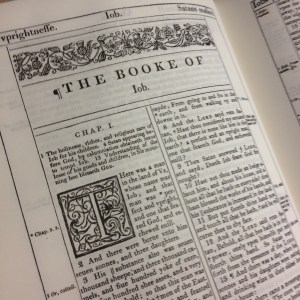
A special brand of Fundamentalism called King James Onlyism is a particularly odd variety of faith simply because of its required backing and filling.  In brief, this particular evangelical position claims that the only inspired translation of the Bible is the King James Version.  It’s best not to look too closely at the KJV, however, or the problems start.  Primary among them is that the version most Onlyists cite is not the original King James.  Published in 1611, this translation is immediately evident by its use of “I” for “J” and for the long s (the one that looks like an f).  Perhaps more troubling for Onlyists, it also includes the Apocrypha.  There was still some debate at the time concerning the status of these deuterocanonical books, and they were part of the actual KJV.

The typical King James used by Onlyists is a revised KJV.  In England, where the translation was done, revisions were made from time to time, leading to an Oxford version (Blayney text of 1769) and a Cambridge version (Scrivener text of 1873).  On these shores further adjustments were made leading to the rather strange situation where there is no single King James Version of the Bible.  There are many King James Versions.  Attempts to control Scripture often end up like that.  The underlying problem is the belief that there is a single version of Holy Writ.  Inerrantists are pledging their faith to something that doesn’t exist.  Defending this approach many would claim that the revisions are minor, but small changes can make huge differences.

The belief in one single version relies on the belief that God inspired not only the original writers, but the translators as well.  It denies that the better manuscripts that have come to light since the early seventeenth century (including the Dead Sea Scrolls) contain any authentic information of what the Good Book says.  Textual criticism, in the absence of any original manuscripts, is the best way we have of discovering what the original likely said.  Onlyists argue that the manuscripts from which King James’ translators worked were the divinely selected ones and their work was inspired—a position against which no empirical proof can be offered.  This faith trades in certainties that only bringing in direct heavenly control can achieve.  And it means that Catholics are wrong, despite King James’ inspired error to include the Apocrypha.  That’s the thing about a trump card like inspiration—once it’s played there’s no way to overcome it.


Chilly Fluids

I’m not sure why I did it.  Read In Cold Blood.  I’d known of Truman Capote’s main claim to fame for years, but an accidental recent mention, a cheap copy in a used bookstore, and a week of grabbing time to read did it.  I’m not a fan of true crime, and despite my fixation on horror movies, I try to steer away from anything that doesn’t have a hint of the speculative about it.  There’s a difference between horror and terror.  I’d happily lived a half-century without ever hearing about the Clutter murders and kind of wish that were still the case.  Yes, there are doubts about the veracity of Capote’s account at points and novelists are often convincing liars, but still, at the heart of the matter more than just four people are senselessly murdered in the course of the tale.

A few elements stood out in the reading of the book.  One was that given the naiveté of the 1950s I wonder how anyone could ever really want to go back to that decade.  We’re run by a government full of doddering old men who seem to idealize the falsity and utter conformity of an age that was really a pressure cooker in which cases such as this would explode.  I was born in the much idealized 1960s but I don’t think we should go back to them.  We learn, we change, we grow.  Knowing what we now do, it was kind of painful reading how blissfully ignorant so many people were.  We may be more afraid these days, but at least we’re more realistic.

Another factor, very much at home in this world older but no wiser, is how the Bible is cited at the trial in support of capital punishment.  Although it may not have been intentional on Capote’s part, he demonstrates a deep truth about Scripture.  It can be read in more than one way.  In conservative Kansas in 1960 it could sway jurors to seek the death of other human beings.  The murders were indeed savage and pointless.  Capote’s account of them is difficult to read.  Perhaps more difficult is the way the Bible is used to unleash the basest instincts of people against other human beings.  Yes, parts of the Good Book require the bad thing, but if we’re over fifty years beyond Holcomb we’re over fifty score beyond a time when just one interpretation stands for all.  If it ever did.  There’s a difference between horror and terror, but the Bible can participate in both.  I prefer to stick to the former.


The Root of All

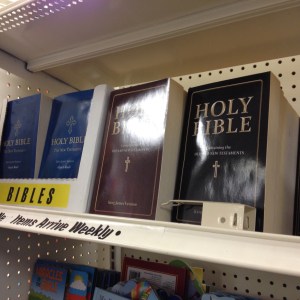
The other day I was in one of those stores where everything is sold really cheaply.  I figure it helps balance out all those times when I’ve been overcharged for things at other stores because I was pressed for time and needed something quickly.  In any case, these dollar store establishments have a constantly rotating stock, it seems (things move at a buck!), and so you might or might not find exactly what you’re looking for.  While just looking around, acquainting myself with the content, I came upon a shelf of Bibles.  God’s word for a dollar a pop.  This isn’t a place I’d normally come looking for books.  Then it occurred to me: many of those who shop in such stores are committed to a faith that keeps them in their economic bracket.

That suspicion was confirmed by other items at the store.  Many of them were Christian-themed.  This seemed like the opposite of the prosperity gospel.  People trying to scrape by, to shave enough off the budget to make it to another paycheck.  Many Americans live like this.  Many of them support Trump.  Selling the Bible to them cheaply definitely involves a mixed message.  There’s indeed a message, as I’ve learned in the publishing, in the way books are priced.  Getting a thousand-pager printed where the unit cost is below a dollar requires a massive print run.  Someone knows that Bibles sell.  You won’t find such cheap divine revelation at Barnes and Noble.  The same content, maybe, but not at the same price point.

The economics of cheap Bibles contains a message.  Those who can’t afford much can be guided toward spending some of it on the Good Book.  While just reading the Bible may indeed bring comfort to those who know where to look, as a whole this book requires major interpretative work.  As I’ve been indicating over the last several days, Holy Writ is not nearly as straightforward a reading experience as many suppose it to be.  Trying to figure out what Nehemiah’s differences with Sanballat the Horonite have to do with the rest of us isn’t an easy task.  To find out, if the internet doesn’t give us quite all the knowledge we want or need, can require some intensive study, up to and including seminary.  Even then you might not get it.  Studying the Bible requires further commitment than simply picking one up for a Washington might imply.  But then, it costs less than a lottery ticket.  And you can get it while saving money on other things you need.


Eastern Canon

It’s complicated.  The Bible, that is.  Tracing its origins as a book can easily occupy a lifetime, but the issue that keeps coming up with Scripture is how, definitively, to close the canon.  If we should.  My research on demons lately has led me once again to the books of Jubilees and 1 Enoch.  The latter has long been popular with the paranormal crowd because it has some weird stuff in it.  Thing is, as I mentioned back in November, these two books are part of the biblical canon of the Ethiopian Orthodox Tewahedo Church.  And the Eritrean Orthodox Tewahedo Church.  That makes these two books by definition “biblical.”  You won’t find them in nearly any printed Bible in the western world, although you can locate them in collections of the Apocrypha and Pseudepigrapha.

This privileging of the western canon has implications.  How do we know what really belongs in the Bible?  Judaism never officially closed its canon, but by consensus the same books contained in the Protestant Hebrew Bible (aka Old Testament) are those recognized.  Early Christian writers had different Bibles.  It took almost four centuries for them to agree  generally on what should be included.  In Europe, that is.  Not all branches of the church were represented in the Council of Rome.  Instead of waiting for the consensus of all—there was an urgency to stomping out heresy—the decision was made.  For some.  Meanwhile other Christian groups continued to use certain books that “the official” closing of the canon left out in the rain.  Or the desert.  Whichever.

The question of just what’s in the Bible goes a bit deeper than that.  The Tewahedo Churches of eastern Africa also recognize the books of 1 and 2 Maccabees.  “So?” did I hear you say, “Catholics recognize them too—what’s the big deal?”  These books, however, in the Ethiopian and Eritrean canons are not the same as western 1 and 2 Maccabees.  The books of the Mäqabeyan contain different content while maintaining the same basic name.  This means that we’re gonna need a bigger canon.  What’s more, these books have been pretty much ignored by biblical scholars.  One of the reasons, no doubt, is that they are written in Geez, a language not on the menu of too many seminaries.  Simply to dismiss them, however, is to ignore the belief system of over 50 million Christians.  It seems that the version of the Good Book tucked under the arm of many an evangelist is the condensed version.  Putting together a canon, it appears, is more complicated than it looks.

Not that kind of cannon! (Photo credit: Walther Hermann Ryff, via Wikimedia Commons)


Chapter and Verse

Maybe like me you’ve read some arguments based on chapter and verse.  I should mention that I mean chapter and verse in the Bible.  The typical scenario will go like this: Genesis (say) uses this word three times in chapter 38.  The case then often slips to making a point on the number of instances a word or phrase occurs within a circumscribed set of verses.  (The actual word doesn’t matter—this is a thought experiment.)  When I ran into an example of this a few days ago a thought occurred to me: chapters and verses are later additions to the biblical text.  They were never part of the original and were only added because Bible readers got tired of saying “That part in Genesis where…”  In other words, chapter and verse are artificial means of interpreting the Bible.  They’re very useful for taking quotes out of context.

I used to tell my students that you have to think carefully about what is the Bible and what isn’t.  As a culture where the book has instant recognition, we tend to think of that discrete unit of pages and cover as coming from one person—the author.  In reality most books (I can’t speak for the self-published) are the work of several people.  Just like it takes a community to raise a child, it also takes one to assemble a book.  That includes the Good Book.  Not everything between the covers is sacred text.  I’m pretty sure about that since as I was glancing through the latest edition of the New Oxford Annotated Bible I found my own name in the Preface.  As much as I’d like to claim otherwise I’m not exactly biblical. 

Modern ways of looking at ancient texts require a degree of facility in understanding how God’s scribes of yesteryear went about their work.  While early experiments in binding books may go back close to the time when the latter parts of the Bible were being written, the scroll—without chapter and verse—contained only the words of the text.  Most ancient manuscripts in Greek, anyway, didn’t even bother to put spaces between the words.  That leaves some room for ambiguity in among all those letters.  The Bible is a complex book with a complex history.  We do it a disservice as modern readers treating it as a modern book.  If you read Scripture online, or via electronic media, an even further layer of interpretation has been added.  That’s why we still need Bible scholars tangled somewhere in this world-wide web.


Spoken Against

“Antilegomena” is a word that appears more often in New Testament studies than it does in those of the Hebrew Bible.  Still, it’s an important part of the discussion of “the Bible,” especially since Heaven stands at the end.  Antilegomena is the Greek word for “disputed texts.”  You see, when the Bible was being compiled, there were many books from which to choose.  The twenty-seven books generally recognized as the New Testament included several that were disputed.  The Antilegomena included these books: the Gospel of the Hebrews, the Apocalypse of Peter, the Acts of Paul, the Shepherd of Hermas, the Epistle of Barnabas, and the Didache, all fine and good.  But the list continues: James, Jude, Hebrews, 2 and 3 John, and Revelation.  This final half-dozen made the cut, although Revelation is still disputed in some quarters.  All of these books were, however, in some early Christians’ Bibles.  The exact date that the New Testament canon was fixed isn’t certain, but it wasn’t widely recognized until the fourth century C.E., that is, over 300 years after Jesus.

The first time I learned about canonization in college I was shocked.  Like most people raised on the Bible, I believed that it had come, fully written, from the hand of God.  Maybe there was even an autographed copy somewhere.  Grove City College, at the time, disputed the Documentary Hypothesis of J, E, D, and P, but to the credit of the religion department they did tell us about it.  Moses, of course, we were taught, did the actual writing.  But then there was the problem of the New Testament.  There were other gospels, some as old as those that made it into the Bible.  The realization dawned that “the Bible” was much more complicated than I had been led to believe.  And what was up with the Apocrypha?

One of my professors said that the problem with inerrancy is that it proposed a Bible more perfect than God.  I’m not sure that I follow the logic there, but I take his point (they were all “he”s, whoever he was).  The Bible may not be a perfect book  There are parts missing and repeated bits.  It is nevertheless one of many sacred books from around the world, and it is the holy book of much of Christianity.  From the very beginning some of the contents were disputed.  Even as an undergraduate I had some inklings that a journey that involved taking the Bible seriously was going to lead to some strange places.  That single book that had always been presented to me with a definite article—“the” Bible—was actually a book that the earliest followers of Jesus didn’t know.  And they seem to have got along fine, as far as getting to Heaven goes.