Read, Mark and

One of the persistent questions of Christianity, given that there are four Gospels, is how to account for the differences between them.  The issue isn’t unique to Jesus-followers, however, as the composition history of the “books of Moses” shows.  Discrepancies in Genesis got the whole ball rolling, after all.  In fact, once I learned about historical criticism I decided that I’d better stick to the Hebrew Bible—there are some things you just don’t want to know about your own faith.  The way doctoral programs are set up these days, you can’t specialize in both testaments anyway, although that’s becoming a lot more common among scholars in these latter days.  In any case, I was reading about the Gospel of Mark lately and the question kept coming up of whether certain phrases went back to Jesus, were coined by Mark, or had their origin in the early church.

The picture that emerges from this kind of jigsaw gospel is of Mark sitting down, pulling his sources together like a graduate student in the days before computers.  Only Mark won’t get a doctorate when he’s done.  More recent scholarship asks the question of what if Mark wasn’t really a completed book after all—we read the gospels through lenses that were ground in the eighteenth century, at the earliest.  Nobody thought to question that Moses or Mark would sit down to write a book just like anyone did then.  (People writing books on their phones in electronic form only, as they do these days, will play havoc with future historical critics and their theories.)  Maybe these weren’t meant to be finished books.  Check out Gospels before the Book by Matthew Larsen and you’ll see what I mean.

The Bible, in other words, is a very complex book.  We know little of its authors beyond Paul of Tarsus.  We don’t even know that they were setting out to write Holy Writ.  Bible is a matter of interpretation.  As I thought about Mark—whoever he was—shuffling his papers about, mulling over what it would mean to become the first evangelist, I thought how like us we’ve made not only God, but also the writers of sacred texts.  True, they weren’t worried about tenure committees, or bad reviews, or being accepted by prestige presses.  It seems, however, that they were also not thinking of what readers down the millennia would do with their words.  When it’s all done we still don’t know who said what, but at least we have persistent questions that can’t be answered.  And job security ensures that Bible reading will continue as long as there are discrepancies to debate.
Absalom v. Occam

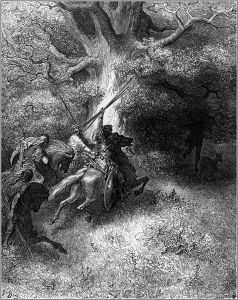
Getting a haircut is like going to confession.  You don’t go as often as you probably should, and you feel embarrassed and awkward when they ask how much you want taken off.  The penance of looking funny several days afterward ought to be punishment enough, without your head feeling cold once shorn of its natural covering.  At least in my experience.  The truth is I like long hair.  Biblical-length hair.  The truth is also that many people think it inappropriate for a guy my age.  I always eventually bow to peer pressure, but it can take a while.  Beautician forgive me, it has been six months since my last haircut.  Absalom, after all died because of his long hair. O Absalom!

This isn’t just idle musing on my part.  I grew up in the Evangelical tradition that is now ripping our nation apart.  One of the greatest markers of that faith is conformity.  In college I learned to call it the “Evangelical haircut.”  Any guy who had hair over his collar or ears was suspect of not being “Christian.”  I began to notice that this same mindset preferred well manicured lawns, cutting down trees and keeping outward appearances neat and tidy.  There’s no better way to mask what goes on internally than to present an outward look of a well-ordered world.  Getting a haircut always brings this back to me—it is a statement being made.  I’m not sure how to explain this to the poor girl standing there with scissors in her hand.  I don’t want to look Evangelical!

Of course, the beard helps.  Until recently Evangelicals didn’t permit beards.  The girls in college said they made men look unclean.  As if they were never washed.  And these days some Evangelicals have come to support the stubble beard—electric razors, those allies of Occam, can be purchased to keep the half-way bearded look fresh.  I prefer to get my money’s worth out of a haircut.  I also prefer to signal that I am not one of them.  Absalom may have been an overly ambitious young man, but despite Michelangelo’s famous statue, David the man was himself in all likelihood bearded and might’ve sported a mullet.  Samson wore dreds.  Uncomfortable with history, Evangelical illustrators in the ‘80s began portraying Jesus with a Roman haircut and neatly trimmed beard.  Perhaps I’m overthinking this, but now that I’ve got Samson’s fate in mind I find it difficult to open the door, knowing I’ll walk out after confession not feeling so much redeemed as just plain chilly.  Even Absalom, I remind myself, had his hair cut once a year.


Getting Dirty

Composting is a very biblical activity.  Adam, according to the second creation account in Genesis, was formed from the divinely created dirt.  Some scholars try to capture the word-play in that story by suggesting “human” was made from “humus,” but since that sounds like chickpea dip it may not help so much after all.  Besides, we now know that soil has a complex and fascinating history.  Erosion grinds up rocks.  Organic matter dies and decays, forming the loosely packed substrate in which plants can survive, slowly breaking up the more dense pieces through the transformative power of water.  It is, imprecisely speaking, a miracle.  When Adam drops dead, he becomes once more part of the soil from which he was formed.  It’s poetic.  Elegant.  Economical.

Now that we have a house we’ve decided to try our hand at composting.  We’d considered it many times over the years since, what with recycling and hoarding, we’d managed to get our weekly garbage down to one fairly small bag.  Besides, since our government won’t be nice to the planet, somebody has to.  Institutional people that we are, my wife and I had to read up on composting before giving this very natural decomposition a try.  Things have to be just so for the process to work perfectly.  It was in the process of this reading that the biblical aspect became clear to me.  

The trick is to make sure the neighbors don’t complain about the smell.  That, in part, determines what can or can’t go into the compost bin.  Meat and dairy can’t go into the mix.  Since I’m primarily vegan such things aren’t generally here to be disposed of in any case.  Even the drier lint can go there, for the clothes that we wear become part of who we are, right Henry David?  And here’s where there’s a danger of TMI, although it’s good theology—cast-offs from our selves can also be composted.  Hair, for example.  The composting literature we have seems to take Adam himself out of the equation by specifying pet hair, but hey, mammals are mammals.  The longer I thought about this, the more obvious it was that burial, ideally, is a form of composting.  Giving back to the earth from which we’ve sprung.  That simple wire bin out by the garage is in the process of making the substrate for new life.  We may not be farmers, or gardeners like Adam, but composting feels like giving back somehow.  It’s an act of creation.


Sinful Thoughts

Nothing is quite so scary as that which is undefined.  I learned that as an Evangelical child.  There’s a verse in the gospel of Mark—I’ll use Mark because it’s the earliest, by consensus—that reads, “Verily I say unto you, All sins shall be forgiven unto the sons of men, and blasphemies wherewith soever they shall blaspheme:  But he that shall blaspheme against the Holy Ghost hath never forgiveness, but is in danger of eternal damnation.”  Now, that was heavy stuff for a kid.  There was an unforgivable sin.  Naturally, the mind goes to what exactly blasphemy against the Holy Ghost might be.  I hadn’t learned much about context by the point, but Mark places this statement right after the good people of Capernaum accuse Jesus of casting out a demon by the power of Satan.  In context the unforgivable sin in stating that what comes from God is of the Devil.  By extension, vice versa.  Keep that in mind.

A few chapters later Jesus is describing sin again.  This time he lists: “evil thoughts, adulteries, fornications, murders, thefts, covetousness, wickedness, deceit, lasciviousness, an evil eye, blasphemy, pride, foolishness.”  If you read the news these characteristics sound very much like the repeated and continued behavior of 45.  Jesus himself cites this as evil—and here’s where it’s important to remember the unforgivable sin—to claim that such things come from God is blasphemy against the Holy Ghost.  Yet Evangelicals are doing precisely that.  Every time they exonerate Trump and his ground in behavior that for any other human being would be condemned as “sinful,” they are committing the unforgivable sin.  And they’re not even scared.

When I was a child, Evangelicals took the Bible seriously.  It was more important than anything—even railroading anti-abortion judges through to the Supreme Court.  Little known fact: Evangelicals of the 1950s supported abortion.  Since that time they’ve lost their faith.  And their mind.  Sucked into a political activism controlled by forces they don’t understand—if any man have ears to hear, let him hear—they committed the unforgivable sin that kept me awake countless nights with the fires of Hell roaring in my head.  I set aside the gospel of Mark and scratched my head.  How’d we come to this?  A nation, one might say a house, divided against itself.  The kind that Jesus, again speaking of Satan, declared could not stand.  No wonder Evangelicals avoid the Bible these days.  It is a very scary book.


Rich Rule

The perils of plutocracy should be obvious, but clearly they’re not.  This is somewhat ironic among its biblical fan base, which seems to be where the GOP draws its energy.  As the truth about Brett Kavanaugh becomes public knowledge, his religious supporters dig in their heels and blame the victims.  As one of the many who grew up far from privilege I found Shamus Khan’s analysis in the Washington Post eye-opening.  Khan makes the case that those who grow up in rich families and attend the “best schools” are endowed with the constantly reinforced message that the rules do not apply to them.  They can get away with things that others cannot and, in general, they are let off the hook for things that lead to imprisonment for other citizens.  What’s surprising is the Bible-thumpers applaud this.

It also explains more than Kavanaugh.  Trump is also a child of privilege and his entire term in office so far has been one of personal exceptionalism.  Many actual presidents were impeached or censured for acts far less offensive than those 45 commits.  The wealthy, however, are not held accountable.  Where is the Bible when we need it?  The Good Book is no friend to those who enjoy great riches.  In fact, one of the most constant refrains of Scripture is that against the privileged.  With great wealth comes great responsibility—the obligation to help those less fortunate.  The idea of getting away with what you can is hardly evangelical.

If the literalists can overlook the misuse of wealth, it is still more surprising that they can pardon lying.  Since the rules do not apply to the privileged, their own narrative bears the conviction of righteousness.  They can’t have made a mistake since their money proves them right.  Morality can be counted in dollars and cents.  It is for those of the underclasses to come up with high-minded ideals and hold themselves to them.  Wealth is its own justification.  Back in the days when America was young, the French lost patience with governance by the elites.  But then, the Fundamentalist class didn’t have much of a voice then.  It was the Age of Reason.  An Age out of which we’ve apparently grown.  Fake news, alternative facts, heavy-drinking frat boy justices, and women-groping presidents.  Can we not see the parallels with the other great plutocracy of the Roman Empire?  Ironically, it survives today only in the form of the church it sanctioned.


Riveting

The days of angry white men backlash are hopefully numbered.  One thing this strange phenomenon of privileged males feeling under threat has brought to the surface is the long struggle of women for the basic acknowledgment of human equality.  Ironically, it took a horrible war to move the cause forward.  Rosie the Riveter became a fixture during World War Two, blazing the message that women could do the tough jobs men had always done, now that males were off trying to kill one another overseas.  These images of Rosie have found new life in the era of Trumpism that has objectified women in the crudest possible ways, because it’s, well, monkey-see monkey-do in the world of politics.  Just consider Brett Kavanaugh and try to challenge the point.

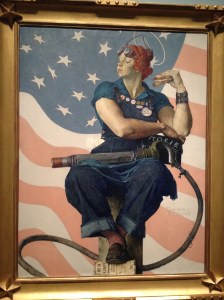
One of the more famous portraits of Rosie, back when Fascism was an evil thing, is that painted by Norman Rockwell.  A pugnacious Rosie eats her lunch with her feet on Main Kampf and her riveting gun in her lap.  (These days she would need to have her feet on an elephant rampant.)  Something about this painting always bothered me.  I could never put my finger on it.  It certainly wasn’t the confident look on Rosie’s face—she’d earned that and deserved it long before it became a reality.  Even the patriotism at that time was tasteful.  No, it was her posture.  There was something uncanny about it.  Then I learned that Rockwell had consciously copied Michelangelo’s Isaiah from the Sistine Chapel ceiling.

Isaiah, according to that famous rendition (Isaiah has never been a popular subject for paintings, for some reason), has his head turned at that peculiar angle because an angel is whispering in his ear.  Instead of a riveting gun, he’s packing a nascent Good Book, but he is receiving a direct message from on high.  I like to think it might be “The Spirit of the Lord is upon me, because he hath anointed me to preach the gospel to the poor; he hath sent me to heal the brokenhearted, to preach deliverance to the captives, and recovering of sight to the blind, to set at liberty them that are bruised, to preach the acceptable year of the Lord,” but then I’ve always been a dreamer.  Rosie, in Rockwell’s rendition, is prophetic.  She is proclaiming an equality which, inexplicably, coming up on a century later, is still unrealized.  Why?  The angry white man only recognizes God made in his own image.


Forgotten Bible Verses

Bible believers are basking in the headlines these days.  What with Mr. “Meet My Genitals” gunning for the Supreme Court and displacing them for a few days, they must be getting anxious for more sonburn in the limelight.  If only they didn’t have the Good Book standing in the way.  As I was reading my Bible the other day, I was reminded of this little gem, “the love of money is the root of all evil.”  Now, liberals like myself know that Paul of Tarsus didn’t write 1 Timothy, but Bible-believers know he did.  So much the worse for them.  They elected a president who stands for nothing so much as the love of money, and the swamp has become quite a root of evil.  Senate Republicans, after hearing a second credible sexual assault allegation against their boy for the black bench responded by trying to rush through a vote before the news got out.  And this reminded me of the forgotten prophets.

“What doth the Lord require of thee, but to do justly, and to love mercy, and to walk humbly with thy God?”  Well, you see, Mr. Micah, we know we’re heading to defeat in the midterms, so we’ve got to railroad through as many of our personal agendas as we can.  Don’t you know, o Lord, that this is a lifetime appointment?  And really, what does justice have to do with it?  Sure, he gropes and demeans women, but you’re a dude, right?  I bet you did the same when you were in high school and college.  And the money thing?  We’re only trying to help the economy because, well, wealth trickles down.  Who said anything like it’s the root of all evil?  “Hate the evil, and love the good, and establish judgment in the gate.”  Now, don’t go quoting Mr. Amos to me.  Next thing I know you’ll be telling me to let justice to run down like waters, and righteousness like a mighty stream.

Forgotten Bible verses, in the new Evangelicalism, seem to be cropping up on the black market.  You might think we should turn back to the start of the Good Book and read from the beginning.  There the GOP will find its solace until they come to the 27th verse, “So God created man in his own image, in the image of God created he him; male and female created he them.”  That semicolon says a lot; they will claim.  Man is the image of God, and he had a son.  Just don’t listen too closely to what that son says, particularly when he makes remarks like “whosoever looketh on a woman to lust after her hath committed adultery with her already in his heart.”  Young men like to drink and grope.  When they grow old they then like to be Supreme Court justices.  What’s that?  One more short verse?  “Jesus wept.”


All Things Being Equinox

The weather around here has been appropriately gloomy for the autumnal equinox.  Although Hurricane Florence gave us a day of rain, the heavy clouds have been part of a pattern that has held largely since May.  Given the gray skies, we opted to watch Alfred Hitchcock’s The Birds last night.  My wife isn’t a horror fan, but she does like Hitch.  We’ve watched The Birds together many times, but this is the first time since I wrote Holy Horror.  I was somewhat surprised to recall how much Scripture plays into the script.  This is mostly due to a drunken doomsday sayer in the diner.  After the attack on the school kids of Bodega Bay, he declares that it’s the end of the world and begins citing the Bible.  He’s there for comic relief, but the way the movie ends he could be right.

When I was writing Holy Horror I had a few moments of panic myself.  Had I found all the horror films with the Bible in them?  Could anyone do so (without an academic job and perhaps a grant to take time off to watch movies)?  I eventually realized that I was merely providing a sample in that analysis.  Several weeks after I submitted the manuscript I watched The Blair Witch Project.  There was the Bible.  The same thing happened last night under a glowering late September sky.  The Birds has the Bible.  Two weeks ago I saw The Nun; well, that one’s almost cheating.  But you get the picture—the Good Book appears rather frequently in horror.  That’s what inspired me to write the book in the first place.

Now that nights are longer, and cooler, the grass has somewhat poignantly relinquished its aggressive summer growth.  Most of the ailanthus trees have been cut down (I must be part lumberjack).  My outside hours are limited not only by work but by the fading light.  In the words of the sage, “winter’s tuning up.”  We moved to a house we saw in the spring as days were lengthening.  Now we’ve come to the dividing line that will slowly leech the light from our evening skies.  I suspect that as I go back and watch some of my old favorites again I’ll discover something I already knew.  The Bible and horror belong together because both are means of coping with the darkness.  Call it puerile if you will, but there is something profound about this connection.  It just has to be dark for you to see it.


Museum Monsters

Timing has never been my strong suit.  As soon as I stopped my daily commute to New York City, the Morgan Library and Museum opened a display titled “Medieval Monsters: Terrors, Aliens, Wonders.”  To appreciate the irony of this fully, you need to realize my office was just across the street from the Morgan Library, and the daily visits would’ve provided a good opportunity for a lunch-time break with my beloved monsters.  Instead I was spending the time moving further west and unpacking.  Still, displays like this are a tacit form of validation.  Those of us who admit, as adults, that we like monsters huddle under a cloud of suspicion.  Monsters are a matter for kids—like dinosaurs and fairies—not something on which an upwardly mobile adult spends his time.  We’ll take whatever validation we can get.

Perhaps we’ve been too hasty to dismiss our monsters.  Even the Bible, after all, has them.  They help us cope in a chaotic and uncertain world.  A world of hurricanes and Trump.  A world lacking compassion and sense.  Monsters have always been symbols of the borderlands.  Creatures that cross boundaries and that shouldn’t exist but somehow do nevertheless.  Science has helped us understand our world, but in our desire to grow up enough to use Occam’s razor, we find that it shaves a little too close.  Besides, what can be more unnatural than shaving?  When we lose our ability to believe in monsters, we lose a piece of our ability to cope with an unpredictable world.  Monsters have their practical uses indeed.

If the world were more predictable, I would still be teaching instead of editing.  Or I’d still be living in an apartment rather than a house.  Moving is chaos embodied.  Like monsters, it’s best left to the young.  It’s just like this world for a monster display to open just across the street right when you’ve moved out of town.  I should expect no less in a cosmos marked by uncertainty.  Medieval Monsters isn’t the only museum display of the weird and wonderful.  Monsters have a way of showing up again once you think they’re safely gone.  Family and friends share with me their visits to other monster exhibits at other museums.  They may wonder at my fascination with them—an adult with a sober doctorate in the field of history of religions, biblical studies, ancient Near Eastern religions, whatever.  It’s kind of a monster in its own right, on display here daily.  If you happen to miss it, don’t worry.  It’ll remain lurking in its own corner of the internet.


Scriptural Slashers

Let me relish this a moment.

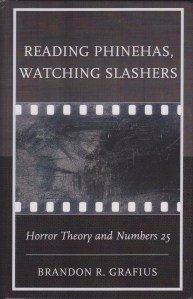
Thanks.  You still there?  It’s not too often, you see, that I get to feel like I’m near the front of the crowd.  I began writing Holy Horror when there were a small handful of books on the market concerning horror and the Bible.  I wasn’t aware of Brandon R. Grafius’ work at the time, but it sure is gratifying to see that others have noticed the connection.  Reading Phinehas, Watching Slashers: Horror Theory and Numbers 25 is pretty much what its title says.  I’ll be having more to say on it in a different venue—don’t worry, I’ll let you know—so I’ll keep to the basics here.  My spellcheck, and I’m sure not a few others, might have trouble identifying Phinehas.

In one of those weird, short, violent episodes for which the Good Book is justly famous, the story of Phinehas is clearly part of a larger, untold narrative.  Like the sons of the gods marrying the daughters of men in Genesis 6.  The grandson of Aaron, Phinehas was one of the hereditary priests of early Israel.  The Israelites wandering for their 40 years in the wilderness were nearly as xenophobic as the Trump Administration.  When one of the chosen people chose a foreign wife, Phinehas, full of zeal, grabbed a spear and skewered the couple.  Tradition says in flagrante delicto.  This act of violence stops a raging plague sent by the Almighty, so Phinehas looks like a hero in context.  If you want to read the story the subtitle tells you where to find it.  Or you could read Grafius’ excellent book.

Horror, which should be already obvious, enters the picture in the form of theory.  Yes, there is such a thing as horror theory.  Grafius uses it to analyze this story, along with other methods.  This is what I’m relishing.  I certainly wasn’t the first to notice the connection.  Many years ago Phyllis Trible wrote Texts of Terror, noting how the Bible seems less holy (my expression, not hers) when read from the perspective of a woman.  Indeed, many accounts that seem like standard issue narratives of God laying down the rules and humans disobeying tend to fall pretty heavily on females.  And the punishments used are fit for horror films.  Grafius focuses specifically on slashers, but one gets the sense that this book is just the start of something larger.  This reader, at least, hopes that is the case.


Somebody Else’s Heaven

Ailanthus is known as the “tree of heaven.”  It’s an introduced species in North America and, like many such species, it outcompetes its rivals.  The tree of heaven isn’t bad to look at—in fact its handsome appearance was one of the reasons it was brought to these shores.  Heaven isn’t all that it’s cracked up to be, however.  The tree is aggressive and resilient, and difficult to eradicate.  Among the many unexpected “gifts” the former owners of our house left us was a back yard full of ailanthus trees.  At first I thought they were pleasant but then I had to remove a small one.  The smell almost knocked me off my feet.  I then learned that the Chinese name for it translates to “foul smelling tree.”  Whose version of heaven is this?

Over the weekend I spent some time lopping off trees of heaven.  Mosquitoes, I found out, love its shade.  It keeps the kinds of friends you might expect.  Heaven is, after all, a construct.  The word can refer to either the great dome of the sky in which the ancients believed deities dwelled, or the realm of blessedness to which the righteous go after death.  In either case, it was assumed to be a pleasant place.  Any trees there (and there are some according to the Good Book) would likely have a pleasing fragrance.  The ironically named version we get down here didn’t get the memo, it seems.  As best as I can determine, the name of the tree refers to its rapid growth, as if it’s grasping for the sky.

A problem with our own species is that we seem to think we know more about this world than we do.  We introduce species from other parts of the planet without considering how they impact the local environment.  In the case of a property with lazy former owners, it can translate to a real problem with heaven trees.  We’re often taken in by the innocence of names.  The first time I saw a tree of heaven, in a public park in New Jersey, I thought I should write a blog post about it.  It took being invaded by heaven, however, to make it seem relevant.  Heaven is a foreign nation, it seems.  It should smell nice and be open to people of all nations and creeds.  According to Revelation the trees up there bear fruit every month of the year.  Presumably in heaven someone else has to take care of the yard work.


Galilean Blues

Call me nostalgic, but growing up Fundie, “Capernaum” tripped easily off my lips.  In fact, it was a word I heard very frequently at church, always pronounced “kap-er-NEE-um” (please pardon my amateur phonetics).  Even though no one I knew had ever been to Israel, we all knew it was in Galilee and that it figured large in the early life of Jesus of Nazareth (although we assumed he was surnamed “Christ”).  When I attended seminary I was surprised to hear the geonym pronounced “ka-per-NUM.”  It sounded so sophisticated—aristocratic, even.  Still, everyone at Boston University School of Theology knew what, and roughly where, it was.  It was a household name, no matter how you pronounced it.

Spellcheck disagrees.  It doesn’t recognize one of the most famous places in the New Testament.  Now, I’m aware that my view of things is idiosyncratic.  This blog should be proof of that.  Those who grow up from Fundamentalism often know this experience—something that everyone knew when you were young and informed is arcane knowledge to the rest of the world where Kardashians and Sedarises are household names.  The Bible, irrelevant at best, is a foreign country.  Then the religious right comes to power and everyone’s confused.  They don’t speak the same language as the rest of the world.  They say kap-er-NEE-um.  Others scratch their heads and glance at their knee caps.

When I visited ancient Capernaum it required some imagination to reconstruct what it had been, back in the day.  Since the ruins were relatively recent—only a millennium or two—some of the buildings were still above ground, including the famous synagogue.  Even among the unchurched archaeologists, everyone knew the connection of the city to Jesus of Nazareth.  That doesn’t mean, however, that the programmers responsible for spellcheck recognize the name.  Kardashian doesn’t get a red underline on my word processor.  Even in the first century, however, Galilee was a backwater (with real water!).  Important people came from big cities and had family connections.

Some things don’t change much over the millennia.  The famous often find their spotlight because of connections.  If the deity decided to incarnate today, s/he’d know to get a website put together first.  And it would help to have some product endorsements.  Even salvation at a click isn’t enough to draw most people in.  Of course, the matter of name—excuse me, “brand”—is important.  More than anything, you want something people can pronounce.  And just to be safe, anchor it to either New York or the city named The Angels.


A Star in the East

The times they are a, well, you know—nobody wants to violate copyright.  In any case, nothing stays the same for long.  New York, for example, is a city in a constant state of transformation.  Fully grown buildings now stand where there were literally holes in the ground when I began working there.  One building near Times Square recently had a facelift that revealed the steel girders beneath.  On the I-beam were the words “Bethlehem Steel.”  And it’s not just New York.  Our cultural transformation has been taking place over the last few centuries as populations have moved to urban areas, abandoning farming to the few who remember how.  Being from western Pennsylvania, I pretty much thought the eastern part of the state was Philadelphia.  I’d heard of other urban regions, of course, such as Scranton and Allentown, but they were well outside my experience.  We didn’t get out much.

Now that I’m here in the eastern part of the state, I’m begun to explore the ever-changing micropolitan area of Allentown-Bethlehem-Easton.  The three cities blend at the edges, and this region is the third largest population zone in the state, after Philly and Pittsburgh.  It’s also the fastest growing region in the commonwealth.  I suppose we might’ve helped with that statistic.  The other day I had to run an errand in Bethlehem.  I pulled over to marvel at the hulk of what had once been Bethlehem Steel.  Now, I grew up in a town with an active steel mill, and Pittsburgh grew to fame for the same metal, but this was a behemoth of a plant.  Subdivided and open to development, it now houses a casino, in part, and an arts center.  And still there’s more space.

Bethlehem was founded on Christmas Eve by the Moravians.  Perhaps appropriate for a town trying to resurrect itself, Bethlehem calls itself the Christmas City.  Star imagery abounds, and many businesses name themselves with this Christian symbol.  The image is quite different from that of a steel city with hard-working men on the shift.  The grime and din of industry.  Bethlehem, like many places in the state, was named for its biblical forebear.  On my visit to the original Bethlehem many years ago I was, like many tourists, disappointed that it isn’t “O little town of” anymore.  There were people everywhere and it was difficult to imagine a quiet stable inside a noisy stone church thronging with the faithful.  Clearly things don’t remain unchanged for long, even in towns famous for their remoteness.  Although far from New York, they share a common heritage of people everywhere, and that heritage could bring us peace if only we would allow it.  The answer, it seems, is blowin’ in the, well, you know.


Truth under Fire

As Evangelicals continue their unflinching support for Trump, Rudy Giuliani has at last said something that rings true with these “Christians.”  According to a Washington Post story 45’s lawyer declared, “Truth isn’t truth.”  This was regarding the Russia probe, something that would’ve led to the ouster of any real president by now.  We’re all used to Trump’s constant state of obfuscation after all these long months, and the former mayor of New York has just come clean—truth is what we want it to be, no more, no less.  It is a meaningless word, a chimera.  If the son of god in the White House has broken the law (and he has) then the truth is there’s no law to be broken.  Democracy is just a made-up word in the hands of the Republican Party.

Now, I don’t have much truck with politicians.  Leopards, according to a certain book, can’t change their spots.  Nevertheless, Evangelicals should object to Giuliani’s direct assault on their sacred text.  The Good Book, you see, is all about “the truth.”  But the truth isn’t the truth.  When it claims that Jesus died to atone for your sins, that can’t be the truth because the truth isn’t.  The only truth is what Trump personally wants.  And the GOP won’t lift a finger to stop him.  Long ago it was clear that the party of Lincoln had abandoned the will of the people they’re elected to lead, but if there were truth we’d see the deep, stinking muck of corruption everywhere within its doors.  At least you’d expect the neat and clean Christians to object.

A certain man about two millennia ago said, according to the Book, “I am the way, the truth, and the life.”  But Rudy says “Truth isn’t truth.”  The Beatles said they were more popular than Jesus and the public revolted.  Rudy says Trump has more authority than Jesus and the Evangelicals cheer.  The capacity for untruth has always been part of politics.  Most politicians know to lie discreetly, when fact-checking will reveal some ambiguity.  Now the gospel-truth is whatever comes from the unholy mouth of Trump.  There is no truth.  There are alternative facts.  There’s fake news.  Surely the Prince of Peace wouldn’t have cancelled a military parade.  Meanwhile someone once said “the truth will set you free.”  The great Giuliani has informed us, however, that there is no truth.  And if truth isn’t truth, there’s no hope of freedom.  At least according to a guy named Jesus, whoever he may be.  


Financial Ethics

In a conversation with a professional colleague recently, I was discussing what might happen to ethics when sex with machines becomes common.  That statement might seem a little bizarre out of context, so let me widen the net a bit.  We were discussing the Bible and sexual ethics.  This led to the question of how those who apply the Bible straight from antiquity might apply their beliefs to a world vastly different than first century Palestine.  In biblical times, in other words, sexual options were limited and people didn’t understand the whole issue of human sperm and eggs, neither of which can be seen without a microscope.  Applying their outlook directly to today is problematic, and so how do we apply a book without outdated views to a world vastly more complicated?

Someone recently paid me a small debt via PayPal.  If sex is complicated, then let’s not even get started on Bitcoin or Apple Pay—for some of us money is money and even getting paid electronically is somewhat suspicious.  I sometimes buy things online with PayPal.  It goes straight onto one of my credit cards and then I write an old-fashioned check to pay for it.  So I had to approach the altar of PayPal itself to figure out what it meant to have money in my account.  What am I to do with it?  Then I found the FAQ—TFIA (The Future Is Acronyms).  One of the questions: “What is PayPal’s policy on transactions that involve sexually oriented goods and services?”  Now, here’s a question of biblical proportions.

Paying for sexual “goods and services” goes all the way back to the book of Genesis when none other than the ancestor of David and later progeny did so.  This is nothing new.  But the question of ethics now looms extra large.  For those who pay for such things, a new layer of complexity has apparently been added—can you pay with PayPal?  My transaction had to do with tickets purchased for a concert online, where we wanted seats together so someone had to do the buying for everyone.  What if the purchase had involved a somewhat more intimate setting?  Who needs paper or plastic when a string of 16-digits, or even a username and password, will do?  That’s to say nothing regarding the ethics of the transaction—this is, as it were, purely mechanical.  What would Moses say?  Surely this is a question of appropriate tips, for Tamar veiling herself by the side of the road had the moral high ground over her father-in-law who was simply looking for a good time.  A staff and seal, however, were no less complicated that paying for goods and services online.