Jewish Annotated

A project with which I have some small acquaintance is the second edition of the Jewish Annotated New Testament (some of you may be noticing an annotated theme lately). The idea behind it is deceptively simple: most of the writers of the New Testament were Jews. What do modern day Jewish scholars see in the text? This annotated Bible gets adopted into both Christian and Jewish courses, and many seminaries have an interest in learning what the writers might have been thinking as they were composing “the other testament.” So far, so good. I was looking at the Amazon page for the book the other day, specifically for the Kindle edition. As usual, you can’t please everyone, and some of the negative comments had to do with functionality. Then one said simply, “There is no such thing as a Jewish New Testament.”

I’m not so naive that I don’t know what trolls are, but I got to thinking about this comment. It didn’t come from a “certified buyer,” so it could be an opinion piece. The mononymed reviewer might be Jewish, Christian, or neither. From a Jewish perspective s/he might mean: Jews don’t accept the New Testament as scripture, so what else is there to talk about? From a Christian perspective the point might be: this is a Christian document so it doesn’t matter what Jews think about it. Either way there’s a call for some exegesis here. Both perspectives can be argued against. Jews have a very real interest in what Christians say about them. And, like it or not, the first Christians, and even Jesus himself, fell squarely within Judaism.

Christianity has become a religion of privilege. That happens when you’re the biggest religious body in the world. Christians get a bit testy when Islam begins encroaching on its numbers. There’s still some hard feelings about the Muslim expansion of the seventh and eighth centuries, too. Being an imperial religion will do that to you. Thoughtful Christ-followers, however, have begun to look back and wonder how this whole thing got started in the first place. Without Jews there would’ve been no Christians. Nobody’s claiming the New Testament is Jewish scripture. Neither side wants that. It’s simply a recognition that we might have something to learn from each other. And that’s not a bad idea. In fact, if we were willing to listen a bit more than talk, who knows how much true understanding might come to pass? The Jewish Annotated New Testament is one possible place to start.


Down the Road

First of all, thank you to my regular readers. I’ve been making daily posts on this blog since July 2009—nearly nine years of illustrated commentary. It seems, however, that I’ve reached my limit. My storage limit, that is, on Word Press. As a result I’m going to be upgrading my account. Now, I’m enough of a Luddite to be uncertain of how this might impact any auto-updates (I flatter myself to think there are some) or links to this blog. I’m planning on continuing Sects and Violence in the Ancient World, but it will be but one page on a website that will offer the opportunity for me to go into more detail about my books. I don’t know how it will look yet, but it shouldn’t be disappearing from cyberspace.

Timing, as they say, is everything. It’s never been my strong suit, however. My current book still has no final title, so it’s a little difficult to promote it properly. Oh, it’s finished, and in the hands of the publishers, and although I can give it its own page, I can’t really title it yet. Perhaps in the height of hubris, the new layout will have pages for my previous two books, A Reassessment of Asherah and Weathering the Psalms. These were both academic titles with very limited sales, but they represent a significant portion of my life and I’d rather not have them completely forgotten. My latest book is for a more popular readership, but I don’t have the platform to interest agents (not for lack of trying), so I’m incorporating it into a website that will allow for its self-serving promotion. So embarrassing. You can imagine how red my face must be.

By the way, there’s another book about half-written. (Actually, there are several, but this one looks like it might actually appear.) A new series has been announced—I’ll write about it once I learn if my proposal has been accepted—that follows my own aesthetic closely. In conversation with the series editors, I’ve put together a proposed book based on my current work. If it happens, a new page will pop up on this future website I’m envisioning. Since I’m no Luddite, I can see possibilities for these pages. The blog will continue with its daily babbling. I’ve been doing this so long I wouldn’t know any other way to start my day. Combined with the hubris of those who spend too much time in supernatural headspace, this could be interesting. If you’re search brings you to what looks like the wrong page, please persist. Sects and Violence will be only a click away.


Panthers and Prophets

Prophetic is a word I seldom use for movies. Prophetic, by the way, doesn’t mean predicting the future. Prophecy was about establishing rightness on the earth. Dress it up with God or dress it down to a girl being shot for wanting an education, prophecy is a necessary ingredient in being human. Black Panther is a prophetic movie. I don’t keep up with comic books, and many regions of the Marvel Universe are unexplored by me. I have no idea if the comics bear the strong message of social justice that this film does, but I left the theater blown away. If those who have the power could only be interested in good rather than personal gain, what a world we could have.

The message of not making race, but humanity, central is one that we have yet to learn. It is so basic, so simple that a child understands it. Somehow world leaders don’t. Any secret advantage is kept in order to make things better for ourselves. To make us feel more secure. To put us in the place of making decisions for others. In Black Panther even the enemy isn’t evil. Humanity is it’s own enemy. We sometimes forget that we have it within our ability to make life fair and equitable. We can share what we have and end jealousy. The Gospel of Adam Smith, however, has supplanted that of Jesus Christ. Just ask the one-percent. The one percent who haven’t most assuredly seen this movie.

I had no idea what to expect when I walked into that theater, but it was nothing short of an epiphany. As it has been from ancient times, one can always tell when they’ve been in the company of a prophet. We’ve come to dislike prophets because they make us uncomfortable. They possess something we can’t have. Integrity. The dignity of the conviction of what anyone can see is rightness. Such things can’t simply be taken, crammed onto a boat, and sold. Prophets bear the burden of speaking the truth. Black Panther may be unlike most prophets in that it is reaching a huge audience. And rightfully so. It is the antidote to the poison that’s surging through the veins of this country for far too long. Even those who will dismiss it simply as another fantasy—it’s a superhero movie—need to see this vision of what a world can be. It’s not very often that a prophetic movie appears, but the days of prophecy, it seems, aren’t over yet.


Who’s Hungry?

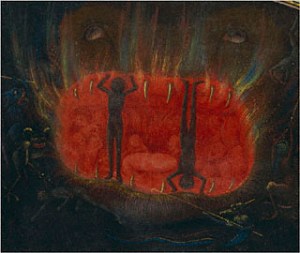
I flatter myself to think that some people enjoy my daily musings, although they’re sometimes grim. Religion often is. One curious example of this is the “Hell-Mouth.” Some time back a friend sent me a link to a British Library blog post “Highway to Hell.” The story is about illustrated medieval manuscripts depicting the Hell-Mouth—a monster with wide, gaping jaws and a gob crammed full of human souls bound for eternal torment. Not a pretty picture. The BL post reasonably suggests that the image originates in early Anglo-Saxon literature. We know the Teutonic penchant for the gothic, so all is fine and good. In fact, however, the image is far older than that.

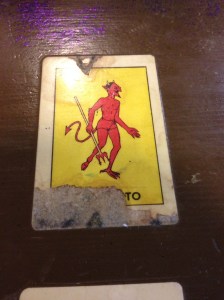
In sorely neglected and almost forgotten Ugarit there is a fascinating mythological text. Known to ancient northwest semitic nerds as KTU 1.23, the text is strange even by Canaanite standards. El, the chief god whose name translates as, well, “god,” seduces two young goddesses (presumably). The young ladies give birth to monsters—devourers with one lip reaching to the heavens and the other to the underworld. Every living thing is swept in. What is this if not a Hell-Mouth? Indeed, if I might indulge in my past passion for Ras Shamra just a touch more, the deity Mot (whose name translates to “Death”) is portrayed with an equally voracious appetite. Everything gets gobbled up, even Baal.

These lurid images of all-consuming mouths, however, aren’t direct ancestors to the Hell-Mouth. Although some of the ideas from Ugarit survived in the culture that would eventually emerge as the Israelites, the city itself was destroyed for the last time before Moses picked up his chisel. The people of Ugarit were long gone before he licked his thumb and applied his quill-pen to Genesis. Ideas, however, may be the closest to eternity that humans can come. The Bible doesn’t describe any Hell-Mouths as such, but Revelation can come close. Ras Shamra was only rediscovered in the 1920s, so no Anglo-Saxon had access to its vivid images of the Hell-Mouth that existed even before Hell itself became a thing. Humans are endlessly inventive. Ideas go underground for centuries at a time only to reemerge when the moment’s propitious. The Middle Ages with their Black Deaths and highly stratified society and burgeoning witch hunts and inquisitions were such a time. Looking over the current landscape I have to wonder if the recent revival of the Hell-Mouth might not have something to do with the time in which it has gained renewed interest as well. Some appetites will never be satisfied.


Becoming Biblical

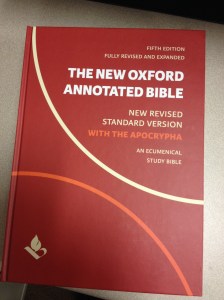
The average reader has difficulty sorting out what’s biblical or not. For example, when Cyrus Scofield began putting 4004 BC [sic] as the date of creation in his annotated Bibles, people thought the date was biblical. It was, literally, “in the Bible.” I used to tell my students that there’s a cultural belief that everything bound between the covers of a Bible is biblical. If so, I’ve just become biblical myself. I must say, it comes with mixed feelings. For the many people with whom I’ve worked on the New Oxford Annotated Bible, having their names inside is an expectation. Employees, however, sometimes make it in, too, in a prefatory way. I was touched to see my moniker there, on Bible paper, amid Holy Writ. Almost life-changing. A little scary.

Imagine a post-apocalyptic world. (I know, it’s easier now than it was just a few short months ago.) What if all books were wiped out except a copy of the book fondly abbreviated NOAB? Some Leibowitzian monk might come across it, and, recognizing that it’s sacred dare to open it, not comprehending the language but eager to begin again. Am I ready to be in such a book? Nobody reads prefaces, I know, but this is the widest circulation my humble family name has ever achieved. In there with Joseph, Job, and Jesus. It’s heady stuff. I’ll be on the shelves of used bookstores from now on. For a guy who’s books have been printed only in the 300 run range, this is dizzying. And not too bad for being only an administrator. None of my deans ever made it into the Good Book.

Surely there’s some grim responsibility that accompanies becoming biblical? Some consummation devoutly to be wished? Looking around at my fellow biblical characters, I’m not so sure. Many cases of men behaving badly surround me. None of them, I expect, had intended to be biblical either. Time and circumstance led to their elevated status. Modern biblical people tend to be famous only among their own guild. Some gain wider recognition, to be sure, but none share the name recognition of those recalled by the unknown recorders of sacred scripture. I’ve written books of my own, and been acknowledged as a scholar and editor in other peoples’ books, but never before have I found myself in such exalted, if accidental company. Where does one go from here? A Herostratus of Holy Writ? I can’t help but wondering if Jeremiah started off working in a cubicle.


Parks and Wreck

It was a bit of a shock to see Bethel Park on the list. I make no bones about being a Democrat. I’ve supported progressive causes on an evolving journey since high school. When I saw the news that Conor Lamb is a worthy contender for the 39th district seat in my native western Pennsylvania, and that this area is “deep red,” I had to look it up. A special election’s coming up and the district is leaning a little blue. Historically, until 2010, it had been Democrat territory. But Bethel Park has other associations for me. My wife will pardon me, I hope, for saying it was the home of my first girlfriend.

As a naive and thoroughly Pauline Fundamentalist, I always believed marriage was against God’s will. The Bible says as much. Still, Paul magnanimously allows for marriage to those who “burn.” I’d felt the heat once or twice as a boy becoming a man, but I’d adequately stifled it with Scripture and the comparative fires of Hell. I was strong. I would never marry, I told myself. College up to that point had involved a cenobitic separation of the sexes in an all-male dorm on a campus where the rule was to sit with a Bible’s width between a guy and his girl. I met her at church summer camp where we were counselors together. She was from the city—Bethel Park is a suburb of Pittsburgh—and I was a kid from what she called “Roosterville” (the town of 900 souls was actually technically “Rouseville”). The ways of love, I was learning, were liberal.

To a point. That relationship limped along for a couple of years. I got on with my life, attended seminary and met my wife there. Bethel Park, I knew, had been named from the Bible. Bethel was the place of Jacob’s dream, the original stairway to Heaven. My first lady friend was impressed with my biblical knowledge—it was really about all I had to offer. Things improved after meeting the woman I would marry. Boston would remain a blue city while Bethel Park would degenerate from purple to red. When did this happen? The working class boy from Roosterville believes in equal rights for all. And now District 39 has a decision to make. Will the stairway to Heaven be limited to those who can afford those swank suburban houses? Or will the district remember its heritage that was blue from 1969 until we had our first African American president? “This,” Jacob muttered “is none other than the gate of Heaven.” Or, it could be, just another brick in the wall.


Frankenstein and Co.

Authors, I expect, don’t anticipate that their work will be annotated. Since I deal with annotated Bibles on a daily basis, I often ponder that the anonymous writers—we know of few biblical writers with any degree of certainty—had no idea that they were writing the Bible. Nor did they realize that some day many people would make their livelihood from interpreting that book. Among the interpreters are annotators. When my wife gave me Mary Shelley’s Frankenstein for Christmas I was at first puzzled. I have a copy of Frankenstein already. In fact, I read it again just last year. Then I realized it was an annotated edition: Annotated for Scientists, Engineers, and Creators of All Kinds. Edited by David H. Guston, Ed Finn, and Jason Scott Robert, the book contains the original text and an introduction, as well as the said annotations. Like a typical study Bible, it also contains essays. The editors joke that it’s kind of like a Frankenstein monster itself.

The “value added” material isn’t all about science. In fact, quite a lot of it has to do with human relationships, and particularly women’s rights. Mary Shelley was an early feminist and her novel shows what goes wrong when men try to reproduce without women. Another recurring theme that, amazingly, had never dawned on me while reading Frankenstein was the Adam and Eve story. Victor Frankenstein, like God, creates a man. Then he creates a woman. Well, almost. Afraid what might happen should his creature find a companion too companionable, he destroys the second creature before she’s finished. The biblical parallels are nevertheless there.

Originally subtitled The Modern Prometheus, the novel was based on pre-Christian myth as much as on Holy Writ. Nevertheless, the Bible suffused British culture in the nineteenth century just as it has continued to overwhelm American culture to the present day. We ignore it at our peril. Morality in science is a major focus of the essays in this volume, but I wondered how many scientists might be enticed to read a piece of feminist fiction in order to learn some ethics. The largest ethical conundrum we face in the United States is that so few people read for personal growth. Spending time with a book is a sacred activity for those committed to the principles of literacy. Frankenstein isn’t a prefect novel; the pacing is pretty slow even for a gothic masterpiece. There are loose ends left hanging. The protagonist is often insufferable. Still, as the editors and annotators have demonstrated, there’s much to learn from this old story. All it takes is the willingness to read and deeply reflect. And perhaps read the annotations.


A Concept

Pardon me for being perplexed in public. You see, things aren’t as clear cut as they used to be. In the world in which I grew up Evangelicalism was good and Satanism was bad. Very bad. It still has the ability to scare people straight. A recent NBC story my wife sent me titled “Satanic Temple challenges Missouri’s abortion law on religious grounds,” by Corky Siemaszko, shows how the GOP has turned the tables on this equation. The Christian Right has utterly aligned itself with the pro-life camp. Most people would agree, I suspect, that abortion shouldn’t be the first choice of birth control options, but life comes with many unpredictable circumstances. There are times abortion is the most humane option and the burden falls almost entirely upon women. It’s not an issue on which men are competent to decide.

The evangelical posturing on the issue—which has, by the way, changed in recent years—has placed the weight fully on women. A rutting male, like a bull elephant in musth, can hardly be responsible, so the thinking goes. Or, to put it more politely, boys will be boys. Women suffer on the tusks of this tautology; it’s no wonder Satan has horns. Only women conceive, so men can make the laws and feel empowered by a male god who, you know, understands where they’re coming from. Missouri Satanists are striking back. The problem is the state requires women to be presented with indoctrination that says life begins at conception before electing for an abortion. Does life begin at conception? The Bible says “no.”

Biblical science was primitive. Ancients understood there was a connection between sex and pregnancy, but infant mortality rates ran very high. Life, in the biblical view, started at first breath. Spirit, breath—the very word for “soul” in the Bible—was the marker of life’s origin. The Bible may not advocate abortion, but in a world where few children made it past five, there was a shortage of surviving progeny. So it turns out that in Missouri Satanists are actually advocating the biblical view while the Evangelicals are violating the constitution by misreading it. Life begins at conception isn’t a scientific premise, it’s a theological one. A theological one on which Christians disagree. And Satanists. In their efforts to keep men on top of women, the Christian Right has no support from the Good Book on the matter of conception. Of course, why read the Bible when you can get what you want by quoting only your favorite verses? After all, God, they say, is a “he.”


Good News Shipping

“And all the ships at sea,” was the closing of Walter Winchell’s radio broadcast introduction. The phrase has a certain poignancy about it—a cross between Melville and Edmund Fitzgerald. The idea of being isolated at sea is foreign to most people, but it is truly as far from others as you can get on this planet. In ancient times the sea was considered evil. It was well-nigh unsurvivable and chaos monsters dwelt in its depths. In the book of Revelation, in God’s kingdom “the sea shall be no more.” But the economic fact is, it’s still cheaper to ship by sea than to fly things from here to there. Amazon seems to have made us forget just how complex delivery is. I was forcefully reminded of this the other day when I received an email saying that the Bibles were at sea. Literally. They’re on a boat in the middle of the Pacific, along with who knows what else.

This is only a parable

The vastness of the ocean makes humans painfully aware of our smallness. As does the Bible. I remember thinking, as a child, that those offering printed salvation did so from the goodness of their hearts. That may be part of the story, for sure, but Bibles are big business. Not as big as they used to be, but still not inconsequential. This was captured well by the character of Big Dan Teague in O Brother, Where Art Thou? “It all about the money, boys!” he shouts as he robs Everett and Delmar. Yes, that evangelist giving away Bibles may have your soul in mind, but your pocketbook too. Like those Bibles snuggled against crates of condoms and smart phones, it’s just business. You’ve got to keep the bottom line in mind.

Bibles can be a lucrative business. The Bible is, however, a large book—expensive to print and bind because it requires special paper thin enough to hold all that text. Such specialized work done domestically would drive the price of the Good Book out of comfortable profit margins. So the word of God is printed overseas and sent across the ocean by boat. There’s a parable deep within this hidden life of Scripture. The romance of the high seas—being completely isolated from land and its comforts. “Here be dragons,” the Hunt-Lenox Globe famously proclaimed, and that’s a parable too. That Bible in your hands comes with considerable cost. Even in a world where drones for personal delivery are not far off, the sea still surrounds us.


Breakfast of Champions

In my efforts to become vegan, I’m finding dairy to be the hardest element to replace. I’m reminded of this every morning since the day begins with cereal. Most people don’t realize that cereal for breakfast is largely of religious motivation. The original Kelloggs were Seventh-Day Adventists, and therefore vegetarian. To promote both health and animal-free diets, they gave a big push to the idea the day should start with cereal. It’s a touch dry, however, and water on your flakes leads directly to paste. So I’ve been experimenting with alternate milks. Often I use soy milk, but it has to be the right brand. Some of the offerings on the market have that oily aftertaste characteristic of soy beans. Not sure of the legality of hemp milk these days, I recently tried oat. Oat milk should taste like oats, i.e., it shouldn’t have much taste at all.

The moral crisis came as I poured it into my oatmeal. You see, there’s a biblical injunction to cooking a calf in its mother’s milk. This is the reason meat and dairy can’t be mixed in kosher settings. Scholars debate the basic concept behind this regulation. Like eating a bird and its eggs, some suggest, this depletes nature and should be avoided. At least one generation should have a chance to avoid exploitation. At least until it grows up. But what of the oats and their oat milk? Have I gone too far? What hidden principle am I violating, however unintentional, here? This is the problem with any religious thinking—taken to extremes it begins to break down. Some of the earliest gods, after all, were agricultural deities.

Agribusiness is huge. People gotta eat, right? And it is one of the most massive environmental hazards humans have ever concocted. Industrial farming is the largest producer of methane and the largest user of potable water, by far. Keeping animals for our food is literally destroying our planet. Religions, interestingly, quite often concern themselves with eating habits. It’s strange how most of them in this country are silent regarding what is obviously an ethical issue. After all, we adapted to the cereal for breakfast lifestyle because of religious conviction. It’s difficult to change eating habits. That’s my current struggle. I could pour the oat milk over corn flakes, I suppose. But then again, the Bible forbids mixing fabrics from different plants. What’s an aspiring vegan to do?


Fool’s Paradise

What with all the Bible-trumping going on these days among the desiccated religions right, I thought it might be helpful to turn back to the Good Book itself. Since we have a self-proclaimed stable genius in house there should be nothing to be concerned about. What, me worry? Right, Alfred? One part of the Bible frequently cited by fundies and others who want to appear chic is the “Wisdom literature.” Although the category itself has come under scrutiny these days it’s still safe to say that Job, Proverbs, and Ecclesiastes have quite a bit in common with each other. Proverbs is a repository of pithy aphorisms. Indeed, it can sound downright modern in many respects (but hopelessly patriarchal and chauvinistic in others, unfortunately). One of the things Proverbs does is condemn fools. The sages of antiquity had no time for stupidity. Remember, we’ve got a stable genius—don’t worry.

Like Laplanders and their many words for “snow,” the book of Proverbs uses several terms for fools. There is, for instance, the innocent fool. This is the person who simply doesn’t know any better. Often it’s because of inexperience. This kind of fool can learn from failures and may go on to better things. Far more insidious is the willful fool. This is the person proud of his or her ignorance. Proverbs goes beyond calling such a thing unfortunate—this kind of foolishness is actually a sin. Not only is the arrogant fool culpable, they will be judged by God for their love of stupidity. As a nuclear super-power it’s a good thing we have a stable genius with the access codes. Otherwise those who thump the Bible for Trump might have a bona fide sin on their hands.

Image credit: Pamela Coleman Smith, Wikimedia Commons

The only kind of fool that’s tolerable in the world of Proverbs is the one that’s able and willing to learn. This means, in the first instance, being humble. Refusing to admit mistakes, forever posturing and preening, this is a certain recipe for incurring divine wrath in the biblical taxonomy of fools. According to biblical wisdom literature, such people get what they deserve. The modern evangelical often has little time for such books. Aside from a misogynistic slur or two, there’s nothing worth quoting from Proverbs that you can’t find in Benjamin Franklin or even in ancient Egyptian records. When you stop to think, however, that the Bible’s said to be inerrant, you’ve must take Proverbs and what it says about fools into account. But then again, what Fundamentalist ever really reads the Bible?


Noah’s Phone

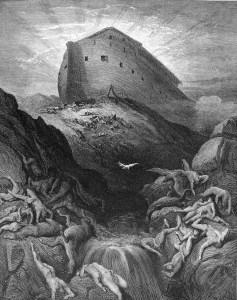
The world-wide flood is a great story. We find it in many cultures, so the idea obviously captured the attention of ancients as well as moderns. What’s strange is that, with the development of human knowledge so many people continue to accept it literally. The only science that can be bent enough to make it work is one where God breaks all the laws of physics and biology to kill everyone, just to make a point. Why bother to make it rain 40 or 150 days? Why not just create the requisite water instantaneously? It would be just as believable. Nevertheless, literalists look for explanations for how this might’ve happened. It’s not to convince God, of course. The goal is to convert unbelievers by showing that the myths of Genesis are literally true.

When I came across a story on Mysterious Universe by Paul Seaburn titled “Academic Claims Noah had Cell Phones, Drones and Nuclear Power,” I was hooked. The academic is a Turkish professor of marine sciences. Using modern technology—rather like the detritus seen scattered in the background of Darren Aronofsky’s recent movie version—he postulates that this could’ve happened. The real issue is why. Not why the flood; the Bible answers that. Why would a scientist feel the need to prove a myth scientifically? Biblical scholars call the flood story an etiology. An etiology is a story to explain the origins of things. That’s its purpose.

Noah’s flood explains why it rains. It also explains why this dome that covers our flat earth doesn’t fill all the way up anymore. It explains why animals are sacrificed and why rainbows occasionally appear to grace the sky after it rains. We also know that the story borrows from an even earlier Mesopotamian myth where the god who causes the flood isn’t even Yahweh. The people of Israel were conquered by the Assyrians and Babylonians and they told flood stories about their gods. The Bible counters with two stories (yes, just like the creation accounts) mixed together in this snow-globe universe of Genesis. Is it easier to believe this or to claim that Noah had access to Verizon, steel manufacturing, Einsteinian physics, remote-control flying machines, and artificial insemination (to help the animals recover)? It’s like when someone suggests natural explanations for the plagues of Egypt. Such special pleading doesn’t prove miracles, but rather it demonstrates that all this could happen without any gods involved. And you’re still going to have to mop up all that water when it’s over. I’m sure it will make for a great story some day.


Devil of the Time

There can be little doubt that evil prospers. We’ve suffered through a year of an evil administration and we’ve seen the government increase the suffering of its own people in deference to the wealthy. And ours is only a mild case of evil. Jeffrey Burton Russell, over the course of some years, wrote three sequential books about evil. The first, The Devil, I reviewed last year. Having just finished the second, Satan: The Early Christian Tradition, it has to be said that the concept definitely evolves. The period between the New Testament and the fifth century was a rich one for diabolism. The writers of this period became increasingly theological in their efforts to make sense of what is obviously an unjust situation created by a theologically good God. These were inventive writers, if somehow less than convincing.

Russell is a careful explainer. He summarizes the views of the “church fathers,” pointing out where their logic fails. This isn’t some liberal trying to dis the Devil, however. Russell acknowledges that he believes a Devil of some kind must exist. Reason, however, must also be applied. It’s difficult to believe that people in the early Christian centuries were willing to take such leaps of logic. Of course, they didn’t have many options for opting out. God was the great explanation for so much of their world. Fitting an all-powerful deity into logic when there’s abundant suffering in the world requires a certain flair for casuistry. No matter how the equations work out, an all-powerful God can’t be all good, not in this universe. Speculation about the Devil, or Satan, ran logic through its courses. Who was this being, and how did he get to be the way he is?

The theologians argued without any glint of irony. This was serious stuff. The Bible, famously, has little to say on the matter. Early thinkers such as Tertullian, Origen, and Augustine had volumes to say on the subject. None of them came up with a workable solution. Logic and the Devil just don’t fit. Theology is always a struggle since it deals with intangibles. Laws of logic sometimes simply don’t apply. If the feeble human imagination can conjure a good world without needless suffering, one has to wonder, why can’t an almighty deity do the same? Is this a god of limited imagination or, as the classic theological chestnut puts it, one who sees more than humans do? You can ask, but you won’t receive an answer. The Devil, it seems, really is in the details.


Recognition

I was reading the account of the Transfiguration the other day, the way that you do, when a thought occurred to me. How did Pete, Jim, and John know that Moses was there? Yes, Elijah came along too, but the Bible physically describes Elijah. They at least knew what he wore. But Moses lived some thousand years before and the Good Book says nothing about what he looked like or his clothes. Fashions didn’t change so quickly back then. When they did it was often because an invading army from another nation was living in your town. If you wanted to blend in you’d start dressing like a Persian. Or an Assyrian. Otherwise people tended to have a set of clothes that might help identify them at a distance. But holy Moses…

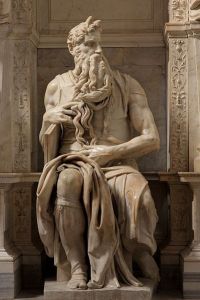
One of the commandments he handed down declared images to be prohibited. There were no pictures made of Moses, no portraits. Our view of Moses comes from sources like Michelangelo and the Charlton Heston character based on Michelangelo’s vision. The inner circle of disciples could presumably make some educated guesses—Moses would be bearded, but so would most men. Beyond that, how do you recognize someone who’s been dead for over a millennium and for whom no images or recordings were ever made? Peter was so confused he suggested camping out on the mountain in housing with private booths. Was it something Moses said that gave him away?

Photo credit: Jörg Bittner Unna, Wikimedia Commons

Or did he have a shiny face and/or horns? The Hebrew Bible’s a bit unclear on the point. Horns, far from being a symbol of the Devil in those days, were a sign of divinity. All the gods were wearing them. Call it divine fashion. Uncomfortable with the implications, later readers decided the Hebrew word meant something like “shining” or “glowing.” That fits in well with the Transfiguration theme, but horns had been signs of power and authority for millennia. Rewriting history, however, has become the fashion of this day. Picture the scene: four men on a mountain top, a bright cloud comes down and engulfs them. Now there are six, a holy half-dozen. Moses, tradition said, had been translated to Heaven. Same was true of Elijah. But also Enoch. Of the three only Enoch has no recorded words in canonical scripture. Then suddenly the mountaintop experience is over and the apostles have to face another Monday. At least they’d had a glimpse of Moses and apparently had no doubt of who he was.


Peter and the Red Giant

Now that my book has been sent off to the publisher, I’m working on the next project. This one has me delving back into the Greek of the New Testament. It may be, some would say, that I’m no longer an expert in such things. Coming to Koiné Greek, however, after lingering among languages like Ugaritic and Akkadian, feels like coming home. It’s Indo-European, after all. One of the books I’ve come back to is 2 Peter. This is a curiosity among the canonical books. All but the most conservatively predisposed of scholars note that this little letter didn’t actually come from the Peter. The idea of using someone famous as a literary pseudonym was a well known and widely accepted practice in ancient times. In fact, the prefix “Pseudo-“ on classical writers is so common that I feel just a little self-conscious. Nevertheless, 2 Peter contains fascinating ideas.

The Bible was influenced, of course, by many outside sources. One of those sources was Zoroastrianism, the religion of ancient Persia. This came to mind because 2 Peter is the only book in the Bible that describes the end of the world as burning and melting. These ideas are tied to the purifying fire of Zoroastrianism. In that religion an evil deity, Angra Mainyu, corrupted this world. Fire, in Zoroastrian thought, is holy. At the end of time, when the blessed ascend to a heavenly mountain, a river of fire will pour down, burning and purifying the polluted earth left behind. The idea is powerful and evocative, and obviously some early Christian writers cottoned onto it. Including 2 Peter.

The idea, in the Bible, stands isolated in this one single book. The real concern of the epistle is false prophets, though. Still, the worldly should take note. The universe in biblical times consisted only of this relatively flat planet—which wasn’t even a planet then—with a starry dome overhead and a fiery Hell beneath. Ironically, 2 Peter’s end is similar to that predicted by modern astronomers. A star the size our sun will likely bloom out into a red giant, parboiling the earth in its death throes. Seems the Zoroastrians, and Peter, may have been correct after all. The thing is they both had an escape hatch that will only come with interplanetary migration, according to science. But then, all of this assumes there will be a world left after the Trump administration. And speaking of false prophets, I wonder what 2 Peter would’ve had to say about that?