Commander in Heaven

I pity the nation that doesn’t have divine founders. Origin myths help to orient our thoughts about where we belong in the order of things. Given enough time, any national founder will become a god. When a friend recently shared a blog post about Gogmagog, I had to dust a few cobwebs from my memory to place the mythic founding of Britain. During our years in Scotland my wife and I read about the heritage of the British Isles, according to bards before the Bard. Bede, Geoffrey, and the anonymous author(s) of the Mabinogion. Long before the Romans arrived on those islands, there had been gods, demons, and giants. The Medieval writers, of course, were drawing from the Bible. Gog and Magog are figures from Ezekiel, borrowed by Revelation. Sacred writ says enough about them only to make them mysterious. Their combined role in British myth makes one think they might be giants.

The founding of Israel, of course, is treated as history by many. I don’t mean the recent founding of the political state, but rather the biblical version of things. Moses leading the Israelites out of an oppressive Egypt, miraculously through divided waters. Foundation myths are that way. We can watch the process unfolding, even after just a few centuries. George Washington’s literal apotheosis is virtually certain. Even Alexander Hamilton experienced an unlikely resurrection when he was in danger of being removed from the ten-dollar bill. For nations to thrive this kind of transformation must take place.

6082318543_90e9752777_o

This is perhaps easier on states whose origins are lost in antiquity. There was nobody there to see the general fall off his horse or the commander in chief inhale. This was what folklorists call illud tempus, the time of events unlike those of today. Quotidian time has become profane—just look at the headlines if you don’t believe me. Those who are gods today are only those who make themselves so. We can see it happening all the time, if we pay attention. The implications should give us pause, when we consider those we think of as heroes or giants. Time makes gods. And it is just possible that we might be better off without a pantheon so terribly large.


Holy Castle

ManHighCastleReading about Philip K. Dick prompted me to read one of his novels. But which one? Some Amazon pick-up lockers on the way to work are painted with a mural of The Man in the High Castle. I haven’t seen the series, but there was the paperback, facing out, at the local independent. It’s been a while since I’ve read Dick, so I have to find my legs for his style. I’m surprised at just how much religious language he uses. Our cultural biases tend to insist that intelligent people aren’t hoodwinked by religion, but it does, nevertheless, appear. The premise of Dick’s novel is based largely on I Ching, the “Book of Changes.” Indeed, the conclusion of the novel relies heavily upon it. Along the way, however, Dick shows his sacred mettle when it comes to Judaism and Christianity as well. His prose is sprinkled with biblical quotes.

More than just a surface awareness, The Man in the High Castle offers some deep reflection for the reader. Mr. Baynes, seated on the rocket to San Francisco, ponders the Nazis who’ve won the Second World War. Reflecting on their hubris he considers how they’ve come to think of themselves as divine. “Man has not eaten God; God has eaten man.” This gave me cause for pause. Apart from Dick’s narrative, the idea of divine anthropophagy is in keeping with much human experience. We often consider ourselves masters of our own fates. Many, however, find themselves dangling like a spider from a web over the fire. Not that of Edwards’ Hell, but simply that of human circumstance. The Nazis didn’t win the battle, but listening to today’s political rhetoric, they may have won the war.

Nobusuke Tagomi explains to Baynes how I Ching, a 5000-year-old book, is alive. “As is the Christian Bible; many books are actually alive.” Far from poking fun, Dick suggests there may be something to all this mumbo-jumbo after all. We are conditioned to mock, dismiss, and ignore religion in this world where rationality leads to presidential races such as this one we’re currently suffering. Follow the trail back, I suggest. Look for clues. Philip K. Dick isn’t the only secular writer who knew more than the average person about what fascism looks like, and about the role of religion in its downfall. The novel may not be easy to read. It demands much of those who approach it. Nevertheless, it preserves the truth that many books, indeed, are alive.


Grasping for Meaning

DSCN6301

How often we’re told—and writers on biblical topics are especially guilty of this—the meaning of a story. Despite what materialists say, we are meaning-seeking creatures. We want to know why. When we read a story we want to know what it means. I occasionally dabble in the pool of fiction. Many times I read the emerging story and wonder what it means. Sometimes the meaning changes over time. Sometimes it means many things at once. Recently I read someone explicating the meaning of the story of Noah. The meaning? No, a meaning. That little article makes all the difference. Definite or indefinite, we need constantly to remind ourselves that stories bear meanings. Plural. They mean nothing otherwise.

Those of us who spend a lot of time with sacred texts see that it suggests something specific to us. Those who manage to gain followers start their own religions. The problem comes when one meaning is fixed to a text. I often saw this growing up as a Fundamentalist. I also saw it frequently at Nashotah House. This verse means this. Nothing other. Any interpretation outside this particular one is heresy. Heresy is, of course, punishable by death. Lest you think this is just the idle musing of an underemployed biblical scholar I must remind you that wars have been fought over such things. People have died. All for someone’s mistaking an indefinite article for a definite. There are those who say certain canons of the Mass must not exclude the definite article or otherwise all you’re getting is a very cheap and meager lunch out of the deal. For this you put on your best clothes?

We read stories for entertainment, but if they mean nothing they are quickly forgotten. Dreamtime stories, as David Abram reminds us, may lack plot but they have place. They take us to a place where we aren’t physically present. Or if we are physically present, we need to be taken there in mind as well as body. They give life meaning. Ironically, as a culture, fewer and fewer people find meaning in their work. Living for the weekend, they find their sense of fulfillment by what they do when not on the clock. And some of that time has traditionally been demanded by those who offer worship experiences. After all, weekends were their idea in the first place. There may be some meaning in that. If there is it is only one meaning among many. And even while attending, it is best to keep an eye or ear open for something other than the meaning which the ordained may insist is the only true one.


Noah Way

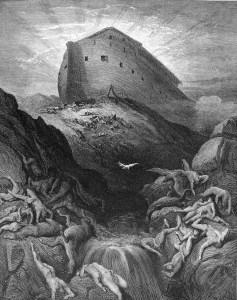
As a fleet of Noah’s Arks near completion, some critics would like to stop these Titanics from their mythical crossing. The Ark Encounter, despite announcements of its demise, is set to open soon in Kentucky. This Noah’s Ark replica, unlike its seaworthy compatriots, is land-locked in bluegrass country. According to a story originating in the Lexington Herald-Leader, Tri-State Freethinkers tried to take out billboard ads suggesting the ark advocates genocide and incest. Well, marrying first cousins has been done before (think about it). And if you go back ten generations things get even a bit dicier with Cain’s wife and that of Seth. All in the Family wouldn’t even air for 6000 years. As for genocide, well, this was more like genomicide. Not a race, but an entire species, apart from kissing cousins, was about to learn the hard lesson of being born not of chosen stock.

According to the article billboard companies have rejected the Freethinkers’ proposal. It might cause accidents, they suggest, which, although not technically genocide, do take the lives of the innocent, even in dry weather. The flood divides people. Thus it always has.

Dore_arch_noah

The culture wars, curiously, pick strange targets. I’m not in favor of teaching children to read myths literally, but then, I’m not in favor of bringing them up as materialists either. There used to be a concept called the “via media”—the middle of the road. Now such a stance appears decidedly wishy-washy. Milquetoast anyone? It is much better to be combative. “Oh George, you’re always so forceful,” sighs Winifred. So we teach our children. Boys, push your way to the front.

Implications can be tricky things. Allowing opponents, no matter how naive, their say has always been a mucking out of the Augean stables. Nobody likes to accommodate other points of view. Watching the parade of politicians we must be assured that we alone are right. Still, the stillborn billboard has a point. Building arks is the sign of the ultimate intolerance. Not only do you condemn those who differ to the outside, you are giving them a self-righteous death sentence. Maybe the billboard should stand. Or maybe it should not. What would Charlie Brown do?


Prophets Paid

Photo credit: Cephas, Wikimedia Commons

Photo credit: Cephas, Wikimedia Commons

Prognostication used to be the remit of oversized rodents and individuals we’d now classify as mad. And news used to be stories about things that had already happened. Past tense things. I don’t read any daily newspapers—a personality flaw, I know—but I do read stories that are sent my way, even if it takes some time. One of the things I’ve noticed, particularly in this election year, is the amount of prediction that passes as news. Future tense reporting. And the future is very tense.

Always one to assume that others know more than I do, I consider the opinions of experts as more valid than my own. After all, they are paid for what they think. Nobody spends good money on amateur opinion, which is one of the cheapest resources available in the civilized world. So when I read the headlines about what to expect this fall I see that the prophets and anti-prophets are lined up along party lines and, if democracy holds up, we’ll find out which group is which, come November. This makes me wonder what life would’ve been like under biblical prophets. No, their job was not primarily foretelling—future prediction was a small percentage of their job description—but they occasionally made political predictions when the boss told them to. Some people think they were primarily concerned with a future political figure, even if Messiah isn’t exactly an elected position. Hoi polloi must have been in a state of high anxiety. Who’s right? We know that for every prophet, according to the laws of rhetoric, there must be an anti-prophet. If a message is coming from on high we don’t know from whom.

Long ago media moguls learned that anxiety sells papers. Or news broadcasts. Sales boom after disasters. Extra! Extra! Read all about it! I’ve seen it in movies and televisions shows, so I know it must be true. As if real life events don’t generate enough trauma, we speculate about a future that tends towards the bleak. What’s a polis to do? The dilemma hasn’t changed in the millennia since we’ve outgrown prophecy—there’s no way to know who’s right. It’s all speculation. As for me, I wonder what the local groundhog thinks. And while we’re at it, could we get a bit nicer weather for a while? I thought the prophecy was April showers bring May flowers, not the other way around. But then again, my opinion is a decidedly amateur one.


Omen, O Man!

Omen_ver4

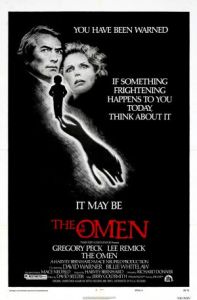
Of the unholy trinity of late-60s to mid-70s horror movies Rosemary’s Baby (1968), The Exorcist (1973) and The Omen (1976), the last always seemed the least effective to me. Having recently read about the Devil in American popular culture, and having a rainy Friday evening alone, I decided to give it a try again. Based as heavily on Hal Lindsey as it is, once one outgrows dispensationalism it is hard to be frightened by the idea of biblical end times. Everything from making up verses in “Revelations” to utterly bogus Holy Land geography (Megiddo is north of Jerusalem, not south—did the writers not even own a map?) contributes to a set of untenable tenets, even among the bibliterati. The film relies mostly on shocks and startles to earn its horror stripes, and after you’ve seen the movie once, these lose their power in subsequent viewings. Nevertheless, on this rainy May night, so close to June 6, I noticed new ways in which the movie undermines its own message.

The premise, of course, is that Damien, the son of the Devil (who apparently has a thing for bestiality), is plotting to take over the world through the means of politics. Having been watching the events of the past few months I have to wonder how the Devil could improve on progress through such channels. But I digress. His step-father Robert Thorn, US ambassador to London, discovers his “son”‘s identity and tries to kill him. With a strong anti-Catholic bias (the Antichrist is born in Rome, the seat of the church, and is protected by Roman clergy) the film nevertheless spawns sympathy for the Devil. As a child, Harvey Stephens hardly appears diabolical. Maybe it’s just because my brothers and I also spilled goldfish from their bowl once, but it seems to me he acts just like most little boys do. Who really wants to go to church at that age? As the movie approaches its climax, he’s represented as the biblical good-guy.

Thorn has to confirm Damien’s satanic identity. Like Delilah, he creeps up on the sleeping boy and cuts his hair. Convinced by a man who introduces himself “I am Bugenhagen” that he has to stab the boy, Thorn in a white car outraces police (so there might be a bit of prophecy here after all) to sacrifice the child on the altar. The movie casts Damien as both Samson and Isaac within a few short minutes. Apart from the film’s use of violence against women’s bodies (Thorn won’t allow an abortion, Kathy seems to have a penchant from falling from high places in slow motion, Baylock gets a fork in the neck) it actually seems ambivalent about the evil of the boy. An unfortunate birthmark does not a devil make. We’ve made it through the change of the millennium and many other hazards, yet dispensationalism is still with us, as is its anticlimactic Antichrist, Damien. He’s less scary than the real politics of an entirely secular age.


Devil’s Workshop

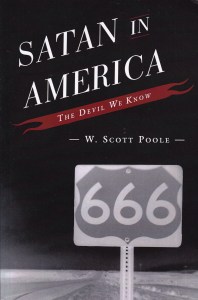
SatanInAmerSome of us prefer taking our monsters neat. With Old Scratch, however, we have a slippery, protean beast. This is amply demonstrated in W. Scott Poole’s Satan in America: The Devil We Know. Not only the Devil, but vampires, demons, and the human minions known as Satanists and witches populate this study of American culture. The Dark Lord is difficult to pin down. This is true even concerning his obscure biblical origins. As I’ve noted before, there is no Devil in the Hebrew Bible. By the time of the Gospels he’s alive and well and on planet earth. Or at least what passed for planet earth in those days. Tempter, father of lies, prince of the power of the air—he was a pretty ambitious fellow, seeking like a lion those he might devour. Those were early days, however, and Poole focuses specifically on his development in American culture. It is, as he shows, a rich culture indeed.

Beginning with the colonial era, with the Matherses, Jonathan Edwards, and their ilk, and bringing the figure up through fairly contemporary times, Poole shows us how the Devil defines America, in many ways. Please don’t misunderstand; Poole does not say America is evil or Satanic, only that our culture has had an undying fascination with Satan. Not everyone agrees, of course, with who he is or how to interpret him. Although theologians have largely left the Devil in the dust, polls tend to show about half of the American population believes in the Beast (yet another character in the mixed martini of evil Poole serves up), or more properly, Satan. It really might help to have a diabolical score card here: is the Antichrist the Devil? Is he the same as the Beast? What about demons? As a child I was taught there is only one Devil, but lots and lots of demons. Legions of them, in fact. There can be only one morning star, one Lucifer.

One thing we can say for certain about Satan, at least in the context of Poole’s study, is that he is evil. Not that some haven’t had sympathy for him. Popular culture has helped to keep the character alive. Sometimes comically, sometimes with dead seriousness, novelists, cartoonists, film-makers, and playwrights come time and time again to the font of the inexplicable evil we all seem to sense, in some sense, exists. The evidence is all around us. Whether conceived as an external agent of supernatural origin, or as some inborn tendency for—at least some—committing atrocity, we do have to explain evil. Satan has been a convenient way of doing so for centuries. But, as Poole intimates, it might be a defense mechanism. Perhaps we need to take a closer look at ourselves. Perhaps trumping our exceptionalism in the face of a world in need is a symptom that requires a serious exorcism.


With Your Measure

“With what measure ye mete,” someone once said, “it shall be measured to you again.” I certainly hope that’s true, but empirical verification seems to be lacking. I’m looking at, with the full armor of irony, a postcard from Nashotah House. Those of you who’ve long read my posts (I know who both of you are!) will know my history with said sacred institution. No, it’s not with me that they stay in touch, but my wife. You see, she’s one of those women who kept her maiden name, so in the eyes of many at the sacerdotal school we were probably never properly married. They certainly never came out to wave goodbye. Anyway, this past year they’ve begun corresponding with my spouse. I can’t remember—did I ever teach there for a decade and a half? So what are these sweet nothings they’re sending?

The card in front of me informs me that they’ve been praying for my spouse. Don’t get me wrong—she’s married to me and she needs all the help she can get—I never begrudge anyone’s prayers. I also can’t help exegeting a bit. Occupational hazard. One of my students once told me “don’t exit Jesus from your exegesis.” And they tell me I have no practical experience in the real world! So I’m looking at this prayer card wondering whose autograph it is. A man wants to know who’s praying for his wife. More than that, it appears that the name was scribbled out and written again. Did someone pray for those in the outer darkness by mistake? Heaven forfend! Alas, for my meting days seem to be about done. I must have a measuring tape around here somewhere.

That same guy whom I’ve quoted above also said, “pray for them which despitefully use you,” which I suppose might be some good advice. I understand that one-percenters and their ilk couldn’t be where they are despite using you. You just can’t help it—if something is inconvenient, you can simply toss it away. Build a tower to the heavens—what can be more biblical than that? See, words are endlessly flexible. They can be twisted and turned and made to say whatever you want them to mean. And should it ever come to meting cups, there are some recipes that might call for more than a wafer and a sip of wine. This is probably all obscure, but I’m trying to read by candlelight, and this text seems to say “when thou doest thine alms, do not sound a trumpet before thee” and “when thou prayest, enter into thy closet, and when thou hast shut thy door, pray to thy Father which is in secret.” But how will anybody send you money if you don’t let them know?

IMG_2767


Narrative Ark

Complete with an artificial giraffe perched on its prow—or aft, I can never tell the difference—a modern-day Noah’s ark is about to set sail. Or set float. The Bible doesn’t describe any kind of steering or propulsion for the ark since its main job was not to sink. According to a story on Huffington Post by Nina Golgowski, the life-size “replica” of Noah’s ark from the Netherlands (that I’ve posted about before) is about to go to sea. Spreading the good news as it goes, it is headed for South America, according to the story. Then the itinerary heads north, where the most rapid true believers can be found. Perhaps intentionally the ark is headed toward the godless left coast rather than hitting the Bible Belt. The fact that an imaginative reconstruction of a mythical ship can float may save many from Hell. A few questions, however, remain.

I’m a visual guy. I study pictures rather than just look at them. As a kid I was amazed at the sheer variety of arks that claimed to follow Noah’s blueprint. Reading the account in Genesis, it is clear that all that’s given are measurements—in cubits, no less—and instructions to make three decks and a window. The Dutch ark follows the design made popular by the 1977 Sun Pictures’ In Search of Noah’s Ark movie. The design, I recall thinking as a teen, looked slick and scientific. Engineered to withstand a fake storm in a bathtub, this has to prove something. When rock outcroppings on Mount Ararat were photographed from satellites and military jets, they suggested this was, in fact, correct, some of the time. Close-up photos were inevitably lost as sherpa after sherpa fell into hidden crevasses with the camera still in hand. Now they won’t let you climb the mountain, just in case.

The drawing that launched a thousand, or at least one, ark(s).

The drawing that launched a thousand, or at least one, ark(s).

Apart from the ark design is the more important question—the question about leg room. With all our technology, and a world that has been pretty thoroughly, if disappointingly, explored, we still haven’t catalogued all the species on the planet. The ark had to hold all the species since evolution is a diabolical lie. Pugs had to be there as well as their non-ancestral wolves. Both African and Indian elephants. Black and white rhinos. Hippopotami, pygmy and economy-sized. It had to have been pretty crowded, and Answers in Genesis claims there had to be room for dinosaurs too. For me the question has always been those left off the ark—the fish. If the oceans are salt water and the whole world was flooded, whence the fresh-water fish? They couldn’t have evolved, since nobody does. That’s a head-scratcher. Good thing too, because there had to have been more than just two fleas on that ark.


The Devil, You Know

I’m the first to admit that I’m behind the times. Too much of my free time is spent reading weird news or going to used book sales to keep abreast of what’s happening in the adult world. If it weren’t for my wife sending me news stories via the internet, I would still be wondering why Gorbachev isn’t helping to hunt down Osama Bin Laden. Since I’m captive to a religious worldview, I was interrupted in my calculations by the news that Ted Cruz is, allegedly, Lucifer. My research had me on the trail of Santa, since the simple transposition of two letters would give us the title of the Zoroastrian prosecuting attorney. And, I figured, it was fairly safe to out St. Nick when Christmas is still eight months away. Hopefully I’ll still find something in my stocking come December. I kind of figured that when we found the real devil he would be a Republican in any case. Even as I write this, Cruz is out of the race. I thought the Devil never gave up.

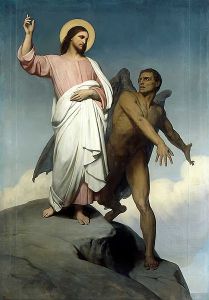
I wonder where else in the civilized world would politics be such a joke. Can you trust the opinion of a man named Boehner? It’s easy to change your name—just ask anyone who came through Ellis Island. They’re laughing at us, folks. Seriously, they are. I don’t get much email, but I’ve had two international missives asking me what’s going on over here. It’s a good thing I don’t know, otherwise I’d have to try to explain. You see, the Bible doesn’t say much about Satan at all. In the Hebrew Bible there is no devil. By scraping together the few references to “the Satan” and morning star, some have said the alleged Ted Cruz of ancient times was clearly in the Bible. Somewhere between the Testaments he showed up. By the time Jesus was old enough to climb temple towers, he was there. In the meantime the Zoroastrians had come down from the North Pole…

Then there’s the fact that when he’s not wearing a conservative suit and announcing a female running mate, the Devil is described as looking like Pan. Goat horns, goat feet, but always the torso of a man. And he’s red, just like the Coca-Cola red of Santa’s suit, and states like Texas. It’s a good thing I don’t read any more conspiracy theories than I already do. You’d probably find me tootling away on my pan-pipes waiting for a bus in the Port Authority. No, there’s a reason I stay away from the real news. It might interrupt my fantasy world. And, I’m afraid, it might actually be more entertaining. And don’t worry about my Christmas—I plan to have an eleventh-hour conversion, just in time to have a chimney installed in my apartment. If I can only be sure I get it done before February.

There's something political going on here...

There’s something political going on here…


Lily White

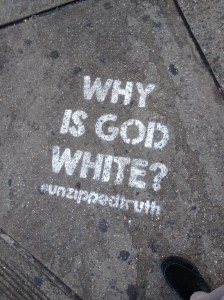
The funny thing about being “white” (I’m more of an anemic pink myself) is that my race seems to think all the gods share our ethnic traits. I’ve seen Thor, so I know. The Daily Kos ran an article recently about Crystal Valentine, a black poet, and how she responded to Megyn Kelly’s 2013 statement that Jesus is a white man. I won’t say what Valentine’s apt response is, but I will say I feel a lot better knowing that I’m not the only one who’s a couple years behind the news. I remember 2013 well. It was a year of transition, some would say enforced exile. If you could pull that trick off 2500 years ago, you’d have no end of books written about you. Just check out the offerings on The Exile and you’ll see what I mean. But I digress. Is Jesus white?

Historically all we can say is that Jesus was Jewish. We don’t have any Jewish men from two millennia ago to ask about their skin tone. One of the problems of having an only child, especially for a deity, is that you have to decide on the race (and gender; perhaps twins would be better?). Other religions sometimes make similar claims, but the problem persists. Especially when one race claiming God’s ethnicity develops an industrialized military economy. Who’s going to argue with that? So if Jesus is white, it stands to reason that his dad is too, right? If you listen to the sidewalks of Manhattan you’ll have your answer. Or the question.

IMG_1558

All of this makes me wonder about the image of God. Theologians like to make it sound academic by calling it imago dei. If you can read Latin then you obviously know the truth. With monotheism and imago dei, you’re gonna run into problems. Nobody likes to be told they’re adopted. Since this theological construct has caused no end of pain and misery, I have to wonder if we’re better off thinking that we’ve not had a case of mistaken identity after all. We all evolved out of Africa. We should, it seems to me, treat our parents with more respect. And that, dear reader, is straight from the Bible.


Come Sail Oy Vey

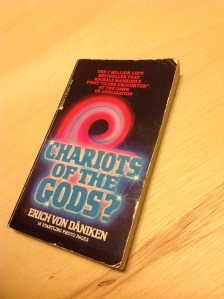
Nothing says unorthodox like a headline that reads “Smart Jews? Thank the Extraterrestrials.” Breaking Israel News ran the story recently and, being constitutionally unable to pass up anything so strange, I had to take a look. The article, by Adam Eliyahu Berkowitz, is really just a half-century retrospective of Erich von Däniken’s Chariots of the Gods?. I remember fifty years ago—not well, mind you, I was only three—but even when I was a teenager and the book had its second (of many ordinal) gasp(s), and a movie came out. People, even those not traditionally labeled as “crazy,” flocked to theaters to see it. The book went through multiple printings. The era of “ancient astronauts” was born. Von Däniken, it seems, is alive and if not exactly kicking, still making people uncomfortable.

IMG_0038

In this news story von Däniken suggests that Jews are more intelligent because of their alien DNA. Don’t quote me on this, but I’m pretty sure that was the plot line of the X-Files season 10. Isn’t Fox Mulder Jewish? Maybe I’m getting myself mixed up in some kind of plot here. I have to admit, however, to having a touch of nostalgia for Chariots of the Gods?. There was a kind of innocence to it. Nobody seemed to be inseminating anyone else, or stealing babies. It was good, clean fun.

Something bothers me, however, about the assertion that aliens are, indirectly perhaps, responsible for holy writ. I remember thinking through the implications of this idea (already floated four decades ago) that God might be more Captain Kirk than Jesus Christ. It is inherently disturbing. Especially when von Däniken says in the interview that the Jews are the chosen people, but they just got the chooser wrong. ET instead of I AM. The really interesting part is that ancient astronauts have become a somewhat accepted cultural trope. I don’t know whether they were there or not (I wasn’t around at the time), but they sure do make Saturday afternoons much more interesting. One wish I hold is that people writing about this old idea might find a new opening bit. Ezekiel seeing the wheel has been done to death. Surely a bit of creative thought might suggest a new, undiscovered ancient truth.


What’s the Message?

I said I’d come back to Bono. A story in the New Boston Post heralds a new documentary on Bono and Eugene Peterson. Both are famous in their own way, but no doubt Bono has the bigger name. Peterson, a pastor, is noted for his book The Message, a contemporary translation of the Bible. The documentary, “Bono and Eugene Peterson: The Psalms,” focuses on the book that brought rock star and scholar together, according to the story. The Psalms have a way of surprising people. In a day when the Bible is treated with considerable suspicion (how Bible scholars must feel, learning now that they are really rouges!) it’s sometimes easy to forget just how readable many of the Psalms are. The collection is, of course, uneven. Some are wonderful. Others are frightening and express immoral, if very human, sentiments. It is difficult to treat the Psalms as a whole.

437px-The_Sunday_at_Home_1880_-_Psalm_23

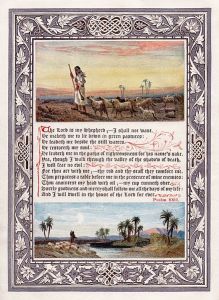
Having researched the Psalms in some depth, I found them to be one of the most challenging books to teach. We tend to have preconceived notions about the Psalter. That they are poems written by either David or God (neither of whom signed them). That they are comforting. That they are appropriate for any occasion. The reality is that Psalms is a most difficult book. Some of the poetry is sublime. Even up to the lifetime of yours truly, it could be assumed that many in secular society could recite Psalm 23 from memory. Not all of them are, however, quite so nice. Those that advocate murdering the babies of your enemies as less easy to consider holy writ.

The Psalms are generally a collection of human poetry. As I used to tell my students, whereas laws, and even narratives, are often top-down, the Psalms are one of the few places in the Bible where people are allowed to speak. There is joy in the Psalter, but there is also bitter frustration. Not all of the poems have happy endings. We seem to think that once a document becomes sacred it can no longer retain human fingerprints. The lie is given to this position in the Psalms. They are a most human book. Maybe the documentary will say why Bono finds this particular collection of poetry so inspirational. His is, after all, a human voice. There may be a message here since the Psalms are so fallibly human. And if nothing else, humans are experts at seeing the same thing in different ways.


Fast One Flood

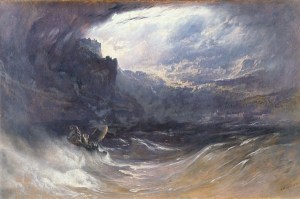
I’m not sure what to believe anymore. This crisis of faith revolves not around religion, but around media. Pundits have been saying for some time that the internet has meant the slow death of journalism, and there are so many websites that redistribute news that its like the whole world is involved in a constant, perpetual game of “telephone.” All of this is preface to a story a friend sent me that appeared on the website God. I’m not sure I trust God. The story is too good to be true. At least in a schadenfreude sort of way. God is hosted on thegoodlordabove.com, and, well, we all know about dot coms. The article concerns the destruction of Answers in Genesis’ Noah’s Ark theme park by a flood. That is believable. Floods do occur, as Noah knew. What becomes unbelievable is that the National Weather Service forecaster stated that there were no storm clouds in the area at the time. That qualifies as a miracle.

Martin,_John_-_The_Deluge_-_1834

Did this really happen? I don’t know. I wasn’t there. Plenty of times when I was there (wherever there happened to be at the time) I wasn’t even sure what happened. Can I find the truth? One of the police sites for internet rumors is Snopes (also a dot com). I remember when Snopes began as a place to quell fears of urban legends. Back when the worldwide web was young, there was a verisimilitude to stories gleaned from the net. Living in the sparsely populated Midwest, it was easy to believe that some of these things could happen to you. At times I held onto Snopes like a crucifix, especially if I had to go out alone at night. Snopes tells me that thegoodlordabove is not to be trusted. The story is false, like others that have originated on the site. Answers in Genesis, unfortunately, is still going strong with its theme park.

Authoritative texts aren’t what they used to be. There was a day when all you had to do was pull a black leather book off the shelf to find the definitive answers. In Genesis or any other of the books. Now we rely on the worldwide consensus of the web. You can’t trust God on a website. Snopes, however, is pretty reliable. It’s the Scully to our natural Mulder. That’s why the web will never have the same impact as print media. Even the website for your bank or government can be cleverly faked. I might’ve looked no further had the purported flood not fallen from a cloudless sky. I guess I’d better be a wary believer. For the internet tells me so.


Biblical Stories

The Bible had quite a week last week. It went from being vetoed as the “state book” of Tennessee to making it onto the list of the ten most challenged and banned books of the year for the first time. Did you ever get that feeling that you should’ve thought a bit more closely about career options? I mean, the Bible’s not half bad. Yes, it has some naughty bits, a few instances of cursing, and adult situations. There are homicides, suicides, and genocides. It endorses slavery and advocates religious intolerance. It’s not all bad news, however.

IMG_2634

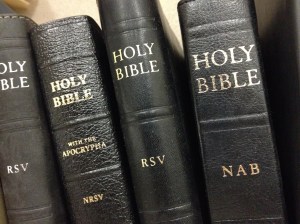
We find it easy to make summary judgments based on our own tendency to elevate human products to divine status. That which is most holy, after all, becomes the most profane when it’s defiled. The Bible itself can be like any other book. Printed on paper, bound between two covers, it contains ideas that must be interpreted. There’s no such thing as “just reading.” Even that road sign that says “slow children” is open to hermeneutics. What is objectionable is the use to which the Bible is put. And that use is objectionable due to the claims made about it. Saying that God rolled up his immaterial sleeve and took a transcendent pen into his incorporeal hand and began to scrawl is a bit naive. We know that people wrote the Bible—and much of it is sublime—and other people compiled it into a book that eventually acquired sacred status. It wasn’t born holy, it had to grow into it.

Once the Bible became objectified it turned into what people eventually use all objects for: a weapon. We can take sticks and stones and break your bones (no, that’s not in the Bible), and we can take paper and ink and hang you as a witch. Or pillory you as a liberal. Or say that it forbids the love you feel in your God-given heart. Something strange has happened here. The Bible’s not a bad book. It’s a bit on the long and repetitious side, but it has many, many memorable sayings and noble sentiments. Entire civilizations have been based on it. Or readings of it. They’ll ask you to put your hand on it and swear in court, and then they’ll ban it so your kids can’t read it. It’s been a tough week for the Good Book. Somehow, however, I don’t think we’ve heard the last of it because people love a conflicted story.