Footprints in the Snow

A friend keenly aware of my interest in the unusual sent me a story about the “Devil’s Footprints” that sometimes occur in snow. The article focuses on an instance in England in 1855 but which was reprised in 2009. The prints, made by a bipedal, cloven-hoofed animal, surmount tall barriers and occur on rooftops as well as on the ground. Such a phenomena is not limited to England. Associated with the Jersey Devil, similar unusual trails were reported during the flap of sightings in the early part of the last century here in New Jersey. As the piece on Mental Floss states, this is most assuredly not diabolical work, but it does make me wonder why people associate the unknown with the Devil.

IMG_2654

As a character in world religions, the Devil can trace his (and, like God, he is almost always a male) origins to the Zoroastrians. Zoroastrian theology is a dualistic outlook: ultimate good versus ultimate evil, Good God versus Bad God. The idea synced particularly well with the burgeoning of apocalyptic thought that hovered in the air during the time that the people of ancient Judah came into contact with Persian thinking. The idea was toned down, of course, to a being with lesser powers than God, but still a real foe with which to contend. By the time of the New Testament, the Devil was ensconced and associated with the Persian accuser known by the title of “the Satan,” or the divine prosecuting attorney. How this character came to be associated with strange footprints in the snow traces an odd trail indeed. The key is the cloven hooves.

No description of the Devil exists in the Bible. The best evidence suggests that the horns, goatish bottom, and cloven hooves come from an association with the Greek demigod Pan. Why Pan was singled out as a particularly bad god is not known. He was popular in ancient Greece. It is certain that the Jews of Jesus’ time would not have recognized a cloven hoofed beast as devilish. The livelihood of too many relied on sheep and goats. Once the transformation took place in the imagination, unexplained cloven footprints appearing in the night suddenly became those of the Devil. As Stacy Conradt points out in her Mental Floss post, several suggestions have been made for creatures of the natural world and their snowy markers. We don’t know what makes the footprints, however, and winter is all the richer for it.

Commitment

Marriage is a human institution. As those who invented it, we should be able to define it. Biology may not help here, since animals become mating pairs in many different ways. Besides, we’re selective in our application of science to the question. Not only that, human views of marriage have changed quite a bit over time, and the practice of marriage is still not uniform today. Back in biblical times, for example, polygamy was more or less normal. Marriages were arranged for tactical and economic reasons, and bonding for love had, one can only guess, very little to do with it. It was practical, pragmatic, and of use to the state. Prior to that, if the evidence is to be believed, “marriage” was a communal practice among groups of maybe 150 individuals. The purpose was the same: social harmony and cooperation.

An article on The Wild Hunt has me thinking about this again. (And you thought I was going to be discussing gay marriage, didn’t you?) According to a recent piece by Christina Harrington, handfasting, the marriage among pagan communities, has now been legally recognized in England and Wales. As far as we can tell, again delving back to the Bible, marriage was not considered a religious matter in antiquity. Part of life, it was handled by families who were witnesses to the promises made. Over time, various religious bodies came to give their blessings to people pledged to each other. In fact, for some religions marriage is perhaps the most important sacrament. Once this happened, however, dominant religions became jealous of their right to declare a marriage binding or not. Even as a child I remember a stigma attached to a merely civil wedding. It is, however, the state the declares a marriage binding.

Photo credit: the ShahMai Network (from WikiMedia Commons)

Photo credit: the ShahMai Network (from WikiMedia Commons)

Marriage is a convenient method to sort out tax statuses among genders with earning disparities. A government has no interest in whether a couple marries for love or not. Even gender doesn’t really matter. Can you tick that “married” box on your tax form or not? So it is that recognizing handfasting is likely, on some level, politically expedient. Meanwhile, those who marry for love have the added benefit of being with someone they chose and having a friend at hand. Tax season is upon us. Valentines Day will soon be here. And in some parts of the world the government is catching up with the times and realizing that marriage is what people make it.


Grim Where?

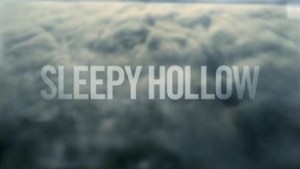
An inordinate amount of my childhood time was spent on television. While the device of the day had been around for a decade already, I was among those who grew up learning that watching was easier than reading. Like most children, I took the path of least resistance. I watched. As a teen, however, I rediscovered reading and from that time television began to take a back seat to books. When the great switch-over to digital occurred we didn’t get a conversion box, and we could never really afford cable for as little TV as we watch. When a program gets commended, or if nostalgia takes too great a toll, we can always purchase programs—the price of watching television without the commercials. So it was that I began watching Sleepy Hollow. Very quickly in the first season the monster of the week trope was established as the plot grew more and more tangled. The Bible was so prominent in that season that I wrote an academic paper on it.

Sleepy_Hollow_-_Title_Card

Over the past few months my wife and I have been working through season two. The DVD version was delayed and we only watch on weekends. Recently we finished the eighteen episodes of the second installment. Clearly the budget had improved over the first season, but the Bible, it was also clear, had diminished. Throughout the first season the driving motif of the story was that biblical “prophecy” (from the book of Revelation) was unfolding in Sleepy Hollow. This is what one scholar has termed a “local apocalypse.” Throughout season two, however, the end of days is shut down. Molech, its architect, is killed. The headless horseman is less Death than a jilted lover. The second horseman, War, loses his armor and dies.

Magic, however, along with special effects, take on an increased roles. Instead of turning to the Bible to solve problems, the most helpful book to have on hand is a grimoire. Sleepy Hollow, which is anything but what its name suggests, is full of monsters. Powerful magic is required to contain them, and, it seems, the Bible is no longer needed as a tool to take down evil. Perhaps there is a parable at work here. I was drawn into the series by its biblical literacy, as well as its literacy in general. More action has been introduced, and fewer books. It’s a pattern I’ve seen before. I suspect I’ll watch season three presently. When I do I’ll be casting a wistful eye on the stack of books I have yet to read, and I’ll be wondering if reading may not have become easier than watching.


When Gospels Mattered

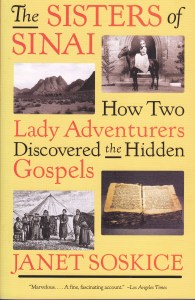
SoskiceOnce I met with a group of writers and intellectuals in the Pacific northwest to discuss ancient—indeed, dead—languages and their cultures. I’d never before been accorded “rock star” status for what, for me, seemed a natural progression. I had spent my youth learning archaic languages and reading documents that few people had heard about and even fewer cared about. It was a delight, therefore, to read Janet Soskice’s The Sisters of Sinai: How Two Lady Adventurers Discovered the Hidden Gospels. I have to admit having never knowingly heard of Agnes and Margaret Smith, also known as Mrs. Agnes Lewis and Mrs. Margaret Gibson, nineteenth-century Scottish twins who chose to use their inheritance in finding, reading, and preserving ancient documents. To appreciate the importance of this avocation, as Soskice points out, in 1881 when a new translation of the Gospels went on sale based on recent manuscript finds, Oxford University Press sold a million copies on the first day of sale and carts carrying the Bibles caused traffic jams in London. Today a doctorate in those ancient languages and five bucks might get you a cup of coffee.

What makes this story so intriguing, admittedly, is that here were two women in a men’s world, accomplishing great scholarship when the University of Cambridge refused to grant women degrees. (The twin sisters lived in Cambridge.) It is with some sense of familiarity that I read how, after discovering and photographing the Syriac palimpsest which turned out to be perhaps the earliest complete copy of the Gospels known at the time, the sisters could not even get Cambridge professors to look at their photographs. Professors, as we all know, are too busy to bother with amateurs like the rest of us. As soon as one of the more promising Cambridge scholars almost accidentally viewed one of the pictures, the men stepped in eagerly claiming the discovery for themselves. The manuscript was in Saint Catherine’s Convent in the Sinai peninsula, a journey not easy to make, even today. Agnes had discovered the palimpsest there on a journey to discover ancient manuscripts. But she was a woman in a man’s Cambridge.

We can congratulate ourselves on many things in academia today. In many fields a woman stands a better chance than a man in landing a teaching job. But we still have far to go. Salaries for women continue to lag behind those of men for doing the same work in general. Healthcare issues that effect primarily women are decided on by legislatures that consist mostly of men. In many parts of the world, women are, by default, treated as the property of men. Two Scottish sisters managed to help upset the world, in their quiet way, at the turn of the twentieth century. They did it by acts of scholarship. Genteel, proper, and very Presbyterian. If only we could say that in the century since then we had reached equality, we might have done something of which we could truly be proud.


Episcopal Pity

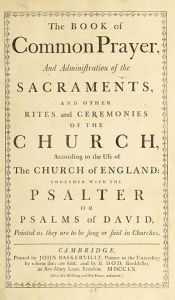
Call me naive. Really, I won’t mind. I’ll readily admit that I was raised in a conservative household that held a fundamentalist view of Christianity. But even though I grew and matured and eventually joined the Episcopal Church, I have always held consistency as one of the basic building blocks of any religious outlook. What’s fair for you ought to be fair for me. When I read that the Episcopal Church has been suspended, like the bad boy of the Anglican Communion, my mind went back to the consistency issue. The Anglican Communion, like many Christian bodies, is marked by strong membership from “conservative” constituencies. This was clearly felt while I was on the faculty of Nashotah House. As a conservative institution, we received many visits from diocesan leaders from more “traditional” cultures. They always expressed concern with America’s sinful, “liberal” culture. We should be more biblical, they opined. They didn’t, however, mind us paying the bill.

Book_of_Common_Prayer_1760

The Episcopal Church is being kept after school because of its approval of homosexual marriage. This is a social justice issue that has the backing of many major Christian denominations. Cultures in the developing world, however, see it as sinful and claim marriage is one man, one woman. Well, most of the time. I’m no anthropologist, but I do pay attention to what people say. While at Nashotah House we had a student from Kenya. He was already a priest, but he was there to get some basic training. Naturally enough, his biblical understanding was quite literal. Once I asked him about his life back home. He had a wife, it turns out, and kids. They couldn’t be with him in Wisconsin, so I asked how they lived when he wasn’t there to support them. He told me his brother took her as wife while he was away. His brother was already married, but in his culture it was traditionally for brothers to act as husbands in the absence of the latter. He gave me to believe that “husband” was used in every conceivable sense of the word. He was, of course, against same-sex marriage.

Levirate marriage (a brother “taking over” a wife) is arguably biblical. The problem is that the Bible states the first brother must be dead for levirate marriage to take effect. My point is not to condemn the “traditional” marriage arrangements of the visiting priest’s culture, but to try to get some consistency here. There are a wide variety of “marriage” practices recognized in traditional cultures. They have two things in common: women are subservient to men and their needs, and males mate with females. Beyond that, variety, as the traditional saying goes, is the spice of life. There used to be another traditional saying about the inappropriateness of peering into other people’s bedrooms. So the naughty Episcopal Church has been sent to a corner with a dunce mitre on its head. Meanwhile the other boys, typical of those in middle school, sit around and talk about the girls they’d like to have. It’s tradition we uphold, after all.


Creating English

From Wikimedia Commons

From Wikimedia Commons

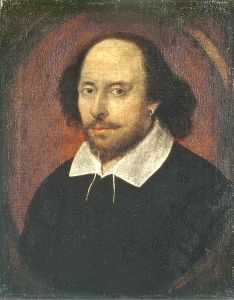
The seventeenth century was a portentous time for the English language. Well, I suppose every day is portentous in some way, but in the year 1611 the King James translation of the Bible was published, and it still has considerable staying power in the English-speaking world. Quotes from it show up regularly among the modern media with many readers (and likely a few writers) having no idea of the origins of the phrases they use. Just five years after the King James Version made its debut, William Shakespeare died. Many languages can point to formative individuals or literatures that codified their forms of expression. In English the honor is shared by the forty-seven translators of the KJV and William Shakespeare. This four-hundredth anniversary of Shakespeare’s death is set to be a year of celebration among Anglophiles worldwide. We will gladly acknowledge that the words we write and speak owe much to the Bard and his lasting influence that still has high school students griping all the way through English class their senior year. I have read a Shakespeare play or two that I was never assigned in school, as many come to do. This year, among my reading goals, is at least one more of the works I’ve never read.

As with the text of the Bible, there is doubt about some of Shakespeare’s plays. Scholars scrutinize. (That’s what we’re supposed to do.) And scrutiny raises doubts. The seventeenth century was a time of generally acknowledged authorship. Some great English epics, such as Beowulf, have no author we can cite by name. Over time, however, quality came to be associated with the person who produced the literature. Even today a name often sells a book far more readily than the contents do. Some of Shakespeare’s plays may not go back to William himself, but the English language wouldn’t be the same without them, in any case. We are heirs to this legacy. Spelling began to be standardized. Grammatical expressions were codified. Classic stories predating Shakespeare became endlessly replicated and copied by those who know there’s no replacing an original.

A story on NPR notes that the First Folio—the first bound copy of all of Shakespeare’s plays—is being sent around the country this year by the Folger Shakespeare Library. Each state will host the first edition during the course of the year. The article by Susan Stamberg notes that this folio is the literary equivalent of the Holy Grail. Shakespeare is nearly as canonical as the biblical canon itself. Even if the Bard’s authorship is in doubt, it is still holy writ. Those of us who’ve spent considerable time with religious texts recognize the hagiography readily. No, these aren’t signed editions. Some of the work may have been done by someone else. Nevertheless, four centuries ago, through a combination of Bible and what we would today call “fiction,” the English language as we know it, was itself becoming canonical.


Defying Labels

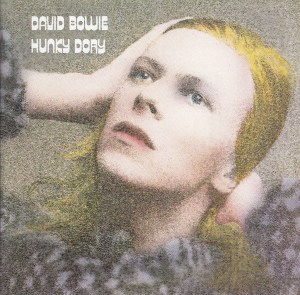
I don’t know much about the music industry, but I do know that as in publishing, labels make a difference. Who doesn’t conjure up a certain sound when they see Motown? Companies jealously sign artists to their label, with a close eye on the bottom line. Labels. Branding. Marking our territory. People like to give things labels to make them easier to understand. By now it’s no longer news that David Bowie has died. The tributes are coming thick and fast, and one recurring theme seems to be that nobody really knew how to label him. Bowie was an original, a creator. Like many truly creative people, he was seldom at the top of the charts, but his fan-base grew over decades and those who listened to him knew that he defied labels. Labels are for convenience, and life is, well, not convenient.

There’s been speculation about his final album, Blackstar, released an iconic two days before his death. The song “Lazarus” has flagged the attention of many, but here we are after the third day and he hasn’t come back. I think of my childhood and tween years in the 1970s, seeing Bowie’s album covers in my brother’s room and wondering if he was a man or woman. His transgressions frightened the young conservative that I was, accepting the label given to me by those who thought they knew me. I heard his songs coming through the open door. I couldn’t understand them, but somehow they remained with me until I was mature enough to learn to listen. Some sounds are too subtle to hear, except with experience. Here was a man telling the world “don’t label me.” And yet label we did.

“Lazarus” is a haunting song. I may be no music critic, but here is a piece by a man who knows he’s dying. The video shows him emerging from a tomb-like wardrobe (in itself significant) and simultaneously lying on his deathbed. He’s in Heaven, but in danger. Still, he knows he’s free. Like the biblical Lazarus from the Gospel of John, resurrection is only temporary. Lazarus has come back, but he must die again. As the frantic Bowie scribbles his final words on the final page, he backs up once again into the tomb from which he emerged. David Bowie may not have been a Bible scholar, but his song is prophetic. The three days have now gone past. He may not have come back, but it just may be that he never really left.

HunkyDory


Imagine the World

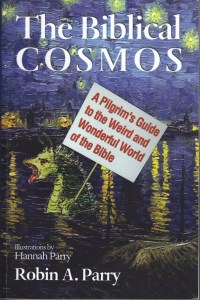
Biblical CosmosRobin A. Parry’s, The Biblical Cosmos: A Pilgrim’s Guide to the Weird and Wonderful World of the Bible is a fun trip through territory already familiar. Familiar, that is, to anyone who has studied the biblical world on its own terms. Fundamentalists, I think, would benefit from taking this guided tour seriously. The fact is, most people have no real sense of how mythology might inform a scientifically inclined world. Not that Parry will convince everyone, but the dangers of literalism are best disarmed by a believer. This little book endeavors to demonstrate just how odd a world produced the Bible we still use today.

Although the point of the book may not be what I took away from it, I would suggest that the most important aspect is that times change.  A biblical worldview, unless one is mentally able to hold two realities simultaneously in mind, is simply not possible today.  I told generations of students that the world described by the Bible does not exist.  It is a flat world, held up by pillars and with a solid bowl inverted over it for a sky.  At the same time, those who lived in the biblical world were not simpletons.  The basics of science were well understood and their engineering capacity easily bypassed that of the current writer.  It was a world based on different assumptions than ours.  The problem occurs when people who know better (i.e., anyone born since about the time of Copernicus) try to pretend that the Bible can be taken literally.  It is disingenuous to say so.  The Bible, regardless of divine status, is a document of its time.  No dinosaurs had been discovered.  The processes of geology were understood only in the most rudimentary of ways.  Stars were not millions of light years away.
 
So what are we supposed to do with this information?  Parry concludes his book by describing ways in which the biblical view of the cosmos might fit, conceptually, into a modern theology.  For many of those starting out in the academic study of the Bible such a demonstration can be quite valuable.  Those who’ve been at it a while will surely have come up with their own systems.  When books become sacred, in the minds of the believing community, the “truth” attributed to the book is the truth of that era.  As any scientist or historian will attest, truth is contingent.  We haven’t learned everything yet.  Given the limitations of the human mind, we likely never will.  We should accept our universe with a little mystery.  Humility can be a good thing, and it is more effective not having to make excuses for what will surely become outdated information sooner than we think.


Who the Devil?

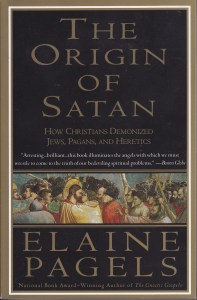
OriginSatanThose who’ve studied the history of ancient West Asian religions know that the concept of a devil, as a character, derives from Zoroastrian origins. In Zarathustra’s dualistic worldview, the forces of evil were concentrated in an “anti-God,” who, upon contact with the emerging monotheism of ancient Israel, became the satan. While scholars still argue about exactly what the role of the satan was, it is clear that it was a role, and not a name. The job of the satan was in some way to bring to accounting wicked deeds. By the time of the New Testament, “the Devil” had developed into an embodiment of evil more along classic Zoroastrian lines. What Elaine Pagels explores in The Origin of Satan is encapsulated in her subtitle: How Christians Demonized Jews, Pagans, and Heretics.

This is not a book about the historical development of the figure of Satan, but rather a study of how early Christians (and to an extent, Jews) viewed “the other.” Naturally she does discuss Satan, who developed along the lines suggested above, but more specifically she addresses how the accusation of being “of Satan” was used. Interestingly, it was generally utilized by those of ancient times to describe those of their own religion, but who held different viewpoints. Sects of Christianity and Judaism generally accused other sects in their own religious tradition of being “satanic.” Foreigners and pagans, well, what would you expect of them anyway? Those closest, ironically, are those most despised. Even early converts to Christianity from Roman polytheism tended to view their former religion as satanic. Satan, in other words, is “the other.” But not the far other. The near other.

While the book is full of Pagels’ usual erudition, it is also disappointing. Not as a book, but as a fact. Religions that claim God only wants us to love one another and treat each other well rely too readily on the figure of personified evil to castigate their enemies. As Pagels demonstrates, even as early as Augustine of Hippo there were those who realized Satan was not a “physical” being, but a symbol for evil. Yet on through the Middle Ages Satan would continue to be evoked to murder women and men thought to be witches or heretics. Satan, it seems, is simply a word for our darkest urges to harm those different from ourselves. We know that religions often have noble intentions. Perhaps the most noble could be to rid the world of Satan, and I don’t mean the mythological figure we all recognize without a hint.


Factor Fiction

An article on CBS that my wife sent me tells how Costco mistakenly labelled a shipment of Bibles as fiction, setting off a tweet-storm. Some offended, some applauding, a 140-character barrage ensued as Costco apologized. What was the fuss about? As a person who has experience with both fact and fiction, it has become clear to me over the years that these categories are not nearly as sharply defined as they might appear. We make labels to help us categorize a confusing reality. Our brains, nevertheless, easily accept fiction as fact, at least for purposes of getting along in the world. The earth is spinning, right now, at over 1,000 miles per hour. We don’t perceive it, and in fact, it took not a few deaths and apologetic clerics before it was admitted that evidence we don’t feel proved the case. Each day we choose to believe the fiction that we are holding still and the sun goes overhead. Is anybody tweeting about that?

One of the angry bird calls pointed out that Costco (which apparently now has an imprimatur) doesn’t label their Qurans as fiction. How many Christians have read the Rig Veda and not wondered whether its proper label fell on that side of the pricing gun? The matter of fact or fiction is one of opinion. Even those books bearing the label of non-fiction are interpretations of evidence. When it comes down to ultimate truth, where it lies is always a matter of faith. Who buys a Bible at Costco anyway?

IMG_2634

When I was a child and Amazon did not exist, buying a Bible was itself a kind of sacred act. You wouldn’t think of going to Wal-Mart to do such a thing. You went to the Christian bookstore (or, I suppose, if you grew up in a city, a secular bookstore might do). You talked to clerks who knew the differences between versions. The place smelled of leather and velvet. It was a place dedicated to the truth. Costco is a big box store. Buying in bulk implies something. Ironically, those who angrily tweet about the Bible’s label don’t seem to realize that Bible selling is big business. You won’t find much in the way of small publishers’ literature in such a store. Next to your giant cartons of cereal and immense packages of diapers, why not tuck in a Bible as well? When you get home you can tweet about how much money you saved buying eternal salvation in bulk.


Reptile Fantasy

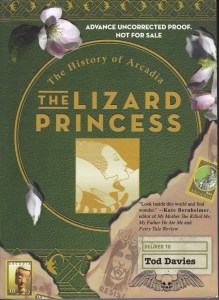
LizardPrincessThe generous folks at Exterminating Angel Press graciously sent me a copy of Tod Davies’ The Lizard Princess to review. A fantasy novel that includes a conflict between a world that admits of the supernatural and skeptics who deny anything beyond the material, it is a tale for our time. Indeed, the antagonism is real enough. We live in a world where fantasy can bring in untold wealth while we are taught that not an atom of it is true. Clearly material explanations fit the physical world we inhabit. It’s the world inside our heads that often rejects such materialism being taken to its “logical” conclusion. Davies clearly feels the angst of this discord. The Lizard Princess is a fantasy in the face of harsh reality. And we still need fantasy—perhaps we need it more than ever.

Throughout The Lizard Princess, whether intentional or not, biblical imagery pervades. The Bible offers classical stories that, no matter how we might receive them, continue to influence our ideas and ideals. Here, in a world created especially for the reader, the battle between good and evil is an everyday reality. The turns taken along this path are unconventional, and at times even uncomfortable. The awareness that there is a larger story in the background, however, offers some consolation. Angels, the Devil, and even a subtly veiled God are all players in this fantasy world of Arcadia. Mythical creatures abound, and transformations lead to new perspectives along the way.

In my conversations with other scholars I’m reminded that academics don’t often turn to novels for escape. Some do, of course, but the academy recommends a steady diet of technical non-fiction for those who wish to make an impact upon the world of knowledge. I have always been grateful for literature, however. During my years in graduate school and early in my teaching career I neglected the kinds of books that were my constant companions growing up. In a rural setting far removed from any institutions of higher learning, novels were often the only reading readily available. I never considered the time between their covers wasted. I found in The Lizard Princess a vivid world strangely like our own, but different enough to be more a parable than a simple piece of fiction.


Seeing Red

Not being commercially minded, it took many years for me to understand why it is called Black Friday. To many people “black” indicates negativity, sort of the opposite of Good Friday which, when you think about it, doesn’t seem so good. After I was forced into jobs in the money-making business, I came to realize that budgets were written in black and deficits were written in red. Since my lifetime, with a few exceptions, has been a series of economic disasters following one another (the implications should be obvious) and businesses operate in the red while projecting budgets ever higher the next year. This model is, in a world of limited resources, the very definition of unsustainable, and yet we keep raising our sights and getting disappointed. Nobody knows for sure where the term Black Friday originated, but it is a modern term. A holiday for those who measure celebration in terms of dollars and cents. (Mostly dollars.)

As I was pondering this phenomenon, my thoughts turned to red letter days. Red here is a positive thing—special days on the calendar that let us step outside the usual routine of pushing ourselves to make this year’s budget and allow us to relax with family and friends. The black and the red have switched places here. In fact, red letters, apart from the dismal science, have historically been considered good. Think of the red letter editions of the Bible. These Bibles had the putative words of Jesus printed in red so that they would stand out. The concept dates back to the change of the twentieth century. Red letter Bibles caught on among Evangelical readers. Red letters, however, go back even further in history.

Who said what now?

The book that Catholic priests used to set on the altar was a missal. Missals contained the instructions for saying mass, and during certain parts of the ceremony priests were supposed to make specific gestures. The places at which these actions were to be made were printed in red to draw the priests’ attention. They were called “rubrics” since they were written in red. Missals date back to the Medieval Period and they give us perhaps the first positive use of red writing that we know. Even further back in history when inks were organic, red writing was found. Epigraphers of antiquity know of red inscriptions but the meaning at that time remains speculative. We call this Black Friday because the one percent hope to get a bit richer. Those of us further down are supposed to enjoy the trickle. For me, in principle I don’t go shopping on Black Friday. I see it as a red letter day.


Birth of a Legend

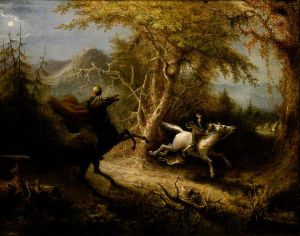
I was sitting in the restaurant attached to W, a boutique hotel cum chain, with my brother-in-law Neal Stephenson. He was on a book tour and kindly treated me to breakfast. Above his head I noticed a slightly salacious painting portraying a nude lady in bed saying “Of course I think you’re adequate. I love you!” In the doorway stood a headless man in a red coat, clearly intended to be the headless horseman. I pointed it out and Neal, being an author, made some inquiries about it. Nobody in the hotel seemed to know anything about the image’s relevance, so I did some internet sleuthing. I knew Washington Irving was born in New York City. I don’t know where precisely, and I’m not really sure how to find out. New York, in those days, didn’t reach so far up Manhattan Island, and we were near downtown, at Union Square. Probably this was the outskirts back in Irving’s day. I had already started my research for my paper on Sleepy Hollow, so I was attuned to the clues. W is now a chain, but I think the first W was the very one where we met. The restaurant where we had breakfast was the Irvington. The website said nothing about the origin of the name. Had we been eating where Irving had spent his youth?

This was a slight synchronicity. I had been researching Irving and had ended up meeting someone at a hotel which, it may turn out, had been named after him. Which Washington was the Squire really named after anyway? Washington Irving had been named after George Washington, so perhaps the point was moot. Months passed, and I wrote and honed my paper for public delivery. I’d almost forgotten the existential pleasures of following a lead and drawing some conclusions, whether or not history might bear them out. My brain was fully active.

759px-John_Quidor_-_The_Headless_Horseman_Pursuing_Ichabod_Crane_-_Google_Art_Project

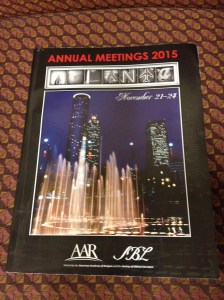
My flight to Atlanta yesterday for the Society of Biblical Literature annual meeting took off from Newark Airport on time. I thought I had a row to myself, but a couple of guys came in, talking, just before the cabin door was closed. They obviously knew one another, but not terribly well. One asked if the other was from Valatie, “where Ichabod Crane is buried.” These were not professorial types, which you often see at the airport this time of year. Just regular guys. “Yeah, there’s an Ichabod Crane High School,” the other replied. Their conversation moved on to other topics, but I sat there thinking about the synchronicities my paper seemed to be generating in my life. Of course, many people do watch Sleepy Hollow, not many, I suspect, are academics looking for connections to American religious thought. It seems that research never really ends.


Atlanta Bound

IMG_2600

Every year as the latter half of November rolls around, the mind of religion scholars goes toward the American Academy of Religion and Society of Biblical Literature Annual Meeting. This morning I’m off to Atlanta to join a myriad of others who still think the academic study of religion is a good and noble thing. For those who read this blog regularly, it will be no surprise that I’m giving a paper this year. Honestly, I’m a little nervous. I haven’t delivered a paper in years—it is nearly impossible to do research when you are cut off from academic libraries and, more importantly, the time it takes to do the work. Having only weekends to pull ideas together is not conducive to pushing the frontiers of knowledge forward. Sleepy Hollow came to my rescue this time around. That, and reception history.

Reception history is the hermeneutic that looks at the Bible from the point of view of later interpreters. For the Hebrew Bible that reception might be that of the New Testament, or even later books within the Tanak itself. Of course, the Bible has been studied and interpreted for nearly two millennia now, and not all those reading the Good Book have official training. Increasingly, with religious extremists making headlines from decrying the color of Starbucks cups to an all-out attack on Paris, understanding the reception of religious texts is important. The Fox network hit Sleepy Hollow is an excellent example. The show begins with the Bible and although the end has yet to be determined, Scriptures have played a role throughout. And a viewership of pitiful biblical literacy drinks it all in. It is important to understand how the Bible has been, and is being, perceived.

It may be, over the next few days, that my posts will be disrupted from their usual schedule. It is always a little hard to predict how things might play out when you’re away from home. I’m not sure what wonders Atlanta might bring. My own book should be on display in the book stalls for the first, and likely only, time. I will be meeting with people from dawn to dusk, discussing their book ideas. And I will, of course, be listening. Listening for the gallop of horse hooves in the background. Yes, the meeting is always a stimulating event, and with apocalypses in the news, I think I have selected a very timely topic this year indeed. If the frogs croak my name, I will know it is only my imagination.


Burden of Democracy

Speaking of revisionist history, I see that I’m negligent on updating my Egyptology. In a year when you need an Excel spreadsheet to keep track of the sheer number of GOP presidential wannabes, I had to ask my wife who Ben Carson was. She sent me a story explaining how the league of presidential dreamers believes that the pyramids were ancient Egyptian grain silos. His reason for believing this has nothing to do with archaeology or with history and everything to do with the Bible. Now, other presidents of too recent memory have had strange biblical beliefs as well. And that raises the intractable question of how you run a democracy with religious freedom. Some people like to claim religious belief is a matter of choice, but that is rarely true. At a young age we are programmed to accept what our parents or guardians tell us is true. Studies of the brain suggest that once wired for concepts of how God works, the circuitry is difficult to displace. In a country where most people can’t tell a Seventh-Day Adventist from an eight-hour clock, they may be surprised that a brain scientist might believe the pyramids were built to biblical specifications.

From WikiCommons

From WikiCommons

The Adventists are a literalist sect. And they are not the only ones who believe the pyramids have something to do with Joseph and the biblical famine that set the stage for the exodus. It is an idea I encountered as a child, and I didn’t even have a denomination to call my own. Religious belief can be, and often is, completely separate from rationality. Some very intelligent people are biblical literalists. The real problem is that the Bible doesn’t mention the pyramids at all, but then most Americans know as much about the Bible as they know about Seventh-Day Adventists. If people actually knew how much incentive George W. Bush had to start Armageddon, the turn of the millennium would have been far more tense than it was. And that’s saying something.

In our democracy, we want freedom of religion, but we don’t want to be bothered with the details of what a religion teaches. Like many, I was shocked by the headlines of a potential president grossly misunderstanding history, but as soon as I learned Carson is an Adventist everything clicked into place. I would suggest that it is a moral responsibility in a democracy to learn something about religion. We like to think we can fudge on that part of the homework. If we want the freedom of having anyone capable of becoming president, we need to learn something about a human being’s deepest motivations. No matter how much reporters and skeptics want to laugh and scorn, religion makes many decisions for by far the largest majority of people on the planet. The thought that a democracy can thrive without learning what truly motivates its leaders, I would suggest, is the most naive position of all.