Problematizing Noah

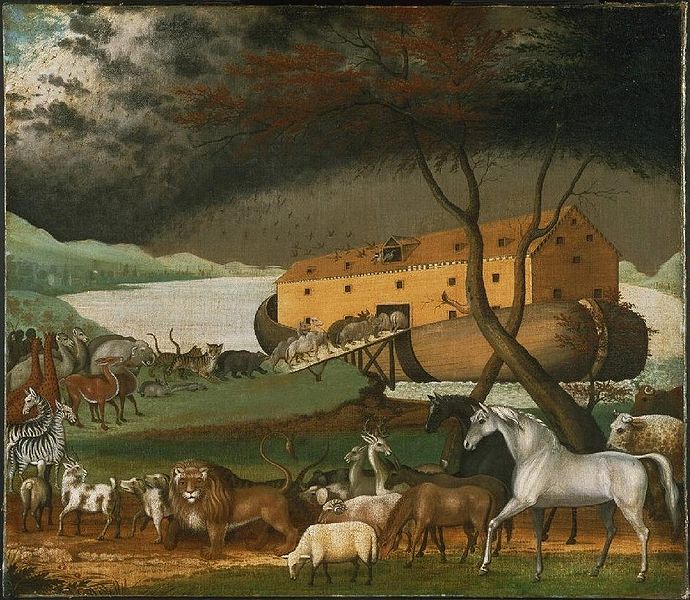
As I continue to Tweet the Bible, I’ve been working through the story of Noah. Considering the number of children’s items imprinted with the friendly, smiling Noah and Mrs., and the cute, predatory animals they’re taking aboard their private yacht, the utter belligerence of the story is frequently lost. There is one seriously peeved God behind this. “And it repented the Lord that he had made man on the earth, and it grieved him at his heart,” Genesis 6.6 states. And it only gets worse from there: “I will destroy man whom I have created from the face of the earth… for it repenteth me that I have made them.” Indeed, the wrath of God is emphasized more than the wickedness of the humans that have spawned it. No matter what is done, it seems, God will still be in a rage.

The truly striking aspect of this account comes, however, when Noah is instructed on whom to save. “Thou shalt come into the ark, thou, and thy sons, and thy wife,” verse 18 dictates. Men first. Now, we cannot judge a product of the past against standards of the present day, but it is quite clear why many women find the biblical text less-than-friendly. Even the animals are explicitly paired from the start do not receive the radical disjointing that the women receive from the men. If the purpose is to procure a new generation, arguably pregnant women could have done that with the men treading water above the remains of Eden. If survival is the point of the story, as the saying goes, ladies first.

The flood story is a complex account of a deity with anger management issues and a preference for the company of men. Although theologians may say with a wink that God has no gender, clearly the Bible begs to differ.

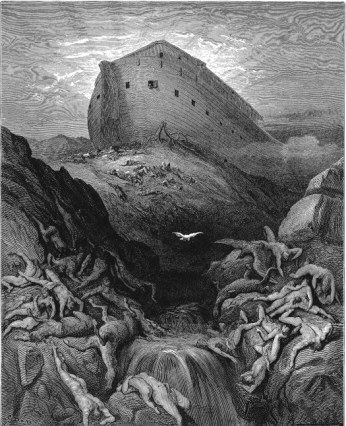
Humans and animals alike are victims of the divine wrath, and even though humanity survives the flood can the relationship with deity ever be the same again? How do humans face a creator turned destroyer, knowing that they will never really please him again? The weight of such divine displeasure is surely greater than all that water pressing our ancient cousins into fossils on the primeval sea bed. I think back to all the children’s toys with the happy little animals and a smiling Noah and I know they resemble the biblical version only in the most fleeting of fashions. Yet the myth lives on.

What shape is your ark?


Lies, Damn Lies, and Statistics

“The fear of the Lord is the beginning of wisdom,” so the books of Psalms and Proverbs agree. It must be true. Religion and fear walk happily along hand-in-hand. Some have suggested that religion began as a human response to fear. So this week I felt a little conflicted as I read Daniel Gardner’s The Science of Fear: How the Culture of Fear Manipulates Your Brain. The book had been recommended to me by one of my brothers. As a child fear defined me—it seemed that in a world where God was meant to be feared (for I was a literalist) that fear was the basic operating system for life itself. Gardner’s book is a fascinating exposé of the culture of fear. Gardner doesn’t really suggest that fear should be eliminated, but he does show how many of those in power manipulate fear into a faulty perception of risk management, for their own advantage. Beginning with 9/11 he demonstrates how the irrational responses of people to the tragedy led to even more deaths that quickly became buried in the white noise of everyday society. Comparing Bush’s response to FDR’s “the only thing we have to fear is fear itself,” Gardner demonstrates that the United States emerged from the depression and Second World War weary but confident and strong. After Bush’s two terms, the country is cowering and weaker. Why? The Bush administration heavily mongered fear.

Funnily enough, the release from fear comes from two main sources: statistics and psychology. Statistics reveal the true odds of common fears—these can be inflated so as to create an atmosphere of threat. People, as herd animals, will gladly give more power to the alpha male when serious treat is perceived (don’t kid yourself, politicians have long known this). Psychology enters the scenario because people think with both reason and emotion. Our immediate, visceral response (the “gut reaction”) is instantaneous and powerful, developed from millennia of evolution. It is, however, irrational. Reasoned responses, often better for us, take longer and people do not like to force themselves to think hard. We have a whole educational system to prove that. Faced with hard thinking or quick solving, which do you prefer? Be honest now!

Ultimately The Science of Fear is an optimistic book. Being made aware of the problem is half the struggle. Garden-variety fear is fine. Systemic fear paralyzes. Religion is often defined as one of the building blocks of culture. Instead of offering release from fear, religions frequently add their own ingredients for recipes of even greater fear. The concept of Hell is a great example: think of the worse thing you possibly can. Multiply it by several orders of magnitude. Repeat. And repeat. You’re still not even close to how bad Hell is. There’s your motivation right there. Place that religion in the midst of a society rich with natural resources and led by schemers who know that xenophobia increases power, and voila! Paradise on earth for some, a life of fear for the rest. Manipulation characterizes both the evolution of religions and societies. Gardner doesn’t directly address the religious side, but that’s the beauty of reason: he doesn’t have to. The cycle can be broken; think of Mark Twain’s words I’ve selected as a title. Think hard.


Adult Reading

Book Expo America is porn for readers. I couldn’t believe how large a space was dedicated to literacy, even if only for a week. It is cheering to see what seem to be so many people flocking to the support of the written word, until one steps outside. The city is busy, fast-paced, and frenetic. Books have almost no place here—in fact, bookstores are increasingly difficult to find. This is the world of finance and action, not quiet, reflective thought. Stepping back into the Javits Center what do I find? As a long-time attendee of academic conferences, I am no stranger to book stalls. In religion conferences one expects to find hundreds of religion titles. Thousands even. One of the surprising aspects of the Book Expo, to my eyes, was the volume of religion titles there. To be sure, they were not the erudite, and recondite tomes that populate religion conferences, but there were many Bibles and many books on faith. The religious, it seems, have always loved their books.

Books offer a stability that is not unlike the ideal of religious teaching. One of the main reasons for the plague of fundamentalisms the world is experiencing is the obvious disconnect between the world of ancient books and a culture that refuses to stand still. Once words are laid down, they have a way of becoming stable, apparently written in stone. To borrow a phrase from those long nights playing hearts or gin rummy, a word laid is a word played. Thus Scriptures, with all their foibles, are born. Even in a world increasingly tied to electronic devices, the written word still voices an air of authority. They may be merely electrons projected onto a glowing screen, but words tell us what we need to know. Some of them may become future bibles.

At Book Expo I found Bibles in child-friendly form. In a world where vegetables are the purveyors of the Gospel truth, and we can’t believe anything that hasn’t been animated by a major corporation, the Deep Blue Kids Bible caught my eye. Based on the Common English Bible, it is not the work of amateurs, but it did bring to mind a scary story I read long ago. (The story and this Deep Blue Kids Bible are only related in the labyrinth of my gray matter, not in any business sense whatsoever.) The story was in a children’s Christian magazine and it still evokes a shudder forty years later, when I recall it. An unthinking parent, it seems, decided to keep rat poison in a peanut butter jar. I really need recount no more of the story than that—as the child lay dying the moment of spiritual crisis came to make that decision for salvation upon his deathbed. I started reading the Bible (KJV, of course) before I was a teen. The Bible is not a children’s book. As I walk through BEA on weary feet, I am very glad for the books, but part of me is somewhere between the devil and the deep blue sea.


Hair Cut

“This is the dawning of the age of Aquarius.” So we hear in the first number of the musical Hair. Since my daughter is learning about the 1960’s counter-culture in US History, she asked her middle-aged parents what life was like then. Well, my wife and I were both born in the early sixties and were a little young to get the full scope of things through juvenile eyes. Besides, I was raised in a biblically literalist family—probably not the best place to gain a great deal of insight into popular culture. We decided to watch Hair instead. One of the few aspects of that era I recall is the Vietnam War (something George W. Bush apparently didn’t remember). The optimism of the hippie movement never really came to fruition leaving an entire era of disillusionment to hang over the remaining years of the millennium. Nevertheless, there is a sense of freedom in Hair that conveys the exuberance of young idealism—something I can honestly claim to have never outgrown. Without idealism we, as a species, are lost.

As I watched the movie for the first time in years its biblical subtext occurred to me this time around. The identity of the youthful protestors is in their counter-cultural hair. Indeed, the show takes its very name from that aspect. Apart from the ubiquity of the hirsute righteousness on the screen, it is essential to the plot. As Claude Bukowski stops in New York City on his way to join the army, he falls in with the Philistine element of society—the long-haired (read uncircumcised) misfits who defy the principles of decency. The dinner party at the Franklin residence makes that perfectly clear. When thrown in jail Woof protests over-strenuously to having his hair cut, leading to the title number. When the friends decide to visit Claude on the army base on the eve of his departure for Vietnam, George Berger has his hair shorn (by a woman) and subsequently loses his strength. His vital force of arguing his way out of any predicament is sapped as he marches to the troop transport plane that flies him to his death. Singing about believing in God as he goes.

I have never used drugs—life has a way of being weird enough already without them—but the sixties seem to have had a moral righteousness that the Tea Party just can’t claim. It was a righteousness borne of speaking the uncomfortable truth to a society that honored the status quo above all else. The very status quo ante the Tea Party craves—a society of bigotry and inequality. A society of privilege and strict conformity. A balding society that has lost its voice. Drugs are not necessary to see unbelievable things. One of the Bible’s original Avengers, Samson tears his Hulk-like way through any crowd, felled only by the cutting of his hair. Hair also led to the death of Absalom, the son whose life David valued more than his own. At the end of the show it is quite clear where the righteousness really lies.


No God for Women

A friend recently asked me to write a post on the feminine image of God. Specifically, she noted that images of God tend to be overwhelmingly male, even today. Having written a book on the goddess Asherah, and being very interested in gender equality issues, I was intrigued by this request. Growing up male it seems natural in our culture to find representations of God as a man. It stands to reason that in a culture more open to feminine experience we should find female images of God. They are, however, still lacking. This combination of improbable facts kick-started some ideas about both religion and culture. To begin at the beginning, although the Bible makes passing references to God as either non-gendered or even female in rare places, clearly the predominant metaphor is masculine. The third-person masculine singular pronoun (i.e., “he”) is almost always used for God, beginning in Genesis 1 and running straight through. The Judeo-Christiani-Muslim deity is decidedly male in his demeanor. All three religions developed in circumstances of male social dominance.

Enter the 60’s (1960’s, that is. C.E.). Women were able to begin expressing their needs without the whole weight of a social McCarthyism bringing down the girth of the government upon them. Instead of finding feminine traits to the god of the Bible, interest in goddess worship revived. Now, serious scholars disagree on just how much a role the goddess played in the development of monotheistic religions. The end result, no matter how you parse it, is pretty masculine. Therefore some women found the goddess to be more conducive to fulfilling their needs. Problem is, there never was, historically, a goddess monotheism. There were always goddesses, plural. Without the unifying force of a single, female deity societies just never fully coalesced around a single, strong image of feminine deity. Some have tried to put Asherah in that role, but she was defined by her husband El and shared the stage with Anat, Shapshu, Ashtart, and a host of other potent females. In a world of two basic genders, monotheism favored the male.

Are there female images of god? Undoubtedly there are. There will be a great deal of difficulty finding them because Christianity very quickly invented the idea of heresy (something Judaism fortunately lacked). This assured that the “orthodox” voice would always be the loudest in the shouting match that we call religion. This situation has had two millennia to ferment and brew. Theologians (mostly male) early on stated that God really has no gender. After all, a male god does imply a lady somewhere in the wings—otherwise human maleness is really superfluous, theologically speaking. Rather than embrace castration, let’s just keep god male, the thinking seems to go. Religions are conservative by nature. They may breed radical free thinkers, but natural selection comes to their rescue by reinforcing the bearded, chastely clothed, divine father. Until society is ready to embrace true equality, however, religion will continue to privilege the big man upstairs.

Monotheism’s bete noir?


Religious Aliens

While surveying books purchased as texts in religion courses (something that an editor sometimes does), I came across a book called Interdimensional Universe by Philip Imbrogno. As I’ve often suggested on this blog, the study of the paranormal is related in people’s minds with the study of religion. I suspect a large part of it is because both deal with matters that go beyond mundane, daily experience. Indeed, the tiresome caricature of those interested in the paranormal is that they are individuals dissatisfied with their lives who project their disappointments into bizarre beings or situations to make up for the emptiness. Sometimes the same thing is said of those who are religious. What is really lacking in both fields, it seems to me, is people with strong critical thinking skills who remain open minded. There are serious scholars who study the paranormal—not many of them—and it is clear from the market-informed choices that Hollywood makes, people are intensely interested. So I decided to read Interdimensional Universe.

On the bus, however, I fidgeted to find ways to hide the cover and contents of the book. I don’t want some urban, Manhattan sophisticate seeing the letters U-F-O in my reading material. Still, like most honest, open-minded people, I have to admit curiosity. After a couple of chapters Imbrogno’s work appeared to be a standard UFO book. Then it started to get weird when he suggested that angels and jinn are, like aliens, interdimensional beings. He went from citing declassified Air Force and FBI documents to quoting the Bible. And not just quoting. He assumed the historicity of biblical accounts that scholars have extensively exegeted (oh, that word!) and demonstrated to have more plausible explanations. For the jinn he draws extensively on Islamic lore, believing that they are responsible for much of the trouble in the world, tricksters like the Marvel Universe’s Loki.

I put the book down disappointed. I still consider myself open minded. I admit to not knowing what is really going on with paranormal phenomena. If the number of reports alone are anything to go on much of the human race is either insane or is seeing some unusual things. The subject requires some real academic consideration. When self-proclaimed experts, however, veer into mythology to start explaining the unknown, we are getting no closer to finding the truth that, as Fox Mulder assures us, is out there. At the University of Wisconsin Oshkosh I taught a course entitled Myth and Mystery. It was some of the most fun I had in the classroom. It was also one of the most difficult classes for which I’d ever had to prepare. Is there intelligent life in outer space? I don’t see why not—the universe is awfully big to rule it out categorically. Are there jinn literally lurking in the closet? For that I’m afraid for that there is a much more prosaic answer.


Lunchtime in Midtown

It was a brilliantly sunny day and there seemed to be rain nowhere in sight. It wasn’t even hot. Days like this have been rare this spring, so I went out for a lunchtime walk in my neighborhood. I’d been by the United Nations with some visiting family the day before, so I went down again and pondered the words attributed to Isaiah carved in the wall across from one of the largest intentional organs of peace in the world. I was reminded that a copy of the Edict of Cyrus resides in the UN; as a historical text it is often considered to be the first document promoting religious tolerance among lesser powers allowed by a greater power. The world could use a few more like old Cyrus the Great these days. I think Deutero-Isaiah would agree. So with biblical thoughts in my head, I strolled back toward Grand Central.

Along the way I saw a phrase from the Eucharistic Prayer on a building and it was like meeting someone from college that moved halfway around the world to disappear from your life. I saw that I was standing outside 815 Second Avenue. To the majority of the world—even the majority of Christians—this will mean nothing. At Nashotah House, however, “815” was regarded as the source of all evil. It is the headquarters of the Episcopal Church in America. It is hard, as a disowned son, to describe the feelings that assailed me there. Those good Christians who intended me such harm did not seem to realize all I had sacrificed to join them. Some of the clergy whose daggers remain in my back are well-paid priests right here in New York. Yon Cassius has a lean and hungry look, I thought.

With that cloud in my sky, I turned the corner back to work. Parked in the street was a truck labeled “Divine Moving & Storage.” That sounded an awful lot like a trope for my life. The reproduction of Michelangelo’s God reaching to Adam contrasting with a phone number ending in 666, this bundle of contradictions might just have been a small sample of the human experience. Caught constantly between Heaven and Hell with doleful prophets and profit-loving dolers of sacramental grace living one next to the other. New York is a religious city in every sense of the word. Somewhere off in the shadows I think I hear Isaiah whispering, “I make weal and I create woe…” I love a sunny day in Manhattan.


Gods Will Be Gods

“And it came to pass, when men began to multiply on the face of the earth, and daughters were born unto them, That the sons of God saw the daughters of men that they were fair; and they took them wives of all which they chose.” Genesis 6 begins with one of the most unusual stories in the entire Bible. And that’s saying something! The sons of God mating with the daughters of men? A couple verses on we hear about giants roaming the earth in those days, presumably the children of this divine-human miscegenation. What is this stuff straight from pagan mythology doing in the pages of Holy Writ? Over the centuries, translators have tried to tidy up the boldly direct language of the King James here, making the sons of God into angels or some lesser beings. It is too hard to accept that sacred scripture admits of polytheism.

Monotheism, it is clear, came to the Israelites somewhat late in their history. The Bible is full of bold clues that other gods exist, and, worse yet, they are sometimes as powerful as Yahweh. In the light of later theological development, translators often bow to popular pressure and clean up the Bible’s language a bit. Fact is, Israelites, like most ancients, lived in a world populated with mythical creatures. Gods galore, monsters, demons, angels, witches, giants—they all haunt the pages of the western world’s sacred book. But that’s not what we expect the Good Book to say. The Hebrew text here is unequivocal, these are the “sons of God” we are talking about. Either that, or worse, “the sons of the gods.” More and more deities.

We can’t be sure why the ancient believed in monsters and giants, but it seems likely that such creatures had explanatory value for their world. Lacking science—paleontology was millennia in the future—they had to explain the huge bones found in the earth. We do know that dinosaur bones had been discovered in the Mediterranean basin in antiquity. These big bones often look human to a non-specialist. Heads are frequently missing. It has been suggested that these give rise to our biblical giants. Yet another response has been the recent trend of fundamentalists with Photoshop skills to post photos of archaeologists actually discovering giants on the Internet. Some of these doctored images are very impressive. It is an effort to save the Bible from the truth. A Bible that requires saving, however, should give even the most fervent believer pause for thought. Isn’t it just easier to suggest the sons of God were typical guys and that little has changed since the world was young?


Blazing Forest

Back in 1996 an angel was on the big screen. In a manner of speaking. Michael, starring John Travolta as the archangel Michael, may not have been an instant classic but it did have a memorable line or two. The image of a smoking angel had been contrived by Van Halen over a decade earlier, but the idea of the prince of the army of Yahweh being a guy just like the rest of us was strangely refreshing. No Park Avenue deity this. When the reporters first meet Michael and wonder if he’s the real thing, one suggests tugging on his wings to see if they’re real. Michael responds by asking if he should pull the reporter’s privates to see if they’re really attached. His companion comments, “An angel that says ‘pecker.’” While the very idea of “bad words” is an unusual one, it is well-nigh a universal. In just about every culture there are words or phrases that just aren’t uttered in polite company. Those who can’t control their mouths, suggests the book of James, can’t control their lives. So it is with a kind of perverse wonder that I read about the bullying bravado that issues from the lips of New Jersey’s governor.

Don’t get me wrong. I never fault anyone for speaking like they were taught. I was raised in a blue collar family and at times the talk could get pretty blue as well. I would, however, point out that you’ll not find a student I taught over my two decades in the classroom that every heard me cuss in class. It is a matter of standards. Emotions, those great clawing monsters inside us, rage to escape. The building blocks of society—restraint and control, and dare we even wish? subtlety and refinement—are signs of civilization. Some of us were taught to leave name-calling on the playground. I am profoundly saddened when politicians believe they are the best America has to offer when in reality they reveal themselves coarse, vulgar bullies. Enter Chris Christie.

In a public venue on Wednesday New Jersey’s governor called the chief budget officer for the Office of Legislative Services, “idiot,” “jerk,” and “numbnuts.” Here’s where we see Tea Party values incarnate. Belittling others, especially in a public forum, reveals a nature that should make all civilized civilians hang their heads in a surfeit of collective shame. America has come to this? Admiring bullies and slashing and burning services for those who need a little communal support? And he has been posturing for a vice presidential nomination. And angels will be smoking cigarettes in the wings. A President/Vice-President who says “numbnuts?” America deserves far better than this. Where is Michael when we need him?

Take that, you #!@&$!


Enoch’s Dilemma

“And all the days of Enoch were three hundred sixty and five years: And Enoch walked with God: and he was not; for God took him.” These two verses from Genesis 5 convey just about all we know of Enoch. That, and he was the father of the oldest man ever, Methuselah. With this intriguing introduction, however, the religious mind insists on a backstory. Over the centuries of antiquity, books grew about this mysterious character as he became the prototype of the person who never died. The Bible doesn’t state that Enoch didn’t die. Nor does it state that he did. Plenty of wiggle room for the mythic imagination. In what appears to be an unrelated story, the Chronicle of Higher Education this past week reported on technology that builds on the strange but natural idea of phantom limbs.

When a person loses a limb, sometimes they report still feeling it. Their brains grew in a body that possessed the limb, and once it is gone the brain still has memory of it. The term used for this is a phantom limb. Knowing that mind does control matter to some extent, robotics experts have figured out ways to wire a robotic limb to the brain of a paralyzed person that responds to brain signals sent to the phantom limb. As much like science fiction as it sounds, this is already happening. The robotic limb responds just like a biological limb. This technology is just developing, of course, and is very expensive. It also implies that cyborgs, once the fodder of futuristic fiction, are becoming reality. Some theorists, such as Raymond Kurzweil, suggest that the brain itself can be converted to electronic signal and transferred into mechanical storage. Once that is achieved, we will have Enoch without any God to take him.

The world that we’ve been engineering bears a strange resemblance to the world of the Bible. For the people of ancient Israel death was the final word, and with rare exception (the only unquestioned case of the undying man was Elijah) people simply accepted the inevitable with no concept of an afterlife. Contact with the Zoroastrians convinced some Jews of the possibility of life beyond death and the quest for immortality was on. It has been a desideratum of human aspirations ever since. We invented machines to help us do what nature has not equipped us to attain. Finer and finer lines have been drawn between the biological and the mechanical. While it make look like immortality to some, to others it seems that we have been kidnapped—taken, if you will—by technology. What really happened to Enoch? The Bible doesn’t say, but it seems that we are getting very close to finding out on our own.


Free Tea

I first became aware of The Town Hall, I have to admit, through the Christopher Guest mockumentary A Mighty Wind. In the movie, three aging folk groups are brought together for a concert in Town Hall to honor the memory of one of their early promoters. When I began to walk past Town Hall on my way to work, I grew curious about its history. This curiosity was piqued by the scriptural quotation engraved on the façade: “Ye shall know the truth and the truth shall set you free.” New York City is an architect’s smorgasbord and I am often intrigued by the little gems I spy here and there. I discovered that The Town Hall was originally a political venue built by The League for Political Education, an organization sorely needed now. Built because of the need for a public space to discuss the Nineteenth Amendment (which the League supported), Town Hall was originally a venue to keep the public informed.

The Nineteenth Amendment—which the Tea Party seems to have overlooked, along with much of what we recognize as democracy—was drafted by Susan B. Anthony and Elizabeth Cady Stanton. It took congress only four decades to ratify it. Women were finally given the right to vote. Stanton was noted for her suffrage activities, including the production of The Woman’s Bible. The idea that an entire half of the human race should share the rights of the other half seems to have required a building erected to educate the public. Of course, there were moments when even The Town Hall couldn’t bear the words spoken on stage, as when Margaret Sanger was arrested for speaking about contraception there in 1921. I suspect there were Tea Partiers in the audience.

The same stage also provided a venue for Edna St. Vincent Millay to have her poetry reading breakthrough. Richard Strauss and Sergei Rachmaninoff performed there, as did any number of other greats. Truth may take many forms. Certainly human equality is as basic a truth as can be found. Art and poetry are equally as parsimonious, in the formal sense of the word. These things that we value are the very aspects of culture that the Tea Party would like to curtail. Thankfully there have been believers in the truth in the past who have been willing to construct monuments to sanity. And I can’t help but think that there would be even more of them if we still had a League for Political Education to help promote the truth. Without it, as it says in stone, we can never be truly free.


Stormy Weather

The privileging of one literature over others is problematic. Of course, the entire industry of biblical studies is built around such preferential treatment. And so is a large share of Christianity. I’ve just finished reading William H. Jennings’ Storms over Genesis: Biblical Battleground in America’s Wars of Religion. For someone who has taught Genesis before there wasn’t too much new material in here, but it strikes me as a very good primer for those who wonder about why the issues of gender inequality, global warming, and evolution remain firmly entrenched in evangelical minds, and therefore, our society. Just the first three chapters of Genesis, as Jennings points out, have led to the much of the irrational, at times inane, arguments that just won’t go away. Tea Party kinds of issues.

At the base of it all is the concept that Genesis somehow represents the way the world is supposed to be (rather than the way it actually is). As if seconding my choice of bus reading, The Economist recently published an article on Glen Rose, Texas. I’ve known about Glen Rose since I was a child. There, in a bizarre twist on the Flintstones, locals claim human and dinosaur footprints intermingle in a nearby creek bed. As the article points out, some locals see this as evidence of young earth creationism—seems Fred and Wilma missed the ark along with Dino. For decades paleontologists have tried to explain that the “human” tracks are actually dinosaur tracks as well. Given their size and stride, if they were human Adam must’ve been a giant. Despite the science, the myth persists. Even the article in The Economist doesn’t give the scientific answer.

It would be difficult to find a book more influential than Genesis. It would also be difficult to find one that is less scientific. Anyone who has studied ancient societies knows that they delighted in telling outlandish stories to explain the origin of the world. After all, there were no eyewitnesses. No channel 11 helicopters hovering overhead to bring you the story live. It all comes from mistaking a good story for a good book. In an era when evidence of evolution literally abounds, we still have nearly half the population of this technological nation trying to make room for the Valley of the Gwangi. Jennings may not hold the answers to all the problems Genesis raises, but if people would read Storms over Genesis, we might be able to afford a little more energy to solving global warming rather than running from dinosaurs in Texas.


Fighting God

Quoting Orson Scott Card, P. W. Singer notes in Wired for War that two of humanity’s “primary occupations” are war and religion. These two aspects of life are simultaneously very distant while abutting each other. While analysts cite many causes of war, there is no agreement concerning why we seem to be constantly belligerent. As a species we are keenly aware of small differences, perhaps like ants, and use those minor points to excuse the exercise of violence. Yet we are also a profoundly religious species as well, believing in supernatural powers that sometimes deliver us from, sometimes into, war. The Bible, just by way of example, contains many accounts of war. Often they are undertaken at the behest of deity. Religion and war coexist a little too comfortably.

Although Singer’s purpose in this book is to analyze the impact of robotic technology on the practice of war, he also finds indications about the origins of war itself. In today’s affluent world, dominated by technology, we should expect that armed conflict would be on the decline. Instead, it would be difficult to find any historic era when unfair distribution of basic goods has been more pronounced. As Singer notes, social disruption today tends to begin in cities, places where those in squalor daily see the opulence of their neighbors’ lifestyles. Our culture awards the aggressive—those with bigger houses, bigger cars, bigger payrolls. To these we defer. At the same time, the vast majority have difficulty finding enough to survive, let alone thrive. Still, we offer tax breaks to those who don’t need them and remind the poorest of their social obligations. This is often done in the name of religion. God is the ultimate capitalist.

The sum result, it seems, is not to lessen human hopes for religious deliverance. The belief in fairness, biologists inform us, is deeply embedded in primate evolution. We believe in fairness, and when it is elusive we thrust it toward the heavens, trusting in divine justice. Millions have died awaiting that justice that isn’t forthcoming. Again, another quote from one of Singer’s sources, “Amid galaxies of shining technologies there is a struggle to redefine human meaning… Half the world is looking for God anew, and the other half is behaving as though no god exists” in the words of Ralph Peters. Although the reference here is to technology, it could just as easily be to money or war. It appears as though we have an actual trinity of casus belli that are inseparable: technology, money, and God.

Some of our earliest technology


Lost Purpose

In a move that demonstrates its love of Inquisitions, the U. S. Conference of Catholic Bishops is officially investigating the Girl Scouts. Seemingly forgetful of the fact that a bunch of unmarried men with a record of protecting pedophiles is not above scrutiny itself, the Catholic Church now seems to think it has the right to police other organizations. The concern these men show for what goes on in other people’s underwear is beyond perverse—WWJD indeed? Both my daughter and my wife are Girl Scouts, and so I know it is not a perfect organization. I also know that it lives up to its goal of offering girls the chance to gain self-confidence and become empowered women. Women who are not trodden under the heavy feet of doctrine are tied to stakes and burnt, in good old-fashioned Christian charity. And why the fuss among our Roman companions? They’re afraid because of demonstrably false allegations that Girl Scouts “associates with” organizations to which the church also objects.

I was a Boy Scout for a few years. Already in those days jokes of homosexual leaders—and a few actual cases—were de rigueur. Where was the Catholic Church? Yet this year alone they have made strident moves against their own nuns and now, again, against the Girl Scouts. Where two or three women are gathered together, the Catholic bishops will begin to pick up stones. Better not read what Jesus is scribbling in the dirt. Some of my readers have problems with my biblical interpretation. I will now ask if anyone can produce a biblical prooftext for the church’s mandate to oversee the organizational structure of secular, non-profit, non-religious associations. What does the Bible say about that? Clearly what the Bible does allow sexually favors men. Where your testosterone lies, there will be your heart also.

All of this belies a lost of purpose for the church. Like the empire whose epithet it shares, the Roman Catholic Church is perceiving paranoid threats from every quarter. The purpose of Christianity, at least according to a guy called Jesus, was to help the poor and underprivileged and to love all people. Even those who crucify you. Now the message the headlines declare is that any organization offering women sexual autonomy will be investigated by the bishops. It matters not whether any allegations have a basis in fact. Christianity’s purpose? To assert male authority. To prevent any organization of women from achieving confidence or equality. To subjugate an entire half of the human race to the will of a single man. Does that sound like the true purpose of religion to you?


Same Sex Sanity

When the people speak, sometimes it’s just nonsense. So the people of North Carolina believe in the exclusive rights of dysfunctional heterosexuals over committed homosexuals. And President Obama makes a powerful statement. As Americans we are reared to respect personal freedom. And what freedom could be more personal than the open expression of love? The reasons given for exclusivity of heterosexual marriage are spurious—certainly the Bible considers marriage in purely pragmatic, not sacred, terms. As citizens of their own time they were as much programmed by their environment as are people today. Marriages were arranged and the concept of sexual orientation simply did not exist. It is not that I castigate marriage—having been married nearly a quarter of a century myself I would be a fool to do so—but I in no way feel threatened by anybody falling in love with anybody else. Nor is it the right of any loving Christian to stand in anyone else’s way.

A God who created gender-changing fish to fry in Hell (particularly on Fridays) seems unnecessarily cruel. (Yes, such fish do exist.) A God who created other animals that exhibit homosexual behavior (bonobos, penguins, elephants, lizards—at least 450 animal species have been caught in the act) and then condemns it is surely working at cross-purposes with the nature he (always he) created. It has become quite clear from nature that sexuality is far more than procreational activity. If your kit is for kid making only, why do so many good, Christian couples have trouble conceiving? And don’t say “God only knows” because Fundies have no monopoly on questions that demand a verdict. What is God playing at here?

Intelligence and sexual behavior seldom go together. Religions, however, have a hard time keeping themselves out of the bedroom. Loving, committed relationships hurt no one. For a religion claiming to be based on love, declaring various expressions of love wrong is diminishing the good in the world. The Bible has very little to say about homosexuality. Good, Bible-believing Christians often turn blind eyes to the many more stringent passages about divorce and remarriage, but single out the very few that mention specific same-sex acts. Do they not see how such cherry-picking makes a mockery of calling anything holy? With all the excised bits, it might be more appropriately called the Holey Bible. For me, it seems they might find it more instructive to observe the moray eels rather than trying to cover their wrasses.