Genesis Gender-Bender

“Male and female created he them; and blessed them, and called their name Adam,” so reads Genesis 5.2 (5.2a, for those sticklers among the crowd). Long ago I lost track of how many times I’d read Genesis. It has a privileged place in the Bible partially because of our modern method of reading books. We assume that the beginning should be read first and that it should lay the groundwork for what follows. The Bible, however, was compiled over centuries and the story may begin at Genesis, but not all that follows is in agreement with it. “Called their name Adam” sent me scurrying back to dust off my Hebrew of the Bible. The King James Version, after all, was translated from manuscripts that are sometimes inferior to many that have been discovered since then, including the Dead Sea Scrolls. Maybe this was one of those strange Elizabethan passages, for after all, Queen Elizabeth I did have a bit of a reputation. To my surprise, however, “their name” remains plainly in the Hebrew, suggesting that the first couple were both Adam.

Since just a verse later Adam and Adam have a son called Seth (and since the genealogies seldom mention their women at all), presumably Adam here means Eve. Literalists beware! The creation story in Genesis 1, as opposed to Genesis 2.4b, pictures the genders created simultaneously. Women and men together are humanity. The second creation story offers Adam a generous dollop of primacy; he gets to be first and even gets to name the animals and the wife; he is the lord and master of his domain. And people refer to eating the fruit as a fall! Now at Genesis 5 we have humanity reunited in the person of Adam, the bi-gendered representation of humanity.

Of course Adam is a play on words. The Bible begins with humanity as a joke. Adam is just one syllable short of the word for “ground” (adamah), and so Adam is the original groundling, or earthling. Yet Adam is never given as a proper name until Eve appears. It is only with the creation of woman that man becomes man. I suspect that may be the underlying of logic (if it is even right to call it such) of the plural, “their name Adam.” It might be easier just to recognize that the Bible doesn’t give us the endpoint of the discussion of human nature, but the starting point. There are those who insist that the Bible has all the answers. In my experience it is primarily full of questions. And the questions require both female and male to answer them. Otherwise, humanity is indeed a joke.

“Adam, I’m Adam”


Battle Bibles

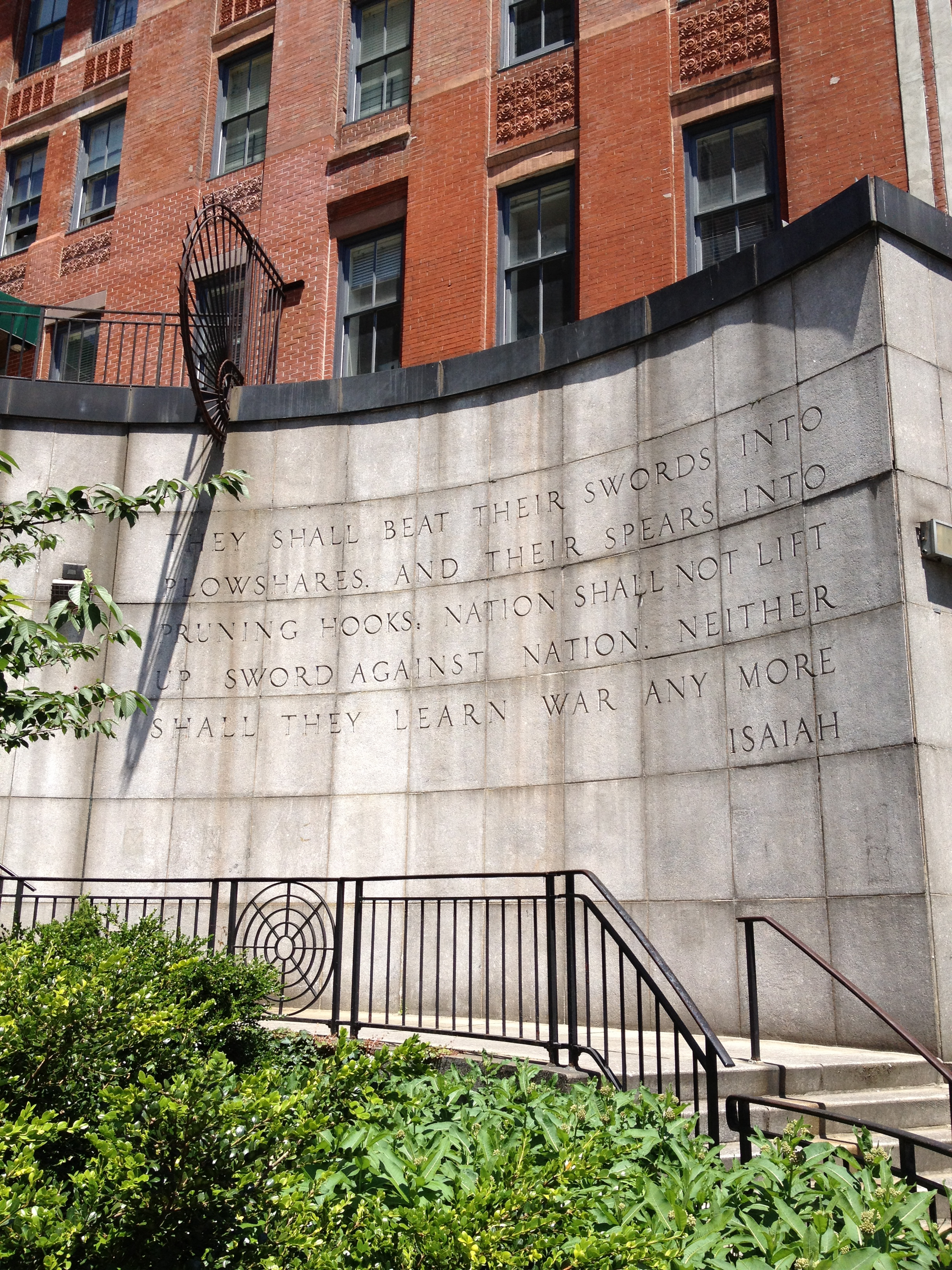
“There are no atheists in foxholes,” so the old saying goes. No doubt, war is among the most stressful circumstances in which humans insinuate others (who goes to war happily and without reservation?). As a corollary, to keep soldiers comforted in hellish surroundings, it has at times been common to supply them with Bibles. In an exhibit I’ve not yet seen, the Museum of Biblical Arts in New York currently has a display of soldier’s Bibles. A poignant dissonance accompanies such a concept. In the newspaper story announcing it, the phrase that leapt out at me was “Bibles clothed in camouflage.” To be sure, the Bible contains many narratives of war, even demanding genocide in certain circumstances, but as a whole the most valued commodity appears to be peace. Too often, however, it is peace on our terms.

According to the article, Bible distribution began in the United States in the Civil War. Bibles were offered to belligerents on both sides. Naturally, taken into the viewpoint of the chosen ones, God is on the side of the reader. God is the ultimate conflicted deity. This is cold comfort to a soldier dying on the battlefield of all-too-human contention. In keeping with religious differences, over time Protestant, Catholic, and Jewish versions have been offered. Notes in these government-issued religious documents urge the soldier to find succor here. One need not read too deeply between the lines to find the message is the willingness to lay down one’s life.

In a world acutely aware of religious differences, the idea of supplying fighting forces with religious backing may seem questionable. Can there be sincerity in the message that Scripture of any description ought to comfort a person who has been placed in this unenviable position by human greed, powerlust, or self-aggrandizement? What reason have we for war any longer? If religion be true, why have we not matured by even a millisecond since Joshua invaded Canaan? Giving a soldier a camouflaged Bible is to place a Band-Aid on a gaping wound requiring many stitches. Far better to take the message of peace to heart and look for reasonable ways to solve our differences. Idealistic? Without doubt. But it might help to save the cost of distributing Bibles to those whose lives are seemingly less valued than those who begin armed conflicts in the first place.

There is no “holy” in war.


Biblically Married

The Bible says—. Fill in the blank. Go ahead, someone will believe you. The problem with biblical literalism is that it is often held by people who don’t read the Bible. Well, it is a gosh-darn big book—well over a thousand pages—do you know how much quality television watching time that represents? So many fundamentalists are surprised to find out how little the Bible has to say about marriage. In fact, it says almost nothing. There are no marriage rites given, and marriages are mentioned but not described in detail. So when modern-day readers want to find guidance about political policy they have to—to be frank—make a lot of stuff up.

Take North Carolina, for example. Next week they are scheduled to vote on an issue of defining marriage. The intent, apparently, is to bring the state in line with the Good Book. In comes Matthew Vines, an evangelical Christian who’s also gay. Being a Harvard student, he has immediately impressive credentials. He has an on-line biblical exegetical exploration of what the Bible says, and more importantly, doesn’t say, about homosexuality. The other solution, to actually read the Bible, is a little too much to ask. Another part of the problem is that the Bible was written in a very different context, and to understand the Bible’s view on anything, you need to fit it into its context. All this Bible reading—and context too? Better leave it to someone on the television to explain it all.

Leonard Pitts Jr. is a columnist that I’ve come to trust. His good sense comes through in all his work. In Wednesday’s column, he highlights Matthew Vines’ hour-long talk as an example of what happens when common sense meets the Bible. For those who bother to read it, it will become clear that the Bible nowhere defines marriage. It says nothing about sexual orientation. The few passages on homosexual acts have a narrow context (that word!) that must be considered. Nowhere in the Hebrew Bible nor the New Testament is marriage considered a religious matter. It’s simply what people do. So as North Carolina heads to the polls, Bibles clutched in hands, but not in their heads, it might do to watch Matthew Vines as homework. I haven’t seen the video myself. An hour is just too long to take from my busy television-watching schedule.


Razzing Cain

Generations of literalists who’ve had their eyes opened by reading what the Bible actually says have stumbled over Cain. His murder of Abel is fine—predictable even. The problem is what happens after that. Since he has murdered his brother, the only other human born so far, Cain seems prematurely concerned about “every one that findeth” him killing him. Seems unlikely that Eve, or even Adam, would like to kill the only surviving child they have. Yet God puts a mark on Cain. Presumably his parents would recognize him, so why is Cain literally a marked man? Rather than Omega Man survival techniques, Cain focuses his attention on kick-starting his love life.

Cain’s wife immediately raises the issue of where the girl comes from. Those who like to call themselves literalists have to back-peddle a little and suggest that since, according to Genesis 5 Adam and Eve had other children, this must be where she derives. Of course, she would in such a scenario, be his sister. Extraordinary circumstances call for extreme measures, but even so, literally, there are no other people yet. Cain is old enough to kill his brother and the next child born, according to the narrative, is Seth. Seth is explicitly a replacement for Abel, and really he doesn’t do Cain any favors in finding a wife. The story here simply slips out of character and gives us a world already partially populated.

As I was tweeting Genesis 4, it occurred to me that immediately after marrying, Cain builds a city. Cities only sprang into existence to allow for mutual protection with the diversification of labor, following on from the agricultural revolution. One of the main characteristics of cities is population. Genesis 4 has only Adam, Eve, Cain, his wife, and Enoch. It may be the smallest city in history since the entire human race could have easily fit into one modest house.

The stories of Genesis are etiologies—tales of origins that have no ties to historical incidents. Cain represents the urbanites, the city dwellers who will always somehow find ways of irritating God. In our urban culture where most people are born in towns or cities, we have lost touch with the life of the nomadic pastoralist. We are, however, merely following the literal path that the Bible lays out for us. As we shall shortly see, the children of Cain and Seth are the same.

Cain just can't figure it out


Two Sparrows

Once I found a baby bird blown from its nest. Many future priests had walked by already that morning, not even noticing. At first I thought it was dead, but then it lifted its head weakly and opened its beak in a soundless cry for its mother. Afraid to touch it, I pulled on some gloves, took it home and called the local animal rescue center. With my daughter keeping the chick warm in the backseat, we drove down the country roads hoping the little thing would survive at least long enough to get professional help. When the trees leafed out and the air warmed up that summer, I received a call from Animals in Need. The bird had survived and was ready for release—would I like to let it go near where I found it? They had worked hard to prevent habituation, and I brought the bird home in a paper grocery bag that it occasionally tested to see if it could find its way out. With my daughter, I opened the bag in the woods and the bird was gone in a flash. We barely saw it as it flew to freedom.

If I were a rich man, well, I guess I would run for president. Perhaps it was being overseas for a week, but the presidential race seemed to fall from the news with Santorum’s demise (if ever I believed in divine intervention, it was on the day he dropped out of the race). Of course, those in Britain who knew me wondered about the carnival characters running for the “most powerful man” job. So we’re now left with a very wealthy man who’s just like the rest of us. Ironically, I’ve been thinking about the Bible—an occupational hazard—and wondering when the ideal of Jesus’ teaching was forgotten in the haste to become the richest Christian on the block (or empire, as the case may be). The disconnect couldn’t be sharper between the man who said that if you wanted to please God you had to give all your material goods away and a man running for public servant has more money than the last eight presidents combined. And Reagan was no slouch on the financial end. Where your treasure is, there will be your heart also.

I can’t remember the last time I felt valued by a politician. At least the Democratic candidates attempt the lessen the suffering of the poor a little bit, but I still see people sleeping in the streets. The roller coaster that is the economy demonstrates its unfeeling course as some get rich then plunge to the depths only to soar out of them again into sunny spaces. According to the Gospels, Jesus said not a sparrow falls to the ground without God knowing it. Apparently that little bird I was privileged to rescue was part of the divine plan. That guy sleeping on the subway grate over there trying to keep warm? Well, the politicians apparently can’t see him, and I wonder if the God who watches the sparrows has noticed either.

Not a sparrow (golden pheasant)


The Price of Religion

Gender is a religious construct as much as a biological one. The study of religion has brought me face-to-face with the reality that religion appeals to many women and to those who would manipulate them. Lately I’ve taken to reading the memoirs of women who’ve discovered the abuse their faith has doled out to them and who’ve taken moves to reclaim their lives. This past week I read Deborah Feldman’s Unorthodox: The Scandalous Rejection of My Hasidic Roots. As someone who has spent much of his life reading and re-reading the Hebrew Bible that gave fuel to the Mishnah that gave fuel to the Talmud that gave fuel to the Hasidic movement, I found Feldman’s narrative gripping. Some branches of Judaism, like some branches of Christianity, try hard to separate themselves from society. Their cloistered lives become secretive, and often by the standards of secular culture, incomprehensible. While reading this wrenching account of sexual domination, I kept wondering why Feldman didn’t try to escape. At the same time I already knew the answer.

I was raised by a religious mother who found her faith both a source of rules and a source of comfort. Unaware that religion can be a trap, women are frequently its victims. In a society that still refuses to give females equal opportunity for earning a living, is it any wonder that religions offer alternative routes that equally entrap? How do you appeal to a higher power when that higher power is, by biblical definition, male? Who will help you out when the largest religious structures in the world are male constructs? Yes, lately some religions have opened themselves to female leadership, but almost always at the cost of splitting off of factions that claim seniority and sanction from the beginning, when, they claim, only men ran this show. Deborah Feldman was trapped in a religion where her life, down to her hair and clothes and reading, was programmed by male expectations. In this continuum between religions we find the same progression in a series of degrees where men make the rules.

Many who read Unorthodox, I suspect, will see it as a condemnation of Hasidic Judaism. It is not. As Feldman makes clear, she has retained her Jewish identity, but she has let it evolve into a place where she is finally free to express herself. Gazing over the religious landscape, I see this as a place that many women find themselves. The very religions that had formerly held them down, however, continue to be male preserves. Even if women may join the club of bishops, clergy, or rabbinate, they do so with the constant reminder that they are only invited guests in what was once a masculine world. The world of men never voluntarily relinquishes its grip. As long as people are considered in the image of God they will always be by default male and female only as an afterthought. To conceive it any other way would be very unorthodox indeed.


Honor Thy Mother

Earth Day should be an international holiday. Perhaps the most disturbing attribute of some varieties of Evangelicalism is their tendency to read the “Be fruitful, and multiply, and replenish the earth, and subdue it” of Genesis 1 to be a mandate not tempered by a literal reading of Genesis 4. As I noticed when tweeting the text yesterday, Genesis 4.11 has God say to Cain, literally, “And now art thou cursed from the earth, which hath opened her mouth to receive thy brother’s blood from thy hand.” Her mouth? What is this if not a biblical affirmation of Gaia? The earth, according to Genesis 2, is literally the mother of Adam. Yahweh is the male element, the fingers molding the dirt (those who have ears, let them hear), while the womb of this bizarre conception is the earth itself. She has a mouth to receive the blood of Abel. The planet beneath our feet, according to the Bible, has not only a mouth, but also hands (Psalm 89, for those who doubt). It is our duty to grasp these hands and save our mother from ourselves.

In the spirit of the day, I decided to fix that pesky leak in the bathroom sink yesterday. We rent, of course, and our landlord—the nicest I’ve ever known—can be a bit slow when it comes to non-emergencies. I fixed the kitchen sink a year or two back, so I stuck my head under the cast-iron monster, baptized by the drips that continued to appear above my head from pipes far older than Methuselah, to see what I could do. After trips to every hardware store in the area, watching bemused DIY experts scratch their heads at photos on my phone of the Byzantine arrangement under my sink, I finally had to admit defeat and reassemble the old faucets again. The drips that fall are Gaia’s tears.

When I was in college I learned of Pascal’s wager. A philosopher who liked to hedge his bets, Pascal deduced that if God exists then our eternal fate relies on our obeying him (always him). If God does not exist, we have lost nothing by behaving ourselves, Pascal concluded. While many Evangelicals find that reasoning attractive, they do not apply it to their mother planet. If God is not coming back any day now, we’d better take care of the planet that sustains us. If God does show up, against all odds, what have we lost? Watching the plants burst back into life after a gray and dank winter, who can help but wonder at it all? Literal or not, the earth is so maternal that we should all pay her the reverence she is owed. Even if it means being a literalist for a day.

NASA's picture of our mother.


Nun Such Luck

It hardly seems to be news anymore when the headlines read “Vatican orders crackdown on US nun association.” Religions are largely characterized as men telling women (and milquetoast men) what to do. Perhaps because of our evolutionary, simian respect for the alpha male, most followers will resist pointing out inequities in the system just to have a smoother ride. The all-male Vatican is reportedly worried about how nuns of the Leadership Conference of Women Religious might be distorting the masculine teachings of holy mother church. No matter how much science the Vatican supports, it just can’t get over the idea that when God is found out there he will have not only a human face, but a human penis as well. The Associated Press article states that the Congregation for the Doctrine of the Faith—that is the organization of the Inquisition, my dear readers—found grave errors of doctrine among the ladies. Sounds like time for an auto-da-fé, n’est-ce pas?

Somewhere on its long and weary trek, the control of fellow humans for the sake of God has slipped into the rut of control of fellow humans for the rush of power. The Catholic bishops are worried about abortion (and other healthcare options for women). The Bible says nothing about abortion, considering life to coincide with the first breath. The chosen people did not have a conception of how conception worked (you can’t see the sperm or ova without a microscope, no matter how divine they may be) and so life began and ended with breath. The only reason to push the origin of life to conception is so that men may control women’s sex lives. These decisions are made by sexless men who wear dresses behind inscrutable walls of power. When nuns start seeking fair treatment for women it quickly becomes heresy.

I don’t mean to single out the Roman Catholic Church here, since many religions proclaim male superiority—loudly or softly. Back in ancient times when goddess worship was taken as seriously as the cult of male gods, a few religions did exist that gave women a position equal to, or sometimes even above, men. The priests of Cybele, for instance, had to undergo ritual emasculation. Strangely, religions with celibate priesthoods today leave their men intact, perhaps as a loophole for sin. I wonder how much more women-friendly official theologies would be if only eunuchs were allowed to serve as pastors. It is, as Genesis famously states, sin that “is crouching at the door,” and therefore it is better to remain gendered and pray not to be led into temptation. Perhaps we have something to learn from history yet.


Cain’s Dilemma

As I tweet the Bible into cyberspace, Cain strikes me as a most misunderstood character. Mercilessly portrayed as an ungrateful boor, the first vegetable farmer in folklore is demonized as the father of all sinners. Genesis, however, is impossibly vague on Cain’s crime. A close reading of Genesis 4 indicates that Cain was the first human being to offer a sacrifice to a higher power. Being a tiller of the soil, that sacrifice was of the fibrous kind, bereft of any fat or blood. The divine nose (metaphorically) is turned up at this attempt at pacification. In steps Abel with his bloody slaughter of animals and God is well pleased. Traditionally, Christian readers have attributed Cain’s evil intent toward Abel as jealousy. Genesis doesn’t seem to bear this out. “But unto Cain and to his offering he [the Lord] had not respect.” Cain was not jealous, but “wroth.”

Much later in time Paul of Tarsus will tell fledgling Christians that God is “no respecter of persons.” Still, in that first moment of divine favoritism, prior to any explicit instruction being given, we catch a glimpse of the future of this nascent religious movement. Even today, the literalists tell us, God expects something from us. What, exactly, differs from interpreter to interpreter. Cain’s crime was simply being human. Even more poignant in this case is the fact that the divine allowance for consuming meat has not yet been made. Abel raises animals for God’s appetite while Cain raises vegetables for human consumption. No sentient being is harmed in Cain’s offering. Abel, one might say, is the first killer in human history.

We all know the story. Cain will rise up against his brother and slay him. He will then receive a prototype of the mark of the beast and scamper off to rustle up a wife somehow. All this before the third natural born human being, Seth, is even conceived. Beowulf will reflect Cain’s dilemma centuries later, as Grendel is the spawn of the first murderer. The descendents of Cain are routinely demonized while the children of Seth repeat the cycle of divine favoritism over again. Here is Cain’s problem: God will like whom God will like. The rest cannot earn divine favor. The bloody consequences of this reading of history continue to play themselves out even today. Those who need divine approbation will go to any lengths to feel special, while all of us, the true heirs of Cain, have to work it out as best we can under silent skies.


Divine Checkmate

The first time I met Jehu I did not recognize him. When I first visited the British Museum a couple of decades ago I hadn’t had the benefit of teaching students long enough to realize the importance of the Black Obelisk of Shalmaneser III. But then, who really does? The obelisk, one of many artifacts essential to understanding the Bible in its context, contains the only known image of an Israelite king from a contemporaneous period. Jehu is here mistakenly considered the “son of Omri,” but is correctly identified as the king of Israel. He is bowing in tribute to a foreign king, a position in which no monarch likes to find himself. Before leaving the British Museum this time around I made sure to include him on my list of ancient people to meet.

The Bible contains far less history than we are accustomed to think, so when we find a case of convergence where Assyrian and Israelite agree, mostly, it is worth pausing to consider. Assyrian interests can only in the most abstruse way be considered religious; ancient peoples lived in a world where gods were both ubiquitous and largely irrelevant to daily life. Irrelevant in the sense that probably most people only tried to access a god’s pity when a time of trouble arose—priests existed to keep the deities happy on a daily basis. Citizens supported this system with taxes. How reluctantly we can only guess.

We have no reason to suppose that Israelites were more religious than the rest. Eventually, after the Assyrian and Babylonian conquests, they came to see their religion in terms of monotheism. Still, the work of keeping Yahweh happy devolved on the priests, with the backing of the king. The king was God’s representative on earth. In this sense the only surviving image of a king of Israel, showing him bowed before the unflinching might of the Assyrians, becomes an unexpected paradigm. Both kings were pawns of the gods, and at the end of the day one stands regally and the other bows in utter submission.


Paradise by Half

Some times the Bible is best taken in small doses. I’m no technical guru, but I do know that Twitter doesn’t always display the Bible bits I type in daily. Perhaps in some far distant future civilization that has learned how to recover “data” from fried pieces of digital storage devices, the Bible will be woefully incomplete. Maybe not woefully, depending on whose point of view sees it. Reading over passages worn smooth by timeless repetition, it is sometimes difficult to notice the harsh undertones. My twittering is up to Genesis 3 now, the infamous Garden of Eden episode. Over the last few days I’ve tweeted, “And the Lord God called unto Adam and said unto him, Where art thou? And he said, I heard thy voice in the garden, and I was afraid, because I was naked; and I hid myself. And he said, Who told thee that thou wast naked? Hast thou eaten of the tree, whereof I commanded thee that thou shouldest not eat? And the man said, The woman whom thou gavest to be with me, she gave me of the tree, and I did eat. And the Lord God said unto the woman, What is this that thou hast done?”

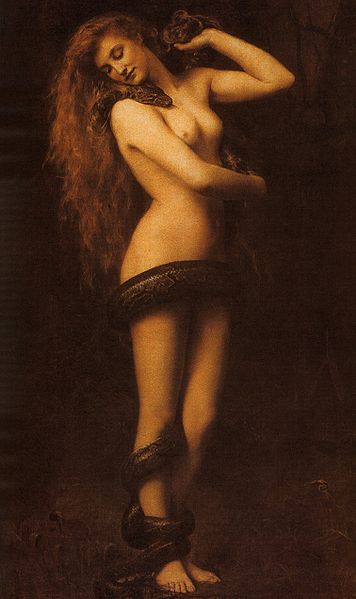
The weary “blame it on the woman” trope aside, several things stand out. God seems to be interested only in Adam. Perhaps the divine Dad wants to take his boy aside for a man-to-man chat, but it seems more likely in the context that Eve is simply irrelevant. Even Adam’s response is completely void of Eve, “I heard,” “I was afraid,” “I hid.” For a man about to shove the blame off onto his significant other (sorry, Tea Partiers, nowhere does Genesis say Adam and Eve were ever married), he is strangely circumspect about his recondite female. Even God sounds surprised, “Who told thee that thou wast naked?” Hmmm, who else is there in the Garden? Adam suddenly abandons the first person singular and begins his response with, “The woman whom thou gavest…” Blame anyone but Adam. The tragic disappearance of Eve until blame is to be attributed should warn us that the remainder of the Bible will not be a happy book.

The first chapters of Genesis have a lot of uncovering going on. God, like a detective in a CSI drama, tries to uncover the mystery of the naked man. When man is found naked he blames the woman, not even bothering with her name. Much is revealed here. Coming as it does as the first biblical story of human interaction, this tale sets the stage for all subsequent developments. From this point onward, with rare exceptions, the story will be a male narrative. Women will be assigned to, literally, support roles. Is it any wonder that women gather to protest against women’s rights, when under the thumb of such teaching? I suggest that what is required is even more uncovering. If we examine the bare facts of the Bible, we might be able finally to get to the root of this problem. That root lies deep in the literal interpretation of mythology.

Who's missing?


Unholy Brides

Hollywood is seldom accused of being a religious venue. Indeed, carrying on from an earlier distrust of theater as idle entertainment, some Christian groups early on deemed movies as tools of the devil. (Some relaxed that harsh assessment when Cecil B. DeMille came on the scene and started offering biblically based epics.) Many directors and writers, to judge from recent vapid box office successes, consider action or titillation sufficient to draw in the dollars. Yet, movies have often proven to be an outlet for the intellect as well, with profound, intricate, and important themes unfolding against the silver screen. The movies we watch reveal much about who we are. A surprising number of them, despite early evangelical concerns, have decidedly religious themes or messages. My regular readers know of my confession to being one of the monster kid generation, and as an adult I re-watch those movies with senses attuned to their religiosity.

Last night, as I watched The Bride of Frankenstein, I was repeatedly reminded of the role religion plays throughout the film. From the opening lines of Lord Byron through to the monster’s moral judgment on humanity as he is about to pull the switch, religious language, symbols, and implications practically tumble over each other to get to the audience. The concept of life—the divine prerogative—being absconded by human scientists forms the skeleton of this story based on Mary Wollstonecraft Shelley’s original work. While Shelley can hardly be considered the poster-girl for religious scruples, her work, and its adaptation into this movie, bristle with the implications of usurping the divine. In the words of Dr. Pretorius, “To a new world of gods and monsters!”

The Bride of Frankenstein is not alone in this aspect of mixing religion and monstrosity. Hollywood of the 1930s was a money-hungry haven, but the classic monster tales that began to shape movie-watchers’ sensibilities often included religious themes. Dracula has his resurrection and aversion to crucifixes. The Mummy arises from ancient Egyptian ritual magic. The Wolfman suffers a gypsy curse. Frankenstein is the power of God incarnate. When the final reel is placed on the projector, we discover that God has rejected all these human attempts to ascend to the heavens. Hollywood gives us conventional religious endings. More recent and daring approaches have emerged, but seldom have they captured the American imagination like the creature features of the 1930s. The religious veneer may have been thicker in those days, but the underlying message could have chilled the blood of the finger-waving evangelists. Even the Bible, from the beginning, has its monsters.


Battle Billboards

Perhaps the oddest intangible accompanying democracy is the concept that all things are negotiable. Add to that a capitalist sensibility that everything has its price and even truth itself feels like a matter of debate. We see this all the time with Creationists so desperately wanting the Bible to the “true” that they twist science into a fairy tale noose from which to hang their literalist god. The tendency, however, does not stop with them.

Surely one of the most tense stretches of pavement in the country is NJ 495 leading into the Lincoln Tunnel. The aorta pumping countless metallic cells into the heart of Manhattan, drivers and passengers often sit motionless in it for seemingly endless periods to crawl forward like an inchworm entering the Olympics. It is there that Battle Billboards takes place.

I have followed the Atheist billboard development with some interest. In my limited experience with the Lincoln Tunnel, I have noted the digital billboard on the Jersey side bears the message of atheist.org near the major Christian holidays, so as Easter approaches the newest one reads “Celebrate Living Without God” to promote a rally on the Mall in DC. Both religion and science make claims of how to know the truth. Truth with a capital T should be non-negotiable by definition. The problem is that nobody has the Truth. We’re still trying to figure it out. Atheist.org holds a firm conviction that life would be better without religion. Clearly not everyone agrees. Clarity, it seems, is the chimera of debates over Truth.

A few seconds after the atheist.org ad flashes off the big screen, an ad for Wrath of the Titans (coming soon to theaters) flashes on. Irony can be sweeter than honey and as bitter as the Dead Sea. The most recent Clash of the Titans (2010) borrowed little from classical mythology beyond the names and large plot lines. An atheistic Perseus just doesn’t fit the classical taste. In the new film, Zeus—surely one of the prototypes for modern conceptions of God—is captured by Hades and has to be rescued by his unbelieving son. Could any movie be a more thinly disguised Easter story? Atheists? Wrath of the Titans? Which way to jump? Fortunately for me, traffic going into the Lincoln Tunnel in these lanes is one way. That’s the kind of certainty we all can live with.

Light from above or hopeless ambiguity?


Battle the Angels

Over the weekend I finally got around to watching Battle Los Angeles. Now, I’ve never been a fan of war movies, but I do have a soft spot for aliens, so I decided to tough it out and see who won. I knew the historic event upon which the premise of the film was based took place in 1942, before flying saucers captured the American imagination. The official Air Force story suggests that old nemesis to our control of the air: weather balloons. Considering that Los Angeles was blacked out and ground forces lobbed 1,400 artillery rounds at the things, I wonder why the balloons at my daughter’s birthday parties never managed to last the night. In any case, the movie runs with the premise that aliens have taken over the city of angels and the U. S. Marines are the ones to get the job done when it comes to taking out aliens. (The Air Force, one expects, is too busy chasing weather balloons.)

Gratuitous aliens and science fiction action may be merit enough to get into this blog, but there is actually a more compelling reason. Back in my teaching days, I tried to demonstrate to students how deeply the Bible pervades our culture. When I taught those long summer and winter term courses, sometimes lingering four hours into the night, I would break up the inevitability of my lectures with a few movie clips to show them just how often the Bible shows up in films. Sometimes the cameo appearance is a matter of fleeting seconds, but when directors pay attention to every detail of a scene, we can be sure that Bibles don’t just show up by accident. Battle Los Angeles is no different. As our platoon is being air-lifted into the alien hot zone, one of the soldiers (I couldn’t figure out which one, since most of them get dispatched in fairly short order) is shown reading the Bible. The camera hovers there a second before pulling back to show the pre-battle chatter.

The viewer is probably supposed to be reminded that there are no atheists in foxholes, as the saying goes. Or it is a sign of how serious this is: before the big guns come out, bring on the Bible? In our culture the Bible has that kind of role. I recently read of a Catholic astronomer who was seeking alien civilizations in order to convert them to Christianity. The premise is as intriguing as it is arrogant. Human beings can be tenacious when it comes to matters of belief. In Battle Los Angeles, however, we speak with our guns and our missiles. But first we read our Bibles. Without wishing to ascribe to much intentional subtlety to the movie, this might be the underlying paradigm. Once the battle begins in earnest, the Bible never comes back into play. It is human ingenuity that wins the day, and perhaps the aliens are being taught to pray.


The Afterthought

This week I finished Genesis 2 on my venture to tweet the Bible, and even before reaching the famous snake scene in Genesis 3, I blushed. Not in a good way. Reading each word of the text in King James English (ironically, technically Elizabethan English), it becomes clear just how androcentric the text is. As a reader with sensitivity to historical eras, it is important not to judge the past by present standards. Nevertheless, it is difficult not to be offended at the assumed male primacy that had begun to be dismantled, only to be propped up again by sacred writ. As soon as people began to realize that sexual dimorphism did not equate to sexual dominance, the Bible came into the hands of the laity and there, beginning in Genesis 2, became the prooftext that women were made for men. Note: “for Adam there was not found an help meet for him. And the Lord God caused a deep sleep to fall upon Adam, and he slept: and he took one of his ribs, and closed up the flesh instead thereof; And the rib, which the Lord God had taken from man, made he a woman, and brought her unto the man. And Adam said, This is now bone of my bones, and flesh of my flesh: she shall be called Woman, because she was taken out of Man.”

One of these things is not like the others...

This passage is, of course, very familiar. Too familiar. Accompanying the ready availability of the Bible was the concept of divine writing. To a society of chamber pots and horse manure in the streets, the idea that God could write a book was sensible enough. The problem is, as our sophistication grew, our biblical sense couldn’t keep pace. Centuries later with probes soaring beyond our solar system, rovers on the moon, and space stations circling the planet, we still believe God wrote a book. And since God is male, the man’s point of view is normative. Of course, no one knows the reason for the story of Adam’s rib, but there is no doubt that ancient society, at least in this instance, was hopelessly patriarchal. It is society that determined which words would be considered sacred. The tale they chose matched their worldview.

The problem is that worldview gave an excuse to a patriarchal tour de force that has lasted for dozens of generations leaving women in their biblically predetermined place. There may be no sin as insidious as literalism. Those who cling to the King James do so only with special pleading, for anyone who has studied Hebrew (or any foreign language) knows that translation is an inexact science. Even Genesis 1 with man and woman created the same day, both in the image of God, still lists man first. Ironically the literalists miss the humor of a God who thinks man will be satisfied with the animals. Presumably all the animals were guys at this point, although the Bible literally doesn’t say. No religion that claims victims has the right to declare itself universally true.