What Would Dinos Eat?

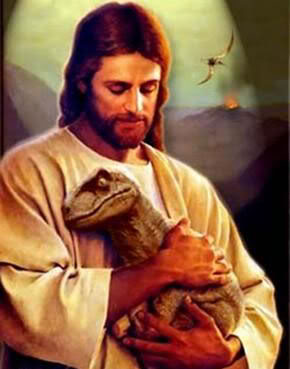
A recent edition of Science Illustrated ran an article about a potentially revolutionary understanding of mammalian evolution. Reponomamus robustus, a large mammal from the Cretaceous Era has been found with dinosaur bones in its stomach. The implication, of course, is that this early mammal may have eaten dinosaurs instead of the conventional reverse of the scenario. Science is open to such radical ideas, but my thoughts turned to the culture war being waged on automobile bumpers across the United States.

Several years ago the Jesus Fish or ichthus symbol began appearing on the backend of cars in what seemed at first to be a “baby on board” tactic with a don’t-ram-me-I’m-a-Christian subtext. Some drivers, however, associated the Jesus Fish with an evangelical power play, a showing of numbers that indicted all other drivers as “non-Christian,” and therefore, by implication, accident-worthy. The Darwin Fish showed up soon thereafter, a counter-symbol for those who seemed to be declaring that Christians could be evolutionists as well. Sensing a challenge — which always appears as a threat in neo-con eyes — the Jesus Fish or Truth Ichthus swallowing the Darwin Fish swam onto car posteriors. Then the dinosaur eating a Jesus Fish came out, and I am certain that I once saw a Jesus Fish eating a T-rex on some oversized vehicle hind-end.

A friend once asked me why I spent my time arguing with those who are so obviously wrong (the anti-evolutionists). The unfortunate answer showed up in the White House at the turn of the millennium and the radical restructuring of society encouraged by the “religious right” gains credibility from the sheer number of people willing to adorn their cars with Jesus Fish. The real victim in this volley of statements in chrome is a guy who said nothing about evolution and who, I’m sure, would be amazed at how misrepresented he is. As the love-hate relationship between Jesus and dinosaurs continues to wax and wane, I’m staying out of it, but I’m more frightened by the fish than by the dinosaur.

Highway Homiletics

“Over the river and through the woods to grandmother’s house we go,” is an assertion to be taken literally in my case. Crossing the Delaware River and trekking through the forests of Pennsylvania are the only means to reach my childhood home from New Jersey. Each time I make the trip I am amazed at how strident the highway preaching along the way has become. Signs on both the interstates and the backroads announce the truths of a certain vociferous brand of Christianity that maintains that everyone must think that way or spend an eternity in hell. Having experienced this kind of fear-driven faith firsthand, I can’t protest too much without being labeled a hypocrite, but some of what I observed over the river and through the woods leapt out at me anew this Thanksgiving.

Firstly it seems that Jesus saves big rocks. Several large, obtrusive boulders worthy of the land time forgot bear the message that Jesus Saves. Locally this form of homiletics can be as persistent as the Trust Jesus notes spray-painted on just about every interstate overpass between here and Illinois. A religiously aware lumber company in rural Pennsylvania hosts a sign declaring, “Read, Heed, Live & Obey the Bible!” When I think of lumber, I think of 2-by-4s and of their standard use of knocking sense into others who look at things differently. This sign said more than its owner might have intended. A few miles down the road I read, “Why not try Jesus? If you don’t like Him the Devil will always take you back.” The assumption, naturally, is that anyone reading the sign is already devil’s food.

One of the great things about freedom of religion and freedom of expression is that such messages declare their writers’ fervent beliefs, but they hold no force beyond the rhetorical. Having met many sincere believers in other faiths over the years, I do wonder what kind of good news such non-negotiable advertisements really send. Some of the writers, I believe, are railing against the godless world they see around them (although the number of churches along these backroads would seem to testify to religion a-plenty) while others can’t accept any form of any religion that differs from their own, even if it be a different flavor of Christianity. Perhaps it is time I put up a sign advocating a vegetarian version of Thanksgiving — no turkey need die for anyone’s sins. In some religions such a message is considered trustworthy indeed.


Religion’s Double-Edged Sword

This podcast discusses a recent visit of Westboro Baptist Church’s “protesters” to Rutgers University. The issue is whether religious freedom includes the right to encourage hate crimes on the part of those not directly involved in the “protests.” Religious freedom is the phenomenon that allows such groups to develop in a democracy, but the end results of such groups is destructive to the democracy that engendered it. This is compared to the Scientology case that is simultaneously taking place in France and noting the differences between them.


We Don’t Need Another Bible

This podcast addresses the issue of agenda-driven Bible translation. Although all translators, being human, have agendas, typically they are for the advancement of knowledge. The news about Conservapedia’s Conservative Bible Project suggests that progress should be turned back to the first century and fast-forwarded to the Neo-Con agenda. The trend is disturbing because not many Americans have the essential background to assess critically whether Bibles are translated with serious scholarly intent or not. The ten principles of conservative Bible translation from Andrew Schlafly’s Conservapedia are examined.


In Our Own Image

Word is out that Andrew Schlafly, spawn of Phyllis, is working on a new Bible. In a stunning move that will amaze even many conservative Christians, Schlafly has decided that the Bible itself is too liberal. On his alternative to “liberal” Wikipedia, Conservapedia, he cites the ten principles for translating the Bible in a conservative-acceptable way. Unable to attain the lofty heights of rhetoric on Conservapedia’s Conservative Bible Project page, I need to quote verbatim the 10 Commandments of Schlafly’s ideal Bible:

1. Framework against Liberal Bias: providing a strong framework that enables a thought-for-thought translation without corruption by liberal bias
2. Not Emasculated: avoiding unisex, “gender inclusive” language, and other modern emasculation of Christianity
3. Not Dumbed Down: not dumbing down the reading level, or diluting the intellectual force and logic of Christianity; the NIV is written at only the 7th grade level
4. Utilize Powerful Conservative Terms: using powerful new conservative terms to capture better the original intent; Defective translations use the word “comrade” three times as often as “volunteer”; similarly, updating words that have a change in meaning, such as “word”, “peace”, and “miracle”.
5. Combat Harmful Addiction: combating addiction by using modern terms for it, such as “gamble” rather than “cast lots”; using modern political terms, such as “register” rather than “enroll” for the census
6. Accept the Logic of Hell: applying logic with its full force and effect, as in not denying or downplaying the very real existence of Hell or the Devil.
7. Express Free Market Parables; explaining the numerous economic parables with their full free-market meaning
8. Exclude Later-Inserted Inauthentic Passages: excluding the interpolated passages that liberals commonly put their own spin on, such as the adulteress story
9. Credit Open-Mindedness of Disciples: crediting open-mindedness, often found in youngsters like the eyewitnesses Mark and John, the authors of two of the Gospels
10. Prefer Conciseness over Liberal Wordiness: preferring conciseness to the liberal style of high word-to-substance ratio; avoid compound negatives and unnecessary ambiguities; prefer concise, consistent use of the word “Lord” rather than “Jehovah” or “Yahweh” or “Lord God.”

Am I the only one to sniff a strong scent of Orwell here? Principle 1 stipulates that the translation, by converse logic (the kind apparently in favor) should be biased, as long as the bias is neo-con. In principle number 4 we are told that the word “word” has changed in meaning. Suddenly I’m reaching out for the railing – steady, steady! Principle 7: “free market parables”? Here is Jesus made-over in the image of Rush (I Can’t Have the Rams) Limbaugh; remove the kindness and compassion please. Jesus’ only goal is to be the CEO, or at least his only son. The translators reserve the right to remove objectionable material traditionally attributed to Jesus. Even Mr. Rogers could spell Revisionist!

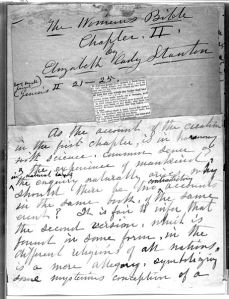
Sure, Bible translators need to give the readership what they want. Thomas Jefferson removed the miracles and divinity claims for Jesus before publishing “the Jefferson Bible.” And he was a president! Suffragist Elizabeth Cady Stanton led efforts to produce the Woman’s Bible, removing masculine bias from the text. Bible scholars, however, do not accept their efforts as original biblical manuscripts. Even the general public knows better. What Mr. Schlafly is proposing is giving a gullible readership a Bible that contains what God meant to say; i.e., if God were me. What is disturbing about this is not that one person is offering his or her own version of the Bible – that’s been done before – but that it is intended to lead the unwary to a vision of Christianity that is new but claiming to be apostolic.

I think I feel a podcast coming on.

Woman's Bible

Woman's Bible

Jefferson Bible

Jefferson Bible


Daniel in the Lyin’s Den

Yesterday I found myself. Online, that is. I was cited ambivalently as “some guy” in the Uncommon Descent blog comments, noting my Creationism’s White Box podcast. For those unfamiliar with Uncommon Descent, this is a blog hosting many posts by William Dembski, a leading creationist. Finding myself there, I instantly recalled that Daniel was never masticated in the lion’s den.

Not being one to judge without good cause, I read the critique with care. It read: “Some guy I read in the last few days here [link to my podcast] has suggested (to the approval of a few clerics) that creationism is an early 20th century phenomenon but all he’s really done is conflate creationism with the Creationist movement that grew out of, or was associated with, the publication of ‘The Fundamentals’.” Since academics like to split hairs (and even atoms), I thought I’d use today’s post to explain, in History 101 style, the problems with this assertion.

Creationism, like any other human enterprise, has a history. Christianity was born in a literalistic age, of sorts. Early Christians took the Hebrew Bible (pretty much The Bible in those days) literally. Belief in a flat earth and mythic beings still predominated the upper cortices of early brains too. My detractor could have been correct had the conflationism charges been laid at my door prior to the Enlightenment. The fact is that everyone born since the eighteenth century (academically speaking) has had access to science and the facts we’ve ascertained about our world. One of those sets of facts has had to do with evolution, and another with the history of the Bible. Interestingly, both of these sets of facts coincide perfectly: biological evolution took place and the Bible was a product of its environment. These truths have been available for centuries for any who would look at them.

The veracity of this statement is attested by the nearly universal acceptance of evolutionary theory by Christians in the western world in the late nineteenth century. Creationism, as such, did not exist at this time. It was in reaction to a number of social and theological factors that Creationism first hatched around the turn of the twentieth century. It was a new bird (I’ll avoid saying “hopeful monster”). Any claim that it was a default version of Christianity is strictly Retro — any such claim is tantamount to declaring that the Enlightenment never happened. I’m not a supporter of revisionist history, so I just can’t accept this flimsy construct. Fact is, Creationism is relatively new.

There is a great bibliography out there for anyone interested in getting the actual facts. Start with Ronald Number’s The Creationists: The Evolution of Scientific Creationism (University of California Press, 1992) and read on. Otherwise, feel free to believe in a flat earth — you can find good proof of this in central Illinois or Kansas.


Let Us Make Moses in Our Own Image

This week’s Time magazine contains an article entitled “How Moses Shaped America” by Bruce Feiler (actually it is an abstract from his book, America’s Prophet: Moses and the American Story). Feiler points out how Moses has been manipulated and utilized by various factions of American society from the earliest pilgrims up through President Obama’s campaign. There’s some interesting stuff here, from the proposal of the Great Seal that depicts the parting of the Red Sea to the Mosaic elements in the Statue of Liberty. No doubt about it, America loves Moses.

As intriguing as I found Feiler’s thesis, I couldn’t help but be a little bit disturbed by it. Serious biblical scholars are early taught to avoid prooftexting like a plague of frogs. Prooftexting is part of a Fundamentalist’s daily spiritual calisthenics, right after chapter-and-verse-presses. Prooftexting is pulling random Bible verses out of context to support a confessional position on any issue. You can always tell it’s coming when someone opens with “the Bible says…” Then you get a chapter-and-verse punctuation mark. What Feiler is describing in his article is just that, a use of Moses that fits the crisis of the moment. While there is nothing wrong about looking to a great leader in time of need, whether that leader be mythical or historical, I wonder how different this is than marching into battle with “Gott und Ich” inscribed on your belt-buckle.

One statement Feiler makes, however, I must take exception to: “With the rise of secularism and the declining influence of the Bible in the 20th century, Moses might have melted away as a role model.” No doubt secularism was in the ascendant during the twentieth century, but the influence of the Bible was never stronger. The twentieth century saw the Bible co-opted as part of a powerful political agenda that drove this nation to the brink of destruction. Never before had the Bible been used to deceive many thousands of untrained religious believers in the ways of war and greed and inhumanity. Bible-thumping had become more effective than rational thinking or coherent speech in the political debates we all so painfully watched. No, the Bible’s influence has not been shrinking. What is needed is a Moses to wrestle it back to its proper place. Even the Bible can be a golden calf.

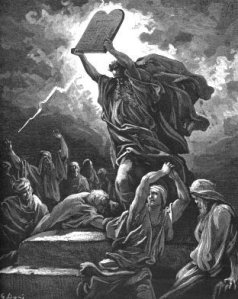
Moses gets down

Moses gets down


Noah’s Lark

This podcast deals with the myth of the great flood. It begins with a consideration of why modern expeditions do not find anything (nothing to be found), and considers the reasons the story is so appealing to present-day readers. The Sun Pictures productions on the flood story are reviewed, along with the story of the hoax played on Sun in their 1992 made-for-television movie. The history of the flood story is briefly narrated, beginning with George Smith’s 1872 discovery of the Mesopotamian flood story, back to Atrahasis and the Eridu Genesis from Sumer. The flood story is one of the earliest religious stories known.


Science Me This

I’ve just finished going over the creation and flood myths in Genesis 1–11 with my students. By my reckoning, this is about the twentieth time I’ve taken this journey. One comfort of walking a well-known trail is you know what to expect. The fact that always sticks in my mind is how good of a job the Creationists have done. In every setting where I have taught I have many students who unquestioningly accept that Genesis 1–11 was written as science by some kind of Mosaic mosaic of scientist, law-giver, and prophet, a regular Bronze Age Renaissance man. Since biblical scholars do not communicate well with the public (nor do they play nicely with each other), most students come into class wondering why the Creationist viewpoint is even under question.

I want to suggest something radical here: in our culture where science, technology, and finance are highly valued, we neglect to educate our kids in the basics of literary study. Schools push the technological envelope, and this is not a bad thing, but the kids come home and are shuffled off to church where the Bible is revered and a basic disconnect forms in their minds. A compartmentalized Bible, factually true, resides in one region of the cortex while in another scientific theory lurks. And when fact clashes with theory, fact always wins. They know they have to tell biology teachers that they understand evolution, they simply don’t believe it. They come to collegiate religion classes expecting Sunday School part 2.

Just this summer a grown man, Randall Price, director of Liberty Uni-, Univ-, University’s (sorry, I always choke on that one) Center for Judaic Studies once again made the weary trek to Mount Ararat to find Noah’s Ark. If he’d read Atrahasis or even Gilgamesh, he might have known he was looking in the wrong place. Nevertheless, he received coverage from a major news network (FOX, of course!), and those who never studied ancient mythology cheered him on. If we could teach children that the Bible is a literary document, teach them that it can be studied seriously, and that the Big Bang and “let there be light” are not the same thing, we might make some progress. Until then, we will have to contend with silly cartoons trumping hard-earned education.

Jack Chick has more publications than any Bible scholar

Jack Chick has more publications than any Bible scholar


Fundamentalist Foibles

Podcast 11 deals with the phenomenon of Fundamentalism, particularly biblical Fundamentalism, and its history. The podcast begins by setting the historical parameters, in the early part of the twentieth century, and considers some of the reasons that the movement may have begun. German biblical criticism, Darwin’s theory, and the First World War among them. A brief sketch of the movement is then offered, starting with the Niagara Bible Conference and the publication of The Fundamentals. The basic tenets of the belief system are summarized, again with suggestions as to why this may have been the case. A cautionary conclusion ends the presentation.


Harry Potter and the Evangelical Emperor

There’s a chill in the air this morning that warns of impending winter and the visceral melancholy of autumn’s graceful death. As I try to warm up like a lizard awaiting the ascending sun, I think that maybe I’d better write this post before everyone forgets Harry Potter completely. It is the beginning of the witching season as sometime late tonight fall officially begins and people in temperate climes are permitted to show their fears as the barrier between seasons becomes effaced and the darkness slinks in. A few Harry Potter novels ago, a local town in Wisconsin sponsored a downtown release party for the book with a street-fair sporting a feel of general bonhomme. While sauntering down the incongruously sun-lit streets, enjoying the sense of people just having fun, I spotted this man with a placard across the street.

No caption necessary!

No caption necessary!

The truly scary part of this scenario is that I knew exactly where this fellow was coming from: the Bible says it, I believe it, that settles it. Black and white. Right and wrong. Good and evil. Strangely enough, there was no such dividing line for fact and fiction. Yes, I knew that the Bible condemns witchcraft, but I also knew that J. K. Rowling was a fiction writer. I had read the Bible enough times to know that it contains no commandments about what genre of fiction is permissible and to know that some biblical heroes were deeply flawed characters. Jonah and his big fish. David and the giant monkey on his back. Hezekiah and his doubts. I can’t pretend not to know the searing sting of needing a clear answer, and yet I had already discovered the infinite shades of gray that reside between pure white and absolute black. Bible covers should all be gray.

That very year a conservative evangelical administration had axed a highly praised job of over a decade’s duration, believing it to be in the name of righteousness. A conservative evangelical president was unleashing hellish terror on a country that had the misfortune of being the victim of a bloodthirsty dictator. And this man with a placard felt he had to underscore that even a flight of fantasy on a broomstick over a quidditch field of imagination was evil incarnate. Once again my mind turned to Molech, the perhaps fictional Canaanite deity who is never satisfied. In the Bible it was enough simply to believe that people were sacrificing their children to the fiery Molech. “White and black,” I could almost hear the tremulous author whispering as he penned his horrid fiction. History tends to paint a different picture, but then, historians make liberal use of the myriad shades of gray.


Bible Land

Once upon a time I took a trip to visit a friend in West Virginia. I made the drive from New Jersey across parts of Pennsylvania and Maryland. Having grown up in Pennsylvania I never supposed it to be considered part of the “Bible Belt,” but it seems that some of the spillover may be making its way north of the Mason-Dixon line.

Interstate 78 has recently struck me as being highly evangelized. I saw a billboard reading “Blessed is the nation whose God is the Lord” and remarked at how out of context this verse was taken. Last time I checked, the Bible tended to be concerned with Israel, not the United States. Further along I saw a church near Bethel, PA called the Assembly of Yahweh. Not being aware that there was confusion as to who the God of the Israelites was, it amazed me to see that they have their own radio station called “The voice of the Assembly of Yahweh.” This struck me as a missed opportunity; the real message could have come through more clearly with “of the Assembly” left out. Yet further along was an ominous billboard from a local Mennonite Church that sounded eerily like Amos. “You Will Meet God” it announced.

Storm's a-comin'

Storm's a-comin'

As I entered Maryland the sales tactics intensified. In Frostburg there was God’s Ark of Safety Church where an actual replica of Noah’s Ark is being built right along Interstate 70/68. Since the steel frame is all that was currently finished, I was glad that it hadn’t recently been raining. Perhaps a more recent translation of the Bible has updated gopher wood to Bethel steel. Further along I spotted a lighthouse atop a hill over a hundred miles from the nearest substantial body of water. This was the World Lighthouse Worship Center. While visiting an actual lighthouse on Lake Superior a few years back the docent informed me that lighthouses were now considered superfluous with the advent of Global Positioning Systems. (Shhh — please don’t inform them that science has again trumped a quaint piece of folklore! I can imagine that the lighthouse may be useful when the new ark is completed.) Along route 219 in McHenry, MD I saw “A House of Love Gathering Place” that I just couldn’t dissociate from the B-52’s for some reason. Just about on the border to West Virginia was the Fresh Fire Church of God.

The United States is truly an impressive reservoir of biblicism. Perhaps university administrators who believe the study of religion isn’t worth the meager salary of an assistant professor should take a road trip. It would be a learning experience.


Lost in Translations

Furor is up like storm waves concerning a revision of the New International Version of the Bible according to the Associated Press. Evangelical groups, fearful lest the word of God be misrepresented (!), claim nothing is wrong with the Old New International Version. The story of biblical translation is long and colorful and peppered with more than a few deaths. People, originally especially Europeans and Americans, but spreading like swine flu around the world with the missionary movement, are very concerned about being certain they have they exact words from the Author himself.

Concern with having the correct answer is natural enough, but the goal of a perfect translation is unattainable. The basic reason is that translation, like Bible-writing, is a human endeavor. And people just don’t achieve perfection. Also, words often betray us. I used to ask students what the word “die” means. Some would say to cease living, while others would say it was the singular form of dice. Some even recognized it as the nominative, feminine singular definite article in German. The truth is, however, that words do not have meanings. Words are symbols that have usages, but the letters “d-i-e” in that order mean only what we intend for them to indicate in any given circumstance. Certainty is a mirage; it can never be reached.

A few years back Today’s New International Version was published and it has been called “an emblem of division in the evangelical Christian world,” by Moe Girkins, president of Zondervan (owned by Rupert Murdoch). Even among self-identified evangelicals unanimity is illusory. Each person’s religious beliefs start to differ from everyone else’s in the privacy of his or her own head. That is because everyone is unique. The Bible can be made to “mean” whatever an individual wants it to mean. Until we became merged into some Borg-esque entity new translations will be loved by some and hated by most.