Horror Homeroom

With a happy coincidence I discovered a website called Horror Homeroom.  Featuring articles and podcasts and reviews on horror films, I felt its siren call.  Then I learned it is run by a professor at nearby Lehigh University, making it even closer than I initially supposed.  I wanted to be part of the conversation.  You see, after years and years of being a Bible scholar and having to fight to find any kind of interest whatsoever in what I had to say, I’ve found the horror community extremely welcoming.  Perhaps because we all know at some level that horror is considered transgressive—it isn’t unusual to find critics who still claim it’s debased—we find each other.  There’s an aesthetic to horror, and it isn’t about gore and violence.  Horror, when done well, is an excellent marker of what it means to be human.

Life always ends in death.  Many people spend as much time as possible trying to avoid thinking about it.  There is, however, great creativity in facing squarely what you cannot change.  Well, that’s a good sounding excuse anyway.  All of this is by way of announcing my guest blog post on Horror Homeroom.  A few weeks back I was quite taken with The Curse of La Llorona.  Not that it was a great movie, but it had a way of coming back to haunt me.  Part of it has to do with the poorly understood way that local customs blend with imperialistic religions.  Faith is a local phenomenon.  Once you switch off the televangelist, you’ll begin sharing beliefs of your neighbors.  There’s no such thing as a pure religion.  Pure religion is one of the most dangerous myths there is.

Those of us who study religion professionally have been taught to call the blending of religions “syncretism.”  I’ve stopped using that word for it because it assumes that there are pure forms of religion.  Religion always takes on an individual element.  We make it our own when it gets translated into our personal gray matter.  The idea that there is a pure form of any religion requires an arbiter of greater rank than any here on earth.  You can always say “but I think it means…”  Horror, I suspect, latched onto this truth long ago.  Without some hint of doubt about your own individualized belief system, it’s difficult to be afraid.  Horror need not be about blood and gore.  Often it isn’t.  Often it’s a matter of asking yourself what you believe.  And once you answer it, opening yourself to asking questions.

Turin Turnabout

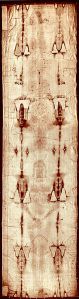
Turn about, they say, is fair play.  Turin, on the other hand, is a city in Italy.  Its claim to fame is a shroud housed there that is believed by many to be Jesus’ burial cloth.  Tests have been done over the years, most authoritatively a carbon-dating done by three independent laboratories, with the results suggesting a medieval origin to the cloth itself.  In case your chronology is a little hazy, the medieval period comes centuries after the time Jesus lived.  Now, some thirty years after the definitive study, some scientists are questioning the results.  They’re being skeptical of the skeptics.  Turn about.  According to a story in The Catholic Register, a Freedom of Information Act request, honored only by one of the three labs (the one at Oxford University) has revealed that the bits of the shroud subjected to analysis were the worst possible parts of the cloth to test.  Herein lies the rub: scientists like to poke holes in credulousness—what do you do when your science is itself the subject of skepticism?

The Shroud of Turin, like Donald Trump, is one of those utterly arcane artifacts that unites Catholics and Evangelicals.  When I was growing up these two groups were the cats and dogs of the theological world.  They united under the umbrella of conservative social causes during the Bush years and have been sleeping together ever since (while both convinced that the other is going straight to Hell when it’s all over).  You see, the Shroud is a Catholic possession and allegedly bears wounds that support the Catholic narrative.  (The Vatican has never declared it an authentic relic, however.)  Evangelicals see it as proof positive that Jesus was resurrected, and so they tend to go further than the Catholics in citing it as proof.  We live in odd times when believers successfully out-skeptic the skeptics.

Since the other two laboratories (the University of Arizona and the Swiss Federal Institute of Technology) haven’t released the raw data, the grounds for a conspiracy theory grow fertile.  When information is kept secret, that’s a natural enough response.  The conspiracy-prone mind asks why the data isn’t being made public.  They do have a point.  The claims of religion are often hoisted on the petard of “no evidence” and when evidence (such as the lab results) exists but isn’t shown, that suggests somebody’s hiding something.  I have no vested interest in the authenticity of the shroud, but we all should have such an interest in getting at the truth.  The turnabout in this case, however, was completely unexpected.


Glossophobia

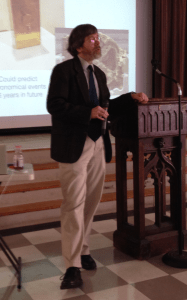
For a guy so full of phobias that there’s no elbow room at Hotel Fear in my head, people are sometimes curious as to why I don’t suffer one of the most common sources of terror: speaking in front of crowds.  Glossophobia is extremely normal.  I suspect it’s one of evolutions tricks for keeping metaphorical cooks out of the allegorical kitchen.  If we’re all talking at once, who can be heard?  The internet will prove to be some kind of experiment in that regard, I expect.  Thing is, I’m not what most public speakers appear to be: confident.  I’m not.  Beneath the surface all kinds of phobias are vying for the next private room to become available.  Over the weekend I had a public speaking engagement, and that made me consider this again—why doesn’t it bother me?

Although the answer to “why” questions will always remain provisional, I have an idea.  It’s kind of creepy, but true.  In my fundamentalist upbringing, I was taught that my life was being taped.  You see, it goes like this: since the book of Hebrews says “And as it is appointed unto men once to die, but after this the judgment,” some Fundies like Jack Chick illustrated this as an outdoor cinema in Heaven.  Or rather, in the clouds just outside Heaven.  Here you’d be summoned, buck naked, as soon as you died.  Other nude souls would gather round the big screen and your entire life would be projected for all to see.  Since everyone’s dead there are apparently no time constraints.  As a kid I realized that I was being watched.  All the time.  Now, I’m not conscious of this constantly, but I did translate it to public appearances.  We’re all, it seems, actors.

With a lifetime of performing experience, by the time I was a teen I wasn’t afraid of public speaking.  Introspection was a big part of my psyche, and when I had a speaking engagement, I knew that I had to be conscious of what I did and said, because people would be watching me.  I learned to play the part.  I did take a college course in public speaking, and even a preaching course offered by the Western Pennsylvania Conference of the United Methodist Church, but both of these were long after I’d begun taking public speaking roles.  I make mistakes, of course, and early on I learned to laugh at them before the audience did.  We were all being taped, after all, and there’s no outtake reel before the pearly gates.  Strange, but true.  If you’re afraid to speak in public just remember—you’re being watched, all the time.


Funny Business

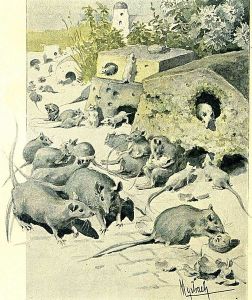
Do animals laugh?  The question sounds innocuous enough, and when my wife played me a RadioLab episode on that very question, the conclusion, although cautious, was that at least rats and chimpanzees do.  This is an instance in which the very question strikes me as terribly speciesist.  Despite the fact that evolution suggests otherwise, Homo sapiens are constantly seeking that fabled northwest passage that will separate us from animals once and for all.  One by one, over the decades, the defining traits have fallen aside.  Animals make and use tools, they build dwellings with ornaments, they solve puzzles, they communicate, and they laugh.  Were we not so obsessed with our own greatness (and consider whom we’ve elected over the past few years!) we might easily recognize that we have evolved to be what we are.

Perhaps it’s because we wish to retain our right to exploit animals.  After all, eating animals is big business and it’s harder to eat someone who’s not so very different from you.  In our culture certain animals are taboo for fodder: dogs, cats, and horses, for example.  This isn’t universally the case, and knowing that animals laugh might just make it a little worse.  We like to think animals “react” using “instinct” rather than respond with genuine emotion.  Until we fuss and fawn over Rover, and accept his affection as genuine.  Consciousness can be quite a burden to bear.  Funny, isn’t it?

We accept evolution up to a point.  Is it any wonder then that creationists still are a force with which to contend?  Often we fail to recognize that science, as it has developed in the western hemisphere, gestated in a largely Christian context.  The reason for drawing a hard line between animals and humans is ultimately, in this setting, biblical.  We’ve moved beyond the idea of God creating each separate species one-by-one, but we haven’t gotten beyond the literal truth of Adam naming and dominating them.  If we don’t consider the biblical origins of these ideas they continue unchallenged, even into the laboratories and sterile rooms of today.  It makes us a bit uncomfortable to consider just how influenced we still are by the Good Book.  At the same time we consider its meta view on the biological world, even as the evidence continues to pile up that little, if anything, really separates us from our faunal kin.  Try explaining that to the rats.  That sound you can’t hear without special equipment, by the way, is their laughing.


A Decade

Please pardon my being sentimental, but today marks one decade of blogging on Sects and Violence in the Ancient World.  I realized, thinking this over, that I used to make some interesting, perhaps even quotable statements back then.  Why not, I thought, farm those older posts to celebrate what I was thinking when I was a tenth-of-a-century younger?  So for today’s post, I’m presenting some quotable quotes from July 2009, starting with one of the zingers from my very first post.  For convenience, I’ve even provided the links to the posts so you can see them in context, if your July has somehow not filled itself up already.

Sects and Violence in the Ancient World, by the way, was the name given when one of my nieces thrust a recorder in my face and asked me what I would call a blog, if I had one.  She subsequently set this site up for me.  One aspect of the title may not have been evident: it’s a quasi-anagram for my initials.  It has been, from the beginning, mostly metaphorical.  Without further ado, then, a few of my favorite lines from a decade long gone:

“He had a sidekick called Cypher (sold separately), and arch-enemies with such names as Primordious Drool and Wacky Protestor. I marveled at the missed opportunity here — they could have called them Text Critic and Doctor Mentary Hypothesis!” First post: Bible Guy, July 12, 2009. <https://steveawiggins.com/2009/07/12/bible-guy/>

“Technology has outstripped reality.” Asherah Begins, July 13, 2009 <https://steveawiggins.com/2009/07/13/asherah-begins/>

“Black and white are not in the palette of serious religious studies.”  God is Great (not)?, July 14, 2009 <https://steveawiggins.com/2009/07/14/god-is-great-not/>

“When he [Aqhat] refuses to release it to the goddess he is unfortunately pecked to death in a hitchcockian demise by a swarm of buzzards with attitudes.” Sects and Violence, July 15, 2009 <https://steveawiggins.com/2009/07/15/sects-and-violence/>

“Indeed, one may think of them [religion and monsters] as fellow ventricles in the anatomy of fear.” Vampires, Mummies and the Holy Ghost, July 16, 2009 <https://steveawiggins.com/2009/07/16/vampires-mummies-and-the-holy-ghost/>

“Better to consider it [weather] human than to face unfeeling nature.” Changing Faces of the Divine, July 18, 2009 <https://steveawiggins.com/2009/07/18/changing-faces-of-the-divine/>

“As the gods are drinking themselves senseless (how else can the latest Bush administration be explained?)…” Drunken Moonshine, July 20, 2009 <https://steveawiggins.com/2009/07/20/drunken-moonshine/>

“As usual, we kill off what we don’t comprehend.” Not Lion, July 22, 2009 <https://steveawiggins.com/2009/07/22/not-lion/>

“A bonobo was recently documented as uttering the word ‘yes’ to a keeper’s question, officially making her more articulate than some clergy I’ve known. Even today there are churches that still call their leaders Primates!” Religious Origins, July 23, 2009 <https://steveawiggins.com/2009/07/23/religious-origins/>

“I never used a computer regularly until I began my Ph.D., and then it was only a glorified typewriter, qwerty on steroids.” Who We Were, July 27, 2009 <https://steveawiggins.com/2009/07/27/who-we-were/>

“I grew up in a blue-collar household where paying ladies for favors was itself considered a sin.” Yes, Mammon, July 28, 2009 <https://steveawiggins.com/2009/07/28/yes-mammon/>

Where do you suppose we’ll be a decade from now?


Trumping the Bible

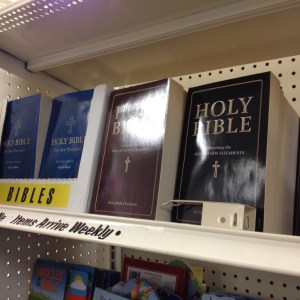
The media is chattering about one of the very many contradictions of evangelicals who support Trump.  Since I have a foot in the world of the Bible business, I read with interest how Trump’s tariffs on China will put Bible publishers in a bind.  You see, the Good Book is generally sent offshore since printing costs (and technologies) are too expensive to replicate in God’s new chosen nation itself.  This lack of divine foresight should be a bit disturbing.  The entire evangelical enterprise is based on their reading of Scripture, and the belief that the divine choice of America is behind such momentous events as 45’s election.  Maybe we should check our pipes for lead.  In any case, Bibles, which are printed cheaply in high volume overseas, are set to become too expensive to give away because of the great pretender’s tariffs.

A few media outlets have picked up this story, including one that noted Trump’s favorite Bible verse is “an eye for an eye, and a tooth for a tooth.”  The famous lex talionis statement was famously, well, trumped by Jesus who said that the ideal was to turn the other cheek.  In a rather Philistine way, evangelicals have sided with a man who says Jesus was wrong.  If you want to check up on me in your Bible you’d better get your wallet out.  Ironically from a Republican point of view, tariffs are themselves the breaking of the commandment of free trade.  Still the party that claims to believe that does nothing to prevent the sale of their souls, cash on the barrelhead.

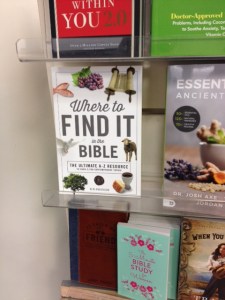
Many evangelicals may find the idea of Bibles as a business distasteful.  It is, however, extremely profitable for those on the supply end of the deal.  Bibles are printed at a volume that would make most authors green, and due to its size the Good Book requires specialized paper most of the time.  This is so much the case that Bibles not printed on “Bible paper” just don’t feel like sacred writ.  Since costs of living in the United States are quite high, and since this kind of specialized printing would be too expensive in this situation, publishers outsource God’s word.  Some publishers have been pleading with the government to exclude books from Trump’s tariff so the Good News can continue to spread.  The fact is that only one deity, called Mammon in the Bible, runs this enterprise.  And to continue to buy Bibles at the evangelical rate will soon be requiring an act of sacrifice.  I guess the lex talionis still applies.


Built To Last

Those pyramids sure are sturdy.  The other day I was reading something from a biblical literalist that was discussing the pyramids.  The great pyramid of Khufu and its companions in Giza were built between about 2590 and 2505 BCE.  They’ve been around a long time.  Somewhat later this author casually mentioned Noah’s flood.  It had never occurred to me before, but since Archbishop Ussher dated the creation of the world at 4004 (and so it appears in the Scofield Reference Bible), the flood took place in 2348 BCE.  Now this flood was so catastrophic that it carved out the Grand Canyon and buried all those dinosaur bones that would eventually become fossils.  It was more than a little inconvenient, and terribly disruptive.  Except the pyramids had been around for well over a hundred years by that point.  It’s a wonder they weren’t harmed.

Such inconsistencies populate much of literalist literature.  When the Bible is the full measure of science and history and all human knowledge, there’s bound to be some issues, given that it was written at a specific time and place.  You see, the pyramids aren’t even held together with mortar.  These are loose stones we’re talking about, under great pressure.  The “Bent Pyramid,” at Dahshur, changed its angle at half-way up.  A physicist calculated that if they’d continued at the original angle, the weight of all that stone would’ve caused it to act like liquid, flowing like water.  Best repent and rethink your plan.  But these monuments were built to withstand world-wide floods!  And the mummies weren’t even mildewed.  If only Jericho’s walls had been so well built.

From WikiCommons

Maybe that’s why so many modern myths about the pyramids developed.  This sacred shape somewhere between a square and a triangle is said to have unusual properties.  I’ve read that if you put a dull razor (whatever that is) underneath a pyramid shape when you go to bed at night you’ll awaken to find it sharpened.  Made of wire, that shape on your head will not only prevent aliens from reading your thoughts, but will boost the power of your psyche as well.  The funny thing about the Bible is that it never mentions the pyramids at all.  Joseph spent a bit of time there and his descendants stayed for centuries.  Nobody bothered to note those wonders of the ancient world.  Since we’re literalists, though, that gives us a way out.  If the Bible doesn’t mention the pyramids they might not exist at all.  Problem solved.


Identified or Not

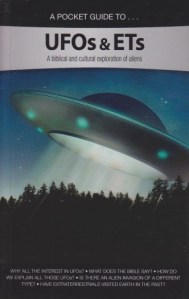
Okay, so this will require some explanation.  It came about like this: I was in a used bookstore.  (This in itself requires no explanation, of course.)  I noticed a slim book, cover out, called A Pocket Guide to UFO’s and ETs: A biblical and cultural exploration of aliens.  Biblical?  I picked it up only to discover it was from Answers in Genesis.  Please note: I do not buy books or paraphernalia of Fundamentalist groups unless I can get it used.  I don’t want to support this particular weirdness in any way.  Well, the money for this used book was going to support a used bookstore and not a religious aberration, so I figured it would be good to see what the Fundies have to say about a topic that seems to have started to engage public interest again.

The book begins by helpfully pointing out that if there’s life on other planets the Bible doesn’t mention it.  And since the only way it could’ve got there is by evolution—for surely the Almighty would’ve said something about it in his book, if he’d invented it—the whole idea is a non-starter.  Evolution, as everyone knows, is a satanic idea meant primarily to challenge the Bible and secondarily explain the diversity of life forms on earth.  And since earth is the only planet the Bible recognizes, it is the only one with life.  So, UFOs, it stands to reason don’t exist.  Well, that’s not quite fair.  They do exist but most can be explained away and those that can’t may well be demonic.  Since there can be no aliens, and since some sightings can’t be otherwise explained, then demons—which the Bible does mention—must be responsible.  They (demons) can also explain why other world religions exist.

There’s plenty in here to offend just about everyone apart from the Answers in Genesis crowd.  The screed spends quite a bit of time knocking down ancient astronaut ideas, and taking Erich von Däniken to task.  Science is useful in explaining how pyramids were built, but not in how the rock used to build them was formed (it takes far too long to make limestone the old fashioned way; God simply used a variety of different rock types to make the one inhabited planet more interesting geologically).  And those UFO religions?  Inspired by demons, no doubt.  In fact, even reading a little book like this could lead you to become interested in the subject, so be careful!  In fact, the safest thing of all (and I’ve only got your well-being in mind) is to leave it on the shelf.


Fear of Religions

There’s a narrative of fear in Christianity that seems to have been absent at the beginning.  This is evident when driving the highways of America where you’ll see billboards (which are meant for selling things) advertising the truth of a kind of biblical Fundamentalism.  On my recent trip across Pennsylvania this fear stood out in some rather obvious ways.  And it doesn’t reflect the Christianity reflected in the Good Book.  Stop and think about it: although the persecution of early believers was probably never as widespread as the usual narrative says it was, the writings we have describe facing persecution with joy.  Believing that they would be delivered, the oppressed welcomed the opportunity to prove their faith.  The Chick tracts I read as a child, however, focused intently on how scary the future persecution would be.  Fear, not joy, was the motivation for belief.

As we stopped in a turnpike rest area, we noticed a kiosk of Christian books amid snacks both salty and sweet.  The only other reading material available had to do with tourist attractions and finding directions.  It was, upon retrospect, odd.  Pondering this I recalled the narrative I heard repeatedly in my youth—a time was coming when it would be illegal to be Christian.  There would be persecution and the only proper response was a faith borne of fear.  This was not a religion of love thy neighbor.  No, this was a religion of armed survival based not on turning the other cheek, but on asserting itself with a show of firepower.  This kind of weaponized evangelicalism has taken over the narrative of Christianity.  Paul of Tarsus, knowing he would likely be executed, wrote of his joy from prison.  In the land of plenty we tremble.

The more cynical side of my experience suggests that politicians—who have learned that fear gets them elected—found in this form of Christianity a convenient set of sheep without a shepherd.  There’s fear in these billboards.  Fear that another religion may take over.  Or that secularism may make cherished beliefs illegal.  This isn’t cause for celebration, as the sermon on the mount proclaims it should be, but rather a call to arms.  In this country we have more than enough.  Among those left out, however, this fear grows just as rapidly as among those who fear they may lose the abundance they have.  They try to convert the weary traveler whose eye is drawn to the billboard.  And even those who stop for a drink of cold water which, the Bible suggests, should be freely given.


Different Kind of Salvation

It’s encouraging and disheartening all at the same time.  And seldom has the evil of money been so obvious.  Last night I attended an environmental panel discussion at a local church.  It was encouraging to see so many people out on a rainy, chilly night in Bethlehem, a city famous for its might steel mill.  Everyone there knew the problem and agreed that something had to be done.  As the speakers gave their presentations it became clear just how corrupt politicians are.  Corruption is bipartisan, of course.  In the name of “economic growth” we allow the fracking rape of our state despite the known and proven environmental hazards.  Despite the fact that Pennsylvania has a green amendment in its state constitution.  Money, as Cyndi reminds us, changes everything.

Shortly after even Mitch McConnell admitted climate change is real, at the state level climate deniers are running things.  It brought to mind the frightening and omnipresent teachings of my Fundamentalist youth: the sooner we can destroy this planet the sooner we’ll make Jesus come again.  Convinced of the absolute certainty of that second coming, there is almost a mandate to ruin, pillage, and plunder natural resources because the Good Book ensures us that, upon a white horse the savior will come in the nick of time.  Politicians, elected officials believe this.  They also believe in mammon.  If you’re gonna go down, you might as well do it in style.  Like John Jacob Astor on the Titanic.  It’s the way of the aristocrat.  Rising seas drown rich and poor alike.

It was a miserable night to be out.  The weather has been freakishly off for some time now, and all the science—real science, that is—predicts it’s only going to get worse.  How the government became the enemy of the planet that gave it birth would be a fascinating story if only it were fiction.  The truth is we’ve elected people that can be bought.  And bought easily.  Laws are passed that violate the constitution of this commonwealth and meetings are held behind closed doors.  Local activists are very active while most of us struggle to keep ourselves employed, heads, as it were, above water.  We need to pause now and again to consider what a wonder this planet is.  We must learn that the only power money has is that which we freely give it.  Rain was pouring down.  Brontide was actual thunder as the state legislature drew up chairs for the last supper.


When Like Rome

Among the constant topics of discussion, both in the academy and in its publishing ancillaries, is the loss of interest in religion.  After a period of growth early in the new millennium, as measured by college majors, interest has dropped off and Nones are set to replace evangelical Christians as the largest religious group in America.  The corresponding lack of interest in religion is extremely dangerous.  I’ve often posted on the necessity of looking back to see where we might be going, and the further back we go the more we understand how essential religion is to the human psyche.  My own academic goals were to get back to the origins of religion itself—something I continue to try to do—and I discovered that they rest in the bosom of fear.  I’m not the first to notice that, nor have others been shy about using it to their advantage.

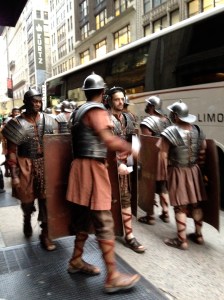
Lack of classical education, by which I mean reading the classics, has led us to an extremely tenuous place.  More interested in the Bible, I followed the track to another ancient system of thought, but as I find out more about the religion of classical Greece and Rome, the more I tremble.  You see, ancient Roman writers (especially) were extremely conscious of the fact that fear motivated people.  In order to construct a steady state, they infused it with a religion based on fear and supported by said state.  An overly simplified view would suggest that the Jews and Christians took their religion too seriously and refused to play the Roman game.  When they wouldn’t worship the emperor (who surely knew he wasn’t a god) they threatened the empire.  The response?  A good, old-fashioned dose of fear.  Crucifixion oughta cure ‘em.

See what I mean?

The thing is, our American form of government, buoyed up by an intentional courting of evangelical Christians as a voting bloc, manipulates that fear even more stealthily than the Romans did.  People ask me why I “like” horror.  I don’t so much like it as I see its role as a key.  It is a key to understanding religion and it has long turned the tumblers of the state.  Ancient societies kept religion under state control—something the Republican Party has been advocating as of late.  Why?  Religion, based on fear, ensures the continuance of power.  Those of us who watch horror are doing more than indulging in a lowbrow pastime.  We are probing the very origins of religion.  And we are bringing to light the machinations with deus.  Let those who read understand.


Self-Convinced

Like many people, I suppose that my own views are right.  All people think this, I suspect, otherwise they’d change their point of view.  Unless they’ve been brainwashed, of course.  Religion has a way of convincing people that they alone are right.  (And perhaps also those who believe just like them.)  I have plenty of experience with this.  Seemingly normal, friendly people suddenly turn on you when you’re not there to defend yourself.  All in the name of religion.  The place, unfortunately, that it’s most found is in “conservative” religions.  With preachers braying about righteousness and being washed in the blood of the lamb the human element is often sacrificed.  Anyone who dares to think differently is going to Hell, and, in most of these traditions, you wish them godspeed.  Then there are those who wish for true dialogue.

Dialogue means, however, that you have to admit you may be wrong.  That’s one of the features the self-convinced fear most.  Ironically, even those who think they’re right can admit that they could be wrong.  Otherwise what’s the point of discussing anything at all?  As Tom Nichols points out in The Death of Expertise, many are offended that someone has greater knowledge of any area than they.  Like it or not, some of us have studied religion, the Bible, and spirituality for our entire lives.  You might not agree with everything such a person says—we often disagree among ourselves—but at least one might admit that a mere Ph.D. counts for something.  Even if on the stock market it simply won’t trade.

Ironically, as a young man I too was self-convinced.  For some reason that I can’t fathom, I decided that if my beliefs were solid they would stand up to the challenge of higher education.  As an undergrad I majored in religion at a conservative college and graduated summa cum laude.  I chose a liberal seminary to challenge further what I believed and came away magna cum laude.  Then the doctorate.  (Edinburgh didn’t offer such trifles as honors; if you made it through the program you should be so thankful.)  Tolerance became a massive part of my outlook, even as I ended up on the faculty of a very conservative seminary.  I was willing to listen, but the same could not be said for those who saw things differently.  Many of whom were far less educated, I say with all due self-abasement, than yours truly, in such things.  As time goes on I can’t help but reflect on this.  Even as I do I know others are completely convinced I’m wrong.


Sustain Chapel

It seems that holidays come thick and fast in the spring, especially when Earth Day follows directly on the heels of Easter.  Given the hard time mother earth has been having with too many Republicans waging war on her, it’s worth taking a few minutes to consider finity.  Our planet is not infinite.  The resources with which it came loaded out of the showroom are all of limited supply.  Somehow we’ve managed to convince ourselves, at least in this hemisphere, that there’s always more where that came from.  Unless, of course, you’re referring to the degrees that contribute to global warming.  Of those, the GOP narrative goes, there really aren’t any.  No credible scientist doubts climate change, although those who are already old and who are benefitting from it will claim otherwise.  Any story depends, of course, on the teller.

Over the holiday weekend I was out of town.  Driving home a few hours I was distraught at just how much litter lines our otherwise scenic highway system.  Stuff falls off of trucks and, despite advertising against it, out of car windows.  The few trash bags piled for pickup by the earth-conscious can’t keep up with the cast-offs of a throwaway culture.  We desperately need to take the narrative back from those with the loudest, and most incoherent mouths.  We all rely on this same planet and the power we cede to the wealthy is due to our complicity in their claims of ownership.  They’ve proven themselves, should I dare to be biblical, unfaithful stewards.

The earth, it is true, is a place of immense beauty.   It’s not aesthetics alone, however, that motivate us.  We simply cannot survive without this biosphere in which animals, plants, microorganisms, and minerals coexist.  We evolved in it.  The mythical narrative of special creation unwittingly played into the hands of those who will claim it all for themselves if the rest of us don’t deny that they had indeed “earned” the right to be considered the most prestigious.  Our societal sin of rewarding bad behavior has led us to this crisis.   We pollute far beyond our needs.  We “speculate,” hoping that “development” will lead to “growth.”  The wealthiest build rockets to escape our planet, but there’s nowhere to go.  Might it not be better to invest in this gift that we already have?  To learn the lessons of nature?  To become students in the classroom of Mrs. Earth?  There have been many holidays lately, but this may indeed may be the most important of them all.


Discriminating Tests

That explains it.  That glow coming through the window as I got out of bed this morning is the full moon.  Since this is the first full moon after the vernal equinox, that means Sunday’s Easter.  If Sunday’s Easter this is Good Friday.  That brought to mind an article my wife sent me from The Atlantic, “Most American Christians Believe They’re Victims of Discrimination.”  In this piece Emma Green explains that Christians of a certain stripe believe they’re under threat.  Most people express surprise at this outlook, but having grown up in a Fundamentalist tradition I can say that this is hardly new.  The narrative of persecution among conservative Christians has been around for a long time.  They have a mandate, you see.  A mandate to make the entire world like themselves.

Hearing the many cries of legitimate oppression doesn’t help, of course.  In this linked world of instant communication and news 24/7, we’ve become perhaps too aware of just how widespread oppression is.  Christians have felt persecuted from the very beginning, and they don’t like now being cast in the role of oppressor.  Forcing other people to conform is no longer considered right or desirable, but Christians have a mandate.  What strikes me as odd here is that we have a means of learning about this—of arming ourselves with knowledge—but we’d rather be surprised at the polls and pay for it with years of actual oppression.  What is this mysterious means of knowing?  The Bible.  If read, this viewpoint can be understood.  And if handled carefully, disarmed.

The Roman Empire, after which, tellingly, American politics is modeled, oppressed Christians.  At least for a while.  Then the faith became establishment.  And it began oppressing.  An ocean away, Christians fled here because they wanted freedom of religion.  They didn’t always want to share that freedom with other groups experiencing discrimination.  Especially, of course, if they could be compelled to do heavy labor without pay.  Now these groups feel they’re being judged for saying “Merry Christmas,” or for declaring loudly that Sunday’s Easter.  They can’t point to behaviors that in their understanding of the Bible are bad and tell people not to do them.  They don’t understand that Allah is the same deity they worship, only in monotheistic form.  And they get all this news while the moon is still in the sky.  I look at the puddle of light on my bedroom floor and head for my writing nook.  It may be Good Friday, but I’ve got to work today, getting Bibles ready to sell.


If Onlyists

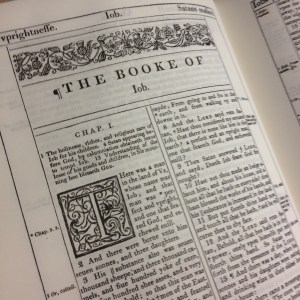
A special brand of Fundamentalism called King James Onlyism is a particularly odd variety of faith simply because of its required backing and filling.  In brief, this particular evangelical position claims that the only inspired translation of the Bible is the King James Version.  It’s best not to look too closely at the KJV, however, or the problems start.  Primary among them is that the version most Onlyists cite is not the original King James.  Published in 1611, this translation is immediately evident by its use of “I” for “J” and for the long s (the one that looks like an f).  Perhaps more troubling for Onlyists, it also includes the Apocrypha.  There was still some debate at the time concerning the status of these deuterocanonical books, and they were part of the actual KJV.

The typical King James used by Onlyists is a revised KJV.  In England, where the translation was done, revisions were made from time to time, leading to an Oxford version (Blayney text of 1769) and a Cambridge version (Scrivener text of 1873).  On these shores further adjustments were made leading to the rather strange situation where there is no single King James Version of the Bible.  There are many King James Versions.  Attempts to control Scripture often end up like that.  The underlying problem is the belief that there is a single version of Holy Writ.  Inerrantists are pledging their faith to something that doesn’t exist.  Defending this approach many would claim that the revisions are minor, but small changes can make huge differences.

The belief in one single version relies on the belief that God inspired not only the original writers, but the translators as well.  It denies that the better manuscripts that have come to light since the early seventeenth century (including the Dead Sea Scrolls) contain any authentic information of what the Good Book says.  Textual criticism, in the absence of any original manuscripts, is the best way we have of discovering what the original likely said.  Onlyists argue that the manuscripts from which King James’ translators worked were the divinely selected ones and their work was inspired—a position against which no empirical proof can be offered.  This faith trades in certainties that only bringing in direct heavenly control can achieve.  And it means that Catholics are wrong, despite King James’ inspired error to include the Apocrypha.  That’s the thing about a trump card like inspiration—once it’s played there’s no way to overcome it.