Chosen Ones

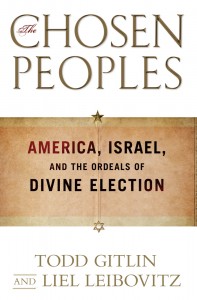
Religious dominance has been so much in the news lately that when my wife pointed out the review of Todd Gitlin and Liel Leibovitz’s The Chosen Peoples in today’s paper my mind once again fastened on the issue. I have not read the book; today’s review is the first I’ve heard of it. The salient point, however, is the continued evidence that monotheism is a tremendous burden on society. Most rationally considered analyses of western religious traditions recognize that the same “base God” is recognized in Judaism, Christianity, and Islam. These three religions are so deeply intertwined in their influences and theological commitments to the singularity of God that such a convergence is inevitable. Nevertheless, three religions sharing a God is like three children sharing a lollipop. Each wants to claim exclusive ownership.

The issue becomes more complex when ethnic identity is tied to religion. Given the nature of religions, this is, however, another inevitability. Religious thought and practice develop among populations separated, in Darwinian fashion, and those who lived in the original arenas of religious development were probably closely related. This is evident in the easy blending of Judaism as a culture and a religion, as well as ethic Orthodox Christianities that maintain a strong cultural component, and in Middle Eastern descent and Islam. People accept the religion of their own people. Monotheism then takes over with the demands of exclusive rights to chosenness or theological correctness. Religion itself contributes to its own fractionalization.

Those who are excluded protest: who wants to be left out of the chosen ones? If there is one God, who wishes to be the second or third or fourth favorite? If we (whoever “we” may be) are those legitimately chosen, are we not in some measure better than other believers? This logical crux slices through all theological niceties for those who examine the issue honestly. Many religions and one God. Chosen people abound. Perhaps it would be less dangerous if God could be divided among the many: one God, divisible, and available to all.


Athtar in Wonderland

Last night I finally got around to seeing Alice in Wonderland, the Tim Burton version. As a child I don’t recall having seen the overly optimistic Disney original, and I only read Lewis Carroll’s two-part, disturbing original after I had finished my undergraduate degree. When I first discovered Wonderland I was in one of my periodic phases of questioning reality and Carroll’s provocative prose and ingenious lyric ability only made the inquiry more complex. Strangely, it felt as if I had rediscovered a missing piece of my own childhood.

Burton’s versions of childhood stories would likely have been my preferred fare had they been available when I was young. Eerie without the overt horror of an R rating, the vision is one of a world where uncertainty reigns supreme. Then came the hookah-smoking caterpillar. It has been a few years since I’ve read the book, but I don’t recall the larval character as having a name. Linda Woolverton, the screenwriter, presumably gave him the name Absalom. Supposing this to be nothing more than the reassignment of a fated biblical name associated with failed attempts at kingship, I simply let the reference pass. Until the chrysalis scene. There he was, Absalom hanging from a plant, just like David’s son swayed from a tree according to 2 Samuel. This mysterious scene in the battle of Ephraim Forest had captured my attention before when I wrote an article on Absalom, eventually published in the Journal of Northwest Semitic Languages.

Noticing the strange phrase that Absalom was suspended between heaven and earth, I suspected that this might be a reflex of the ancient morning star (Venus) myth. The story of Athtar, the god who would be king but who must decline the throne, is a brief tale preserved in the Ugaritic Baal Cycle. As I watched the sage caterpillar giving wise advice to a confused Alice, the name Absalom took on new significance for me. I have no way of knowing if the reference was intentional or not, but in a culture deeply suffused by the Bible it would appear to be a logical guess. And if I was correct in my article, I was seeing a cinematographic reference to Athtar as a blue caterpillar last night. Wonderland indeed.

Curiouser and curiouser


Quran 451?

One of the saddest books I remember is Ray Bradbury’s Fahrenheit 451. Any society that burns books has whip-lashed far beyond Fascism into the enemyhood of humanity. Much of ancient culture has been lost through the natural or premeditated destruction of misunderstood “inflammatory” writings and we are much the poorer for it today.

According to an Associated Press story, the ironically named Rev. Terry Jones of the even more ironically named Dove World Outreach Center in Gainesville, Florida, is agitating for a “burn the Quran” day on September 11. Other than momentary, self-righteous catharsis, nothing is to be gained by burning books. The contradictory impulses here lie thick and deep: a Christian clergyman feels insulted by an extremist attack that killed indiscriminately (Muslims and well as Christians, Jews, and Atheists died in the September 11 attacks), bearing the symbol of peace he wishes to declare his personal war, and the follower of the willing victim of Nazareth wears a gun.

Burning books does not solve any problems. Surely Rev. Jones knows that plenty of copies of the Quran abound throughout the world. His action is calculated as a poignant symbol. Is such a symbol anything more than a base expression of outright hatred? When, apart from medieval Christendom, has Christianity insisted that violence is the way forward? All you need is hate? For although the burning of books may not physically harm anyone, the violence in this hatefully symbolic act is the very antithesis of tolerance and understanding that the religious world so desperately needs. Islam has given much to world culture, and we reap the benefits of Muslim scholars and thinkers each day, without any conscious consideration. Rev. Jones needs to read more than just Fahrenheit 451. He must learn truly to read and, like Montag, weep.

Jones' theological comrades


Inception of Theseus

Never the first for new cultural memes, but often among the last, I finally took my family to see Inception over the holiday weekend. The Internet has been buzzing with comments about the movie for the last couple months, so it was difficult not to have preconceived notions of what to expect. Nevertheless, I found the film utterly engrossing. At one point I realized that I hadn’t blinked in so long that my eyes had begun to dry out. Having just finished Mark Danielewski’s House of Leaves at the end of June, and having begun my Mythology class on Friday, the Theseus myth has been on my mind anyway. Inception takes the hero’s journey through the labyrinth of the subconscious.

The first hint that Inception was the Theseus story, for me, was the introduction of Ariadne. The daughter of King Minos, Ariadne informs Theseus how to escape the labyrinth, and her first task in Inception is to draw a maze that takes a minute or longer to solve. Dom Cobb, like Theseus, is a deeply flawed hero. Part Theseus, part Daedalus, Cobb has trapped an unlikely Minotaur in the form of Mal, his wife, deep in his subconscious mind. She stalks him in his unsavory work, and when she threatens his very concept of reality, she is slain by Ariadne.

Coupled with classical mythology, the film also raises the unresolved question of the nature of reality. Is conscious existence any more real than the subconscious? This theme was explored in David Cronenberg’s eXistenZ back in 1999 with a similar ending that refuses to answer the question. Both films raise the troubling interference of technology with the most secret of human psychological repositories, the uninhibited subconscious. The closer the Internet comes to a global intelligence, the more the individual mind recoils into its own obscure and unexplored territory. Despite Freud and his disciples, we have not yet even begun to understand our own subconscious minds. Movies like Inception draw on classical sources to help us deal with the Minotaur that surely lurks there.

Ariadne explains her dream to Bacchus


God of the Gaps = Poof!

In Stephen Hawking’s new book, The Grand Design, according to MSNBC, he declares that God is not necessary, physically speaking, to get the universe going. The only people who should be surprised here are those who took Hawking’s final lines from A Brief History of Time too literally: “However, if we do discover a complete theory, it should in time be understandable in broad principle by everyone, not just a few scientists. Then we shall all, philosophers, scientists, and just ordinary people, be able to take part in the discussion of the question of why it is that we and the universe exist. If we find the answer to that, it would be the ultimate triumph of human reason – for then we would know the mind of God.” I remember being a bit surprised when I read that the first time.

Whose eyes are watching you?

At some level, it seems, many people took comfort in knowing that one of the greatest scientific minds alive had left a door open for God. The great cosmologist looking through a theoretical telescope and seeing God on the other end looking back. There was a symmetry here, a sense of rightness. Some, to gauge by the reactions reported, feel that Dr. Hawking has betrayed us in stating the obvious. God was never to be found in the petri dish or under the electron microscope. According to the theorists of a theological stripe, God has no quantifiable qualities that might be measured. As the article states, the only God to disappear here was the God-of-the-gaps.

As a young, undergraduate religion major, when I first heard that God-of-the-gaps was bad philosophy/theology, I was a bit surprised. (I spend a lot of time being surprised.) If God has no explanatory value in the real world, whence deity at all? If religious folks behaved better, there might well be cause to suggest that the evidence for God comes in human kindness and charity. Unfortunately, religious folk quite often instigate the hatred and suffering that scars much of human society. No, Stephen Hawking has not killed God, just as Friedrich Nietzsche did not commit deicide in the nineteenth century. If the God-of-the-gaps is gone, nothing of value has been lost. The minds of theological thinkers will only have to be stretched just a bit farther.


Gort to Flood

There seems to be a society-wide fascination with the end of the world as we know it. Or maybe it is the just the perspective I bring to it. The past two decades with their breathless run up to Y2K and grappling to forge some sense out of 9/11 before 2012 rolls over us, have been awash in popular representations of how it might all come to an end. A society begging somebody to apply the brakes. We’ve got many senior citizens still around who’ve never used a computer attempting to coexist with a generation that has never been without one. From Kitty Hawk to the moon in just 66 years. I remember watching the latter on (black-and-white) television. Now I watch students walk into class with devices about whose function I can only ask Mr. Spock to speculate.

So it was that I finally got around to watching The Day the Earth Stood Still last night. The 2008 remake. Having long been a fan of the original, I can understand the insistent draw to bring it up-to-date. Even by the time Star Trek (original series) aired, it was hard to see what had terrified 1950s audiences about Gort or the idea of aliens. Thus I had great expectations when I first saw the trailers for the remake, but the reviews took the edge off my shine and I’ve only now experienced it. Naturally, I was looking for the religious angle.

Like Justin Cronin’s The Passage, the religious metaphor came in the guise of an ark. Klaatu is here to save all species except us, prompting Regina Jackson to state that after the ark is filled, the flood will come. The apocalyptic end of the world – being eaten by bugs (perhaps prescient of New York’s bed-bug infestation) – brings nanotech and the Bible together in an unhappy marriage. As soon as the authorities learn that Klaatu’s sphere is an ark they try to blow it to kingdom come. And yet Helen Benson is here to tell the tale.

We are vulnerable. For all our achievements, we fear the kids down the block that are bigger than us. Whether they be cold, emotionally flat aliens or ragingly wrathful gods, we are constantly watching the skies waiting for the next great flood.


Two Roads Diverged

Back in my Gorgias Press days one of my co-laborers (BU) suggested that I might enjoy reading Cormac McCarthy’s The Road. Since then it has come out as a movie, and further apocalyptic events have occurred – the Deepwater Horizon disaster and the election of Chris Christie come to mind – so I finally got around to reading it. It is a harrowing book for any parent to read and I doubt I have the heart to see the movie. Already the book is spawning internet quotes and quips, but I was particularly interested in seeing how this post-apocalyptic novel handled God.

Since the Bible, via Zoroastrian influence, gave us the religious concept of the apocalypse, it is fitting to see how religion fares in its unhallowed progeny. Mostly God is absent. When the man and his son mention God, the language is spare and laced with betrayal. “There is no God and we are his prophets,” the old man declares after the man and his son leave the bunker. A few paragraphs later he states, “Where men cant live gods fare no better.” The value of the apocalyptic metaphor is that it forces us to face life as we find it: raw and uncompromising. In the fictional apocalypse it is permissible to utter aloud implications of life’s callous lessons.

My career has had its share of jagged edges. The lacerations I’ve personally received have been at the machinations of Christians eager for self-justification. Self-congratulatory individuals and collectives that suppose God has specially favored them. “There is no God and we are his prophets.” It is like reading Camus in slow motion. One of the lessons both Nashotah House and Gorgias Press taught me was that it can always get worse. Reading McCarthy’s sad yet true tale of the woe we bring upon ourselves, the lesson for those eager for the apocalypse is that they have only to open their eyes.


Woeful Wisdom

“There is a wisdom that is woe; but there is a woe that is madness. And there is a Catskill eagle in some souls that can alike dive down into the blackest gorges, and soar out of them again and become invisible in the sunny spaces. And even if he for ever flies within the gorge, that gorge is in the mountains; so that even in his lowest swoop the mountain eagle is still higher than other birds upon the plain, even though they soar.” Herman Melville takes the credit for this passage. It is one of the many pericopes that make Moby Dick the greatest book ever written. Those who know me only as a biblical scholar may be surprised to read that, but I invite anyone who has ever instantly fallen in love with 1 Chronicles 1-9 to reply and argue the point.

Although Moby Dick has fallen into the provenance of books that are kept alive only by required high school and undergraduate required reading lists, this novel still comes back to me at many points in my life and fractured career as both a solace and a warning. Melville was clearly a man tormented by his search for meaning. He drew heavily on the Bible for Moby Dick, likening Ishmael to Ecclesiastes at one point, and the whaling haunts of New Bedford to tophets. To appreciate Moby Dick deeply, one must be familiar with the Bible.

Is this the Bible, or what?

Considering the great changes that are taking place in society, I often wonder if we have reached a breaking point. In my university life, I see students absolutely frantic to achieve an A in an easy class, one that would not have broken a sweat in my undergraduate days. Their anxiety is real; grade inflation has forged the B into the new D, or F. Yet these same students know nothing of life apart from the internet. In times like these, I betake myself to the Catskills, and with Melville, turn my eyes upward, seeking madness.


Dark Night of the Ark

Vampires continue to be the rage of the age. My own interest began back in the days of Bram Stoker, Bela Lugosi, and Barnabas Collins. Stoker’s Dracula is one of the earliest novels I remember reading. Dark Shadows was a regular, gloomy fixture of 1960s daytime programming, and black-and-white vampire movies were often available on Saturday afternoons on commercial television. I have not kept pace with the current fetishism surrounding our toothy friends, but I did read Justin Cronin’s new novel, The Passage. I didn’t know the book featured New Age viral vampires, but they do make for a compelling story.

What particularly captured my attention in Cronin’s work, however, was the crossover between religious and monstrous themes. I have mentioned this connection previously, so I was glad to see confirmation that religion still features in monster stories. The religious element comes in the form of a virus developed by the military to create super-soldiers (a theme X-File affectionados might find familiar) that ultimately goes awry. The result is a girl who is part of a project named Noah; she lives the tremendous lifespan of the biblical hero without the debilitating effects of old age. She is also the ark by means of which humanity might survive the ordeal. The novel is apocalyptic and yet vaguely hopeful. It is also very difficult to lay aside for too many minutes at a time.

The tie-in of Noah and vampires is a novel one. The point of comparison is longevity – those who imbibe the blood of others do not age and wither as mere mortals do. Noah’s survival is a matter of grace (or science in the case of the novel). The last mortal to breech the two-and-a-quarter century mark (thank you, Terah), Noah is symbolic of those who stand out as examples of righteousness in a wicked world. It was refreshing to see the theme so creatively rendered by Cronin. The biblical flood is a kind of prepocalypse, a foreshadowing of what might recur if evil prevails. The Passage has left me strangely sentimental for both vampires and ark-builders alike.


Weather the Psalms

Among the academic detritus cluttering my desktop is a book I wrote while employed at Nashotah House. Not being a native Midwesterner and finding myself where severe thunderstorms are a blasé fact of life for much of the year, I was captivated by and terrified of the weather. At the same time, daily recitation of the Psalms was a major part of our required, twice daily worship. With the thunder louder than I could ever imagine it outside, we’d calmly read the Psalms, at our stately pace, confident that he who rides upon the clouds could protect us, his humble servants. After many years of recitatio continua I noticed the plenitudinous mentions of the weather in the Psalms. After a painstaking five years of reading and rereading the entire Psalter, I had translated every verse with a weather reference and had written commentary on them.

Publishers showed no interest, this despite the enormous success of Sebastian Junger’s The Perfect Storm, and Erik Larson’s Isaac’s Storm (both of which I eagerly read) and the recent release of Twister. One publisher deigned to make comments as to the great problems of my thesis, so I sat down to revise this behemoth of a book. The very day I was called into the Dean’s office and fired was the last time I looked at the material. I had been revising the book that very morning. The one sad aspect of this entire episode is that every colleague to whom I mentioned the book was excited to read it when it came out. There was a real interest, but no publisher willing to take on the project, this side of vanity publishing.

Some days I think I may go back to that dead beast of a project and try to resurrect it. My academic publishing has slowed to a tortoisene pace without full-time institution support or interest (independent scholars are not worth investing in, I have learned), especially under the weight of teaching nearly a dozen classes a year. Nevertheless, the idea seems sound to me. I keep a weather-eye on the academic horizon and I have yet to spot a book like mine anywhere within the publication catalogues. Considering the importance of storm gods in the ancient world, perhaps we’ve simply moved beyond this interest, tucked away in our interior settings. Nevertheless, when a rare thunderstorm comes to New Jersey, I still remember the majesty of the weather and a forgotten book on the Psalms.

Even the NWS recognizes Noah


Lost Apocalypse

The Bible has many eminently quotable passages. I suspect that is one of the reasons it has the staying power that it does. Many critics of the theologies spun off by the Good Book have turned their vitriol toward the Bible itself, but I believe such hostility to be misplaced. Not everyone enjoys reading the Bible – that much is true for any book. The Bible, however, is foundational for not only our society, but the entire western literary tradition. Its influence on Shakespeare alone, who has, in turn, influenced just about every writer since the seventeenth century, underscores its literary importance. That’s why I’m always surprised with film-makers use concocted verses from the Bible when actual passages would produce the same effect. Granted, few Bible scholars comprise movie audiences and producers and directors seldom worry about writing the story for them. Last night I watched the “horror” film, Lost Souls, released in 2000. I’d read about the movie in Douglas Cowen’s Sacred Terror, so I wanted to see how it rated.

The movie begins with a false Bible quote: “… A man born of incest will become Satan and the world as we know it, will be no more. Deuteronomy Book 17.” Now granted, the movie failed to rock the critics, but the sheer weight of errors from pre-scene one should be the first warning to start from a better script. Beginning with an ellipsis for dramatic effect may be acceptable, but it serves no purpose – and what’s with the misplaced comma? A man born of incest in Deuteronomy is a non-starter because his potential parents could only be found dead, crushed together under a pile of hurled stones before the unfortunate could even be born. Satan as a devil is never mentioned in the Hebrew Bible, let alone Deuteronomy. Deuteronomy is almost never quoted by apocalypticists since it does not predict the end of the world, and Bible books are divided into chapters, not “books.” Well, the biblical illiteracy of Hollywood may be overlooked for a good story, but this is no such thing.

Lost Souls fails on the premise that a biblical “literalism” (and that is only if certain Evangelical interpretations are given unwarranted credence) about the coming of an Antichrist should be shored up by a fabricated quote from the Bible. I’m not trying to be a movie critic here, but a cultural one. The whole “end of the world” scenario held by many Evangelicals is a hodge-podge of biblical verses brought together by clever nineteenth-century clergy with little exegetical training. It is like trying to connect the dots while having to change pages constantly. The idea caught on amid the discarded lives left behind by advancing industrialism and the perceived threat of evolution. Apocalypticism has become its own industry as some otherwise unknown writers can attest. Movies like Lost Souls, or even The Omen, however, pale when compared to the antics of religiously motivated apocalypticists in the real world. Some of the rules in Deuteronomy itself are more frightening, if better written.


Writing the Divine

The media has displayed considerable interest of late in the views of well-known writers towards the divine. Given the vast numbers of non-famous people daily consigned to Hell by the righteous, there are more tears shed for Anne Rice than for the thousands who’ve never written a vampire novel. Equally fascinating is a story from CNN yesterday on Ray Bradbury’s views on God. I cut my literary teeth on Ray Bradbury. I don’t even recall how I discovered him in the small town where I grew up. More likely than not I found used copies of his story collections at Goodwill. Already interested in science fiction, his tales of the future or fanciful past and alternate worlds captured my imagination. Living in a town where nothing ever seemed to happen, Bradbury was a doorway into someplace colorful.

According to John Blake and Bradbury biographer Sam Weller, the doyen of the sci-fi short story is an avid believer in something out there. Reluctant to accept any single religion, Bradbury embraces religious concepts as the wisdom of the sages. He believes, according to the article, that we have much to learn from religions. The views suggested in the interview may lack the rigor and sophistication of the professional theologian, but Bradbury’s emphasis on love comes close to the mark for several religions. People build superstructures around their religious founders and insist on orthodoxy and military adherence to human speculation about them. Often in the process, love becomes just another tenet left over, if you have time for it.

For many decades as I pursued formal degrees in religious studies, I was taught to put away childish things. I gave away my Ray Bradbury books and purchased hefty tomes of incomprehensible gibberish that passes for theological erudition. Then my daughter was assigned Fahrenheit 451 as high school reading. I picked up Bradbury again. His writing lacked the absolute wonder and fascination it held for my twelve-year-old eyes, but it was like greeting an old friend once again. My thinking had been partially shaped by this storyteller, and it is perhaps even possible, in a Bradburian sort of way, that I felt a “spiritual” connection as I read his books as a young boy. Reading his amateur views on religion was a quiet sort of homecoming.

An old friend


The Return of Christendom

Well, the Internet is shaking because Anne Rice has left Christianity. Not exactly, however. In her own words, according to her Facebook page, “I remain committed to Christ as always but not to being ‘Christian’ or to being part of Christianity. It’s simply impossible for me to ‘belong’ to this quarrelsome, hostile, disputatious, and deservedly infamous group.” For years I have observed decent people “quitting” Christianity because the name has been co-opted by intolerant, bigoted Neo-Cons who more often than not have political agendas in mind. I think the battle has been lost, the trademark name of Christianity must be surrendered to those who claim it most loudly. The meek have disinherited the earth. How many Catholic students have introduced their comments to me with “Christians say…” as if Catholics aren’t part of the club?

There was a perfectly good word for what Neo-Cons are calling themselves. It used to be “Christendom.” Harkening back to the imperial days when Orthodox Christianity ruled the East and Roman Christianity ruled the West, Christendom implied the power and the glory in its very name. Beyond a religion, it was a system of rule. The world was fine as long as everyone stepped in line to a magisterial faith that held the only set of keys to Heaven. Then Islam. Then Reformation. Then Enlightenment. The keys began to jangle amid many others on that divine keyring. Christendom seemed pretentious when there was no military might to back the strappado or red-hot iron. Christianity was but one belief system, deeply fragmented, among others.

Under the vision of James Dobson, Ronald Reagan, George W. Bush, and their minions, Christianity in its Neo-Con armor has once again become a forum for abuse and intolerance. Bearing little resemblance to the ethics and outlook of the carpenter of Nazareth, this religion would find an easy home in imperial Rome or medieval Aragon. As Ms. Rice notes, she is committed to Christ, but not a Christian. Although my impotent voice bears little weight in this overly loud and hyper-productive world-wide web, I would humbly suggest that Christendom be reinstated, instead of Christianity, to describe the Neo-Con religion. Christendom, after all, retains the imperial bearing and absolute authority the movement craves. Those, like Ms. Rice, who prefer to follow the teachings of Jesus might then have use of the traditional term of “Christian” once again.


Truth in Fiction

In my more optimistic moods, I like to think of myself as a literary sort. Not constrained by the narrow confines of academia’s hallowed — and often hollow — halls, I have spent much of my life reading literature. I can’t say what started me on this track; my parents were not readers and the small-town school I attended encouraged little beyond subscribing to MAD Magazine. When I stumbled onto the literary giants, I was hooked. There are still great writers I have yet to explore, but one that I only really discovered at the prompting of my wife is Mark Twain. I’d of course known who he was. In my youth I never read any of his books. Then on a fateful, if carefully planned out, trip to Hannibal, Missouri to dig geodes during my geologist phase, we were rained out. The geode farm was closed. Sullen beyond shattered rock-hound dreams, I was at my wit’s end (not a long trip) when my wife suggested we not waste the miles we’d traveled, since Hannibal was also the boyhood home of Mark Twain. While there we bought souvenir quality volumes of Tom Sawyer and Huckleberry Finn. Upon returning home, I read them non-stop.

While on vacation last week my wife was discussing her literary pursuits with her family and it emerged that the full, uncensored, autobiography of Mark Twain will begin its public appearance in November of this year. One of the topics to receive his attention is religion. Twain was a Christian, insofar as any Presbyterian can make that claim, but he was critical of formal religion. A quote purporting to be from his autobiography runs: “There is one notable thing about our Christianity: bad, bloody, merciless, money-grabbing, and predatory. The invention of hell measured by our Christianity of today, bad as it is, hypocritical as it is, empty and hollow as it is, neither the deity nor his son is a Christian, nor qualified for that moderately high place. Ours is a terrible religion. The fleets of the world could swim in spacious comfort in the innocent blood it has spilled.” A bit caustic, but honest. When the books come out, I’ll be able to check it for veracity.

One of the things I value most about Mark Twain was his ability to hit his readers without giving away that they’d been hit. He accomplished this through a brutal honesty, often cloaked in fiction. When I explain myth to my students I tell them that it is an attempt to clarify the truth through story. Modern people tend to be fixated on historicity and sometimes miss the importance of a story because “it never happened.” If Huckleberry Finn never navigated a raft down the Mississippi, it would not affect the truth of the story or the insight of the author. It seems to me that with a writer so honest we would do well to consider what he had to say about his own religion before unsheathing our swords and rattling our sabers.


The Mist in the Pulpit

With the teaching schedule I have, vacations are not viable. One semester blends into another like some demonic tapestry with blurred edges between the somewhat discrete components. Breaks just aren’t part of the picture. While my family is on a well-deserved vacation, I’ve been home doing class prep and lecturing. On those nights when I have no classes, I sometimes watch a movie to hear the sound of human voices. This week one of my picks was The Mist.

My fascination with horror films stretches back to my college days, concurrent with my first degree in religious studies. Never a slasher fan, I’ve preferred the more thoughtful movie that has a (hopefully) profound message. I’d never read Stephen King’s novella on which this movie was based, so I didn’t know what to expect. All I knew was “there’s something in the mist.” The build-up was great until the creatures were shown – after that it became a standard monster flick. A human menace arises in the form of Mrs. Carmody, a religious zealot who is convinced the mist is the apocalypse. As the survivors try to form some plan of action, Carmody’s preaching becomes more and more strident and self-convinced as the “wicked” die and the “righteous” are spared. Not having read the book, I’m not sure if her over-the-top rhetoric originated with King or with Frank Darabont, the screenwriter/director.

I have often posted on the relationship of monsters and religion, but The Mist is almost too easy to cite. Perhaps released too late to make it into Douglas Cowan’s Sacred Terror, the connection between religion and fear is patent and bald. Mrs. Carmody’s religion, apart from being very generally Christian, is hard to identify. She insists on human sacrifice while constantly referencing the Bible. Although there are examples of human sacrifice in the Bible, that particular cultic activity is never advocated for monster invasions or the apocalypse. Carmody is a parody of religious over-reaction to the unfamiliar and dangerous. In her insistence that others take her point of view, the caricatured Carmody becomes a danger that threatens the community. It is left indeterminate whether her followers survive or not.

The religious agitator is a trite and tired character, but one that has instant recognition value. In The Mist, however, I came for the mystery and stayed for the monsters. Mrs. Carmody could have said much more by saying much less.