Dog-Headed Saints

Eastern Saint Christopher

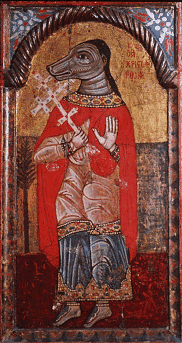
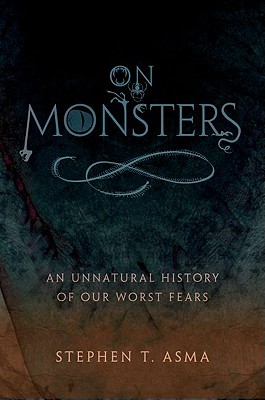
In Stephen Asma’s recent book, On Monsters, he discusses the role of early Christianity in perpetuating or perhaps even inventing various monstrous creatures. As is clear from sources going all the way back to Sumerian times, ancient religions are the spawning beds for monsters. One of the monsters Asma mentioned that caught my attention was the familiar St. Christopher. According to sources as orthodox as St. Augustine, there lived races of dog-headed people in Late Antiquity and the early Middle Ages. These Anubis-like cynocephali were barbarians in the extreme, eating human beings like the more familiar werewolf.

In some Eastern Orthodox traditions, St. Christopher was said to be among the cynocephali. Converted to Christianity, the dog-headed saint was martyred and entered the great kennel in the sky. The message proclaimed by this strange story is the tolerance of the early Christian movement. While battles raged over Orthodox vs. heterodox vs. Gnostic vs. pagan, there was still room to allow dog-headed humans into the fold. (They could be quite useful in rounding up straying sheep as well, one supposes.)

One of the hallmarks of modern Christianity is its exclusiveness. Naturally, not all Christians fit this profile, but many of the current movements define themselves by those not permitted to enter. In the sordid history of the Religious Right there are many chapters demonstrating a stark mistrust of non-Anglo believers. Roman Catholicism maintains that it is the only historically correct version of the faith. Other religions also erect barriers to keep others out. If religions truly promoted tolerance we might see a few more dog-headed saints in the news today instead of those who earn headlines for their exclusive claims on the truth.


On Faithful Monsters

From the moment I saw Stephen Asma’s On Monsters summarized in the Chronicle of Higher Education, I knew I had to read it. Having been fascinated by monsters as a child, and then having grown out of that fascination, this book is a respectable way to indulge my juvenile interests while learning something. The book’s subtitle, An Unnatural History of Our Worst Fears, reveals perhaps why I was so compelled by this particular volume. Those of you who follow this blog know that I contend that religion and fear are very closely related, well nigh inseparable even. As Asma delves into the origins of our monsters, he pauses for a while on the Bible.

The Bible hosts its share of monsters. From lengthy descriptions of Leviathan and Behemoth to tantalizingly creepy references to Azazel and the night hag, the writers of holy writ were as aware of monsters as we are. Asma focuses on the fantastic beasts described in the apocalyptic material, Daniel and Revelation. Obviously not intended to be taken literally, the descriptions of these fantastical beasts represent various ancient empires that threatened the early Jews and Christians respectively. Their monstrosity rests in their intent to destroy, not their hideous physical form. To quote from our host, “monsters are not creatures of natural history but symbolic warnings of a horrifying life without the Abrahamic God (or, in the case of Christians, without his son).”

The ancient fascination with monsters very likely has religious roots. These beings appear to stand outside the rationally created order and lurk in places where the divine is not. The fear they engender leads to the very religion that shuns them. Vampires fear a crucifix, demons are banished at the name of Jesus, and even the headless horseman shuns a church. People run to their faith to protect them from monsters, and monsters, in their turn, provided early believers with a rationale for their faith.


Sects Sells

Once again the headlines tell the story of a child molested by a “celibate” priest now suing the church as an adult. That money dropped in the collection plate goes to cover the cost of sin. The disclosures continue to find the light of day not only in the Catholic Church, but across the religious organizational spectrum. It is an extremely unfortunate situation, but I can’t help wonder if religions are naturally susceptible to sexual expression.

Sexuality and religion go back a very long way. I have suggested elsewhere on this blog that some of the earliest evidence for religion, all the way back to the Paleolithic era, is sexual in nature. One of the blatant aspects of our own cultural conditioning is that we can no longer see the connection. We inhabit a post-Victorian world, a world that strenuously repressed sexuality and removed it from the sphere of human discourse. One of my favorite examples of this is when the standard classical Hebrew-English dictionary (Brown-Driver-Briggs, for those of you who need to know!) makes reference to sexual activity in the Bible (and it is abundant), the editors delicately slip from English to Latin, so as not to offend the sensibilities of clerics and other gentleman-scholars reading the entry. This antipathy to the human condition can be traced even further back to the Greeks who felt that the physical body was much more base than the spiritual, or intellectual aspect. Sexuality was a source of embarrassment and perhaps even shame.

I’m not a psychologist, but it is pretty clear what occurs when strong feelings and drives are repressed for a long time. The early Christians who believed Jesus’ second coming to be imminent did not wish to be caught in flagrante delicto. Sexuality was to be avoided since time was short. When this became formalized and priests, probably very decent people overall, were forced to relinquish their sexuality, it was assumed that it would simply evaporate into the ether and harm no one. We have known for decades that this is naively wishful thinking. As the margarine commercial used to say, “it’s not nice to fool Mother Nature!”

What's Mother Nature hiding?

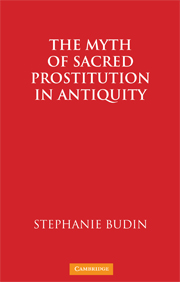
Ancient sects were not sexually depraved. Stephanie Budin (The Myth of Sacred Prostitution in Antiquity, Cambridge, 2008) has done a good job showing that the case for sacred prostitution in the ancient world has been grossly overblown. Nevertheless, sexuality had a natural place in ancient religions. Any number of nervously giggling teenagers who’ve just discovered the Song of Songs in the Bible know that! The problem arises when our religious culture refuses to acknowledge the obvious. We bottle it up and try to keep it hidden, but when it finally appears the price tag is very steep indeed.


Sacraments and Sea Cucumbers

Directly across the fold from each other on pages 4–5 of today’s New Jersey Star-Ledger are two articles that my brain comprehends as related by more than mere proximity. On page 4 the headline reads, “In sunless depths, marine life thrives.” In an Associated Press article bi-lined New Orleans (where many of my colleagues are currently enjoying the Society of Biblical Literature annual meeting), scientists reported that over 17,000 deep-seas species have been found below the point where sunlight ends. What was thought to be a barren zone just decades ago, it turns out, is teeming with organisms adapted to living without light.

One page 5 the headline reads “Bishop admits barring Kennedy from sacrament.” In a ploy that has become distressingly frequent of late, the Roman Catholic bishop claims that Representative Kennedy’s political views on abortion effectively excommunicate him. I find it unconscionable that clergy feel that they have the right to direct public policy when they are not publicly elected officials. Any clergy attempting to coerce officials democratically elected are guilty of abusing their putatively divinely appointed trust. The millions of Catholic laity who privately support freedom of choice they may rhetorically chastise from the pulpit or by some papal bull but they do not deny them the sacrament. Let’s be honest here, this is about politics, not theology.

I have been reading Max Blumenthal’s Republican Gomorrah, perhaps the scariest book I’ve ever read. In it Blumenthal demonstrates how the Catholic Church got onto the pro-life bandwagon in the intricate political maneuverings of the “Religious Right.” They quickly learned techniques up to and including lying to get their agenda across. It should distress all members of a democracy that their leaders are being led by dishonest clerics of all stripes. Those who mix their religious views with politics seek to end the religious freedom that allowed them to be born in the first place. They practice late-term religious freedom abortion.

What does this have to do with the wondrous world of the great deeps? They represent, to my mind, two forms of life that thrive far from the enlightening rays of the sun.


The Call of Balu

After writing a post on Natib Qadish, a modern revival of Canaanite religion in the United States, I received some comments from Lilinah of Qadash Kinahnu, another modern Canaanite religion revival. These movements are a fascinating development in an overly technological era — both movements have online resources that include serious scholarly treatment of ancient religions of the Levant. Both appear to be sincere attempts to get in touch with what modern religions seem to have lost. Both have heard the call of Balu.

In a society where universities seldom offer programs to study the Ancient Near East, people are starved to know about it. I realize that the field of study will never bring in the money that the sciences or finance do, but obviously there is something deeply satisfying about it. And students are hungry for it. Not only appreciated by those who start revivals of ancient religions, many of those who read more recent popular treatments are intrigued. Neil Gaiman’s American Gods was a New York Times bestseller. Although much belatedly, H. P. Lovecraft’s Cthulhu Mythos has become a paradigm for many undergraduates I’ve met. I was reminded of this as I watched Stuart Gordon’s 2001 movie entitled Dagon. A relentlessly tense and macabre film, the Lovecraftian base assures a constant draw for those who hear the call of the ancient deities.

We love technology. I’m posting this entry on an internet where ideas are simply electrons forced into recognizable patterns. We can’t imagine what life was like before being able to communicate with people just about anywhere in the world instantaneously, and where we can live our entire lives without ever actually touching physical money. Over all the noise of technological progress, however, can be heard the distinct call of Balu — a call to a simpler era, pre-Christian, pre-Judaism, pre-Iron Age. It was an era when human destiny fell into the hands of ancient gods.


Death of the Gods

Americangods

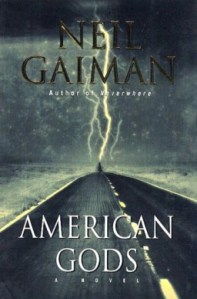
Ancient gods surround me these days. Surely part of it is due to having recently finished Neil Gaiman’s American Gods (I know I’m a few years late on this, but novel-reading time is at a premium even when teaching only part-time). Gaiman’s not the first to have taken on the theme of “what if ancient deities still survived?”. As a child I read Lester del Rey’s Day of the Giants with its science-fictionalized version of Ragnarok, and even earlier H. P. Lovecraft had resurrected Dagon and Cthulhu. Gaiman’s treatment, however, is contemporary and is a barometer of how the old gods are faring these days.

Dark and witty, Gaiman’s treatment is a fun-house ride through the fanciful concept that old-time gods and folk-heroes emigrated to American with their believers. The resulting adventure brings a multi-cultural mix of supernatural powers that end up mostly focusing on the Norse mythological cast. Same was true of del Rey — the Norse mythology reflects a stark world of raw power, betrayal, death and resurrection, that resonates with northern European experience. Anansi and Chernobog also take starring roles in American Gods, although the only ancient Near Eastern deities with any prominence in the story are the Egyptian Thoth and Anubis in supporting roles.

Casting an eye over the American landscape, this assessment is perhaps true to life. Ancient Near Eastern deities seem so distant and unfamiliar. Gods long dead. Despite recent movements to revive the worship of Mesopotamian or Canaanite deities, their powers seem to have dissipated at the middle of the first millennium B.C.E. as Yahweh gained a prominence he has never relinquished, and the Greeks and Romans paved over the graves of Ninhursag and Yarikh with European versions of the more prominent West Asian gods. Universities reflect this lack of knowledge with slowly dying departments of Ancient Near Eastern studies. Like Gaiman suggests, America seems to have gone after the more modern gods suited to our present-day lifestyle.


Picturing Genesis

genesiscr

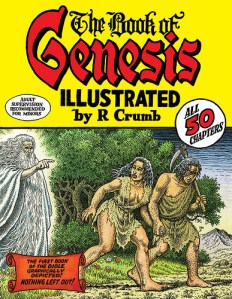
The book of Genesis is elusive and evasive, telling stories that have been read as both science and fiction, but never revealing its own deepest secrets. For over two decades I have been researching the book, never publishing my work since there is so much more yet to read on it. Many truly bizarre interpretations on the introductory section of the Bible have appeared with the proliferation of publication — Robert Capon’s Genesis the Movie and Harold Bloom’s Book of J come to mind — even by otherwise careful scholars. Nobody seems able to get to the essence of the book while everybody thinks he or she already understands it. As a piece of literature it is perhaps the most influential ever penned since it is the basis for so much of the world we’ve constructed around it. Maybe the reason we can’t understand it is that we don’t have it in pictures. Now that’s all changed: R. Crumb’s (serious) comic book version, The Book of Genesis Illustrated, is finally available.

R. Crumb is well regarded in the comic book world, but less recognized in the biblical academy. He is not the first to storyboard sacred writ, nor will he be the last, but he is grappling with the same material that defies definition. Creationists can’t live without the assertions of Yahweh’s creatio ex nihilo, that they read into Genesis (for those who are willing to read what’s there, chaotic water is pre-existent, not created), and many biologists wish that J and P had shown a bit more discretion and humility before setting the framework that dogs their each and every evolutionary observation. Those who take Genesis too seriously will likely be offended by a comic-book version, but the text is based on the revered King James Version and Crumb said in an interview that he had “no intention to ridicule or make visual jokes.” The problem is, the text is full of its own riddles and jokes, along with serious assertions of the superiority of Yahweh over Marduk and Baal and Teshub.

Unlike many Bible readers, Crumb does not stop his Genesis with the Flood or the Tower of Babel. Instead he takes his readers through the entire book where “iron-willed Old Testament matriarchs” are presented in his characteristic muscular style, perhaps recalling She-Hulk more than Sarah. The images may be unfamiliar and a little frightening, but I applaud Crumb for taking on the patriarchal chokehold over shy, hand-wringing wives wondering why they can’t seem to take the biological package their virile husbands send their way. The Bible was written in a man’s world, but it is now ensconced in a more enlightened age and it is ready to benefit from a new, and unfamiliar reading.


Moral Monsters

trees

Everyone likes to feel vindicated. From my childhood I have felt marginalized because of my interests in monsters, and now a book has just been released from Oxford University Press that vindicates my interest! Stephen Asma, a philosophy professor at Columbia College, Chicago, has written a monograph entitled On Monsters: An Unnatural History of Our Worst Fears. Further vindicating my idiosyncratic interest is the fact that the Chronicle of Higher Education even has an electronic front-page article on the book this week. I am overcome with credulity! I haven’t been able to lay my hands on the book yet, but I hungrily read the article and look forward to the whole product.

Readers of this blog know my assertion that monsters originate in a mental space shared by religion. Both are responses to the unknown. Asma writes in his Chronicle article, “The monster concept is still extremely useful, and it’s a permanent player in the moral imagination because human vulnerability is permanent.” Indeed, his article is entitled “Monsters and the Moral Imagination.” The thesis he promotes is that our morality (again tied to religion for many people) benefits from its struggle with monsters. We imagine our moral responses to being faced with the truly horrific, and the monsters themselves are less frightening than our imaginary responses. The top box-office winner this past weekend was Paranormal Activity, a movie noted for not showing the menace, but implying it. There is an evolutionary advantage here; we learn about coping with real danger by imagining danger.

So as I look out the window on yet another cold, gray, rainy October morning, and see the trees swaying in the wind, my imagination takes flight. Those Saturday afternoons and late nights filled with cinematographic visions of even worse things that could happen are cast in a new light. Instead of scaring myself, I was building moral character! As my friend K. Marvin Bruce likes to say, “monsters are only mirrors.” Sometimes the mirror reflects a truly untamed world, and Dr. Asma informs us “inhuman threats are great reminders of our own humanity.” I would simply add, “and of our religions.”


Daniel in the Lyin’s Den

Yesterday I found myself. Online, that is. I was cited ambivalently as “some guy” in the Uncommon Descent blog comments, noting my Creationism’s White Box podcast. For those unfamiliar with Uncommon Descent, this is a blog hosting many posts by William Dembski, a leading creationist. Finding myself there, I instantly recalled that Daniel was never masticated in the lion’s den.

Not being one to judge without good cause, I read the critique with care. It read: “Some guy I read in the last few days here [link to my podcast] has suggested (to the approval of a few clerics) that creationism is an early 20th century phenomenon but all he’s really done is conflate creationism with the Creationist movement that grew out of, or was associated with, the publication of ‘The Fundamentals’.” Since academics like to split hairs (and even atoms), I thought I’d use today’s post to explain, in History 101 style, the problems with this assertion.

Creationism, like any other human enterprise, has a history. Christianity was born in a literalistic age, of sorts. Early Christians took the Hebrew Bible (pretty much The Bible in those days) literally. Belief in a flat earth and mythic beings still predominated the upper cortices of early brains too. My detractor could have been correct had the conflationism charges been laid at my door prior to the Enlightenment. The fact is that everyone born since the eighteenth century (academically speaking) has had access to science and the facts we’ve ascertained about our world. One of those sets of facts has had to do with evolution, and another with the history of the Bible. Interestingly, both of these sets of facts coincide perfectly: biological evolution took place and the Bible was a product of its environment. These truths have been available for centuries for any who would look at them.

The veracity of this statement is attested by the nearly universal acceptance of evolutionary theory by Christians in the western world in the late nineteenth century. Creationism, as such, did not exist at this time. It was in reaction to a number of social and theological factors that Creationism first hatched around the turn of the twentieth century. It was a new bird (I’ll avoid saying “hopeful monster”). Any claim that it was a default version of Christianity is strictly Retro — any such claim is tantamount to declaring that the Enlightenment never happened. I’m not a supporter of revisionist history, so I just can’t accept this flimsy construct. Fact is, Creationism is relatively new.

There is a great bibliography out there for anyone interested in getting the actual facts. Start with Ronald Number’s The Creationists: The Evolution of Scientific Creationism (University of California Press, 1992) and read on. Otherwise, feel free to believe in a flat earth — you can find good proof of this in central Illinois or Kansas.


Let Us Make Moses in Our Own Image

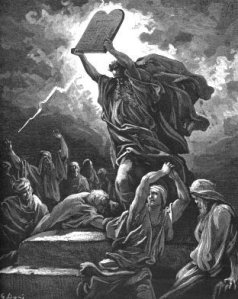
This week’s Time magazine contains an article entitled “How Moses Shaped America” by Bruce Feiler (actually it is an abstract from his book, America’s Prophet: Moses and the American Story). Feiler points out how Moses has been manipulated and utilized by various factions of American society from the earliest pilgrims up through President Obama’s campaign. There’s some interesting stuff here, from the proposal of the Great Seal that depicts the parting of the Red Sea to the Mosaic elements in the Statue of Liberty. No doubt about it, America loves Moses.

As intriguing as I found Feiler’s thesis, I couldn’t help but be a little bit disturbed by it. Serious biblical scholars are early taught to avoid prooftexting like a plague of frogs. Prooftexting is part of a Fundamentalist’s daily spiritual calisthenics, right after chapter-and-verse-presses. Prooftexting is pulling random Bible verses out of context to support a confessional position on any issue. You can always tell it’s coming when someone opens with “the Bible says…” Then you get a chapter-and-verse punctuation mark. What Feiler is describing in his article is just that, a use of Moses that fits the crisis of the moment. While there is nothing wrong about looking to a great leader in time of need, whether that leader be mythical or historical, I wonder how different this is than marching into battle with “Gott und Ich” inscribed on your belt-buckle.

One statement Feiler makes, however, I must take exception to: “With the rise of secularism and the declining influence of the Bible in the 20th century, Moses might have melted away as a role model.” No doubt secularism was in the ascendant during the twentieth century, but the influence of the Bible was never stronger. The twentieth century saw the Bible co-opted as part of a powerful political agenda that drove this nation to the brink of destruction. Never before had the Bible been used to deceive many thousands of untrained religious believers in the ways of war and greed and inhumanity. Bible-thumping had become more effective than rational thinking or coherent speech in the political debates we all so painfully watched. No, the Bible’s influence has not been shrinking. What is needed is a Moses to wrestle it back to its proper place. Even the Bible can be a golden calf.

Moses gets down

Moses gets down


Religion or Death

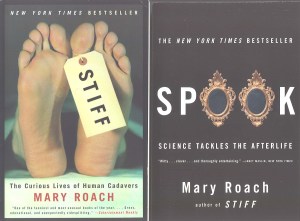
Researching traditions about death can lead to some occluded avenues shunned by many Ancient Near East scholars (generally anything after about the rise of the Roman Empire is irrelevant). It has long been my contention that death and religion are intricately intertwined, well nigh incapable of being teased apart. I’m also very interested in the research of writers on popular culture. Findings, no matter how erudite, if they don’t reach the public will only fail to impress. Mary Roach, ever masterful, wrote a morbidly fascinating account of the afterlife, so to speak, of corpses. This work (Stiff) was followed shortly by Spook — her foray into the science of ghosts. Anyone who can have you mortified one minute and laughing out loud the next deserves to be read.

Can't have one without the other

Can't have one without the other

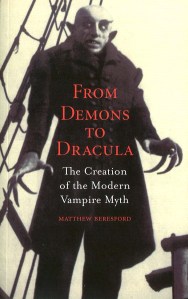
I recently finished Matthew Beresford’s From Demons to Dracula: The Creation of the Modern Vampire Myth (Reaktion, 2008). I was pleasantly surprised that Beresford ambled back to the Neolithic Period in his quest for vampire origins. A number of unexpected facts jumped out at me from his pages — vampires historically have very few traits that last through the folklore about them over the ages. Primarily all they share is being improperly dead. This horrific concept is among the most deeply rooted of human terrors. We prefer the properly dead who stay dead, thank you. Whether revenant or still alive, the vampire somehow threatens the lives of the living and must be dispatched by making him (or her) properly dead.

More rat than bat

More rat than bat

Having been a youngster and woefully unaware of international news at the time, I had never heard of England’s Highgate Vampire of the 1970s. A disjointed and confusing account involving an actual vampire-hunting Catholic priest, a rival vampire-hunting occultist, and ending with the actual staking of a corpse (in 1970! CE!), the tale in Beresford’s book is almost incredible. A little web research demonstrated that the story still has a much wider following than this blog will ever have. Overall, however, it convinced me that my inklings of the danse macabre between religion and death were as accurate as a vampire hunter’s stake.


Rosslyn, New Texaco

Back before Dan Brown had becoming the Most Important Human Ever, even before he published Angels and Demons, my wife and I visited Rosslyn Chapel in Roslin Glen, Scotland. While not actually seeking the Holy Grail, I had been doing some research on Celtic lore, ostensibly where the Grail legend originates, and so we made our way to the remote and (then) desolate site of this unusual church. Officially the Collegiate Chapel of St. Matthew, it is, without doubt, the busiest piece of architectural stonework I have ever witnessed. We went for the grail. We stayed for the art.

WikiCommons image, ours isn't this good

WikiCommons image, ours isn't this good

The research I had been conducting (finally published just last year as a contribution to a Festschrift for Nicolas Wyatt) involved the Mabinogian, a repository of Celtic mythology, and the legend of Bran. For sharing the name of a healthful breakfast cereal, Bran is renowned for also having had a life-restoring cauldron. He even made a journey to the netherworld and his head kept singing even after having been dissociated from his body. An uncommon hero indeed. All historical indicators, however, point to the cauldron as the original of the Holy Grail. Certainly the Bible does not mention it, nor does it appear very early in Christian mythology.

People, as Dan Brown’s financial independence loudly indicates, like a good conspiracy theory. There is a comfort in believing that a magical object of great power is out there somewhere and that a rather ordinary Harvard professor (!) might be able to find it, yet resist taking it. Far truer to life is Indiana Jones and the Final Crusade; people feel the need to touch, to control the power beyond themselves. Even at the cost of their lives. Despite the fact that the Grail is a fiction, it simply will not disappear — although no one can find it and it has never been seen. Faith tends not to be based on tangibles. This is attested every time Dan Brown makes his way to the bank and the population reads with wonder about meanings that simply don’t exist.


Turning Brown to Green

Dan Brown’s The Lost Symbol comes out tomorrow, and I, for one, will not be standing in line to purchase a copy. I actually read his previous two Langdon stories in the correct sequence — Angels and Demons then The DaVinci Code — and what immediately struck me was their similarity of plot and lack of historical veracity. Perhaps as a sometime writer who has had difficulty finding publishers I am just jealous, but the stories to me seem to draw on tired theories of some great conspiracy in antiquity that involved Jesus and Mary Magdalene eloping to France after the crucifixion where they happily raised a family only to be forgotten by history while he was off becoming a deity some thousands of miles away.

I read an interview with Dan Brown about his new book in which he confesses that he’s not a believer in conspiracy theories. To me some of the Area 51 stories sound more convincing than the trite material from Holy Blood, Holy Grail that has been recycled into a fictitious field of academics — symbology — and given a fake pedigree by placing Langdon at Harvard. I was in college when Holy Blood, Holy Grail came out and my literature prof told our class that the work was revolutionary and would restructure modern society. The only restructuring I’ve seen is the planet tipping a little towards Brown’s bank account trying to readjust to all the cash rushing in.

Perhaps my real frustration is with the fact that the ancient world is already fascinating without requiring fictionalization, yet those who actually do know something about it experience difficult times finding non-fictional university posts. Meanwhile average citizens will swirl around bookstores like the insects in an Indiana Jones movie waiting to purchase a copy of a book that fictitiously recreates that ancient world. If Harris tweeds are as miraculous as they seem to be in Brown’s books, maybe I should click my elbows together and say three times, “There’s no place like Rutgers” and I’ll end up in a fulltime professor of Symbology instead of teaching Ancient Near Eastern Religions as a mere adjunct tonight.

An authentic Harris tweed in its native Scottish environment

An authentic Harris tweed in its native Scottish environment


Intelligently Deceived

One of the most difficult things about the life of the academic gypsy is having tons of books. Literally tons. Having been cast from institution to institution in search of that mythical full-time teaching post, we’ve put books in storage and sometimes even forgotten that we’ve had them. So it was that when I was looking for a copy of Great Expectations for my daughter’s English class assignment, I was in the dusky attic, hoping the upstairs neighbors didn’t burst in on me, up to my armpits in boxes of books, that I rediscovered a treasure. Taking a leaf from Dr. Jim’s Thinking Shop, I decided I would review a few of the Creationist books I grew up with. Fortunately I had the presence of mind to keep them although I’d long dismissed their facile, often juvenile, point of view. They have provided great entertainment and even some poignant instruction in the ways of manipulating the minds of the young. Fear of Hell is a great motivating factor to a kid who sees ghosts in every corner and finds bats on his pillow!

So, without further ado, I present the top 5 creationist books of my youth. (Those that I purchased as an adult I bought from used bookstores so as not to add any royalties to the fundamentalists’ already bursting coffers.)
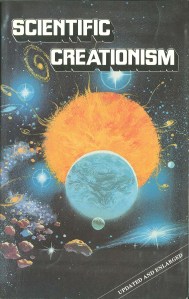
Textbook

We’ll begin with the textbook. Scientific Creationism makes no pretense, such as the “Intelligent Design” school does, about being non-(necessarily-but-we-all-just-happen-to-be)Christian specific. Here Henry Morris begins with the assertion “the Bible and theistic religion have been effectively banned from [public school] curricula” and offers the present book as a corrective to the situation. A better title for the content, however, might have been Scientific Fiction.
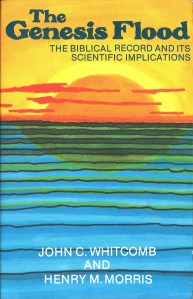
GenFlood

The work that really opened the flood-gates, so to speak, was The Genesis Flood. This craftsterpiece was penned by Henry Morris (again) and his compatriot John Whitcomb. Both proudly proclaiming themselves “doctors” they point out “evidence” designed to confuse the unsavvy into believing that there is a physical way the world could be entirely flooded. They even make room for dinosaurs on the ark, noting that they would have been juveniles of the various species. I’ve been in academics long enough to know that a Ph.D. does not guarantee credibility (or even sanity) on the part of the holder. The fact that Whitcomb’s doctorate is from Grace Theological Seminary ought to speak quite plainly as to its objectivity.

Gish

Written by Duane “the Fish” Gish, Evolution, the Fossils Say No! is an attempt to demonstrate that since not every single phase of the fossil record has been uncovered, the whole theory of evolution is in shambles. Gish, one of the few authentically scientifically credentialed Creationists, should have been able to see that his “back-and-fill” technique was going to fall on hard times as new fossil forms were discovered. As the fossil record grows more complete each year his book becomes more and more outdated.

EvolutionHS

Evolution and the High School Student terrified me in my delicate years. This booklet intimated that when I reached high school the unending assaults of the atheistic non-believers would be unrelenting. I feared for my very soul. Instead, in high school I found nose-picking, pocket-pool playing, and chalk-print-on-the-pants-seat teachers were among the openly committed Christians. Some even kept Bibles on their desks. (This was a public school.) The book lost its teeth.
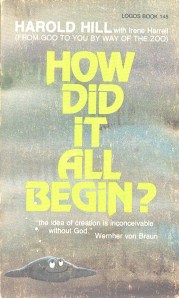
GooZoo

My personal favorite is How Did It All Begin? (or From Goo to You by Way of the Zoo) by Harold Hill (obviously when he was not out swindling River City, Iowa folk of their hard-earned cash to start a bogus boy’s band). This booklet, complete with cute, cartoon drawings, convinces grade-schoolers that evolution answers no questions at all. He had me going as a kid, until I got to the part where he claimed scientists had invented a machine that could indicate if you were “saved” or not. Even as a gullible child I couldn’t buy that.

The efforts of the Creationists are tireless. Even this brief survey of books that I happened to chance upon is nowhere near a comprehensive survey of what is out there. What it does serve to demonstrate is that all reasonable people should be wary. After all, even Jesus knew that a person in the wrong, if persistent enough, could convert even a hard-hearted judge.

Lost and Found

As a young lad I was fascinated by the supernatural. This may explain, but in no wise excuses, my choice of a career in religion. As I grew in years and skepticism, this interest began to feel like a security blanket in a college dormitory — an embarrassment to be jettisoned as quickly as possible. Along the way, of course, I’d given away what I thought to be the detritus of childish fantasy, including my collection of cheap, pulp fiction, tending toward the Gothic.

As I grow more ancient, and more observant, I see that sometimes the impetuousness of youth cradles a profound wisdom. Sometimes we do get it right the first time. I still haven’t figured out if that’s the case with me, but it seems to be a hypothesis worth the exploration. Part of my current search for reality is the reassessment of my childhood learning in the school of classical Gothic fiction. The books are no longer as cheap as they used to be, and when I take them out in public I hide them inside a larger, more academic book so that no one really knows what I’m reading. As a friend once observed, people think that those of us who hang out in the religion sections of Borders are immediately suspect. More so the adult toting a beaten-up paperback written for a teen readership a number of decades ago.

One of my lost memories was a juvenilized version of Rod Serling’s Stories from the Twilight Zone. I had shoveled my copy off to Goodwill along with many other shards of my childhood when I “grew up.” The memories of the angst that the very cover generated in me led to a frantic online used book hunt a few years back. Inside the stories seemed flatter than I’d recalled, but the larger ideas they generated were still worth paying attention to. Perhaps the real lesson is that childhood should not be dismissed as wasted time playing and indulging in carefree amusements. Our childhood proclivities, it now seems, preset the trajectories for our lives. So I still have a quasi-career in a religion department, and I have a copy of a book that started me asking the bigger questions.

Anybody else remember this?

Anybody else remember this?