Go and Dust No More

Finally getting around to reading Philip Pullman’s The Golden Compass (I hate to admit that it took the movie ads to prod me into reading the book), I have been surprised by the depth of the story. Spoiler warning! From the very first chapter I have been pondering what dust might be, and I have just discovered that it is Pullman’s metaphor for original sin. In the chapter where this is finally revealed to the protagonist, Lyra, her father reads an explanatory passage from Genesis 3 (somewhat altered). Indeed, dust drives the plot of the story.

With apologies to the magisterium

With apologies to the magisterium

Pullman’s treatment of the topic once again throws into relief a popular, but mistaken, concept. “Original sin” is simply not a biblical idea. Nowhere in either the Hebrew Bible or the Christian Scriptures does the text suggest that people are born with the taint of a physical liability passed on from the first human coupling, as Augustine hypothesized. In fact, the Bible hosts several potential explanations for the origins of human troubles. One solution that it never reaches is a genetic passing on of an original sin.

Tradition often makes Scripture into its own image. Ideas are inevitably read back into the story and a chimera of hazy concepts emerges. Pullman’s treatment of the human condition is to be applauded, and to his credit he does not attribute the concept of original sin directly to the Bible. Although he alters the text a bit he doesn’t add this most damaging concept to it. The belief that people are inherently defective has allowed for some of the worst crimes imaginable against our species. As a concept original sin is dust in the wind.


Hell on Earth

October 8, 1871 is remembered by many as the night of the great Chicago Fire. Few Americans ever learn that it was also the night of what many consider to be the greatest natural disaster in United States history: the Peshtigo Fire. The autumn of 1871 was tumbleweed dry in the upper midwest. A wildfire that burned over a million acres of northern Wisconsin and Michigan completely incinerated the town of Peshtigo, Wisconsin on the same night Chicago burned. 1,200 people were killed in a single night. One of the most terrifying books I’ve read is Robert Wells’ Embers of October (also published as Fire at Peshtigo), a factual horror story filled with survivors’ accounts and early aid workers’ reports. Many described the scene as reminiscent of Hell.

Gehenna in Wisconsin

Hell is an interesting concept. Following on from my podcast on the origins of the Devil, the concept of Hell is an equally interesting development. The Hebrew Bible knows of no Hell. The dead, good and bad alike, go to Sheol, the gloomy world of the dead, after they die. There is no punishment or torment beyond the languor of being deceased. People seem to be described as having some recollection of life and its benefits, but they are weak and sleepy and attached to their drying bones. The concept of an afterlife comes pretty late to the Israelites, depending on how you define “afterlife.” The book of Daniel, the latest in the Hebrew Bible, provides our first glimpses of a kind of resurrection for the righteous who died before their time. The earliest biblical Hell is the Gehenna of the Gospels, the garbage heap perpetually burning outside Jerusalem.

To picture an eternity of constant burning and torment requires a kind of distinction between an afterlife and afterdeath to be made. Zoroastrian influence on emergent Judaism provided the dualism that made a Devil possible after a few centuries. It also provided the distinction between the glorious afterlife of the good and the doleful fate of the wicked. Concepts that eventually blossomed into the theological constructs now regarded as Heaven and Hell drew their inspiration from an ancient religion of Afghanistan and Iran. Given what human imaginations are, Hell has naturally grown more and more gruesome over the centuries, but if one requires a sense of an entirely natural version of what can happen to good and bad alike, the Peshtigo Fire may also deliver many sleepless nights.


Edoc Elbib Eht

A number of 40-year commemorations of the Manson Family murders have brought these gruesome events of my childhood years back to memory. I was really too young to understand what all the fuss was about then, and now that I am old enough, I’m not sure I want to. Nevertheless, I have committed myself to exploring sects and violence in a religious setting, and the Manson murders have prongs of both phenomena. While recently refreshing my memory on these horrific events on a gray and rainy day, I noticed something I had not seen before.

Looks like someone's been on the yellow submarine a little too long

Looks like someone's been on the yellow submarine a little too long

Charles Manson was (probably still is) a believer in hidden codes. He allegedly cracked a code in the Beatles’ White Album that led him to the belief in an apocalyptic battle that he was determined to begin. I wondered why the Manson Family tends not to be listed among other apocalyptic groups such as the Branch Davidians or Heaven’s Gate. They all share several traits, and although Manson’s revelations came from the Fab Four rather than the Holy Trinity, a revelation from on high spurred him into actions that had a tragic outcome, just as David Koresh or Marshall Applewhite.

The whole Helter Skelter code also reminded me of another, equally bogus pawning of randomness as divine messages: Michael Drosnin’s The Bible Code. When I read this bestselling bit of intellectual dry rot a few years ago, I was amazed that anyone could possibly take it seriously. God writing hidden messages in a holy book like some hormone enraged high schooler? And figuring out that a singular genius would figure it out just before the apocalyptic end without realizing that it is possible to read messages back into any media after they occur? It seemed all too much for a rational mind to take. In one of my courses at the University of Wisconsin Oshkosh I gave students the option of reading it for a secondary project. To my chagrin, when I had the papers in one particularly tear-stained paper wailed (seriously) that the writer wished she had been warned sooner! This book changed her life! Everyone must know! Unfortunately I left Oshkosh without finding out what became of her.

God may not play dice, but apparently he likes crosswords!

God may not play dice, but apparently he likes crosswords!

I felt bad for introducing an undergrad to such “academic” sleight of hand; some college students just haven’t developed the critical facilities to see through the remarks of Balaam’s various sidekicks. Come to think of it, Manson’s followers accepted his revelations uncritically as well. Maybe the real lesson in all of this is that we must examine very closely those who claim special revelation, whether it be from Lenin, McCarthy, Starr, and Harrington, or just from God Almighty.


Animal Alarm

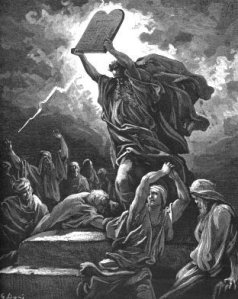
Where was Moses when the lights went out?

Where was Moses when the lights went out?

After undergoing a bout of oral surgery earlier this week, even before the nitrous oxide wore completely off, I pulled George Orwell’s Animal Farm off the shelf for a re-read. I hadn’t read it since at least 1984. It was even more disturbing reading it this time just off the Bush-Cheney years, and I realized that the Napoleons and Squealers are still with us. As a prophet Orwell may not have always got the dates right, but he was clever at spotting trends.

In this reading of Animal Farm a minor character leaped out at me. Among the tame, but non-domesticated animals was the raven Moses. Moses is the special favorite of farmer Jones and tells the animals of Sugarcandy Mountain vaguely up in the sky, where conformist animals go when they die. When the rebellion takes place, Moses flies off and remains absent until near the end of the story when the situation has deteriorated. Once again he is back to tell the others about Sugarcandy Mountain. The connection between Moses and Mount Sinai is transparent, although the heavenly connection is slightly misplaced.

The Hebrew Bible (certainly in the period of Moses) does not recognize what will become the Christian concept of Heaven. Like many ancient West Asians, they supposed that Yahweh lived “up there” at times (at other times he lived in the temple, or on the world at large, or atop some mountain). The “heaven” they knew of had no place for dead humans; the afterlife was a concept that developed very slowly. Moses’ motivation for the ancient Israelites, however, also resonates in Animal Farm, even as it does in the startlingly similar film Chicken Run — freedom. Freedom is the pipe-dream of many religions, but even as early as Moses those dreams run into regulations. Religions have laws long before they have heavens. Perhaps Orwell was onto something after all.


Memento Mori

This is the end, my friend, my only friend, the end

This is the end, my friend, my only friend, the end

Those of you who’ve listened to my podcasts have no doubt noticed my reference to George Pendle’s, Death: A Life (Three Rivers Press, 2008). This fictitious account of Death’s memoir, all things considered, is a fun read and a wild romp through various ancient religions. Postulating a loveable, if somewhat obtuse, God (no more obtuse, however, than the supreme being in Harold Bloom’s Book of J) Pendle populates his mythological world with a vast array of embodiments, personifications and supernatural beings, all slightly neurotic, and more or less on an equal playing field. Although the book is intended as fun, it does offer some serious consideration to the phenomenon of death.

One of the earliest intimations that Homo sapiens had begun to consider religious sensibilities is burial, the concomitant state to death. Burial serves an important biological function of preventing the diseases borne of putrefaction from infecting others, but it also serves as a condensed statement of a fledgling belief in an afterlife in some form. Even Neanderthal burials have been discovered with rudimentary grave goods. Concern for the wellbeing of the departed is surely a religious sentiment. Death and religion are never far from each other. Even the early Mesopotamians trembled at the etemmu, their version of a ghost, and marked it with the divine determinative on their clay tablets. Religion has been a fine-turned handle that humans have used to get a grip on death.

That is not to say, of course, that death is religion’s only concern, but there is some wisdom in that old saying that people seek out their religious leaders when they are “hatched, matched, and dispatched.” Mesopotamian (and Hebrew Bible, for that matter) afterlife was a gloomy prospect, yet it was certainly brighter than the alternative of the simple cessation of biological functions. Death as a concept inserts meaning into the all-too-natural act of dying. Not a religion exists that does not address itself to this great leveler of all human aspirations. If at times it seems that my posts tend toward the macabre, peopled with vampires, werewolves, zombies and Republicans, bear in mind that such creatures of the night are expressions of the essentially human and indisputably religious preoccupation with death. Its unbeating heart transfuses life to religion.


Momma Maya, Is It the Apocalypse Already?

Where have all the Maya gone, long time passing?

Where have all the Maya gone, long time passing?

While recently reading a Gorgias Press book on the Maya (Sam Osmanagich’s The World of the Maya) I couldn’t help but notice the concern of the author with the year 2012. Actually, Osmanagich is looking forward to 2012; it will be when a new era in human existence begins. Since he freely admits throughout the book that extraterrestrials provided technical support in the Mayan monumental architecture, I suppose the fixation on 2012 should not be surprising. The book is charming as a folksy travelogue and disarming in its innocent sense of wonder, but academic it is not.

Concern with the end of the world as we know it seems to have entered the Judeo-Christian tradition with Zoroastrian contact. As soon as the idea was conceived it was immediately apparent that this was going to be a very large baby, and it has not disappointed. Back in my rural Pennsylvania high school, concern that the world would end in 1980 was seriously rampant. (Considering that the Reagan-Bush years were about to begin, it makes sense in retrospect, at least on a metaphorical level.) Worry ran so high that on the stated day — noon was the confirmed hour of doom — my English teacher laid down her grammar book and had us spend our final earthly minutes writing an essay arguing why the world was, or was not, going to end that day. When the class-bell rang, other than some soiled undergarments, everyone seemed pleased still to be there.

I was at Nashotah House for Y2K. A prominent administrator insisted that we all prepare for the likely event of a societal collapse. (From my present vantage point, I’d rather have taken my chances just about anywhere else.) Yet here I am to recount the tale.

Now only a dozen years down the road from Y2K we are being told to prepare for yet another apocalypse. People I speak to seem genuinely concerned about this one, and even I had a shiver or two as Osmanagich calmly laid out how the Maya just didn’t make mistakes like that. As I see it, there are two choices: people should study the origins and rationale of apocalypticism or someone should start a business selling Apocalypse insurance (the name Four Horsemen might be catchy). People seem ready to believe that extinct civilizations knew something about our fate that we just can’t see. And if the world does end in 2012, well, you wouldn’t want to have all those premiums weighing you down by then, would you?

The Four Horsemen -- would you buy insurance from them?

The Four Horsemen -- would you buy insurance from them?


Cenobites and Angels

I recently became aware of Hellraiser. Actually, I’d seen images of Pinhead around for years, but never realized that he was a Cenobite until reading Douglas Cowan’s Sacred Terror (see my post on Vampires, Mummies and the Holy Ghost). In fact, Pinhead is featured on the dust jacket of the book and comprises a large part of Cowan’s evidence. Curious enough to watch the movie, I steeled myself for the macabre and terror, but although there were gory scenes it was no more disturbing than the Republican National Convention.

Pinhead for president?

Pinhead for president?

This movie draws its lifeblood from religious, particularly Christian, imagery. Cenobite, of course, is an old word for “monk” and in the movie Cenobites are interdimensional beings known as “demons to some, angels to others.” In a strange convergence of themes, I had recently viewed Dogma again after a gap of a few years. Here Loki and Bartleby are fallen angels, who, rather like myself, move from Wisconsin to New Jersey. Both of these films are pervaded with a healthy ambivalence towards those beings who have the potential for so much good but who opt for what most of us would consider evil.

Angels have a long pedigree in ancient religions, probably originally being gods who only ever achieved supporting roles. Not all gods were created equal. At Ugarit we find a whole class of deities below the power and dignity of reigning gods. Besides, in a non-scientific worldview, angels, especially fallen ones, had great explanatory value. When things unexpectedly go wrong and you’ve made all the proper sacrifices to appease the resident deity, bad angels might just be the cause. Theirs was a world of naive realism; what the eye observes is pure reality and what the eye doesn’t see is divine. Today we know this to be overly simplistic — reality is so complex that even our brightest can’t completely comprehend it. Yet when we have trouble explaining things, even in a scientific world, many are ready to point to the angels in the wings.


Gods bless you

Which god sneezed?

Which god sneezed?

In a recent reading project to keep me edgy and paranoid, I went through Surenda Verma’s The Mystery of the Tunguska Fireball (Icon Books, 2005). Quite apart from giving me a quick X-Files fix, this book is a thorough and reader-friendly account of an event that, no matter what you make of Mulder and Scully, should have been a major wake-up call for those of us who call planet Earth home (some exceptions apply).

On June 30, 1908, a fireball exploded over a remote region of Siberia. Even today it is nearly impossible to reach the spot. The traces of this event, which don’t seem to support any given theory completely, point to an explosion on the order of 10–20 megatons (the bomb dropped on Hiroshima, for contrast, weighed in at about a thousand times lighter on the TNT scale). The sparsely populated region was devastated by shock waves and fire, and only by a slim thread of fate did all of us not end up on the extinction list. A blast of that intensity, had it been located lower in the atmosphere, could have easily brought on a nuclear winter — with no Jingle Bells!

Sometimes when life seems too intense, I find it helpful to think of what a wonder it is to be here at all. Perhaps it is a religion of wonder. Earth’s history is replete with mass extinctions that ultimately allowed for our own evolution, but which wiped out over 99 percent of all species that have ever lived. The Permian Extinction, which allowed for the rise of the dinosaurs, nearly obliterated life itself from our rocky home. When I look to the future I see disjunction and continuity. Jupiter was dealt a second cometic blow within two decades last week, and the odds are ticking on our own tiny planet. I wonder what ancient mythology would have made of Tunguska — who was the lady or lord of the fireball?


Changing Faces of the Divine

One of the most intriguing books I’ve read on the origin of religion in the past few months has been Stewart Guthrie’s Faces in the Clouds (Oxford, 1993). Guthrie offers the suggestion that our in-born, evolutionarily driven need to see people or faces, even where these are false positives, may have led to the concept of god/s. As a respectable academic, I am obligated never to agree completely with anyone, but Guthrie seems to be onto something here. When I’m jogging in the pre-dawn hours it is amazing how many people are about — that is, until I get close enough to see that they are a small tree or a tall newspaper stand. We do see what we consider important everywhere.

The picture says it all.

The picture says it all.

Having recently stumbled upon “Ghost Hunters,” I am amazed at how quickly some people (with the obvious exception of Jason, Grant, and the TAPS team) are inclined to claim a human shape to be a supernatural entity. This phenomenon is ubiquitous. On the web, while looking to find a good example of pareidolia to present to my class, I found an image of Michael Jackson’s face seared onto a piece of toast. If ever a divine sign was needed, here it is indeed! A more prosaic example was a natural water-stain I found on a saucepan in my own kitchen. I picked it up and asked my wife what she saw, just to assure myself I alone wasn’t crazy. Take a look and see what you see!

It looks like an oriental man reclining to me; perhaps an oriental Jesus?

It looks like an eastern Asian man reclining to me; perhaps an oriental Jesus?

Ancient religions were quick to put human forms on dangerous, threatening, or awe-inspiring phenomena. Lightning and thunder became the purview of Baal. It is a natural defense mechanism: you can pray to or offer a tasty animal sacrifice to Baal and the terrible storm will stop. Of course, in time nature itself would take care of it too. One summer at Nashotah House, however, the storms kept on coming. It was termed a “recurrent mesoscale convective system” by the meteorologists, but to the Baal worshiper it would seem that nothing could assuage the divine anger. Baal kept coming back at you. I have a photo in a shoebox somewhere of me standing nearly up to my knees in the icy rain water. Better to consider it human than to face unfeeling nature.

Today people still look for faces in the clouds to allay their fears. But we also have a rudimentary understanding of the physics of our universe. When people are forced to choose between facts and faces, when fear or extreme desire comes into the equation, the safe odds are always on the faces.


God is Great (not)?

As a teacher/editor with an “advanced” degree in religious studies, I was intrigued by the sudden popularity of Christopher Hitchens’ God is Not Great (Twelve Books, 2007) a couple years back. I bought it as soon it was available and read it cover-to-cover after a morning out picking strawberries.

Reading Hitchens’ analysis I found myself nodding my head quite a bit; he scores a substantial number of points on which various religions should plead “guilty.” And while I found many of his arguments persuasive, part of me still wonders if perhaps religion, that most ancient of cultural forms, has not had at least some positive impact on humankind. In the most basic sense, our civilization would not be here to critique religion if religion had not been an impetus to get our civilization to begin its motion towards today’s civilization. Black and white are not in the palette of serious religious studies.

For the scholar of religion, however, Hitchens should be required reading. Sometimes we have to stare hard into the face of the facts of what our object of study has become and wonder, with Samuel F. B. Morse, “what hath god wrought?” Religion bears the mark of Janus, and scholars of religion have to pay attention to what people are saying about it.