Fearing Hubris

I’m afraid of hubris.  You see, my academic career was not exactly distinguished, and as an editor you’re encouraged to keep to the background.  Still, when you write a book you need to promote it a little, which is one of the things I learned as an editor.  I was equally parts embarrassed and pleased to see the bookstore display for my upcoming book signing in Bethlehem.  I mean, although I wrote Holy Horror for a general readership, the publisher tends more toward academic books and their pricing, so this is not an inexpensive purchase.  Those who write are nothing, however, without readers.  Those chosen for interviews are writers who’ve made a sales impact or who have a university behind them.  When it’s just me, it feels like maybe I’m trying to ascend Olympus on my own initiative.
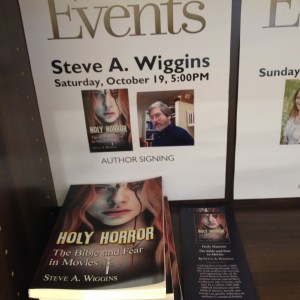
I was in the Moravian Book Shop to purchase Neal Stephenson’s Fall; or, Dodge in Hell.  I’ve fallen a bit behind on Neal’s work, largely because Goodreads challenges are measured in numbers of tomes read.  I was pondering this, book in hand, when I noticed—there I was with my own display.  You see, Holy Horror was meant as a guilty pleasure read for those of us who like the scary time of year.  The book price is the scariest part about it, however.  I feel a profound gratitude when anyone actually buys it.  Since there are now copies available on sites such as eBay, I’m guessing some who’ve read it want to recoup a little of the cash outlaid.  While all of this is happening, however, I know that I have to learn the art of book promoting.  Still, it feels like that self-promoting I was warned against as a kid, an unseemly thing.

Writing is a form of conversation.  When I’m in a room with a bunch of other people unless I’m the teacher I have trouble making myself heard.  I’m soft-spoken by nature.  I suppose it’s obvious, then, why a book signing feels hubristic.  Perhaps it’s appropriate for a book about fear to engender this sense of discomfort.  Entering the conversation has always been difficult for me.  At the same time, as the beneficiary of so many books, I feel compelled to give something back.  My insights, if such there be, won’t rock the world.  As I think of myself signing books, I wonder what I could possibly say to someone who’s willing to pay that price for something I produced.  If you’re going to try to climb that mountain, you’d better think about what you’ll say when you meet the gods at the summit.
Paradoxical Psychology

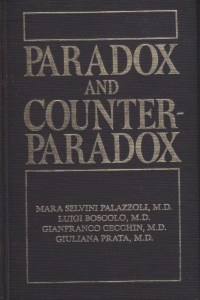
In college I took enough psychology courses that I could have minored in it, had I simply declared it.  Focused on ministry at the time, this declaration never happened.  My own psychological issues (who doesn’t have them?) show up, I suspect, to those skilled at spotting such things, and friends sometimes suggest books I might enjoy reading.  As a result I recently finished Paradox and Counter-Paradox by Mara Selvini Palazzoli, Luigi Boscolo, Gianfrancro Cecchin, and Guiliana Prata.  Attempting to summarize the study would necessarily over-simplify what is clearly a very complex topic—what used to be called schizophrenia—but the basic idea can be explained.  These psychoanalysts worked as a team to help patients with (since it was the 1970s) schizophrenia.  Realizing that the basic mental processes are developed within a family, their practice used group therapy to treat families rather than singling out the “sick individual.”  This book is an account of the methods they used.

Seeing schizophrenia as a family issue rather than an individual one, the therapists saw the identified patient as often a child trying to keep family expectations in order.  The psychoanalyst team called this a “game” played by families seeking homeostasis—the perceived state of balance between members to assure that things stay the same.  The psychotic member enables this to happen and families, as recounted in some of the cases, clearly try to manipulate the situation to keep this strange and awkward balance.  The doctors used paradoxical (thus the title) scenarios to treat such families and reported a good rate of success.  The focal point of their work was often not on the “sick” member, but on the group dynamics which led to the sickness.

The idea is a fascinating one.  We are all members of families (with some exceptions), and the way our group functions is, for the most part, acceptable.  Dysfunction, however, sometimes leads to psychosis, which, according to these authors, is a state of affairs best treated on a family scale.  While it may be easy for me (having grown up in a clearly dysfunctional family) to see this, I sometimes wonder at how widespread mental issues really are.  Our species lives a highly unnatural existence for evolved beings.  Our work together in family units often leads to conflicts, overt and subtle.  Children—often the identified patients here—can see such things much more clearly than we frequently suppose.  Afraid of the consequences, they learn to play the game to keep the situation stable, if untenable.  There’s great insight here, even if the book is a touch outdated; our learning about the human mind is never-ending and it makes perfect sense to pay attention to the context when wondering about the results. 


Book and Bell

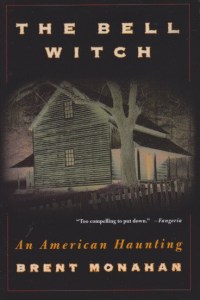
The Bell Witch: An American Haunting, by Brent Monahan, is a book I’ve read before.  The subtitle was used for a cinematic version.  I discovered the book, however, through what might be considered a chance encounter with the author.  He was teaching a course on offering distance education courses at Rutgers University, and, as an adjunct teaching over eight classes per year, I’d been selected for the distance education program.  (As life goes, of course, I was hired by Routledge for a full-time job before I could actually deliver the course.)  By a strange irony, I had watched An American Haunting just the weekend before the course, and I had no idea who would be teaching it.  Neurotically punctual, I was the first one there for the class, and as Dr. Monahan and I talked, I knew I’d need to read the book.  I posted on it back when I did, but this time I decided to pay better attention than one can on a bus.

Of course, when you watch the movie first, which I had, you know “the reveal” well before it comes late in the novel.  In case you’ve done neither, I won’t give it away.  The tale is based on an historical haunting, attested in sources from near the period.  And it is a strange kind of possession story.  The “witch” is actually a demon conjured by a trauma, and although book wraps things up nicely, it leaves a few questions at the end.  I suppose that’s appropriate for a scary book.  One of my current projects involves tracing the accounts behind fictionalized narratives to their originals.  The Bell Witch was well researched, and is a good example of how the line between fiction and fact can be effectively blurred.

The Bell Witch legend is credited with influencing several horror films, including The Blair Witch Project and others which tellingly have “Bell Witch” in their titles.  The story has a fairly incredible longevity, given that it was a localized legend from early in the nineteenth century.  Monahan’s novel is written as a “confession” from the schoolmaster, and historical personage Richard R. P. Powell.  This blurring of the lines makes for the kind of ambiguity that gives horror its particular ability to stand between fact and fiction.  The early versions of the lore, combined with elements intended to offer verisimilitude, leave plenty of queries at the end.  So much so that I’ve occasionally contacted the author for clarification.  What really happened?  It depends which side of the line you prefer.


The New Purple

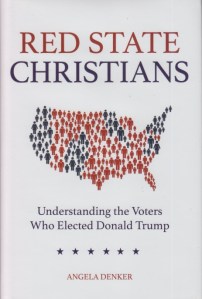
Those of us who grew up Evangelical hold an unusual place among our liberal peers.  We’re often able to peer around, over, and under that wall that has been built between those who want a faith-based nation and those who want a free one.  Angela Denker is a fellow traveler on this road, and her book Red State Christians: Understanding the Voters Who Elected Donald Trump is a useful roadmap.  Some of us fall further from the tree than others, but one of Evangelicalism’s more endearing traits, when taken seriously, is the love of those who are different from you.  That love is often forgotten in the political rhetoric daily whipped into a froth by an unstable president being used by his party to install agendas that hardly fit the moniker “Christian.”  That’s why books like this are so important.

I confess that reading studies such as this make me uncomfortable.  Uncomfortable because my Evangelical past haunts me worse than any ghost, but also because Denker is clearly right that basic humanity is being left in the garbage as battle lines are drawn up in what could be a great, diverse nation if a leader were determined to work for unity.  I recently wrote about lunar landings.  Kennedy was a Catholic who had to work to bring a nation together around a common goal.  Instead of tearing the country apart for his personal aggrandizement, he pointed to the moon.  Sure, there was a xenophobia concerning the Soviet Union, but at least in this pocket of the world there was a sense that we should work together.  When religion entered politics with Richard Nixon and his followers, a deep rift opened up.  The two topics you were never to discuss—religion and politics—were now in the same bed.

Red State Christians is an extended road trip on which Denker interviews people who largely fall under the Evangelical umbrella.  Some of them are Catholic.  Some of them are Hispanic.  Some of them are less concerned with social issues, but are hard-working laborers often overlooked by the Democratic Party.  The resulting pastiche is one in which Americans are cast not in sharp relief, but rather with the hazy edges that are a far more accurate way of understanding human beings.  Many, it becomes clear, elected Trump out of fear, or out of fear of his opponent.  These aren’t bad people, but they are people afraid.  This wasn’t an easy book to read, but it is an important one.  And those who want to work for a future that might include realms beyond the moon might find this work a small step in the right direction.


Upstate Reading

In terms of cash flow I don’t fall into the wealthy bracket.  My assets are largely in pre-printed paper form, and when I visit the local Little Free Library it’s generally to donate books rather than to take them.  Over Labor Day weekend I was in Ithaca.  One of the more famous features of the town is its weekend Farmers’ Market.  Indeed, the north-south corridor through town is a continuous traffic jam during Market hours.  Not only are there farm stands in the permanent open-sided structure, but there are a few craft booths and several places to buy al fresco fair from local restaurants.  In the summer parking can be hard to find, but the place has a carnival-like atmosphere nevertheless.  It also has a Little Free Library.  I’ve been to the Market many times but I’d never noticed it before.

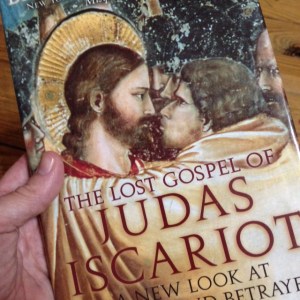
Upstate New York is beautiful but it tends toward the conservative end of the political spectrum.  Ithaca is a pixel of blue in a screen of red, and that strangely showed in the Little Free Library.  Many of the books were either Bibles or popular kinds of devotional titles.  Given that Cornell isn’t known for its religion department (Ithaca College has a respectably sized philosophy and religion department, however) these books aren’t the kind you’d expect to find in an institution of higher education.  That’s why I was surprised to see a near mint copy of Bart Ehrman’s The Lost Gospel of Judas Iscariot on the shelves.  The Gospel of Judas hasn’t been big news for a few years now, but this was a book that suggests a different demographic than your average evangelical readership.

Like Ehrman, I once made a living as an adjunct at Rutgers University.  Indeed, it was this commonality that helped me to get to know him a bit.  He’s gone on to a kind of fame rare for biblical scholars.  Indeed, to have a sufficient number of copies of your book printed to end up in a Little Free Library—in other words, you have to have more cachet than your garden variety Ph.D.  In my local community LFL I like to leave books for others to take.  Just last week I stopped by and noticed that the summer had depleted the stock.  Ironically, I had noticed one of Neal Stephenson’s novels in the same circumstances as Ehrman’s.  I’m glad to see intelligent works on offer for the reading public.  And trading books with no money involved suggests to me that there’s a better form of economy than material greed.  All it takes is a Little Free Library and a little good will.


Better Places

I have to confess that I’d never heard of Ottessa Moshfegh before.  Shame on me, I know.  As a wannabe writer, I feel compelled to know other writers’ names.  Hang in literary circles.  Etc.  The good news is, however, that I found Homesick for Another World in an indie bookstore.  I’d gone in for something else that they didn’t have, but I don’t like walking out with nothing, especially when it’s a small store.  Besides, I trust the taste of most independent store owners. 

I can’t remember the last time I read a book of short stories all the way through.  As with most writers some work appeals to you more than others.  In my mind the first and last stories stick the firmest.  The latter, “A Better Place,” is haunting, almost Shirley Jacksonesque.  Others make you uncomfortable in your own skin.  This is a rare talent.

Finding a writer who, using simple words and expressions, takes you to another place is a rare gift.  The short story (the only kind of fiction I’ve actually published) is a versatile and engaging form of literature.  Books collecting them are often good for picking up when you have a little time and putting down for a while again.  I felt compelled to go through this whole work, being drawn into the weird and somehow familiar worlds of characters who seem to have no purpose, no goals.  It’s almost as refreshing as Kafka or Camus.  To be a writer who requires only one name to evoke a genre must be glorious.  These stories are strange without recourse to the supernatural, and they defy easy genre assignment.  (This makes publishers crazy.)

There’s an earnestness and a longing in this collection.  A kind of nihilistic spiritualism.  A wanting with no particular object in mind.  I read a lot of fiction, some of it very good.  The kind that leaves you a little stunned and questioning what reality is.  This is that kind of book.  Had I not gone into that indie shop that Saturday morning I never would have found it.  I certainly didn’t know to look for Ottessa Moshfegh.  Here again I’m reminded of the value of the bookstore experience.  The ability to browse without clicking or scrolling feels like a luxury to me now.  I may have to pay more than Amazon’s competitive pricing, but then this is like a finder’s fee for being in the real world.  Even if the book makes you question that reality when you’re done.


Linking

So I’m active on LinkedIn.  I try to keep social media down to the essentials, but you never know when opportunity might rap its knuckles next to your shingle.  When LinkedIn began they ran the warning that you should only connect with people you actually knew, since people can say bad things about you and hurt your job prospects.  Since that kept me down to about a dozen connections (many academics, being secure with tenure, don’t bother with LinkedIn), I eventually followed the advice of a wise friend and accepted invitations from people I didn’t know because, as he pointed out, they might be the ones with jobs to offer.  That made sense.  There is a flip-side to it, however, and that is people think I have work to offer.  I don’t.  At my job I have no hiring capacity whatsoever.  (I can feel the links being broken even as I write this.)

The vast majority of people who contact me on LinkedIn want something from me.  They obviously don’t read this blog.  (See paragraph above.)  Many people send me messages wanting me to publish their books.  Editors, my dear and gentle readers, work in specific disciplines.  No one contacting me on LinkedIn has written a book about the Bible, although my profile indicates that’s my gig.  And besides, many companies, including mine, have policies against doing business over social media.  I often think of this because the book business is easily researched.  There’s a ton of information both online and on shelf about how to get published.  Messaging someone on LinkedIn is not recommended.

Writing a book takes a lot of effort.  I know, because I’ve done it a number of times.  If you’re going to put years into doing something, it pays to spend at least a few minutes learning about how the publishing industry works.  I made rookie mistakes in my younger days, of course.  But that led me to learn about publishing even before I had a job in the industry.  Quite apart from my job, I freely admit to being a book nerd.  And publishing, despite its many problems, is an inherently fascinating industry.  Although I’ve had academic books accepted for publication, I still struggle getting my fiction to press (I have had short stories published, but my novels remain unread).  I won’t contact other publishers I know through LinkedIn, though.  I’d rather have it be a personal experience whether it’s acceptance or rejection.  And that’s something social media just can’t replicate.


Reading Railroad

Rereading books takes time.  When I was a professor my reading time was largely limited to the summer and winter breaks.  Those who haven’t experienced the academic lifestyle firsthand may not realize just how incredibly busy you are during term time.  Class prep, grading, delivering lectures, leading seminars, committee meetings, office hours—it really is much more than a nine-to-five job.  Time to sit down and read through books is limited, and since those books are heady, academic tomes, they take considerable time.  (I’m reading an academic book at the moment and I can only get through a finger-full of pages at a sitting.)  All of this means I’m generally reluctant to reread books.  Not that I’m a traditional academic anymore, but because I have a huge and growing stack of books I haven’t read yet.

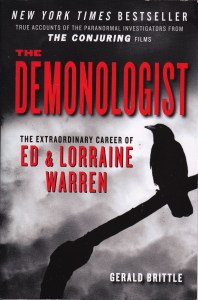
Nevertheless, a project on which I’m working required rereading Gerald Brittle’s The Demonologist.  I read this about two years ago, while commuting.  The thing about reading on a bus is that the quality of reading time is strained.  Recall isn’t the same as when you’re in a comfy, stationary chair, and no stranger’s head is lopping onto your shoulder as they doze.  (Yes, that happens, and frequently for those of us on the first bus of the day.)  In any case, my copy of this book doesn’t have an index and I couldn’t remember if some specific instances were discussed.  The only thing for it, then, was to read it again.  My second reading was done with more skepticism than I could conjure on a bus ride, but still my original sense remains: we willfully cut out much of human experience if we stop our ears completely.  At least in principle.

Ed and Lorraine Warren were self-taught ghost-hunters.  More often than not, their cases turned into what they believed were demonic cases.  Since academics tend not to publish much about such things, the self-taught are pretty much free to declare themselves experts—just switch on reality TV and check me on this.  Experts are those with experience who are willing to share it.  The other day I met someone who, like me, used to live the commuting life.  We both agreed that telecommuting was a more authentic way to exist—your otherwise mandated three or four daily hours traveling can be more sanely used at home.  Still, we had to agree, bus time could be used for activities like reading, and once you stop commuting you have to carve time out for it.  In such a situation rereading a book is at times necessary.  When I was a professor, I reread frequently.  But then, it was mostly articles or books that I wouldn’t take on in their entirety.  In the reading life there’s never enough time.


Clear Thinking

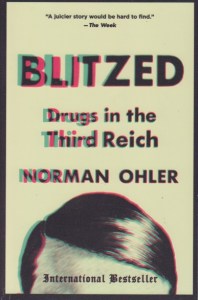
I first heard of Norman Ohler’s Blitzed: Drugs in the Third Reich before it found a publisher.  Even at that point I found the idea fascinating.  My knowledge of the Second World War isn’t deep.  I was born less than two decades after it happened, so it was still heavy in American consciousness, but as a child I wasn’t much interested in history.  (I was a fan of monsters even then.)  Like many people, since November of 2016 I’ve had a renewed interest in how the Nazis rose to power, and how a highly intelligent nation could follow someone as unstable as Hitler.  When I spotted Blitzed on a discount table at the Moravian Book Shop I figured it was a good opportunity to learn more.

Never a drug user myself, I grew up in a culture where such use was prevalent.  I had never realized, however, just how ubiquitous drugs were in Nazi Germany.  Ohler begins by noting the use of crystal meth in keeping German soldiers awake and alert for days at a time, thereby allowing Blitzkrieg to take place.  The offensive on the western front would likely not have worked without it.  The story gets seedier from there.  Hitler, a vegetarian who eschewed drugs and alcohol, had a personal physician who began giving him daily injections of vitamins and what we’d likely recognize as placebos for a number of physical ailments.  Even as decisions were made for genocide, der Führer was being injected with hard drugs of the opiate family, eventually becoming an addict.  Decisions about the fate of an entire nation were being made by a leader so high that straight thinking wasn’t a possibility.

Ohler is careful not to claim that Hitler’s excesses of hatred and megalomania were the results of his drug use.  They were there well in advance of his decline.  Outside the bunkers in which Hitler spent much of the war, drugs were widely used, and abused, in the German military.  In order to try to entice young men into what would become suicide missions, high doses of drugs were provided, often enough to prevent the effective outcome hoped for.  This is a fascinating, sordid story.  It’s a side of the tragedy of the war that we don’t often hear, and it’s a further indication of just how easily madness spreads.  Reading the descriptions of Hitler’s personality, in this particular era, was frightening.  Especially since history has a nasty tendency to repeat itself.


Somebody’s Coming

Sometimes updates don’t help.  That’s because evil is so good at masquerading as righteousness that constant vigilance is required.  Michelle Goldberg’s Kingdom Coming: The Rise of Christian Nationalism was recommended to me by someone at a local church.  I’ve been giving educational talks to help people understand what Evangelicalism is, so I figured I’d better read it.  The optimistic epilogue to this otherwise excellent book allowed relief after the 2006 midterm elections.  Of course, nobody back then could’ve believed an even less intelligent president than W could ever be put forth by the GOP.  That doesn’t mean Kingdom Coming shouldn’t be read.  It should.  And it should be required reading (aw, gee!  Homework?).  There have been many studies that have demonstrated repeatedly that Christian Nationalism is highly organized and well funded.  Meanwhile intellectuals scoff that religion is dead.

I spent most of the last week in a kind of panic.  I have another public talk coming up, and I needed to read Goldberg before that.  Yes, it is dated.  But yes, we have Trump’s bumbling form of “leadership” with a well funded, highly organized Evangelical subculture calling the shots.  Forget the politicians—they’re only interested in money—it’s everyone else who suffers from America’s growing fascism.  The fact that the GOP won’t stand up to 45 shows that we’ve already turned the corner toward das Vaterland.  Anyone the Republican Party elects from now on could be the new dictator.  Christian Nationalism stands behind this as journalists scratch their heads.

Goldberg’s book has likely been shelved because eight years of Obama made it seem like the threat was gone.  The problem is, silence works to the benefit of Christian Nationalists.  Perhaps the most frightening thing about all of this is that many intellectuals simply don’t take the threat seriously.  At the same time I was reading this, I was also reading about Nazi Germany (because I’m such a cheerful guy).  The parallels are blatant and entirely too obvious to miss.  Christian Nationalism has an agenda and it is fascist in nature.  Even obeying the words of Jesus takes second place to the political objective of making America in their own image.  This may sound alarmist, but it’s based on solid information.  The Devil, they say, is most powerful when people don’t believe in him.  Those who would make America into a theocracy would claim to follow the other guy, but looking at their tactics, it’s pretty clear who’s really in charge.


Book Culturing

The other day I met one of the organizers of the Easton Book Festival.  Coming in October, this festival is something new.  It took the efforts of a couple with vision—the owners of a small, independent bookstore—to get other people on board, but now it’s going to happen.  A weekend dedicated to books.  I found out about the Festival as I was looking up area bookstores that might let me do a presentation on Holy Horror.  For whatever reason, my last book missed its projected autumnal publication date, and fall is when people are really thinking about horror movies.  Approaching its birthday in late December, it never really had a proper launch.  Priced the way it is, I don’t expect a sales boost, but I would like people to know about it.  When you spend years writing a book you’d like it not to be completely obscure.

In any case, when looking up one of the Easton shops—hey, book lovers, the Lehigh Valley has lots of bookstores!—I noticed that the Festival was still seeking participants.  Since it falls just before Halloween, the timing felt perfect.  I signed up.  Now this is one of the many new tricks for this old dog.  I tell authors all the time that self-promotion is key to book sales, even when a press is fairly widely known.  In fact, the store owner himself writes books and has to pay for his own tours to promote them.  Book culture is worth promoting.

On a personal level, it does me good to see that there are others who appreciate books.  They are a form of collective mind.  A communion.  When I’m feeling down, or uninspired, a trip to a bookstore—or even a library—often helps.  Reading books leads to a sense of accomplishment.  Every year I set a goal on Goodreads.  I don’t set the goal to make me read—I’d do that anyway—but to share with others both what I’ve been reading and what I think about it.  The Easton Book Festival will be a way of doing something similar, hopefully with those many others who feel the draw of books.  Writing, for me, is a labor of love.  I don’t know too many people personally, so meeting them through books is one of my own goals.  Just the other day I met an academic who wanted to read Weathering the Psalms.  Such things happen only in that wonderful land built of books.


Fun and Fear

It’s curious the way people find books.  I sometimes see them advertised (the way publishers suppose people see them), but far more often I find them more serendipitously.  I’m active on Goodreads, and many times a book someone else has reviewed will catch my eye.  I like to read things that I notice in independent bookstores.  I’m always on the hunt for a bargain.  At work we have a used book rack where any volume is half-a-buck.  During lunch one day I spied Victor Gischler’s Vampire a Go-Go.  Now the title told me this wasn’t exactly a serious novel, but it had vampire in the title and when I write horror it often ends up on the funny side.  All in all it seemed like it would be worth the tiny investment, even if I don’t have a clear idea of what go-go really means.

While not laugh-out-loud funny, this is an enjoyable romp through monster land.  Kind of like Harry Potter with some adult themes thrown in.  The characters—which include ghosts, witches, wizards, a werewolf (sorry lycanthrope), a golem, and a vampire—are likable and strangely believable.  An unexpected twist came with the Battle Jesuits, a nice touch that shows yet again how close religion and horror can be.  I won’t try to summarize the action here, but I’ll simply note that there are twists and turns aplenty and smiles and splatter along the way.  It’s clear that Gischler researched the novel well, bringing interesting texture to the tale.

Like the last novel I read, also acquired in an inexpensive browsing situation, much of the story is set in Prague.  My wife and I visited Prague back when it was still in Czechoslovakia, and before it had become a tourist haven.  From reading these recent novels, apparently quite a lot has changed there.  Of course, in those days I hadn’t tapped into my love of monsters for many years.  Working on a doctorate has a way of doing that to you.  Now that I’m back, I’m enjoying the variety available in the genre these days.  I still have a soft spot for Stephen King novels, and Poe will always remain among my sacred texts, but I’m inclined to read these newer treatments as well.  There’s nothing really to scare you in Vampire a Go-Go, but there are remarkably moving moments.  And some of the monsters are quite a lot of fun.  It would restore my faith in the power of the accidental find, if it ever required resurrection.


Hidden Monsters

I don’t think much about having been born male.  I’m starting to realize that that’s because I don’t have to.  The same is true of being caucasian, although I’ve always objected to the labels of “white” and “black” as being polarizing and wildly inaccurate.  Although I grew up in poverty, my “social markers” put me in a place of privilege, even if others sharing my demographic have locked me out of the club.  These thoughts were raised by Mallory O’Meara’s excellent The Lady from the Black Lagoon: Hollywood Monsters and the Lost Legacy of Milicent Patrick.  As soon as I saw the book announced, I knew I had to read it.  As O’Meara would doubtlessly not find surprising, I had never heard of Milicent Patrick before.  I’m not surprised that a woman designed the Creature from the Black Lagoon, however, because woman create memorable monsters (can I get a “Frankenstein”?!).

The reason I don’t think about being male is because the crumbling society built by males assumes that it’s the default.  Men have always been shortsighted, I guess.  Having been raised by a “single mother” (she was technically not divorced because a male-made religion said it was sinful), I always believed women to be protectors, capable heads of families, and far more empathetic than the men I met.  I didn’t realize at the time that we lived so close to the brink because men devalue women.  Milicent Patrick grew up in a family where this was much more obvious.  A talented artist, she incurred her family’s lasting wrath by going to Hollywood and doing what was then movie makeup work.  That she designed the beloved Gill Man makes sense to me.

O’Meara’s book is sure to make thoughtful readers angry.  Not at the author, but at the behavior of men.  Perhaps due to my unbalanced upbringing, it has taken many years to see what others probably notice much more readily: women have to struggle for that which someone like myself can simply claim.  Bud Westmore, Patrick’s boss at Universal, claimed her creation as his own work.  There are monsters in this book, and I’ll give you one guess as to their gender.  Still, I’m glad to have read it for I know I’ve found another monster fan.  O’Meara’s clearly aware of how those of us who admit this odd passion are marginalized in a world that prefers super heroes and those good with finance over those who see monsters everywhere.  This is an important book; read it and you’ll see them too.


Good Monster

The little free library is a great idea.  Just after our move last year we contributed to our local many times as we discovered duplicates in the process of packing.  On one such venture, I discovered a book I wanted to read.  Not that I’d heard of it before, but any book with “golem” in the title catches my eye.  For the first (and so far only) time, I took a book.  Jonathan and Jesse Kellerman’s The Golem of Hollywood proved a fairly quick read for being over 600 pages.  I believe the industry term is “potboiler,” but it’s also a page-turner.  Nevertheless, it made me think.  The story follows a hard-bitten Jewish detective in Los Angeles.  Struggling with personal issues, he gets assigned to a bizarre homicide case that eventually takes him to Prague and Oxford, and then back to LA to clinch it.  And the killer is a golem.  (That’s not a spoiler, since it’s right there in the title.)

Parallel to the modern-day crime drama is the retelling of the biblical tale of the first days of humanity outside the Garden of Eden.  One of Adam and Eve’s daughters is headstrong and beautiful and when the tragedy between her brothers plays out she eventually takes her revenge on Cain.  Although not explicit about it, for violating the mark of Cain she witnesses the horrors that people will visit upon one another and her redemption is to become the soul that animates the golem of Prague.  Not your garden variety golem, she can transform into different shapes, and she stays loyal to the family of Rabbi Judah Loew ben Bezalel, the legendary first creator of the golem of Prague.

One of the frequent topics raised on this blog is how the Bible appears in everyday life, often unnoticed.  This novel is an example of that.  A further point, which is what stands behind my book Holy Horror, is that the Good Book is understood as mediated by popular culture.  Even those few biblical scholars who make it into the limelight can’t compete with the myriad representations of Scripture in the entertainment media.  Like The Golem of Hollywood, Holy Horror sees the Bible in the context of monsters.  Horror is an outsider genre.  Despite the many intelligent, thought-provoking exemplars extant, the default among the more refined is to see horror as something base and low.  It can also be a lot of fun.  Perhaps not great literature, The Golem of Hollywood is entertaining even as it underscores the continuing influence of the Good Book. 


International Standards

I risk being seen as even more of a book nerd by addressing the topic of International Standard Book Numbers, or ISBNs.  For those who’ve purchased a book in the past several decades, you’ve seen ISBNs, but perhaps unwittingly.  They’re represented by a barcode, often on the back cover in the lower left corner, or sometimes the middle.  The ISBN is the edition’s unique identifier, but it isn’t necessarily a guarantee that the contents will be exactly the same since typos corrected for new printings may use the same ISBN already purchased.  Yes, you read right.  Publishers have to purchase ISBNs.  Without them listings on many websites and distributors’ lists would be impossible.  The ISBN is what fulfillers use to order books since neither author nor title is necessarily unique.  Many book titles have been used to the point of dullness.

A typical ISBN

A colleague recently complained to me about being able to request permission to reuse something from a book without an ISBN.  Rights vendors often require them.  The ISBN came into usage, however, only in 1970.  As I’ve learned from trying to load older books into my Goodreads list, there are all kinds of complications and potential confusions if you don’t have the unique identifier for your source.  Titles cannot be copyrighted, and many are consequently overused.  The ISBN is your guide to a specific book.  If the book came before the ISBN system it’s going to take some extra work to ensure that you find the correct way to identify what you’re talking about.  This is only one of the many ways in which the book industry differs from most others.  It’s also the reason that I generally object to corrected printings.

Perhaps it’s odd to see a publishing professional take a hard line on book content.  The fact is almost always an author is given the opportunity to proofread, well proofs.  The copyedited, typeset book is given to them.  Yes, errors may creep in after this stage, but that’s not very common.  If an author didn’t catch mistakes, then a corrected edition ought to be published with a new ISBN.  But that’s not how it works.  Each ISBN should indicate the exact same content.  Although an ISBN must be purchased, just one isn’t expensive (witness all the self-publishing going on these days and that should be obvious).  Publishers that have to buy many thousands of them, however, are disinclined to waste them.  I’m not a fan of all technology, but the ISBN seems like a good concept to me.  Even if it’s not a guarantee that things are what they seem.