Honest Labor

When an artisan begins a new job, s/he must acquire the tools of the trade.  During a period of unemployment I seriously considered getting certified as a plumber.  I’d done some plumbing repair and, unlike many people, I wasn’t afraid of it.  (I am, however, terrified of electrical work.)  When I was looking into it, it became clear that there would be a significant outlay of tool purchasing up front.  While all of this may seem obvious, people are often surprised to learn that writing books also involves tools acquisition, although it generally pays far less than plumbing. The tools used to be made of paper, but they can wrench pipes apart and rebuild a bathroom from scratch.  I’m referring to books, of course.  In order to write books you have to read books.

Long ago I gave up on trying to read everything in an area before writing.  There’s just too much published these days.  When I was teaching and actually had a modest book allowance I would attend AAR/SBL only to come back with armloads of books that I needed for my research.   Of course I had the backing of the seminary library as well, so I could find things.  As an independent scholar doing the same work, however, you have to do a lot more tool acquiring since no library will back you up.  Nightmares with the Bible came back from peer review with a standard-issue academic who wanted me to “show my work.”  (I.e., document everything.)  Apart from slowing the book down (it is written), this also means acquiring tools.  AAR/SBL always reminds me of just how much is being published these days and that my toolbox, although already quite hefty, isn’t nearly big enough.

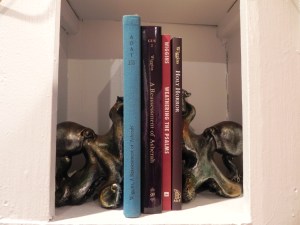
As I’m going through Nightmares rewriting and adding footnotes, I’m discovering more and more material that could be included.  As an editor myself I try hard to keep to assigned word counts, and the entire allotment could easily be taken up by bibliography alone.  I am very modest in my spending at conferences now—independent contractors have to be.  Nightmares will likely be my last academic book; I can’t afford to keep going like this.  I don’t plan to give up writing, of course, just academic publishing.  Both this book and Holy Horror were written for non-specialist readerships, to showcase my non-technical way of explaining things.  Both ended up with academic presses and are slated to be among those specialist tools that the beginning artisan covets but for which s/he has to budget.  And when this house is finished it will have an impressive, if most unusual, private library.


Mad Dog

Like those who write long books, those who write very many books ask for some level of commitment from their fans.  I’m sure I’m not alone in wishing I had more time to read.  I tend to be driven to Stephen King’s novels by the movies made around them, and there’s nothing wrong with that I suppose.  I decided I wanted to read Cujo some years back when I was on a werewolf kick.  I knew it wasn’t a werewolf story, yet as one who suffers from cynophobia even a large household pet will do.  I didn’t know the story in advance, and I had no idea how it ended.  It’s good to read novels like that sometimes.

I took it with me to San Diego and read most of it on the plane, finishing it somewhere over the mountain west.  It is a bleak story, one of King’s more drawn-out and wrenching tales.  It’s made more so by the fact that it could happen, at least in the main storyline.  Or could have happened.  Maybe I waited too long to read it, but I kept thinking as I was going through—today we have cell phones.  A large part of this story unfolds because of Donna Trenton’s inability to contact anyone while a rabid dog keeps her trapped in her car during a record-breaking heat wave in Maine.  I suspect it’s kind of a story about redemption, but I really need some time to think about it before rushing to such conclusions.  There’s not much you can really consider religious in this particular tale, and perhaps it’s because Cujo is a very natural kind of monster.

I saw my first rabid dog when I was maybe five.  My brothers and I reported a dog acting strange to our mother, after which she kept us in the house.  That wasn’t the origin, I don’t think, of my cynophobia.  Two of my brothers were bitten by a family dog when I was little, and I was once chased by a dog about as big as I was, certain that it was going to eat me.  At the same time, we had dogs as pets, and apart from the one that liked to bite, they never gave cause for fear.  Cujo tapped into those memories and made me reflect on what it means to befriend wolves.  It won’t be my favorite King novel, but it did help to pass the time from coast to coast.


Sister Monsters

Every once in a while you read an inspirational book.  I’m hoping readers will keep in mind that inspiration comes from different locations for some of us.  Monster, She Wrote: The Women Who Pioneered Horror and Speculative Fiction, by Lisa Kröger and Melanie R. Anderson, is a source of inspiration.  With the usual Quirk Books touches, this isn’t a tome heavy on literary criticism, but it is a wonderful compendium of brief bios on women who walk(ed) on the dark side.  I find books like this encouraging in a number of respects.  First of all, these are women who did what they loved and were recognized for it.  Secondly, it gives the rest of us some hope that getting through the establishment to actual publication isn’t as impossible as presses would have us believe.  And third, it’s also a lot of fun.

It isn’t often pointed out that women played a major role in the development of the horror genre.  Some of the earliest Gothic novels were by Ann Radcliffe and Margaret Cavendish.  Probably the first fully fledged horror novel was Frankenstein, by Mary Shelley.  The real learning kicks in when the other names come out—many women found, and continue to find, the genre compelling.  Most of them, like most of us, are lost to history, but many of them have been rediscovered.  Here again is cause for hope; those of us who write, I think, have our eyes set on the far distant future.  We’re inscribing our “Kilroy was here” on paper—I still can’t think of ebooks as actually existing—in hopes that those down the road might know us a little better.  The fact that some of our sisters have been found suggests that we too may be resurrected some day.

There’s no plot here, and the point isn’t to present some great discovery.  This is a book that encourages women to be who they are through example.  The fact that it involves monsters and horror is simply a bonus.  As a non-female reading this it struck me time and again that women have long been informed of what they should or could do by men.  Men don’t like to see women knowing as much as they do about the shadow side of human existence, even as they relegated them to the shadows.  It’s my hope that this book will inspire women to be themselves.  And if they want to invite monsters along, so much the better.


Frozen Streams

I was walking in Ithaca, with my feet not far from Sagan.  Winter had settled in prematurely, as it often does in upstate.  I was wearing a hoodie and old fleece combo and I suppose I looked a bit tatty.  My wife and daughter had gone to see Harriet, but movies about how badly people have mistreated others, strangely for a guy who watches horror, really depress me.  Ithaca, until recently, supported three independent bookstores, so I figured I could pass the time easily enough.  It was growing dark and breezy, and I visit bookstores only with a list, otherwise it’s too dangerous.  Autumn Leaves, a used vendor, I’ve visited many times.  Their religion section is disappointingly small, but I tend to find offerings in other areas when I blow in.

Buffalo Street Books is the last remaining indie that handles new books, but I stopped by The Bookery, now closing, on my way.  This was saddening.  Ithaca houses both the ivy league Cornell and the highly regarded Ithaca College.  I suspect many of the street sweepers hold doctorates.  Has book culture entirely bent the knee to Amazon?  At the end of the last millennium, Ithaca housed 25 independent bookstores.  Today it’s evident that Buffalo Street (formerly The Bookery II) struggles to keep its hold.  I feel ethically obligated to buy something there, to take one for the team.  I had a short list and the shelves in The Bookery had been nearly bare.  It was just too depressing to stay there.  I found an inside bench and sat to read until the movie was over.

Or so I thought.  I ventured back outside and now it was fully dark, being six p.m., and I wandered back to the familiar Ithaca Commons.  I went into a couple of shops, but they looked at me as if I were homeless.  (I suppose I was, in a sense.)  I haven’t had a haircut in a while, and my beard is scruffy and white.  My hoodie and fleece don’t speak to affluence.  I had unconcealed books—I routinely refuse bags—and I suppose I could come across as a touch eccentric.  (I don’t have enough money to be authentically eccentric.)  I wondered how street people do it.  Outside the east wind was decidedly sharp and windbreaks on the pedestrian zone are few.  I came to the monument to Martin Luther King Junior.  I was walking in Ithaca but I really felt that books could make that dream come true.


Dead Language

Tis the season for returning from the dead.  Goodreads is one of the few websites that I allow to send me notices.  I try to check them daily, and I even read their monthly updates of new books by authors I’ve read.  I was a bit surprised when November’s newsletter began with The Andromeda Evolution by Michael Crichton.  I really enjoyed The Andromeda Strain when I was in high school.  The fact that I was in high school four decades ago made me wonder about the robustness of Dr. Crichton, especially since I knew that he had died over a decade ago himself.  I don’t know about you, but the writing industry feels crowded enough without dead people keeping in the competition.  It’s like those professors who refuse to retire, but also refuse to teach or do research.  Some people, apparently, can never get enough.

We live in an era of extreme longevity.  In the scope of human history, people haven’t lived so long since before the flood.  Some of us—not a few, mind you—work in fields with limited job openings.  We are the sort who don’t really get the tech craze, intelligent Luddites who’d rather curl up in the corner with an actual book.  There are very few professorates available.  Even fewer editorships.  And anyone who’s tried to get an agent without being one of the former knows that there are far too many writers out there.  Now the dead keep cranking ‘em out.  I’ve got half-a-dozen unpublished novels sitting right here on my lap.  Crichton’s gone the way of all flesh, but with an active bank account.

The end result of this Novemberish turn of events is that I want to read The Andromeda Strain again.  I haven’t posted it to Goodreads since when I read it the internet itself wasn’t even a pipe dream, except perhaps in the teenage fantasies of some sci-fi fans.  Since you can’t rate a book twice on Goodreads, and because paper books don’t disappear when you upgrade your device, I can do it.  I can actually walk to the shelf and pull a vintage mass-market paperback off it.  Even if the Earth passes through the tail of some comet and all networks are down.  And I seem to recall that the original strain came from outer space.  As did the strange radiation that brought the ghouls back to life on The Night of the Living Dead.  Now if only some of the rest of us might get in on the action.


The New Light

Sometimes you meet kindred spirits in books.  Barbara Brown Taylor’s Learning to Walk in the Dark has been waiting patiently.  It’s one of those books that I suspected would meet me where I live, and regarding this I was correct.  Brown Taylor, a former Episcopal priest and professor of religion (both of which I attempted but failed to achieve), has the courage and insight to suggest that darkness might just be a friend.  The darker half of the year settled hard on me this year.  As its black wings gathered about me I reached for this book.  I’ve been struggling with a question I’m sometimes asked: why do I let my thoughts linger in what must be considered darker corners?  I watch horror and write books and stories about monsters.  What’s wrong with me anyway?

One accusation may be fairly leveled at much of American religion is that it is shallow.  Light is uncritically accepted as good and dark becomes somehow evil.  There are biblical prooftexts that can be used to “prove” this, but they change color when you wrestle with them.  Learning to Walk in the Dark contains many ways of reflecting on realities which are inevitable.  Brown Taylor visits museums that give the sighted the experience of being blind in a safe environment.  She spends time in caves.  She stretches out beneath the stars and contemplates the dark night of the soul as well as the cloud of unknowing.  These latter two are, of course, spiritual classics.  There’s quite a bit that can be learned from experiencing darkness and listening intently.

My own predilections toward subjects called “dark” are forms of therapy.  My religion simply can’t be shallow.  I need enough water to swim.  And yes, I’m afraid of deep water.  Darkness perhaps comes more naturally to those of us who are awake for every sunrise.  If I move far enough north that may cease to be the case, but for the last decade or so my internal alarm goes off a couple hours before the first sliver of light creeps over the eastern hills.  And I seem to have assimilated to it.  As I read Learning I could imagine the accusations flying from my former Nashotah House context.  Looking at that patriarchal theology of sin and misery, however, I think there’s no question whence true darkness comes.  Without the dark we could never tell that it was light.  Since we need both, it seems wise to follow the sage advice here offered and get to know the dusky side a bit more intimately.


Panic at the Bookstore

Usually it works like this.  I go into a used bookstore with a list of titles I’d like to find.  Yes, I know I can look them up on Amazon and pay some price gouger more than the book’s worth, but you sometimes find things forgotten on a shelf out of the reach of technology.  When I went into a used bookstore in the vicinity of Ithaca last month I didn’t have my list with me.  When I visit such a store, especially the first time, I don’t like to walk out empty-handed.  The word “Exorcism” on both the spine and cover of Ken Olson—excuse me, Dr. Ken Olson’s book on the subject, well, how could I not?  Exorcism: Fact or Fiction? is published by Thomas Nelson.  That immediately told me something of what the book would be like.  It wouldn’t be an academic treatment, and it would be somewhat evangelical.  Still, I didn’t have my list with me.

Olson hasn’t had an easy life.  His license to practice psychology was revoked after he performed an exorcism and my sympathies are always with those who have lost jobs.  Rejection is, after all, a form of violence.  The book, however, isn’t so much about exorcism as it is about evangelical views of it.  Written around the time of the satanic panic in the 1990s, the book takes seriously the claims of the alleged victims and also the physical existence of the non-corporeal Satan.  This actually leads to a few logical brick walls.  Referring to the body parts of non-physical beings can be an exercise in metaphor, but evangelicals tend to be literalists otherwise.  This discrepancy begs for discussion but receives none here.

The history of moral panics is interesting.  We live in the midst of them pretty much constantly now.  The internet doesn’t really help.  Moral panics are times when particular concerns spread rapidly (for which the web is ideal) without having any critical questions asked.  They often lead to a mob mentality that can victimize the innocent.  Although that’s clearly not his intent, Olson’s book tends to do this too.  If a victim is female, as is often the case, conservatives blame her for such things as abortions, forgetting, it seems, that a male was involved.  Since abortion scares are another example of a moral panic, it’s not surprising Olson treats them along with other forms of spiritual warfare.  Those who turn to the book looking for The Exorcist will be disappointed.  You might find a copy of that, however, at your local used bookstore.


After Easton

I’m still recovering.  The Easton Book Festival was a fine example of liminal time.  Ordinary time—the day-to-day, or “workaday” variety of time—may pay the bills but comes up short on meaning.  Literary time is rare and sacred.  No, there weren’t great crowds at my two sessions.  In fact, the crowds were modest.  More people showed up for my church presentation on Sunday morning than came to either of my more “secular” presentations.  The festival, however, wasn’t about numbers.  It was about the love of books.  Much of the time those of us who love reading are perceived as “Poindexters” who deny the excitement of a life spent in sports and adventure.  There’s no reason, however, that the two can’t get along.  After all, authors write about adventure and sports as well as religion and philosophy.

As Halloween nears and November encroaches on the days of trees losing their leaves, I reflect on how my entire October was leading up to this.  Half a year ago I was contacting libraries and bookstores about doing Holy Horror presentations in the autumn.  Only the Moravian Book Shop and the Easton Book Festival took me up on my proposal, but they allowed me, as my wife expressed it, “to put myself out there.”  To be part of the conversation.  People are busy, I know.  Still, I came away with the business cards of a few more successful writers, and I gave away a handful of bookmarks for my too-expensive tome.  I was after conversation, not fame.

Although I met the director of the festival a couple of times, I don’t know the results.  I do sincerely hope that another will be offered next year.  Gatherings of the bookish are dicey affairs.  I attended the banquet not knowing a soul, but left having learned of others nearby who practice the craft.  Many had made that transition from workaday to writer.  I learned that getting the pennies I do for my books is, really, an aberration of the academic publishing scheme.  Most academics have good paying university jobs and don’t really need the cash.  Book festivals are opportunities to learn, classrooms in everyday life.  I met authors of topics more obscure than my own who’d earned healthy advances.  This was liminal time indeed.  I feel honored to have been included among those feted for putting their words out there for reading and possible rejection.  Books are conversations, and in a world far too busy, book festivals are a source of truly significant discussions.  Long may they continue!


Rivers and Books

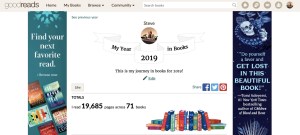
“You can’t” Heraclitus said, “step into the same river twice.”  The same also applies to reviewing books on Goodreads.  I met my official pledge of 60 books “officially” a couple weeks back, but I had re-read two books already reviewed during the course of the previous month, so I’m actually up to 65 at the moment.  Not that this is a contest.  Well, it sorta is.  But the one thing that keeps coming back to me is that my reviews of the same book change after a couple of years.  In general I’m not a re-reader.  There are lots of books I want to read for the first time, and there are few, historically, that I’ve gone back and read again.  Right now, however, I’m working on a couple of books that require some going back and checking facts.  Whenever you write “X does not” you need to make sure X doesn’t.

Reading is a self-rewarding enterprise.  I’ve not stopped reading when I don’t post about books, but I’ve been reading bigger books.  Despite my academic background and current job as an editor, I’m a slow reader.  I always have been.  I set my Goodreads goal based on the fact that without commuting I hope to read five books a month.  I have to throw in some short ones to make such a goal, and I never count the children’s books (I read The Lorax several times this year) and I can’t count the books I read for work that haven’t yet been published.  Nevertheless I keep making my Goodreads pledge—it gives me a goal I can attain—and in a life where meeting goals is becoming more difficult all the time, I appreciate those I enjoy reaching.  Enjoy reading.

Goodreads is a community.  Some of my friends there comment on my blog posts, which is really neat because almost nobody comments on my blog itself.  It’s nice to have that little extra extension.  I skim through the reviews that come to my email inbox every day.  I like to know what others are reading and I get tips for future goals from the books my Goodreads’ buddies post.  And now that November looms—and over its shoulder I can see December—I think of the Modern Mrs. Darcy’s reading challenge.  I generally meet that goal by about September.  Reading books is like meeting new friends.  And some of them, unlike Heraclitus’ river, you can meet twice.


Read a Book

A huge shout-out to Andrew Laties for conceiving and organizing the Easton Book Festival!  Easton may not be the largest city in the state, but the Lehigh Valley is Pennsylvania’s fastest growing area.  As we discovered when we moved here almost a year-and-a-half ago, it is a region that supports bookstores.  Even before the Festival we’d explored some six or seven and after moving from central New Jersey—where keeping a small shop or two open was a struggle.  We’ve become spoiled for choice.  Writers may not be the easiest people to herd—many of us are quiet and tend to live in our own heads quite a bit—but the festival has brought some 200 of us together, and we write on all kinds of things.

Although the panel on which I participated had religion as one of its themes, my wife and I noticed that at each session we attended religion was mentioned.  Either it was in an author’s background, or it figured into their writing, or most embarrassingly, it objected to and tried to silence them through censorship.  Although my book’s subtitled The Bible and Fear in Movies, it was evident that I wasn’t the only person who found the Bible’s effect on people scary.  And the theme continued into the evening as I attended the author’s banquet solo.  Many of the people I met had religion in their background or in their present motivations for writing, and not one of them was judgmental toward a guy like myself who’s trying to find his way.

The Easton Book Festival is in its first year.  Although by late afternoon the weather had deteriorated into the rain we can’t seem to shake around here, it was wonderful to see people walking around with festival booklets (there are enough events to warrant one) and not bothering to conceal and carry.  Books, that is.  For a moment, they were cool.  My second session is this afternoon.  As I learned both last weekend at my book signing and at sessions yesterday, a sell-out crowd is unlikely.  This is a free event and even authors who had more fingers than attendees were gracious and glad for the opportunity to explain what they were trying to do with their writing.  And they unstintingly shared what they’d learned with one another.  This was community, centered around books.  It was a small slice of what Heaven could be like, if we’d all just take an interest in each other.  Even if we’re shy and secretly would rather be home writing.


Book Festival

So it’s here.  The Easton Book Festival begins today.  The weather?  Partly sunny, temps in the mid-60s.  There’s no excuse not to go!  (Well, actually, there are plenty of reasons, but if you’re in the area please consider it!)  I have to admit that my involvement with it was opportunistic.  I contacted the organizer because I was looking to promote my autumnally themed book, Holy Horror, in the season for which it was written.  I understand delayed gratification.  What author isn’t delighted when her or his book arrives?  Thing is, mine came around Christmas time, and, while a wonderful gift, nobody was thinking about scary movies during the joyful winter season.  My observation is this: books are lenses to focus thoughts.  I enjoy Halloween, but I also enjoy Christmas.  One follows the other.  The Easton Book Festival just happens to be during the former rather than the latter.

It’s heeerrreee…

My own involvement with the festival doesn’t start until tomorrow.  Today’s a work day, after all.  Employers don’t give days off for self-promotion (or even for writing books) so festivals are extra-curricular activities.  I’ll be on a panel discussion tomorrow at the Sigal Museum and on Sunday afternoon I’ll be doing a presentation on my book, same venue.  Maybe I’ve got this backwards (nobody tells you these things), but I’m not doing this primarily to sell books.  I’m doing it to promote dialogue.  During my less-than-stellar book signing last week at the Morvarian Book Shop I had only one brief conversation of substance.  It was with a scientist who pointed out that science and religion had nothing to do with one another.  I guess my hopes for the events of the next two days are that folks might want to discuss the ideas in the book.  Or at least think about them.

Sunday morning I’ll be giving a church presentation on the book as well.  Being in the publishing biz I’ve learned the importance of authors getting out there to talk about their books.  Hands up, who’s read a McFarland catalogue lately?  Case in point.  The only problem with all of this is that I still have to get my weekend errands done.  My daily schedule doesn’t allow for trips to the grocery store or even putting gas in the car.  And no matter how much time I put into work, there’s always more to do.  Festivals, of course, are intended to be time set apart from regular pursuits.  So I’m going to put on respectable clothes and I’m going to speak about what’s on my mind this time of year.  If the Lehigh Valley’s in your orbit, I’d be glad to see you there.


Influential Brethren

Outsized ideas from under-recognized sources always captivate me.  I have to admit that my own childhood fascination concerning, and fear of, “the rapture” still haunts me.  While our house isn’t large, the other day I couldn’t see or hear my wife anywhere when I knew she was home and my first thought was that she’d been raptured and I’d been left behind.  Please don’t try to console me with logic; I know very well the problems with this initial assessment and knowing the history of the idea of the rapture can’t stop the primal fear when it strikes.  So it is with religious ideas inculcated in the young.  That’s why I knew I had to read Massimo Introvigne’s The Plymouth Brethren as soon as I heard of it.  The Plymouth Brethren, and specifically one of their formative leaders, John Nelson Darby, were the inventors of the rapture.

Introvigne’s book doesn’t trace rapture history (other books do that), but he does narrate, in an admirably succinct treatment, whence the Brethren arose.  In the nineteenth century in the British Isles, some were very concerned that Christianity had gone off the rails.  Accommodating with secular society, it had become heavily doctrinal and, worse, political.  Breakaway groups were common, including those who went back to the “Bible alone” as the basis for assessing what being Christian truly was.  The Plymouth Brethren developed in this atmosphere and they still remain a relatively small Christian sect (I use that term completely neutrally).  Even though they themselves splintered over time, they were never a very large group.  They, however, invented the rapture.

John Nelson Darby, one of the founders of the movement, believed history was divided into dispensations, or periods, predetermined by God.  The dispensation in which we now live (and in which they lived two centuries ago) would include a dramatic rapture that would allow Darby’s understanding of eschatology to fall within the system he developed.  This idea was picked up by Cyrus Scofield and included in his enormously influential Scofield Reference Bible.  That Bible, although many evangelicals considered the Plymouth Brethren as a kind of “cult,” was used as the unquestioned roadmap for the end times.  It was picked up by such promoters as Hal Lindsey and Timothy LaHaye and made into a meme that just about any educated person recognizes.  We all know what “the rapture” is, although the Bible itself doesn’t spell it out at all.  Introvigne’s book is very informative on the Brethren but his chapter on their ten main divisions is, necessarily, a touch confusing.  Well balanced and fair, this is a great source for those who wonder who these people were that gave us such worries when our wives have “disappeared” into some other part of the house.


Amityville Rehaunted

One of the problems with scarce resources is the desire not to squander any of them.  Time is so rare these days that I keep multiple writing projects going (and growing) and when they’re ripe I pluck them and take them to market.  One of my writing projects had me read Hans Holzer’s Murder in Amityville.  Why?  Fair question.  It was the “inspiration” behind Amityville II: The Possession.  I discuss this film in Nightmares with the Bible, and I’ve been going back and reading those period pieces from the 1970s that formed so much of our culture through the end of the last century.

In case you didn’t grow up with an interest in parapsychology, Hans Holzer was a pretty big name then.  I can assert that with some confidence because I grew up in a small town without access to big city resources (where fame is made) and I knew about him.  Holzer wrote well over 100 books, which might give you a hint regarding their quality.  He was an interesting person.  Like Ed and Lorraine Warren he made a living by investigating, writing, and lecturing.  (I can’t seem to break into that cycle—times have changed!)  A firm believer in ghosts and demons, Holzer was naturally drawn, like other moths around the candle, to Amityville.  Murder in Amityville is his summation of his investigation and all I can say is it’s a good thing he wasn’t a lawyer.  Apart from containing lengthy transcripts of Ronald DeFeo’s trial, the book also contains interviews conducted by Holzer.  Full of leading questions and lacking evidence, it fails to convince even a sympathetic reader.

Still, you’ve got to give Holzer credit for including interviews where his loaded questions get him nowhere.  In interviewing a town historian for Amityville, Holzer kept bringing up allegations about the house at 112 Ocean Avenue only to have the nonplussed historian tell him point blank that his (Holzer’s) allegations are incorrect.  His assertions of an “Indian burial ground” are taken for granted, although no historical records substantiate it.  His interview with DeFeo demonstrates Holzer’s irrepressible faith.  After being told by DeFeo that he’d heard no voices—something he made up for a failed insanity plea—Holzer keeps coming back to what the voices told him to do.  Not only that, when Holzer does stumble upon a good question he fails to follow up, chasing some other notion down another rabbit hole.  There was clearly enough material here to work into a horror movie, but for sorting out the troubled home life of the DeFeo family the critical reader finds her or himself being asked to take a lot on faith.


Thoughts on a Book Signing

I’m a small-town boy.  Having the opportunity to hold a book signing, even if nobody requested said signing at the event, in the oldest continuously operated bookstore in the country was an honor.  This is a prelude to the Easton Book Festival next weekend, in which I have two roles—part of a panel discussion and an individual presentation on Holy Horror.  Putting yourself out there when you’re a writer is important, even if nobody pays attention.  I thought quite a lot about it; horror movies are almost always successful, but do people like reading about them?  Well, some of us do, obviously, but the average viewer, probably not so much.  And then there’s the somewhat embarrassing juxtaposition of the Bible.  People know what it is, but don’t want to talk about it.

Two people stopped to chat at the signing desk.  One was an adjunct geology professor.  We discussed science and religion, which is something on which I used to teach classes.  He thought the book idea was interesting, but not enough to read it.  The Moravian Book Shop scheduled this on the evening of their sold out ghost tours.  Quite a few people came in for a Saturday night, mostly for the haunted Bethlehem walks.  The second conversation was with a ghost tourist who thought the book idea was unusual.  It is.  I admit it.  As I say in the book itself, “If you see something, say something.”  So it was with me, with Bibles in movies.  The bookstore did a nice display, but then, I have an awareness of the smallness of my impact.  No surprises here.

The thing that really struck me was just how many people avoid looking at you when you’re behind a table with your books.  I know I’ve done the same thing.  I’ve gone into bookstores when an event was going on, not knowing about it and having no interest whatsoever in the book being presented.  That’s the way these things go.  I wasn’t doing this to make sales.  McFarland isn’t the kind of publisher you use to make money.  For me it was all about the experience.  It was like seeing my name outside a church in Manhattan.  It doesn’t do anything for you materially, but at least you can say you had it happened to you once.  The signing was advertised in the local paper, and on its website.  Maybe someone out there took a glimpse and saw something that sparked their curiosity.  It doesn’t matter if they buy the book.  As a teacher at heart, it is simply the interest that I’m hoping to raise.


Fly Away

Humans can be quite likable, but we have some nasty traits.  One is that we tend to think of ourselves as the only intelligent beings on the planet.  The funny thing about evolution is that it gave us both big brains and opposable thumbs—a winning combination to destroy the planet.  (Just look at Washington, DC and try to disagree.)  Jennifer Ackerman’s The Genius of Birds is poignant in this context.  Page after page of nearly unbelievable displays of intelligence among birds demonstrates that we are hardly alone on the smarts scale.  Birds make and use tools, have better memories than most of us do, and can solve problems that I even have trouble following.  We tend to take birds for granted because they seem to flit everywhere, but the book ends soberly by noting how global warming is driving many species to extinction.

Homo sapiens (I’ll leave out the questionable and redundant second sapiens) like to think we’ve got it all figured out.  We tend to forget that we too evolved for our environment—we adapt well, which has allowed us to change our environment and adapt to it (again, opposable thumbs).  Many scientists therefore conclude that we are the most intelligent beings in existence.  Ironically they make such assertions when it’s clear that other species can perceive things we can’t.  Ackerman’s chapter on migration states what we well know—migrating birds can sense the earth’s magnetic field, something beyond the ability of humans.  We lack the correct organ or bulb or lobe to pick up that signal.  And yet we think we can rule out other forms of intelligence when we don’t even know all the forms of possible sensory input.  We could learn a lot from looking at birds, including a little humility.

The Genius of Birds explores several different kinds of intelligence.  What becomes clear is that birds, like people, have minds.  Like human beings they come on a scale of intellectual ability that doesn’t suggest only one kind is necessary.  For our large brains we can’t seem to get it through our thick skulls that we need biodiversity.  We need other species to fill other niches and our own remarkable ability to thrive has only been because we are part of a tremendous, interconnected net encompassing all of life.  Other species have contributed to our evolution as we clearly do to theirs.  When we end up thinking that we alone are smart and our own prosperity alone matters we are sawing away at the branch on which we sit.  Further up the birds look at us and wonder if we really know what we’re doing.