Trolls and Tolls

Fall creeps up on me every year.  I like to have an array of seasonal books to read so that when it arrives I’ll be ready.  With house repair costs this year I’ve had to curtail book buying.  That, and most of the titles on my to-read list are used books that seem to have become extortionately expensive since the 1970s.  In any case Cherie Priest’s The Toll stood face out on the shelves of Buffalo Street Books in Ithaca and it caught my attention.  Set in the Okefenokee Swamp in Georgia, this unsettling novel brings the reader into the liminal space of the dying small town.  There’s a bit of magic in Staywater, although everyone who lives there knows it hasn’t got long before it goes altogether.  And every thirteen years a monster comes.

Priest knows not to describe the nameless creature too clearly.  The monster seen in broad daylight can quickly lose its patina of fear.  This is some kind of supernatural swamp beast and everyone local seems to know it’s picking them off.  The outside authorities, however, pay no attention to small towns that have “nothing to offer” to the greater economy.  That aspect resonated with me as the erstwhile denizen of a community of less than a thousand.  I watched the dissolving of my adoptive hometown as the tax-base shrank to the point that they could no longer afford to pave the streets and decided to go back to gravel.  Once the oil refinery—what gave the town “value”—closed, outside interest disappeared.  Ah, but I digress from fiction.

The Tool is a moody novel that doesn’t take itself too seriously.  There’s backstory here that remains untold.  Two of the protagonists are elderly female cousins who are comfortable with the spiritual world.  They are the past saviors of this little town in the swamp.  The other characters have all come to an uneasy peace with their periodic tormentor and they have nowhere else to go.  When the monster strikes against unwary outsiders the locals don’t welcome outside attention.  Those acquainted with small communities know that’s what life is like.  Attention brings cash, but often unwelcome change as well.  One of the more haunting aspects of this novel is the number of threads left dangling in the wind.  Not everything is resolved, and life goes on much as it always has, without or without the monster.  A moody read, this ghost story has, it is clear, a deeper message.


Digital First

Publishers these days are all yammering about being “digital first.”  Now, I use technology when I write these days, despite the fact that I am coerced to shut down programs at 3:30 a.m., my writing time, because tech companies assume people are asleep then and that’s when upgrades happen.  Still, even as an author of the modest academic sort I know the unequalled thrill of seeing that first printed copy of my book.  Authors live for that moment.  It’s our opiate.  Publishers don’t understand that.  Five years back or so I had a novel accepted for publication.  (It never happened, but that’s a long story.)  At one point the publisher changed its mind—post-contract!—and decided that my story would be only an ebook.  They tried to make me feel better by saying they thought it would do well in that format.

Who wants to hold up a plastic device and say “Look what I wrote!”?  It makes about as much sense as smoking a plastic device.  No, writing is intended to lead to physical results.  Even those of us who blog secretly hope that someday someone will say, “Hey, I want to publish your random thoughts as a book.”  As long as it’ll be print, where do I sign?  In some fields of human endeavor there are no physical signs that a difference has been made.  Is it mere coincidence that those who work in such fields also often write books?  I suspect not.  Writing is a form of self-expression and when it’s done you want to have something to show for it.  All of that work actually led to something!

Since I work in publishing I realize that it’s a business.  And I understand that businesses exist to be profitable.  I also know that technology sits in the driver’s seat.  Decisions about the shape of the future are made by those who hold devices in higher regard than many of us do.  I’m just as glad as most for the convenience of getting necessary stuff done online.  What I wonder is why it has to be only online.  The other day I went looking for a CD—it’s been years since I bought one.  At Barnes and Noble about all they had was vinyl.  I’m cool with records, but my player died eons ago.  I had to locate a store still dedicated to selling music that wasn’t just streamed or LP.  That gooey soft spot in the middle between precomputer and 0s and 1s raining from the invisible cloud.  I went home and picked up a book.  Life, for a moment, felt more real.


Weird Publishing

It’s a weird world.  Publishing, I mean.  In the early days of shock and angst after Nashotah House, when it had become clear that UWOsh—the University of Wisconsin, Oshkosh—wasn’t going to hire me full-time after a full-time year there, I considered that classic fall-back of the academic—publishing.  I wasn’t exactly clear on what an editor did in those days, but I was pretty sure I could learn.  Gorgias Press hired me and after just over two years, downsized.  I’d been in publishing long enough at that point to have learned about Transaction Publishers.  Housed on the Livingston campus of Rutgers University, where I’d been teaching for a few years at this point, Transaction had been founded by the sociologist Irving Horowitz.  Now that Gorgias was out of the picture, I contacted Transaction out of the blue and landed an interview with Horowitz himself.  Although he was most cordial, it didn’t lead to a job offer.

Eventually I was recruited by Routledge.  I was about to learn the nature of publishing in a whole new way.  Early in my time in the Taylor & Francis group (they had a letter signed by Walt Whitman in one of the board rooms) I learned that presses grow by acquiring other presses.  I suggested Transaction, only to be told it was too small of a “concern;” Taylor & Francis preferred larger fish.  When Routledge downsized I found myself again applying to Transaction.  Irving Horowitz had passed away by this point and before I could make an appeal, I was hired by my current employer.  There I have been ever since.

The other day I had cause to look up Transaction.  It was with some surprise that I learned they had been acquired by Taylor & Francis and merged with Routledge.  I’m sure that my suggestion of that acquisition had nothing to do with it, but I pondered what would’ve happened had I been hired by Transaction after Routledge cut me loose.  A few years later I would’ve found myself working for Routledge again.  And likely I would have found history repeating itself.  Publishing is a fairly small industry.  Books are a low-margin commodity (it pains me to type those words, but that’s the way the business world sees them).  Not too many people are interested in a company that has to sell lots of a specialty item in order to make them profitable.  Consumers tend not to buy books in bulk.  My time in publishing has been about connections.  And some of those connections are just plain weird.


Fall Festivals

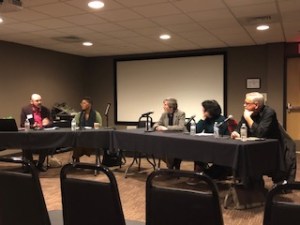
Now that it’s October, it’s officially okay to be scared.  Determined to fight my fright of hubris, I make brave to mention that I have two appearances scheduled for the first ever Easton Book Festival, coming up from the 25th to the 27th.  The Festival has turned into quite an event, with some 200 writers taking part.  I got involved by being in the right place at the right time, for a change.  Authors are being brought in from as far as New York City, Vermont, and Massachusetts.  I know from experience that even Manhattan is a trek.  I contacted the organizers back in the summer since I have an autumn book that came out in late December last year.  For the festival I’ll be involved in a panel discussion “Poets as Prophets—Merging Art and Religion” on Saturday, and a presentation on Holy Horror on Sunday.

Like many people who write, I’m shy and not naturally good at promoting myself.  The other day while out for a walk my wife and I were run by by a group of shirtless high school guys, presumably on the track team.  It felt like the gallimimus scene from Jurassic Park—we’re smaller folks, and these confident, athletic sorts were not.  It felt like an object lesson to me.  Some of us are born with genetic dispositions to grow large and to feel confident.  Others not so much.  When we watched the caber toss at Celtic Fest last weekend, the contestants were all well over six feet tall, which I suppose makes sense if a caber is in the cards for you.  As they showboated for the crowd, I knew a small display with my book was just up the hill in the Moravian Book Shop.  Like me, in the shadows of the shelf above.

Perhaps my only regret about the Easton Book Festival is that I don’t have a fictional novel to present.  Well, I do, but it isn’t published.  Lately I’ve been exploring that wall of separation between fiction and non.  In the kinds of books I read in the fall, the wall is more of a hurricane fence.  And it’s only about waist high at that.  Holy Horror isn’t an academic book, it just plays one on the market.  If it were a standard academic title I wouldn’t have put it forward for the Easton Book Festival; people come to such events to be entertained as well as to learn.  This one will encompass pretty much all of downtown Easton for the weekend.  And that weekend is just before Halloween, when the wall between worlds is especially thin.


Flipping

The mind-blowing book I mentioned last week is here unveiled.  I discovered Jeffrey Kripal’s work years ago, and have subsequently had a few conversations with him.  The Flip: Epiphanies of Mind and the Future of Knowledge is a challenging and necessary book.  In a way that only full-time academics can, Kripal examines the large picture.  When I say “large” I mean cosmic in scale.  He does so through the lens of the humanities and, especially, religious studies.  If anybody’s going to make religious studies cool, it is he.  The world is full of weird things.  If we’re honest most of us will admit to having had strange things happen to us.  Often we’ll filter them out or explain them away, but at other times we will stop, scratch our heads, and wonder what just went on.

The Flip is not a book of such anecdotes (and I, along with the author, am willing to take anecdotes seriously).  There is some strange stuff in here, but there is also a lot of science.  Historically the humanities, as understood by ancient Romans, included what we would call sciences.  Humanities, in other words, were attempts at understanding the world.  Today religious studies is among the humanities while science is separated out into STEM.  Kripal takes science seriously.  In fact, much of what he discusses here is the application of quantum physics to the macroscopic.  (I’m probably not explaining this well, but then, I guess you’ll have to read the book!)  In other words, science and the humanities need to come together again.  It’s not either/or, but both/and.

Holding out a hand across the aisle is uncomfortable.  Religion has done a great deal to disgrace itself of late, and it’s no wonder respectable folk want to keep their distance.  To understand what we are, however, requires a willingness to admit that humans are both deeply intellectually curious and deeply religiously inclined.  We can be both.  In fact, it is unlikely we can be any other way.  Anomalous occurrences aren’t generally welcome in religious studies any more than they are in the sciences.  That doesn’t stop strange stuff from happening.  This little book of big ideas uses that disjunction to lead the reader into spaces where the future might faintly be discerned.  Wide-ranging and provocative, this book needs to be read.  It is a strange world where two different approaches to knowledge so often decline to speak to one another.  Here they do, and their conversation is mind-blowing.


Grasses and Bans

It’s been so busy that I didn’t realize it was Banned Books Week until yesterday, when there was but one day left (today).  I usually make a point of reading a banned book during this week, but I suppose I read so many of them normally that the observance might lose its edge.  But that’s just an excuse—in this world of uber-corrupt governments, preventing censorship is a sacrament.  We’ve seen just this week how dictators try to silence those who expose them.  Banned books, whether we like what they say or not, should be available for reading.  This is an amazingly bipartisan holiday.  Some places have banned the Bible, to which true believers in the principles of Banned Books Week would respond “Even books we might disagree with should be made available.”  Censorship seeks to cut off discussion.

Although I won’t finish in time, after work yesterday I quickly grabbed my unread copy of Walt Whitman’s Leaves of Grass to begin to make up for my oversight.  Leaves of Grass has been called America’s homegrown Bible and it has an almost religious following, as it has for decades now.  Poetry has a way of moving people that frightens autocrats.  It taps into something that skirts around our conscious mind at times, opening up possibilities that censors would rather keep closed.  Over the past couple of years books of poetry have again begun to appear on the New York Times Bestseller list.  People read to be moved.

One element banned books tend to have in common is that they’re honest, even when they’re fiction.  Honesty is a source of great anxiety for many.  We don’t like to let our true selves be seen because, truth be told, we feel vulnerable.  Banned books take us into uncomfortable places.  And sublime places.  Not all books are great literature, of course.  Even I have been known to part with a book after reading it because it simply didn’t speak to me in the way I like to be spoken to.  Still, I’m loath to give such a book a negative review.  It didn’t speak to me, but it spoke to the author and the publisher, obviously.  It is a voice that deserves to be heard.  That’s what Banned Books Week is all about—defending the right of human expression.  I may not finish my banned book by the end of today since weekends tend to be busier than many work days.  Still, I’m looking forward to my encounter with America’s other Bible.


Book Signing

Okay, so I’ve got a book signing for Holy Horror coming up at the Moravian Book Shop in Bethlehem.  And they’ve advertised it in the local paper.  I’m humbled and honored by this, especially since I have no local following.  When I go to the website of the newspaper, The Morning Call, ads pop up on the top, bottom, and center of the page, obscuring the event.  I take this as kind of symbolic.  Life is crowded.  We seem to have turned the corner to autumn around here with nights being distinctly chilly.   After the languorous heat of summer when even thinking about winterizing seemed to add another layer of insulation over already too warm body, now we suddenly have to try to fit it in among an already crowded schedule.  At least I don’t have to commute too much any more.

I’m trying to get ready for the book signing, but I don’t really know what to do.  Perhaps I should try to get some business cards printed up.  Maybe I should think of some catch-phrase to use if anyone actually buys a high-priced book.  What should I wear?  Working at home can make you feel like a recluse sometimes.  I don’t have enough money to be considered eccentric, but I don’t get out among hoi polloi much either.  If most people have as much trouble as I do clicking off the ads to get to the event underneath, those who swing by the table are likely to be few.  Still, I’m looking forward to meeting local horror film fans.  They are, in general, a surprisingly cordial bunch.

After Nightmares with the Bible I’m going to focus on trying to find more mainstream publishers.  The reason is simple: academic publishers tend to be overpriced.  I’ve worked in publishing long enough to be able to decode pricing schemes.  There is a logic to them, even if at times it feels like you’re being overshadowed by pop-up windows.  To get a wide readership you need a pretty big platform, and getting a following on any form of social media takes the one thing I don’t have enough of.  Time.  You see, just the other day it was summer and we felt like we were baking.  Now the equinox has plunged us into the days of getting the furnace cleaned and operational and looking at the prices of insulation and shaking our heads.  Somewhere under all of these pop-ups are ideas waiting to be written down.


Time To Meet

I feel compelled to state up front that this wasn’t the mind-blowing book I was writing about in yesterday’s post.  One of the perks of working in publishing is the occasional offer of a free book.  (It’s not as generous as you might think, so when one is offered I always say “thank you.”)  The Surprising Science of Meetings, by Steven G. Regelberg, isn’t exactly “mind-blowing.”  The realization that some people make a living studying meetings was certainly, well, surprising, but the corporate world is all about returns on investments and boring stuff like that.  We all hear of companies that value innovative and exciting ideas, but most of us know the feeling of being desk drones parked behind a soulless monitor all day.  At least I’m no longer confined to a cubicle.

The academic world I once knew was the stimulating environment of learning for its own sake.  The academy has followed the business world to its own form of perdition and as Rogelberg points out, there are millions of meetings any given day.  Many of them are poorly run.  This book is for those who want meetings to flow more effectively, to better the bottom line.  Still, I found the chapter on servant leadership particularly hopeful.  I couldn’t help but wonder if Rogelberg was aware that servant leadership was something that developed in the church, out of the effort to imitate the way Jesus was said to have led his flock of disciples.  The point was not to aggrandize himself (this is a chapter 45 and his ilk should read) but to help others to be their best.  This is the kind of leadership—rare, to be sure—that the church has always, at least vocally, promoted.

It didn’t take long for ecclesiastical organizations to start running like businesses, however.  The bishop became a boss rather than someone who reluctantly had the crozier forced into his (or her) hand.  I’ve always believed you should have to take a pay cut to become a bishop.  That would immediately weed out most of the climbers.  In fact, if servant leadership is really the ideal, and the good of the company is really the goal, pay cuts should be expected as you climb the corporate ladder.  Can you imagine a business world where workers were well compensated, and those who really had vision sought promotion because their motivation wasn’t their own bottom line?  It’s an intriguing idea, to be sure.  I’d like ponder it more, but I’ve got a meeting to get to.


Book Magic

Something happens to you on a long bus ride, reading a mind-blowing book.  Part of the transport—literally—is that you’re captive for an hour or two and your book is your boon companion among snoring strangers.  Another aspect is the earliness of the hour.  Days like yesterday, when I have to commute to New York, involve awaking at 2:30 a.m.  The day is cast very differently when your timing shifts back by a few hours.  It’s almost mystical.  The largest portion of the transformative experience, however, is the book itself.  I’ve begun commutes with a book that I quickly realize is a mistake, but since I’m not a quitter, I soldier through it to the end anyway.  On yesterday’s commute the book was one of those that caught my imagination and flew it like a kite from the rear of the bus.  Arriving in Manhattan before six a.m. added to the feeling.  The city’s a very different place that time of day.

Not everyone enjoys reading, I realize.  My late stepfather once had a job as an elevator man.  Not the kind dressed in livery at a big-city hotel, but as an operator in an antiquated building in Oil City, Pennsylvania, where you had to pull the metal gateway  physically across the door and wait until the floor leveled before opening it again.  I didn’t get along with my stepfather, but one day I went to visit him in the elevator.  It wasn’t a busy building.  He sat on a stool, staring straight ahead.  For hours at a time.  Not a man prone to meditation, I knew he had to be bored.  I asked if I could bring him something to read, at least.  He declined for fear of missing someone’s call signal.  It was one of the most frightening scenarios I could imagine.

The clock in the Port Authority read 5:49 when we pulled in.  The day seemed full of possibilities.  I caught the 4:30 home, but the magic was gone.  The book had moved on to more technical things.  Traffic was bad, and there’s a world of difference between reading while the bus moves and trying to do so when it’s caught in traffic.  The commute out of New York City is normally a nightmare, and yesterday traffic didn’t flow freely until we were nearly through New Jersey.  My book was still my companion, but rather more like when a conversation ebbs after an intense discussion.  There was the worry of getting home, taking out the garbage, and trying to stay awake until a reasonable hour.  The book would still be there tomorrow, but I wouldn’t be the same.


Ambling through Amityville

I may be a week too late for Friday the 13th, but I just finished rereading The Amityville Horror.  One of my current projects required my paying close attention to what was and was not claimed, and although it doesn’t count towards my Goodreads goal, I just had to do it.  I noticed, as also occurred to me when rereading Gerald Brittle’s The Demonologist earlier, that the second time through raises more questions than the first.  The book has been demoted from nonfiction to novel over the years, but it seems pretty clear that Jay Anson believed it to be based on actual events.  He could’ve been wrong, of course, but with a long list of documentary writing credits to his name one does have to wonder.  Anson died just a year after the film came out.

When the movie was released I was still in high school and what everyone was saying about how scary it was kept me out of theaters.  (That, and lack of funds.)  It’s hard to imagine now, but there weren’t even VHS options in those days, especially for those of humble circumstances.  As a result, I was well into adulthood before I saw the cinematic version.  Reading the book, however, is an attempt to pry open the question of what might’ve happened at one of the most famous “haunted houses” this side of the Atlantic.  I’d just read a headline that the house had been sold again, and such was the impact of this story that a simple property transaction is now considered news in some circles.

Controversy permeates this tale.  I suspect that’s because it made a lot of money.  The search for the truth is often compromised by lucre—just look at the White House and try to disagree.  The usual rendering is that the Lutz family, in financial trouble, concocted a story that would bring in big bucks.  Such accusations came, of course, once the story did indeed prove valuable.  The second highest grossing film of 1979, The Amityville Horror held records for the highest grossing independent film for a decade.  Add to that the estimated book sales of 10 million copies and you have a nice retirement account laid up.  Those levels of remuneration are enough to corrupt any narrative.  Still, it’s clear that many people wonder what really went on at the house on Ocean Avenue.  I sat down with the book again and I have to admit that I’m no wiser on the question for having read it again.


Pay Per View

One of the things editors can teach academics is that the latter should pay more attention.  Especially to the world of publishing.  An erstwhile academic, I learned to go about research and publication in the traditional way: come up with an idea that nobody else has noticed or thought of, and write about it.  It is “publishing for the sake of knowledge.”  (Yes, that is Gorgias Press’s slogan, and yes, it is one of my hooks—marketing, anyone?)  The idea behind this is that knowledge is worth knowing for its own sake.  Researchers of all kinds notice details of immense variety and there’s always room for more books.  Or at least there used to be.  The world of publishing on which academics rely, however, is rapidly transforming.  Money changes everything.

The world has too many problems (many of them generated by our own species) to pay too much attention to academics.  Universities, now following “business models” crank out more doctorates than there are jobs for employing said wannabe profs, and those who get jobs pay scant attention to knock-on changes in the publishing world.  Just the other day I was reading about “pay per use” schemes for academic writing that, unsurprisingly, came up with the fact that most academic books and articles lose money.  If someone has to pay to read your research, will they do it?  Especially if that research is on a topic that has no obvious connection with the mess we’re busy making of this world?  Probably not.  Publishing for the sake of knowledge is fast becoming a dusty artifact in the museum of quaint ideas.

For those still in the academic sector that means that research projects now have to be selected with an economic element in mind.  “Would anyone pay for this?” has to be one of the questions asked early on.  The question has to be answered honestly, which requires getting out from beyond the blinders of being part of the privileged class of those who are paid to think original thoughts.  Academia has followed the money.  A capitalistic system makes this inevitable.  How can you do business with an institution that doesn’t play by your accounting rules?  And academic publishers, which have difficulty turning a profit due to low sales volume, are bound to play along.  This situation will change how we seek knowledge.  More’s the pity since some of the things most interesting about the world are those that nobody would think to pay to view.


Fearing Hubris

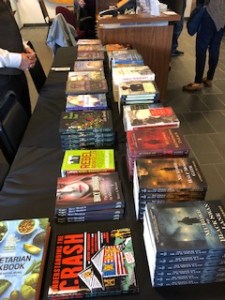
I’m afraid of hubris.  You see, my academic career was not exactly distinguished, and as an editor you’re encouraged to keep to the background.  Still, when you write a book you need to promote it a little, which is one of the things I learned as an editor.  I was equally parts embarrassed and pleased to see the bookstore display for my upcoming book signing in Bethlehem.  I mean, although I wrote Holy Horror for a general readership, the publisher tends more toward academic books and their pricing, so this is not an inexpensive purchase.  Those who write are nothing, however, without readers.  Those chosen for interviews are writers who’ve made a sales impact or who have a university behind them.  When it’s just me, it feels like maybe I’m trying to ascend Olympus on my own initiative.

I was in the Moravian Book Shop to purchase Neal Stephenson’s Fall; or, Dodge in Hell.  I’ve fallen a bit behind on Neal’s work, largely because Goodreads challenges are measured in numbers of tomes read.  I was pondering this, book in hand, when I noticed—there I was with my own display.  You see, Holy Horror was meant as a guilty pleasure read for those of us who like the scary time of year.  The book price is the scariest part about it, however.  I feel a profound gratitude when anyone actually buys it.  Since there are now copies available on sites such as eBay, I’m guessing some who’ve read it want to recoup a little of the cash outlaid.  While all of this is happening, however, I know that I have to learn the art of book promoting.  Still, it feels like that self-promoting I was warned against as a kid, an unseemly thing.

Writing is a form of conversation.  When I’m in a room with a bunch of other people unless I’m the teacher I have trouble making myself heard.  I’m soft-spoken by nature.  I suppose it’s obvious, then, why a book signing feels hubristic.  Perhaps it’s appropriate for a book about fear to engender this sense of discomfort.  Entering the conversation has always been difficult for me.  At the same time, as the beneficiary of so many books, I feel compelled to give something back.  My insights, if such there be, won’t rock the world.  As I think of myself signing books, I wonder what I could possibly say to someone who’s willing to pay that price for something I produced.  If you’re going to try to climb that mountain, you’d better think about what you’ll say when you meet the gods at the summit.


Paradoxical Psychology

In college I took enough psychology courses that I could have minored in it, had I simply declared it.  Focused on ministry at the time, this declaration never happened.  My own psychological issues (who doesn’t have them?) show up, I suspect, to those skilled at spotting such things, and friends sometimes suggest books I might enjoy reading.  As a result I recently finished Paradox and Counter-Paradox by Mara Selvini Palazzoli, Luigi Boscolo, Gianfrancro Cecchin, and Guiliana Prata.  Attempting to summarize the study would necessarily over-simplify what is clearly a very complex topic—what used to be called schizophrenia—but the basic idea can be explained.  These psychoanalysts worked as a team to help patients with (since it was the 1970s) schizophrenia.  Realizing that the basic mental processes are developed within a family, their practice used group therapy to treat families rather than singling out the “sick individual.”  This book is an account of the methods they used.

Seeing schizophrenia as a family issue rather than an individual one, the therapists saw the identified patient as often a child trying to keep family expectations in order.  The psychoanalyst team called this a “game” played by families seeking homeostasis—the perceived state of balance between members to assure that things stay the same.  The psychotic member enables this to happen and families, as recounted in some of the cases, clearly try to manipulate the situation to keep this strange and awkward balance.  The doctors used paradoxical (thus the title) scenarios to treat such families and reported a good rate of success.  The focal point of their work was often not on the “sick” member, but on the group dynamics which led to the sickness.

The idea is a fascinating one.  We are all members of families (with some exceptions), and the way our group functions is, for the most part, acceptable.  Dysfunction, however, sometimes leads to psychosis, which, according to these authors, is a state of affairs best treated on a family scale.  While it may be easy for me (having grown up in a clearly dysfunctional family) to see this, I sometimes wonder at how widespread mental issues really are.  Our species lives a highly unnatural existence for evolved beings.  Our work together in family units often leads to conflicts, overt and subtle.  Children—often the identified patients here—can see such things much more clearly than we frequently suppose.  Afraid of the consequences, they learn to play the game to keep the situation stable, if untenable.  There’s great insight here, even if the book is a touch outdated; our learning about the human mind is never-ending and it makes perfect sense to pay attention to the context when wondering about the results. 


Book and Bell

The Bell Witch: An American Haunting, by Brent Monahan, is a book I’ve read before.  The subtitle was used for a cinematic version.  I discovered the book, however, through what might be considered a chance encounter with the author.  He was teaching a course on offering distance education courses at Rutgers University, and, as an adjunct teaching over eight classes per year, I’d been selected for the distance education program.  (As life goes, of course, I was hired by Routledge for a full-time job before I could actually deliver the course.)  By a strange irony, I had watched An American Haunting just the weekend before the course, and I had no idea who would be teaching it.  Neurotically punctual, I was the first one there for the class, and as Dr. Monahan and I talked, I knew I’d need to read the book.  I posted on it back when I did, but this time I decided to pay better attention than one can on a bus.

Of course, when you watch the movie first, which I had, you know “the reveal” well before it comes late in the novel.  In case you’ve done neither, I won’t give it away.  The tale is based on an historical haunting, attested in sources from near the period.  And it is a strange kind of possession story.  The “witch” is actually a demon conjured by a trauma, and although book wraps things up nicely, it leaves a few questions at the end.  I suppose that’s appropriate for a scary book.  One of my current projects involves tracing the accounts behind fictionalized narratives to their originals.  The Bell Witch was well researched, and is a good example of how the line between fiction and fact can be effectively blurred.

The Bell Witch legend is credited with influencing several horror films, including The Blair Witch Project and others which tellingly have “Bell Witch” in their titles.  The story has a fairly incredible longevity, given that it was a localized legend from early in the nineteenth century.  Monahan’s novel is written as a “confession” from the schoolmaster, and historical personage Richard R. P. Powell.  This blurring of the lines makes for the kind of ambiguity that gives horror its particular ability to stand between fact and fiction.  The early versions of the lore, combined with elements intended to offer verisimilitude, leave plenty of queries at the end.  So much so that I’ve occasionally contacted the author for clarification.  What really happened?  It depends which side of the line you prefer.


The New Purple

Those of us who grew up Evangelical hold an unusual place among our liberal peers.  We’re often able to peer around, over, and under that wall that has been built between those who want a faith-based nation and those who want a free one.  Angela Denker is a fellow traveler on this road, and her book Red State Christians: Understanding the Voters Who Elected Donald Trump is a useful roadmap.  Some of us fall further from the tree than others, but one of Evangelicalism’s more endearing traits, when taken seriously, is the love of those who are different from you.  That love is often forgotten in the political rhetoric daily whipped into a froth by an unstable president being used by his party to install agendas that hardly fit the moniker “Christian.”  That’s why books like this are so important.

I confess that reading studies such as this make me uncomfortable.  Uncomfortable because my Evangelical past haunts me worse than any ghost, but also because Denker is clearly right that basic humanity is being left in the garbage as battle lines are drawn up in what could be a great, diverse nation if a leader were determined to work for unity.  I recently wrote about lunar landings.  Kennedy was a Catholic who had to work to bring a nation together around a common goal.  Instead of tearing the country apart for his personal aggrandizement, he pointed to the moon.  Sure, there was a xenophobia concerning the Soviet Union, but at least in this pocket of the world there was a sense that we should work together.  When religion entered politics with Richard Nixon and his followers, a deep rift opened up.  The two topics you were never to discuss—religion and politics—were now in the same bed.

Red State Christians is an extended road trip on which Denker interviews people who largely fall under the Evangelical umbrella.  Some of them are Catholic.  Some of them are Hispanic.  Some of them are less concerned with social issues, but are hard-working laborers often overlooked by the Democratic Party.  The resulting pastiche is one in which Americans are cast not in sharp relief, but rather with the hazy edges that are a far more accurate way of understanding human beings.  Many, it becomes clear, elected Trump out of fear, or out of fear of his opponent.  These aren’t bad people, but they are people afraid.  This wasn’t an easy book to read, but it is an important one.  And those who want to work for a future that might include realms beyond the moon might find this work a small step in the right direction.