Good Monster

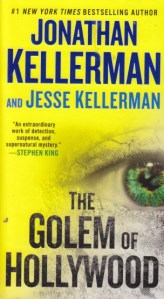
The little free library is a great idea.  Just after our move last year we contributed to our local many times as we discovered duplicates in the process of packing.  On one such venture, I discovered a book I wanted to read.  Not that I’d heard of it before, but any book with “golem” in the title catches my eye.  For the first (and so far only) time, I took a book.  Jonathan and Jesse Kellerman’s The Golem of Hollywood proved a fairly quick read for being over 600 pages.  I believe the industry term is “potboiler,” but it’s also a page-turner.  Nevertheless, it made me think.  The story follows a hard-bitten Jewish detective in Los Angeles.  Struggling with personal issues, he gets assigned to a bizarre homicide case that eventually takes him to Prague and Oxford, and then back to LA to clinch it.  And the killer is a golem.  (That’s not a spoiler, since it’s right there in the title.)

Parallel to the modern-day crime drama is the retelling of the biblical tale of the first days of humanity outside the Garden of Eden.  One of Adam and Eve’s daughters is headstrong and beautiful and when the tragedy between her brothers plays out she eventually takes her revenge on Cain.  Although not explicit about it, for violating the mark of Cain she witnesses the horrors that people will visit upon one another and her redemption is to become the soul that animates the golem of Prague.  Not your garden variety golem, she can transform into different shapes, and she stays loyal to the family of Rabbi Judah Loew ben Bezalel, the legendary first creator of the golem of Prague.

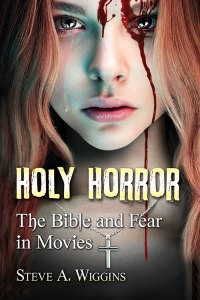
One of the frequent topics raised on this blog is how the Bible appears in everyday life, often unnoticed.  This novel is an example of that.  A further point, which is what stands behind my book Holy Horror, is that the Good Book is understood as mediated by popular culture.  Even those few biblical scholars who make it into the limelight can’t compete with the myriad representations of Scripture in the entertainment media.  Like The Golem of Hollywood, Holy Horror sees the Bible in the context of monsters.  Horror is an outsider genre.  Despite the many intelligent, thought-provoking exemplars extant, the default among the more refined is to see horror as something base and low.  It can also be a lot of fun.  Perhaps not great literature, The Golem of Hollywood is entertaining even as it underscores the continuing influence of the Good Book. 


International Standards

I risk being seen as even more of a book nerd by addressing the topic of International Standard Book Numbers, or ISBNs.  For those who’ve purchased a book in the past several decades, you’ve seen ISBNs, but perhaps unwittingly.  They’re represented by a barcode, often on the back cover in the lower left corner, or sometimes the middle.  The ISBN is the edition’s unique identifier, but it isn’t necessarily a guarantee that the contents will be exactly the same since typos corrected for new printings may use the same ISBN already purchased.  Yes, you read right.  Publishers have to purchase ISBNs.  Without them listings on many websites and distributors’ lists would be impossible.  The ISBN is what fulfillers use to order books since neither author nor title is necessarily unique.  Many book titles have been used to the point of dullness.

A typical ISBN

A colleague recently complained to me about being able to request permission to reuse something from a book without an ISBN.  Rights vendors often require them.  The ISBN came into usage, however, only in 1970.  As I’ve learned from trying to load older books into my Goodreads list, there are all kinds of complications and potential confusions if you don’t have the unique identifier for your source.  Titles cannot be copyrighted, and many are consequently overused.  The ISBN is your guide to a specific book.  If the book came before the ISBN system it’s going to take some extra work to ensure that you find the correct way to identify what you’re talking about.  This is only one of the many ways in which the book industry differs from most others.  It’s also the reason that I generally object to corrected printings.

Perhaps it’s odd to see a publishing professional take a hard line on book content.  The fact is almost always an author is given the opportunity to proofread, well proofs.  The copyedited, typeset book is given to them.  Yes, errors may creep in after this stage, but that’s not very common.  If an author didn’t catch mistakes, then a corrected edition ought to be published with a new ISBN.  But that’s not how it works.  Each ISBN should indicate the exact same content.  Although an ISBN must be purchased, just one isn’t expensive (witness all the self-publishing going on these days and that should be obvious).  Publishers that have to buy many thousands of them, however, are disinclined to waste them.  I’m not a fan of all technology, but the ISBN seems like a good concept to me.  Even if it’s not a guarantee that things are what they seem.


Infinity

It occurred to me the other day that I will never read all the books on my list.  Only in my fifties, it’s not as if I’m knocking at death’s door, but who hasn’t been aware that that gentle rapping might come at any time?  Macabre?  Maybe.  Realistic?  Definitely.  Perhaps I’m a little old to be thinking about prioritizing, but it’s pretty clear that between work, writing, and the requirements of daily life (taking the car to the shop, scheduling a dentist appointment, trying to find time for a haircut, lawn care), that something’s got to give.  Work’s the non-negotiable since without it avoiding starvation (or perhaps getting medical coverage) becomes a full-time job.  Best to leave that sleeping dog slumber.  Then come the other three Rs: relationships, reading, and writing.  After that the time left to divide is pretty petty indeed.

My reading list grows almost daily.  Reading is a form of relationship.  I’ve recklessly written to writers after finishing their books, convinced that they’d written it to me.  I’ve also read material that, when done, makes me regret the time spent.  Still, I don’t, I can’t give up.  Writing is a form of giving back.  The other day an editor who’d accepted one of my fictional stories wrote that she couldn’t stop reading it.  It doesn’t matter that the magazine doesn’t pay—I’ve received back already what I’d planned for all along.  A kind of relationship with a reader.  If WordPress is to be believed, there are some followers on this blog.  Most think I write too much, and some, perhaps, too little.  Writing, however, like reading, is the formation of relationships.

Like relationships, reading takes time.  I carve out a spot for it daily but that doesn’t really make a dent in the growing reading list.  I can’t claim that it’s because I’m no longer a professor.  Except during the summer I read more now than I did when I was teaching (the professor’s life isn’t what most people think).  It is, I believe, that there are so many interesting ideas out there that one person simply doesn’t have time to think them all.  Reading and writing are a form of very slow conversation.  Of course, with technology the rest of life is speeding up.  Things seem now to happen instantly.  The world of books is slower, and the pace is far more sane.  I may never get through my list of books to read, but at least I have good conversation with those I don’t know, and that’s what really matters.


Victorian Nightmares

J. Sheridan Le Fanu isn’t exactly a household name, but as a writer from the same era (and perhaps same cloth) as Poe, he was known for his gothic imagination.  Since he was Irish his work never really took off in America as some other writers’ did, and he’s certainly not likely to be found on bookstore shelves because there’s not great demand.  I have a fondness for gothic literature and Le Fanu’s name had been on my list for some time.  At a used bookstore I found one of his books, and as I was checking out the clerk said “I was just checking in another of his books,” so I bought that one too.  (When you’re paying just two dollars a pop for books, it feels like virtue.)  The latter turned out to be In a Glass Darkly, which apart from its biblical title, contains five stories loosely linked by a narrative framework.  Poe wrote that short stories should be read in one sitting, but these tale venture into novelette territory, with some requiring considerable time to finish.

That having been said, the experience was enjoyable enough.  Each story is quite different and they range from the vampire classic “Camilla” to a foiled murder mystery and a canonical ghost story or two.  While better known across the Atlantic, several of Le Fanu’s stories have been translated to film, and he was regarded as one of the best ghost story writers of his era.  Perhaps because modern readers have been subjected to much more subtle foreshadowing, some of the tales are predictable to those on the lookout for twist endings.  The Room in the Dragon Volant, for example, suggests that the mysterious lady at the masquerade is indeed the narrator’s adulteress love interest, although the final twist is nicely wrought.

Probably the most well-known of the stories in the collection is “Camilla,” the account of what’s regarded today as a lesbian vampire.  The tale is well-crafted, but the credulity of the narrator is almost unbelievable as the pieces fall together and the puzzle picture still isn’t seen.  Nevertheless, it’s a creepy account that has captured the imagination of filmmakers through the years.  It took me long enough to finish the book that the earlier stories had faded by the time I’d reached the end, but the fault lies with me, not the author.  As a gothic fix each of the narratives serves quite well.  My other Le Fanu purchase was a much larger book, so it will take some time to achieve that goal.  In the meantime, I’ll look forward to discovering more Victorian nightmares as autumn wends its way forward.


The Zone

My youth—who am I kidding?—my life has been a search for father figures.  Since I grew up with television, many of them came from the tube.  The professor from Gilligan’s Island, Mr. Rogers, Barnabas Collins, and Rod Serling.  Serling was like the father I couldn’t remember in that he was always smoking.  But unlike my father, Serling had an imagination in sync with mine.  The Twilight Zone was in reruns by the time I caught up, but it gave me an odd kind of happiness.  The sort that you had as a kid after the bath was over and you were wrapped up snuggly and warm in a bathrobe, and you got to watch one of your favorite shows before going to bed.  I discovered Serling as a writer when I was in Junior High School.  He was right up there next to Ray Bradbury, in my book.

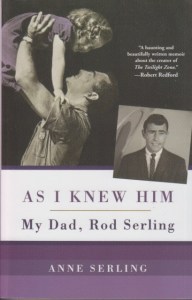
I have to admit to feeling anxious as I read Anne Serling’s As I Knew Him: My Dad, Rod Serling.  You see, she actually was his child and I’m afraid of learning too much about those I put on my personal pedestals.  Her book, however, didn’t disappoint.  Serling lived a writer’s life, something I’ve coveted since I was a kid.  If I couldn’t have a father, at least I could write about life as I saw it.  I still write fiction inspired by, among others, Rod Serling.  Spending much of my time in Binghamton and Ithaca for my own family reasons, I was only obliquely aware of how much I was traversing the region Serling considered home.  As I read his daughter’s autobiography—or is it a biography?  Who can tell the difference?—I was inexorably drawn in.  Fathers and daughters can be the best of friends.

Sometimes I wonder if those who know writers the best are their true fans.  I don’t mean groupies or the like, but rather those whose lives have been transformed by their words.  I’m reminded of Evermore, written by a relative of Edgar Allan Poe.  Family, it is true, see a side of a person that the reader does not.  But who are we, really?  Those of us who write may be saying more in our fiction than we care to admit even to those who know us well.  Rod Serling recognized dimensions well, I suspect.  A writer’s life requires sacrifice and keeping things hidden.  Anne Serling’s book is a gift to those who write, even if it is about someone else’s father.


Universals

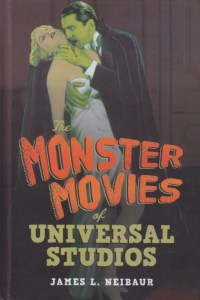
It was on television that I met them.  The Universal monsters.  The entire run of films from Dracula to The Creature Walks among Us had been shot, printed, and screened before I was born.  In other words, I’m a late monster boomer.  By the time I was old enough to handle monster movies, they were on television and my early memories of them are tinged with the nostalgia that accompanies what seemed like better times, although each era is about equally difficult.  When I saw James L. Neibaur’s The Monster Movies of Universal Studios I knew I had to read it.  Neibaur goes through all the films in the series, chronologically, encapsulating the Draculas, Frankenstein’s monsters, mummies, invisible men and women, wolf-men, and the gill-man.  As I child I never watched them systematically, being subject to television schedules, among other things.

Not understanding studios or business, and certainly not copyright, I never understood why other favorites such as Jekyll and Hyde, the phantom of the opera, and various assorted ghosts and ghouls weren’t part of the collection.  Nevertheless, this study in discrete, brief chapters, treats the official canon reasonably well.  The line between religion and monsters is sometimes crossed in these movies, which gets at an underlying theme of my own interest—how horror and religion interact—but that’s not Neibaur’s purpose.  That dynamic is, however, the driving force behind my two most recent books.  A tie-in to the paranormal may also be found there.

As I dropped off some promotional material for Holy Horror at an area bookstore recently, the events manager revealed her interest in the paranormal.  In my mental schematic, it’s wedged in there between monsters—which are fictional—and religion, the antithesis of fiction for most people.  What do we do with ghosts and others that don’t fit into the neat lines of a theology that draw a stark line between the supernatural and human?  Universal’s monsters sometimes ran into problems with the Production Code for stepping over that line.  Of course, the Universal monsters are pretty tame in comparison with today’s fare.  Still, they were the monsters who showed, in many ways, what it was to be human.  Neibaur isn’t going for an in-depth analysis here, and his treatment is readily readable by anyone interested in revisiting the monsters of yesteryear.  Some of the descriptions reminded me of movies from my childhood that I’d forgotten.  It is pleasant to relive them for a few moments while the real monsters in the real world lurk not far from my door.


Fearing Errata

Well before I became an editor, I noted mistakes in books.  I go through phases of marking up books as I read them—in pencil only, please!—and not doing so, but I used to mark mistakes when I found them.  At that point I hadn’t realized the complexity of the process of book production and I had no idea of the many ways in which errors might creep in.  I’m a bit more forgiving now.  In any case, errors are a regular part of book publishing.  Older books used to carry pages with incantational-sounding titles like “errata” and “addenda et corrigenda.”  Errors, in other words, were considered inevitable because every time you have another set of eyes look over the manuscript it adds to both the costs and time for the production schedule.  Then I started writing books.

Now, before I get too far I should explain that many book editors don’t line edit submissions.  The standard “editor” is an acquisitions editor, which means you sign up books for your press, but you don’t necessarily (if ever) actually edit them.  I still have the sensibilities of a copyeditor, however.  That’s the main reason I fear to read my own books after they’re published.  I’m afraid I’ll find mistakes.  I do take the proofreading stage seriously, but often a writer has little control over when proofs arrive with a tight turnaround time.  You have to drop everything to get them returned by the deadline.  I’m always worried that errors might’ve crept in.  For example, with Holy Horror, I corrected with website copy for the book.  The errors, however, remain online.  They’re minor, but as the author you’re always considered culpable for such oversights.

Now that I’m working on a presentation to give for Holy Horror, I find myself facing my fears.  I need to go back to a book already published and look inside.  Since writing it I’ve completed another book, Nightmares with the Bible, and my mind can’t help mixing up a little in which book I said what.  To make sure I don’t tell potential readers the wrong information, I need to go back and reread parts of my own work.  What if I find errors?  Will I have to mark up my own copies like I used to do to those of others?  Will I need to compile an errata sheet?  I tend to be a careful reader, especially with proofs.  But facing possible errors is nevertheless a terrifying prospect, even if it’s a regular hazard for those who attempt to write books.


Internet Epistemology

Where do we find reliable information?  I’m asking this question on an internet-based medium, which itself is ironic.  While spending time with some younger people, it’s become clear that the web is their source of truth.  You find purveyors of information that you trust, and you accept their YouTube channels as representing correct data.  This can be a disorienting experience for an old doubter like me.  One of the reasons for studying for a Ph.D., apart from the vain hope of finding a career in higher education, is to hone critical thinking skills.  When I went through the process, that involved reading lots and lots of print material, assessing it, and weighing it against alternative views, also in print format.  You learn who really makes sense and you judge which publishers have good information more frequently.  As you navigate, you do so critically, questioning where they get their information.

Now, I’m not one of those people who think the younger generation is wrong (in fact, there are YouTube educational videos about just that).  The situation does, however, leave me wondering about how to fact-check when you don’t know the publisher.  It may be an older person’s problem, but it’s essentially the same dilemma behind self-publishing—the reason you trust a self-published book depends on the author alone.  Is s/he persuasive?  Did s/he document the sources of her/his information?  Are those sources good ones?  The young people I know seem quite adept at filtering out obviously biased information.  Many YouTube personalities footnote their presentations with links to sources (many of them online), and after an hour of watching I’m left questioning what’s really real at all.

You see, many of these internet personalities have sponsors.  Sponsors bring money, and money biases anyone’s angle toward the truth.  In fact, many of these YouTube sources call out the lobbying groups that influence public opinion for political ends.  Only someone completely naive—no matter their generation—would not acknowledge that government runs on money provided by corporations with interests to be protected.  There have been reliable sources, even from the days of print, that prove beyond any reasonable doubt just how corrupt governments tend to be.  But who has time to fact-check the government when the rest of the information we receive is suspect?  Those of us with training in advanced critical thinking aren’t immune from biased information.  It’s just that there’s so much data on the web that my head’s spinning.  I think I need to go read a book.


Making Monsters

It’s not so much I’ve been away from monsters lately, but that life has intervened between them and me.  Life can be scarier than monsters sometimes.  In any case, the summer is when my mind turns back to haunting even as on the breaks during heat waves a whiff of autumn can be caught on the air of a July morning.  Yes, we’ve past the solstice and days are getting shorter.  Slowly, of course, but that’s what builds suspense.  And there are local signs that I need to get my haunting in gear.  It is finally time to get Holy Horror out of wraps and give the book a proper launch.  Being published around Christmas last year was poor timing for a subject so readily coded for fall.

I received the welcome news this week that the Moravian Book Shop—the oldest continually operating bookstore in the country—will be hosting a book signing for Holy Horror in October.  This is a fortuitous turn of events because when I first approached them with the idea the price of the book made the idea look unrealistic.  But we’re now thinking of autumn, and with autumn comes Halloween.  There have been a spate of horror films this summer, all of which I’ve unfortunately missed.  Time, as Morpheus notes, is always against us.  There does, however, seem to be a lively interest in the genre and the curious wonder what it has to say about what we believe.  Horror loves religion, and indeed, thrives on it.  So it’s been from the beginning.

October will also see the Easton Book Festival in this area.  I will be on the program for that as well.  While none of this is earth-shattering, these events represent the first successes in trying to build awareness of Holy Horror.  This was a book written for a general readership, but not priced for one.  Working in the academic publishing world, this is a phenomenon with which I’m all too familiar.  Many colleagues offer to read and spread news about your book.  It seldom happens, though.  Academic presses can’t afford book tours (especially if they have to price books at $45), but these self-driven presentations are opportunities to spread the interest in ideas.  That’s what those of us who write really want—to be part of the conversation.  We’re in the midst of a heat wave here.  It’s the height of summer.  Even so, those who know about monsters can feel them coming, even from here.


Identity Crisis

Living in Boston can be a heady trip for a budding academic.  Even if you’re across the river from Harvard and MIT, it’s a city known for its education scene.  Like many who studied there, I never wanted to leave.  A fringe benefit of being a student of religion was that a short trip would take you to Peabody.  Why?  Peabody was home to CBD—Christian Book Distributors.  In their showroom they had rock-bottom prices for something theology students crave—books.  That was many years ago now, and over time CBD grew to be the largest distributor of Christian paraphernalia in the country.  In my mind they’ll always be associated with happy little trips that ended in armloads of reading.  What more could you want?

A story by Emily McFarlan Miller explains why the revered CBD is changing its name.  Cannabidiol, a legal derivative of cannabis, is popularly known as cbd.  Lots of things share initials, of course, but these are the days of the web, and an internet search for cbd now pushes the distributor (at least the book distributor) off the first page.  One thing we all know in this online universe is that you’ve got to be on the first page.  CBD’s decision might seem extreme—changing the name of the business to get back on the front page.  Despite the amusing aspects to this story, it emphasizes something of an ongoing jeremiad with me: the web has redefined reality.  Think about it this way: when a digital image is over-enlarged it pixellates.  That’s because it’s composed of minuscule squares of a single color.   When brought together in a pattern, they form images we recognize.  It their basis, however, they are squares.

The earth, however, is an orb.  The natural state of falling liquids—the principle behind the shot tower—is a sphere.  Now, spheres together in a closed space leave gaps—just look at a jar of marbles and you’ll see what I mean.  That’s the order of the natural world.  Reality, if you will.  Tech, on the other hand, is pixels.  They fill the space better, and if done well can create the illusion of a curved line.  They can never, however, fit into a round hole of the same surface area.  The world has gone after the convenience of the internet in a small box.  It has changed the recording industry, the movie industry, and the publishing industry.  And just try to find your way to CBD on it.  You might have to change your search parameters.


Good Ground

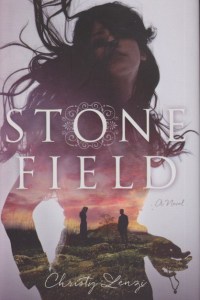
Young adult literature gives me hope.  The quality, speaking for a guy who grew up in a small town with limited choices, has improved astronomically over the past several years.  One of my favorite (adult) novels is Wuthering Heights, and so it’s no surprise that I found Christy Lenzi’s debut novel Stone Field quite engaging.  Set in a different time and place, and with a younger readership in mind, it retells the story of forbidden love based on xenophobia.  The message has never been more relevant.  Although it avoids explicit language, it does include adult situations and features a strong female protagonist in an age of explicit gender inequality.  During the chaos leading up to the Civil War, star-crossed lovers are set against one another because prejudice is a most effective poison.

While not a religious story, the iconic Bible plays a large role in it.  One of the main characters is a preacher, but even without him Catrina Dickinson’s family and friends are ready to quote the Good Book as unquestioningly as a Republican (with my apologies to fiscally conservative friends untainted by this aberration).  This is beyond a realistic portrayal of American life of the 1860s, it reflects the way that many people continue to think of Scripture.  Nevertheless, in one crucial episode of the story set in the church at Roubidoux, Missouri, the iconic role of the Bible becomes clear.  It is deftly woven throughout the story in a way that might serve as a lesson for modern writers seeking verisimilitude.  Many authors fear to address religion, but the Good Book is alive and well in these post-frontier days.

Often the desire to avoid religious motivations leads to stories that lack a key element of the social fabric.  In my own attempts at fiction religion is seldom absent.  It is the way average people live.  Lenzi presents Cat as being aware of but unwilling to be cowed by the Bible.  Indeed, as the story unfolds with several tragic events (remember, Wuthering Heights) she demonstrates that Catrina knows but doesn’t accept the strictures of Scripture.  The issue of theodicy hangs heavily in the atmosphere of the novel.  To me, this makes stories appear more life-like than tales that simply suppose religion doesn’t impact people.  When tragedy strikes, many people question what God, or their stand-in for the divine, is doing.  Anyone who’s asked “why me?” has directed that question into the world of theodicy, whether intentionally or not.  Reading this story while going through a family illness may have drawn this to the surface, but it underscores just how effective it may be for a realism that is otherwise lacking, whether in fact or young adult fiction.


Naming Rainbows

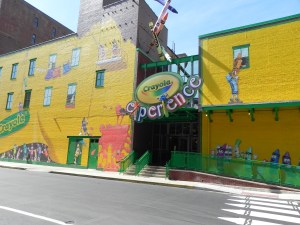
Living in the area around Allentown-Bethlehem-Easton (ABE, in airport parlance), one can’t help but be aware that Crayola is based in the E sector.  We visited the Crayola Experience while still residents of New Jersey and if there’s any place that smells like childhood this was it.  One of the truly interesting aspect of Crayola is that it defined specific shades of color.  Or at least Crayola’s version of it.  Many of us have pretty clear ideas about the basic six colors: red, orange, yellow, green, blue, and purple.  Sure, they added “indigo” to make it into a pronounceable name, and changed purple to “violet” to give us the standard seven, but this illustrates the point that I’m making—colors are somewhat relative.  Try to get anyone to describe, famously, puce (which I’ve learned is French for “fleas”).

A friend has recently been sharing stories from a book on the origins of color names (Secret Lives of Colors by Kassia St Clair), from which I learned about puce.  Although I haven’t read the book myself, it has become clear that colors indicate different things to different people.  All of this reminded me of a crisis I faced in my youth.  One of my teachers in middle school, in physics class, mentioned that not all people perceived the same color in the same way.  Or at least there’s no way to know whether they do or not.  Perhaps, he suggested, everyone has the same favorite color, but what they call it is different.  While the latter point seems unlikely, I took to heart that not everyone sees things the same way.  The same dilemma came back to me as my friend showed me various colors and said that her idea of what that color name designated was something quite different.

As in much of what I write, there are metaphors and analogies active here.  A paradox of religions is the great variety among them combined with the certainty that one’s own alone is “the truth.”  And all religious believers tend to be certain that theirs is true.  Like the color names we learn as children, we seldom grow up to question what we were told in our youth.  Some religions appeal to adult converts, but most people stay close to the orthodoxies of their youth.  Religions, like colors names, are a matter of consensus, for there are any number of shades and hues, and what we decide to name them is not revealed from on high.  They do, however, give the world considerable color.


Waiting for a Miracle

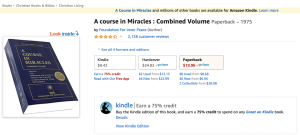
A friend recently sent me a New York Times story about Marianne Williamson’s spiritual background.  Before I say anything more about this I have a confession to make.  I didn’t know who Marianne Williamson was and, consequently, I’ve never read any of her books.  I also didn’t know about her presidential bid, although she seems much more grounded than whatever it is that sits in the Oval Office these days.  In any case, it’s the spiritual background part on which I’d like to focus.  Williamson is apparently a devotee of A Course in Miracles, a book written by Helen Schucman in the 1970s.  According to the NYT article, Schucman penned the book by the dictation of a divine voice.  This aspect seems worthy of further exploration, regardless of politics.

You see, sacred books have a long history of divine dictation.  The Bible makes such claims only obliquely, but clearly there were some who believed that Moses was the recipient of narration from on high.  Mohammed heard a voice saying “Write.”  Centuries later the Book of Mormon was written out at the dictation of Joseph Smith.  The point is that such texts are often believed to have had sacred origins.  I find Schucman’s reluctance to put herself down as the author of A Course in Miracles instructive.  She didn’t believe she wrote it.  Not to devalue any of these sacred texts mentioned, I would nevertheless note that authors often feel that their words come to them.  Maybe academic books don’t count, but when I’m writing fiction, it’s like somebody’s hands are on the wheel, but I’m not sure I’m the one driving (with apologies to Jeff Daniels).

A Course in Miracles has been translated into double-digits languages, something quite rare even among many bestsellers.  What this says to me is that people still crave answers from an authoritative text.  The written word has a power that electronic publication lacks.  Who wants to point to a screen and say, “this is divinely revealed truth”?  Hefting a heavy book, printed on actual paper, has a symbolic power that outweighs that of ebooks.  Probably it’s because the Bible paved the way.  We’re already primed for a sacred text, in physical form.  The longer I study holy books the clearer it becomes that they will unlikely ever cease to be written.  Helen Schucman didn’t have the last word.  As long as people write it’s doubtful anyone ever will.


Ghostly Thoughts

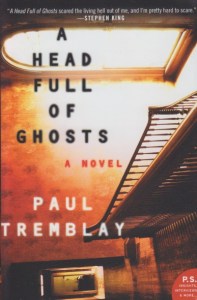
Ghosts tend to be on my mind in the autumn.  Paul Tremblay’s A Head Full of Ghosts, however, has been on my reading list for quite some time.  As a novel about possession, it has some scary moments, but it’s difficult to compete against The Exorcist in that regard.  Tremblay handles the topic with an ambiguity worthy of Shirley Jackson, however, and there are a few clear nods to her work here.  At the risk of giving out spoilers (you have been warned!) although it’s pretty clear by the end that much of the demonic was a cry for attention, the family member behind the tragedy is clearly left obscure.  We find out whodunit, but we’re left unsure as to the real reason behind it.

For fear of giving away too much (although my Goodreads assessment might be guilty of this), I’d like to consider something that I address in Nightmares with the Bible.  Demonic possession is largely coded as a feminine phenomenon.  The reasons for this are likely complex, but they are clearly related to the idea behind witch hunts and fear of women’s power in “a man’s world.”  Possession narratives, while they predated William Peter Blatty, became an essential part of the revived interest in demons brought on by The Exorcist.  Tremblay’s story is clearly aware of this, as he has his characters citing both fiction and non-fictional treatments of the topic.  Since researching the subject on my own, I’ve been wondering if anyone else has been able to handle it as deftly as Blatty did, and although Tremblay has two girls under threat, the question of whether it’s real or not tends to outweigh the pathos of believing Marjorie really has a demon.

In the end, it seems as if her father might be the real source of the family’s haunting.  An unemployed man looking for a way to support his family, he turns to religion.  This scenario is all-too-real to life.  And religion gives us not only a rationale for demons, but also a solution in the form of procedures and proper responses.  There are priests here—the males who alone can deliver the females—but whereas Blatty clearly made them the target of a demon that was pretty obviously real, Tremblay doesn’t play that card.  The priests come and go, and deliverance takes a form not expected for such a narrative.  A Head Full of Ghosts raises lots of questions and, like all good fiction, leaves us pondering at the end.  There’s still time to read it this coming fall.


Dark Theology

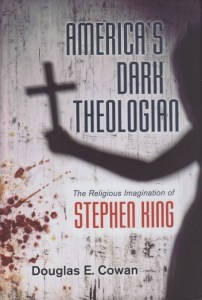
I’ve been struggling for several years, I expect it’s no secret, with how horror and religion relate to one another.  Many think the task itself pointless, as if pop culture can simply be brushed off like an annoying bug.  But flies keep coming back.  They won’t be ignored.  Almost a decade ago I discovered Douglas E. Cowan was also walking this spooky path past the cemetery.  I also know that as an academic he must demonstrate his chops in technical projects.  America’s Dark Theologian: The Religious Imagination of Stephen King was extremely welcomed by me.  Like many people I’ve read some Stephen King.  Like Cowan, I’ve noticed how often and how deeply religion is entangled in his story-worlds.  Before King is simply dismissed, we must reckon with the fact that movies based on his novels and stories have a long  pedigree and almost canonical status.

This is not the place to analyze America’s Dark Theologian in depth, but it is a place that would highly recommend the book.  Cowan takes several aspects of King’s works and shows how they tie explicitly to traditional religious thinking and longing.  I haven’t read nearly all the books Cowan cites here, nevertheless, the analysis he offers is compelling.  Scholars of disciplines outside religious studies have tended to dismiss it as being moribund.  Cowan shows that those who make a living in pop culture disagree.  King makes no bones about the fact that he sees the application not only of religion, but also theology, as one of the driving forces for his fiction.  We dismiss such observations at our peril.  Think of you favorite King novel and ponder; is there religion there?

Clearly religion’s not always the cause, but Cowan gives a careful consideration to much of King’s oeuvre, and there’s no denying he’s onto something.  As he points out, King is far more interested in the questions than in the answers.  Those who know religious studies—theology, if you must—know that the same is true there.  I’ve studied religion my entire intellectual life.  One of the reasons students evaluated my teaching so positively, at least I hope, is that because I encouraged the questions and did not privilege the answers.  In this field, answers are merely speculations.  We only really fall into serious danger when we cease asking questions.  Cowan does an excellent job of parsing out some various pieces that will make some kind of basis for a systematic theology of Stephen King’s thought-worlds.  We would be wise, I believe, to pay attention.