Hiding Out

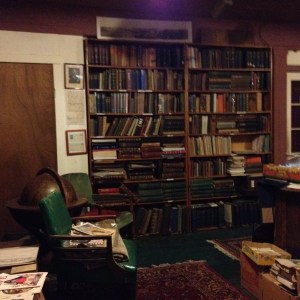
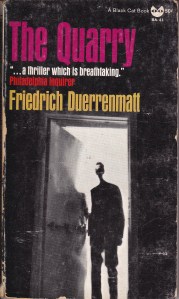
It’s seen better days. The spine is coming unglued and the pages are brittle, fracturing into tan snowflakes as I turn the pages. Still, this unusual little book is crowded with memories. I recall the used book store where I bought it—the Boston Book Annex, now sadly defunct. Unlike any other paperback I’d purchased, this one has gray-dyed page edges, adding an appropriate October gloom to the reading. Friedrich Duerrenmatt may not be properly among the existentialist novels, but that’s where he lives on my bookshelf. I picked up The Quarry three decades ago when “Der Besuch der alten Dame” was still relatively fresh in my mind. If I were a younger man I might’ve tried to find an edition in German, but the internet didn’t exist in those days and after a few years of no use, my Deutsch was dusty. It had been my gateway language.

As I read The Quarry I wondered why I had waited so long to do so. The story is brief but intense. And like novels of the period, it is philosophical and theological. (Like many translations it is sold under different titles; this one is also known as Suspicion, but The Quarry captures the duality nicely.) Hans Bärlach, a Swiss police commissioner, is on the trail of a Nazi war criminal. Suffering from cancer, Bärlach is bed-ridden but his quarry is a doctor and he finds a plausible excuse to become his patient. To help him set the trap, he enlists the aid of Gulliver, a Jewish concentration camp survivor. Their dialogue is what makes this brief story so theologically pregnant. Gulliver calls Bärlach “Christian” and reflects on how that feels to a Jew who was intended to be exterminated. I won’t spoil the ending here, but when Bärlach meets his quarry and realizes that he is also the quarry, the conversation once again turns to religion.

There’s an honesty to such novels as this. Writers were not yet afraid to invoke philosophical dialogue. A friend at the time I purchased the book once told me “nobody writes like that anymore.” Since his father-in-law was a novelist, I supposed he was right. I should have instead relied on my memories from high school German. We read “Der Besuch der alten Dame” and even went to see a stage adaption at the local community college. I’d shortly discover the existentialists. Their views on the absurdity of life mingled so readily with a theology becoming broken, tired, and top-heavy. Those ideas I’d met in class such as, if memory serves, Ilse Aichinger’s “Wo Ich Wohne,” became a part of my young psyche and, not surprisingly, many years later I’m finding myself their quarry.

Infinite but Expanding

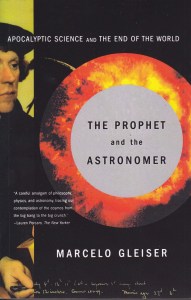
What could be more humbling than living in an infinite but expanding universe? Since the days of Copernicus, Brahe, Kepler, Galileo, and Newton we’ve known that the apparent reality of both our own lives and that portrayed in Holy Writ is inaccurate. The earth doesn’t hold still, and the sun doesn’t rise or set. The universe isn’t a layer-cake with Heaven above and Hell beneath. Instead it’s mind-numbingly massive. The only appropriate response, it would seem, would be silent awe. Marcelo Gleiser, whose work I’ve mentioned before, is a rare scientist. Rather than continually slapping the rationalist card on the table and declaring science the trump suit, he brings an element of humility to his writing. So much so that he’s willing, almost eager, to engage religion. Not in debate, but in conversation.

The Prophet and the Astronomer is a wide-ranging book that is tied together around the theme of the end of the world. A few weeks back we had yet another brush with a biblical literalist declaring the end of all things. Gleiser, although his book was published over a decade ago, was called in to comment in various places. This book opens by discussing ancient ideas of the end of the world. These are necessarily religious ideas. We don’t fully understand ancient concepts, but enough remains for us to see that apocalypses have their origins in Zoroastrian thought. Judaism encountered such thinking and the book of Daniel ran with it. Early Christians also had the world’s end on their minds, and the book of Revelation developed into a full-blown apocalypse. The world, or at least the western hemisphere, has never been the same since. Centuries of living under the threat of a cataclysm that could come at any second surely takes its toll.

Gleiser then shifts to the real harbingers of potential apocalypses. Comets and asteroids still exist and could theoretically deliver what the Bible implies might happen—a fiery end to the planet. This is sobering stuff. But the book doesn’t stop there. Bidding adieu to the dinosaurs, The Prophet and the Astronomer sweeps us into this great, expanding universe and how it may end, scientifically. Black holes and the heat death of the universe can be truly terrify. What is remarkable about the book, however, is that Gleiser openly acknowledges that science can’t give the comfort and meaning that religion can. Instead of saying, “be tough, face facts” he suggests that scientists might consider a narrative that adds value to a cold, dark universe. That’s not to say some of the story isn’t technical and some of the concepts aren’t difficult to grasp, but it is to suggest that science and religion should sit down and talk sometime. Hopefully before the end of the world.


How to Talk to an Editor

There are right ways and wrong ways to get your book published. When approaching an editor, there are a few things to keep in mind. For one thing, we’re human. Yes, I know that I have something you want. The usual career track for an academic is Brown, Harvard, dissertation published by a certain academic press with which I’m familiar. I get that. The internet, however, has made publishing into something different than what it used to be. First of all, you can self-publish. Sorting through all the self-proclaimed experts can be a full-time job when you’re trying to find the latest authoritative treatment of a subject. Also, the internet has made research into publishers much easier than it used to be. My first book, back in the day, was simply sent off to a European publisher that specialized in academic monographs in my subject area and then I moved on. Today authors see flashy first books online and want just that. You can have it all, they’re told.

My LinkedIn profile took a definite boost once I became an editor. Now I often think it would be great if someone asking to connect actually knew me. But I digress. One way not to get your book published is to state right on your LinkedIn profile—or other social media—that you have a great book and you’re letting all publishers know. You then invite them to connect on LinkedIn and your book announcement, like a peacock’s tail, is supposed to attract the hungry editor. In reality what attracts an editor is professionalism. Research publishers, find out what they actually publish. That’s pretty easy these days; there’s more than funny videos on the internet. Even browsing titles similar to your own on Amazon can help. Pay attention to the publishers of the books you’re using for your research. If a publisher has done several books in your area they are more likely to be interested in your proposal than a publisher who’s never ventured into those waters.

It may be easy to think of us editors as sitting bored in our lonely cubicles, awaiting the next great thing. The fact is we receive plenty of submissions and we have to sort through them. Treat the subject professionally. Many of us hold doctorates and are keenly aware of hyperbole when we see it. You don’t need to tell the editor your book is ground-breaking. They will make that decision based on the evidence before them. And trust your editor when it comes to things like how a book should be titled or placed or marketed. Publishers—some of which have been around for centuries—daily face the harsh realities of producing books in an era of YouTube and online television. We know it’s difficult out there. Many of us want to help. Some of us write books and have to go through the same travails as other authors in finding publishers of our own. Do your research on publishers. When an editor offers free advice, take it. A little bit of extra work by an author goes a long way in helping a book proposal succeed.


Amityville

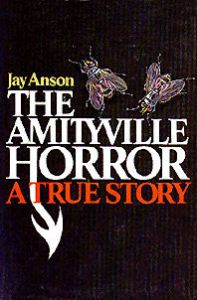
Surely one of the most controversial haunting stories of my own lifetime was that which came to be known as The Amityville Horror. After the tragic deaths of the DeFeo family in 1974, the next occupants of the fatal house, the Lutz family, claimed to have experienced 28 days of terror before moving out in the middle of winter and taking no belongings with them. Their story, written by Jay Anson, became a sensational bestseller. Published just four years after the unexpected cinematic success of The Exorcist, a movie was quickly signed and it was all the talk of my high school before I was quite at the stage of watching real horror films. By the time I got around to seeing the DVD, the tropes were so well known that it wasn’t really that scary. I realized that I had never read the book.

Whether you find Anson’s account scary or not probably depends on your level of belief in demons. Although he concludes his book with the suggestion that a combination of ghosts and a demon plagued the Lutzes and their priest, the focus of the narrative is clearly on the demonic. Fr. Mancuso suffers because the demon wants to keep him out of the house. The multiplication of flies, the constant waking up just after 3:00 a.m., and the smell of excrement all point to demonic activity. The book does have its share of historical inaccuracies and embellishments. It has been declared a complete hoax by some while others claim that at least some of what was described in the book happened to the blended family that called it home for less than a month. If you don’t accept demons, there’s little here to frighten you beyond a couple of benign ghosts.

As with any story claiming supernatural activity, we’ll never really know what happened. The Amityville Horror is often classified as a novel now. Our minds are conditioned to reject anything so terribly out of the ordinary that it is difficult to accept what you’re reading. The DeFeo family was undoubtedly murdered in the house by one of their own. The Lutz family did buy and then abandon the house in fairly short order for such an expensive purchase. There was a priest involved. The question marks hover about the supernatural elements, as they generally do. These are the ghosts and demons of the rational world which we inhabit. We safely confine them to fiction. Then we sleep at night with the lights left on.


Scared Space

Ghosts appear whether they exist or not. People have seen them, we know, since as early as written records permit us to know. I first ran into Colin Dickey’s name in a review of the new Ghostbusters movie. The bio made mention of his book, Ghostland: An American History in Haunted Places. Then it was a matter of waiting until autumn to read it. It’s a book that will long stay with me. Dickey’s not out to prove or disprove ghosts—they are simply there (and sometimes not). Ghosts, however, teach us quite a lot about the living. What we value. What we fear. What we disdain. Some of the ghost stories in this book are famous and familiar, others obscure and pedestrian. What they all have in common is a sense of place.

This book is primarily about place. Ghosts seem to be generated by the fact that people have lived here before us. Focusing on the United States, Dickey points out that land stolen from others has inhabitants already. On top of Native American sites, we now have a few hundred years of European and African and Asian building. Lives lived on top of other lives. And although we can’t say for sure what ghosts are, they do seem to be associated with buildings, or at least places. Organized in a kind of concentric structure, the book describes ghosts of haunted houses, then haunted businesses and public buildings, including haunted outdoor spaces. And finally haunted cities. These hauntings are residue of our own making. We build, we inhabit, we die. Whether ghosts are just memories or uncanny feelings, they are ghosts nevertheless.

Combining a couple of my favorite ideas—ghosts and the sense of space—Ghostland is a rare blend of history and folklore. The architecture of our constructions functions like tombs for our imagination. We are spiritual beings, whether religious or not. Even if we’re in denial of that spirituality, we sense that somehow life doesn’t simply end. We’ve left a mark, a scratch, a dent. As long as those who’ve known us live, we continue on in their minds and lives. And some, it seems, remain beyond even that to be seen by strangers centuries later, maintaining the sacredness of space once familiar while living. Ghost stories are human stories, and Dickey is a sure guide along the way. He doesn’t tell you what to believe, but he tells you something you already may know but not realize. No matter whether they’re ever proven, or whether they even really exist, as long as there are human beings there will also be ghosts.


Novelty Religion

Religion is dead. So they say. They have been wrong before. One of the great things the web has given us is book fan sites. There are a number of them, and my wife frequently sends me stories from BookRiot. Often they are lists, and the most recent one is Teresa Preston’s “100 Must-Read Novels about Religion.” As I scanned through the tons of tomes to see which I’d read, it struck me once again just how many novels touch on—at the very least—religion. Many are based on it. That’s because religion is an inherently fascinating phenomenon. We don’t really understand it, and even the staunchest of atheists believe something, no matter how secular. Novelists are those who, successfully finding a publisher, express their views of living on this planet in terms of fiction. It’s often factual fiction.

One of the best bits of advice I can give to academics who want to write for a wider readership is this: read fiction. There’s been a time-honored stigma, of course, outside literary studies, of academics reading fiction. Once, at a conference, I was awaiting an author meeting. It was a small conference so I had taken a book to read between appointments. When my author came up, he asked what I was reading. (I’d cautiously removed the book jacket before taking my novel along, not wanting this topic to come up.) “Just some fiction,” I explained. His eyebrows shot up and he questioned why an academic should be reading fiction at all. I have known academics successful in the fiction market, but they’ve had to use a pseudonym because their real name might discredit their scholarship. We are a divided, perhaps schizophrenic, society.

Not all academic novels, of course, are cases involving religion. Still, it’s often there. I recently finished Annie Proulx’s The Shipping News and Neil Gaiman’s The Ocean at the End of the Lane. Both involved religious themes at various points. This is so much the case that unless it’s really obvious or unusual I don’t always discuss such tropes on this blog. (Although I do register the books I read on Goodreads, yet another excellent book fan site.) If they want to appeal to the deepest of human needs, novels must address religion from time to time. Paying respect to the dead is, after all, a very human thing to do. And should it prove true that rumors of its demise have been greatly exaggerated, we shouldn’t be surprised. Like they say, reading is fundamental.


The Falls

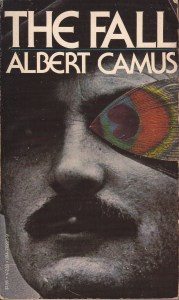
I can’t recall if I’ve been to Mexico City before. You see, back in the late 1980s I frequently read the novels of the existentialists, and although a copy of The Fall has been on my shelf since then, I don’t recall if I read this Camus classic. It’s sometimes that way with existentialists. In late 1980’s Back Bay, a used bookstore called the Boston Book Annex charmed my days. The Annex has sadly closed, but I do remember buying my Camus novels there. This one, however, I don’t remember reading.

So, unsure of my past, I decided to read it. Perhaps again. The existentialists make sense to me. I have to say that in today’s rushed and harried lifestyle it’s a little more difficult to find time to spend in Mexico City. Although the book is short, it’s not quick. There’s much to ponder as you wend your way through an evening bending elbows with Albert. Perhaps that’s an unwonted familiarity regarding a man who died before I was born, but existentialists know that kind of thing happens.

One of the more compelling aspects of this literature is that the existentialists often address religion. The Fall is a first person narrative throughout, and about four-fifths of the way through Jean-Baptiste Clamence begins to address Christianity explicitly. Since this is a retelling, in secular terms, of the biblical “fall,” this is not unexpected. Jean-Baptiste is a lawyer who is making his confession. He states that his clients “probably feared that heaven could not represent their interests as well as a lawyer invincible when it came to the code of law.” Genesis, of course, is attributed to Moses, himself a law-giver. From this point until the end of the chapter he reflects on the fact that although no one is innocent, all are glad to find the crime in others. He describes torture devices of the Middle Ages, exonerating God from their invention. He respects Jesus, but not what people have made of religion.

Reading, perhaps re-reading, this reminded me of why I found the existentialists so compelling as a seminarian. They force you to think. I read Kafka, Camus, and Duerrenmatt, pondering how much wisdom could be crammed into such brief books. Ironically, it takes time to read them. Our world is crowded with concerns about money over meaning. Matter over mind. Once in a while we need to step back, spend an evening or two in Mexico City, and consider how we’ve become a fallen race.


Gendered Lupines

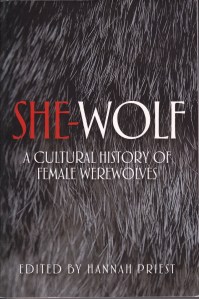
No doubt an excuse isn’t required for reading about werewolves this time of year. Something about October encourages that sort of thing. Hannah Priest edited a collection of essays from various scholars titled She-Wolf: A Cultural History of Female Werewolves. As is to be expected among academics, there are several interpretations wrapped together here and the book covers female werewolves from the Middle Ages—where they are sometimes associated with witches—up through modern cinema. A number of literary sources and a few television representations, and even an RPG, are also part of the mix. The problem with multi-contributor books is that it’s difficult to draw any overarching conclusions, but some observations do come up repeatedly here, and they are worth pondering.

The connection of the female with the animal nature of human beings is stressed for the female werewolf. As might be expected in a patriarchal culture that is becoming more so daily, this is considered an aspect of inferiority. The connection between lunar cycles and werewolves as an inherent feminization of the monster is also brought up more than once. The bodily transformations of puberty also play a role. What we can clearly see amid all of this is that although male werewolves outnumber females in literature and film, and, with a few exceptions, in folklore, the very nature of the werewolf is coded as feminine. This is something that isn’t obvious until a book like this points it out.

Given my own idiosyncratic interests, I was surprised how much religion came into the discussion. Among classic monsters, werewolves tend toward the secular end of the spectrum. There was, however, from the Medieval Period up through early modernity, an ecclesiastical fascination with werewolves. This fascination often came in the form of recriminations against women—attempts to subject them to the wills of men. The church often blamed werewolves on women out of the control of menfolk. And of course, you may kill a monster with no need to feel guilt. More modern views of female werewolves—particularly in movies—are more, well, humanizing. Recognizing that wildness is part of being an evolved animal means that we’re more sympathetic (or had been until November of last year) to the woman who is able to let go of convention and become truly liberated. Now that we experience the poignant lengthening of nights that stir our primal fears, werewolves come naturally to mind. If only we could learn what they have to teach, we might all howl at the harvest moon.


Church Vampires

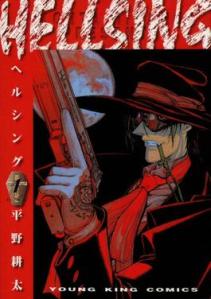
For people my age manga is a new form of reading that is easily ignored. Although I’ve read a graphic novel or two, “comic books,” no matter how adult the theme, seem juvenile. Note that word “seem.” I do know some younger folks, and one of them insisted that I read Kouta Hirano’s Hellsing. This particular friend is as interested in vampires as I am, and, knowing my history with religion, suggested this might down my alley. Dubious, I gave it a try. In this manga universe Hellsing is a Protestant organization for fighting vampires and ghouls (non-virgin vampire victims who come back as zombie-like creatures who are very hard to stop). Their activity is in England, but when they cross into Ireland they encounter a Catholic organization that kills all vampires, including the “secret weapon” of Hellsing, who is indeed a vampire.

What made reading this tale so interesting is that the reader’s sympathy is drawn to the Protestant sect. The Hellsing characters are engagingly drawn—handsome or beautiful, resilient, and naturally good fighters. The Catholic characters are ugly and maniacal. They kill all monsters, regardless of their “heart.” In this the direction from the movie Van Helsing is reversed. There Van Helsing is a hireling of the Catholic Church who won’t kill a monster unless it’s evil. The idea of the graphic novel is that religious rivalry runs deep between these two Christian organizations. Thinking about this, I wondered how Christianity might look to someone from Japan. In this context, it makes sense. Christian missionaries penetrated east Asia from both Protestant and Catholic evangelistic efforts. Although they worship the same deity, they are quite different religions. At least it must look so to anyone not raised in this strange milieu.

Colonialism, in all its forms, has forced peoples to make decisions about new religions in a somewhat violent way. Imagine someone confronting you with your way of life and warning you that you’re going to suffer never-ending torment unless you accept a faith of which you’ve likely never heard. Then you discover that there are two very different versions of that faith that mutually condemn each other. The natural result, if you acquiesce at all, would be to choose the one that either makes the most sense, or the one that got to you first. Hardly the way to gamble with eternal life. I’m not sure Hellsing is intended as commentary on the experience of the colonized. It seems reasonable to me. And if vampires are a problem, you’ll want to be sure to select the right belief system the first time around.


The Struggle for Relevance

Futility is a specialization of those of us who consider ourselves fans of Ecclesiastes. Thus it is that the blog of an editor gets so little attention among academics. Since you’ve been kind enough to drop in, I’m going to share some secrets with you. Make sure the door is closed. Ready? I want to talk about academic publishing. If you, like me, have written academic monographs, you’ve probably figured out that we aren’t famous yet. What’s going on here? What happened to the day when “I wrote a book” meant something? Like all organisms, academic publishing evolves. Many academics want to write for a wider audience, but sometimes miss the bigger picture. Here are some tips to help out:

If you want to write for non-academics get to know some. A good first step is ditching the jargon. “Prosopography” wasn’t on many people’s SAT vocabulary flash cards. Even if you know how to use a thesaurus to find an archaic synonym to use, don’t assume your reader will do the same. Try reading a novel once in a while. They can teach academics quite a bit about how to communicate. Learning to speak the vernacular is only part of the battle, though. The larger part is learning what is of interest outside the academy. Some things, such as Ecclesiastes, aren’t. Oh, I know, I know! Five years of your life spent on some obscure topic should be worth publication. It probably is. A handful of people will read it (print run numbers would only make you weep). If you want to reach a wider readership, you have to go where people actually live. What’s of interest to them? Hoi polloi. They won’t bite. To write for a wider readership you need to learn what people find interesting and what they simply don’t.

An editor can be your friend here. You see, editors are measured by how well their books sell. We can usually tell at a glance if a topic is in the “less than 200 copy” camp or not. I know that you were taught in your doctoral program to find some abstruse subject never before addressed and research it from every possible angle. Write up your results and publish. A far better way to write for a wider readership is to begin a conversation with your editor. Are you thinking of a book on a specific topic? An editor can tell you if it’s likely to work or not. The idea of writing the book your colleagues said would be hot and then finding a publisher seldom works to everyone’s satisfaction. It’s all about communication. And you, dear readers, now know something most professors don’t.


Learning to Evolve

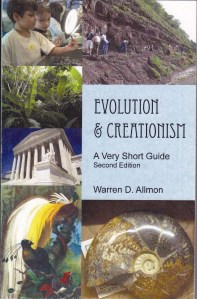
Not to beat a dead hadrosaurus, but creationism is in danger of driving us extinct. On a visit to the Paleontological Research Institution’s Museum of the Earth in Ithaca, I picked up a copy of Warren D. Allmon’s Evolution and Creationism: A Very Short Guide. Although I’ve read plenty of books on the subject, a refresher is never a bad idea. When it came to statistics, though, it grew scary. The majority of Americans do not accept evolution, despite all the evidence for it. What’s even scarier is that a large percentage of physicians—particularly Protestant ones—do not accept it either. Allmon is writing for a local readership, but these issues are quite large. World-wide, in fact. One thing most scientists don’t understand is that “religion” isn’t to blame. Literally reading of texts is.

Were it not for the creation myth in Genesis 1 there would be no conflict over evolution in Christianity or Islam. The question comes down to how one understands a sacred text. Many religious believers can’t get beyond the basic issue of if it took more than six days to create the world then that house of cards called biblical truth collapses. There’s a panic involved here. A very real and visceral fear that heaven itself is on the falling end of the balance. No amount of scientific reasoning will help with that. Hell is just too scary. And reason tells us that reason can’t solve this dilemma. Those raised religious by caring parents can’t believe that Mom and Dad would teach them wrong. Emotion plays a stronger role here than reason. More Kirk, less Spock. When even a majority of high school science teachers feel that “teaching the controversy” is okay, we’re in trouble.

Allmon’s book is well-intentioned. Of course, it was written before the post-fact world evolved. The stakes for not accepting reason (think Trump) are extraordinarily high. Having a figurehead that doesn’t accept rational explanations for what the educated can see plainly encourages widespread copycat ignorance. In the rational world there is no doubt about evolution. Most mainstream biblical scholars and clergy accept it. Don’t try to convince others with an argument, however. This is a matter of belief. Allmon does point out that science can’t speak to non-physical processes. It can say nothing about God. But a certain book can and does. Had it been written in modern times none of this might have become an issue. Until we realize the power of that book, we’re going to continue to struggle to come to grips with simple facts.


Getting Exorcize

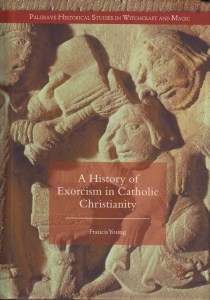
Supply and demand may seem to be an odd framework to apply to religion, but it obviously exists within the polity of churches, synagogues, and mosques. What the people want does influence what’s on offer. Watching movies about demonic possession isn’t something that comes naturally to me. Demons are scary, and it doesn’t help that, historically speaking, they’ve never really been properly defined. Francis Young has provided a service to the curious with his book A History of Exorcism in Catholic Christianity. The book is just what it says, an examination of how Catholics have formally dealt with demons, or more properly, demoniacs, over the centuries. Young notes the protean nature of demons at the beginning—they meet cultural expectations of their time rather than obeying theological niceties. What to do about them?

Long relegated to the realm of epilepsy and mental illness, possession has gone through several periods of ascendency and decline. Indeed, in the nineteenth century it looked as though exorcism, in Catholicism, might have been on the endangered species list. Science was calling the reality of the spiritual world into question and nobody likes to be thought naive. With few exceptions, the move toward eliminating the role of the exorcist was gaining steam. Then in the twentieth century the demand for exorcism revived. As Young notes, a large part of the increasing interest arose from the novel and subsequent movie, The Exorcist. Possession was something so little talked about for so many years that it proved a rich ground for a new kind of monster that was eminently believable. The church, after all, never said there weren’t demons. Since that time, interest has been waxing once again.

Part of the reason would seem to be that humans are meaning-seeking creatures. When our main sources of authority in that realm are eroded, we start looking elsewhere to find succor. Ironically, outside Catholicism the mainstay of exorcism has been among various evangelical Protestant groups. They may not have an ancient ritual to use, but what they lack in experience they make up for in enthusiasm. Their demons are culled from a literal reading of the Bible. And interest among Catholics, in this strange supply and demand rubric, has meant that more exorcists are being trained and made available. The world that Young leads his readers through is one in which strange things reside. He makes no judgment about demons or their reality. He does, however, provide a very thorough history of what the Catholic Church has done about them, when the demand exceeds supply.


Books Anonymous

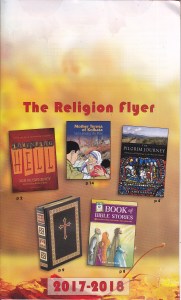
If you stick with something long enough, you’ll get onto all the mailing lists. These days even if you innocently click on an internet ad it will come back to haunt you for weeks on every web-page your visit. One kind of ad I don’t mind is the book catalogue. For those of you old enough to remember print catalogues, you’ll know what it was like, paging through. You’d see volumes you didn’t know about, but suddenly you couldn’t live without reading them. Around the time of the American Academy of Religion and Society of Biblical Literature Annual Meeting, your mailbox would fill up with these catalogues from anyone who publishes books on religion. Not a single year passed when I didn’t come up with a wishlist based on those catalogues.

The other day one arrived called simply “The Religion Flyer.” I flipped it over to see from whom it came. No indication. Inside the offerings were largely Catholic. But then some evangelical publishers appeared there too. And the Society of Biblical Literature. The only commonality I could find here was the Bible. These were biblical books. Again, as I taught Bible for nearly two decades, this was no surprise. Still, who was to benefit from these sales? I’ve been in publishing long enough to know that books aren’t produced if they aren’t projected to make money. Sad, but true. So who sends out a catalogue with no contact information? Who benefits? The backside has a list of bookstores, along with an order form. As in the catalogue itself, the stores are mainly Catholic, with a few Evangelicals thrown in. The Society of Biblical Literature, which sells its own books, didn’t make the cut.

Could this be truly altruistic book advertising? Not many people suppose that biblical study is good for the world, so I admire the conviction of these stalwarts, whomever they may be. Publishing is a business like any other. The powerful voices that say knowledge should be free don’t, I notice, office their classroom instruction without university tuition to pay their salaries. We’re all the victims of capitalism, I fear. Someone, or ones, took from the limited time that they have to produce a catalogue simply to promote the subject. They were likely hired to do so—I’m not really that naive—but they did so without drawing attention to their own efforts. There once was someone who said that acts of goodness should be done by one hand without the other hand knowing. Not many believe that any more. Even though it’s biblical. Who benefits? Those who have eyes to read.


Good Wrinkles

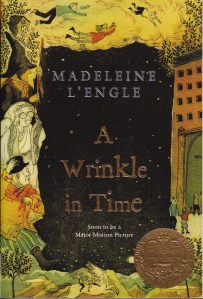
Since I was late getting my Banned Book in order this year, I went to something that I could read within a week. While my bus time is generally reserved for non-fiction reading, I had to pick something fairly easy so that I could get back to more serious stuff. Madeleine L’Engle’s A Wrinkle in Time was published the year I was born, and I’d never read it. It has ended up on banned and challenged lists every decade since it was published, so I was prepared for some radical stuff. Instead what I found was a well-written book for young readers that quoted the Bible quite a bit and even had a worldview that was appropriate to the Gospel of John. When the Murry children try to name the forces that fight the encroaching darkness, the first name offered is Jesus. The differences between good and evil are the subject of discussion among the characters and it’s pretty clear there’s an obvious distinction. So why is it a challenged book?

Never underestimate the sententiousness of the self-righteous. Objections to a medium, and characters—perhaps best understood as guardian angels in the book itself—perceived as witches, have led to the now familiar accusations of the occult. Here is a book that quotes the Bible, upholds the distinction of good and evil, and encourages children to fight for the former rather than the latter. Yet it also teaches tolerance. Parents who want children to think that only those like them can possibly be righteous start to shudder a little at that. The only good heretic is a dead heretic.

When I saw just how benign A Winkle in Time was, I had to think back over my own Bible. In addition to stories of horrendous violence, explicit sex, and with even a “witch” or two, the Bible contains diverse views. Paul argued with Peter in public, after all. Madeleine L’Engle was concerned about the book burning tendencies of Nazis. We now seem to think that the place for illiteracy is in the White House and, more recently, Alabama. Reading the news convinces me more and more each day that a steady diet of banned books is just the catholicon our society needs. Different viewpoints, like the rays of the sun, will shrink the mildew that finds its ways into dark corners, rotting the very fabric of our universe. A Wrinkle in Time may not sway adults in the same way it has engaged the wonder of children for the past half-century, but it is a start in a battle against darkness that is never-ending. There’s always time to read a banned book.


Small Wonder

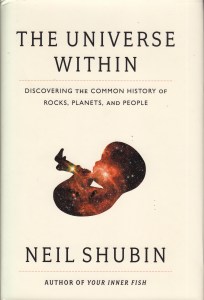
Nothing makes me feel small like thinking about the universe does. Never a large individual anyway, thinking how this apartment encompasses me and it is dwarfed by the small town in which I reside, it’s only a matter of moments before I become a mere microscope slide. And that’s before I even reach the level of just our planet. I’m sure Neil Shubin didn’t mean to make me feel bad when he wrote The Universe Within: Discovering the Common History of Rocks, Planets, and People. In fact, I’m pretty sure that he intended it to be a book that makes the reader feel connected to life, past and present, as well as to the stars that long ago spewed out the elements that have made such life possible. This is a big picture book. From the perspective of a paleontologist the very rocks that entomb the fossils live. The stream of particles is unbroken from the Big Bang to our little corner of the Orion Spur.

The great orthodoxies of science, however, require faith. No matter how the math works, it seems impossible to the rational mind the the entire universe could fit inside the space of the following period. Then, for some reason not yet known, bursts out to infinite but expanding size. Shubin brings many concepts together here—the effects of Jupiter on bringing earth into the Goldilocks Zone, the impact light and dark have on our bodies, whence the dinosaurs might’ve gone—and weaves a tether through it all that ends up in the hand of humanity. Evolved beings we are, but evolved from stardust as well as primordial soup. And then there’s the fact that the earth itself, as is inevitable, is slowing down. Days are growing longer yet we don’t get any more done. And we have maybe a billion years left before the sun goes Trump on us.

There is a strange comfort in being connected to all of this. And also a sense of shame as well. We are, as far as the fossil record reveals, the only species to initiate a mass extinction single-handedly. We have this whole planet and we want even more. It comes as no surprise that religious language crops up now and again in a treatment like this. After all, words divested of such concepts can take us only so far. The Universe Within is a book with a universal perspective, placing us squarely somewhere within a context that we simply can’t comprehend. And yet, reading it somehow leaves me feeling small.