Alternative Reality

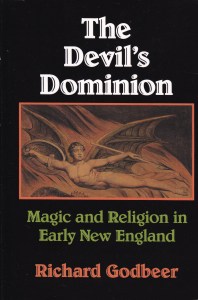
devilsdominionIt is a caution that may become increasingly necessary as Trump’s supporters of “alternate facts” begin to sink their insidious hooks into feeble American minds that magical belief is part of our culture. While most would deny it in any kind of direct way, from the earliest days we have been a credulous lot. Richard Godbeer explores this historical affinity in The Devil’s Dominion: Magic and Religion in Early New England. Mostly concentrating on the events that led up to the Salem Witch Trials, and some analysis of the trials themselves, he traces the origins to such belief back to the theology of Calvinistic Congregationalists who held undisputed sway in the earliest days. Without benefit of clergy who might urge them to look at the world as a good creation, people instead saw evil and the Devil lurking everywhere. Magic was a regular component of their intellectual diet.

Now, some three centuries later, it’s looking as if things haven’t changed much. Those closest to the highest office in the land—and more frightening still, the most powerful single office on earth—are claiming that facts can have alternatives (what used to be called “lies”) and that if a rich man feels offended reality must be rewritten to make him feel better about himself again. The rewriting of history and science and law is really a mere trifle if you can claim “alternative facts” whenever you please. I wonder what you might find in Alternative Facts on File? I had a chance to thumb through recently and here’s what I found:

Alternative fact 1: Donald Trump didn’t win the election after all! We got the wrong guy in the White House. It’s a fact. Alternative fact 2: the Electoral College was abolished on November 8, 2016. That means that the popular vote wins the White House and Hilary Clinton is, in fact, President of the United States. Go ahead and challenge me on any of this Sean and KellyAnn—for any of your facts I can offer alternatives and they are, by definition, equally valid. Who’s with me? As long as alternative facts are now official discourse supported by the White House, let’s use them to the advantage of the entire nation. Is there a lawyer in the house? Even a Jesuit would do. The one I feel sorry for, however, is Richard Godbeer. His fine book has had to play Devil’s second fiddle to the new reality of post-truth Washington. Maybe the White House really does believe you can shake the Devil’s hand and say you’re only kidding. Wake up, America—you’re being laughed at and mocked by your own government.

Illusions Incorporated

illusionsFiction and fact aren’t so different. Long before the Wachowski Brothers came up with The Matrix, Richard Bach wrote Illusions: The Adventures of a Reluctant Messiah. I was in seminary when I read it and it seemed, at that time, to change my life. Fiction, or fact, has a nasty habit of getting into the way of things and over the course of decades I forgot. The Matrix reminded me—reminded me multiple times—but Illusions sat on the shelf, gathering dust. I was reminded of this book that refuses to be categorized when playing a family game. Like many games these days it’s a set of pre-printed cards and what makes the fun is the context in which you put the words. In this particular game you have to find the suggested idea in the book you have at hand.

I have to confess that this is just a touch artificial at our house. We don’t have much in the way of things, but we have books. Lots and lots of books. When we play this game, we think ahead of time what books we might bring to the table. You never know what the cards will ask, so books with diverse ideas are a good choice. I saw Illusions on the shelf. As I thumbed through, it was as if the decades were wearing thin. I knew I had to read it again.

Stubbornly refusing to classify itself as fact or fiction, the narrative of what it’s like to meet a messiah is inspirational. I can’t claim to have come to the conclusion on my own—I’ve read Illusions before, and I have seen The Matrix many times—but I recollect the realization coming to me on the streets of Manhattan. This is not real. Standing in the shadow of the tallest buildings in this country, that’s not a comfortable realization. Nobody said reality was comfortable. We easily let ourselves accept what we can’t do and what’s impossible. It’s far more rare to consider what is truly possible. What we can do. These ideas will be a hopeful ebenezer over the coming months. We choose to elect reality. Despite what the loud and angry say, the mind is the arbiter of truth. I read the book before I knew much about the world. If I’d had the good sense to believe it, it might not have taken me decades before pulling it off the shelf to remind myself of what I already knew.


Alas, Binghamton

“Store Closing” the signs veritably shout. “Everything Must Go.” It’s something I hate to see in an economically depressed town. The tragedy is redoubled when it’s an independent bookstore. While undergoing the ritual of returning our daughter to college after the holiday break, we were driving through Binghamton, appropriately enough, at twilight. In that first, lonely freshman year we’d discovered River Read books in downtown. Like many indies, it was small. Intimate even. I never walked out, however, without some treasure that I wouldn’t have found in a larger store. River Read eventually became an irregular habit based on parents’ weekends and academic breaks, and I’ve come to depend on it after a long drive across three state lines. Once again, however, the lack of concern regarding reading takes another victim.

img_2947

In the ancient world there was a poetic genre scholars now call the lament for a fallen city. I’m that way about bookstores. Amazon has proven wonderfully capable of getting things to me quickly. Obscure tomes, sometimes. Since our nearest independent is a 25-minute drive, this is often a necessity—I can spare 25 minutes only on a weekend, and then, only select ones. Ironically, just on the way to Binghamton we stopped at the Bookworm in Bernardsville, New Jersey. We try to help them survive. My mind goes back to fond occasions outside the home and how often they involve bookstores. Finding a new one. Returning to one already well loved. Even, back in the day, Borders. In a pique of nostalgia I starting searching the web pages of past favorites. Books & Company in Oconomowoc, Wisconsin. Farley’s in New Hope, Pennsylvania. Pages for All Ages in Savoy, Illinois. Ah, alas, the latter has also closed its doors forever. The store I’d visit after a long commute to Nashotah House and back, looking for something I really want to read.

The neon after dark is like an alien invader in my car. River Read is closing. The liquor stores and “gentlemen’s clubs” seem to be fine. The cars up here sure weave around on the road a lot after 9 p.m. on a Saturday. It’s not just here, I’m sure. I’m seldom out this late any more. Perhaps, even likely, this has been a long time coming. Civilization unable to support its foundation. Literacy, after all, spread the common ideals we used to share. Presidents united us and we were eager to read and every town wore its own bookstore like a badge of honor. I’ve seen the signs and I lament the fall of yet another fondly recalled city.


Hopeful Horror

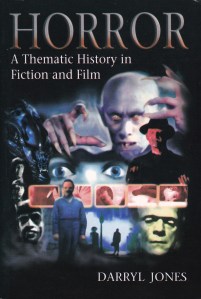
joneshorrorI don’t make New Year’s resolutions. To my way of thinking, if I’m aware I’m doing something wrong, I try to change it at that point, rather than waiting. Needless to say, then, I’m up to my old habits of reading about horror movies. Actually, Darryl Jones’ Horror: A Thematic History in Fiction and Film goes a bit broader than just the cinema. As the subtitle indicates, this charming book also addresses narrative fiction as well and the result is quite engaging. Divided thematically, Jones considers the various types of horror without delving into pretentious theorists to give him academic credibility. Here is a true fan who’s capable to sharing the excitement of the genre. Along the way, accompanying the usual observation that horror and religion share considerable conceptual space, he makes the point that in movies horror is one genre that makes use of academics as characters of authority. Sure, there are others, but in this realm to be educated is a benefit, whether the plan is to take over the world or to stop some evil force from doing the same.

I’ve been watching movies that can be broadly classified as horror since I was young. And I had admired—emulated to some extent—the professors and scientists I saw in those presentations. When a monster was on the loose, you went to find an expert to learn what to do. At the risk of contradicting myself, theorists have been suggesting that one of the problems with post-truth is the death of expertise. Anyone can be an expert these days. The question, “Why should I listen to you?” is on every self-appointed smarty’s lips. Earning a doctorate, the horror world tells us, gives you access to some kinds of knowledge that others don’t have. Problem is, zombies don’t respect such learning. They only want brains to consume.

It never seemed to me that watching horror was a means of learning. As a kid escapism is part of everyday life—taking things seriously is for adults. Growing up, however, I kept my love of scary movies in reserve. Little did I realize that it was a form of training. Now university-affiliated academics are finally able to begin admitting that they find monsters compelling. More than that, they actually learn something from them. Although not a resolution, I see myself reading further books about horror movies this year. It may be a naive hope, but it would be wonderful if they were all as insightful as this one has been.


Reel Salvation

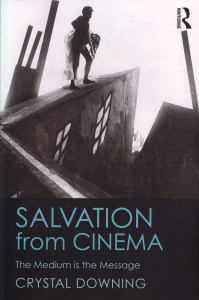
salvationcinemaSalvation is a fraught concept. It’s one of those topics that’s been commandeered by the evangelical camp so that mainstreamers are afraid to touch it, as if it’s catching. The thing is, Christianity is built around the idea that people require saving. The question is how you go about getting “saved.” Some insist it’s being “born again,” while others take a more gradual, one might dare say “evolutionary,” approach. Either way the end result in the same—being rescued from that which threatens you. Like many people, I watch movies. Sometimes I do so with manic intensity, not really knowing why I do it. My personal rationalization is escapism. Living in a world of harsh realities such as Trump (and even before there were sources of great anxiety) one needs an escape hatch. You might say I’m seeking salvation through film.

Crystal Downing suggests I may not be alone in this. Salvation from Cinema: The Medium is the Message is a book that explores the salvific function of movies. These are not just Christian or Bible movies she’s talking about. Indeed, she spends some time wrestling with that preposition “from” in the title. Is cinema something from which one might be saved, or by which one might find salvation? The latter is her focus and she sharpens it by looking at theories which might make it happen. The stories, the stars, and even nudity are put forward as ways the silver screen has been thought to bring salvation to viewers. She also includes a very interesting discussion of breaking the fourth wall. This technique brings the contents directly to the viewer. The second half of her book is more theoretically dense, engaging with modern theorists about what salvation from cinema might mean. Her selection of films to discuss is wide and intriguing.

There can be little question that cinema has a deeper significance than it’s usually supposed. Part of the reason is, as Downing discusses, the easy marriage of capitalism and celluloid in the United States. Movies make money. To counter this she also discusses foreign and art house films as well. There can be little question that those who stand in the queue are seeking something. While cheaper than many diversions, going to the movies does involve a small investment and as capitalists we expect a return on that. So it is that we sit in the dark and allow others to guide us toward the light. That’s as fine a metaphor for salvation as any that the preacher might proffer.


Wild Things

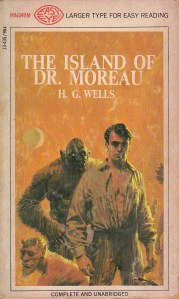
islanddrmoreauLast year my wife suggested we each do a reading challenge for the year. The one we selected was Modern Mrs. Darcy’s, which, with only a dozen books, seemed doable. What makes it a challenge is that to meet Mrs. Darcy’s expectations, you have to read certain types of books, not just go through the stack beside your favorite chair than never seems to get any smaller. I finished the challenge in October or November and posted on most of the books on this blog. This year’s challenge includes a book you’ve read before. Since I’ve been reading about horror movies I decided to reach back to childhood and once again read H. G. Wells’ The Island of Dr. Moreau. It was a timely choice.

For anyone not familiar with it, the story concerns a mad scientist (Moreau) who experiments on animals, making them “men” on an isolated island in the Pacific. These creations aren’t fully human and most of them are blends of different animals as well as part human. They can talk, and they can reason, in a rudimentary way. To create them without anesthesia, Dr. Moreau subjects them to tremendous pain and to prevent them from attacking him, he establishes a basic religion where they obey his rules or he will subject them once again to the “House of Pain.” The narrator, victim of a shipwreck, ends up on the island and has to come to an uneasy peace amid these very strange circumstances. The heart of the book is the chapter where Moreau explains what he’s doing and to justify it he makes a secular theodicy. He is, after all, god to these poor creatures. The book has been made into a horror movie or two over the years, but I’ve never seen any of the cinematic treatments.

What struck me as particularly interesting, revisiting this book some forty years after I last read it, was how easily Wells slips into theological thinking. This is a book unafraid of implicating the Almighty in the troubles of an island that clearly stands in for the world. I wouldn’t have noticed that as a tween. I don’t think there even were tweens when I was one. In any case, the story ends in chaos, rather than creation. What makes it such a timely choice? I suppose the arrogance and entitlement of Dr. Moreau suggested themselves as analogues to our current situation here in the US. Only Moreau is clearly intelligent as well as deranged. This little book is a cautionary tale of what happens when a strong will has its way, unimpeded. It might be a good time for all of us to pick up a copy.


Need to Know

It’s particularly encouraging when the first book I finish in a year is an important one. I try my best to read books that won’t disappoint, but the thing about books is that you sometimes can’t tell until the end. In any case, I can highly recommend Stephen Prothero’s Religious Literacy: What Every American Needs to Know—And Doesn’t. It’s easy to acquire blinders, especially when you stick with a subject through childhood, three degrees, and a career of teaching and editing in that same field. You kind of think other people can see how important it is. Having grown up religious, I was well aware that other people didn’t share my family’s convictions, but it was pretty clear about the continuing uproar of prayer being deemed unconstitutional in public schools that many Americans were concerned about religion. Or so it seemed in my small town.

Prothero, a specialist in American religion, demonstrates in this book just how little we really know about religion—any religion. He traces this lack of knowledge to the Second Great Awakening and the conviction that belief required Christians not to study religion, but to feel it. This “ethic” of knowing little about what you believe, he suggests, became dominant and has reigned ever since. Clearly, watching the results of the presidential election, many people have no idea what Christianity has historically taught, or in official channels, continues to teach. They know that they feel it is right, but they can’t quite say what “it” is. Most Americans fare even worse when it comes to other religions. As a culture we remain very religious. It’s just that we don’t know what we say we believe. Belief has become politicized and it bears little resemblance to what its historic roots have been.

Critics will say that of course people like Prothero—he’s a religion professor after all—will say that we should know about his subject. The truth, however, goes much deeper than that. The world is a very religious place and we have effectively blocked our children’s way to learn about it. Religion motivates billions of lives, but most Americans know very little about it. Those of us who’ve spent our lives studying it are often condemned to stints of unemployment because what we know is deemed unimportant to Wall Street. Religious Literacy, although the statistics are a bit outdated after nearly a decade, remains more relevant than ever. The potential to learn about religion is widely available. The spirit may be willing, but the mind, it seems, is weak.


New Year’s Resistance

Now that 2016 is safely behind us, it’s time to start looking ahead to a year of peaceful protest and renewed social activism. When you reach a certain point in your life you’d like to think your country will represent your best interest but the crooked electoral college system with which we’re shackled has lived up to unthinking obedience to convention. Now we all will pay the price. Not all protest has to be highly visible, however. Education has a way of improving things even if done subtly. The key is not to let up. The moment we do, the evil Borg will assimilate us. I’m beginning my new year with a literary protest against ignorance. I mentioned Modern Mrs. Darcy’s reading challenge yesterday. It doesn’t have to be that one, but taking on a reading challenge—any educational imperative will do—is a way of saying that the darkness can’t last forever.

img_3022

2016 was a busy year, in spite of its many challenges. I wrote two books during the course of the year. Don’t go rushing to Amazon, because neither has been published. One likely never will be, although I have high hopes for my most recent effort. I write this not to draw attention to myself, but to suggest yet another form of social protest. Writing is a powerful tool. Long ago one of the most influential people in my life, a high school English teacher, told our creative writing club to write at least 15 minutes a day. There have been times when I’ve slipped, but by far the majority of my days since then have included spells of writing at least that long. This blog is only one outlet, in addition to the fiction and non-fiction I also write. Write your protest! Your thoughts can’t be known if you don’t share them!

Most important of all, we can’t give up hope. The end of the story hasn’t been written yet. We know that Trump lost the popular vote by an historic landslide of almost 3 million. Many, many, many, many, many people are unhappy with the results of this election. The mistake is to think that so many citizens are powerless. We’re not. Even before last year ended I committed to the peaceful march on Washington the day after the “inauguration.” We need to stand up and be counted. We need to say we’re just as American as the bullies who’ve taken over the schoolyard. And we need to continue to educate this country, no matter how reluctant it may be to pre-post-truth.


2016 in Books

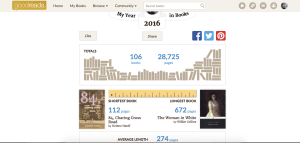
As is my custom on this last post of the year I’ll be revisiting the books that made an especial difference to me in 2016. I record most books I finish on Goodreads, and I welcome friends in that venue. I draw on their recollection for what I’ve read and all of the books I mention here have individual posts on this blog. Use the search function. It’s free!

screen-shot-2016-12-30-at-4-50-39-am

The first important book was Scott W. Gustafson’s At the Altar of Wall Street. If you missed this one, it is well worth your time. Economics has become a religion. If you doubt that, look at 11/9 and tell me so. Philip Gulley’s The Quaker Way was also an early read that’s worth revisiting. November has made many of these books more important than they seemed at the time. Whitley Strieber and Jeffrey Kripal’s The Super Natural will expand the minds of those who allow for unconventional possibilities. And Marc Bekoff’s Minding Animals will remind us we’re not alone on this planet. The Soul of an Octopus by Sy Montgomery was a book I really couldn’t put down, and a nice complement to Bekoff. Marcelo Gleiser touched a chord with The Simple Beauty of the Unexpected, a book worthy of anyone who wants to consider how science and humanity might cooperate for everyone’s benefit. While not really a reading-through book, Tristan Gooley’s The Lost Art of Reading Nature’s Signs is important and worthy of attention.

In the realm of monsters, Elizabeth Baer’s The Golem Redux was a fantastic introduction to a Jewish legend that I revisited in three more books over the year. Several other monster books followed, but especially memorable were Carol Clover’s Men, Women, and Chainsaws, and Maya Barzilai’s Golem—please be patient with me regarding this one. I haven’t written a post on it yet, since an official review has yet to be published. Alexandra Petri’s A Field Guide to Awkward Silences won her an instant fan. I’ll read anything she writes. I didn’t give Alice Miller’s The Drama of the Gifted Child the attention it deserves. It’s kind of a personal thing. Kyle Arnold’s The Divine Madness of Philip K. Dick was utterly fascinating, looking at another person Miller would have found intriguing. Also on the topic of writers, Melville’s Bibles by Ilana Pardes spoke deeply to me.

For fiction, highly recommended are Amy Tomson’s The Color of Distance, Peter Rock’s My Abandonment, Emily St. John Mandel’s Station Eleven, Toni Morrison’s, The Bluest Eye, Pete Hamill’s Snow in August, and Jennifer McMahon’s The Winter People. Less profound, but thoroughly enjoyable were Jonathan L. Howard’s Carter and Lovecraft, and Jasper Fforde’s The Woman Who Died a Lot (reading anything by Jasper Fforde is time well spent). My childhood favorite, Lester del Rey’s Day of the Giants retains its magic.

According to Goodreads, I finished 106 this year. Along the way I finished the 2016 Modern Mrs. Darcy reading challenge. Many of the books were excellent, and this shortlist represents those that idiosyncratically stick out in my mind. Please participate in a show of hope for the future: make 2017 a year of reading.


Prejudicial Monsters

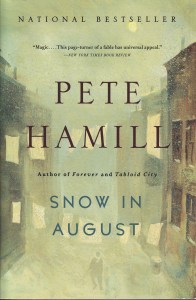
snowinaugustWitnessing injustice is traumatic. Especially when you’ve been conditioned to believe there is nothing you can do about it. That helpless feeling crushes you as you see the guilty, the powerful, the cruel getting away with whatever they want to do. This is the perspective of young Michael Devlin in Snow in August. Pete Hamill’s novel is full of observations about prejudice and ignorant blustering about those who are different in 1940’s New York City. Michael accidentally observes a robbery that may also be a murder. The perpetrator, an older boy who leads a gang in Brooklyn, hates Jews. Michael, however, has become the shabbos goy for a synagogue that has seen better days. Although a Catholic, he is curious about this strange rabbi he comes to know and what this other religion teaches. At the same time, Jackie Robinson is being called up to the Brooklyn Dodgers and prejudice about an African American playing in the major leagues sets up a parallel to the story of understanding the Jews.

It is an engrossing novel. I have to confess, however, that I read it because of the golem. A traditional Jewish monster, the golem is an animated being of mud that protects oppressed Jews. In the novel this begins as a legend Rabbi Hirsch tells the boy as they teach each other their native languages. Michael learns Yiddish as the rabbi learns English, and the story of the golem is part of the rabbi’s own sad history as a Jew during Nazi days. Then as Michael, his mother, and the rabbi are all beaten or molested by the gang, it is time for the golem to make his appearance.

Not exactly a monster story—as often in such cases the monster is someone recognized as fully human but without sympathy for those who are different—Snow in August is a thoughtful, almost nostalgic tale of “a simpler time.” What we learn, however, is that it wasn’t really simpler at all. Prejudice could be worn openly and proudly. What many of us may have forgotten, until recent elections forced us to remember, is that such hateful intolerance is still very common. We live in a world where hatred can be currency and bigotry has more power than we’d like to admit. Reading stories, such as Snow in August, will become increasingly important in days ahead. We will need to remind each other that even if only as metaphors golems do indeed exist. All we have to do is believe.


Bible Riots

One of the more embarrassing questions I get asked is “What do you do?” This has been true throughout my career (if what I do can be called that). I should clarify—I don’t mind saying “I’m a professor,” or “I’m an editor”—it’s the follow-up question that’s difficult. “What do you teach/edit?” Mentioning the Bible is a conversation-stopper. In the silence that inevitably follows you can almost hear the electronic buzzing in the interlocutor’s brain as s/he tries to come up with something nice to say while backing away. In actual fact my degrees have been more in the history of religions rather than Bible per se, but those who’ve done the hiring haven’t tended to see it that way. This is not a nostalgic post, asking to go back to yesteryear (that’s happening politically without my help), but it is a reflection of what James Wallace Harris says on BookRiot—the Bible is a good book to read.

It’s easy to get swept away in the criticism of religion, and particularly Christianity. Those who profess it, historically, have a lot to answer for. What we’ve allowed religion to do to others is inexcusable. What we sometimes miss is that the motivation is one in which all people participate—learning the truth. This is more difficult than it might seem. If someone had discovered “the truth” we’d all know by now. The fact is we’re deeply divided about what that truth is and that alone proves no one has found it. We’ll recognize it when we see it. We just haven’t seen it yet. What sometimes gets forgotten along the way is that the Bible was, and is, a great milestone of humanity’s search. As I keep having to remind myself, there’s some really good stuff in there.

IMG_2634

Harris isn’t alone in suggesting that atheists should study the Bible. Some very prominent non-believers have declared the same thing from time to time. The Good Book is densely interwoven with western culture—even secular western culture. I’m currently at work on a book that explores one thread of that complex fabric, and it’s amazing to me how much we miss when we ignore holy writ. We shouldn’t throw out the baby with the bathwater, as the old saying goes. That’s not biblical, but it does hint at the truth, I think. Or maybe it’s just that I want to be able to answer that most basic of questions without having to make excuses for what otherwise looks like a series of poor life choices.


Evil That Men Do

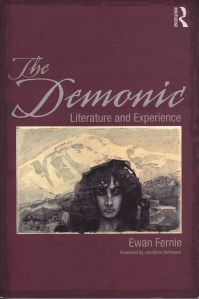
the-demonicTheologians, for the most part, gave up studying demons a long while ago. With the advent of modern medical science, the descriptions of demonic possession in the New Testament seemed pretty clearly to be cases of epilepsy. Since people in antiquity had no means to study brains electro-chemically, there was no recourse for them to understand the sudden changes in behavior that often accompany seizures. They drew on what their culture knew—malevolent spirits—to explain this disturbing behavior. Ewan Fernie takes a different approach in The Demonic: Literature and Experience. As an English professor, he looks at both demons and the demonic in mostly English literature, often focusing on the adjective more than the noun. There is a great deal of insight in this study and characters the reader may or may not recognize seem to fit fairly easily into the category as described by the author. Indeed, God and the Devil appear much closer than many religious readers would feel comfortable seeing them.

Although I enjoy reading about literature, my favorite chapter in this book was the treatment of Martin Luther. Not having grown up Lutheran, I feel that I don’t know the great reformer well enough. The anniversary of his 95 Theses is coming up next year and there’s a lot of attention being paid to the former monk right now. Even despite this, he was a fascinating figure who firmly believed in diabolical activity in the world. Indeed, much of what science would eventually strip away he saw as evidence of the demonic. Other theologians who’ve followed him built on these same ideas. The Dark Ages were the high point of official demonology, after all.

Writers since Luther, many of them touting fiction, also latched onto the concept of the demonic as a great explanation for “the evil that men do.” Quite often Fernie traces them to Shakespeare, the anniversary of whose death is quickly drawing to a close. The Reformation would’ve been much closer to the Bard than it seems to us. Demons were still around and available for all varieties of nastiness against human beings. Fernie makes the point that the association of the demonic and sexuality became more pronounced over time. We see this even today in possession movies. The origins of the ideas, however, are more complex than they might seem. The Demonic will give the reader plenty to think about in this season of long nights and short days and the basic confusion running rampant over what is good and what is evil.


Engendering Fear

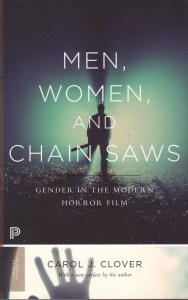
menwomenchainsawWe live in fear. At this point in history, it seems, with good reason. Horror films, apart from being considered low art, teach us to deal with some of these fears. I hadn’t been reading about the genre for very long before I began to notice the repeated references to Men, Women, and Chainsaws: Gender in the Modern Horror Film. This is Carol J. Clover’s seminal study of gender theory and horror. Probably best known for first identifying the trope of “the final girl,” Clover gives much more than that to the conscientious reader. Her chapter on possession movies is among the most insightful that I’ve read. And yes, she does make a very good case for the final girl.

Using theories of gender, she explores why both boys and girls (the former numerically more obvious) flock to such disturbing movies. Although she suggests masochism has something to do with it, is isn’t simply that boys enjoy seeing girls suffer. Quite the opposite. Boys often see themselves in the place of female victims. As with most things associated with gender, it’s far more complicated than it seems. In that sense, this is a book for our time. We live in what George Banks calls “the age of men,” and while Mary Poppins can hardly be called horror, the underlying narrative bears some warning tones. Men, left to their own devices, will seize what power they can grasp. We’ve spent the last five decades teaching men that this is no longer appropriate, only to have that message wiped away with the final trump. Horror can be remarkably pro-feminine. Business, as we’ve seen over and over, is less so.

Not having ever formally studied gender theory, some of the intricacies of Clover’s argumentation were no doubt lost on me. I was, however, able to gather a remarkable amount of appreciation for the subtexts in many of the movies I’ve watched. Gender, you see, touches everything we do. It behooves us to be aware that careless, or thoughtless support of misogyny does not lead to the results that many men suppose. Some horror movies are truly difficult to watch. Not all conform to the standard expectations. What Clover has shown, however, is that often the women are able to draw from a depth of strength to which the male characters lack access. They don’t do so willingly. In fact, they are often reluctant. When the horror is at its end, however, the final girl emerges triumphant.


Publishing Weakly

Those of you who aren’t professional religionists might not understand the cultural impact of the American Academy of Religion and Society of Biblical Literature annual meeting. Every November a largish city (New York and Los Angeles are too expensive, but many of the other biggies have hosted us) is inundated with religion scholars. Nearly a literal myriad of them. Church attendance spikes, that weekend, as do the takings in the local bars. Restaurants near convention centers are swamped and tips, I expect, aren’t that great. And publishers show up in spades. We tout our recent books, attractively displayed for the book-hungry, and hope the cash rolls in. It’s not a cheap conference to which to send your staff. Books, though, make you think and we have to get our ideas out there.

img_3042

The conference is big enough for the book industry that Publishers Weekly, a standard periodical for the biz, generally has a story about it. Even when people were worried about the election results, we had to get together and discuss what’s God got to do with it. Or so it would seem. In the story by Emma Koonse and Lynn Garrett, it is noted that InterVarsity Press, a stalwart of conservative Christian publishing, has generated its own Trump-like crisis. Owned by InterVarsity Christian Fellowship, the press has been instructed that anyone who disagrees with the parent company’s stance against gay marriage must resign. They hasten to add that this doesn’t apply to their authors. There is such a thing as a double-standard, you know. You need to bring in that money, otherwise you can’t afford to oppress your employees.

The idea behind publishing is that ideas should be—must be—shared. There is an educational imperative. Many IVP readers may be surprised to learn that the Bible says nothing about gay marriage. I’m pretty sure it doesn’t mention Donald Trump either, although reading the account of Balaam I might have to admit being wrong about that. It’s funny what you can make the Bible say when your theology is merely thinly veiled prejudice. Perhaps we should put belief meters on our government houses. Of course, if we did that I’m not sure the national budget could cover the cost of all the lie detectors they’d need to install as well. Publishers, of all people, should be the ones with the most open minds. Unless they find the wallet more compelling than the truth. Let’s just ask Jesus’ wife about that.


Monsters and Men

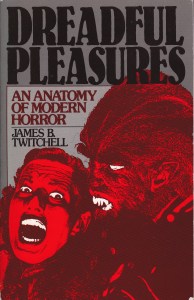
dreadful-pleasuresHorror films are something you either “get” or you don’t. I have no empirical evidence for that, but then again, “getting” is hardly a precise verb. In my recent desire to find some explanation for my own fascination with the genre, I turned to James B. Twitchell’s Dreadful Pleasures: An Anatomy of Modern Horror. This is a smart book. Twitchell, an English professor, knows to include Gothic novels in his accounting for this strange addiction. He has several insightful things to say about the differences between terror and horror. He gives a fairly complete analysis of the “big three”—vampires, Frankenstein monsters, and werewolves/wolf men/Jekyll and Hydes. Still, at the end, I have to wonder if he really “gets” the monsters he explores. Part of this is his early admission that he didn’t grow up with monsters, but that he was introduced to them academically. Another part of it is his sometimes dismissive style when talking about movies that meant a great deal to us monster boomers when they came out. Either you get it or you don’t.

Still, I recommend this book for those who want to make sense of some of the hidden dynamics of classic monsters. That the analysis is sexual should come as no surprise. Twitchell finds evidence for a sublimated incest in many of his creatures, but the true fan knows there is more to them than that. The monster does indeed cross boundaries—that’s what monsters do, after all—but that’s only scratching the surface with their claws. Of course, the book suffers from having been written perhaps a little too early. Although there is protest to the contrary, horror films have grown up considerably since the 1980s. Not all of them, of course. The same thing could be said of the kids I knew in high school.

Having a single theory to approach a phenomenon is respectable. So respectable that it’s called Occam’s Razor and everyone is expected to shave with it. I’ve never liked shaving. The more I reflect on reality, the more it seems to me that answers are more complex than single causation. Sometimes the simplest answer isn’t the most parsimonious. Sometimes there is far more going on than meets the cyclops’ eye. In my experience, limited though it may be, the horror movie has unexplored dimensions. One of them is the coping ability that they offer when evens such as 11/9 occur. There’s no simple way to understand monsters, but if we see them around enough, we might just be able to survive them.