The Canine Mystique

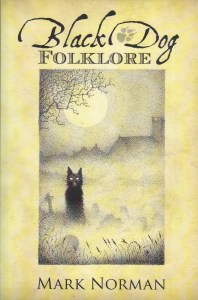
BlackDogAnyone who spends long enough in the United Kingdom will hear about them. Not everyone believes in them, but reports of their presence are pervasive. Some call them ghosts while others call them protective spirits. They are the black dogs. As Mark Norman points out in his new book Black Dog Folklore, the tales of these spectral canines go back centuries and they also appear in other parts of the world. The majority of the lore comes from the British Isles and even there they are concentrated into certain parts of the country. Norman isn’t setting out to prove that they exist, though. This book is an exploration of folklore and the question of the reality of the phenomenon isn’t the point. The fact is people have reported encountering similar kinds of black dogs that vanish in similar ways frequently enough that secondary characteristics can be described and the accounts can be treated as lore.

Dogs were the earliest domesticated animals. Long before cattle and sheep could be tamed, humans and dogs had learned the mutual benefits of each other’s company. This very long association between species has, however, not always been smooth. Dogs retain something of the ancestral wolf in their nature, even as we harbor our inner ape. Some people fear dogs, and indeed, dogs are still used for security and can be trained to attack, or even kill, people. Their millennia-long association with humans, however, has assured them a place in our mythologies. Ancient cultures frequently mythologize dogs, making them prime candidates for an afterlife in folklore.

Traditionally, dogs are chthonian creatures. That word tripped me up the first time I encountered it. “Chthonian” is literally something like “of the earth,” but in mythology it is used to designate that they are associated with the underworld. As in life, dogs may act as guides in mythology, and one of their regular associations is with the realm of the dead. It’s no wonder, then, that dogs came to be associated with ghosts. As Norman demonstrates, the lore was pervasive enough to engage Sherlock Holmes in The Hound of the Baskervilles, and perhaps even Bram Stoker used the image in Dracula. Winston Churchill referred to his depression as a black dog. Norman’s book won’t convince the reader that such things actually exist, but what it does do is draw the tales together to determine what there is to analyze. Since dogs have been our companions for so long, they have become part of our narrative tradition, participating in what it means to be human. As with all good folklore, there are those today who still swear these spectral dogs still haunt those who are willing to believe.

Consciousness Times Eight

SoulOctopusPerhaps the characteristic that marks our species most distinctly is its arrogance. Conscious of who we are (we think) we stake the claim for minds for ourselves alone while all the evidence points away from that very conclusion. Naturalists are castigated for “anthropomorphizing” animals by stating that they have consciousness too, or—oh the heresy!—personality. Any of us who’ve spent time with two or more of the same non-human species, however, know that personality is a given. Animals think and feel and, yes, act on their own view of the world. I have to admit I fell in love with Sy Montgomery’s The Soul of an Octopus. I’ve read animal books from my youngest days, but finding an author so forthright about the feeling of getting to know another species is rare. And I learned tentacles full of information about octopuses. I had already known that octopuses are intelligent—I hadn’t realized just how smart—but since my interactions have only been with sleeping cephalopods on the opposite sides of aquaria glass, I had little to go by.

Throughout her charming book, even if the evidence is anecdotal, Montgomery reveals the personalities of the octopuses she got to know at the New England Aquarium. The reader can be left with no doubt that these are animals with personality, different from one another and strikingly conscious. We can’t define what consciousness is, but I tend to agree with Montgomery that it is what many people call “soul.” She admits that her religious tradition would likely frown upon her willingness to share such a valued commodity with an animal—an invertebrate, no less—but surely she is right. Many, if not all, animals have a form of consciousness. Heaven will be a much more interesting place for it.

Please don’t confuse my enthusiasm with sentimentalism. Those of you who regularly read this blog will know that books on animal intelligence by a variety of scientists make up a steady part of my literary diet. Biology, however, often has a difficult time in a world where physics and chemistry are treated with reductionistic glee. I was strangely satisfied when Montgomery mentioned that Stephen Hawking signed the Cambridge Declaration on Consciousness which proclaims humans alone are not the guardians of this phenomenon we don’t even understand. The Soul of an Octopus was one of those books that I couldn’t wait to keep reading, even if it meant being on my long commute each day. And I can’t help but think of how much intelligence we squander by claiming that only our own kind possesses it.


Up, Up and Away

OurSuperheroesIntellectuals often have difficulty, it seems, taking popular culture seriously.  I remember feeling slightly guilty taking a class on Science Fiction in college and actually getting credit for it.  At the time—I remember the Dark Ages—a course on comic books, or even superheroes, would’ve been laughed out of the academy.  And not in a good way.  Monsters, likewise, were considered the opiate of the small-minded.  I’m not sure what happened to turn all of this around, but I think my generation growing up may have had something to do with it.  Scholars began to pay attention to more than the cheap paper and eye-catching, if impractical, costumes.  There were, unnoticed by standard readers, messages embedded in comics.  Superheroes may have been telling us something about ourselves.  Now tenured professors can write about various caped crusaders without fear of ridicule.  Some of the books are quite good.

Robin S. Rosenberg’s Our Superheroes, Ourselves, is a rare example of a uniformly fascinating edited volume.  Contributions from a variety of psychologists and psychologists explore several of the deeper aspects of  the superhero phenomenon.  Insightful and thought-provoking, this little book gives the lie to the frequent admonition of my youth that reading such things was a waste of time.  Anything but.  Now, I didn’t have the level of commitment to comics that Big Bang Theorists do, but I recall being entranced by much of what I read.  Some comic panels are still vivid in my head, although I haven’t seen the original in more decades than I’d like to admit.  They are, as one of the essays suggests, a form of modern mythology.  Another form of modern mythology is the movie.  Superhero movies are discussed as well as the print versions.  These cheap, easily read books were more, it seems, than meets the eye.  I’ve fallen a little behind in my superhero movies, but perhaps it is time to start trying to catch up with Superman.

What is really striking, to me, is the discussion of super-villains.  As more than one contributor points out, you can’t have a superhero without the nemesis of an arch-criminal.  This quite naturally leads to the discussion of abstracts: good and evil.  Early comics tended to be Manichaean in this regard.  In our world evil may be much more subtle than it appears on the outside. The book appropriately ends with a reflection on morality. More than one ethical system may be found in superhero tales. Super-villains, apart from becoming role models for some political candidates, allow us to explore our own dark sides. In the end, however, we know that Batman must overcome the Joker, no matter how appealing he may be.


Biblical Literature

HB as LitIt must be difficult to write a Very Short Introduction. Although the series is published by Oxford University Press, I’m not being a shill. As someone who writes the equivalent of several of these little books a year, I imagine it must be nearly impossible to confine what you need to say to such a small space. I recently read The Hebrew Bible as Literature: A Very Short Introduction, by Tod Linafelt, and I imagined the anguish of my colleague as he had to decide what to leave out. Professors these days appreciate short books because there is an actual chance that students might read them. The Bible itself is intimidating as a textbook—massive and brooding as it is. Then, in addition to the Ding an Sich, the instructor also has to provide interpretive tools. One of the most common these days is that of the Bible as literature.

This obvious assignment is not without dispute, however. Literature is defined by some as a secular category. The Bible, as a set of one, is a holy book. That is to say, it can’t be considered literature at all. As a collection of written texts, however, the Bible can be understood as a literary venture as well as a sacerdotal one, and for many schools this is the only way the Bible can be legally taught. Not only that, but almost all scholars now realize that, protestations aside, the Bible is literature. It is one of the great books of the western canon. Civilization for huge swaths of the planet was based, in some way, on this book (the Bible, that is). Understanding it as literature is the venture of a lifetime, and condensing that down to an easily digestible Very Short Introduction is no mean task. Linafelt performs his duty admirably. The basics of prose and poetry are covered, as well as their interaction. The examples he chooses are compelling and I learned quite a bit myself, even having taught the Bible many years.

As I read, it struck me that the main objection to the Bible as literature revolves around the concept of truth. Linafelt raises this question early, and it stayed with me throughout the book. In a kind of sacred exceptionalism, “Bible believers” treat literature literally. Ironically, this can lead to grave misunderstandings. Truth, however, is a difficult concept to pin down. Many people equate literature with fiction and truth with fact. Truth is actually a bit more fluid than that. As any poet knows, some truths can’t be expressed in prose. Or history. Or philosophy. And some truths are best expressed in fiction. That brings us back to literature as a form of truth. I suppose that’s a good thing too, because were I to write much more I might be in danger of accidentally composing a Very Short Introduction. As long as I’m being a shill, just consider this a very short introduction to a Very Short Introduction.


For the Dogs

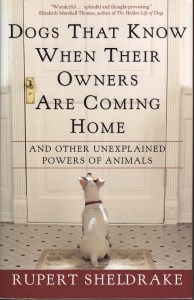
DogsThatKnowYou know that feeling of being dropped into a very strange place?  Sure, it’s disorienting for a while, but once you get used to it, you start to enjoy your surroundings.  Now ask yourself: what if my entire way of looking at life is based on a faulty paradigm?  Many, I suspect, will drop out at that point.  There’s strange, and then there’s going too far.  For those wedded to the idea of finding the truth, however, weirdness is part of the journey.  I just finished reading Rupert Sheldrake’s Dogs That Know When Their Owners Are Coming Home.  Yes, it felt like the room was spinning (actually, I read it on the bus, so that might’ve been true a time or two), but it confirmed something I’ve suspected for many years.  The reigning, mechanistic universe paradigm is wrong.  Please don’t take this as an anti-science statement.  Sheldrake is a bona fide scientist, and I’m an avid reader of science books.  It’s not so much that science is wrong as it is that science doesn’t go far enough.  Ever since the Industrial Revolution—not coincidentally—we’ve been informed that the universe is really a giant machine.  We can figure out how it works using this squishy stuff in our heads that insists we can find Pokemon everywhere we look when it’s not busy solving the riddles of the mulitverse.

Sheldrake, who is given a wide berth by many scientists, states what any of us who grew up with pets knows: they know more than they’re saying.  Admitting up front that much of the evidence is anecdotal, Sheldrake provides empirical studies to demonstrate what folk say.  Dogs do know when their owners are coming home, before they are within sight, hearing, or smelling range.  His study, however, isn’t limited to dogs or to knowing when someone’s coming.  Animals, by virtue of their own minds, have abilities that we do not.  Since they don’t speak our language, we assume they are dumb.  In fact, as this book shows, a great many animals know a great deal more than we do.  The question is, if this is the truth why don’t we hear more about it?

We prefer, it seems, our truth to be qualified.  There’s a lot at stake here.  The reigning paradigm keeps us plugged into this corporate machine we’ve devised.  Our lifestyle cannot subsist without the subordination of animals.  We can’t give them abilities we lack, apart from tastiness.  If the universe isn’t a machine, it might open the door for a broader view of reality.  Maybe it is better to be post-Christian, but religion has proven benefits to humans (and perhaps animals).  Why does religion remain in a mechanistic universe?  Perhaps what we call “souls” are the same as “minds” and perhaps they aren’t the same as brains.  If we really do have minds, it is in our best interest to care for them, develop them, and improve them.  It may seem like a strange world indeed where your dog informs your view of reality.  Read Dogs That Know When Their Owners Are Coming Home, however, and see if you don’t find yourself wagging your tale, just a bit.


Nazi Religion

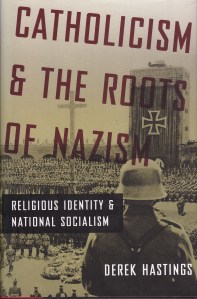
CatholicismRootsAs a lifelong pacifist, I’ve never been a fan of war books. Indeed, war seems to be to an utterly useless waste of life and a source of herculean suffering. The fact that wars happen, and books about them depress me, causes me to avoid them. Still, Derek Hastings’ Catholicism and the Roots of Nazism is less about war and more about, as the subtitle phrases it, Religious Identity and National Socialism. As I read through this history of the early Nazi movement, it occurred to me that this was probably the first actual book I’ve ever read about it. My knowledge of the Nazis had previously come from articles, movies, and documentaries. And Hogan’s Heroes. Being largely of germanic pedigree, I suppose I bear some residual guilt. I have to remind myself that my ancestors had left Europe before Germany had even existed as a unified state. I like to think they would’ve left during the rise of the Nazis, if they hadn’t already left generations before.

In any case, I had no idea of how the Third Reich dealt with organized religion. I have heard anecdotal opinions from time to time that the Catholic Church should have been stronger in its condemnation of the atrocities that wartime Germany perpetrated, but I had no sense of their official outlook toward each other. Hastings makes clear that although Catholicism and Nazism came to distrust each other implicitly, at the beginning of the Nazi movement they were considerably more chummy. In fact, anti-Semitism was something they had in common. Many of the early member of the party were Catholics—some of them priests—who felt an accord with the developing ideology. As Hitler’s rise to power increased, his personal antipathy to Christianity widened the growing gap between his own outlook and that of the early Catholic Nazis.

The book has no schadenfreude for the church, however. This is academic history. As Hastings notes, few studies have focused on the early developments of Nazism. In today’s political climate, that struck a chord with me. It seems vitally important to be aware of how such movements start so that we can recognize them as they attempt to rise again. I have little confidence, reading the news, that we are any better in the 2010s than people were in the 1920s when political instability, economic distress, and hatred of those who were different led to a reactionary, fascist regime. Could it happen again? I look around at a culture in love with guns and endless, selfish gain, and distrust of those of different ethnic origins and I wonder. The early stages are, I think, the most crucial to recognize. Surely no German Catholics could’ve anticipated just what Nazism would become.


Joban Vampires

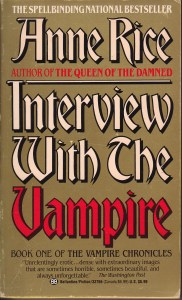
Interview VampireThe first vampire novel I ever read, I remember correctly, was one of the Dark Shadows series written by Marilyn Ross. I don’t recall which one, since I had to buy my books from Goodwill or some such vender utilized by the poor. Now, I’m really a squeamish guy and the sight of blood bothers me. Barnabas Collins, however, was a compelling character—deeply conflicted and a reluctant vampire. The combination of his sadness and the setting in coastal Maine kept me looking for Dark Shadows books every time we went shopping. It surprised me, given all that, that I had such difficulty getting into Anne Rice’s Interview with the Vampire. I started reading it years ago (it was also a second-hand copy, and, interestingly, the color scheme of the cover nearly matched Dark Shadows novels) and some eighty pages in put it down only to forget about it. Starting from the beginning a few weeks ago, I gave it another try. Although Louis is a conflicted vampire, the pace is languid and it was almost as if the self-pity was overdone. I was determined this time, however, to see it through.

One of the recurring themes of the book, and I presume the Vampire Chronicles series, is that vampires are not evil because of the Devil. In fact, there is nothing Satanic about them. Blame tends to fall on God for their state. The more I thought about it, the more the theodicy of the vampire began to resemble that of Job. Like Job, death for a vampire takes a long time. There is much suffering along the way. Louis can love, in a measure, and can loath himself. He never really understands what it is to be a vampire. The other undead he meets help to define him, but he can’t get too close. His life is a kind of Hell without Satan.

Rice’s vampires don’t fear crucifixes or shun churches. In fact, Louis takes a priest as one of his victims, sacramentally near an altar in a church. Religious imagery and discussion abound in the book. It truly is a vampire theodicy. Perhaps, for its day, it was the next step in vampire evolution. Bram Stoker, while the most famous contributor to the modern vampire myth, didn’t corner the market on defining the undead. When Louis meets vampires of the old world, they are mindless, plodding killing machines that even other vampires avoid. Rice’s vampires feel, think, and yes, theologize. I feel strangely satisfied now that I’ve finally finished the Interview. It was a vampire at my bedside for so long that it feels like an accomplishment to have finally laid it to rest.


Kidnapped by Religion

The title is, unfortunately, not mine. My wife sent me a story on NPR entitled “Humility Is Embedded In Doing Science, But What About Spirituality?” by Barbara J. King. The piece is largely an interview with physicist Marcelo Gleiser about his new book, The Simple Beauty of the Unexpected. Of course, now it’s on my reading list. The interview treads the well-worn path of science versus religion. Science is presented as humble (which I don’t doubt, when in the right hands—or the right minds, rather) while religion is arrogant, claiming to know everything. Gleiser states that spirituality has been “kidnapped by religion” but still has a place in the life of a scientist. I wish there were more of them like Gleiser.

Now, I have to admit my data are limited. I read science books—I have since I was a teenager—but with a layman’s eye. My scientist dreams were dashed against the unyielding rocks of complex mathematics, something evolution cruelly withheld from my gray matter. I wouldn’t have survived high school pre-calc without my younger brother’s help. I’ve nevertheless read the pre-chewed, partly-digested science regurgitated for the formulaically challenged, and find myself, like Glieser, awed at the wonder of it all. Still, I also find many scientists—at least those with the loudest voices—claiming that what they’ve discovered is all there is. There is only matter, and we with our three-pound brains have figured it all out, by the gods, without the gods! We know all that can possibly be known will conform to the system our brains have developed, and there are no gods out there and no spirits in here and that pang you’re feeling in your gut is merely physiological, not spiritual.

I haven’t read The Simple Beauty of the Unexpected, but I have found many scientists walking the same trail I’m on. We are those who are seeking the truth, and who don’t assume the answers. Religion need not be arrogant. At its best, it’s not far from science. As a species, we have developed rationality extremely well (even if we fail to use it). Much of biological existence, however, is emotion, or feeling. That we sometimes leave behind. It participates in reality as much as rationality does. I’m reminded of this every time I hear someone in the business world refer to “soft” skills. What mere humans bring to this rationalistic business of making money. We’re just the squishy stuff that CEOs can’t live without because wealth mean nothing if you can’t compare it to someone else’s. Humility? I agree, Dr. Gleiser, we must maintain a sense of wonder. For those of you who say we’re just a number waiting to be quantified, I would humbly ask for 42, if it’s not already taken.

DSCN0633


Summer of Frankenstein

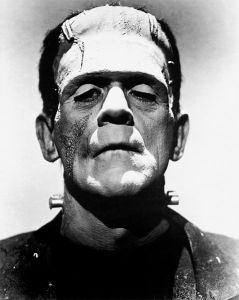
Two centuries can make an enormous difference. Just two-hundred years ago Napoleon’s defeat at Waterloo was merely one year in the past. North America and parts of Europe were experiencing “the year without a summer.” Perhaps due to that cool and rainy summer, when Mary Godwin and Percy Bysshe Shelley called on their friend Lord Byron, their thoughts turned to ghosts. According to the legend, together with Byron’s personal physician John Polidori, the friends spent a night writing scary stories. Polidori, although not widely remembered today, invented the vampire that would, in Bram Stoker’s hands, become the aristocratic Dracula, and eventually, with Anne Rice’s influence, Lestat, Louis, and Armand. Mary Godwin, soon to be Shelley, gave birth to perhaps the most successful of new monsters ever created—that of Victor Frankenstein’s construction. Many have claimed the monster’s pedigree to have been that of the golem, but Shelley’s creativity went beyond this forebear into the sympathetic misfit who, like all of us, never asked to be born. The two centuries since that summer have been haunted.

477px-Frankenstein's_monster_(Boris_Karloff)

Quite apart from the monster tale, Frankenstein is also about building that which we, in our hubris, can’t understand. Progress without forethought, as Epimetheus could never learn, housed immediate and very real dangers. The two centuries since Frankenstein have proven Mary Shelley a prophet. An early supporter of women’s equality, she profited from her novel, but never managed to thrive. Just six years later her famous future husband would die tragically in the Romantic genre of a shipwreck. Even with important friends, Mary found it difficult to capitalize on her success. The monster was real enough.

We’ve become accustomed to making things we can’t control. When’s the last time you were able to fix a car broken down by the road, apart from the occasional flat tire? Can you really stop your job from becoming completely different from what you signed up to do? What about when that bully wanders from the playground into the political field? Once you’ve figured out how to split an atom, you never forget. It may have been Napoleon still recently in the news, or the fact that 1816 failed to warm up like it was expected after the solstice. Perhaps it was the fact that Mary Godwin was a liberated woman in a world still utterly determined by men. We can’t know her intimate and ultimate reasons for creating a monster, but we do know that once the monster is unleashed we can never bind it again.


Popular Eternity

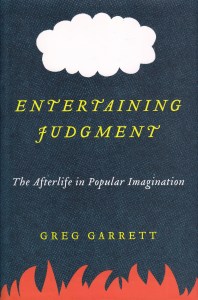
EntertainingJudgmentPopular culture, it seems to me, mediates reality. The media of various descriptions teach us what to think, and even if there is a religiously “orthodox” answer to questions, we will weigh it in the scales against what larger society says. This becomes clear in Greg Garrett’s Entertaining Judgment: The Afterlife in Popular Imagination. Garrett, a scholar of religion and popular culture, turns his attention to death in this book. More precisely, what happens after death. The usual suspects of ghosts, vampires, and zombies are here, but also the realms of Heaven, Hell, and for the Catholics in the house, Purgatory. All of these are seen through the various lenses of movies, television, song, comic books, regular books, and games. It’s fair to say that we’re a culture obsessed with death. But then again, what culture isn’t? It may be just that it comes across more charming when there’s a buck to be made at it.

What I found interesting is that although the Bible has little to say about Heaven or Hell (and nothing at all about Purgatory), each of these realms has developed a canonical script. Hell is hot and fiery, Heaven is cool and cloudy. Purgatory is gloomy, but beyond that comes in mild, medium, and hot varieties. We know these things from various teachings of our respective religions. In popular media, however, the script has been changing. We now have mild unpleasantness passing for Hell, if it lasts forever. Nobody needs to get burned. Heaven, meanwhile, can be just okay. It’s certainly better than the other place. Or the other two. We’ve overused our superlatives and have been left feeling like we’re on antidepressants.

Polls continue to tell us that many, if not most, Americans believe in literal Heavens and Hells. A point Garrett raises, however, is they may not mean by that what their clergy assert to be the case. Since near death experiences are controversial, nobody can say that they’ve actually been to either place, or the third. The exception to this rule is those who work in fiction—in whatever form. Since we can see their visions of the afterlife so clearly they have become the arbiters of eternity, with or without any religious training. In this day of marketplace religion and nones, Heaven and Hell seem to have become secular. The church may have introduced the ideas (actually, they seem to go back to the Zoroastrians, but I’m thinking of American culture) but the media have taken them over. We may be secular, but we still die. Entertaining Judgment might give you an idea of what to expect, depending on whose vision you buy.


True Fiction

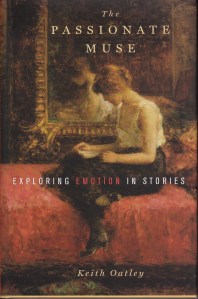
PassionMusesIn this world of rational materialism, people still turn to fiction. Some prefer it in the form of movies, television, or internet, but those of us “old school” like our fiction in print. No matter how we take it, fiction appeals to that part of us that makes us human—our range of emotions. This became clear to me in The Passionate Muse: Exploring Emotion in Stories. As a typical human, I spend a good part of my mental energy trying to make sense of things. Our social existence can be quite confusing and isn’t always rational. If you doubt this, read the headlines. Keith Oatley offers insight into psychology, or mental life in general, with this little book. We read stories because we like to find ourselves caught up in emotions. Successful writers can draw us into the fictional world not with reason, but with feeling. We seek emotional satisfaction and what we can’t do in fact, we can in fiction.

This aspect of human existence also plays into religious texts. Those of us raised to read sacred texts literally lose a lot of what they have to offer. Fact may tell us what to believe, but fiction helps us learn to feel. Thinking, as many cognitive scientists now believe, incorporates both rational and emotional information. Reality, in other words, isn’t purely reasonable. We interpret things. We interpret with our guts as much as with our heads. This combination of different ways of understanding the world—and the society—around us blends into a distinctly human milieu. We can’t reason our way out of emotions. They are who we are.

While teaching full-time I found myself turning to novels to recover from all the research I was doing. Reading only non-fiction (which, I suppose, is what The Passionate Muse might be) can lead to a lopsided view of life. I’ve had colleagues tell me that fiction is for others—non-academics, those who don’t have the weight of the intellectual world upon their shoulders all the time. Interestingly, since I’ve allowed myself to read more fiction I’ve discovered that the wisdom embedded in stories often surpasses that of erudite monographs. Scholarly literature, of course, has its place. Still, it leaves room on the plate for desert as well. Oatley builds his academic study around a fictional story he wrote to show what he wanted to tell. The rational meets the imaginative. I feel more human already.


Biological Imperative

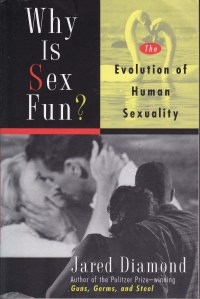
DiamondNothing used to make you feel smarter than being in a British bookstore. With that curious blend of proper, insane, and bawdy, books are displayed that you might find surprising. Alarming, even. Last year as I strolled around Blackwells in Oxford, I spied Why is Sex Fun?, by Jared Diamond. I mean, it was sitting right there, face-up, on a table with perfectly respectable, straight-laced books. Curious, but not curious enough to pick it up in a public place, I remembered the title so that I might find it on Amazon, where it could arrive in a nice, safe, opaque box. I finally stored up enough points on Amazon to get it, but then the problem was how to read it. I do a great deal of my reading on public transit—a place where you inordinately care what others might think of you. Finally, planning a seating strategy that would hide the cover by sitting on the left-hand side, next to the window, I took the book along, hoping it would keep me interested to and from work.

Subtitled The Evolution of Human Sexuality, the book isn’t salacious at all. It is scientific, but not clinical. I’ve mentioned before that all religions have something—quite a lot, usually—to say about sex. While religion doesn’t play into Diamond’s book, morality does. What I found interesting is his use of the phrase “God or Darwin,” which comes up a few places in the book. Diamond is a witty writer, and he explains that not all his phraseology is to be taken literally, but I appreciated his hedging his bets, nevertheless.

This book isn’t really titillating. In fact, it’s somewhat depressing. Perhaps it’s just phrasing again, but the production of offspring is described in economic terms. Resources, investment, efficiency, and the like. I think back to being a child. My family life wasn’t ideal, but I never thought of myself as anyone’s resource or investment. I was just me. That delusion stayed with me until I started working in the corporate world. I quickly discovered that others considered me a resource. “Human resources,” we call it. An investment. My efficiency was valued. Was it God or was it Darwin? Although I learned a lot from this little book, I wonder if it was worth the effort of having to hide the cover on the commute. After all, we’re all stuck together on this bus, units of investment, born to yield a profit. Why not have a little fun on the way?


Cryptology 46

From Wikimedia Commons

From Wikimedia Commons

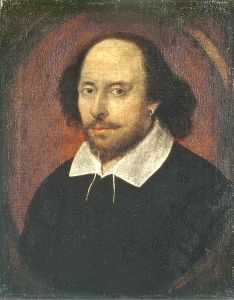
Four centuries ago this year William Shakespeare died. In the literary world there have been lots of commemorations going on, and all the fuss reminded me of a post I’d written some years back concerning Psalm 46. While teaching at Nashotah House, one of my students told me that William Shakespeare had covertly been involved in the translation of the King James Bible. The King James Version appeared in 1611, and Shakespeare was the prominent writer of England in that era. If you look at Psalm 46 in that version and count the 46th word from the beginning, you find “shake,” and the 46th word from the end is “spear.” I mentioned in my post that I’d not found any academic treatment of the issue and I’m happy to announce that I finally have. Of course it would be in an Oxford University Press book.

I’ve not read Hannibal Hamlin’s The Bible in Shakespeare, but I am able to glance through it at work. It turns out that I didn’t have the full details of this biblical urban legend. Apparently if you find the sixth and seventh words of verse 10 of that Psalm you find “I am.” The sixth and seventh words from the end are “will I.” Will.i.am would be proud (pardon the capital W). As much fun as all this evangelical exegesis might be, Hamlin calls shenanigans on it all. He demonstrates the literary history of the tale, pointing out that—not to spoil our fun—the cryptographic mentions of the Bard in the Bible are creative efforts of those of later generations. The interesting thing is, however, that the Bible is so closely scrutinized for codes that all kinds of hidden messages may be found. Look, for example, at what I discovered:

“For the Lord himself shall descend from heaven with a shout, with the voice of the archangel, and with the trump of God: and the dead in Christ shall rise first.” I don’t know about you, but to me this is clearly Paul warning the first Thessalonians of the present day’s troubles. When Trump is elected the dead will walk. Could anything be more prophetic than that? I haven’t done the math yet, but I’m just sure if you count the millions of letters in the Bible, you’ll find the name “Donald” spelled out somewhere. Scripture, after all, is the repository of all truth. One thing you won’t find, however, no matter how deeply you look. The billionaire’s tax returns are something God himself will never be able to see.


Philosophies of Reading

I like my Starter. For those of you unaccustomed to New Jersey Transit buses and their ways, a Starter is a person who makes sure the buses scheduled to arrive at her or his gate do so on time. It’s not a job for the faint-hearted. If a bus is late, or AWOL, the Starter takes the heat from angry would-be passengers. Since they’re present “on the ground,” angry people lash out with their frustration. My regular Starter recognizes me. I’m usually early in my line, so I appear about the same place most days. My routine is, well, routine. I get to the Port Authority Bus Terminal, pull out my book, and read. Starters can’t really get involved in anything like a book because their job requires constant interruptions. Even when no buses are coming in because of an accident in the Lincoln Tunnel, they still have to answer questions and hold up the occasional crucifix. My Starter came to me the other day, as I was reading, and asked me what I thought of an incident four days earlier. To put this in context, the incident happened on Friday. I was there for it, in my usual spot, and this was Tuesday. Clearly it still bothered the Starter that someone had come out and yelled at him for not getting us a bus on time.

I sympathized. Starters can’t materialize objects. If they could, they wouldn’t be Starters. Yet, I realized as I turned back to my book, that I had lost some reading time. I don’t mind helping out my Starter, but it occurred to me that there are a couple of different philosophies behind reading while waiting for, and on, the bus. Many people, I suspect, read to pass the time. I don’t know what they’re reading, since much of it is on a flat device, but knowing that research reading is nearly impossible on the bus, I suspect they are just reading to make the weary time go quicker. Others, I know, read for content. For me, reading is very seldom passing time. I read because reading is what I want to do.

Commuting behavior isn’t conducive to my life choices. No longer do people sit quietly on the bus, respecting that inherent violence of awaking before 4 a.m. to try to get to the city before traffic inevitably makes you late. Devices make their unmuted bodily noises and glare in your face. The guy next to you pulls out his wide-screen laptop, while tapping away on his phone. Or pulls our her iPad to watch a movie with fast-paced images splashing in your face. The book is demanding company. Your time, your attention, your concentration are required to get the most out of it. I don’t mind supporting my Starter. I feel for the ennui of my fellow commuters. I also crave time alone with my books.

IMG_0899


Prophetic Shaman

Lewis EcstaticDon’t complain. So I’m told. Work with the system (i.e., the privileged), do your part, and most of all, don’t complain. What would Jeremiah do? Or any of the prophets? It seems to me that prophets had the job of calling out where society had gone wrong and doing so with a healthy dose of complaint. If you don’t call out evil, it only grows. Prophets come to mind because I’ve just finished reading I. M. Lewis’ Ecstatic Religion: A Study of Shamanism and Spirit Possession. Spirit possession is chic, at least in the horror movie industry, but if you get beyond the stereotypes, you soon learn that inspired, or ecstatic, religion is largely based on good possession. The gods can temporarily inhabit the shaman, and, as Lewis points out, there is often an element of the underprivileged being those who are visited by the gods. Interestingly enough, indigenous cultures that feature shamans—or shaman-like practitioners—accept the rebuke of the gods, even when it may be a thinly veiled attempt to right an obvious wrong.

Shamanism is a bit of a misnomer. Not really a religion, but a set of spiritual practices originating among the Tungus of Siberia, shamanism is now conveniently applied to native peoples around the world. In our love of easy classification, we like to say this belief is similar to that belief, so they must be a type of religion. In fact, however, “religion” is much more integrated into the daily lives of indigenous peoples and specific beliefs vary widely. Nevertheless, we understand possession and shamanism, and we apply them as categories to try to make sense of it all. Lewis does so with an anthropologist’s eye, finally in the last chapter addressing the psychological questions. It is often claimed, for instance, that shamanism is a form of mental illness. What seems clear to me is that shamans are responsible for preventing injustice from getting too far established.

And that brings me back to prophets. Prophets, particularly among those who study the Bible, are often seen as religious authorities. It seems to me that prophets, as opposed to priests, grew out of the untamed concern for justice typically exhibited by shamans. Priests are establishment religionists. They support the government and the government supports them. Temples are built. Religion is regularized. Prophets, however, can come from anywhere. They are liminal figures, complaining, in God’s name, when injustice appears. They don’t support the status quo just because it makes people comfortable. In other words, complaint is often the only way to make the divine will known. They are the heirs of the shamans. One thing that’s pretty obvious—whether you live in Siberia, Israel, or America—shamans are still sorely needed.