Paraleipomenon

EarnestI suspect, like most people, I missed quite a few classics in school. This was the ’70’s when new and experimental were still the rage. One of the must-reads I missed was Oscar Wilde’s The Importance of Being Earnest. As usual when approaching books like this, I’m delighted at the sheer number of famous lines I’ve repeatedly heard, whispering to myself, “So that’s where that comes from!” as I go. Since I expect you, my cultured reader, have walked on the Wilde side, I need not provide any of these lines here. I won’t even have to go over the plot. The edition I read, however, contained lines and scenes that did not make it into the canonical version. As an erstwhile writer, I know that final versions seldom resemble those that felt so magical at their penning. Cuts must be made. Editors must be satisfied. And so goes the life of the writer.

It was one of these cut lines that caught my eye. With Wilde’s keen wit, the clergy, represented by Dr. Chasuble. (For those liturgically challenged readers, a chasuble is a priestly vestment in the Roman and Anglican traditions.) In an unfortunately stricken scene the minister says, “I am compelled, like most of my brother clergy, to treat scientific subjects from the point of view of sentiment. But that is more impressive I think. Accurate knowledge is out of place in a pulpit. It is secular.” Accurate knowledge is secular. That thought stayed with me long after reading the out-takes and deleted scenes of the play. Those that remain contain priceless comments about the church and the dangers of christenings. This particular gem, from the cutting room floor, would be hilarious were it not so often true. It explains, for example, creationism.

It’s a fair wager that science remains, even today, a subject that flummoxes clergy and laity alike. It is the new revelation, after all. No truth cannot be reduced to numbers. Even my scribbling this post is mere electro-chemical signals jumping synapses like electro-chemical salmon dying to spawn. We’ve simply substituted one clergy for another. When’s the last time a preacher has been cited as an authority on anything? What with televangelists setting the bar (for anything we see on the media is necessarily representative), it stands to reason that no real intelligence lies here. By default we nod toward those who hold the paten and chalice of empirical evidence. As it is now, but never was, and shall be forever, amen. Who’s being earnest now?


Human, Nature

Wild EarthSomeone recently told me that a city blocks a certain vibration that people draw from contact with the earth. I know that vibration often sets off “new age” alarms, but this person was rational, scientific, and had grown up in New York City. I grew up in a town on the edge of the woods. We didn’t live on concrete. In fact, the floor of our shack was so thin in some places that you could see the actual soil underneath. Even our driveway was gravel. Although it was a dysfunctional family, I felt more connected to my planet back then. Wild Earth, Wild Soul: A Manual for Ecstatic Culture, by Bill Pfeiffer, is just what it says. It’s a manual for how to get back in touch with nature. Basing his ideas on those of indigenous cultures world-wide, with a healthy dose of shamanism, he explores the vibrations of the earth. I had, at times, to force myself to listen. He’s right about so much that I stayed with the narrative to the end.

Civilization comes with a price tag. A very high price tag. The rates have been set by a small group of “progressives” who operate with the idea—mistaken—that all nature is a machine. Physics, they claim, and chemistry, show that all of life is mathematical. Nothing in the universe doesn’t add up. But biology, as Pfeiffer repeatedly shows, often doesn’t. The mistake is as fundamental as it is reductionistic. Life isn’t quantifiable. Biology messes up the nice, neat system we’ve invented. Indigenous peoples, while not idealized, lived in much better harmony with the land, not over-exploiting. It was a sustainable existence. What “civilized” people wanted was more. More of everything. A surplus, in fact. Without that surplus there is no business, right? Capitalize on that!

We’ve lost touch with nature. Our “leaders” want to exploit it. Mine it, refine it, and make it “useful.” When’s the last time I looked at a tree just to appreciate it as nature? Civilization can’t envision a tree without an axe. If it grew it can be improved. Even our food has to be genetically modified because obviously nature can’t make a profit on its own. No, Wild Earth, Wild Soul hasn’t made the impact on the world it might have. I’d never have found it if it weren’t for a used book sale. That doesn’t mean, however, that it isn’t right. We need to dismantle. We are not electronic devices, as much as the internet tells you otherwise. I knew that as a child. And as my feet ache from walking over acres of concrete on my way to “work” I know it’s true. There are indeed good vibrations out there, but here they’re too deep under my feet to feel.


Stations, Everyone

Station11There has been a movement, of late, among some sci-fi authors, to envision a more optimistic future. I have always been a fan of dystopias, myself. Perhaps it’s the working-class mentality backed up by being raised in poverty speaking, but sometimes I feel that collapse is more fair than progress. What passes for progress, anyway. Maybe I’m thinking this way because I just finished Emily St. John Mandel’s Station Eleven. This book has been on my radar for some time since it is one of the more hopeful dystopias out there. The story of a group among the very few who survive banding into a traveling troop of musicians and thespians is about the most hopeful outcome I can imagine. Not a day passes when I don’t feel the effacement of humanity that has been slowly taking place since I first became aware of the world. Sure, I do appreciate the strides made in medicine. Of this internet, which is the only place anyone ever really sees me, I’m less sanguine. It has its benefits, but even Mandel mentions the cell-phone zombies that are all too real and as omnipresent as an omnipotent deity used to be.

Station Eleven has, as many dystopias do, a religious sect that emerges after society collapses. This element of bleak futures is actually very accurate, I anticipate. We’re constantly being told by the “intellectuals” of the public variety that religion is for weak-minded dreamers with milquetoast aspirations for fantasy. The fact is the vast majority of people in the world are religious. The numbers are nowhere even near close. If a pandemic were to wipe out all but one percent (and hopefully it wouldn’t be the one percenters that survive) those who remain would, without doubt, turn to religion. People are easily led in this area of life. Mandel gives us The Prophet. His vision of the world is not helpful, but he has no trouble gathering a following. He’s also somewhat messianic: child of a single parent, raised in Israel, he comes to bring a sword to a nation already prostrate in the dust. This is powerful stuff.

Societies that try to rebuild themselves after traumas quite often rely on religion. This is hardly surprising as civilization itself began as religions coalesced into temples and their priesthoods. What is surprising is that so many intelligent people today can’t see just how important religion is to our species. As I suggested before, part of this is that religion defies simple definition. It’s easy to belittle “magical” thinking when it’s assumed religion has to do only with the supernatural. Religion, however, reaches into whatever we believe. Some ideas in modern cosmology, derived from physicists and their mathematics, can look sort of religious when viewed from a certain angle. As those who write dystopias know, religion is complex. It may lead to massive destruction. Chances are, however, that if there are any human beings left to crawl out of whatever pit we dig, they will do so with religious ideas in their heads. As usual, the writers have foreseen it.


The Lure of the Dark Side

I have to confess that the easy self-publishing of ebooks is a real temptation sometimes. Perhaps it’s one of those inexplicable side-effects of earning a Ph.D., but sometimes you have the impression you have something to say and traditional publishers just don’t agree. In my work life I see many clever ideas that, well, let’s be frank, just won’t sell. Publishers do have to keep an eye on whether a book can earn back the money put into it, and sometimes a good idea leads to no cash payout. So when you can easily sign up online—you don’t even have to talk to anyone—and post your unedited words right on Amazon and call it a book, well, anyone can be an author. So I was looking up books with the terms “Bible” and “America” on Amazon when I came up with Donald Trump in the Bible Code. I found the self-designed cover frightening, and the sentiments expressed in the description grounds for terror. Then I noticed it was only 15 pages long. I’ve written student evaluations that were longer than that.

Trump

At three bucks, that’s—wait while I get my calculator—twenty cents a page. Now anyone who’s been able to read the original Bible Code and not cover a snicker or two will possibly find such a jeremiad palatable. After all, it’s a book! Somebody published it. Well, actually, all you need for self-publishing is an internet connection and at least one finger to type and click. Or a toe. You too can become an expert! No education required. Publishing fiction in such a format is one thing, but when people can’t tell a prestige publisher from a vanity press when it comes to factual material, we’re all in trouble.

There’s an old saying: “those who can’t do, teach.” I think I first came across this wisdom in a Peanuts cartoon, with all the gravitas that such implies. Editors, it seems, are not required for publishing. In fact, some of us who live by the word seem destined to die by the word. Even with connections I have trouble getting my ideas published. More than once I’ve lingered on Amazon’s CreateSpace page with my finger hovering over the mouse. Publication is one click away and some people make six digits a year publishing only on Amazon. Since I produce about 145,000 words a year on this blog alone (apart from my other writing), the urge is very strong at times. Then I look at that cover and I stay my finger as it hovers. I’ll wait a little longer. At least until November.


New World Witches

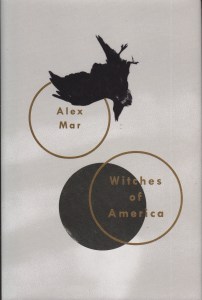
MarWitchOne of the most coveted phenomena in the publishing world is the bad review. Controversy sells a book like nothing else. It wasn’t because of the controversy, however, that I read Alex Mar’s Witches of America. Looking back, I wasn’t even sure of what to expect. Witches can mean many things and there is little one can do, beyond reading the blurbs and summaries (and who has time for that?) to know beforehand what a book’s really about. I like books about witches, so I just read it. I soon found myself engrossed in a spiritual memoir. Perhaps even more than books on witches, I’m drawn to women’s experience of religion. Many such accounts have haunted me over the years, but Mar’s story was different than most I’ve read. Women often write of escaping intolerant, priapic religions of a conservative stripe. Mar may be the first account I’ve read of a spiritual seeking becoming part of modern paganism.

The negative reviews largely focus on what they perceive as a false bill of goods. A woman passing herself off as an authentic seeker just to write a book that violates confidences. As a writer, and as someone who knows authors, I was a little taken aback at this. Those who know writers know they’re disruptive personalities. They look at things differently than most other people do. More than that, their experiences are subjective and must be explained in that vein. Some reviewers claim Mar was just wanting to write a book. Writers know that books write the authors. Spiritual experience is notoriously difficult to capture in words. I’ve read plenty of books about modern witchcraft, including the balanced, academic titles everyone commends. Mar was able, however, to explain the lure far better by taking a personal approach.

There are inherent dangers to sharing your innermost experiences. Other people are involved and honest perceptions will sometimes hurt. A writer finds it difficult to hold back. Spiritual experiences are something complex, multilayered, and scandalous. Often I was told, as an undergraduate at a conservative Christian college, that mystical experiences were to be avoided. They are powerful, frightening, and addictive. I can’t say if Mar violated any confidences, but it seems to me that the portraits she paints of witches are complimentary, and generally feel heartfelt. Then again, Christianity has been analyzed seven ways to Sunday, so it may feel like violation if a religion is still largely secretive. Were it not for the negative reviews, I would’ve never guessed that I’d read anything more shocking than the spiritual memoir that offers other ways of looking at what we think we already know. Oh, and did I mention the book was about witches?


Moving Mountains

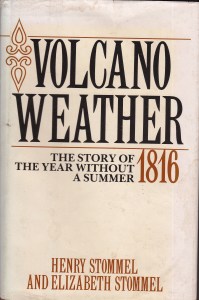
VolcanoWeatherJust 200 years ago, there was a “year without a summer.”  Well, that’s an exaggeration, but the name has stuck and is familiar to those of us with an undue interest in weather.  Although the coldness of that summer was far from universal, frosts came in New England in June, July, and August, killing off the staple corn crop for much of the region.  Snow fell even later than it usually does in the northeast, including a measurable fall in July.  My interest in this particular cooling episode was spurned by reading about the eruption of Krakatoa in 1883.  The connection?  Mount Tambora, a relative neighbor of Krakatoa, erupted in 1815 with an ejected debris volume of about ten times that of its later colleague.  The dust cloud from Tambora has long been a culprit for the dismal summer the following year.  Henry and Elizabeth Stommel researched and wrote a little book on this event entitled, Volcano Weather: The Story of 1816, the Year Without a Summer.  Although the book shows its age (it was written in the early 1980s), it remains a fascinating exploration of the many things that weather can do.  And has done.  Two of my favorites from this book were Napoleon’s adventures and the writing of Frankenstein by Mary Shelley during a rainy summer in Switzerland.
 
I should note, however, that the Stommels do not declare that Tambora was the reason for the year without a summer.  They tend to think the volcano had something to do with it, but the weather, that most protean of phenomena, can be impacted by the very small as well as the very large.  In fact, their description of the eruption includes the recognition that locals felt volcanic eruptions to be normal acts of the gods.  Many island cultures recognize the divine power of the molten earth.  The weather getting out of whack, we can be sure, leads to much prayer even today, thousands of miles from any eruption.  Something that hasn’t changed since the 1980s is that natural phenomena—especially powerful ones—evoke the divine.  Huge, impressive volcanoes, or even the very immensity and complexity of the atmosphere, suggest something we can’t comprehend.  Global warming will soon, however, bring this point home.
 

One of my takeaways from this book is the fact that the weather’s lack of uniformity emphasizes just how little we know.  The year without a summer mainly affected the northern hemisphere, and that only piecemeal.  Parts of northern Europe and North America felt it more intensely than other places.  It was not “the coldest year ever” and anyhow, is it even possible to know whether the coldest year would feel unnecessarily chilly where you are?  I’m pretty sure it’s snowing in some part of the world right now.  Human arrogance when it comes to global warming can be put into perspective by such acts of nature as Tambora.  From a human perspective, we live on a time bomb.  Volcanoes care not a whit for our bidding and wishes and dreams.  They can impact climate more instantly than our trite human efforts and thinking we alone are gods. To prepare for the future sometimes we need to look two centuries back.


Holy Castle

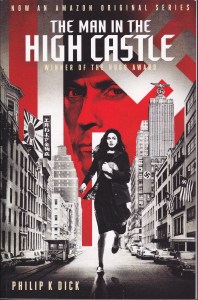
ManHighCastleReading about Philip K. Dick prompted me to read one of his novels. But which one? Some Amazon pick-up lockers on the way to work are painted with a mural of The Man in the High Castle. I haven’t seen the series, but there was the paperback, facing out, at the local independent. It’s been a while since I’ve read Dick, so I have to find my legs for his style. I’m surprised at just how much religious language he uses. Our cultural biases tend to insist that intelligent people aren’t hoodwinked by religion, but it does, nevertheless, appear. The premise of Dick’s novel is based largely on I Ching, the “Book of Changes.” Indeed, the conclusion of the novel relies heavily upon it. Along the way, however, Dick shows his sacred mettle when it comes to Judaism and Christianity as well. His prose is sprinkled with biblical quotes.

More than just a surface awareness, The Man in the High Castle offers some deep reflection for the reader. Mr. Baynes, seated on the rocket to San Francisco, ponders the Nazis who’ve won the Second World War. Reflecting on their hubris he considers how they’ve come to think of themselves as divine. “Man has not eaten God; God has eaten man.” This gave me cause for pause. Apart from Dick’s narrative, the idea of divine anthropophagy is in keeping with much human experience. We often consider ourselves masters of our own fates. Many, however, find themselves dangling like a spider from a web over the fire. Not that of Edwards’ Hell, but simply that of human circumstance. The Nazis didn’t win the battle, but listening to today’s political rhetoric, they may have won the war.

Nobusuke Tagomi explains to Baynes how I Ching, a 5000-year-old book, is alive. “As is the Christian Bible; many books are actually alive.” Far from poking fun, Dick suggests there may be something to all this mumbo-jumbo after all. We are conditioned to mock, dismiss, and ignore religion in this world where rationality leads to presidential races such as this one we’re currently suffering. Follow the trail back, I suggest. Look for clues. Philip K. Dick isn’t the only secular writer who knew more than the average person about what fascism looks like, and about the role of religion in its downfall. The novel may not be easy to read. It demands much of those who approach it. Nevertheless, it preserves the truth that many books, indeed, are alive.


The Devil Made Me

TheWitchesWitch-hunts, I suspect, will become all the rage again if a certain presidential candidate is elected. The fear of witches is not easily explained in a world driven by materialism, but certainly misogyny plays an unholy role in much of it. Stacy Schiff’s The Witches: Salem, 1692 has been selling well. Since my wife is one of the many descendants of the Towne family that suffered three witch accusations resulting in two executions (Rebecca Nurse, Mary Esty, and Sarah Cloyce) we read this book together. It is a detailed account of the year we went mad. A year when being different, especially not being Puritan, and not being male, was dangerous. Religious tolerance was not a gleam in the colonists’ eyes since religious freedom translated into not being forced into the government church, not allowing others the same privilege. Indeed, as Schiff points out, religious tolerance was considered by many to be a satanic idea. If ministers starved due to such freedom, it would be easy for Satan to take over. As it was, the Dark Prince seems to have done a pretty good job among the Puritans without such tolerance.

The idea of the Devil has been (and still is) the ultimate scapegoat. People in a capitalist society are naturally frustrated—surprisingly few see this—and frustration always seeks a reason for its own existence. That is patently clear at Salem: blame the Indians, blame the French, blame the Quakers, blame the women. Any and all may be agents of the Devil. Even the descriptions of the Lord of Darkness varied so much that, were he a human, no one could be quite sure who it was they saw. The Devil always takes the form of your enemy. All it takes is an influential clergy willing to push tense believers over the edge. Soon we begin building walls. Then we build gallows.

Religious tolerance has always been a frightening thought. Protestantism challenged a somewhat uniform Catholicism and the mite of a doubt burrowed deeply into peoples minds: is my religion the wrong one? Tolerating other religions means admitting that yours might be wrong. The logic that plays itself out is a terrifying one to some. Belief is never easily changed. States can’t stand dissenters. The only capital crime for which the federal government still executes citizens is treason. Treason sits uncomfortably on the other side of the coin whose obverse reads “tolerance.” You’d think that three centuries would be long enough to learn something. Unfortunately some lessons—often tragic ones for the powerless—have to be played out over and over before we start to comprehend that Satan can be anyone we want him to be.


Nature’s Voice

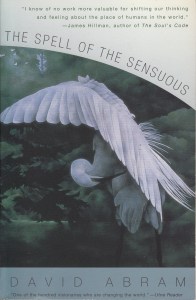
SpellSensuousCivilization isn’t all it’s cracked up to be. Sure, it’s got its moments—modern medicine, indoor plumbing, Honey Boo Boo—but often it’s artificial. It’s like somebody made up a set of silly rules and those who dare violate them are treasonous barbarians. Over the past few years I’ve been reading books that consider our biological development and what nature seems to indicate about how people might exist more holistically in the world. I don’t mean New Age outlooks, although, surprisingly, such treatments often aren’t far off base. I’d never heard of David Abram or his book The Spell of the Sensuous. (For those who think sensuous means only one thing, the subtitle is Perception and Language in a More-Then-Human World.) Although somewhat dated, this is an insightful book. The basic premise is that we are, by nature, part of a much larger world but we have, like spoiled children, decided to take it all for ourselves and isolate our species from all others, claiming a superiority that none dare challenge. In the process we’ve lost much of what it benefits us being animals, and have separated ourselves from the wonders of the world all around us. Working in Manhattan, I have to agree.

Basing his observations on having lived among aboriginal peoples, Abram notes that although anthropologists have denied the tenets of Christian missionaries on the religious front, they have continued in that teaching concerning biases against nature-based belief systems. Peoples who live close to the land observe things which seem superstitious to the “civilized,” but which are, in reality, simply astute realizations based on watching how the world works. Like Thomas Nagel, he notes that consciousness pervades the natural world. Animals, plants, even the earth itself displays forms of awareness that we ignore in our rush to exploit and gain “wealth.” In reality, we suffer for having made ourselves something we’re not.

There’s a lot in this book, far more than a single blog post can say. I don’t agree with all the points Abram makes—that writing may be responsible for our dilemma is a bit of a stretch—but there is great wisdom in this tome. At several points I had to stop and ponder the implications of what he was saying. Yes, nature speaks. Creating a world where “success” is measured in removing yourself as far from nature as possible requires elaborate rules. As far as I can tell, obeying the rules means that if you’re one percent of the one percent you’ll have nothing to complain about. If you have enough money—itself an artificial construct—you can run for president with no other qualifications. Meanwhile, nature suffers at our hands and may only recover once the world is forced from our hands and the sensuous once again takes over, doing what it has always done.


Not for Prophet

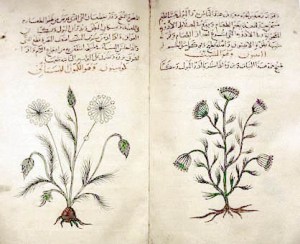
Delicate isn’t a word we’ve been taught to associate with Islam. I remember a priest speaking to me oh-so-earnestly about how Islam by nature wanted to take over the world. I wondered about his education in the history of Christianity. If you turn the clock back far enough, even the early Israelites, according to Judges, attempted genocide. We do religions a grave injustice by reifying them in this way. A recent story on NPR tells about the restoration efforts of a library in Fez, Morocco. As Leila Fadel points out in this story, we tend to suppose Islam is ISIS destroying history, but this library, full of Arabic manuscripts, is one of the oldest in the world. We sometimes forget the great contributions Arabic—yes, Islam—has made to world culture. Including literary culture. Some of the scientific works of Aristotle were preserved only in Arabic. Even the word “algebra” bears the distinct signature of its Arabic roots. What we should be attempting to halt is extremism.

Arabic_herbal_medicine_guidebook

One of my readers commented the other day about absolutism. This was in the context of Christianity, but it applies here equally as well. Absolutism tends to see only sharp divisions in a world where everything, in reality, blends into everything else. Islam emerged from a prophet who was influenced by Christianity and Judaism in the context of Arabian polytheism. Many of the tenets of Islam would settle comfortably in the pew, if we would let them. “Revealed” religions, however, take no prisoners. The concept of “revelation” means that your scriptures come straight from God’s anthropomorphic mouth to your all-too-human ear. When your religion is revealed, you can’t mix it with the best of your competitors. That’s one of revelation’s greatest dangers.

It does my soul good to see the begloved curator of the Qarawiyyin Library touching an Arabic manuscript so gently. It is the very picture of a pair of lovers. Those who love books—truly love books—can wish no harm on their fellow human beings. Reading is, after all, exploring the minds of others. All texts, in this way, are sacred. All are revealed. Too often we listen to those who tell us this is all an apocalyptic struggle to the death. In reality, revelation never ceases. Of its source I’m uncertain. Of its literary progeny I am certain that human minds are only richer for having received the words of the many prophets of the literary endeavor.


Literate Madmen

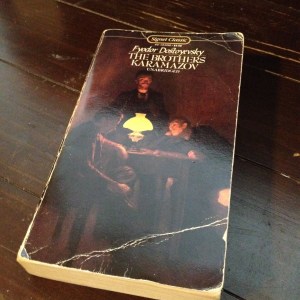
My experience of paternal parents growing up never led me to think Father’s Day was a holiday particularly worth celebrating. (Don’t panic—today’s not Father’s Day!) I do have an ironical sense of humor about the commemoration, though. So the other day when I clicked through one of Amazon’s many daily ads to my email account, I noticed it was for Father’s Day gifts. The first item listed was Fyodor Dostoyevsky’s The Brothers Karamazov. Probably based on my browsing history, I thought. But no, I’ve been looking at non-fiction lately and I bought my well-worn copy of Dostoyevsky before Amazon was a gigabyte in Jeff Bezos’ eye, back when I was in seminary. Then it dawned on me: this is perhaps the most famous patricide novel ever written. Had the Amazon advertisers really thought about what they were recommending? “Here, Dad. It’s a book about sons killing their father.” If marketing is driving America, it may be time to pull over at a rest stop for a coffee break. Or at least read the book first.

IMG_2796

I don’t pay attention to when Father’s Day is. It comes somewhere in that complex of spring holidays that include Passover, Easter, Mother’s Day, and Memorial Day. When my father was alive I sent him a card. It was a card to a stranger, but as Episcopalians know, it’s the done thing. I loved him, but I didn’t know him. Not that I’ve been a parent that deserves a holiday dedicated to my skill either. I confess my fair share of parental failures. They play and replay in my head, in the way the Protestant brain can never quite clear itself of guilt. We, as people, I believe, generally try our best to be good parents. It can be difficult, though. Nothing really prepares you for it.

One of my brothers once told me that, after having a girlfriend with kids from a previous marriage, he better understood how our stepfather viewed us as inherited children. Although I always want to claim the victim role in that scenario (I was only ten, what could I do?, etc.) his insight has stayed with me. It can’t be easy to inherit someone else’s progeny. It’s tricky raising your own child—that new person you want never to experience your own disappointments in life. Even cynics can be sentimental. But then again, I’ve been plowing through The Brothers Karamazov again since January, frequently laying it aside for weeks at a time. It’s not the kind of book I’d give a father on the edge. It’s okay, I think I’m good to drive again. I just won’t pay any attention to the ads I see beside the road.


Religious Melancholy

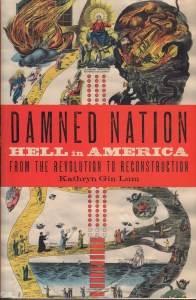
DamnedNationI’d never come across the term “religious melancholics” before, but somehow it seemed to suit me. Perhaps that goes without saying as I’m reading Damned Nation, by Kathryn Gin Lum. While sitting on a bus. We’re sitting in traffic and the guy sitting next to me has obviously just finished a cigarette before climbing aboard. Having grown up as the victim of second-hand smoke for my first two decades in life, I’m thinking about Hell as well as reading about it. You see, Gin Lum’s descriptive subtitle is Hell in America from the Revolution to Reconstruction. The fact that Hell’s alive and well, despite some evangelicals’ attempts at annihilating it, suggests that it’s best to keep informed on the topic. This book’s mostly historical, however, reporting how Americans interpreted Hell in the eighteenth and nineteenth centuries.

As with most histories, I find the earliest material the most interesting. Gin Lum tends to focus, naturally, on preachers at this period since they are the ones most likely to talk about eternity. The thing that struck me the most was the number of people she describes who, after contemplating (a primarily Calvinist vision of) Hell, attempted suicide. I tend to think of suicide as a contemporary problem, but obviously it has been a steady human practice since our species first learned that you don’t have to wait for someone else to help you slough off this mortal coil. It is troubling, however, that it was a “doctrine” barely found in the Bible that led people—most of whom later became preachers—to try to kill themselves. It also seemed a touch odd that evangelicals in those earlier days of our nation didn’t find it troubling that those leading the flock had almost sent themselves to perdition. These early days of literal Hell believing were most interesting indeed.

The phrase “religious melancholics” comes from the resistance. There were those—generally skeptics, doctors, psychologists, and the like—who felt that the preaching of hellfire and brimstone took a toll on the healthy psyche, particularly of the young. As one of those who grew up attending revivals where Hell was a featured guest, I know that my life has been a prolonged attempt to avoid said eternal lake of fire. Even when I rationally learned that there is no three-tiered universe in which it still fit, and that the idea was cobbled together from a variety of religions into the ultimate scary place, Hell still manages to haunt me. Does it keep me moral? I don’t suppose that to be the case, since I have tended to believe people are basically good. Don’t bother trying to convince me logically that Hell doesn’t physically exist. I know that already. It’s the mental one that I’m trying to avoid. And that can be a full-time job for a religious melancholic brought up on a diet of overcooked theology.


Being Humanity

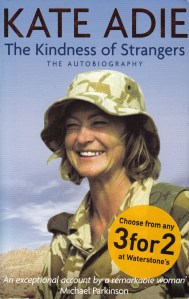
KindnessOfStrangersWhat do you want to be when you grow up? The question kept recurring as I read The Kindness of Strangers. The name Kate Adie may be more familiar to readers from the UK than to those from the US. While spending three years and a bit in Scotland, my wife and I grew accustomed to hearing her name as a reporter with the BBC. I’ve just finished reading her memoir and it brought to mind several points that hit quite close to home. Apart from being engagingly written, her biographical essays highlight the difficulties women still face in much of the world. As a journalist, Adie traveled to many vexed locations where some expressed surprise that a woman would have such freedom as to run around with men, investigating, reporting, and being seen by many, many viewers. Meanwhile, those she sojourned among had to deal with oppressive regimes, low standards of social justice, and, not infrequently, the fear of rape. It is a poignant and at times maddening account. Men the world over seem to share a horrid, deeply ingrained and reinforced concept that women are somehow there to serve them. Here we are in the twenty-first century and we’re still struggling with basic biology.

If I might tear myself away from that particular observation for a moment, I also found Adie’s firsthand accounts of the atrocities she witnessed deeply troubling. In this day of Holocaust awareness and the belief in human dignity, it is distressing to see how cheap life is under many governments in the world. How humans can be so inhumane boggles the mind of those with any sense that we’ve somehow evolved. Often the hatred is based in differing religious outlooks, but often religion is only an excuse. The offending religions that are touted almost all teach the descent treatment of your fellow human beings. Sadly, nothing appears to have been learned from the all-too-intentional violence of the past century. The real issue, reading between the lines, is power, not faith. It is easy to have a scapegoat, and some analysts (not Adie, I would emphasize) like to suggest a simple solution by placing their hands on the head of religion and confessing the deadly sin of being human over it.

The book, I should add, is not all gloom. Adie is witty, sophisticated, and a charming writer. One of the positive takeaways I had from her life story is that the question “What do you want to be when you grow up?” is all wrong. Adie never wanted to be a journalist, but through a series of circumstances eventually found herself one. A much decorated and honored one, no less. This is a lesson for our time. The old stabilities of choosing a career and staying with it seem to have eroded from beneath us. It is increasingly difficult to plan ahead for an uncertain future. Adie is a fine example of how to adapt along the way. More than that—and men pay attention here—she’s an exceptional example of what it means to be human. This is what we should all strive to be when we grow up.


The Found World

LostWorldChallenges will make you do funny things. One enjoyable dare has been Modern Mrs. Darcy’s Reading Challenge. With a modest twelve books in twelve months goal, the specific target is to read the types of books laid out. Into one of those categories, for me, fell Michael Crichton’s The Lost World. It’s sad that I feel I need so many disclaimers—I never really outgrew my love of dinosaurs—such escapist literature is indeed a guilty pleasure. Crichton could write a quick read, not bothering to pause for literary hindrances, and this novel fits the bill. It always surprises me when at the end of a traumatic story where friends die (this time ripped apart by reptilian carnivores) that the protagonists escape and never mention the dead. They joke, explain holes in the story, and generally look forward to a better, raptor-free future. There is, however, some food for thought here, among the lucre-grubbing sequel to Jurassic Park.

The first religious element that caught my attention was resurrection. Ian Malcolm rather convincingly died in Jurassic Park (and even an unconvincing death works for most people). In The Lost World he’s suddenly back again, with a barely disguised deus ex machina, and is as diffident as ever. The other former protagonists know better than to return to an island full of dinosaurs. Resurrection is a time-honored literary trope. So much so that it’s sometimes difficult to believe that death is in any way permanent. Well, come to think about it, the dinosaurs too are resurrected. Do reptiles have souls? Crichton’s dinosaurs seem to.

Then, just over halfway through the story, I was stunned. The chapter, or section, called “Gambler’s Ruin” explains how science and religion (or the humanities in general) are really the same. I couldn’t believe that a bestselling novel actually took the point of view that scientific objectivity is just as fraught as post-modern literary theory. There is no way to observe without influencing. When a conscious presence enters the equation, the facts have to counterbalance in return. Many, of course, would disagree in principle. Still, this unexpected bit of profundity stopped me in mid-chomp. Materialism, beguiling as it may be, doesn’t explain Heisenberg or Schrödinger. It takes a resurrected mathematician to do it. No wonder chaos abounds in this world where dinosaurs still rule the earth.


High Castle Blade Runner

DivineMadnessGrowing up evangelical, one of the popular topics of conversation was crypto-christians. (My spellcheck insists that this is a lowercase expression.) Crypto-christians are people, generally famous people, who might be secretly “Christian.” You see, despite stereotypes most evangelicals really do want people to go to heaven. In fact, they tend to be obsessed with it. And besides, it can’t hurt to have a celeb backing your claims. One name that never came up in my circles was Philip K. Dick. I grew up reading science fiction. My reading patterns (which haven’t changed much) involved reading what I could find among used books at Goodwill. We were poor, and besides, there were no bookstores in our town. Like many people, I’m sure, I learned of Dick by watching Blade Runner. I occasionally heard others discussing the movie, but I hadn’t seen it myself and thus continued blithely unaware until I began teaching. I then read how Blade Runner is a possible Christian analogy, and curious, I read Do Androids Dream of Electric Sheep?

Since then Dick, who never made it big in his lifetime, has become a staple of the sci-fi diet. In The Divine Madness of Philip K. Dick Kyle Arnold explores the now famous 2-3-74 episode. Dick, in addition to being over-medicated, had mystical experiences. The “big one” took place beginning on the date implied in its title. This vision, while not orthodox by any standard, is clearly religious. Critics tend to think that Dick may have either faked it or that he underwent some kind of schizophrenic episode. Arnold, a clinical psychologist, has the chops to demonstrate that these latter explanations are off base. Dick had a legitimate visionary experience—something even neuroscientists can’t access because the experience is subjective and personal. It had a large impact on his life, but it did not make him mentally ill.

Arnold is not, as far as I can tell, a crypto-christian hunter. He is a psychologist attempting to understand a most complex and tormented writer of superior science fiction. What becomes clear, however, is that Dick was well-informed about Christianity. He imagined himself a secretive first-century Christian in an oppressive Roman Empire. This aspect of his life tends not to emerge in pop culture discussions—how Christian can you be and still be cool? Certainly Dick was not a conventional believer, but religious imagery and even actions became some of the most important moments of his life, according to his own recollections. Philip K. Dick was clearly a haunted man. And one of the specters haunting him was an often undiagnosed religion.