The Philosophical Neanderthal

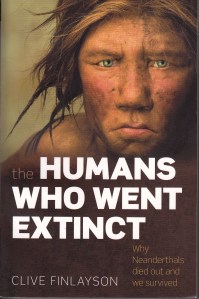
HumansExtinctExtinction. It’s a depression concept, but one that nevertheless constitutes a reality in evolution’s world. When applied to members of our own species we term it genocide and declare it an evil. Our perspective—not to dispute the value judgment—is hopelessly foreshortened. Our brains have evolved to promote individual survival, not to see the longue durée. How often do we worry about the extinction of Homo erectus? Or the australopithecines? Without them we wouldn’t be here, and yet, they’re gone. The case of the Neanderthals is perhaps closer to home. We now know that Homo sapiens overlapped with Neanderthals. Some of the questions raised by Neanderthal extinction are given serious consideration by Clive Finlayson in his study, The Humans Who Went Extinct: Why Neanderthals Died out and We Survived. To get a sense of how this works out, and how it applies with our current contribution to global warming, we must be prepared to view the extreme longue durée. Duration beyond comprehension.

One thing that becomes clear from the very beginning here is that climate has driven evolution perhaps more than we often think. Species, which tend not to live through the relatively long reach of climate change timescales, adapt to the circumstances of their environment. They either do, or they go extinct. Climate, however, is a balancing act teetering toward equilibrium. Hot and cold, evening each other out. Over an even longer duration, our sun will run out of metaphorical steam and things will get quite a bit chillier out there. For the meantime, however, shifts between ice ages and periods of warming will continue to seesaw across time and our race, among many, will need to adjust to survive. Perhaps acknowledging our own role in the current global warming might be a way to start. Our species tends to be short-sighted.

There is an irony here. History and prehistory have shown that, as Finlayson points out, that those best equipped to survive radical changes are the poor. Extinctions—some of them quite dramatic—have occurred before. They will surely come again. When times get tough, it seems, the comfortable get going. Going extinct, that is. Those who climb the corporate ladder the highest have the longest distance to fall when things go bad. The poor, who have to struggle every day to survive, are the ones who know how to get along in circumstances that turn sour. I have called this an irony for what might seem obvious reasons. There is another as well; here we have science pointing again in the direction of the Bible. There it was noted long ago that the meek would inherit the earth. And that’s a bit, it seems, that should be taken literally.

Foundational Books

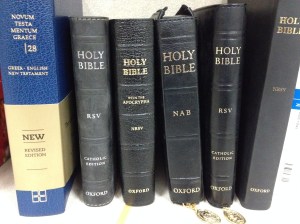
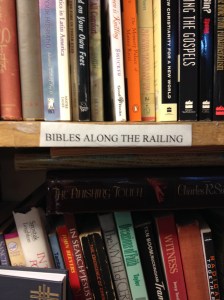
Over the weekend I visited one of my favorite used book stores, The Old Book Shop in Morristown. It’s neither huge nor fancy, but it has the feel that is so important to the restless mind. The feel of not knowing what you may find. The mystery of discovery. As I browsed, it occurred to me that although books of all varieties lodge here, the predominance of the old books tends toward the religious. The books associated with the church have survived for their centuries, closely followed by the classics—what was once considered the purview of the educated. I suppose one might argue that the breviaries, hymnals, and Bibles indicate overprinting on the part of overzealous presses, but I know that’s not the whole story. In fact, until quite recently the educated were expected to be religious as well. There was a kind of humility at work here. Even scientists respected the God who’d put all of this into place. This was not so much overprinting as it was meeting a prevalent need.

In early America, for example, if a household owned a book, it was more than likely a Bible. Bibles existed in profusion due to—putting it most crassly—demand and supply. People wanted to have a Bible. Particularly Protestants who’d been taught that it alone held the key to their salvation. There are some things you just don’t leave to chance. As that era continues to fade and people unload the books they no longer need or want, the Bibles and hymnals and prayer books make their way to antiquaries and I spend my weekends browsing among them and pondering how we came to be in this place.

Education—books—is/are foundational to our society. Books may be messy and lend to clutter, I’m told. In our apartment they climb in stacks alongside overfull bookshelves like ivy up the side of a tower, and yet I find them difficult to release. There’s knowledge here for the taking. The visit to the used bookstore inevitably leads to finds I hadn’t expected. There were no Bibles in my hand as I checked out, but no matter. I’ve got many Bibles at home. I’m aware that building requires foundations. Architecture may change over the centuries, but old foundations remain for millennia. To be educated is to be aware of them and appreciate them for what they are.

IMG_2732


Golem

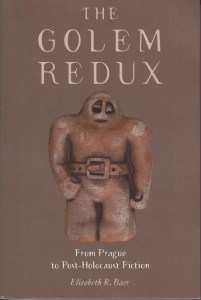
GolemReduxI read a lot of books. About a hundred a year. At the end of the year I go over them all again and many of them, I see, failed to make a deep impression. Some, I know, before I close the back cover, will stay with me. Maybe even haunt me. I count Elizabeth R. Baer’s The Golum Redux: From Prague to Post-Holocaust Fiction among those that will linger long. My regular readers will know of my predilection for monsters, so a golem book will hardly be a surprise. I realized, however, upon completing my academic paper on Sleepy Hollow, that my reading on the golem was rather slim. I’m no longer sure that it’s even a monster. As a goy who’s spent a good deal of his life among the Hebrew Scriptures, there’s a natural resonance, it seems, with those oppressed for being who they are. Golems are created in times of crisis but have unexpected, or at least unwanted, repercussions. Baer offers a thoughtful, intertextual study of the golem, largely through the lens of Jewish fiction.

Having dealt with the Bible as portrayed in Sleepy Hollow, I treated the episode where its significance truly unfolds (“The Golem”) as the entryway into the culmination of the first season. Now it appears likely that season three will be the erasure of the aleph, it seems appropriate to give golems their due. The story begins with the oppression of the Jews in early modern Prague. Rabbi Loew makes a golem from mud to protect the beleaguered community. This soulless, selfless protector becomes an archetype for various superheroes and literary characters ably summarized by Baer. The book put me in mind of my only visit to Prague, too brief and too ill-informed to truly appreciate what I was seeing. To see you have to learn to read.

While some writers have fun with the golem, others understand it in more serious tones. Those who can’t forget the Holocaust see things in a way that others cannot. Not that only Jews can summon a golem, but its origins and reuse have a special place in a community that longs for a protector. I’m reminded of the book of Job, and there’s a good reason for that. While reading The Golem Redux on my commute, I came home to find a copy of Pete Hamill’s Snow in August on my wife’s stack of books to read. As it is one of the titles studied by Baer, I felt an odd synchronicity at play. The book had been recommended by one of the booksellers at our local indie shop just a few weekends back. Tied in with all the other golem-based thoughts in my head recently, I’m inclined to think that this was no mere coincidence.


Strange Chemistry

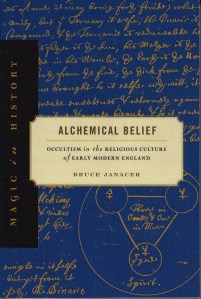
AlchemicalBeliefOne of the many antiquated beliefs that have been left behind over the centuries is alchemy. Today we tend to think that anyone who supposed natural substances could have been transmuted into others must have been naïve at best, or credulous at least. Bruce Janacek’s Alchemical Belief: Occultism in the Religious Culture of Early Modern England sheds light on the wider worldview of the alchemists. Some of them, anyway. Firstly, it is quite clear that many adepts of alchemy were very intelligent people. We easily forget that in addition to rewriting the laws of physics, Sir Isaac Newton practiced alchemy throughout his adult life. There’s something incredibly beguiling about the idea of an underlying unity of materials. Today atomic theory has answered that unity, perhaps a little too well. And that bring up the second important insight in Jancek’s book: alchemists often had an ulterior motive.

Early modern alchemists (think of those emerging from the wake of the Reformation, and you won’t be far wrong) often had a religious motivation for their work. Alchemy isn’t just turning base metals into gold—that’s just its most spectacular claim. Janacek points out that several alchemists were also attempting to prove the legitimacy of Christian theology through their explorations. Concepts as strange as the Trinity, or even the divisions of Christianity itself that were happening in the shadow of Luther, indicated to ordered minds that theological truth must be a unity. That unity, once found in alchemy, would naturally apply to the world of the church. The church, after all, can’t defy the very laws of the universe, can it? These early scientists accepted that there might also be a mystical element involved. Some rejected that aspect, but felt that the basic ideas of alchemy itself were sound.

Like dinosaurs, alchemy pretty much went extinct with the onset of the empirical method. Also like dinosaurs, it survived into the new age, transmuted in form. Alchemy was one of the ancestors of that bane of college students everywhere: chemistry. We tend to forget that astrology laid the groundwork for astronomy and creation (not quite an “ism” in those days) led to the study of biology. Religious ideas underlie much of what led to modern science. Religion, after all, indulges the curiosity of humankind. We are allowed (in the best instances) to let our minds range where they will. Later on theology, or some such device, will rein them in, but until such a time the psyche is free to explore. And build systems. And offer explanations. The alchemy comes when all of this is taken from the hands of natural philosophers and put into the laboratory only. And the rest of us await pronouncements from above of what might be real, or not.


Durable Goods

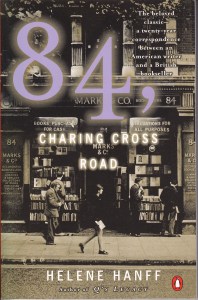
CharingCrossThose who love books share a soul. A weekend never feels complete to me without at least an hour spent in a bookstore. On one such weekend a clerk in our local indie recommended Helene Hanff’s 84, Charing Cross Road. The recommendation was actually for my wife, but knowing me, she said I’d like it. What’s not to like about a set of revealing letters between a struggling, New York-based writer and a London used bookstore clerk? Books tell the story of a person’s life. If I’m invited to someone’s house, I look at their books. I would expect the same if they ever came to see me. Kind of like dogs sniffing each other out. Books reveal the inner person. They also give me ideas of more things to read.

I can’t help but think we’ve lost something intangible in the world of ordering books online. Don’t get me wrong, I appreciate Amazon maybe more than is proper, but how many treasures have I found simply by browsing? The days are well past when a single person could claim to have read every book (and really, who would want to?) so there’s always something undiscovered lurking at the bookstore. And these days used bookstores have the most character. In Milwaukee I used to frequent a used bookstore that could have passed the building inspectors’ visit only by bribery. I spent happy hours there. You see, books are durable goods that can outlast their owners. Can anyone really ever own a book?

84, Charing Cross Road was an unexpected delight. A quick web search reveals that Marks & Co. Is no longer with us. It is now a McDonald’s. Helene Hanff is gone too. And she thought she was born a century too late! Yet here we are in the twenty-first century and books are still with us, despite our losses. They have something of eternity to teach us. The ebook has not yet managed to kill off print. Our local used bookstore closed some years back. I confess to visiting a Barnes and Noble in a state of desperation. There a guy, older than me, was talking to a clerk. I couldn’t help but overhear when they mentioned the used bookstore, now long gone. Even the clerk sighed that they were the only show left in town. Although they were strangers I knew that we somehow share a soul. So it is with those who love books.


Modern Vampires

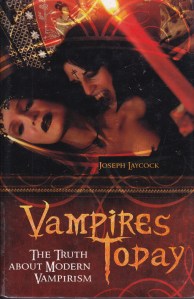
VampiresTodaySometimes I feel guilty. A grown man reading about vampires? Then I think of such puerile things as television and the stock market over which other adults waste their time and my pituitary gland releases endorphins and I carry on. I must say, however, after reading Joseph Laycock’s Vampires Today: The Truth about Modern Vampirism, that I’m not a vampire. Nor have I ever wanted to be. I am fascinated by the idea, however. The more I read—as is the case with most good academic books—the more I questioned definitions. Laycock does a good deal of that questioning himself in this book, and I came away wondering what indeed defines a vampire? As a child it seemed pretty clear. The vampire was a blood-sucker who came out at night. Fangs, a thirst for blood, and a faded aristocracy seemed to be the essential characteristics. But I was only a child.

Before you get the wrong idea about Laycock’s book, I need to say that his is a serious study of modern day vampires. Yes, they exist. No, they’re not easy to define. As an academically trained scholar of religion, Laycock is keenly aware that self-definition is crucial to categorization. Religious believers self-identify. We have no way of categorizing an adult (and some would say no way at all of children) without their own affirmation of what they believe. Vampires Today, however, raises the pointy question of whether those who self-identify as vampires constitute a religion. Or if vampire communities may be considered religious groups. In case you’re confused: many people identify themselves as vampires—sanguinarian and/or psychic. They believe they require the life energy of others to live and prevent illness. They sometimes drink blood—with permission—or siphon the life force of other people. Like all adults, they should be treated as self-identified. Probably not, as Laycock carefully spells out, a religion.

As in his other books, Laycock takes seriously groups that would, based on numbers alone, be considered fringe. Nevertheless, these groups are a part—sometimes an influential part—of larger society. We live in a world where we’re authoritatively told there is nothing but matter and energy, and as biological beings our purpose is reproductive success and then death. Is it any wonder that vampires and others are seeking something more? I’m no vampire. I read the occasional, thoroughly pulp, Dark Shadows novel to recapture a little of that after-school wonder I felt watching the waves pounding on the Maine cliffs while Barnabas Collins lurked inside. And he bore a strange truth that was perhaps instilled in those young years. Age is only partially a biological matter. Defining it any other way is, I have to believe, immature. So I read about vampires and wonder.


But Loses (His) Soul

Although a couple steps from the real thing, a book review can be an art form of its own.  A short piece in a recent Wired magazine focused on an ironic bestseller that I keep seeing on the standard lists: The Life-Changing Magic of Tidying Up, by Marie Kondo.  Apart from something we’ve probably all heard from our moms, I wonder why so many people buy a book telling them to get rid of things.  Clive Thompson notes in his review (“Clutter Clash: How Tidying up Can Hamper Creativity”) that one of Kondo’s pieces of advice is that books should be on the list of things to discard.  Disagreeing in principle with this assessment, it is an even larger argument that I would like to challenge: “studies” apparently show (I’m not sure which studies) that clutter can be “soul crushing.”  Given that we have no empirical way to assess souls, I’m uncertain how to measure the number of angels crushed under my stacks of books.  Who has the right to assign clutter to the ranks of venial sins—or mortal, for that matter?
 
The book’s subtitle, The Japanese Art of Decluttering and Organizing, may provide some vague spirituality to the topic, and I agree that entropy can get the upper hand from time to time, but soul-crushing?  Some of us keep books and papers precisely because of their value in lifting the non-verifiable soul.  In fact, I was just reading (ahem) about how religions (the traditional home of wisdom about souls) revolve around their books.  Perhaps we should leave at least a showy Bible for the coffee table to display along with our copy of Feng Shui for Dummies.  My soul feels lighter already!

IMG_2727
 
When did advice for improving our souls shift from those who spend their ruminative lives asking the weighty questions to those who suggest picking up after yourself might just work as well as a life of self-denial and putting others first?  And why would you buy a book that recommends you don’t keep books?  My existential crisis deepens, and I haven’t even read it.  I can’t shake the feeling that  I spent thousands of dollars over multiple years getting an education in what turned out to be merely housekeeping.  I marvel at the clutter-free environment as much as the next person.  That’s one of the reasons I love art museums so much.  Yes, my soul does get a boost there.  If I go to the gift shop on the way out, however, I’ll likely want a book to help recapture those sublime moments.  Then I will go home, where my clutter awaits, and will truly feel peace in a place where books abide in profusion.


Ethology Theology

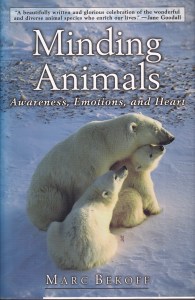
MindingAnimalsProminent public intellectuals, we’re used to hearing, often lament the survival of religion into a rationalist age. As an obscure private intellectual—if I may be so bold—I am always pleased to see when a credentialed scientist asks if we are being too hasty. No, but actually says we’re misguided to dismiss the evidence of our own observations. Marc Bekoff’s Minding Animals: Awareness, Emotions, and Heart is an encouraging study by a balanced individual. Bekoff, unlike many scientists, realizes that emotion does play into observation and reasoning. More than that, materialistic reductionism does not account for human or other animals’ experience of life. Historically motivated by religions to separate ourselves from animals, we have only come to know slowly—painfully slowly—that the distinctive markers of humanity are shared in degree by other animals. Bekoff is bold enough to give the lie to the belief that animals have no emotional life. Traditionally science has said that we cannot know what goes on in animal brains so it is best to take animal emotions off the table. Then scientists go home and love their dogs, who love them in return. When’s the last time I read a scientist writing about love?

Minding Animals is a manifesto. We have, in our arrogance, made unwarranted assumptions about both animals and our unique status on the earth. We drive other species of animals to extinction at a rate that required an asteroid collision or some other catastrophic event in the past. And we use animals as if they had no interests of their own, even such basic interests as avoiding pain and suffering. “They’re just animals,” we’re told. Bekoff is an ethologist—someone who studies non-human animal behavior. As common sense, both the sine qua non and bête noire of science, reveals, animals experience and express happiness, anger, and love. They can be depressed. They can be overjoyed. And we treat them as if they were objects to do with as we please.

Bekoff admits some of his fellow scientists treat him as if he’s gone soft. Like Diogenes, however, I search for an honest man and I think I have found him. Instead of castigating religion, Bekoff ends his book with a chapter on theology. Not to make fun of it, but to show that even scientists must integrate different kinds of knowledge. Not only is the science that Bekoff describes appealing to the emotions, it also makes sense. No scientist is completely objective. Even Mr. Spock breaks down once in a while. We all have perspectives. And that includes our fellow earthling animals. We evolved from the same ancestors and yet treat them as if we own them. Minding Animals will—or at least should—make us feel guilty about that. Being human and being humane, after all, are only a silent e apart.


Lovecraft Legacy

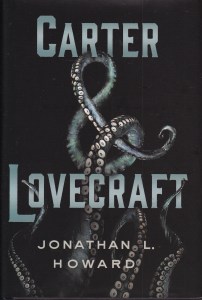
CarterLovecraftHistory can be a funny thing. Take the way it treats some people. H. P. Lovecraft wasn’t famous in his lifetime. In fact, his isn’t exactly a household name even now. His creation Cthulhu lurks grandly in the internet, and even Lovecraft himself is finding mention in some literature courses, despite his lack of literary finesse. Yet, fiction is being written about him. I just finished Jonathan L. Howard’s new novel, Carter and Lovecraft. While H. P. doesn’t appear as an acting character in the novel, he is related to one of the protagonists in a way that is essential to the story’s plot. I won’t give away any spoilers here, but the novel takes over where Lovecraft, the non-fictional character, left off.

Lovecraft, famously, was an atheist. Nevertheless he spun a mythic world of Old Gods that has become canonical in its own right. His stories veritably teem with religious themes as well as monsters. In fact, in Howard’s treatment of the mythos, the religious elements still show up. As I’ve noted before, one need not be a theist to be a capable theologian. Fiction like that of Lovecraft, or that of Howard, inherently holds a kind of numinous quality. In fact, fiction frequently does. In reading, we allow ourselves to be drawn into another world. What could be more religious than that? The beliefs of the writer, it seems, may not ultimately matter.

At one point, at least, in Carter and Lovecraft the sentiment becomes explicit. One of the characters contemplates starting his own religion, only to realize that he’d have to write a holy book. That, he decides, would be a lot of work. As one who dabbles in various forms of literary art, I can take his point. There is something wondrously exhausting about giving birth to words. And those words make worlds. When you stop to think about it, that’s kind of a religious thing to do. I’d recommend Carter and Lovecraft to H. P. L. fans. It’s not a Cthulhu-fest, but it is an enjoyable, compelling tale that raises questions which, if not handled carefully, will quickly turn theological.


Long Live Life

Horseshoe CrabsShortsighted and arrogant. No, I’m not describing Richard Fortey’s Horseshoe Crabs and Velvet Worms, but rather the collective human race. I love people—I really do. Collectively, however, we sometimes act in the most inexplicable ways. This thought came to me repeatedly while reading Fortey’s book. The subtitle might explain the subject a bit fuller: The Story of the Animals and Plants That Time Has Left Behind. Fortey is a paleontologist who tells the stories, almost biographies, of various creatures that have survived eons with little change. He is quick to point out that all creatures evolve, but in the case of some, evolution has been minimal. Animals, such as his titular examples, and many others (cyanobacteria, tuataras, and, of course, coelacanths, just as a sampling) can sometimes be so well adapted to their environments that they change very little over time. In this book Fortey travels to see the living examples of those creatures he’s studied in fossils, and tells the story of an amazing continuity in a world of constant change.

Some of the species, particularly the plants and microscopic organisms, I’d never heard of before. I also have to admit to being surprised at how many very old life forms still exist. And admittedly, this is only a snippet of a much larger cloth. Throughout, I was pleased to see, Fortey mentions various religions—themselves often throwbacks—but not disparagingly (except the creationists). Noting that some creatures have a Buddhist-like calm, or that the Bible occasionally provides the phrase a naturalist writer seeks, here is an irenic meeting of science and religion that is so much needed. So why did I say “shortsighted and arrogant” at the start of this post?

One of the more disturbing truths revealed, and not just about charismatic megafauna, is that people have often hunted animals to extinction. Fortey suggests it has always been so. Large animals (megafauna) are easy targets and we have repeatedly hunted (and continue to hunt) them to extinction. We destroy habitats and thereby drive species extinct that we haven’t even yet discovered. What could be more arrogant of a single species? Looking back over 4 billion years of evolution should give us some perspective. We’re relative newcomers on this planet, and it isn’t ours to do with as we please. Fortey is gentle, but he does remind us that some of the creatures in this book will likely, no matter how great the catastrophe, long outlive us on the planet. Ours is a brief day in the sun. Shouldn’t we care for our planet rather than pillage it for our own gain? Ask the horseshoe crab. When we understand its language we might be able to begin to call ourselves wise.


Holy Haunted Book

Religion is one of those words that defies easy definition. As I’ve suggested before, you know it when you see it, but trying to pin the idea down is a different matter. Consequently, religion is closely related to a number of other areas of interest: philosophy, ethics, monsters, and the paranormal, to name a few. I was interested, therefore to see a blog post recently concerning a “haunted Bible.” Call me naive, but the thought had never occurred to me before: could a holy book be haunted? Churches are notorious for housing ghosts, of course. As someone who’s spent overnight retreats in churches I can vouch for the fact that a sanctuary after dark is a naturally eerie place. I’ve never seen a ghost in a church, however, and I’m not entirely convinced they exist, and if they do, what they might be. In any case, a haunted Bible is a different story.

David Weatherly is a fairly well-known paranormal writer. My web search brought up his blog where he explains that the haunted Bible was for sale on eBay with an asking price of $180,000. The owner, who remains anonymous, claimed to take no responsibility for any damage the supernatural scripture might cause. Instead of thinking that we have here a genuine haunted leather scripture, I know it can be nothing other than a genuine hoax (not on Weatherly’s part). Realtors know well that a haunting can, in today’s climate, counterintuitively drive the price of a house up. With people hungry for some element of the supernatural in their lives, and ghost hunters of all sorts on their televisions, they are willing to shell out a few more dollars to have a spirit around. And since ghosts can’t sign contracts, there’s no guarantee that they’ll be there once you move in. The supernatural can, it turns out, be the perfect scam.

If items can be haunted, I suppose a Bible might as well. When an owner, however, turns down an offer of 50,000 pounds that odor you’re smelling is that of a rat. I love old books. I have a few around that have more than a century’s weight on them. Looking at used bookstores longingly, I see first editions of Poe or Shakespeare that sell for far less than the asking price of the most printed book in the western world. Bibles, if you know where to look, can be had for free. I’ve got at least a dozen of them myself. Nothing makes fakery quite so clear as greed. No wonder the haunted Bible was such a disconnect. There’s nothing paranormal about love of money. That’s all too normal for anyone who tries to sell a Bible for implied spirituality.

IMG_1235


Soul Library

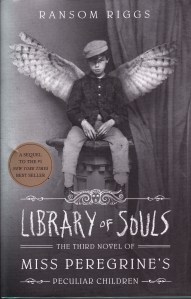
LibrarySoulsThere’s a kind of trinitarian logic to the trilogy format. Long before Hegel’s model of thesis, antithesis, and synthesis, people have grouped things into threes. And there is a hook that film-makers have used to ensure that viewers will come back for the third installment: the cliffhanger. The second episode leaves everything unresolved and you’ll be sure to see the third. Think of the original Star Wars trilogy, or Back to the Future, or even Pirates of the Caribbean. In each case the first film could stand alone, but the second insisted on a third. This is a little trickier with books since, as we all know, publishing is a slow business and writing takes time. I saw Miss Peregrine’s Home for Peculiar Children, by Ransom Riggs, in 2011. I knew I would read it since the cover alone was so intriguing. Young adult literature, it turns out, has come a long way since I was able to classify myself that way. Then Hollow City came out. It ended as a cliff hanger (remember the formula), back in 2014. Just over a year and a half later, The Library of Souls was released.

Having just finished the trilogy, reading each as it came out, I would say that, like most trilogies, the first installment was the best. Freshest, a new idea, where characters exist with whom the reader participates by in filling in the blanks, a series grows more complex as it expands. Some elements that weren’t there at the beginning have to be read back into the previous installments. In my case, I’ve read so many books in the interim that some of the details have grown hazy due to the simple passage of time. Still, Riggs is to be highly commended for bringing souls back into discourse among the young. Too long we’ve been sold the story that we have no souls.

I’m not going to go into any great detail here since those who want to learn how Riggs handles the tale will read his books, but I will say that a stubborn materialism has settled over intellectual culture. Some neuroscientists have naively said, “we’ve looked for it and can’t find it, therefore it must not exist.” And since most of us don’t have access to their kinds of equipment or training, we’re told to acquiesce. Give up your souls—buy into materialism. Buy stuff. That’s what we’re all about. It is a relief, in the midst of all of this, to have a popular writer suggesting, through fiction, that it is souls that make us who we are. The books aren’t preachy. Indeed, it would be difficult to say they are religious in any conventional sense. They are, however, soulful. And for that I am very glad to have read them, even as a middle-aged adult.


Holy Seer

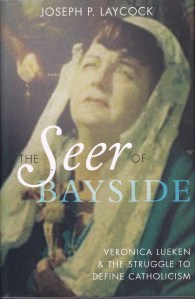
SeerOfBaysideHands up, all who’ve heard of Veronica Lueken. Maybe one of you in the back? I have to confess to having been in the “Veronica who?” crowd until reading Joseph P. Laycock’s The Seer of Bayside. The subtitle would have made the difference: Veronica Lueken and the Struggle to Define Catholicism. It’s a fascinating story. Lueken, a Catholic laywoman in Bayside, Queens, began to have visions of the Virgin Mary. This was in the days of Vatican II. Lueken was a traditionalist who felt the reforms were misguided, and found Mary to be on her side. She grew a large following during her outdoor vigils, eventually becoming so popular that people bussed down from Canada and in from other states to join her. The neighborhood association complained, and, some say, planned to assassinate the seer. The movement, known as Baysiders, eventually moved their vigils to Flushing Meadows Corona Park, where it—or they—continue to meet.

Critics of religion tend to claim believers credulous. The Catholic Church, however, has been notably reluctant to approve of Marian apparitions. Lueken’s visions and her movement were condemned by the authorities, but now, even two decades after her death, two groups of her followers continue to meet. I’ve read quite a bit about Marian apparitions over the past couple of years. As Laycock points out, Marian apparitions are frequently classed with the paranormal since anomalous events often accompany them. It is no different with Baysiders. They claim healings and other unexplained events associated with their devotions, including mysterious lights on Polaroid photographs taken during services.

How are rational people, especially non-Catholics to make sense of this? Obviously one can say that the thousands who’ve claimed to witness such miracles throughout history were simply mistaken. Or deceived. Or one could suggest that there may be more to this old world than we’re generally willing to admit. Laycock takes his book in a different direction by asking the salient question of who gets to decide who Catholicism is. Protestants have no single center like the Holy See, and fractions do what fractions do. They divide. Hierarchy hath its privileges, of course. Rome declares the Baysiders in error. Each side, as is to be expected with religions, claims that it is correct. It seems that only Mary knows the real answer.


Dream Time

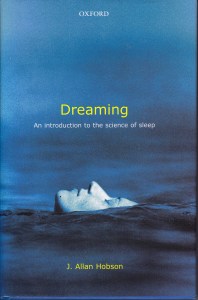
DreamingLike most people, I seldom remember my dreams. When I do, or when only the powerful feeling remains, I know that they are very emotional events. Something is always going on, and my attention is riveted. I recently read J. Allan Hobson’s Dreaming: An Introduction to the Science of Sleep. It must be intimidating, I have to note right away, for a neuroscientist to write a book. Our understanding is changing so rapidly that even academic treatments become a kind of ephemera. Published over a decade ago, it shows its age. Even I’m aware that changes in brain science have occurred and perceptions have changed somewhat since then. What struck me most, however, is Hobson’s absolute confidence that mind is a function of the brain, and that dreams are merely the madness we experience when we sleep. The madness I don’t mind so much. The materialism, however, I think is largely wrong.

Consciousness remains a great unknown. There is disagreement around whether it is emergent—coming from the brain, or receptive—perceived by the brain. Or perhaps something completely different. One of the greatest human foibles is to claim that we understand anything completely. I’ve always been amazed—knowing that the world involves much more than just sight, sound, scent, taste, and touch—that some scientists are so quick to write off complex experience as “merely” activity in the brain. Some animals, for example, seem to perceive magnetic fields. Others use navigation devices we simply don’t comprehend. They may experience senses we don’t even have. And yet, we happily claim that we’ve gotten this one nailed down. Dreams are only activities in the brain when we sleep.

Only? How can any dreamer say that this is only chemical reaction in our heads? The experience of dreaming is, implicitly, so much more than just random thoughts. Hobson does a good job describing how dreams are a form of madness, a psychosis when the reasoning part of our brains are inhibited. Fair enough, but who can experience madness and think it completely material? Our minds are more complex, it seems to me, than we give them credit for being. Hobson begins the book by noting that dreams used to be within the purview of religion. Since has now claimed them. We have an entire universe in our skulls, and yet we insist that although we don’t understand it, we can be certain that it is nothing but material. My dreams continue to suggest a different reality.


Used Bookends

There’s nothing like spending a Saturday in a bookstore. It is actually a rare treat these days with Borders gone and some of the smaller indies having trouble keeping up. I particularly like used bookstores. Unlike most durable goods, books—at least some of them—grow in character with renewed ownership. Like most academics, I have books that had previously been owned by big names in the field. Sometimes because I was a student of one of their students, at other times because their library went for sale and I found the tome in a second-hand shop. A few years back I had to go to Boston for work, and I stopped at the Boston Book Annex only to find it closed. It’s sad when even a used bookstore can’t keep up.

So when my wife told me she had to work on Saturday, and it was in Montclair, my thoughts turned to the Montclair Book Center. It isn’t the largest bookstore around, but it does have used books and it is a healthy walk from my wife’s office. I never go planning to spend much, but being in a bookstore, you see things you didn’t know existed. When the staff comes up to ask if they can help me find anything I just smile and say, “No thanks, I just want to browse.” Maybe it’s because I have no idea what I’m looking for. I’ll know it when I see it.

IMG_2685

I used to visit the Cranbury Bookworm. In a sprawling old house outside Princeton, I often found pleasant, used surprises there. Then the landlord evicted them. They sold off most of their stock and moved to a closet down the street. Even though it’s tiny, there are always others there. I’m never alone in a bookstore. Other patrons feel the draw. I wonder if everyone who reads doesn’t owe a debt of obligation to stop into their local bookstore and pitch in. I grew up in a town without any bookstores at all. The nearest one I knew of was thirty miles away. I know what it is to be book-deprived. It’s Saturday, and a little too cold to spend much time outdoors. It’s probably just an excuse, but you’ll find me in the bookstore nevertheless.