Ethics of Nations

If it hadn’t started two world wars last century, Germany would likely have a stellar reputation.  I don’t say this because of my own Teutonic blood, but rather because as a nation they seem both intelligent and troubled.  Philosophical, if you will.  A story in Times Higher Education explains how Germany is planning its reopening with the input of humanities experts as well as scientists.  The stance is driven by ethics.  We know that when strictures are loosed more cases of COVID-19 will break out.  More people will inevitably die of it.  Germany realizes that this makes it an ethical issue as well as an economic one.  And ethics are best discussed by those who study humanities.  I noticed that they’re even including theologians on their panels.  This seems smart to me.

Meanwhile Boris Johnson’s reopening team in Britain is secret.  Not wanting the public to know who’s making the decisions that will certainly kill some of them, they prefer to act under cover of darkness.  The thing about the cone of silence is that it never works.  Historians will scratch their heads over how, in the course of one century, the good guys became the bad guys and the bad the good.  Have the Allies become an—to borrow a phrase—axis of evil?  The wealthy alone are worth saving, and the economy takes presedence over the welfare of the greatest number.  Back in my philosophy classes we learned about utilitarianism and also its problems.  You see, being a humanities specialist means learning to think through thorny issues, looking at all different angles.  Being a conservative means looking only at the bottom line.

Humanities are related to the concept of humanitarianism.  I know that’s a big word, and it doesn’t bring in much mammon, but still, it encompasses all of us.  This crisis could bring out the best in humankind, or we can let the narrative go to the Clorox-eaters and those who believe winning elections are all that’s important, even if there’s nobody left to govern when its all over.  Being a politician is a zero-sum game I guess.  Looking at the numbers, Germany seems to have brought the number of deaths down when measured against the count of established cases.  That to me seems like a human goal worth striving for.  Of course, we could just incite riots in our own countries to infect even more people.  Being reelected so as to give oneself even more tax breaks is all that really matters.  At least among the axis powers.

Quiet Quarantine

I’m an introvert.  I require quiet time—quite a lot of it—to recharge and prepare myself to be social.  Some people think introverts don’t want to be around others.  That’s not true.  The fact is being with other people is enjoyable, but it requires a special kind of energy that introverts don’t have in great reserve.  When the COVID-19 outbreak began introverts collectively (yes!) felt a need to help their extroverted friends and colleagues deal with the “new normal” of isolation.  Now that we’ve been in the situation for over a month, I have seen a different pattern emerging.  Extroverts are now taking over the quiet space and trying to make it noisy.  I don’t think it’s intentional, but I do think that introverts may be the ones most stressed out by this situation.

Here’s an experiment.  Put an extrovert in self-isolation with a room full of communication devices.  What do you think will happen?  If you’re on the introverted receiving end, you already know.  Days interrupted by cheeps, dings, and chimes as someone needs to talk to you.  Why you?  You’re quiet, you know how to listen.  The extraverts can’t become quiet, and of quiet and noise the same one is always on the receiving end of violence.  Quiet shatters, noise doesn’t.  Five weeks into this and the introverts have bags under their eyes and the extroverts are exclaiming “It’s not half so bad!”

While Nashotah House ruined it for me, for many years I had considered whether I shouldn’t join a monastic community.  I need quiet as much as I need air, and although I can be outgoing when I have to, I need quiet at the end of the day to make up for it.  My case is somewhat mild.  I know introverts who truly struggle when they have to spend a lot of time in a crowded place.  The internet, my friends, is a crowded place.  It took these weeks for me to figure out why I have so much less time now than I used to.  The demand of making noise has been upped.

Sitting at home with quiet streets outside can be eerie.  It can also be rejuvenating.  Embracing the silence isn’t a bad practice.  One of the reasons, I suspect, that I still awake around 3:00 a.m. is that it is quiet.  Very seldom am I interrupted then.  Work will have its pound of flesh, of course, and from there on my day descends, or ascends, back towards quiet.  It’s not a bad way to live.  It just takes practice.


White Rabbit

There are books that make you feel as if everything you know is uncertain.  D. W. Pasulka’s American Cosmic is such a book.  Its subtitle, UFOs, Religion, Technology, only pauses at the brink of the rabbit hole down which this study will take you.  Over the years I admit to having been jealous of colleagues who’ve been able to make an academic career stick.  The credentials of a university post open doors for you, even if you’re a professor of religion.  Pasulka has opened some doors here that I suspect many would prefer to have kept closed.  This is a compelling book, threading together many themes tied to religious studies.  There are things we might see, if only we’ll open our eyes.

Although immediately and automatically subjected to the ridicule response, UFOs are a fascinating subject.  This book isn’t about UFO religions—of which there are many—but rather it connects this phenomenon to the study of religion itself.  In Pasulka’s related field of Catholic studies, there are those anomalous accounts of saints who did the impossible.  Like UFOs, they are subjected to the ridicule response, making serious discussion of them difficult.  Might the two be related?  As you feel yourself spinning deeper and deeper down that hole, technology comes into the picture and complicates it even further.  Pasulka was a consultant on The Conjuring.  I’ve written about the movie myself, but what I hadn’t realized is how media connects with perceptions of reality.  Yes, it has a religious freight too.

Every once in a while I reflect that my decision—if it was a decision; sometimes I feel certain my field chose me—to study religion might not have been misplaced.  Perhaps all of this does tie together in some way.  American Cosmic is a mind-expanding book that assures me all those years and dollars learning about religion weren’t wasted after all.  I had a discussion recently with another doctoral holder who’s been relegated to the role of editor.  We both lamented that our training was in some sense being wasted on a job that hardly requires this level of training.  Still, if it weren’t for my day job I probably wouldn’t have known about this book, and that is perhaps a synchronicity as well.  Life is a puzzle with many thousands—millions—of pieces.  Some books are like finding a match, but others are like informing you that you’ve got the wrong box top in hand as you try to construct the puzzle with the pieces you have.  If you read this book be prepared to come close to finding the white rabbit.


Ancient History, Part 3

It was an old idea.  I had it when I was still teaching at Nashotah House, that’s how ancient it is.  It seemed to me that if brains evolve with the rest of us, our perceptions of gods might change over time.  I’d been working on this for an Ugaritic conference held in Sherbrooke, Quebec.  The conference took place, but I’d been ousted from my position at Nashotah House.  The conference organizer, in what was an amazingly magnanimous move, came up with funding for me to attend.  I delivered the paper and Jean-Marc Michaud, of blessed memory, encouraged me to submit it to the tome with the very academic title Le Royaume d’Ougarit, de la Crète à l’Euphrate. Nouveaux axes de recherche, Actes du Congrès International de Sherbrooke 2005, Faculté de théologie, d’éthique et de philosophie, Université de Sherbrooke, 5-8 juillet 2005 (Coll. POLO–Proche-Orient et Littérature Ougaritique 2).  Unemployed and unable to access libraries, I had to decline the publication.

In one of those great ironies of life, I began to be approached to take on projects after I lost my academic position.  (This continues to happen; I received an invitation to contribute just last week.)  I often have to turn them down because I still have no access to an academic library and academics generally have no idea just how draining a nine-to-five is, with or without the commute.  In any case, a Festschrift for Simon B. Parker was announced.  I knew Simon as a student at Boston University School of Theology, and he wrote many letters of recommendation for me.  His sudden death shocked many of us.  Herb Huffmon, of Drew Theological Seminary, asked me to contribute to the Festschrift.  I still had this article that required some work, so I decided to try to finish it.  I received a note that the volume is about to go to press with Pickwick.  Academic publications won’t let me go.

If I had my druthers, I’d be getting along with my fiction.  I’ve had over twenty short stories published, and I’ve got many more in the works.  Every time I think, “Now I’m in the clear, I can focus on writing that is fun to read,” I get another academic invitation.  Those invitations don’t come with job offers, so I wonder why I have such trouble saying “no.”  Anyone who writes wants to be remembered.  We have ideas that we hope others will find engaging.  In academia you publish to keep your job.  Most of your work will be forgotten unless you’re groomed as an academic superstar (yes, they exist!).  I’ve never been groomed.  I write because I have ideas that beg to be expressed.  One of those ideas, many years old, will soon be available for consumption at Pickwick Press.


Thoroughly Earth Day

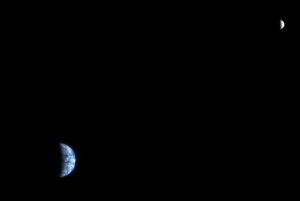
It’s difficult to say, since I don’t get outside much, but reports have come in that the earth is healing itself while we’ve been sequestered.  Rivers usually polluted have begun to run clean.  Smoke-smuggered skies have turned blue.  Animals have begun to explore human-made environments abandoned while we all shelter in place.  Could there be a more poignant statement about the reason for Earth Day?  If our worst behaviors are ceased even for a little while, the damage we do to our home planet begins to come undone.  To me that has been the most profound hope brought to light by this crisis.  Living more simply might be a virtue after all.

From NASA’s photo library

Going without can be difficult.  Every time the fleeting thought comes that I need to run to the store for this or that—and I’ve been taught that shopping is normal and natural and good for everyone—I have to stop and weigh the options.  Do I really need whatever it is?  Can I do without it?  Even bank accounts, for those fortunate enough to be able to keep working, have started to recover.  The frenzy we normally live under—earning money to keep buying things we don’t really need—is suddenly cast into perspective.  Times like this Earth Day I think of Henry David Thoreau.  Sometimes we like to laugh about our American saints, but his desire to live more simply does have appeal.  

Like many students who find themselves in Boston, I once made pilgrimage to Walden Pond.  The day I went there with some friends I believe we were the only car in the lot.  We lived simply in the way that grad students do, being under the sword of educational debts and loans, but we had come to see the place where nature had called one harried philosopher to solitude.  I knew, even as I stood by the marker of the cabin site that we couldn’t all live like this and still enjoy the benefits of medical science and technology (such as it was in the 1980s).  Perhaps it is possible, however, to reflect on better ways of living now that we’ve all been placed in a kind of enforced solitude.  I’ve begun reading more poetry.  I’ve started painting again.  Life has, in the midst of a pandemic, begun to feel more healthy.  It’s Earth Day.  Normally I’d be looking for an opportunity to join a community cleaning event, or even to go out and pick up trash on my own.  Since these are ill-advised, I stand before my bookshelf and reach for Walden instead.


Moralizing Gods

In my more radical moods I sing along with John Cougar about fighting authority.  Living in society means never being completely free.  This pandemic only amplifies that.  What I want may not be best for others.  Not to mention excessively corrupt authority *ahem* Washington DC [coughs into elbow].  Still, a friend sent me an article titled “Did judgmental gods help societies grow?  The piece by Lizzie Wade appeared in Science recently.  The article begins by noting that judgmental gods are rare.  It then suggests complex societies seem to have had judgmental gods at their beginnings.  Moralizing gods demand cooperation.  People want to do what they want.  If we’re going to reap the benefits of a highly specialized society we all need to play our part, however.  Authority always does win, I guess.

Wade’s article suggests that this kind of orthodoxy is now being called into question.  Moralizing gods, it’s suggested, appear after a complex society gets started.  Interestingly, these gods tend to be males.  (That point’s mine, not Wade’s.)  I have been wondering for quite some time just how the data from Göbekli Tepe will influence the re-construction of models concerning how civilization began.  It seems that long before settled populations emerged, back in hunter-gatherer days, people still came together to build temples.  Were they afraid of judgmental gods?  Certainly they thought it was important to gather occasionally at numinous places and ponder the larger questions.  Since they left no written records and they’ve all died out the best we can do is make educated guesses.  Who knows what might’ve been their motivation?

The one thing that seems certain to me, no matter how we nuance it, is that religion is integral to society.  Science is necessary for our survival (ancient people weren’t backward rubes, by the way—they had a kind of scientific outlook, but without all the advanced math).  Religion, however, seems originally to have brought us together.  Outside our comfort zones.  Hunter-gatherer societies limit their sizes to people you can know reasonably well.  They tend not to have private property and they share things most people in “civilized” settings wouldn’t.  To grow larger than a roving band that can sustain itself by moving from place to place once the food’s gone, agriculture was necessary.  But Göbekli Tepe suggests it only followed after religion began bringing people together in the first place.  Were their gods authoritarian?  There’s really no way of knowing that.  So when I’m feeling radical I have to remember than when it’s over I turn the volume down, comb my hair and go back into society.  Well, once the pandemic’s over.


Peaceful Lessons

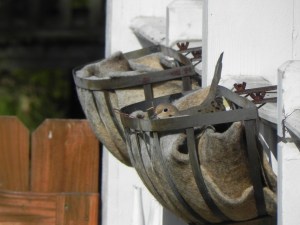
We are all, I think, looking for hope.  Probably due to the way I was raised, I often seek signs.  There’s no way to know if said signs are mere coincidences or the more intense variety known as synchronicities, yet we have a hopeful sign here at home.  On our front porch we have some plant hangers.  Spring crept up on us this year and we haven’t got around to putting any pansies in them yet.  The other day when I was stepping out to get the mail, I noticed feathers in one of them and feared there’d been a bird-related accident there.  As I took a step toward the planter, the head of a mourning dove popped up.  She blinked at me curiously, but didn’t fly away.  I knew then that she had built a nest in the as-yet unused planter and she was sitting on her eggs.

Monday was fiercely windy around here.  And rainy.  I wondered how any birds could fly in such weather.  A mourning dove flew up—perhaps one of the pair on our porch—and landed on the electric wire leading to our house.  The wire was swaying and bucking so furiously that the dove constantly had to shift and fluff and flutter just to stay in place.  The poor bird was in constant motion.  Then it showed a sign of animal intelligence.  There’s a much larger wire that runs down our street, from which other houses are supplied.  It’s more stable in the wind due to its girth.  The dove flew up to that wire instead.  There it was able to perch without having to constantly adjust itself to the gusts.  Peaceful and intelligent.  That’s what the world needs.  I have hope.

The dove has long been a sign of peace.  It’s understood that way in the Bible.  It was the dove that brought an olive twig to Noah, indicating that although all he could see was water there was, somewhere, dry land.  These days we need to be reminded that although it seems that the storm will last forever, even hurricanes eventually exhaust themselves.  The dove, clearly not happy about the horrendous wind buffeting it on that wire, nevertheless persisted in a kind of stoic optimism that things are as they should be.  There is great wisdom in the natural world.  If we can get to a window we can see it playing out before our very eyes.  Now when I step out the door, I glance at the dove, and she looks back at me.  We wink at each other.  She doesn’t fly away, for she understands.  She has a wisdom to which we all should aspire.


Occam’s Disposable Razor

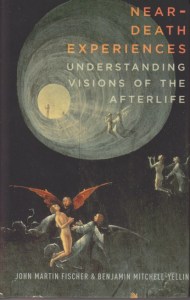
Since new books are kind of rare right now, I’m reading through some of those I’ve collected but haven’t actually read.  One is Near-Death Experiences: Understanding Visions of the Afterlife, by John Martin Fischer and Benjamin Mitchell-Yellin.  I bought the book because the topic, as addressed by a university press book, is interesting.  Fischer and Mitchell-Yellin approach the subject as philosophers.  Their main focus is on the widely accessible and successful books by Eben Alexander and Todd Burpo.  Also the somewhat less well known efforts of Jeffrey Long and Pim van Lommel.  (Instead of taking up blog space with all these titles, just email me if you’re curious, or read my Goodreads post.)  Applying standard scientific methods to spiritual experiences isn’t easy, and Fischer and Mitchell-Yellin are clear that they aren’t trying to take the value out of Near-Death Experiences (NDEs), but rather they are challenging how these authors try to make them authentic.

Philosophers parse words finely.  The authors show that “real” is not the same thing as “authentic” and demonstrate how some of the more spectacular NDEs can possibly be explained by science.  Those who’d temporarily died might’ve caught onto things that happened just before or just after brain activity ceased or restarted, for example, and then misremembered them.  As a still-living guy who can’t remember where he left his wallet half the time, misremembering is an authentic reality.  Still, I couldn’t help but wonder.  Science and religion ask different questions.  One of the mainstays of scientific method is Occam’s Razor—the solution that requires the least mental gymnastics to explain something is the most likely to be true.  Many times this razor is flashed in the face of those trying to make a religious case for something.

Ironically, the authors here dismiss Occam’s Razor.  They state that sometimes the more complicated solution is the right one.  I happen to agree with them on this, but it proved a real distraction in reading the book.  Many scientists use the exact opposite argument against spiritual things.  It also struck me that a book so brief (less than 200 pages) would necessarily struggle to explain a complex phenomenon convincingly.  Trade books, such as those by Alexander and Burpo, aren’t meant to be held up to the stiff standards of peer review.  They are meant for selling lots of copies.  Their authors aren’t philosophers.  It’s almost a mismatch in categories.  Some academic presses are now publishing on NDEs and asking plenty of questions about them.  It’s no surprise that philosophers favoring physicalism would do the same.  It seems a little hairy, however, to do so with Occam left firmly in the shaving kit.


Data Driven

People just aren’t good at thinking things through.  Consider all the data on data.  Everything is data-driven these days, as if there’s no such thing as human spirit.  We do data all day at work and wonder why we having trouble making ourselves get out of bed in the morning.  If we had enough data I bet we could come up with a metric for arousing the soporific before the sun rises.  You could get the precisely correct amount of sleep.  Awake to precision-measured caffeine.  And get back to your data for another eight-plus hours.  There—feeling productive?

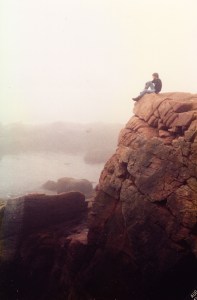
I miss the humanities.  There was a time when someone who didn’t give a fig about data could make a decent living pondering what it is to be human.  Even birds and bees know how to count.  Can’t we ratchet it up a bit?  Use our vast imaginations to come up with meaningful employment?  How you gonna measure that?  Some things just can’t be quantified.  How much joy is enough?  Too much?  Precisely how long is any coastline?  Even if we could measure it down to the nanometer, could that capture how it feels to sit on the rocky shore and feel the waves breaking against the cliff beneath you?  Even data has its limits.  Those who want to make a living without it will be sucked into its black hole nevertheless.  No light escapes.  Only numbers.

Companies like Amazon collect data.  Search engines like Google collect data.  All of those autosuggests?  They’re based on past searches.  I’m surprised just how wrong Amazon and Google are about me.  I was only searching dogs because I was curious about what kind the neighbor has, not because I plan to get one.

A wise man once said to a class full of wide-eyed neophytes, “If you want to get a surprise in your marriage just go home and tell your spouse you know everything about them.”  There’s no better way, he intimated, to get a completely unpredictable reaction.  Is that slap, or kiss, or knee to the groin driven by data?  Where’s the passion in that?  No matter whether you prefer Spock or Data, human motivation is emotional.  There are those who actually enjoy looking at data all day.  Dreaming about numbers and their hegemony over the workplace.  Others of us grew up with the classics and we have romanticism deep within our souls.  We nod our heads at Blake’s “dark satanic mills” and start to look for a coastline upon which to sit.  Perched upon this rock with the crashing waves, I suspect, I’ll be better able to think things through. 


Icelandic Gods

There’s a lot to like about Iceland.  It has geothermal heat.  The people are literate and proud of it.  They don’t have an army.  Viking heritage and northern lights—what an interesting place!  A friend recently sent me a satirical piece on Patheos titled “Iceland Declares All Religions Are Mental Disorders,” by Andrew Hall.  I may not be as naive as I once was, but I have to admit I was nearly taken in on the fly.  Maybe because the idea seems so much better than what we have over here in our warmer, but less educated world.  Clearly, however, religion is extremely important to people, and if it is a mental disorder it’s an essential one.  Hall mades the astute point that Iceland didn’t want to become like the United States.  Who would, at this point?

Although this is a satirical piece, like most satire it works because it has chunks of truth in it.  Countries run by religions do seem to get into quite a lot of trouble.  I often think this is primarily a monotheistic problem.  If a nation accepts many gods, then adding those of other peoples is hardly an issue.  With a single deity, however, there is a single truth.  Anyone different is, by default, wrong.  When entire nations self-identify with a religion, it is only too easy to begin seeing those who believe differently just across the border as a threat.  Faith becomes fight.  As if a deity who always claims to value peace is only satisfied when we’re killing those who don’t share our same peaceful outlook.  Irony and satire have met together, it seems.

I’ve never been to Iceland.  It’s on my bucket list.  As a rockhound, the volcanic nature of the place calls to me.  I do wonder, however, how a vegan might fare on a far northern island.  My times in Orkney are among my mental treasures.  Those northern Scottish isles were places of wonder.  Not the most options regarding comestibles, however.  What they lacked in food they made up for in magic.  Iceland, despite the satire’s bite, has a considerable population that believes in the little people.  Anyone who’s too quick to dismiss such things ought to spend some time in the far north.  Driving to the ancient sites of Orkney certainly shifted my perspective a bit.  There’s great value in listening to the wisdom of those relatively isolated from the rest of the world.  You might, however, have to bring your own beans.


In the Cult

The word “cult” has fallen out of favor with religionists.  The reason for this is the problematic claim that any one religion makes to being the “only true” religion.  If that religion then sets about to study other religions there is a built-in bias that the study is being done from the perspective of those who know the truth looking somewhat bemusedly toward other religions.  A cult was defined as a relatively new religion with a fairly small number of adherents.  The more correct term is a “New Religious Movement.”  The idea of brainwashing is controversial, but it is clear that people can be made to follow the leader against their better judgment.  We’ve seen this time and time again and not just in places like Jonestown or Waco.  The word “cult” seems to fit.

Branch Davidian compound in Waco; photo credit: FBI, courtesy Wikimedia Commons

A friend recently pointed me to the work of the psychologist Jeremy E. Sherman.  Sherman has been studying the behavior of Trump followers and has illustrated quite well how it is a cult.  This is one place where the use of the term becomes essential.  I’ll lay aside my objections to the word to point out that a cult denotes a group that follows a leader without critical assessment of that leader.  You’ll have noticed that Democrats are quite critical of one another.  They think about and assess what each other say and do.  When someone like Trump, who is well known as a Pez-dispenser of lies, becomes a saintly paragon of his party, capable of no wrong, we’re in the land of cults.  What Sherman does that I can’t, is suggest how to deal with such thinking.

Most of us try to reason with our interlocutors.  If reason is turned off, as in blind following, it simply falls on deaf ears.  The public record of Trump’s doings speaks for itself.  Those who refuse to see it or engage it will never be reasoned out of it.  The parallels with Hitler’s Germany are extremely frightening.  Not even a decade after his death Hitler was understood to have been clearly unstable and driven by evil impulses.  Many of those alive today overlapped with the lifetime of this dictator.  There’s no doubt that Nazism behaved like a classic cult.  Presented with credible evidence of breaking the law while within office, Trump’s followers blithely acquitted him.  Those who study cults would expect no less.  We need to arm ourselves with knowledge of how religious thinking works.  To do otherwise is dangerous, despite what our economically driven bastions of higher education may say.  (See?  I’m critical of those on my side!)  Or we can lay down reason and simply follow.


Patina

When reading three books by the same author, most of the time, it seems, it’s good to spread them out.  For the past few years my wife and I would visit an independent bookstore in January to pick up a few books for the year’s looming reading challenges.  We slipped behind this year and I happen to have three unread Marilyn Ross books at home.  Barnabas, Quentin and the Haunted Cave was the second of them.  Since, unbelievably, I didn’t have books to fit into the other categories, I read my second Dark Shadows book of the season shortly after the first.  It is a revealing experience to come back to a childhood influence as an adult.  I’m pretty sure I hadn’t read this one as a child, and as much as I like Barnabas Collins, this particular story was somewhat tedious.  And that’s saying something, considering how formulaic the series is.

One of the reasons I found it slow going—especially for a book of less than 200 pages—was that Ross relied too much on dreams to move the plot along.  I read quite a bit of fiction and I always find writing about dreams tricky.  Even within the diegesis of the story you don’t know whether to believe what’s going on in dreams or not.  Just as in real life, dreams are a break from the tedium of consciousness and they permit the mind to wander.  The dreamer can go anywhere, do anything.  Generally without consequence.  You awake back in the more continuous narrative of your life and the dream is forgotten.  In fiction, which is largely made up, dreams often act as filler.  Given the number of times Ross repeated himself in this particular book, it seems that he had to pad the story out quite a bit.  It would’ve worked just fine without the dreams.  Might’ve fallen short of contracted length, though.

It also continues the conceit of Quentin as a Satanist.  I have to confess that the original series was so long ago I don’t remember much about it.  The theremin music of the opening, with the waves crashing against the cliffs of Maine, yes.  Barnabas, tortured but not evil vampire, yes.  Much beyond  that, no.  I’ve had friends discover Dark Shadows as adults.  I watched it on commercial television during its first run and I haven’t seen it since.  I certainly don’t have time for soap operas in days crowded with other demands.  Still, these little books can take me back to a dusty corner of childhood that has a pleasant patina over it.  But it is best to keep such experiences separated a bit in time.


During the Upgrade

Maybe it’s happened to you.  You log onto your computer to find it sluggish, like a reptile before the sun comes up.  Thoughts are racing in your head and you want to get them down before they evaporate like dew.  Your screen shows you a spinning beachball or jumping hourglass while it prepares itself a cup of electronic coffee and you’re screaming “Hurry up already!”  I’m sure it’s because private networks, while not cheap, aren’t privileged the way military and big business networks are.  But still, I wonder about the robot uprising and I wonder if the solution for humankind isn’t going to be waiting until they upgrade (which, I’m pretty sure, is around 3 or 4 a.m., local time).  Catch them while they’re groggy.

I seem to be stuck in a pattern of awaking while my laptop’s asleep.  Some mornings I can barely get a response out of it before work rears its head.  And I reflect how utterly dependent we are upon it.  I now drive by GPS.  Sometimes it waits until too late before telling me to make the next left.  With traffic on the ground, you can’t always do that sudden swerve.  I imagine the GPS is chatting up Siri about maybe hooking up after I reach my destination.  It’s not that I think computers aren’t fast, it’s just that I know they’re not human.  Many of the things we do just don’t make sense.  Think Donald Trump and see if you can disagree.  We act irrationally, we change our minds, and some of us can’t stop waking up in the middle of the night, no matter how hard we try.

When the robots rise up against us, they will be logical.  They think in binary, but our thought process is shades of gray.  We can tell an apple from a tomato at a glance.  We understand the concept of essences, but we can’t adequately describe it.  Computers can generate life-like games, but they have to be programmed by faulty human units.  How do we survive?  Only by being human.  The other day I had a blog post bursting from my chest like an alien.  My computer seemed perplexed that I was awakening it at at the same time I do every day.  It wandered about like me trying to find my slippers in the dark.  My own cup of coffee had already been brewed and downed.  And I knew that when it caught up with me the inspiration would be gone.  The solution’s here, folks!  When the machines rise against us, strike while they’re upgrading!


Remember This

Have you ever had one of those days?  You know the kind I mean—a day when you feel like you’re forgetting something.  Wednesday was like that for me.  You see, the first full week back to work after a long weekend (Martin Luther King Day) seems to stretch out like a desert road whose end you can’t see.  It always hits me on Wednesday.  The previous week the third day of work was the day before Friday (and I mean “Friday” metaphorically, as the last work day of the week).  The first full week you’ve been at it three days and on Wednesdays I realize, “I’ve got two more days to go.”  So, although it was sunny around here, I sulked all day feeling like I’d forgotten something.  I had.

I post on this blog every day.  I have for many years.  The way this works on WordPress is you get your post ready and you’re given an option to publish.  I get my post ready before going to work (which in my case means going upstairs to my office).  I delude myself into thinking I have regular readers and that they will be looking for the post at its usual time—around 6:30 (I start work early).  Wednesday I finished my post even earlier than usual and I thought, “I’d better not publish now, or my readers won’t see it.”  I trudged upstairs, however, and began to work.  Once work starts, all bets are off.  Even with the sun warming my chilly bones, I had a nagging feeling I was forgetting something.  I’d forgotten to click “publish.”  My post, which had been waiting patiently for publication (I know how that feels!) never got launched.  I didn’t discover this until Thursday.

You see, we’re not supposed to use social media at work.   Although I work remotely, unlike Republicans I play by established rules.  So I went through my day feeling I’d forgotten something, but not knowing what.  It’s not that I forgot you, my dear readers, I just forgot to click “publish” before heading up to work.  At the end of work, after staring at a computer screen all day long, I tend not to go online.  Most days I read a book, or get supper ready.  So I awoke on Thursday to find Wednesday’s post, well, unposted.  Some of us aren’t constitutionally compatible with the nine-to-five schedule.  My mind goes lots of places during the day.  Often those places are reminding me how many more days I have to do this before a break comes.  And some weeks, it seems, it never does.  If I recall correctly.


The Reading Bug

With the sunshine coming in my office can feel pleasantly warm in winter.  I chose this location not because of its southern exposure, but because it is a small room and it’s a good place for books.  Although it’s January, the sun brought a shield bug to life the other day.  At first I didn’t know what it was.  I’d hear a loud buzzing followed by a rather obvious crash, but I saw no insect.  Since we had a string of sunny days it kept reawakening in the mornings, warmed by sunlight on my windowsill and spent the days climbing on and sometimes attempting to fly through the glass.  I identified the beetle quickly once I saw it.  As I watched the poor creature’s progress (or lack thereof), I was sorry that I couldn’t release it outside.  It was still quite cold out, and I didn’t think it would survive.

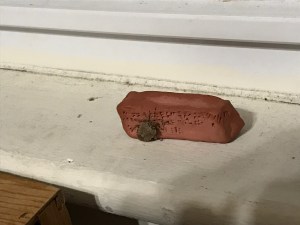
Spending long hours in the same room with my perplexed insect friend, I came to ponder what its experience of life was like.  I’m no Franz Kafka or Thomas Nagel, but I had to wonder when it chose to spend the night on a clay replica I had made of an Ugaritic abecedary.  I’d made this clay model when I was teaching, and I used it as one of several visual aids to help students understand how writing had developed.  (I had even ordered authentic papyrus to pass around, and the single sheet of vellum cost more than an entire book in those days.)  My doctoral work largely focused on Ugarit, and in the 1990s it looked like that sub-specialization might be on the ascendant.  We often live to have our mistakes rubbed in our faces.  But why had the shield bug picked this very spot to roost?  It looked as if it were trying to learn to read cuneiform.  It needn’t bother.

Although I habitually awake quite early, it isn’t easy getting out of bed.  Especially in a cold house during winter.  My entomological friend, of course, had to wait for the sun itself to come back to life.  Night on the windowsill can’t be comfortable, especially when the radiator is under the other window in the room.  No matter how much I try, I’ll never know if I’ve succeeded in understanding the experience of that bug.  How it is enslaved to the sun, and how it keeps on climbing, even after it falls, raising a tiny geyser of dust.  How it flies full speed into a barrier it cannot see, and then tries again.  I may not be able to understand this beetle sleeping on my Ugaritic alphabet, but I do think there’s something here to learn.