Bodies and the Fall

Less common than it once was, the term “Dark Ages” was formerly used to denote what in Europe was known as the Medieval Period.  We now know that the pervasive darkness ascribed to the time was only partial: science, legal thinking, and rationalism were well underway.  Nevertheless, the sway of the church was enormous, and even until and beyond the days of Isaac Newton, the supernatural was assumed to exist.  Dyan Elliott’s Fallen Bodies: Pollution, Sexuality and Demonology in the Middle Ages is a fascinating journey through this contradictory time.  Elliott explores how the mysteries of sex (nocturnal emissions and menstruation loom large among them) played important roles in the development of Catholic theology that ultimately led to the close association of demons and witches.  Concerns with priestly purity, largely due to concerns about transubstantiation, led to enforced celibacy and the (further) denigration of women.

It would be difficult to summarize this insightful book.  Although relatively brief, it packs a wallop.  Concerns about purity go back to the Bible and before.  Ancient cultures had recognized aspects of contagion and knew that some diseases spread by contact.  Their perception of biology was “scientific” according to their current understanding, but it lacked microscopes and knew no shortage of supernatural entities.  Demons had great explanatory value in such a world.  As Elliott shows, they often appear in disquisitions about sex.  How can spiritual beings engage in physical relations with human bodies?  What were they made of?  Were they all bad?  Although demons had explanatory value they also raised many questions.

Fallen Bodies draws correlations between the dismissal of priests’ wives and the evolution of witches.  As the Eucharist became more and more holy, stricter controls had to be placed on consecrating hands.  Sex was the great source of pollution, and the Virgin Mary became rather less human through her own miraculously sterile conception.  The implied misogyny may not have been so much intentional as a reflection of the struggle to understand what modern medical science generally explains materially.  We still grapple with the mystery of life.  Conception can be viewed clinically, and biological responses can be “explained” scientifically (anyone who’s been in love will admit to the mystery of it, though).  Denizens of the Middle Ages worked with the tools they had to make sense of a world often bewildering.  Even physics still has to deal with quantum realities.  History teaches by its unfortunate missteps.  Someday those who “govern” the world may learn to read it and exorcise demons now otherwise readily explained.
Integrity

I’m not lying when I say untruth has been on my mind a lot.  A few days ago I posted on freedom of speech and how it’s an ideal rather than an actuality.  What with lies being lobbed at us daily, I got to thinking about the ethical implications for honesty.  Integrity.  The freedom to state what we actually think is something a little different.  How often in daily life do we act authentically?  And when we’re with others we act differently than when we’re alone.  Which is truly us?  Someone pointed out to me recently that if you walk with someone your body language is different than if you walk alone.  Even walking alone your body language shows your interior frame of mind.  A sad walk isn’t the same as a happy walk.

As social creatures, the ideal of being forthright all of the time would lead to chaos.  All of us lie, one way or another, at times.  That’s where integrity comes in.  Integrity, it seems to me, indicates someone who is honest, all things being equal.  I once noticed a politician who blinked every time he said the word “God.”  That blink, I believe, was a form of “scare quote.”  I don’t know, but I suspect said politician didn’t have any strong belief in a deity.  Some circumstances require that you pay lip service anyway.  Ethics dictates that we try to be honest, but even keeping secrets is a kind of lie of omission.  Our own personal wants—which are honest—often have to be suppressed for the sake of fairness.  Again, we live in a situation where the most powerful pursue their own desires while neglecting the needs of others.  Is this then integrity?

Often I ponder what it means to be social creatures.  Some of us are naturally introverts.  We nevertheless rely on others because society is too complex.  What any one person could build an iPhone single-handedly, and then set up the 3G, 4G, or 5G network on which to use it?  Could that same person grow their own food, manufacture their own automobile, and construct their own house?  The self-made rugged individualist is a myth we cherish, but it too is an untruth.  We rely heavily on others and we count on those closest to us to be honest.  When lying becomes a lifestyle integrity lies in tatters on the floor.  Just three years ago I wouldn’t have been having such thoughts, if I’m honest with myself.


Now You Don’t

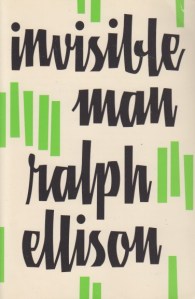
Quite some time ago I realized I should read Ralph Ellison’s Invisible Man.  What put me off, as usual, was length.  Long books take a real time commitment, but since Black History month is coming up, and we’ve just celebrated Martin Luther King, I planned ahead and read.  A profound book, at several points I felt like a voyeur reading it.  The African-American experience of life is something I always feel uncomfortable approaching.  I’m afraid of appropriation, and I’m afraid of not paying attention.  I grew up not having a sense of racism, but nevertheless am implicated in the whole.  Maybe that was intentional.  As a story Invisible Man is often described as a picaresque, but having an unreliable narrator who was a victim of my own culture was difficult to countenance.  It was hard to know what to think.

We never understand another person’s experience of life.  We sympathize, we empathize, but we can’t really get inside the head of even our best friends.  I can’t help but think we’d all be better off we recognized that race is a social construct, and a potentially evil one at that.  We are all human beings and we should act that way.  But this novel left me wondering if it’s really possible.  Good novels will do that to you.  So I’m sitting here scratching my head and a little bit flummoxed by what I’ve just experienced.  Was it authentic or can I not help but project my own experience as an non-minority upon someone else’s writing?  Even questions like this are socially conditioned.  I too am trapped in my own mind.

You might think that by this time we would have evolved beyond our distrust of those long separated from us by natural barriers.  Homo sapiens are distrustful of strangers, and even the internet hasn’t brought us the understanding we require.  Not yet, anyway.  The background to “race relations” in the United States can’t be separated from slavery and the attitudes it engendered.  On almost every page of Invisible Man its traces can be seen.  That kind of cultural memory, and other cultural memories such as Jews being routinely castigated by Christians, or monotheists being raised to combat polytheism, are deep dividers.  Our cure for these evils is understanding.  I had to keep reminding myself that this was a work of literary fiction.  It rings true, however, and although it represents a world I do not know the fact of its publication invites  those of us outside the tradition to read.  Indeed, doing so is one way of attempting to reach understanding.


Amendments

Funny thing about freedom of speech.  It doesn’t really exist in a capitalist system.  Words, I suspect the powers that be know, are extremely potent.  Any system that brooks no rivals will insist on silencing dissidents.  And not just on a national scale.  Several years ago I was interviewed by a Catholic magazine for an editorial position.  I was between jobs and this looked like a good fit; in fact, the woman who arranged the interview told me that if this position didn’t work out they’d likely be able to find a different one for someone with my particular skill set.  When the power that was interviewed me, however, he noted that I had a blog.  “If we hire you, you’ll need to take it down,” he said.  It would confuse readers who might think I was speaking for the Catholic Church.  My candidacy did not proceed.

In a job I would eventually get, in academic publishing, a similar concern was expressed.  Although I hold an earned doctorate from a world-class research university, my opinions might be mistaken for those of some true authority.  Problematic.  This issue keeps coming up.  I write fiction and publish it under a pseudonym.  Sometimes I think about coming out of my literary closet, but the issues pour in hard and fast when the door’s opened.  What would those who read my nonfiction (both of them!) think?  Would I discredit myself because I have too much imagination?  What would an academic employer say?  If I ever went back on the ordination track, would a congregation of any sort understand a clergy person who thinks such things?  I get enough flak from writing about horror films.

The fact is, freedom of expression is very, very limited.  Capitalism measures all things by the bottom line and anything that might cause that trend to waver is forbidden.  Lack of team spirit.  If you want to publish, don’t work in publishing.  It’s like saying (if I might be so bold) that you shouldn’t teach if you earn a doctorate, because you might actually contribute to what we hopefully call knowledge.  This dilemma has become an entrenched part of my psyche.  I grew up innocently writing fiction.  I completed my first stories about the age of 12 or 13.  I was eventually groomed for the ministry and so the fiction had to be set aside as one of those “childish things.”  Was it?  Perhaps.  More likely though, it was simply a lesson that I would find repeated throughout my adult life.  Give lip service to freedom of speech, but don’t ever use it.


Dancing

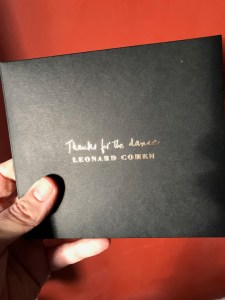
An artist is never really gone.  I have been listening to Leonard Cohen’s posthumous Thanks for the Dance.  Haunting in the way of Bowie’s Blackstar, there’s a poignancy to listening hard to the dead.  Especially when they saw it coming.  Artists are never really gone, and we can forgive them because they’re oh so very human.  Cohen was an exceptional poet and this album captures a man who knows the end is near.  Still he sings of girls and sins and God.  There’s an eternal soul there, and Cohen captures longing better than just about anyone.  The artist knows longing and understands not knowing for what.  The album struggles with religion and depression, a remarkably common combination.  Memories of glories that linger even as the body ages.

Listening to someone else’s music is taking a stroll through her or his head.  Someone once gave me a disc of songs built around a theme.  Although the theme came through I feared a little of what I heard here.  Some who know me primarily from my overly pious upbringing would be shocked to find Cohen on my favorites list.  For me he has no pretense.  Instead of ignoring religion, sexuality, or politics, he tried to make sense of them through song.  For me—and listening to music is a very personal thing—I think I understand when I’m drawn into his lyrics.  His experience of life was vastly different from what mine has been, yet he’d accurately mapped the direction my mind might wander, if given free rein.  Religion will hold your imagination captive, if left to its own devices.

Those who reduce Leonard Cohen to his over-used “Hallelujah” catch only glimpses of this complex man.  I once read an article about Bruce Springsteen in which a friend of his said that if he hadn’t succeeded in music he might’ve become a priest.  There’s an authenticity to these artists who write probing songs that have deep spirituality yet allow themselves to be human.  Cohen’s songs revealed he could see death with some ambivalence from afar.  Even in albums recorded thirty years ago the hints were there.  Instead of running and attempting to hide, Cohen’s lyrics, at least, indicated that he’d continue to try to live.  Maybe these are just the reflections of a middle-aged man who’s only glimpsed a fleeting connection between an artist in perpetual motion and a one-time scholar sitting up alone at 3:00 a.m., seemingly stuck in one place.  Whatever else they may be, such quiet moments will ones be haunted by Thanks for the Dance.


Strange Powers

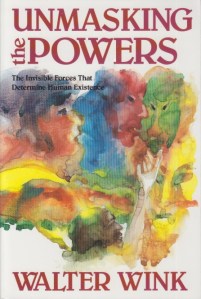
Some books take you to strange places.  Not all of them are fiction.  I began Nightmares with the Bible as a way of understanding the many, disparate ideas of demons I encounter in popular culture.  (I can’t tell you too much about my conclusions, otherwise you wouldn’t be tempted to buy the book!)  One of those nagging questions is: what does “based on a true story” mean?  I’ve known of Walter Wink’s powers trilogy for many years.  Because of my research I’ve now settled down to read Unmasking the Powers (number two, for those keeping count).  This book will take you into strange places.  Wink was very much a Christian in his outlook and orientation.  At the same time, he raises questions I’ve had other Christians put to me—were the “gods” of other nations, as in the Bible, real?  That word real is slippery, and Wink tries to hold onto it.

Unmasking the Powers is a kind of systematic exploration of the various “spirits” found in the universe we inhabit.  One of these is the Devil, and although Wink doesn’t see him as necessarily a “being,” neither does he find the Bible making him entirely evil.  Indeed, one of the great conundrums of monotheistic belief is theodicy; how is it possible to justify the goodness of a single, all-powerful deity in a world with so much suffering?  Wink approaches this question from an angle we might not anticipate.  He then deals with demons.  Since this is my subject in Nightmares, I found his discussion apt.  And yet again, strange.  Powers emanate from the institutions we create (you might have correctly guessed this was the book I wrote about on Tuesday).  Wink is willing to challenge materialism and take such powers seriously.

Finding a new perspective when we’ve been reared in a materialistic one, can be difficult.  For those of us raised religious, there was an inherent schizophrenia involved.  Our teachers told us of a mechanistic universe, but had Bibles on their desks.  (Yes, this was public school, but let’s not kid ourselves.)  While physics taught us everything could be quantified, church taught us that spirit couldn’t.  At least not by any empirical means.  Wink will unblinkingly take you there.  He offers both scientific and spiritual points of view on these entities, although he tries to refrain from calling them such.  Still, he records many people who have seen angels.  And although quantum entanglement wasn’t really known when he wrote this book, if it had been, Wink would’ve been nodding his head.


Cave Monsters

A story in Discover back in December discusses cave drawings from Indonesia.  Dating back almost 40,000 years before the creation of the world, these cave paintings represent the oldest yet discovered.  The interesting thing about such cave art is the representation of figures—both human and animal—that are instantly recognizable.  Scientists studying the art are able to identify likely species, but, as John Morehead pointed out on his Theofantastique Facebook post, there are also fantastical beasts.  We might call them monsters.  It’s interesting to see how scientific writers shift from their awe at life-like illustration to a nearly palpable embarrassment when the creatures become mythical.  Indeed, the article itself suggests such figures point to a very early sense of either fiction or spirituality.  The monstrous and religion have long trod parallel paths and we are only now beginning to explore the implications.

Monsters are beings over which we have no control.  They don’t abide by human rules and often the only recourse against them is religious.  When monsters come knocking, it’s often wise to drop to your knees.  Or at least reach for your crucifix.  Many rationalists like to claim that human civilization developed without religion.  The discoveries at sites such as Göbekli Tepe gainsay that assessment, indicating that humans first gathered for religious reasons and agriculture and all the rest followed from that.  Perhaps they came together for fear of monsters?  That’s only a guess, but I recall the defensive tower of Jericho.  The archaeologist lecturing us as we stood by this neolithic structure asked “What were they afraid of?”  He never answered that question.

Bringing monsters into the discussion isn’t an attempt to make light of these significant discoveries.  Rather, we need to learn to appreciate the fact that monsters are serious business.  Religion, whether or not literally true, is important.  Civilization has been running the opposite direction for some time now.  When surveys emerge demonstrating that the vast majority of the world’s population is still religious, analysts frown.  It does make me wonder, however, if nature itself programs us this way.  To other sentient creatures who experience us as predators, humans must look monstrous.  We come in a variety of colors and textures (clothing), we smell of deodorant, shampoo, soap, aftershave, or none of the above.  We emit strange sounds (our music).  Are we not the monsters of the natural world?  And should animals develop religion, would we not be one of the causes?  It’s just a guess, but I need to sit in my cave and think about it for a while.


Search Yourself

I was searching for someone on the internet (surprisingly, not myself).  Since this individual didn’t have much of a platform, I looked at MyLife.com.  Such sites draw in the curious and you soon end up paying (I suspect) for any salacious information such as arrest or court records.  In any case, what stood out is that we all presumably have a meter on the site that shows whether we’re good or bad.  It’s like a Leonard Cohen song.  Call me old-fashioned, but that’s what religion used to do.  Some forms of Christianity (Calvinism comes to mind) tell you that you can never be good enough.  Others are more lax (Episcopalians come to mind), as long as you go to mass enough and feel some guilt for misdeeds, you’ll get in.  All the various groups, however, have metrics by which you’re measured, largely based on what you believe.

The odd thing—or one of the odd things—about religion is that it is now categorized as what you believe.  Historically religions began as a kind of bellwether of what you do rather than what you believe.  The two are related, of course.  The motivation behind an action might well be good while the end result is less so.  Secular justice regularly seeks to answer the question of why someone did something.  Was there malice involved?  Aforethought?  Was it an unfortunate accident?  Religion drives over this ground too.  Without getting into the many shades of gray that are morality, value judgments as to the goodness or badness of an action (or a person) were traditionally the purview of religion.

The internet itself has become a kind of god.  We turn to it for all kinds of answers.  It’s both a Bible and encyclopedia rolled into one.  When we want to know something about someone we google them.  Some of us have tried to control the narrative about ourselves by making websites.  (This, of course, presumes others will be interested in us.)  Social media also injects us into larger arteries of traffic.  People judge us by what we post or tweet.  Often without ever meeting us or getting to know who we really are behind our physical walls.  So this person I searched had left little to find.  Scraps here and there.  I didn’t believe everything I saw on MyLife.  After all, not everyone wants to subject her or himself to the constant scrutiny of the connected world.  Maybe it’s a religious thing.


Social Madness

I’m reading a book written in the mid-1980s.  (All will become clear eventually.)  The author notes the connection between social madness and personal mental illness.  He cites the alarming rise of teen suicides.  This was over three decades ago.  Suicide rates have continued to climb, and this particular author got me to thinking about something that troubled me even as an undergrad.  Although I went to college intending to be a minister, I ranged widely in the subjects I studied.  (Being a religion major in those days allowed for quite a bit of flexibility.)  I took enough courses in psychology to have minored in it, if I had declared it.  Since my mind was set on church work I saw no reason to make said declaration.  The thing that troubled me was I had also taken sociology classes.

Like most people who grew up in uneducated households, I suspect, sociology was something I’d never heard about.  Asking what it was, in college, someone answered along the lines of “psychology of groups.”  My own experience of it was that it involved math and graphs—it was a soft science, after all—and now I read sociologists who say that such numbers can be made to declare what the sociologist wishes.  In other words, psychology.  The point of all of this is that the book I’m reading suggests societies exhibiting illness cause individuals to be sick.  Sociology leads to psychology.  In times of national turmoil, individual mental illnesses rise.  I had to pause and put the book down.  The eighties weren’t a picnic, but the national madness of the Trump era bears no comparison.  We are a nation gone mad, and when society can’t project health, the many who stand on the brink of individual mental illness simply get pushed over.  That sure makes sense of what I’m seeing.

Looking back, I often think I should’ve probably declared that minor.  Raised in a strong biblical environment, however, I wanted to learn as much about the Good Book as possible.  I was teaching Greek by my last year in college and in seminary I specialized in the Hebrew Bible.  It would’ve been a natural place to continue studying psychology.  By that point I’d decided to go on to a doctorate, and psychology required medical training.  For a guy as squeamish as me that wasn’t possible.  Ancient languages, though, they were something I could handle.  It’s rather frightening that those writing at that time already saw America (in the Reagan years, I might add) teetering towards national insanity.  We’ve gone far beyond that now.  And a society that doesn’t know it’s ill will sacrifice many individuals who realize that it is.


Biblical Employment

The other day I read something where the author casually suggested some biblical personage was doing their job.  That idea seemed to stick in my throat on the way down, like improperly masticated toast.  Jobs are something we do in a surplus economy, but in biblical times could what anyone did properly be called a “job”?  Sure, there were kings (aka bullies), and priests.  They were exempted from too much physical labor.  Even the plaintive bleating of sheep followed by a thud and sudden, eerie silence, was carried out by lesser temple functionaries.  But did these people think of what they did as jobs?  Did someone write them a check at the end of two weeks so they could pay their rent and utilities, and spend their weekends wishing they were doing something else?  Jobs are a modern phenomenon.

How easy it is to forget that ancient people were by and large country folk.  Even until late in the nineteenth century (CE, for those who are counting) in the United States most people were farmers living in the country.  Their job?  Simple survival.  Trading on the surplus—of course money had been invented by this point—they grew or tended what their land allowed but what they did wasn’t so much a job as it was a way to keep alive.  In the earlier biblical times, back beyond the New Testament, money wasn’t always an assured way of trade.  Many people could go their entire lives without seeing silver or gold.  Those in cities specialized their trades somewhat, but if they grew weary of say, weaving luxury textiles, did they have to carefully consider healthcare options before “quitting their jobs”?  Rolling over their 401Ks?  Writing new killer cover letters?

We need another word for ancient occupations.  And we also need an awareness of how our modern lenses distort our vision of ancient lives.  People lived for short periods of time.  Most men died by forty and most women by their twenties.  Sure, you could survive longer than that—much longer—but healthcare perks weren’t then what they are today for those who can afford them.  Your perspective would certainly shift if your life expectancy were so short.  I can’t help think, though, that there were people like me out there in the field, perhaps watching over a flock of mangy sheep, thinking about the larger issues consciousness affords.  They couldn’t get a job as an editor, I don’t suppose, since literacy was rare.  If they’d been trained to write their future would’ve been secure.  But times change, even as does the very concept of a job.

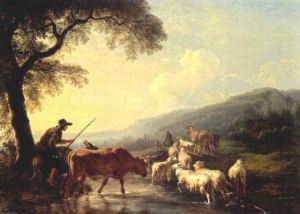
Balthasar-Paul Ommeganck, Landscape with shepherds, via Wikimedia Commons


Virtually Religious

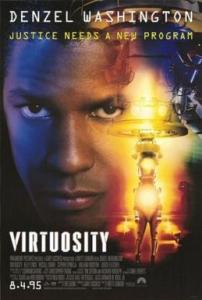
“Which god would that be? The one who created you? Or the one who created me?” So asks SID 6.7, the virtual villain of Virtuosity.  I missed this movie when it came out 24 years ago (as did many others, at least to judge by its online scores).  Although prescient for its time it was eclipsed four years later by The Matrix, still one of my favs after all these years.  I finally got around to seeing Virtuosity over the holidays—I tend to allow myself to stay up a little later (although I don’t sleep in any later) to watch some movies.  I found SID’s question intriguing.  In case you’re one of those who hasn’t seen the film, briefly it goes like this: in the future (where they still drive 1990’s model cars) virtual reality is advanced to the point of giving computer-generated avatars sentience.  A rogue hacker has figured out how to make virtual creatures physical and SID gets himself “outside the box.”  He’s a combination of serial killers programmed to train police in the virtual world.  Parker Barnes, one of said police, has to track him down.

The reason the opening quote is so interesting is that it’s an issue we wouldn’t expect a programmer to, well, program.  Computer-generated characters are aware that they’ve been created.  The one who creates is God.  Ancient peoples allowed for non-creator deities as well, but monotheism hangs considerable weight on that hook.  When evolution first came to be known, the threat religion felt was to God the creator.  Specifically to the recipe book called Genesis.  Theistic evolutionists allowed for divinely-driven evolution, but the creator still had to be behind it.  Can any conscious being avoid the question of its origins?  When we’re children we begin to ask our parents that awkward question of where we came from.  Who doesn’t want to know?

Virtuosity plays on a number of themes, including white supremacy and the dangers of AI.  We still have no clear idea of what consciousness is, but it’s pretty obvious that it doesn’t fit easily with a materialistic paradigm.  SID is aware that he’s been simulated.  Would AI therefore have to comprehend that it had been created?  Wouldn’t it wonder about its own origins?  If it’s anything like human intelligence it would soon design myths to explain its own evolution.  It would, if it’s anything like us, invent its own religions.  And that, no matter what programmers might intend, would be both somewhat embarrassing and utterly fascinating.


Conversations

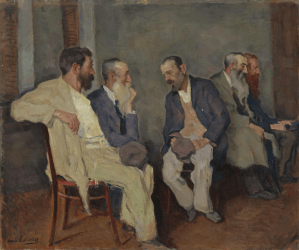
Arnold Lakhovsky, The Conversation, via Wikimedia Commons

While I tend not to discuss books on this blog until I’ve finished them, I realize this practice comes with a price tag.  Reading is a conversation.  Your mind interacts and engages with that of another person (or persons, for books aren’t usually individual efforts).  I find myself as I’m going along asking questions of the author—whether living or dead doesn’t matter—and finding answers.  Materialists would claim said answers are only electro-chemical illusions spawned by this mass of gray cells in my skull, only this and nothing more.  The realia of lived experience, however, tells us something quite different.  These interior conversations are shaping the way I think.  There’s a reason all those teachers in grade school encouraged us to read.  Reading leads to an equation the sum of which is greater than the total of the addends.

I’ve been reading through Walter Wink’s oeuvre.  Specifically his trilogy on the powers.  Although this was written going on four decades ago, I’m struck by how pertinent and necessary it is for today.  As he posited in his first volume, the embrace of materialism has blinded us to spiritual realities.  Wink was bright enough to know that biblical texts were products of their times and that simple acceptance of these texts as “facts” distorts what they really are.  He also convinces the reader that institutions have “powers.”  Call them what you will, they do exist.  Throughout much of western history the “power” cast off by the church has been somewhat positive.  Christianities has established institutions to care for the poor and for victims of abuse and natural disaster.  Orphans and widows, yes, but also those beaten down by capitalism.  They have established institutions of higher education to improve our minds.  Until, that is, we start objecting that our improved outlook demonstrates that the biblical base isn’t literal history.

Churches then often fight against those educated within its own institutions.  Ossified in ancient outlooks that value form over essence, many churches take rearguard actions that we would call “evil” if they were undertaken by a political leader such as Stalin or Hitler.  Those evil actions are justified by claiming they are ordained by an amorphous “Scripture” that doesn’t really support those behaviors at all.  I’ve been pondering this quite a lot lately.  Although I taught Bible for many years my training has been primarily as an historian of religions.  I specialized in the ancient world of the northern levant, for that culture provided the background of what would eventually become the Bible.  Reading Wink, I think I begin to see how some of this fits together.  I won’t have the answer—we many never attain it—but I will know that along the way I’ve been engaged in fruitful conversation.


Veg Out

It came to me vividly when I heard a speaker self-deferentially say he was crazy.  This was, I suspect, a way of defusing the fact that when vegans speak others often think they’re being judgmental or preachy.  I’m pretty sure this speaker wasn’t, and I try my best not to be.  It can be difficult when you’re passionate about something.  At the event, which included several people in age brackets more advanced than even mine, the question of “why” was predictably raised.  Apart from the rampant cruelty of industrial farming—some states even have laws preventing people from knowing what actually goes on in such places—there are other considerations.  One of them involves Greta Thunberg, Time magazine’s person of the year.

Global warming is no joke, no matter how much the Republican Church laughs it off.  Greta Thunberg has become the face of a generation with a conscience, but one fact few wish to know is that industrial farming is by far the largest environmental threat to our planet.  The amount of pollution it causes is staggering.  The rain forests are being cleared for grazing land because people will buy beef.  The largest methane emissions come from farms, not factories.  Our lifestyle of eating animals on an industrial scale is one of the many hidden costs to the modern way of living.  Or of dying.   There are doubters, to be sure.  It’s pretty clear, however, that the agriculture business is massive and it is just as powerful as the other great offender—the petroleum industry.

Making facts known isn’t being judgmental.  People’s eating choices are up to them.  I’ve only been a vegan for about two years now and I sometimes can’t comply with my own ethical standards when I go out to eat.  Or when other people give food.  Many places have no concept of dining without animal products.  I’m not trying to make everyone else accept my standards; I have beliefs about animals that are based both on personal experience and lots of reading about faunal consciousness.  I fully accept that many others don’t agree.  What I do hope, however, is that people like the speaker I recently heard will not have to jokingly call themselves crazy because they’re vegan.  The narrative must change.  We must be willing to look at the way we live on this planet, and accept the fact that just because major polluting industries hide behind large, brown cow eyes doesn’t mean we shouldn’t question what they feed us.  We need to look at our plates and count the cost.


Why not try Veg Out, Bethlehem’s new vegan restaurant, if you’re in the Valley?


Sci-Fi Culture

I’ve recently taken up rereading Ray Bradbury stories from my childhood.  Bradbury’s difficult to classify, but he’s often genrefied as science fiction, but many of his stories are horror and fantasy related, or just plain stories.  One aspect upon which future readers, I believe, may pick up—and this isn’t just a Bradbury thing—is how people were projected into the future with the culture of the past remaining intact.  Things like characters smoking in the most unlikely of places.  I picked up on that the first time I watched Alien.  In space, where no-one can hear you scream, air has got to be a precious commodity.  And yet there they are, smoking in space.  Same thing with Bradbury.  The culture of the 1940s and ‘50s when he was writing such stories simply couldn’t see beyond the time when culture was what everyone did.  It seems weird in 2019.  How much weirder it will look in 2050 (presuming we make it that far).

There’s almost a “gee-whiz” quality to such stories of the past.  People in the future, and in space, drink coffee and wear blue jeans.  They may have more technological homes, but their home lives reflect the forties and fifties as well.  The women are housewives and the husbands go to the office, or outer space, to work.  I suppose cultural verisimilitude was a different thing back then.  Did nobody really consider that patriarchy might be a problem?  Did everyone think clothing would never really change?  And not a hint that vegetarianism might catch on.  What makes the future the future in these stories is tech.

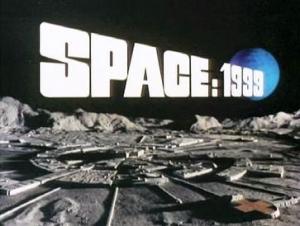
These days we’re loaded with tech.  In some ways we have more of it on our person at any given moment than all of Bradbury’s space-workers ever had.  In one of his stories a character was born in the impossibly far year of 1993.  I used to watch a show called Space 1999.  We haven’t colonized the moon yet (we may be working on it, but considering how long things like an obvious impeachment take, I wouldn’t hold my breath).  Speaking of holding breath, I’m pretty sure some of the characters were smoking on Moonbase Alpha.  Or my memory is cloudy.  (The earlier, and more lasting series Star Trek pretty much avoided several earth-bound habits, although Captain Kirk was pretty fearless when it came to the possibilities of space-spread STDs.)  I read Bradbury as a throwback to my childhood.  His stories have both an prescience and naivity that make them compelling period pieces.  From our current standpoint, one wonders if there will be any culture left at all in the future.  Perhaps we should enjoy what we have, while we still can.


Aging Goddesses

While not a woman, I am over fifty and I have both a personal and professional interest in goddesses.  Some friends recently asked how I came to write a dissertation on a goddess, and thinking about that has revealed some aspects about my outlook, but those will need to wait a little.  We read Goddesses in Older Women by Jean Shinoda Bolen because my wife wanted my opinion on it.  We read books together while washing dishes—we’ve been doing this since we married over thirty years ago—and despite my not requiring the subtitle, Becoming a Juicy Crone, I was game.  I have been curious about the experience of others since I was quite young.  Since half the others in the world are female, it makes sense to be in dialogue and to be willing to learn.

Bolen uses classical goddesses as Jungian archetypes to help post-menopausal women sort out their feelings and spirituality in what has been called the “crone” phase of life.  This is part of an antique triad that many would rather dismiss: virgin, mother, crone.  Still, Bolen embraces it as fairly common in women’s experience.  Men, although they can be elected to the White House while doddering old fools, don’t pass through such distinctive stages.  In fact, some never mature.  Women’s lives are defined by reproductive capabilities in ways men’s simply aren’t.  Instead of dismissing half of human experience as irrelevant, we should listen to the accumulated wisdom of women.  Bolen, who is an M.D., isn’t an historian of religion, but her remarks about the various goddesses explored (Asherah isn’t one of them) are insightful.  I listened as my wife read, and this was quite a learning experience.

We have, as a species, often failed our females.  Males, using that “might makes right” physiology and theology, have often assumed masculine agendas are the only ones that matter.  Look around the world today and see where that’s gotten us.  We’re killing our own planet in the name of greed and ignorance just so that nobody can be richer than me.  I think it’s time we let the women have a chance to run things.  Even though ancient mythologies often reflect the patriarchies under which they were written, many allow women more powerful and authentic roles than they currently have.  Even El, the head of the Ugaritic pantheon, could change his mind when approached by Asherah.  I learned much from this book, just as we learn so very much by listening to those who differ from ourselves.  And the goddesses, almost always, are the ones who possess true wisdom.