Seeing the Future

Nine.  That’s the number of people before me in line.  It’s not yet 4:30 a.m., and our day began at least an hour ago, but work won’t start for another two.  As the bus pulls up to the stop, I think about work.  Well, like most people I think about work a lot.  You see, I’m often asked about how to get into the publishing business.  There’s a cosmic irony to this because I had never planned to be an editor and never undertook any of the usual training.  The anticipated trajectory of a doctorate in the humanities used to be teaching, which is what I did for many years, but when an educational career slips off the rails in a capitalistic society you have to be willing to learn real fast.  (Fortunately the long years of schooling do help with that.)

I’m sure that I’m not the only person whose career plans didn’t pan out as anticipated.  Back in seminary one night long ago, three friends and I had a “future dinner.”  We prepared a supper and each came as who we would be twenty years down the road.  I recall that I was a world-traveling professor and the author of several books.  “Come on,” my friends complained, “be realistic!”  It’s a bit beyond those two decades now, and I was a professor for many of them.  I have written several books, although so far only three have been published.  World-travel?  Well, that’s been a bit modest in recent years, I have to admit.  One of the other friends I’ve lost track of.  Another committed suicide after graduating.  We really can’t see far into the future.

Publishing is a challenging gig.  My rapid career contortions perhaps prepared me better than I think.  I have a kinship with those who ask about how to get started in it.  Generally we’re educated people who like books and wonder what kind of career you can find with that combination these days.  (There are more of us than you’d think!)  Compared to higher education academic publishing is a small world.  I’ve come to know many more academic colleagues since being an editor than I ever did as a professor.  I have something they want—a reputable venue for publishing their latest book.  Often I have to do a lot of educating since publishing doesn’t work the way that most people think it does.  It’s like being a professor without the status.  No, I didn’t see this in my future.  As I look for a seat on the already crowded bus I wonder how many of these other early risers planned their careers just like me.

Difficult to see where this is going.
Receiver

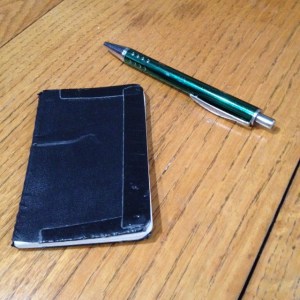
Being a writer (I can’t claim to be an author since I don’t make a living at it) is like being a radio receiver.  You pick up signals, or so it seems, and it’s your job to try to make sense of them.  That’s why I always carry a notebook.  Specifically a Moleskine volant extra small plain notebook (I can’t abide lined paper).  I’ve been using them for years and I’ve got quite a little stack of them in my writing nook, battered, taped, and well-used.  There’s part of my soul in those little things.  But they’re getting increasingly difficult to find.  More than once I’ve come to the last page only to have searched in vain all the local bookstores and speciality shops without finding a replacement.  (Big boxes like Staples appeal to the lowest common denominator and writers demand special treatment.)

Tools of the trade

Sometimes they’re not even available on Amazon, surprising as it may seem.  You see, I’m particular about where I store my thoughts.  People have suggested to me that I use my phone, but by the time I get it out of my pocket, turn it on, type in the passcode, and open the app, the thought is gone.  They travel quickly.  My notebook, always with me, has a pen companion.  It’s refillable and I take great care to buy refills that write instantly, without having to scribble to get them going.  I keep careful note of the brands that are reliable.  There’s nothing more frustrating than watching a great thought flee as you’re furiously scribbling to get your pen to capture it in your Moleskine.  No, this is an area where there can be no compromise.  If only notebook sellers saw it that way!

The trouble with being a receiver is you have no control over when the signal comes.  You wouldn’t know it from my publication record, but I have many, many unpublished pieces.  Most of them, regrettably, have to be reduced to electronic form so they can be submitted and rejected via email or Submittable.  I would have nothing with which to build, however, if my zibaldone were absent.  After my brain this is the first filter.  And when they’re full it’s time for another.  The next time I find them in my favorite indie bookstore I’m going to buy them out.  I’ll store them in the attic—I can find space up there, along with my pen refills—against a time of need.  Somethings a writer just can’t do without.


Winter Travels

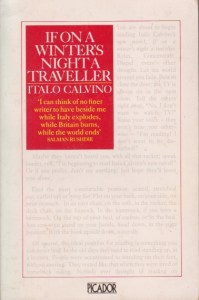
Every now and again you read a book that drops you into a world of wonder.  That’s how I’d describe Italo Calvino’s If on a Winter’s Night a Traveller.  What’s it about?  It’s difficult to say.  It’s a novel about reading, and more specifically, interrupted reading.  You might call it Post-Modern, but in a good way.  I came across the book in a manner that, like the story itself, emerged from different narrative structures.  First of all a colleague sent around a quote from the book that grabbed my attention.  I decided that if I ever found a copy in a bookstore I’d buy it, based on that quote alone.  A second stream was the Modern Mrs. Darcy’s reading challenge.  One of this year’s categories was a book in translation, which this is.  And yet a third factor was that I found the book on the shelf of a used book vendor in Ithaca.  And so I read.

Like David Mitchell’s Cloud Atlas—and having nothing to do with the fact that it was the most recent novel I’d read—If on a Winter’s Night a Traveller is a nested story, a story within a story.  Breaking the “fourth wall” Calvino addresses his readers in the second person and makes them characters in the plot.  The reader buys a defectively printed book and when he tries to return it to the seller, a fantastical world opens up.  I’m not sure that there’s a particular genre here—literary fiction constitutes a genre of its own—but there are a few speculative elements that keep the story pulling you along without really giving any conclusions (that the po-mo aspect to which I referred).

Apart from being merely fun, the story is thought-provoking.  What goes on when we read?  Do we not get absorbed into the mind of the writer?  And not only of the author but also of others who’ve read the book with whom we might discuss it?  Writing is an endlessly addictive activity.  One of my observations about careers without sabbaticals is that those who wish to practice the art must carve time out from days interrupted by work to be writers.  For me that means awaking early, for this blog is only one of many writing projects I have going.  To write well, however, means reading much.  And if you’re casting about for a story that’s hard to classify and difficult to put down, I would gladly recommend If on a Winter’s Night a Traveller.


Double the Magic

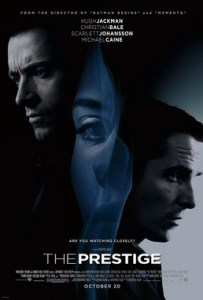
Since The Prestige came out over a decade ago I’m not going to worry too much about spoilers below.  This post also comes with another caveat: if you watch this film you’ll be left scratching your head and finding yourself strongly tempted to punch the replay button immediately.  Like most Christopher Nolan films, the movie is complex and intelligent.  It also plays on an age-old horror theme of the doppelgänger.  There be spoilers here!  

Following the rivalry of two stage magicians seeking the ultimate illusion, there’s a great deal of sleight of hand in the way this movie manipulates its viewers.  You are in the audience of a magic show and you’ve volunteered to go up on stage.  I watched this film on the recommendation of a friend without even checking the genre.  That can be a disorienting experience in itself.  One of the first questions we bring to movies as well as to texts is “what kind is it?”  I had the assurance that it was “the good kind” and that was about all.  That assessment was right.  While the credits rolled—it was already late at night, for me—I was strongly tempted to start it all over.  Sometimes people ask me why I watch horror films (and no, this is not horror) and I think the answer is related to what I find here.  Like most people I want the advice of others on what to do should things go wrong.  And in The Prestige they do go wrong.  Spoilers follow.

The crux of the film involves actual doppelgängers that result from Nikola Tesla’s experiments.  Tesla was a mysterious person in real life, and without knowing the genre you can watch this film and find it believable.  There’s a kind of faith involved in movie-going, after all.  One of the early exploiters of the doppelgänger was Edgar Allan Poe.  In “William Wilson” he narrates a tale of a double that might indeed be the real William Wilson.  The Prestige plays the same card.  Most of us live knowing that daily our senses can be fooled.  We actually enjoy it once in a while.  Stage magicians stake their livelihoods on it.  Nolan is a master of bringing complex twists to the silver screen.  In Holy Horror I briefly discuss his Memento.  I have a suspicion that I might’ve had more to say about it had I watched this film earlier, with a copy of Poe in hand.


Youth Evolving

Picture a picture.  A photograph.  I’ve got a specific one in mind, but it’s likely one you’ve not seen.  Any photograph will work for this lesson, but if it’s one of your own, one from your youth works best.  Your teenage years.  The photograph that I’m imagining is one of a slightly older friend of mine.  It shows him as a teenage machine-gunner in Vietnam.  I didn’t know him at the time, of course; I was too young to be sent off as a national sacrifice for a police action to protect capitalism.  In any case, I got to know this friend later, after he’d survived the conflict, wounded but alive, and I was struggling to survive puberty.  Emotions at that time were off the charts, but I never saw the photo until I was an adult.

Why am I asking you to think of old pictures?  I was recently reading a discussion where intelligent people were wondering why, throughout human history, we have idealized youth.  I suppose there’s no single answer, but I have a suspicion that it has to do with evolution.  We often wrongly assume that we can get at the naked truth.  As if we could somehow get outside of our own frame, our personal point-of-view, and look at reality objectively.  Our brains, however, evolved to help us survive in an often hostile environment.  The “point”—if you’ll allow me to hypostasize a bit—of evolution is to survive long enough to reproduce.  Many species with young that can care for themselves simply die at that point.  Mission accomplished.

As human beings (and mammals) our young need parental care to survive, at least for a few years.  Biology would seem to dictate that by the time we can reproduce—that self-same puberty which is such a difficult age—is the point at which we’ve reached our evolutionary goal.  There’s something deeper going on here, of course, but I wonder if this might not be behind the question of why we idealize youth.  We remember with a sharp pang—don’t need to see a doctor about that one—the incredible and unsurpassed discoveries we personally made at that age.  There will be other surprises as life goes along, of course, but nothing will ever equal our biologically determined goal.  I’m oversimplifying, I know.  Still, this may be one mystery that is less mysterious than it seems.  I know this because I have a photograph of a young man.  It matters not if it is of someone I know or me.  We have made it through our most awkward age, and we reflect on how it made us into who we have become.

Was I ever that young?


Mission Impossible

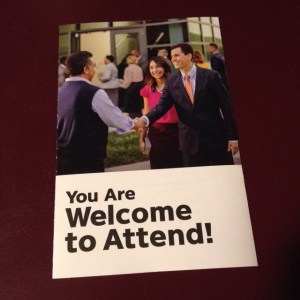
You can always tell Jehovah’s Witnesses by their tracts.  When I heard a tap, tap, tap on my front door the other day I was handed a flier and a cheery invitation to an important celebration (Easter).  The circumlocution used for the holiday made we wonder so I flipped over the tract and saw the familiar JW on the bottom.  I always treat religion at my door with respect because, well, you never know.  It’s this latter bit—the uncertainty—that has always given me pause when it comes to missionaries, domestic or imported.  Missionaries by definition believe their particular spin on religion is the only correct one, otherwise there’s no reason to convert others.  This is often the highest hurdle over which globalism must leap—the willingness to admit one might be wrong.

I could be wrong about this, but I have always considered the willingness to admit you might be incorrect as a sign of spiritual maturity.  I also know from my youth that that kind of uncertainty can drive you crazy.  We want to know we’re right!  But then, who doesn’t?  Those of us who think globalization is a good thing have failed to take into account just how difficult it is for many people to admit possible error.  For the vast, vast majority of human history we were separated from one another by natural boundaries.  Travel for leisure did not exist.  Within a local group beliefs would likely be fairly uniform.  Then you encounter others who might say, well, you’re wrong.  That’s seldom a welcome prospect.

More than air travel, the internet has shown us, as we connect, just how diverse a species we really are.  What about that missionary at my door?  For religions indoctrinated into one doctrine this can’t be easy.  I’ve had conversations with Jehovah’s Witnesses before.  There’s no convincing them they might be wrong.  Missionaries come with the assurance they’re saving you.  Rare is the proselytizer who’s there possibly to learn the truth.  As I think about it, after decades of attending church how many times has anyone wanted to have an in-depth conversation about belief?  Outside confirmation class, that is.  And even there, when most are either teenagers or older specialists in some secular business, discussing deep issues seems to make others uncomfortable.  When the missionaries come, I want the conversation to go both ways.  I’ve spent half a century thinking about these things, after all.  When there’s a tap, tap, tapping at my door, I wonder what tracks will be left behind.


The Reboot

It lied to me.  My computer.  Don’t get me wrong; I know all about trying to save face.  I also know my laptop pretty well by now.  It was running slow, taking lots of time to think over fairly simple requests.  A lull in my frantic mental activity led to the opportunity for me to initiate a reboot.  When it winked open its electronic eye my screen told me it had restarted to install an update.  Untrue.  I had told it to restart.  I gave the shutdown order to help with the obvious sluggishness that suggested to this Luddite brain of mine that my silicon friend was working on an update.  There’s no arguing with it, however.  In its mechanical mind, it decide to do the restart itself.  I was merely a bystander.

Technology and I argue often.  Like JC says, though, authority always wins.  I should know my place by now.  I’ve read enough about neuroscience (with thanks to those who write for a general audience) to know that this is incredibly human behavior.  We are creatures of story, and if our brains can’t figure out why we’ve done something they will make up an answer.  We have trouble believing that we just don’t know.  I suppose that will always be a difference between artificial intelligence and the real thing.  Our way of thinking is often pseudo-rational.  We evolved to get by but machines have been designed intelligently.  That often makes me wonder about the “intelligent design” crowd—they admit evolution, but with God driving it.  Why’d our brains, in such circumstances, evolve the capacity for story instead of for fact?

As my regular readers know, I enjoy fiction.  Fiction is the epitome of the story-crafting art.  Some analysts suggest our entire mental process involves construing the story of ourselves.  Those who articulate it well are rewarded with the sobriquet of “author.”  The rest of us, however, aren’t exactly amateurs either.  Our brains are making up reasons for what we do, even when we do irrational things (perhaps like reading this blog sometimes).  Stories give our lives a sense of continuity, of history.  What originally developed as a way of remembering important facts—good food sources, places to avoid because predators lurk there—became histories.  Stories.  And when the facts don’t align, we interpolate.  It seems that my laptop was doing the same thing.  Perhaps it’s time to reboot.


Devil or Con?

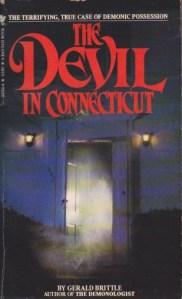
You can’t believe everything you read.  That’s one of the first tenets of critical thinking.  This whole process is about how to get to the truth, and in a materialistic world that truth can’t involve anything supernatural.  These were my thoughts upon finishing Gerald Brittle’s The Devil in Connecticut.  Controversy accompanied Ed and Lorraine Warren’s investigations and some of the people involved in these cases have later claimed the extraordinary events didn’t happen.  Others claim that the Warrens offered them to make lots of money by selling their stories.  The effect of reading a book like this is a blend of skepticism and wonder.  Among their fans the Warrens are held in the highest regard.  Anyone who begins to look into their work critically ends up frustrated.

So when I put this potboiler down—it is a compelling read—I went to the internet to find out more.  Then I realized what I was doing.  Using the internet?  To find the truth?  It’s a vast storehouse of opinion, to be sure, but what with fake news and alternative facts who knows what to believe anymore?  I found websites debunking the whole case as a hoax.  Others, naturally, claim the events really happened.  Both kinds of web pages have the backing of someone in the family involved.  It’s a pattern that follows the Warrens’ work.  In one of the many books I’ve read about them they claim to have ten books.  If my math is right this was number ten.  Even that remains open to doubt.

The word “hoax” seems a bit overblown.  Dysfunctional, maybe, but hoax?  Reading Brittle’s account it’s clear there were some issues in this family.  Having grown up in a working class setting, I’m aware such scenarios are extremely common.  Accusations were made that this was an attempt to spin gold from straw.  The nearly constant stress of blue collar families makes that seem less far-fetched than a stereotypical devil showing up in a modern house because a satanic rock band placed a curse on the family.  Lawsuits—the most avaricious of means for determining facts—apparently prevented a movie deal and have even made this book a collector’s item.  Somebody, it seems, is making money off the story.  As after reading the other nine books, the truly curious are left wondering.  My skepticism kicked in early on, but then again, I’ve always liked a good story. 


Time Saving

As we suffer through another pointless Daylight Saving Time, I’m thinking of rituals that have lost their meaning.  Life is full of them.  We do things because we’ve always done them this way and even when they become harmful because of the way lifestyles change (auto accidents, for example, increase after shorting people of an hour’s sleep) we can’t seem to let go.  DST alone should’ve been enough to convince those who claimed religion would simply go away when science kicked in that they are wrong.  This is one reason that I’ve always found the origins of ideas fascinating.  Why did people believe this?  Why did they do this?  What started this whole process?  (Just to be clear, I’m not asking this about DST; I’ve written about that before.)

We can’t know the ultimate origins of religion.  I’ve suggested in the past that what we would term religious behavior has clear origins in the behavior of animals.  A somewhat fully developed consciousness provides incentive to rationalize such behavior.  The earliest organized religion of which we know involved state functionaries (priests) supporting, probably for sincerely believed reasons, the “secular” government.  Kings and priests needed each other and people quickly conformed.  Even when those on the inside came to realize that they were merely pretending, they kept on doing so.  It was too late (or if DST, too early) to change anything, so the mascarade continued.  Tracing the history of religious ideas reveals perhaps more than we want to know.  And human beings are natural actors.

Once, while in a restaurant, I sat near the kitchen.  The smiling servers, as they neared that portal lost their smiles and harried looks came to their faces as they told frantic cooks what the couple at table eight wanted.  Yet they continued to pretend they were happy when at table-side.  Or think of work with its “public facing” information that is inevitably different from what is known by those on the inside of the company.  Actors.  We’re all actors.  Perhaps it’s the price to pay for living in a civilization.  If we stopped to think about why we’re doing something as inane as pretending five o’clock is now six o’clock, or even that all people are the same and should be at work between nine and five, society could not stand the scrutiny.  Anarchy would erupt in the streets.  We should be thankful that people don’t think about these things too deeply.  Or, then again, maybe I didn’t get enough sleep last night.


How Many, Now?

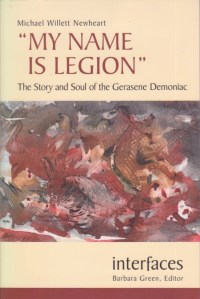
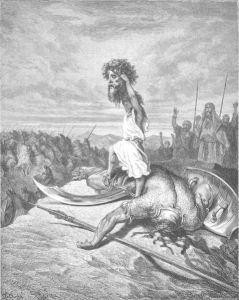
One thing you can say for the Bible—it’s been interpreted six ways to Sunday.  This point was brought home to me in reading Michael Willett Newheart’s “My Name Is Legion”: The Story and Soul of the Gerasene Demoniac.  Part of the Interfaces series, now apparently defunct, it takes an unusual biblical character and explores it.  Them, in this case.  The story of the Gerasene or Gadarene demoniac is one of the more famous episodes in the Synoptic Gospels.  Jesus and the disciples cross the Sea of Galilee and the possessed man runs out at them.  He has superhuman strength, and he lives among the tombs.  Jesus asks the man, or the demon, its name only to receive the reply “Legion.”  He then casts the demons into a herd of swine that drown themselves in the lake.

Newheart approaches the story creatively, first by considering the Gospel of Mark as a book, and then treating his version of the story via narrative criticism.  This was pretty good, and I learned quite a bit from his analysis.  The book then moves on to psychological criticism.  I have to admit that this approach is one I haven’t ever used and, like many reader-response methods, it can seem somewhat arbitrary.  That’s not to suggest it shouldn’t be utilized, but rather to note that results could be uneven.  Your psyche’s not my psyche, savvy?  Subjective approaches may be all that we really have when considering an ancient text, but I always tend to look at things historically.

This book caught my attention because I’m researching demons.  You can’t really ignore a book with this title if you’re trying to figure out how the New Testament looks at them.  In any case, the historical method seems to me the only way we can really engage the question of what the ancients thought demons were.  I don’t want to say too much or you won’t have any reason to buy my next book.  (That’s a joke, by the way, before anyone suggests I’m exploiting my readers.)  Newheart doesn’t really raise the question of what demons are.  He does briefly mention The Exorcist, but it isn’t his main interest.  The character of Legion, however, is difficult to place if we can’t really say what demons are.  I did find the allusion to the Roman occupancy to be worthy of consideration.  The demoniac, however, may have begged to differ.  It couldn’t have been easy being an unnamed character in the Good Book.  And demons are often not what they seem.


Green Eyes

All of us fall prey to the green-eyed monster once in a while.  For an editor like me, it starts lurking when I see others make content production look so easy by taking copyrighted material from elsewhere.  I’ve read books—often self published—that take great swaths of material under copyright and reuse it with no permissions acknowledged.  You can build big books that way.  Quickly.  And there are websites that use  crisp, clean images that look more immaculate that any kitchen counter.  Often those images, however, come from sources “protected” by copyright.  With a web this large, who’s going to find them?  They’re not making money off them (usually) so what’s the harm?  My jealousy, I suppose, comes from working in publishing where copyright is a daily concern.  It’s the currency in which we peddle.

Copyright isn’t intended to make websites like this one look lackluster.  No, it’s intended to protect the intellectual property, or visual or auditory inspiration, or the creator.  It’s a remarkable idea, really.  If I have an idea, it’s mine.  Once I express it in written, aural, or visual form, it is covered by copyright.  (We haven’t figured out a way to regulate original smells and tastes yet, beyond protecting their recipes.)  Putatively copyright is to protect the creator’s rights.  In fact, it tends to impact the publisher more.  This week at work I had to spend some time, once again, reviewing copyright law.  One thing most authors don’t comprehend is that a book contract is a negotiation for trading rights for royalties—turning ideas into money.  Even intangibles can be purchased.  Intellectual property can have a fence around it.  And a dog or two in the yard.

I try not to violate copyright.  When I want to borrow my old published ideas in new venues, I rewrite them.  When I want to use somebody else’s pictures on this blog I take them from public domain or fair use sources (thank you Wikimedia Commons!).  A great number of them are my own that  I cast upon the web, hoping they will come back to me in time of need.  With the exception of one guest post many years back, all the words on this blog (approaching a million-and-a-half, at this point) have made their way from my addled brain through my trembling fingers and onto the internet.  Maybe I just want to protect my babies.  Maybe some would call it jealousy.  I like to think of it as a mother bear and her cubs.  Or perhaps the spawn of a green-eyed monster.


Lore of the Folk

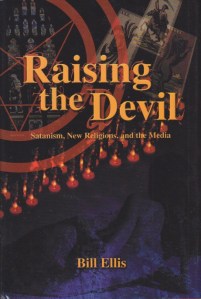
Once in a great while you read a book that has the potential to shift paradigms.  The unusual and provocative Raising the Devil: Satanism, New Religions, and the Media, by Bill Ellis, is such a book.  Perhaps the main reason for this is that Ellis is a folklore scholar who takes his subject seriously.  He cites some unusual sources non-judgmentally, but critically.  He suggests that folklore can actually dictate reality for its believers, while not demanding that it defines how everyone else sees the world.  This fine parsing allows him to examine the satanic cult scares of the 1980s and ‘90s with a kind of passionate dispassion.  He traces the historical contexts that made such panics possible, all the while keeping belief structures in place.  In the end, the giving in to this folklore on the part of society can lead to tragic results.  Understanding folklore might well prevent that.

Since our prevailing cultural paradigm is a materialism based on empirical observation, at least among those deemed “educated,” it is easy to lose track of how belief constructs our worlds.  Ellis finds the cradle of satanic panics in the Pentecostal tradition where deliverance ministry—a Protestant form of exorcism—takes seriously the belief in demons of many kinds.  This leads to a study of ouija boards and Spiritualism.  Although neither led to Pentecostal theology, both play into it as doorways for demonic activity, in that worldview.  Add into this dissociative identity disorder (what used to be called, and what Ellis refers to as “multiple personality disorder”) and the recipe for a spiritual mulligatawny is simmering away.  You need not believe what the victim says, but if s/he believes, you must pay attention.

Outside the strict confines of Satanism, other cultural phenomena allowed for panics to grow.  Popular narratives, largely false, of satanists cum evangelists (think Mike Warnke) mingle with cultural fears such as the Highgate Vampire scare and cattle mutilations to make a narrative of satanic ritual abuse believable.  A folklorist sees the connections that a strictly wielded razor by Occam tries to shave away.  All of this fits together.  When we don’t pay attention to how real this is to those involved, a half-baked public panic can erupt.  Ellis suggests such circumstances might well have led individual witch hunts into large-scale witch crazes.  While both are unfortunate, the latter tend to lead to many, many ruined lives.  The subtle awareness that one need not believe in order to understand those who do is something worth pondering.  Reality may be far more complex than the activity of electro-chemical signals in a strictly biological brain after all.


Yes or No

Reading about demonic possession is enough to scare you away from ever using a ouija board.  In fact, I’ve never played with one; growing up my strict religion would’ve prevented it in any case, and already as a child I’d been warned of the dangers.  During my research for Nightmares with the Bible, I’ve been reading quite a bit about ouija.  Originally a species of divination, the ouija, or spirit board, became popular during the growth of Spiritualism.  Spiritualism is a religion based on the idea that the dead still communicate with the living, ensuring believers that life continues beyond death.  It still exists, but not with the numbers that it boasted in the early days.  Among the solemn admonitions of Ed and Lorraine Warren (about whom I’ve posted much in recent months) was that ouija boards opened doorways for demonic entities.  Some of their stories are quite scary.

Image credit: Mijail0711, via Wikimedia Commons

Whatever else you can say about America, a fact beyond dispute is that if something can make a buck it will be marketed and sold.  So it was with ouija boards in the 1970s.  I remember seeing them on the shelf with other games at local department stores.  Even then I knew they weren’t a toy and I wondered how anyone could be promoting them for general consumption.  At Grove City College—that bastion of undergraduate conservatism—stories circulated about how students (usually coeds) were attacked in their locked rooms after playing with ouija boards.  This is, I was later to learn, a staple of collegiate urban legends.  At the time, however, I took it very seriously.  

Thus it’s strange when I find out that others my age were more curious about them.  Recently at a party with friends around Valentine’s Day, the question naturally came up of how some of us met our spouses.  One of the women mentioned that before she’d met or even heard of her future husband (who has an unusual surname) a ouija board spelled out his name.  She later met and married him, not on the board’s recommendation, but she remembered that years before she’d been given a hint.  Now these friends are not cheats and liars—they’re not even Republicans.  They’re people we trust.  On our drive home that night my wife mentioned she’d used a ouija board once, with friends, back in her high school years.  She asked the name of her spouse (long before we met) and came up with Sam.  I’m no Sam, but when we first met in grad school I was still going by my stepfather’s surname and my initials were S-A-M.  Coincidence?  Probably.  My future wife did not pursue me; indeed, it was the other way around.  Even so, there in the dark on the nighttime highway I felt a familiar frisson from childhood concerning a form of divination that seems to know more than it should.


Goliath and Company

First UltraViolet.  Then Google +.  Well, actually neither of these was first—tech initiatives cease to exist all the time.  Giants aren’t immune to extinction, it seems.  I’ve got to be careful with my confessions toward Luddite sympathies since, as it turns out, tech is king.  Emperor, in fact.  But since tech only works as long as society holds together, I still want paper knowledge in my library.  I don’t own a Kindle and despite what visitors say, I don’t want to “save room” by getting rid of books.  I like books.  I wink at them from across the room.  Sidle up to them when in private.  Get to know them intimately.  Books are a way of life.  If the grid breaks down, I’ll have books to read and candles to do it by.  For a while there I even made my own candles, although most of those were used up in the aftermath of Hurricane Sandy.

Just sayin’

You see, my hairs bristle when I hear tech experts complain that “authors should be taught to write in XML.”  Said techies have apparently never written a book.  Ideas, you see, flow.  When you’re in the zone, there’s no stopping to mark-up your text.  In fact, the best, purest kind comes in scribbles on paper with misspelled words and all.  You can hold it in your hands and remember the Muse who had you at the time.  For me the hours of inspiration are before dawn.  I mostly use a computer now, but I can still find myself typing too slow to keep up with manic inspiration, desperate to record my ideas before paid work starts.  Work is the Medea of creativity—both mother and slayer.  Once I login I check out.  I need to wait for another day to dawn.

We’ve invested heavily in technology.  The internet is largely responsible for the globalization against which the world has recently rebelled.  No matter how many times people like me say we love books somebody will say, “Have you considered a Kindle?”  Why?  I bought a house as a place to keep my books.  These little bricks are bits of my mind.  Pieces of my soul!  What we read makes us who we are.  The last person who said the remark about authors learning XML literally sighed with disgust as he said it.  How could, you could feel him thinking, anyone be so backward as to think this is a problem?  I recall Hurricane Sandy.  Sitting in an apartment lit by candles we’d made ourselves, we read old-fashioned books and were eerily content.


Prejudices of the Time

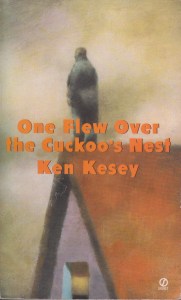
When my daughter was in middle and high school, I made an effort to read every book she was assigned for her English classes.  This gave us something to talk about during the years when many teens grow laconic and uncommunicative.  Some of the books I’d read before, but one frightened me off.  Ken Kesey’s One Flew Over the Cuckoo’s Nest pressed the wrong buttons.  You have to understand that I saw the movie for a class in college.  It disturbed me.  Even before encountering H. P. Lovecraft, one of my deepest phobias was insanity.  Children of alcoholics sometimes fear those who are out of control, and mental patients had become, in my head, associated with the non-rational behavior of my father that frightened me so.  During a clown ministry event we visited the local state hospital for mental patients.  I trembled for about a week after we left.

One Flew Over the Cuckoo’s Nest is in many ways a sixties novel.  One reflection of that is the fact that the religious imagery in the novel is presented in the form of punishment.  Everyone knows the narrative of R. P. McMurphy’s battle of the wills against Nurse Ratched.  The latter uses electroshock therapy as punishment and she tries to wear McMurphy down by using it repeatedly after the fight in the shower.  The electroshock table is described as a cross.  The metal headset is a crown of thorns.  Indeed, one of the patients is described as being crucified to the wall of the ward where he hangs throughout the novel.  The sixties frequently saw religion—especially the staid, conservative evangelicalism of the 1950s—as a form of punishment.  That’s pretty clear here.

Although the novel celebrates the freedom of the sixties, it also reflects the prejudices of the times.  The African-American attendees on the ward aren’t portrayed sympathetically.  The women—nurses and prostitutes alike—are there for the pleasure of the male patients’ gaze, exemplified in the leering laugh of McMurphy.  Still, there’s a kind of catharsis to this tale.  The Chief, from whose point-of-view the story’s told, is arguably cured by the antics and special attention McMurphy shows him.  Beneath the callous, self-serving conman there is a human decency that “the system” fails to find.  Indeed, McMurphy is a kind of Christ figure.  A fallen savior, no doubt, but a liberator nonetheless.  This was a difficult novel to read.  I couldn’t make myself pick it up half-a-decade ago, but I suspect somewhere beneath the surface I’m glad I’ve finally read it.  It didn’t cure any of my phobias but it made me think.