Horror Homeroom

With a happy coincidence I discovered a website called Horror Homeroom.  Featuring articles and podcasts and reviews on horror films, I felt its siren call.  Then I learned it is run by a professor at nearby Lehigh University, making it even closer than I initially supposed.  I wanted to be part of the conversation.  You see, after years and years of being a Bible scholar and having to fight to find any kind of interest whatsoever in what I had to say, I’ve found the horror community extremely welcoming.  Perhaps because we all know at some level that horror is considered transgressive—it isn’t unusual to find critics who still claim it’s debased—we find each other.  There’s an aesthetic to horror, and it isn’t about gore and violence.  Horror, when done well, is an excellent marker of what it means to be human.

Life always ends in death.  Many people spend as much time as possible trying to avoid thinking about it.  There is, however, great creativity in facing squarely what you cannot change.  Well, that’s a good sounding excuse anyway.  All of this is by way of announcing my guest blog post on Horror Homeroom.  A few weeks back I was quite taken with The Curse of La Llorona.  Not that it was a great movie, but it had a way of coming back to haunt me.  Part of it has to do with the poorly understood way that local customs blend with imperialistic religions.  Faith is a local phenomenon.  Once you switch off the televangelist, you’ll begin sharing beliefs of your neighbors.  There’s no such thing as a pure religion.  Pure religion is one of the most dangerous myths there is.

Those of us who study religion professionally have been taught to call the blending of religions “syncretism.”  I’ve stopped using that word for it because it assumes that there are pure forms of religion.  Religion always takes on an individual element.  We make it our own when it gets translated into our personal gray matter.  The idea that there is a pure form of any religion requires an arbiter of greater rank than any here on earth.  You can always say “but I think it means…”  Horror, I suspect, latched onto this truth long ago.  Without some hint of doubt about your own individualized belief system, it’s difficult to be afraid.  Horror need not be about blood and gore.  Often it isn’t.  Often it’s a matter of asking yourself what you believe.  And once you answer it, opening yourself to asking questions.

AKA

“Professor?”  While not technically correct, I was surprised and not unpleased to hear the title yesterday while on the streets of Easton.  One of the greatest compliments a former teacher can receive is word from a former student.  While dressed in Saturday clothes on the way to the country’s oldest continuously operating farmer’s market, I wasn’t sure the voice intended was for me.  I’ve been out of the classroom now since 2011.  Sure enough, one of my students from Rutgers recognized me and called out.  We had an ersatz but wonderful conversation after a completely chance meeting.  Already since graduating he’s had a few different jobs, but he remembered the classes I’d taught and I recalled that he’s the person who started me reading Neil Gaiman.  Teaching is, you see, a two-way street.

I’m doing a guest service at a local church next Sunday.  In preparation I’ve had lots of emails (for me).  One of them was from the music director.  He opened by calling me “Reverend.”  I’ve never been a reverend.  The idea isn’t unappealing but I’ve gone pretty far down the path of independent thinking and any church that would ordain such as me would need to be comfortable with that.  In fact, I heard a sermon recently by an Episcopal priest and was pleasantly surprised at how welcoming and, dare I say, liberal it was.  I was never really welcome in that club, I know.  When I was still fairly fresh out of seminary and working on my doctorate the idea of being “Rev. Dr.” was still appealing.  Now I go by my first name.

Labels.  I tend to eschew them.  Like my young colleague I’ve had to learn that work doesn’t necessarily define you.  (I’ve had many employers, however, who not only beg, but insist to differ on that point.  The ideas of owning individuals die hard, apparently.)  On the weekend, though, off the clock, people are calling me “professor” and “reverend.”  I’m generally sitting in a corner with my laptop on those early mornings calling myself a “writer.”  For none of these things do I receive any pay.  (Well, perhaps some for writing, but very little and very infrequently.)  The move to our new location was a chance, I think, to try to remake myself.  A chance to figure out what labels, if any, really fit.  Better throw “telecommuter” and “remote worker” into the mix.  Those are the ones, come Monday morning, that matter most.


Positive ID

It’s a little bit worrying.  Not just the GOP’s indifference in the face of two mass shootings on the same weekend, but also the fact that the internet knows who I am.  I am the reluctant owner of a smartphone.  I do like that I have the internet in my pocket, but I’m a touch paranoid that I can be traced to anywhere unless I lose my phone.  Even then the government can probably email me and tell me where it is.  Don’t get me wrong—I’m not important enough for the government to pay attention to me, but what is really worrisome is that the web knows me.  Here’s how I came to learn that.  On my home computer I had done a rather obscure Google search.  (If you read this blog that won’t surprise you, and no, it wasn’t anything naughty!)  When I signed into my work computer—different username, different email address, different IP address—and had to do a work related search, Google auto-suggested the search I did on a different computer over the weekend.

I’m savvy enough to know that Google metrics are all about marketing.  The internet wants customer information to predict what they might sell to us.  Advertisers pay for that.  Assuming that I want to buy underwear and summer dresses online (why?), they tailor their ads to sites I visit.  As a sometime fiction writer I go to some sites from which I’m not interested in purchasing anything.  (As an aside, old fashioned book research didn’t leave such a “paper trail.”)  I’ve gotten used to the idea of my laptop knowing me—it sits on my lap everyday, after all—but the work computer?  Does it have to know what I’ve been doing over the weekend?

Artificial intelligence is one thing, but hopping from one login to another feels like being caught in the shower by a stranger.  Like everyone else, I appreciate the convenience of devices.  When I get up in the morning my laptop’s more sure of who I am than my own sleep-addled brain is.  That doesn’t mean my devices really know the essence of who I am.  And it certainly doesn’t mean that my work computer has any right to know what I was doing on another device over the weekend.  Those who believe machine consciousness is now underway assume that this is a step forward, I suppose.  From the perspective of one who’s being stalked by electronic surveillance, however, the view is quite different.  Please leave my personal life at the door, as I do when I go to work.


Infinity

It occurred to me the other day that I will never read all the books on my list.  Only in my fifties, it’s not as if I’m knocking at death’s door, but who hasn’t been aware that that gentle rapping might come at any time?  Macabre?  Maybe.  Realistic?  Definitely.  Perhaps I’m a little old to be thinking about prioritizing, but it’s pretty clear that between work, writing, and the requirements of daily life (taking the car to the shop, scheduling a dentist appointment, trying to find time for a haircut, lawn care), that something’s got to give.  Work’s the non-negotiable since without it avoiding starvation (or perhaps getting medical coverage) becomes a full-time job.  Best to leave that sleeping dog slumber.  Then come the other three Rs: relationships, reading, and writing.  After that the time left to divide is pretty petty indeed.

My reading list grows almost daily.  Reading is a form of relationship.  I’ve recklessly written to writers after finishing their books, convinced that they’d written it to me.  I’ve also read material that, when done, makes me regret the time spent.  Still, I don’t, I can’t give up.  Writing is a form of giving back.  The other day an editor who’d accepted one of my fictional stories wrote that she couldn’t stop reading it.  It doesn’t matter that the magazine doesn’t pay—I’ve received back already what I’d planned for all along.  A kind of relationship with a reader.  If WordPress is to be believed, there are some followers on this blog.  Most think I write too much, and some, perhaps, too little.  Writing, however, like reading, is the formation of relationships.

Like relationships, reading takes time.  I carve out a spot for it daily but that doesn’t really make a dent in the growing reading list.  I can’t claim that it’s because I’m no longer a professor.  Except during the summer I read more now than I did when I was teaching (the professor’s life isn’t what most people think).  It is, I believe, that there are so many interesting ideas out there that one person simply doesn’t have time to think them all.  Reading and writing are a form of very slow conversation.  Of course, with technology the rest of life is speeding up.  Things seem now to happen instantly.  The world of books is slower, and the pace is far more sane.  I may never get through my list of books to read, but at least I have good conversation with those I don’t know, and that’s what really matters.


The Price of Writing

Academic writing strives to remove personality from your work.  It can be soul-crushing.  I remember well when my daughter—a talented writer—came home in sixth grade with a note from her teacher.  An otherwise ideal student, she was writing her science projects with *gasp* her own voice!  Mr. Hydrogen and how he joins Mr. Oxygen—that sort of thing.  Granted, it would never be published in a scientific journal, but it was a personalized expression that demonstrated an understanding of the concepts.  Having been the recipient of an old school education, I also learned that academic writing should lack personality.  Those who’ve bothered to read my academic papers, however, may have noted that I don’t always obey the rules.  Subtle bits (very small, I’ll allow) crept in amid the erudition.  And now I find myself wishing I’d persisted a bit more.

Pure objectivity, anyone living in a post-modern world knows, is a chimera.  It doesn’t really exist.  We all have points of view, whether they eschew adjectives or not.  I still write fiction, but since my publication history has been “academic” I indulge in it while trying to break through where someone’s voice isn’t a detriment.  I’ve been reading non-fiction by younger women writers and one of the things I’m finally catching onto is that your own voice shouldn’t be the enemy.  It may be so for most publishing houses, but I’m wondering at what cost.  So many ideas, just as valid as any staid publication, never see the light of day beyond some editor’s desk.  That’s not to suggest that anyone can write—I’ve read far too many student papers to believe that—but that those who can ought not be shackled by convention.  If only I could get an agent who believes that!

Holy Horror isn’t exactly flying off the press, but it does represent a kind of hybrid.  It’s transitioning to a kind of writing that allows some personality onto the page (yes, I’m old enough to still believe in pages).  A now departed family friend—he’d known my grandfather—was determined to read Weathering the Psalms.  He didn’t make it through.  It was an academic publication.  In the humanities, it seems to me, we need to allow authors to be human.  It’s in our title, after all.  Please don’t take this as professional advice; careers are still broken on the wheel of tradition.  Writing, however, shouldn’t be a caged bird.  But then again, the clock says it’s now time to get to work.


The Zone

My youth—who am I kidding?—my life has been a search for father figures.  Since I grew up with television, many of them came from the tube.  The professor from Gilligan’s Island, Mr. Rogers, Barnabas Collins, and Rod Serling.  Serling was like the father I couldn’t remember in that he was always smoking.  But unlike my father, Serling had an imagination in sync with mine.  The Twilight Zone was in reruns by the time I caught up, but it gave me an odd kind of happiness.  The sort that you had as a kid after the bath was over and you were wrapped up snuggly and warm in a bathrobe, and you got to watch one of your favorite shows before going to bed.  I discovered Serling as a writer when I was in Junior High School.  He was right up there next to Ray Bradbury, in my book.

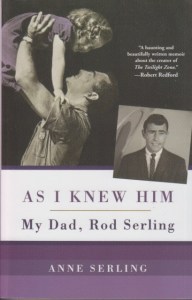
I have to admit to feeling anxious as I read Anne Serling’s As I Knew Him: My Dad, Rod Serling.  You see, she actually was his child and I’m afraid of learning too much about those I put on my personal pedestals.  Her book, however, didn’t disappoint.  Serling lived a writer’s life, something I’ve coveted since I was a kid.  If I couldn’t have a father, at least I could write about life as I saw it.  I still write fiction inspired by, among others, Rod Serling.  Spending much of my time in Binghamton and Ithaca for my own family reasons, I was only obliquely aware of how much I was traversing the region Serling considered home.  As I read his daughter’s autobiography—or is it a biography?  Who can tell the difference?—I was inexorably drawn in.  Fathers and daughters can be the best of friends.

Sometimes I wonder if those who know writers the best are their true fans.  I don’t mean groupies or the like, but rather those whose lives have been transformed by their words.  I’m reminded of Evermore, written by a relative of Edgar Allan Poe.  Family, it is true, see a side of a person that the reader does not.  But who are we, really?  Those of us who write may be saying more in our fiction than we care to admit even to those who know us well.  Rod Serling recognized dimensions well, I suspect.  A writer’s life requires sacrifice and keeping things hidden.  Anne Serling’s book is a gift to those who write, even if it is about someone else’s father.


Live Long

Maybe you went through it too.  In your teenage years the fascination began.  Before you knew it, you had a stack of them tucked away, each well-thumbed and ogled over.  Guinness Books of World Records, I mean, of course.  We’re captivated by extremes.  While working on a fictional story the other day, I started wondering about longevity claims.  The Good Book suggests that once upon a time a century was the equivalent of becoming a teenager, and people were acting like teenagers well into their eighth or ninth centuries.  Modern scientific analysis provides an alternative narrative, putting upper limits at 120, with only one verified, and disputed, case putting someone over it.  Curious, I looked at Wikipedia.  Two pages (at least) address the issue, one on human longevity tout court and another on verified claims.  Since the lists include home nations, I began to notice a pattern.

The verified records tend to feature the United States, Japan, Canada, and Europe.  The unverified Russia, Latin America, and Western Asia.  This disparity struck me as perhaps a bias concerning the source of reliable information.  Not only affecting longevity reports, concerns about reliable data impact all our sources of information.  I’ve written about internet resources before, but here I’m mainly worried about the bias of “first world” records as opposed to the records of less developed countries.  Not only that, but in the case of longevity claims, those born in outlying areas—beyond the reach of official government recorders—are suspect when compared to those kept by city dwellers.  We tend to trust our own kind, especially when it comes to extreme claims.

Like John Mellencamp, I was born in a small town.  Official records, comfortably handwritten, indicate when and where that happened, to the nearest day.  (Birth is a process, of course, and doesn’t always obey conventional human time-marking practices.  Organic events are often that way.)  The fact of the existence of other people indicates that they too have been through this in some form.  The event was marked in the way of local custom.  It’s locally true.  I knew a doctor trained in Sweden.  She couldn’t practice medicine in the United States for fear of what boils down to competing forms of belief.  Xenophobia in medical practice extends to other areas of human knowledge as well.  We are taught to trust the information given by our own authorities, but not those of other cultures.  I’m suppose to accept that without question, but I wasn’t born yesterday.


Internet Epistemology

Where do we find reliable information?  I’m asking this question on an internet-based medium, which itself is ironic.  While spending time with some younger people, it’s become clear that the web is their source of truth.  You find purveyors of information that you trust, and you accept their YouTube channels as representing correct data.  This can be a disorienting experience for an old doubter like me.  One of the reasons for studying for a Ph.D., apart from the vain hope of finding a career in higher education, is to hone critical thinking skills.  When I went through the process, that involved reading lots and lots of print material, assessing it, and weighing it against alternative views, also in print format.  You learn who really makes sense and you judge which publishers have good information more frequently.  As you navigate, you do so critically, questioning where they get their information.

Now, I’m not one of those people who think the younger generation is wrong (in fact, there are YouTube educational videos about just that).  The situation does, however, leave me wondering about how to fact-check when you don’t know the publisher.  It may be an older person’s problem, but it’s essentially the same dilemma behind self-publishing—the reason you trust a self-published book depends on the author alone.  Is s/he persuasive?  Did s/he document the sources of her/his information?  Are those sources good ones?  The young people I know seem quite adept at filtering out obviously biased information.  Many YouTube personalities footnote their presentations with links to sources (many of them online), and after an hour of watching I’m left questioning what’s really real at all.

You see, many of these internet personalities have sponsors.  Sponsors bring money, and money biases anyone’s angle toward the truth.  In fact, many of these YouTube sources call out the lobbying groups that influence public opinion for political ends.  Only someone completely naive—no matter their generation—would not acknowledge that government runs on money provided by corporations with interests to be protected.  There have been reliable sources, even from the days of print, that prove beyond any reasonable doubt just how corrupt governments tend to be.  But who has time to fact-check the government when the rest of the information we receive is suspect?  Those of us with training in advanced critical thinking aren’t immune from biased information.  It’s just that there’s so much data on the web that my head’s spinning.  I think I need to go read a book.


Digging Well

Having spent a good bit of the past week in waiting rooms in Ithaca, I fell to reading Tompkins Weekly, the free local community paper.  If you’ve spent any time on this blog you’re no doubt aware that I have an interest in the weird and unusual.  Although I got teased rather mercilessly for this as a kid, thanks to The X-Files such interest has become somewhat mainstream.  In any case, after fumbling with the crossword and finishing the sudoku, I read an article about dowsing.  Now Tompkins County is the home of both Cornell University and Ithaca College, so I was a little surprised in finding such a topic addressed at all.  What’s more, the usual ridicule expected with anything even approaching the paranormal was lacking.

Dowsing is the practice of finding water, or other underground resources, by using a crotched stick or dowsing rods.  A larger version of the quantum “spooky action at a distance,” dowsing is said to produce an effect on the twig or rods that will point to the hidden source.  Like ESP it is decried by mainstream science yet used by some governments when other methods fail.  As an example of “folk wisdom” dowsing occupies a similar, if less conventional, space to religion.  Scientism has taught us not to trust the invisible.  Scientists, however, are well aware that we can’t see everything.  We slide a finger around our collar, however, when something “unscientific” seems to work.  As the dowsers explain, however, there is a kind of science to what they do.  Problem is it doesn’t work for everyone.  Only some people can do it.

Now I’m not a credulous person.  I spent many years and even more dollars learning how to be a critical thinker.  Skepticism, however, leads me to ask how we know that dowsing can’t possibly work.  Have we discovered all there is to know in this infinite but expanding universe?  With finite minds it seems highly unlikely.  Duke and Princeton Universities once studied parapsychology in an academic setting, and the University of Virginia has left some related areas open to investigation.  The real problem is that we’ve been taught to laugh at anything we’re told to.  The US Navy, for instance, has recently revealed that it takes UFO reports seriously (unlike Project Bluebook).  We’ve been laughing so long it’s difficult to take even the military at face value.   Does dowsing work?  It’s difficult to say without all the facts.  Of course, I’ve been sitting in a waiting room, pondering what we don’t understand.


A Decade

Please pardon my being sentimental, but today marks one decade of blogging on Sects and Violence in the Ancient World.  I realized, thinking this over, that I used to make some interesting, perhaps even quotable statements back then.  Why not, I thought, farm those older posts to celebrate what I was thinking when I was a tenth-of-a-century younger?  So for today’s post, I’m presenting some quotable quotes from July 2009, starting with one of the zingers from my very first post.  For convenience, I’ve even provided the links to the posts so you can see them in context, if your July has somehow not filled itself up already.

Sects and Violence in the Ancient World, by the way, was the name given when one of my nieces thrust a recorder in my face and asked me what I would call a blog, if I had one.  She subsequently set this site up for me.  One aspect of the title may not have been evident: it’s a quasi-anagram for my initials.  It has been, from the beginning, mostly metaphorical.  Without further ado, then, a few of my favorite lines from a decade long gone:

“He had a sidekick called Cypher (sold separately), and arch-enemies with such names as Primordious Drool and Wacky Protestor. I marveled at the missed opportunity here — they could have called them Text Critic and Doctor Mentary Hypothesis!” First post: Bible Guy, July 12, 2009. <https://steveawiggins.com/2009/07/12/bible-guy/>

“Technology has outstripped reality.” Asherah Begins, July 13, 2009 <https://steveawiggins.com/2009/07/13/asherah-begins/>

“Black and white are not in the palette of serious religious studies.”  God is Great (not)?, July 14, 2009 <https://steveawiggins.com/2009/07/14/god-is-great-not/>

“When he [Aqhat] refuses to release it to the goddess he is unfortunately pecked to death in a hitchcockian demise by a swarm of buzzards with attitudes.” Sects and Violence, July 15, 2009 <https://steveawiggins.com/2009/07/15/sects-and-violence/>

“Indeed, one may think of them [religion and monsters] as fellow ventricles in the anatomy of fear.” Vampires, Mummies and the Holy Ghost, July 16, 2009 <https://steveawiggins.com/2009/07/16/vampires-mummies-and-the-holy-ghost/>

“Better to consider it [weather] human than to face unfeeling nature.” Changing Faces of the Divine, July 18, 2009 <https://steveawiggins.com/2009/07/18/changing-faces-of-the-divine/>

“As the gods are drinking themselves senseless (how else can the latest Bush administration be explained?)…” Drunken Moonshine, July 20, 2009 <https://steveawiggins.com/2009/07/20/drunken-moonshine/>

“As usual, we kill off what we don’t comprehend.” Not Lion, July 22, 2009 <https://steveawiggins.com/2009/07/22/not-lion/>

“A bonobo was recently documented as uttering the word ‘yes’ to a keeper’s question, officially making her more articulate than some clergy I’ve known. Even today there are churches that still call their leaders Primates!” Religious Origins, July 23, 2009 <https://steveawiggins.com/2009/07/23/religious-origins/>

“I never used a computer regularly until I began my Ph.D., and then it was only a glorified typewriter, qwerty on steroids.” Who We Were, July 27, 2009 <https://steveawiggins.com/2009/07/27/who-we-were/>

“I grew up in a blue-collar household where paying ladies for favors was itself considered a sin.” Yes, Mammon, July 28, 2009 <https://steveawiggins.com/2009/07/28/yes-mammon/>

Where do you suppose we’ll be a decade from now?


Truth or Dare

I once knew a man who was what can only be called a pathological liar.  I never knew when he was telling the truth.  It was a disorienting experience relating to him because, as a literalist I wanted to believe what others told me.  In this case you simply had no solid ground on which to stand.  Recently someone else who knew him (he died some time ago) asked me for some information about him.  I was at a loss to come up with anything.  Since he seemed routinely to mix fiction liberally with fact, I didn’t know where to start.  In this post-truth world we now inhabit, I fear this may become much more common.  Everyone lies from time to time, but when it is a way of life, well, even Jesus had a name for the “father of lies.”

It’s with a bipartisan sense of sadness that I lament how the Republican Party has completely backed up a man that they know is like this.  Intentionally or not, political leaders set the character of nations—just consider how often we think of Russia as Putin or North Korea as Kim Jong-un.  America has become the nation of lies.  Don’t believe me?  Maybe I’m lying.  See what I mean?  Often I tried to figure out what this man I knew was up to.  What was his endgame?  I couldn’t be sure I’d ever know, even if he told me.  Especially if he told me.  You see, I was quite young at the time, and the young often don’t have the experience to get to the truth.  And when the truth is bartered for power, well, the father of lies is lurking nearby.

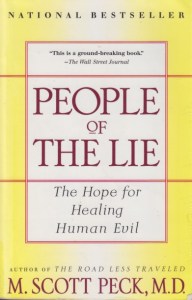
Recently I finished reading M. Scott Peck’s People of the Lie.  This person I knew was in my mind quite a bit as I tried to sort out all the psychology being presented.  If I’m honest I know that even as a child I said this man was evil.  It was clear to me that he wanted to survive on his terms or no terms.  To do so, he believed his own lies.  Now I don’t know if he lied at work.  He had a job where many people depended upon him to carry out his tasks.  He seemed to do so conscientiously.  When not at work, however, he was back in the land where he felt the most comfortable, the land of untruth.  Recently someone again asked me about him.  I tried to recollect as much as I could, and like much of the world these days I answered, “I just don’t know.”


See Above

As we slide beneath the hegemony of technology, I’m impressed by the redefinition of vocabulary it demands.  Because new printing technologies assume, for example, that the XML (one of the many mark-up languages) is primary, directional references in texts are inadequate.  An example might help.  If you’re a human being reading a book, and the author has discussed something a few pages ago, s/he might write “see above.”  Now, it’s not literally above in the sense of being higher up on the same page (but it may be considered literally if the book is closed.   And lying face up).  The pages you already read are above those where you left the bookmark.  I remember the first time I encountered this language; having been raised a literalist (and a naive realist) my eye hovered over the header and I wondered about the accuracy of “see above” or “see below.”  The terminology soon became second nature, however, and I knew it wasn’t a literal reference.

In the days of XML (“eXtensible Markup Language,” therefore literally EML), the sense of play is now gone from writing.  I’ve heard editors explain to authors that, in an ebook there is no above or below because there are no pages.  A time-honored metaphor has been sacrificed on the altar of a tech that sees the world in black-and-white.  You can’t point vaguely in the direction from which you’ve just come and say “it’s back there somewhere.”  I sense, given all of this, that most copyeditors haven’t written a non-fiction book (for this is mostly an academic affectation).  As a human being writing, you get into the flow and you don’t think, “Ah, I mentioned that in paragraph 2749; I’d better say it’s there.”  And the reason you need to know the paragraph number is so the ebook can have a hyperlink.  The argument itself suffers for XML precision.

As someone who writes both fiction and non, I am bound to look at this from the viewpoint of a human author.  I’ve been known to paint and make sketches on occasion.  All of these forms of expression have flow in common.  At least when they’re good they do.   If you want to stop a project cold, just say “Hey, I’m writing!” and watch yourself drop like a cartoon character who’s run off a cliff and just realized it.  I’m sorry, I can’t point you to exact where that’s happened.  It’s in many vague recollections of many cartoons I watched as a child.  If the technomasters aren’t watching I’ll just say, “see above.” 


Dolls and Puzzles

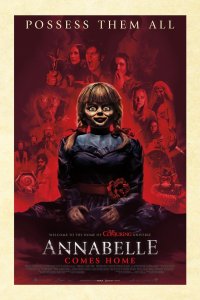
Maybe you’re anticipating it too.  Annabelle Comes Home, I mean.  My latest book, Nightmares with the Bible, has a chapter on The Conjuring universe, and with the recent death of Lorraine Warren I’ve been working on another piece trying to fit this whole puzzle together.  “What puzzle?” did I hear you ask?  The puzzle, I answer, between what really happened in the Ed and Lorraine Warren investigations.  You see, the paranormal is one of those things we’ve been taught to laugh at, and we’re told that people who “see things” are dweebish kinds of gnomes that don’t see the light of the sun enough.  Reality television has brought some of these ideas into vogue, what with ordinary people gathering “scientific” evidence of ghosts and the rest of us scratch our heads while hoaxes are revealed on the B reel.  But still, Annabelle lives.

It has also been announced that The Conjuring 3 is in development.  For some of us—and I’m well aware that movie-making is an industry and that profit is its goal—the question of what’s real can be as haunting as any ghost.  You see, I buy into the scientific method, as far as it goes.  That caveat is necessary, however, since science is neither able to nor interested in assessing all the strange things people see.  Our senses can be fooled, and a great many people haven’t developed the critical ability to scrutinize their own observations skeptically.  Skepticism itself, however, need not become orthodoxy.  It’s like any other tool in our mental box—each has its own purpose.  A car engine is dismantled in order to rebuild it in working order.  And there may be a ghost in the machine.

That’s what gets me about this whole Conjuring thing, and beyond that the contested livelihood of the Warrens.  There may be such a thing as mass hysteria (the current state of the US government can hardly be explained any other way), but the Perron haunting that was the subject of the first film provides, I think, a good test case.  A family of seven living in a house where they experienced things not only collectively and individually but also in different combinations would seem to be a place where multiple angles could be used.  According to Andrea Perron’s written account, the Warrens’ investigation never really took off there.  That didn’t prevent a very successful movie franchise from being launched, loosely based on their story.  And getting at the truth is never as simple as buying your ticket online and waiting for the show to begin.


Let It Lie

At the grave risk of over-simplifying, the list is brief: destructive scapegoating behavior, intolerance of criticism, concern with public image, and deviousness.  These characteristics, back in 1983 (note well the next year), were widely considered the description of evil.  Now look at the White House.  What do you see?  I know that I’m reading into the current situation, but how can one not?  I have never read anything by M. Scott Peck before.  Growing up I saw The Road Less Traveled on many, many bookshelves of friends and clergy.  I recently picked up Peck’s People of the Lie because, along with Malachi Martin’s Hostage to the Devil, it convinced many in my generation that demons actually exist.  At the time, still pretty much a Fundamentalist, I didn’t require any convincing.  Reading Peck’s People, however, in the era of Trump is a frightening thing.  And not just for the politics.

I always find books by psychologists and psychiatrists difficult to read.  I admit to having had a less-than-ideal childhood, and although self-healing is possible such books make me think I should spend my free time in therapy rather than writing.  In any case, People of the Lie is difficult in another respect as well—the labeling of evil.  Peck advocated for the scientific study of evil.  Good and evil, however, have generally been considered values rather than facts.  Science studies the latter while religion and philosophy deal with the former.  Not that lines in the sand are intended to be permanent.  Still, what one person calls evil may not be what others call evil.  Peck focuses primarily on narcissism and laziness as sources of evil.  He may very well be right, especially with the narcissism aspect, but some of the patients he described certainly didn’t seem evil to me.

Many aspects of this book could be discussed on a blog like this.  No doubt many of them will be, in sublimated form, in future posts.  Books, however, are part of the context in which they’re read.  In Peck’s day, the great political evil still fresh in many minds was the Vietnam War.  Today’s world, however, is one where Vietnam, Watergate, and even to a great extent the tragi-comedy of the W administration have all been eclipsed.  The cult of personality headed by one of the most obviously narcissistic individuals this nation has produced makes what Peck labeled “evil” seem perfectly normal.  And those who have the authority to do something about it either sit idly by, or worse, use it for their own means.  Roads less traveled indeed.


World Environment Day

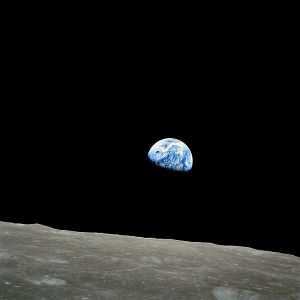
Do you like where you’re living?  Planet earth, I mean.  Today is World Environment Day.  It’s not enough of a holiday to score time off of work, but it is well worth observing nevertheless.  More than that, it’s vital.  Other holidays tend to be the decaying remains of religiously appointed observances or sops thrown to the Cerberus of patriotism, but World Environment Day impacts every one of us, all of the time.  Whether sleeping, waking, working, or playing, it’s in the context of the one planet we have.  Even those in space have to check in here to survive.  We might try to make World Environment Day an international holiday, but I’m sure we could never all agree to it.  Business would collapse if everyone took the same day off, all at the same time.  Instead we’re left to dream.

I recently watched The Lego Movie.  Although released in 2014 it perfectly anticipated 45 with “President Business.”  Overlooking for a moment that Legos represent big business, the film underscored the problem: the only thing hard enough to cut a diamond is another diamond.  And the only way to fight business is with business.  Perhaps there aren’t enough people to envision what life could be like without the constant stress of having to make more money.  It’s a sickness, really.  But it’s a pathology we worship.  There are some abysses, it seems, into which nobody dares peer.  Who doesn’t want to be in charge?  And those in charge care nothing for Mother Earth.

We have spent the past two-plus years watching helplessly as the Republican Party has done its level best to lay waste the planet.  Rolling back and abolishing environmental initiatives deemed detrimental to “business,” these are folks who need to feel what it’s like to lose a job or two and have to reinvent themselves.  Not that long ago, most of the humans on this planet lived on farms or supported those who did.  Daily in touch with the planet in a literal way that those who mow with industrial, sit-down lawn helicopters can never be—how can you be in touch when your feet never even meet the ground?—they knew that paying attention to the planet is crucial.  But that’ll have to wait.  It’s a work day, after all.  And a Wednesday, no less.  In the middle of the week-long worship at the altar of Mammon.  Still, I urge you to take a moment or two today to consider how to save the only planet we’ve got.  It’s worth celebrating.