Book Life

Like a book, life can be divided into chapters.  This is perhaps an instance of art following reality, or perhaps it’s the other way around.  The episodic nature of life suggests the chapter structure of books.  As I was waking up this morning (disappointingly before 4:00 a.m.) I was reflecting on the chapters of my life.  As with a book, the most recently read decade is perhaps freshest in one’s mind, but the decades do seem to fall roughly into format.  We tend to think of that first decade—childhood—fondly, even if in reality it wasn’t all games and candy.  It’s biology’s way of encouraging us toward that weird teen chapter of puberty with its intense emotions and maturing bodies.  That chapter is recalled, at least in my experience, as a turmoil involving both good and bad.

The twenties, in my book, were spent in higher education.  It was a cerebral chapter.  Finishing college and starting grad school.  Finishing a masters and discovering employment difficult to find with a master’s degree.  In my book marriage was in the twenties chapter, along with a doctorate.  The next chapter, the thirties, was spent entirely at Nashotah House.  That involved becoming a father as well as a professor.  The other faculty were fathers of a different sort.  I always thought chapters should show some continuity but the forties chapter was that part of the book known as the crisis.  The upending of convention.  The self-reinvention.  The move.  I suppose in terms of a novel that was when it started to get really interesting, but from my perspective life had been plenty interesting enough by that point.

The fifties have been a bit more settled.  The publishing chapter.  The house-buying move added drama, of course, but otherwise the nine-to-five is like a mind-numbing drug.  Mine involved a commute that lead to its own unpublished book, as well as two somewhat academic  tomes.  All of this was going through my head the way thoughts do when you can’t force yourself back to sleep.  The paradigm suggests itself to someone who has, in one form or another, been writing for his entire life.  Or writing his life.  My first attempts at being a novelist began in chapter two.  On yellowed paper somewhere in the attic I still have that first handwritten attempt at literary expression.  The current chapter has me becoming a gruncle (with a nod to Gravity Falls fans) and wondering how a great niece might read a book written like this.  If she will even have an interest.  That’s the way of books, as any librarian knows.  Maybe some warm milk and a cookie are indicated.

Life is a book.

For the Love of Dog

All I have to do is say “Old Yellar,” and everyone will know the feeling.  Everyone of a certain age, I should add, who’s owned a canine.  The love of dog.  From where I pass my days I can see out the window into the neighbors’ back yards for four houses over.  They all have dogs.  Big dogs, mostly.  They also have fenced in backyards.  One of the things I haven’t seen too much in our neighborhood is dog walking.  People let their dogs out to frolic, and do their, ahem, other outdoor activities in the yard.  Once a day some member of the family, either with the basic plastic bag or with the specialized, long-handled brush and scooper, slowly surveys the yard to remove any offensive matter so the space may be used for human activities.  It’s a level of care that most would shudder to provide for their own species.

Wolves were the earliest domesticated animals.  In those hunter-gatherer days either they or humans—the jury’s out on which—realized the advantages of working together.  Kind of like we were fated to be partners.  Besides, unless the dog turns on us, there’s no question of who’s the master here, and everyone likes to be the boss.  When I catch a glimpse of one of the neighborhood pets being scolded, or praised, it’s clear they share emotions with us.  The bond is deep.  I often wonder about this—they recognize the tone of voice, something that takes humans a while to learn.  I grew up with dogs and I found out that even if you insult them in a friendly, encouraging tone of voice they’ll love you for it.  Dogs are just that way.

Our first real dog—the one that ended up staying with us his whole life, was a beagle pup we got at a farm.  Dogs like to be with others.  Unlike humans, they don’t have to pretend.  (Although they can do that too, as when they growl at you during a game of tug-o-war.)  Then we leave home and go to our places of business, where capitalism reigns.  We treat other humans coldly, clinically.  “It’s only business,” we’ll parrot, especially if we feel bad about doing what the boss tells us.  That’s the way we treat our own species when money’s involved.  And we’ll sit at our desks, daydreaming of our dog at home that will be so glad to see us when we walk through that door.  And we’ll gladly clean up after our pets what we find obscene even to write in human language.  It kind of makes me wonder when I glance out the window while at work.


Truth Is Marching On

A funny thing happens to human minds when they’re in a crowd.  They begin thinking collectively.  We’ve all heard of “mob mentality” and dismiss it as so common that we don’t stop to think how remarkable it is.  Maybe we’re afraid to.  Yesterday I attended my third Women’s March, this time in New York City again.  Being an introvert, I find the prospect of putting myself into a large crowd daunting, and with a winter storm warning posted, worries  about getting home provided a convenient excuse.  My wife knows me well enough, however, to sense when my enochlophobia kicks in and tries to kick out that part of me that’s passionate about social justice.  You see, women are still not counted equal citizens in this “land of equality.”  The Equal Rights Amendment has never passed.  Pay is still based on gender rather than qualification.  And we have an unrepentant misogynist in the White House.

Once I’m in a likeminded crowd, supporting social justice, it’s clear that my thinking is influenced by the activity of all those brains around me.  Scientists know this happens in nature.  Ant colonies, for example, “know” more than a single individual does.  Recent studies have even suggested this “hive consciousness” can exist beyond a lifespan, creating an archive of learning that exceeds the lives of an entire generation.  If only we could teach Republicans to do that.  In any case, being in the crowd of bright, intelligent, hard-working women found me in a good head-space.  The men in DC are certainly doing nothing to make the male gender proud.

Although crowd estimation isn’t an exact science, the media has consistently underestimated the sheer numbers of these marches.  The National Park Service, on duty in Washington in 2017, estimated 1.3 million had shown up for the march.  It’s still not unusual to see the number cited as 500,000.  Regardless, with the sister marches it was the largest single-day protest event in U.S. history.  We have to keep marching as long as men continue to elect the most ignorant of their gender to high office.  There’s nothing controlled about the chaos in the White House.  Fake news, alternative facts, a revolving door of staff, and Fox News’ nose so brown you could grown corn on it is not the way to run a democracy.  I may have been part of a hive mind for a few hours yesterday, and it was a far better mind than those that abound in the federal government seeking only their own glory.  Let’s hope the collective mind outlives this generation.


Turnabout

Fair play, so the adage dictates, includes turnabout.  Well, that may be overstating it a bit, but after reading Joe Nickell I decided to give the other side a shot.  Guy Lyon Playfair’s account, This House Is Haunted: The Amazing Inside Story of the Enfield Poltergeist, was originally written in the aftermath of the truly bizarre happenings at that location in the late 1970s.  My reason for reading the book, as maybe you’ve guessed, is that Ed and Lorraine Warren had a hand in the story.  Or at least a finger.  The movie The Conjuring 2 was based on the Enfield case and it placed the Warrens front and center in its resolution.  This is Hollywood, however, and since I’m working on a book on demons I need to try to dig beneath the surface a bit, into regions where tenure-seeking academics often fear to tread.

Interestingly, the Warrens are not even mentioned in Playfair’s book.  The edition I read was updated in 2011.  Playfair himself was one of the two primary investigators from the Society for Psychical Research.  The other was Maurice Grosse (who features in the movie).  Before eyeballs start rolling, it’s worth noting that the Society for Psychical Research is actually a respectable academic association.  As Playfair makes clear in his book, many of the members are skeptical and few believed that the evidence gathered by Grosse and Playfair indicated anything paranormal at all.  The book isn’t shy about dropping the names of the many investigators who dropped in—some uninvited—to either study or debunk the infamous poltergeist.  The incident, however, went on to inspire the movie Poltergeist by giving it free license to change almost all of the details.  Of the many investigators the Warrens remain unmentioned.

On this blog I’ve been chronicling the on-going struggle of trying to figure out what Ed and Lorraine Warren were up to.  Those who met and interviewed them invariably state that they were/are sincere.  They didn’t accept payment for their investigations, and often seem to have been genuinely interested in helping the people plagued by what mainstream science claims simply can’t exist.  Nevertheless, they had and have detractors even amid the parapsychology crowd.  Playfair’s account is quite interesting.  Called in early after the onset of strangeness on Wood Lane, Playfair recorded and recounted what he saw.  He caught some trickery and wasn’t shy about pointing it out.  At the end of the episode, however, he remained convinced that something unexplained had happened there.  Nickell dismisses it all with a sentence or two.  In the interest of fair play it would seem only right to hear the other side of the story.


Quantum Magic

This history of ideas is perhaps the most stimulating of intellectual topics.  At least to me.  The pedigree of an idea tells us something of its validity—its authority, as it were.  I have been reading about the early days of science.  (Even the idea that science is modern is a mistaken concept; the earliest tool-makers were in some sense scientists.)   A book I was reading made the point that in the Renaissance, magic was a proper competitor to science.  Magic was sophisticated, based on much of what we would now call “science”—the belief was that the connections between an interconnected universe were hidden.  All things were tied together, nevertheless.  This presages not only the concept of evolution but modern cosmology as well.  The more I thought of this, the more it occurred to me that oppositional thinking, in some sense, dooms the possibilities of finding the truth.

Quantum mechanics, which I understand only on a lay level, has been puzzling over entanglement for some years now.  Entanglement was characterized by Einstein’s phrase “spooky action at a distance.”  Still, experiments have show that particles that have no way of “knowing” what each other are doing, are nevertheless connected.  That connection is nothing physical, nothing material.  Indeed, it makes materialists quite nervous.  The inert world of quanta should show no tendency towards “will” or “intention” at all.  So we call it something else—entanglement.  As I read about Renaissance magic, I realized that it was suggesting just this.  Of course, they had no means of observing what particle accelerators, such as that at CERN, reveal.  Their “science,” however, successfully predicted it.  Were it not for the history of ideas we could let materialists think they’ve discovered something new.  Historically, though, they haven’t.  (I’m not suggesting that quantum mechanics work on the macro level, but I’m observing that magic supposed some kind of entanglement existed.)

This is some kind of entanglement!

Often I have made bold to challenge Occam.  I wear a beard for a reason.  One size does not fit all in the entangled universe.  Some consider the exploration of spiritual aspects of life to be a waste of time.  Look at any university pay scales and be so bold as to differ.  The funny thing is, science is only now beginning to catch up with what we historically have called magic.  There seem to be multiple explanations to the behavior of the material world instead of a single one.  Once an idea becomes orthodoxy it becomes dangerous.  Reason is very, very important.  But reason sometimes get entangled in a world only revealed in the history of ideas.


Fun with Skeptics

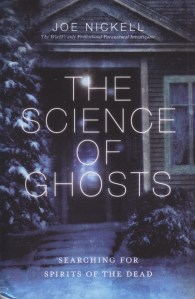
You have to love skeptics.  Really.  Like most people who’ve spent many years attaining a doctorate, I’m naturally skeptical about many things.  One thing that I only temporarily lost (between about 1991 and ’99, if I recall) was an open mind.  That is to say, I discounted many things out of hand because people with doctorates don’t countenance such things.  I eventually realized the folly of academic arrogance and went back to considering things by actual evidence.  The results were interesting.  In order to help with my Ed and Lorraine Warren dilemma, I decided to read The Science of Ghosts by Joe Nickell.  It’s hard not to like Nickell.  He was a stage magician and eventually earned a doctorate in folklore.  He then made a career out of being a paranormal investigator.

He begins his book by claiming to have an open mind about ghosts.  Very quickly, however, a skeptical reader with an open mind notices his magician’s tricks.  He’s very good at misdirection.  While putatively not debunking (but actually debunking) ghostly encounters, he time and again comes to the states of consciousness when individual super-impose images from the  unconscious mind onto what they’re seeing: when falling asleep, in the middle of the night, when waking up, when doing routine chores, when concentrating, when working.  That about covers over 90 percent of human time.  During these periods we’re likely to mistake what’s not really there for what is.  It could explain much of the driving I’ve witnessed in New Jersey, if not ghosts.  And he also picks straw men (and women) to knock over (pardon the violent metaphor).  Accounts by the credulous are his favorites to explain away.

What we really need is a middle ground between credulousness and a skepticism that can’t be convinced even by evidence.  Yes, ghost hunters use ridiculous methods for claiming “proof.”  Yes, some credible people legitimately see incredible things.  Nickell never deviates from his definition of ghosts as a form of energy left by the departed.  Nobody knows for sure what ghosts are, of course.  If they did there’d be little mystery about them.  Although Nickell claims openmindedness, he states at several points that at death brain activity ceases therefore nothing can think, walk, or talk afterward.  As any experimentalist knows, the results reflect the way an experiment is set up.  If the assumption is that there can’t be ghosts, there won’t be ghosts.  To get to the truth of the matter something between credulousness and biased skepticism must be brought to the table to see if it really tips.  Skeptics are fun, but an actual conversation might be more fruitful.


Now Hiring?

In keeping with my recent theme of jobs you never knew you could have, I recently read a story a friend sent me from The Vintage News.  The story concerns a spiritual counselor who is planning to marry a ghost.  I didn’t know that spiritual counselor was an available job.  You see, I had taken enough psychology courses in college that I could’ve had it as a minor, but I didn’t declare it.  At the time I was destined, or so I thought, for a career in ministry and psychology seemed a good subject to assist with that.  Also, I naturally tend to try to figure out what motivates people.  Like most career options, not having a science background prevented me from pursuing psychology as a fall-back career.  But spiritual counselor?

The woman in the story lives in the United Kingdom.  Here in the United States, where unhappy people seek any opportunity they can find to sue someone, having a job as a spiritual counselor probably involves ordination.  Even if you’re ordained, as I learned from long years both attending and teaching in seminaries, you always refer those who come to you to a licensed psychologist.  Clergy can easily be sued for providing bad advice.  That’s why the counselor part of this job seems so odd to me.  That, and the woman the story features is only 27.  I suppose that’s time enough to finish a doctorate, for the truly ambitious, but apparently she doesn’t have a terminal degree.  Just a post-terminal lover.

Also, I learned that spectrophilia is a condition with a name.  The idea of intimacy with spirits is nothing new, of course.  The ancient idea of incubi and succubi reflect this concept, and a number of the stories in the Ed and Lorraine Warren oeuvre include sexual attacks by demons or ghosts.  What’s different here is that the young woman wants to marry a spirit she can’t see.  Unlike most such reputed cases of spectrophilia, she claims spirits are superior to physical lovers.  Despite the oddities that make such a story newsworthy (in a sense) a potentially important point could emerge from all of this.  Love is not a physical phenomenon.  We all know it when we feel it.  I suspect that other such feelings, like finding the perfect job that matches your skills and interests, are likewise intangible.  The problem is finding out that such jobs even exist.


The Truth of Fiction

The thing about reading is that it’s a lifestyle.  I record books both here and on Goodreads, but I read a lot more than books.  Although I don’t have much time for magazines or even newspapers, I read a lot on the web.  And billboards.  And sidewalks.  I’m quite content doing it.  One thing I’ve noticed in all this reading is that fiction writers tend to be more often cited as experts and intellectuals than do non-fiction writers.  Oh the non-fic practitioners get their footnotes, and other specialists mention them, but fiction writers get analyzed, probed, and explored.  Literary types wonder what they meant by some obscure doggerel they wrote.  When’s the last time a non-fiction writer drew that kind of attention?  It makes me wonder about all the time I’ve been spending on non-fiction lately.

I suffer from graphomania.  There’s no cure.  The other day I went looking for an old, pre-electric typewriter to get my fix in case the power goes out.  I have notebooks, zibaldones, commonplace books.  I carry one in my pocket.  I have one on my bedside stand.  And the thing I’ve noticed is that the ideas that come to me unbidden are often fictional.  You see, I have a hidden life as a fiction writer.  That persona is very poor since he’s never made any money from his writing.  He was nominated for a Pushcart Prize some years ago, but he never won.  That fiction writer has been suffering cabin fever because I’ve been finding publishers for my non-fiction work.  I wonder, however, if maybe I shouldn’t be spending my time on fiction.  It’ll never get me to the point I can make a living on it, but it might get quoted after I’m gone.

Writing, after all, is a stab at immortality.  Those of us who do it are legacy builders.  Even as the web has moved us more and more toward visual, iconic forms of entertainment, it has still left a few dusty corners for the written word.  When I pass the sometimes impressive graffiti on the way into New York I think I know what the vandals are feeling.  We’re kindred spirits.  We don’t want to be forgotten.  Whether with spray can, fingers on a keyboard, or fountain pen (or maybe even an old-fashioned typewriter) we are trying to say, “I was here.”  I used to print out all my blog posts in case the web failed.  It grew to thousands of pages.  I had to stop.  I was beginning to act like a fictional character.


Mephistopheles

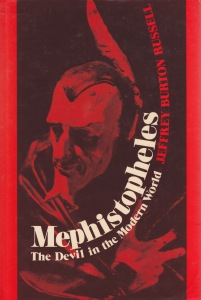
Jeffrey Burton Russell is one of the clearest thinkers I’ve ever read.  I first encountered him in my background reading for Holy Horror, and have subsequently tracked down his books on the history of evil.  In what is a dangerous move for a scholar, Russell admits in The Devil that he believes in some kind of personified evil.  Except for religion scholars employed in seminaries, such thoughts are generally kept carefully guarded as academia has followed the materialist paradigm since it boldly declared that there’s no other way to know the world.  Russell’s intellect penetrates through that posturing and logically lays out what can or can’t be known based on empirical evidence.  And in Mephistopheles: The Devil in the Modern World, he concludes his historical sweep of an idea as old as civilization itself.

This is a wide-ranging book.  The previous three covered long periods as well: antiquity through the Hebrew Bible, New Testament through late antiquity, and the Medieval Period.  Mephistopheles has to cover from the Reformation through the present of the latter 20th century (when it was written).  Finding evil in the modern world is arguably way too easy.  Since 2016 it has become more fashionable to the point that an entire political party can laud it.  Russell writes with the strong conviction that love and the will to goodness can overcome the tendencies of humans to allow hatred, fear, and prejudice to rule.  What seems to be lacking, some three decades on, is the will.  We have given in to our cynicism and elected the worst of our inclinations.

In William Friedkin’s documentary The Devil and Father Amorth, Russell, looking depressed, is interviewed about the reality of demons.  His advice is to look for the good instead.  Nevertheless, having spent years of his life researching how evil appears and reappears, his own fascination demonstrates why we return to the subject time and again.  The world hasn’t righted itself.  His books indicate that there is a way, but we continue to ignore that way, preferring instead to follow the loudest of mouths rather than the warmest of hearts.  Some would personify this into Mephistopheles, the modern, entertaining aspect of the Devil.  Others would claim it’s merely a metaphor.  No matter which may be the case there’s no denying that evil exists.  And if it exists it behooves us to know about it.  And once we learn its identity we must name it.


Care and Keeping of Books

I take good care of books.  It’s my personal goal that after I’ve read a book you won’t be able to tell.  I used to mark books up, but it occurred to me that I want the books to outlast me and if someone else is to get the full benefit of them I shouldn’t be doing such scribbling.  Of course, when a book has to commute with you there’s bound to be some scuffing from being put into a briefcase along with other necessities.  On the days I don’t commute, I try to replicate bus time for reading.  I curl up in a chair with my book and a cup of coffee to warm my fingers, and read.  The other day as I did this, a drop of coffee made its way from my mug onto the open page.  I was aghast.

Reading a marred book page is eternally distracting.  My eye is immediately drawn to the imperfection and I sometimes can’t even make sense of the sentence in which the blemish occurs.  Not because I can’t read it, but because I can’t get beyond the hurt.  Coffee rings are chic, I know, on the cover of a book or a notebook page.  It’s one of the truest clichés of the literary crowd.  Coffee and a good book.  Not coffee in a good book!  I tried to get back into the flow of the narrative.  My eye kept wandering back to the spot I’d unintentionally marred—I’d violated my own principles.  Unintentionally of course—this isn’t Starbucks where the heat is set at a reasonable level and you don’t have to scrunch up to keep warm.  But still.  But still.

After many minutes of feeling like I’d shot a friend, I managed to move on.  I kept turning back to my coffee page to see if the damage was as distracting as I thought it was.  After work that night when I picked my book up again—commuting is a twice a day activity—I turned back to the damaged page and frowned.  Books are, to some of us, friends.  I want to treat them right.  I line them up in order on their shelves, knowing just where to find them when I need them again.  One careless drop of coffee had taken its eternal toll on an innocent tome.  I realize this world lacks perfection; I’m not naive.  Still, this book, which wasn’t cheap, now bears a scar that I dealt it.  Will I ever comprehend what that one page says?  I hope my silent friend will forgive.


Mastering Ravens

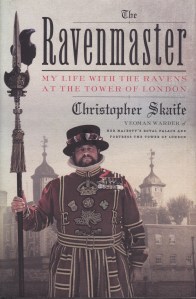
One of the most difficult things in modern life is to keep up with all the new jobs available.  That’s not to suggest that unemployment isn’t a real problem—it is—but that the game has changed since the days I went to the guidance counselors’ office and thumbed through the box of microfiche to learn about potential colleges.  (And what strange people the guidance counselors were!)  Since 1981, when I graduated from Oil City High School, the Internet has been invented and has changed employment forever.  I understand that making YouTube videos can now be a full-time job, with benefits.  Who knew?  So when I was kindly presented with a copy of Christopher Skaife’s The Ravenmaster: My Life with the Ravens at the Tower of London I wasn’t too surprised to learn that there is such a job.

Delightfully written, The Ravenmaster goes into the ins and outs of life in what is a ceremonial job.  That the Brits are fond of tradition is no secret, and this little book is so full of them that it becomes a delightful gallimaufry that includes, I kid you not, dog biscuits marinated in blood.  Although Skaife takes you on a few detours through his own life, the book is mainly about ravens.  We’re so used to materialists telling us that everything is simply cause and effect of neurons firing that I wonder how they might react to the obvious intelligence and personalities of ravens.  Reading about their antics as well as their wisdom it’s difficult not to surmise that consciousness isn’t a purely human preserve.  With the ravens and the wolves we are a piece.

Intelligence is more common in the animal world than in the White House these days, and this book may help to show why.  Ravens can plot, plan, and be cruel.  They can also be kind, compassionate, and friends.  I’ve long had a fascination with corvids, and I tried to befriend some before moving out of New Jersey.  It was a bit tricky with the strictures of my own Tower of London—the commute, the bus, the job—and so my friendship with the local crows in the back yard of our apartment remained strictly casual.  We lose so much by not paying attention to the natural world of which we are, increasingly, so unnatural a part.  When humanity disappoints and the ridiculousness of human behavior haunts, I recommend reaching for The Ravenmaster.  It’s comforting to know that real minds exist out there in the wild.


The Problem with History

The problem with history is that it shows foundational views are constantly shifting.  Let me preface this statement by noting that although I taught Hebrew Bible for many years my training was primarily as an historian of religion.  More specifically, the history of a religious idea that shifted over time.  My dissertation on the topic of Asherah required specialization in Ugaritic and in the religions of the ancient world that included Israel.  I have subsequently been researching the history of ideas, and my current, apparently non-sequiturial books on horror and the Bible are simply a further development of that interest.  The focus has shifted more toward the modern period, but the processes of uncovering history remain the same.  Many people don’t like horror.  I get that.  It is, however, part of the larger picture.

History, to get back to my opening assertion, is not fixed.  It’s also tied to the dilemma that I often face regarding religion.  Since Jesus of Nazareth never wrote anything down, and since Paul of Tarsus was writing to specific groups with their own issues, no systematic theology of Christianity emerged during that crucial first generation.  What eventually grew was an evolving set of premises claimed both by Catholicism and Orthodoxy to be the original.  Neither really is.  Then Protestantism made claims that the establishment had it wrong and the Bible, which was a bit ad hoc to begin with, was the only source for truth.  It’s a problematic source, however, and systems built upon it have also continued to evolve.  Herein lies the dilemma.  With stakes as high as eternal damnation, the wary soul wants to choose correctly.  There is no way, though, to test the results.

Eventually a decision has to be made.  Christian history is full of movements where one group or another has “gone back” to the foundations to reestablish “authentic” Christianity.  The problem is that centuries have intervened.  That “original” worldview, and the sources to reconstruct that worldview, simply no longer exist.  The primitivist religions have to back and fill a bit in order to have any foundation at all.  What emerges are hybrid religions that think they’re pristine originals.  Historians know, however, that no originals exist.  We have no original biblical manuscripts.  Teachings of Catholicism, and even Orthodoxy, change in response to the ongoing nature of human knowledge.  History contains no instructions for getting behind the curtain to naked reality itself.  At the same time the stakes have not changed.  The consequences are eternal.  Those who choose must do so wisely. 


Reentry

Image credit: NASA/ISS Expedition 28, public domain from Wikimedia Commons

They call it reentry, I suspect, because of the perils and stress experienced by astronauts reentering the earth’s atmosphere.  If the calculations are off, you either burn up or bounce back into the void.  Neither is a pleasant prospect.  It is also the feeling many of us experience at returning to work after the holidays.  We’ve had a taste of life without gravity, then suddenly you’re back into the thick of things.  It didn’t help that among my accumulated emails (I do not check work emails during my few allotted vacation days or holidays) was the notice of the sudden death of fellow scholar Gary Knoppers.  Gary’s interest early on included Ugaritic, before shifting to Second Temple Studies.  I once asked him over breakfast if he recalled the question I posed as a grad student when he presented an Ugaritic paper back in Kansas City.  Of course he didn’t; I don’t recall any questions I was ever asked either.  (With one exception.)

Gary died prematurely, just back before Christmas.  The usual venues for finding out such news, like the Society of Biblical Literature portal, were also on vacation.  It is maybe best that I didn’t learn about it until reentry.  Still, it didn’t make it any easier.  I can’t claim to have known Gary very well, but the suddenness with which someone you know dies can lead to shock.  Not so much the fact of death itself, but that it has claimed someone you knew.  I was working with him on a book idea for my employer.  We had traded health complaints about not being young men anymore.  It’s all so very human.

On Ash Wednesday a couple years back one of my colleagues asked if I was going to get ashes.  I replied that I thought about death every day and that I didn’t need ashes to remind me.  She thought it was a funny response, but it is actually true.  One benefit of my religious upbringing is that it early took away the fear of dying.  Since all people have to face mortality, it never made sense to me to fear it.  That doesn’t mean the same thing as wanting to die, but the price to pay is frequent visits to the valley of the shadow in my mind.  I was merely being honest that Ash Wednesday; my interest in horror is, by the way, related to that constant awareness.  Gary was a productive scholar and a kindly man.  Learning of his death so soon after the holidays became its own kind of reentry.  And a reminder that January looks both forward and back.


Slight Reading

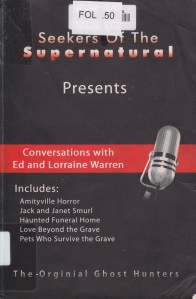
It will soon be time to turn to holiday-oriented posts, but if you’re like me you’ve been seeing the decorations and hearing the music for some time now already.  Given that, at least in name, Christmas is a religious holiday it fits naturally into this blog.  So does the supernatural in itself.  This year I have read most—there’s one book unavailable—of the book-length work of/about Ed and Lorraine Warren.  The latest, some five years after Ed died, was Conversations with Ed and Lorrain Warren by T. Sealyham.  My copy, which came used from a library, has all the marks of self-publication.  It really needed an editor to go over it.  The transcribed radio interviews with Tony Spera, the Warrens’ son-in-law, the accounts told are familiar to those who know the Warrens’ other work, with a few new ones thrown in.

What is immediately striking here, apart from the factual errors (the Isle of Skye is not in the North Sea and Loch Ness is not between Edinburgh and Jedburgh) is the strong desire for credibility.  Personal anecdotes are offered as proof.  Even on the radio claims are made to having photographs (which can’t be seen in that medium) that aren’t shown because of various restrictions.  There’s no doubt that Ed and Lorraine were completely sincere in that they believed in the reality of the phenomena they studied.  They have to be credited with taking seriously what mainstream science simply cannot study.  I often found myself wondering why there can’t be any middle ground here.  The truth only appears when all the hands are face-up on the table.

Volumes like this, that preserve misstatements of a clearly aging Ed, do not help the cause of credibility.  Yes, people get forgetful with age.  Yes, people sometimes misspeak.  Credulity, however, doesn’t lead to credibility.  Many times Tony, after receiving an intriguing answer to a question, would immediately switch the subject instead of following up with a probing request for more detail.  The interview becomes a pastiche of friends remembering old times and claiming this is the truth because they all agree that it is.  Perhaps my negative response comes from the fact that truth itself is under attack by the United States government even as I write.  The world has lost the ability to judge objective evidence and come out with a reasoned assessment.  Are there ghosts?  Perhaps so, but to get to the truth of the matter will require more than the insistence that we believe “because I told you so.”


Solstice Musings

Should my posts of late be castigated as against the Christmas spirit I would rely on Andy Williams’ song, “The Most Wonderful Time of the Year” in my defense.  “There’ll be scary ghost stories,” the crooner sings amid images of cheer and celebration.  What may not be appreciated by my less sober celebrants is that the long nights of winter have as close an association with ghosts as they do with the numerous religious holidays that fervently pray for the return of the light at this time of year.  In merry old England, which along with Germany developed the modern concept of Christmas, the holiday was observed with evening ghost stories as is well represented by Charles Dickens’ A Christmas Carol (likely the source behind Williams’ lyric reference).

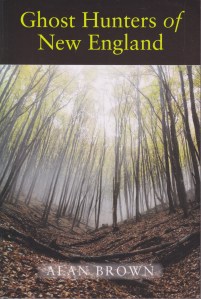
So I read about ghosts when the light begins to fail.  Or at least that’s my excuse.  When Ghost Hunters took to the air in 2004 the world became aware that electronic devices can pick up anomalies and other ghost-hunting groups began to appear.  Alan Brown, apparently curious about this development, wrote Ghost Hunters of New England as a field guide of sorts to paranormal investigators.  The book divides the region by states and includes the answers to survey questions asked to each of them.  The result isn’t especially inspirational, however, as these groups share in common the obvious absence of scientists.  It may be that professional scientists fear the career impact of such associations, but as is the case in many academic disciplines, their lack of participation simply erodes the credibility of science in the eyes of many.

Human investigation of the world has reached a point where many academic specialists can no longer communicate effectively with the average person.  I work in academic publishing and it is clear that many specialists simply do not recollect the level at which those without advanced training read.  We therefore see the rise of hoi polloi as self-appointed experts.  If scientists won’t investigate ghosts, plumbers will.  And since, no matter what science declares, many people experience ghosts, they will listen to those who at least seek answers.  The problem with books like Brown’s, of course, is that if a fad fades the groups disappear leaving the information outdated.  A couple of the groups were interesting enough to send me to the websites listed only to find the domain name for sale and the ghost hunting shingle removed from the door.  Still, the book had some useful information for those willing to consider the possibilities.  After all, the nights can be awfully long in December.  And there’ll be scary ghost stories…