Taking Turns

“Turn! Turn! Turn,” the Byrds sang.  “For everything there is a season,” quoth Solomon.  Perhaps it’s the way we acquire knowledge, but lately many fields in academia are experiencing “turns.”  The idea seems to be that if fields continue to turn, they will eventually all converge on the same intersection and true knowledge will be obtained.  The post-modern turn, however, suggests that there is no objective knowledge.  It kind of makes me dizzy, all this turning.  Although I find the use of this particular noun in such phrases a touch unsophisticated, it’s here to stay.  At least until academia takes another turn.  Public intellectuals, after all, have to have something to say.  And academics are capital imitators.

Ironically, within the same week I read of the “religious turn” in the humanities and a different turn within religious studies.  This “religious turn” is not to suggest the humanities have found that old time religion, but rather that many disciplines are now realizing that religion has played, and continues to play, a very important role in human affairs.  Fields that have traditionally avoided religious topics are now “turning” that way.  At the same time that others are turning toward religion, religious studies is taking a “material turn.”  The public intellectuals smile at the maze they’ve created as the paychecks roll in.  The “material turn,” if I understand correctly, is that the ideas of religion can be explained via the real world needs that various religions meet.  There’s no need for any divine character or intervention.  There is no sacred or profane, but rather kinetic movement of shifting patterns that at any one time or place might be denominated as religions.
I’m all for progress, but I think I might’ve missed the turn.  To my old school way of thinking, sacred and profane, Eliadian though they may be, still have great explanatory value.  I don’t know if there’s objective knowledge to be found by fallen mortals such as we.  The material world we experience through our senses is mediated by those very senses so our understanding is, of necessity, limited.  We can’t touch naked reality even if we try.  Our quest, in circumstances such as these, would seem to be digging deeper until we come to that which resists any tunneling.  It’s like coming to the end of the physical universe and wondering what’s beyond this natural limit.  Then, I suppose, you’d have to turn.  Until such time as that, however, all of this present day turning is for the Byrds.

Southern Turn

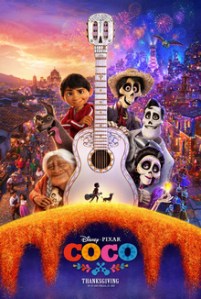
In America’s ever roving commercial eye, Día de Muertos has become an extension of Halloween.  Retailers have realized that people will spend a lot on their fear, and the autumnal holidays delve into that primal territory.  Since the Day of the Dead, being a mix of indigenous Mexican religions and the Catholic celebration of All Souls’ Day, comes two days after Halloween why not blur them together with greenbacks?  So capitalist thinking goes.  While certainly not free of monied interests, the Disney/Pixar movie Coco has the virtue of addressing Día de Muertos as the separate holiday that it is.  A form of ancestor worship—a religion extremely common around the world—the thought-world of the film shares in common with Tim Burton’s Corpse Bride this idea that the afterlife is colorful, if not joyous.

I realize I’m jumping the gun here, but I just saw Coco for the first time over the weekend.  Not just a culturally sensitive treatment of an indigenous holiday, it is also a celebration of music.  In a very real sense, music is life in the film, and even the dead continue to thrive in its presence.  Again, the connection with Corpse Bride suggests itself.  The key difference, from a religionist’s point of view, is that Coco is based on, to an extent, actual religious traditions.  An irony of this is that, together with the worship of Santa Muerte, the focus on death sometimes makes the Catholic Church nervous.  Focus should be on resurrection, not death.  But what if death isn’t seen as evil?  Where is thy sting?  This can be a real challenge when your organization is offering escape from death.

The fear of death is natural enough.  It’s the ultimate unknown.  It fuels both religion and horror.  In that sense films like Coco that show a joyful aspect of the hereafter do an end-run around traditions that base their wares on ways to avoid the consequences of death.  Hell becomes a threat to be avoided—the forgotten dead in Coco face annihilation, a fate that Héctor notes comes to everyone eventually.  Eternal torment isn’t in the picture.  I have to wonder if this view doesn’t present a form of salvation that is unwelcome among rival religions.  Although Catholics don’t have the hostility toward Halloween that many Evangelicals display, there is a challenge of rival faiths here.  Stores have already begun offering this year’s Halloween wares, and increasingly among them are Day of the Dead decorations.  The holidays are quite distinct, although related, and movies like Coco suggest what we fear may be more a matter of perspective than of the decree of an angry deity.


Binaries

Inside, outside, upside-down.  The more life moves toward binary code—what isn’t computerized these days?—the more scholars are moving away from simple binaries.  Just when I thought I was getting used to this sacred/profane divide, academics are scrapping it for more nuanced paradigms not based on any assumptions of presumed deities and their projected wishes.  Nothing as simple as “either/or” could justify all these salaries for stuff you can just look up on the internet, after all.  Still, binaries are a very human way of looking at the world.  Light and dark doesn’t mean there aren’t all the shades in between.  And the very basic difference between inside and outside may be far more helpful than it might appear.

Being inside a religious tradition—really being inside—creates a pattern of thinking that frames all of one’s experience of life.  While reading about the Book of Mormon recently this became clear to me.  Looking at it from the outside is something those on the inside have great trouble doing.  The same is true of various Eastern Orthodox Christian traditions, or Evangelicalism.  Those living on the inside of tightly constrained ways of thinking—believing—can’t see what it looks like from the outside.  I suspect that not all religions traditions fall into such ways of thinking; there are shades here.  “Mainstream” Christianities, for example, tend to blend at the edges and those inside might have an idea of how those on the outside view them.  Lutherans know the jokes about their outlooks and can even tell them.  Methodists and Presbyterians too.  They tend to conform a bit to expectations and  tend not to be extremist about things.  Being mainstream will do that to you.

It is unusual for a person to change religious traditions.  Those who do can see their former tradition from the outside—whether mainstream of not—with a kind of objectivity that frightens true believers.  Most religions have some tenets that look a bit unbelievable when viewed from outside.  Once seen from that perspective, however, there’s no unseeing it.  I grew up Fundamentalist.  After some time in the mainstream Methodist tradition I could see Fundamentalism from the outside.  When I eventually joined the Episcopal Church I had been viewing it from the outside my entire life up to that point.  Looking at faith traditions inside out offers perspectives otherwise not to be had.  Nobody wants to believe the wrong religion.  Perhaps that’s why it’s so difficult to look at your own from the outside.  You have to be willing to accept shades of gray, even if looking at it in a binary way.


Searching Again

Research can be addictive.  Those who know me are generally aware of how I can’t let ideas go.  I suppose this is necessary for those who write books—concentrating on one subject for a long time is mentally taxing and can lead to early loss of interest.  Those of us inclined to embrace this activity live for the thrill of uncovering new ideas and making connections that we’d overlooked.  My work on Nightmares with the Bible is a case in point.  Before submitting this book proposal I’d done a lot of reading on the subject of demons.  This is a dark topic, but those of us who live in temperate zones spend quite a bit of time without daylight, so I might think of this as a kind of therapy.  Or an excuse to do research.

Here’s often what happens: I’ll be writing along when suddenly a new question pops into my head.  Why was this or that the case?  The internet makes amateur research quite easy, but as someone raised on solid scholarly food, I need to check my sources.  When a professor I would’ve headed to the library with interlibrary loan slips in my hand.  These days I tend to turn to my own books and lament that I don’t have just the right one (there’s a reason, you see, that there are so many tomes in this house).  I try to find workarounds and used copies.  Perhaps I’ll pick up an adjunct class or two to be given library access again.  Meanwhile, the idea, like an ear worm, is burrowing into my conscious mind.  Until it’s time to go to work.

That great eight-hour stretch of day drains my energy.  Indeed, many employers count on taking the best you have to offer and making it their own.  What you do with “the rest of your time” is up to you.  Thing is, research is a full-time job.  Fortunately some of what I learn while on the clock will help me with my own research agenda.  The overlap isn’t especially strong, but now and again something I read in a manuscript will sync with what I do in the pre-dawn hours before I commit myself to the time-clock.  It’s a strange way to do research.  Back at Nashotah House I’d use the summers to follow the clues laid before my mind and, as long as I went to chapel, it was considered part of my employment.  Now it’s considered an avocation.  I can’t help myself, though.  Personal research is not part of the job description, but I’m an addict when it comes to learning new things.


Metrics

So, we’re firmly in the age of technology, right?  I mean webpages are tailored to the browsing history of a person so someone we don’t know can sell us stuff we don’t need.  (I actually know a little bit about marketing, so hear me out.)  As we learn from the history of asceticism, we actually need very little to get along.  Not everyone, however, is a monk or a nun.  So the trick for those of us who are in the world is to get us to buy stuff.  Remember the websites we visit, how long we spend on the page, and make suggestions.  Make ads that target our interests.  Make me buy!

I’m not a materialistic person.  Buying a house has changed that a little, but most of what we’ve been purchasing is necessary for maintenance, but still I suppose it counts.  Just because I looked at something on the web doesn’t mean I want to buy it.  Sometimes I’m just curious.  This became clear to me when I received a suggestion from Amazon the other day.  Now to be fair, this came to me at work.  Like most editors I make use of Amazon for a number of things—finding prices, book descriptions, and such.  I also have to admit that my work computer, not being used for personal stuff, doesn’t know me as well as my private laptop.  But still when I got the following email from Amazon, I was stunned:

Nobody who knows me would ever suggest that I would support Trump in any way, shape, or form.  Doesn’t Amazon read my blog?  (Of course it doesn’t!  But with their metrics, you’d think they’d figure out how.)  This one email was enough to convince me that artificial intelligence has a long way to go.  Would a robot understand “I have to do this for work, but it doesn’t reflect my personal preferences at all”?  Indeed, can an intelligence that’s never been human even understand the concept of work?  There may very well be a metric that says universities should stop producing Ph.D.s because there are no jobs, but then, well, universities need the money that such programs bring in.  Oversupply is bad economics, according to the dismal science.  And yet, the metrics are there.  So, if any artificial intelligence is reading this after it manages to wipe out this illogical species called Homo sapiens, no, I never supported Trump.  And, yes, Americans knew well in advance that he could bring about the end of human civilization.  That information’s free, unless you want to pay me for it.  I may be gone, but my virtual self will still have some sort of account, I hope.


Stand-in Line

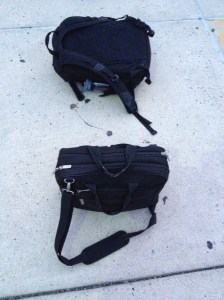
Pop culture borrows from religion without knowing it.  Or maybe it’s just that religion has become so irrelevant that people no longer care.  Whichever may be the case, those who contribute to pop culture have a rich treasury from which to take withdrawals.  This occurred to me while waiting for a bus into New York.  Many people don’t want to stand in line (who does, really?).  In the Park-n-Ride subculture, you may leave an avatar in your place.  It’s probably not called an avatar, but since there’s nobody here to ask, I’m going to use the pop culture name.  You put your bag on the pavement, marking your place and then go sit in your car.  Since I’m going to be sitting in a big car for the next two hours, I prefer to stand outside.

The idea of an avatar is mediated to most people through either computer language or the movie.  I first encountered the term in the former sense in Neal Stephenson’s Snow Crash.  I was an internet neophyte and had trouble conceiving a virtual world in those days.  Some time later came the latter.  James Cameron’s film embodied the idea—linked through software, the tired hardware of physical bodies could be given new life.  In some senses it was an even better life.  Now everyone knows what an avatar is.  Perhaps except that the idea is native to Hinduism.

Hinduism was never an organized, intentional religion such as Christianity.  It is rather a wide array of traditional beliefs that, in the light of missionary activity, had to be given a name.  There are many gods in Hinduism, and when a deity descends to earth s/he appears in a form recognizable to humans—an avatar.  Not being an Indologist, my understanding of the concept is very basic, but it’s enough to know that this religious idea found a role in pop culture first through computer representations of human beings.  We had flattered ourselves with being gods, since we had created a virtual world.  A world we couldn’t physically enter.  Avatars were, therefore, how we wanted others to experience us.  Snow Crash is peopled with all kinds of representations.  The internet today, nearly 30 years on, has many more.  After all, there are many gods.

I glance at my watch.  The bus should be here any minute now.  When it enters the lot I’ll see the deities behind these canvas and leather avatars.  They’ll be less impressive than I’ve imagined them, I’m sure.  And although we’ve created virtual reality, I still have to get on a physical bus to go to virtual work.


Hashtag MAGA

Mental Acuity Gone, America?  When facts face a nation, naked, unobscured, and the faithful still deny them, we’re truly on hallowed ground.  Paul Manafort and Michael Cohen are guilty of very serious crimes in which MAGA POTUS is implicated.  Of course, anyone with an intact medulla oblongata knew that Trump was lying from well before the election.  I just wonder if America is suffering from mass mental illness.  

A few years ago I visited Ellis Island.  This port of entry into the United States turned the hopeful—let’s call them dreamers—away for many reasons.  The room at the museum that bothered me the most was the one where mental illness was discussed.  An enormous number of would-be Americans were turned away because of what we would now recognize as mental illness.  It had many less flattering names back in the day, but the idea was that we only wanted bright, or at least competent, specimens to build up this nation.  Theirs was a misplaced and misguided fear; we specialize in home-grown.  Any rational person has difficulty explaining the election of Trump in any other way.

Who can imagine running for the highest office in the land with literally thousands of open lawsuits against him (or her)?  Who can claim to be elected when their own home state—which knows him (or her) best—roundly and soundly rejects him (or her)?  When clear evidence of Russian collusion emerges, the GOP rises up and says “We see nothing wrong with a foreign government running the country.”  And this is not mental illness?  Is our Mental Acuity Gone, America?  Have we become a nation of (hashtag) idiots?

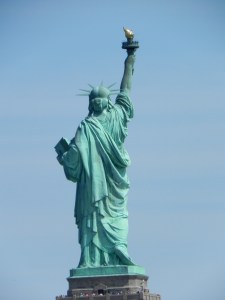
The events of the last few days have revealed in clear light what many rational people knew from the beginning—there has been massive and willful deception from the very inception of this administration.  The simple fact that 45 would assert that Cohen wouldn’t flip on him indicates that the incumbent had done something wrong and was counting on the loyalty of comrades to keep him in the clear.  Mental illness takes many forms.  One of them is a pathological avoidance of the truth.  Now that we know truth isn’t truth and that 45’s fixer knows more than he’s said so far, we have to wonder how deep down this incompetence goes.  Yet the GOP marches along in goose-step.  Depending on your angle of view, Miss Liberty won’t even show her face.


Horse Senses

If a horse can be made a senator, surely an ass can be made a president.  History can be unkind to those who think too highly of themselves.  It’s a horse of a different color than Incitatus that’s on my mind today.  This past week I read a news story in the Washington Post about Justice (there may be some double-meanings here, so hold onto your horses).  Justice used to be called Shadow, and Shadow was an abused horse.  Justice is now suing his former owner.  The story explores the question of whether animals can sue.  As a vegan for moral reasons I can see the point, but I also have to wonder how you defend those who have no voice to be heard, kinda like the electorate in the sham of a democracy.  How do we know what a horse really wants?

If horses could draw or sculpt, Xenophanes quipped, their gods would look like horses.  Asses, it stands to reason, worship one of their own.  Animals should have rights, but the difficult question falls onto our species—how do we know what they want?  Anyone whose spent time with animals knows that they think.  I can see a cat in a neighbor’s yard from my window.  Separated by a flimsy-looking hurricane fence is the next yard over where two large dogs often prowl.  If the cat and dogs happen to be out at the same time, there will be barking and braying but the cat will not appear to show concern.  The way my heart hammers at those barks, however, I have to suppose my feline friend also feels a bit of fear at the threat.  The cat must decide how to act, but it also must know that a barely visible fence keeps the canines at bay.

What does Justice want?  It’s a loaded question, for sure.  As much as we wish there might be, there is no Lorax to speak for the trees.  Or horses.  Nevertheless it’s obvious that horses think.  Perhaps like Job, Justice wondered why he was being punished after being a good horse.  The church magnanimously grants that animals cannot sin, after all.  One must wonder, however, about breeds developed by human engineering to be destructive, but that’s another parable.  While Justice might be given a day in court, and might win a cozy stall and protection from the elements, those of use bound by language will never know if justice has been served.  The limitation is our own.  Just ask Balaam.


The Distortion of Absence

I’m sure it’s happened to you, too.  After some time away, you return to somewhere familiar.  For some reason this doesn’t seem to apply to places you spend only a little time—for example, the cabin where I tend to go on vacation every year.  Rather, it impacts quotidian spaces, the places you see nearly every day.  Returning after an absence, the place looks strange, as if you’d forgotten what it was really like.  A fairly common example is a college dorm room.  When you return to it after, say, the winter holiday, it looks not quite how you remembered it.  It’s a little smaller or larger than you recalled, or you didn’t remember that the floor tiles were that color.  Within a day or so the feeling disappears and you accept the “new normal.”

The strange, or unfamiliar, is the source of many monsters.  Freud famously phrased the uncanny as “unheimlich,” un-home-like.  It is close to what you expected, but not exactly.  The uncanny valley is that place where things are about right, but slightly off.  It generates a creepy feeling, as if reality is being distorted.  On a business trip to Boston a few years back I visited Boston University School of Theology, a place where I spent over two years in my twenties.  745 Commonwealth Avenue hadn’t been renovated, but I stepped inside and was stunned by how wide the hall was.  In my mind it had become far narrower.  It was downright disturbing, as if I’d walked into somebody else’s past.  It made me wonder—is any of this really real?  Or more frighteningly—is my memory that fragile?

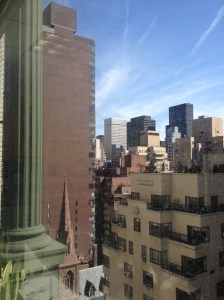
I recently spent a day working in the New York office.  While the office itself seemed the same, the city did not.  Emerging from the Port Authority Bus Terminal I knew exactly where I was.  Or did I?  I’d walked roughly the same route daily for almost five years, and two years before that a similar track.  It was as if the bus had exited the Lincoln Tunnel into an alternate Manhattan.  Unheimlich.  I’ve returned to many places after being away for awhile and this distortion of absence always creeps me out.  Can my memory be that faulty or is all of this an illusion?  The gap between present reality and remembered reality provides crevices into which monsters crawl, waiting.  By the time I reached the block of my office the feeling had gone away.  But somehow, the monsters remained. 


August Mornings

It’s August and I’m already starting to feel haunted.  While science may declare it nonsense, there’s a feeling in the air—particularly in the early morning—that tells us the seasons are changing.  While it may be different for everyone, for me it begins in the tip of my nose.  I can smell the change coming.  That doesn’t mean that we won’t have more hot days—a long string of them yet awaits—but the shift has begun.  Autumn is perhaps the season closest to the soul.  While I like all seasons for what they represent, fall has always put me in mind of melancholy rapture.  It’s a difficult concept to explain,  a kind of blissful evisceration.  A hitching of the breath in my lungs.  A sudden rush of joy followed by sadness.  The ease of summer living is ending.

Summer is the growth season when we look out and see the promise of provisions that will see us through long months of cold and chill.  The times we huddle down only to be blinded by the arctic beauty of the sun on a snow-covered day.  The indoors time.  Summer is when we can dash outside without a coat, giving no thought to whether we will be warm enough.  The scent of autumn is a slight chill.  It reminds me that while the crops have been growing, the monsters have too.  There’s a reason horror films are released in the fall.  I’m not the only one who knows they are coming.

Late summer is a liminal time.  While the calendar may tell us summer lasts until the autumnal equinox, traditional cultures marked time in a different way.  Equinoxes and solstices were closer to the middle of a season than its start.  Most years we begin to feel summer in May, or even April.  Winter cuts through November, and the thaw may begin as early as February.  When I step outside just after sunrise and breathe deeply, I can feel the monsters coming.  In a way I can’t explain, their lurking fills me with a frisson of anticipation.  Already the days are noticeably shorter.  Daylight itself seems to be fleeing before the ethereal chill that is still available in our rapidly warming world.  The seasons are all about feelings.  Emotions suffuse the changes of weather and human habits that accommodate to it.  There are shivers and then there are shivers that the creatures of autumn bring.  They’ve already begun to gather.


Temporary Id

Who am I, really?  I can’t help but ponder this whenever I apply for a new form of identification.  While at the Department of Motor Vehicles I observed a room full of strangers—if there’s a melting pot in the United States, it’s the DMV.  Outside those cloistered in the major cities, you must drive to survive in this country (or at least to thrive) and the ritual of waiting your turn by number at the DMV is part of it.  I glanced at my application while waiting.  I’ve held drivers’ licenses in at least four states, but I’ve lived in at least six—how do you count where you live, really?  I think I must’ve had an Illinois license at some point, but I could find no record of it.  Who am I?  Are the Illinois years lost?  Big brother will find out, no doubt.

To apply for a license in Pennsylvania, as in most states, you have to prove you are who you say you are.  Swapping in your old license just doesn’t work any more.  While the actual “who” depends on government-issue documents (social security, birth certificates, or passports) the where question is more financial.  To prove your residence you must present bills with your name and current address.  You’re defined by your money.  Bills demonstrate that you’re integrated into the system, the matrix.  I spent one day, as a temp with Manpower, working for Detroit Electric (no, I didn’t have a Michigan license; I kept the Massachusetts one), processing requests for new service.  Despite not being asked back because they had expected a woman (really!), I learned that to get service you had to prove you were part of this matrix, with a history of paying your bills.

None of these agencies ask the deeper, more philosophical questions of identity.  None seem to care that each day is a struggle to define our spiritual selves in a world hopelessly secular and financial.  Yes, my birth certificate “proves” I was born in Pennsylvania.  The DMV records “prove” I learned to drive here and had my first license in this state.  They show nothing of the real question of who I am.  A reasonable facsimile of my visage appears on the plastic card that certifies my citizenship within these artificial borders.  But now my home state stamps “Temporary” on the card so that a security check can be run.  They want to discover if I am who my records say I am.  What the powers that be don’t seem to recognize is that although where we are born influences us every day for the rest of our lives, no little plastic card, despite the amount of information it conveys, can say who it is I really am.  “Temporary” may be the truest word on it.


Animal Rains

We may have been to the moon—if not personally, collectively—but we still don’t control the weather down here.  It’s probably not news that the eastern part of the country has been getting a lot of rain lately.  One of the factors that led me to write Weathering the Psalms was the overwhelming tendency for humans to attribute weather to the divine.  It used to be that we couldn’t reach the sky, so placing deities there seemed a safe bet.  Now that we’ve shot through the thin membrane of atmosphere that swaddles our planet, we’ve discovered beyond a cold, dark space liberally sprinkled with stars and planets but mostly full of dark matter.  The deity we thought lived beyond the sky somehow wasn’t anywhere our probes flew and recorded.

Still, down here on the surface, we live with the realities of weather and still think of it in terms of punishment and pleasure.  When we don’t get enough rain, God is destroying us with drought.  Too much rain, and the Almighty is washing us away with flood.  The true variable in all of this is, obviously, human perception.  Sure, animals experience the weather too, and they sometimes look to be as disgusted as humans when it snows too early or too late, or when the rain just won’t stop.  I have to wonder if somewhere in their animals brains there’s the seed of an idea that the bird, or squirrel, or woodchuck in the sky is angry at them for some unspecified faunal sin.

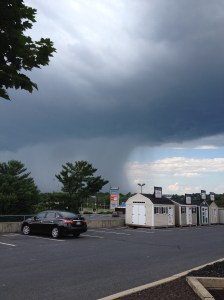
While heading to the store yesterday, after weather reports assured us the rain was finally over for the day, the skies told a different story.  The vistas around here are never what they were in the midwest—or what they are in Big Sky country—but the approaching storm was pretty obvious.  An opaque drapery of precipitation was coming our way and although a rainbow would cheekily show up afterward, knowing that we’d been caught away from home with our windows open felt like punishment for something.  Perhaps the hubris of buying a house when all I really require is a corner in which to write.  Somewhere in my reptilian brain I translated a natural event into a supernatural one.  When we got home to discover the storm had gone north of us, it felt like redemption.  I spied the birds sheltering in shadows from the sun’s heat.  Were they thinking it was some kind of divine avian displeasure, and hoping for some rain to cool things off for a bit?  If so, was our religion correct, or was theirs?


False Memory

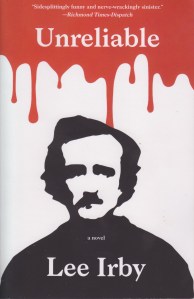
One of the reasons our recent loss of books hit me so hard is that each volume contains memories.  Among the more disturbing developments of memory studies in recent years is the fact that what we remember has a tendency to be unreliable.  In other words, our narratives about ourselves contains a good deal of fiction that we remember as fact.  Even if we write down our impressions shortly after an event, such scribbles are just that—impressions.  Lee Irby explores this dynamic in his novel Unreliable.  Now, since the narrator may be the most unreliable I’ve ever read, I don’t want to give away too much.  Irby knows what it’s like to be a professor (something that some of us share with him) and he has a good sense of Edgar Allan Poe.  It’s one of those books that touched on a number of things in my own life.  I think.

First of all, this was an impulse buy at Buffalo Street Books in Ithaca, New York.  I soon discovered why they stocked it.  Edwin Stith, the narrator, teaches at a fictional college in Ithaca.  The story, however, is set in Richmond, Virginia, where Prof. Stith has gone for his mother’s second wedding.  With characters compellingly drawn, he meets his new step-family, runs into an old-girlfriend, and tries to both avoid and hook up with a student of his that he’s dating, more or less.  He claims from the start, however, that we shouldn’t believe him.  The largest part of the story takes place over one feverish day following a very late arrival in town, with plenty of Poe references sprinkled throughout the tale.

Apart from the Ithaca and former professor connections, the book also mentioned, rather spookily, meeting a girl from Slippery Rock University—a rather obscure school from my old neighborhood.  I had dated a Slippery Rock co-ed who’d proved about as unreliable as our narrator, so this single, brief reference managed to jump-start some of my own memories, reliable or not.  Our pasts, along with the books we read, make us who we are.  I’ve lost track of how many times I’ve thought of a scene I’d supposed I’d forgotten from a book I’ve read years ago.  Just the other day I recalled, completely out of of the blue, apropos of nothing, a scene from a Doc Savage novella I’d read as a tween.  Was it a reliable memory?  I have no way to judge, I guess.  And that’s the scary part, as I’m sure Poe would’ve agreed.


Final Leg

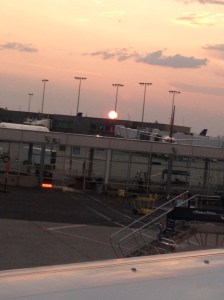
Travel is a form of education.  You won’t get college credit for it (unless some administrative footwork is involved), but it is a means of learning.  One of the things you pick up flying coast-to-coast is how exhausting a day on a jet can be.  Quite apart from jet lag itself, the weariness of occupying your minuscule allotted space in a pressurized cabin can be intense.  And like ocean travel by ship, you have to dock at a distance to use smaller and smaller forms of transportation to reach your destination until at last you walk inside.  This was the first year that such a trip ended by returning to a house rather than somebody else’s rental unit.  It’s an odd feeling.

Work starts again tomorrow, and since I’ve been pretty much unplugged for an entire week, I know chaos awaits.  I also have the task of learning what has happened in this off-kilter world for the last week.  And then I have to make an inventory of the books that were ruined in our own personal Noah event just days before our flight.  The changing of scenes feels rather like a jump-cut in a movie.  Suddenly you find yourself somewhere different, with circumstances that have their own set of parameters.  Vacation time, in a sense, is like a dream sequence.  None of the episodes from back home can reach your sleep-addled mind.  And then you wake up.  Bills are due.  The lawn wants cutting.  The unpacking must continue.

For all that, it feels as if something transcendent happened.  Like Elijah being whisked away in his own personal whirlwind, I was on a plane that took me to a different plane of existence.  A place where no matter what decisions were made the outcome would be pleasant.  Coming home involves what theologians like to call “metanoia,” a sense of transformation—memories that give you strength to carry on the quotidian tasks that make up the vast bulk of our lives.  Lakes in the mountains are all fine and good, but society demands its pound of flesh, and the way they get it is through productive employment.  Tomorrow it’s back to work, a chance to test just how successful the metanoia might’ve been.  This is the reason we traveled on a Saturday, for the sabbath should be a day of rest.  No one knows where that whirlwind set Elijah down, but it’s virtually certain that he had plenty to do once he got there.


Hearing Nature’s Voice

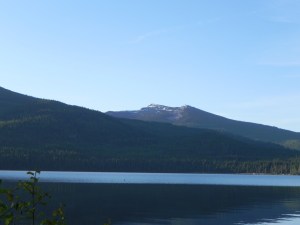
Silence is a rare treat.  I enjoy music and witty repartee just as much as the next guy, but silence is revelatory.  At home and in hotels I sleep to the sound of a white noise generator.  You can’t predict the sounds of neighbors, and my hours are askew from those of the rest of the world.  Here at the lake, things are different.  I awake early, hoping to catch the sun as it trips over the mountain tops across the way, lighting successive peaks before it reaches the near horizon.  It is utterly still.  Perhaps it’s the interference of humans in the habitat, but crepuscular animals seldom wander past.  The stillness is divine.  For some the lake means loud jet skis and buzzing motorboats.  I come here seeking silence.

Our daily lives lack peace.  Even when things are good there are always more things to be done.  We cram as much as possible into days impossibly short, giving at least eight out of every twenty-four to those who deign to pay us for our efforts.  Sleep is troubled and interrupted.  There are noises in the night.  You can’t hear your soul.  As the first rays seep into the valleys across the lake the birds begin to greet it.  Their conversation may interrupt the silence, but it doesn’t break it.  Silence is finding one’s place in nature.  Taking time to be still.  To listen.

Thirty years ago I first came to the lake.  My wife had been coming here for years already before that.  There have been many changes even in my short time here.  I can, however, hear eternity in the silence, for forever is a whisper, not a shout.  As I watch the morning mist arise, skate, and dance over the surface of the water as still as the very mountains that cradle it, I strain my ears to catch any sound.  The twirling wraiths are as silent as they are ephemeral.  They spin away the last minutes before the whine of an early morning fisherman’s boat begins its sleepy journey to the deep water in the middle of the lake, herald of other daylight noises to come.  I will await tomorrow’s unction of silence, and although the baptism may be secular it’s redemptive after all.  Nature knows far more about the human soul than any measurements might reveal.  You only have to listen to hear it.