Spirits and Souls

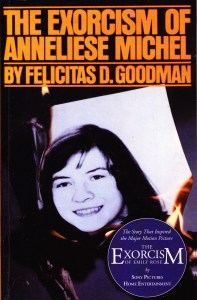
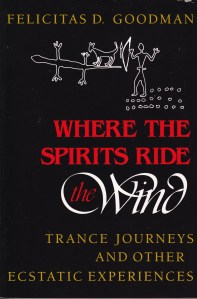
I first became aware of the work of Felicitas D. Goodman because of her classic text on spirit possession. Published by the reputable Indiana University Press, that book has become a standard for anthropological understanding of a strange phenomenon, which includes demonic possession. I found Where the Spirits Ride the Wind: Trance Journeys and Other Ecstatic Experiences in a used bookstore. Recognizing Goodman’s name, and always eager to learn about spirituality, I picked it up, It’s one of those books that makes you wonder. In an effort to experience trance states, Goodman began to experiment with various posture represented in the archaeological record. When she taught classes where students had no foreknowledge on the postures, she found they they reported similar visions during their trances while using the same posture. Matter, it seems, can effect mind.

I couldn’t help but wonder, as I read her account, what Indiana University Press must have thought about what they were publishing. This could be some serious woo, depending on how far you’re willing to go with Goodman. She was a doctorate-holding professor, so academic convention suggests she should be taken seriously. The BISAC classifications (those categories that often appear on the back cover of a book) tell the reader that this is Anthropology and Psychology of Religion. Neither field tends to give a whole lot of credence to the supernatural. At least not necessarily. And yet, there it is. Neither field really captures what Goodman describes in this book. Nobody really doubts that trances can happen; alternate states of consciousness are acknowledged phenomena. What we don’t have, however, is an explanation of what’s really going on.

A good deal of the this book consists of her students’ accounts of their visions. Although a native of Hungary, Goodman, through fieldwork and experience, became quite adept at Native American and other indigenous religious practices. The images that suggested the postures to her come from archaeological contexts around the world. This suggests that, according to Goodman’s worldview, these are some universal experiences. Attaining trance states, like meditation, takes practice. They can shift perceptions of reality. We tend not to hear too much about religion faculty who explore such things too openly. It’s a dangerous move in academia. Ironically, the institutions we build to understand our world tend to restrict themselves to the physical world or those fields that make ample lucre. I’m impressed that, even if by labeling it anthropology or psychology of religion, at least one university press took a chance at offering an exploration that might have some real world consequences.


Trained Witnesses

The problem with lying is that it generally doesn’t hold up. Eventually people will figure out that a falsehood is exactly that and the liar will be scorned. In other words, truth is determined by witnesses. This is tested and confirmed every day in our legal system. The witness is invaluable (except in the hands of lawyers). Since no one person can see everything, we rely on others to help us fill in the blanks. Think of it; when you see something unusual don’t you ask whoever’s with you “did you see that?” We witness the world around us, and unless we’re untruthful that observation becomes part of the collective narrative of what the world is like.

A story from IFL Science! sent by a friend describes “Ancient Legends And Myths That Were Later Proven True By Science.” Apparently this is part of an annual series. What the article lays out are recorded myths later confirmed by science. Scientists are trained witnesses. Taught to silo information, they separate belief (so they say) and eschew non-natural causation. They peer into the mirror each morning with Occam’s razor firmly in hand. Then everybody seems to be surprised when non-scientists have actually observed something correctly. This is the ancient bickering between religion and science—you can’t have it both ways, the reasoning goes. This is a zero-sum game. The winner takes it all. Reality, we observe, is seldom so simple. Articles like this one express surprise that non-scientists can get it right once in a while. The fact is, we’re all witnesses to what happens on this planet. Some of us are just taken more seriously than others.

Don’t get me wrong—I’m not equating religion and science. Nor am I suggesting that all people are equally good observers. It’s just that sometimes things happen when there’s no scientist in the room. Or if there is there’s no time to wire everything up appropriately. The events in the IFL Science! piece are all like this. Observed by people before science was invented—some of them before civilization was invented—events were called myths until scientists came round with their notebooks and validated the long-departed witnesses. The problem with occasional phenomena is that they don’t come on cue. The universe isn’t here to please us or satisfy our curiosity. It’s just that sometimes we see things that don’t match up with the textbook. Whether you call an exorcist or a scientist depends entirely on your point of view.


The Deity Electric

The title set me back. “Deus ex machina: former Google engineer is developing an AI god.” The article in The Guardian is surprising in several ways. Firstly, technocrats tend to suggest that since there is no deity, worship of said non-entity is a waste of precious time. Is this, then, an acknowledgement that those of us who’ve spent our lives on religion may have had at least an inkling of the truth after all? Scientific studies have repeatedly shown that religion is an inherent, and perhaps unavoidable, aspect of being human. Whether you call it inspiration or superstition, we think in religious terms. It’s entirely natural. Perhaps it’s evolved behavior. It’s anything but absent.

Another aspect of the article that generates wonder is the idea that we can create God. Yes, analysts have long claimed that we humans made God in our own image. Traditionally, however, the very concept of God was based on the idea that there was something non-human about the deity. Artificial Intelligence, however, makes the hubristic assertion that human intelligence knows enough to create a god. We don’t even know enough to elect a sane person as president. Looking at the wider world—let alone the universe—there is so much we don’t know. Our five senses are limited. There are realities which we have no way to measure. Is is perhaps not dangerous to make a divinity when our own way of looking at the universe is so terribly limited? What if I don’t like the god you build? At least with the old fashioned one we can shrug our shoulders and sigh, “that’s just the God there is.”

Any fulfilled future humanist will need to find an outlet for this need to worship. Can we truly respect a deity whose transistors we’ve manufactured? This Godhead will be, at the end of the day, only 0s and 1s. And what’s more, we will know that. Traditional religions have given us gods from the outside. Some of them are flawed, some are perfect, but they all have this in common—we didn’t make them. The universe imposed them upon us. Throughout history people have attempted, in various ways, to build their own gods. It generally doesn’t end well. It’d be like designing your own parents. They made you what you are and what would you be if you could somehow reverse engineer them into more perfect versions of themselves? Can we invent gods? Oh yes. We do it all the time. But when we set about making one that our disembodied, downloaded consciousness can worship we might want to consider the history of such attempts.


Scared Space

Ghosts appear whether they exist or not. People have seen them, we know, since as early as written records permit us to know. I first ran into Colin Dickey’s name in a review of the new Ghostbusters movie. The bio made mention of his book, Ghostland: An American History in Haunted Places. Then it was a matter of waiting until autumn to read it. It’s a book that will long stay with me. Dickey’s not out to prove or disprove ghosts—they are simply there (and sometimes not). Ghosts, however, teach us quite a lot about the living. What we value. What we fear. What we disdain. Some of the ghost stories in this book are famous and familiar, others obscure and pedestrian. What they all have in common is a sense of place.

This book is primarily about place. Ghosts seem to be generated by the fact that people have lived here before us. Focusing on the United States, Dickey points out that land stolen from others has inhabitants already. On top of Native American sites, we now have a few hundred years of European and African and Asian building. Lives lived on top of other lives. And although we can’t say for sure what ghosts are, they do seem to be associated with buildings, or at least places. Organized in a kind of concentric structure, the book describes ghosts of haunted houses, then haunted businesses and public buildings, including haunted outdoor spaces. And finally haunted cities. These hauntings are residue of our own making. We build, we inhabit, we die. Whether ghosts are just memories or uncanny feelings, they are ghosts nevertheless.

Combining a couple of my favorite ideas—ghosts and the sense of space—Ghostland is a rare blend of history and folklore. The architecture of our constructions functions like tombs for our imagination. We are spiritual beings, whether religious or not. Even if we’re in denial of that spirituality, we sense that somehow life doesn’t simply end. We’ve left a mark, a scratch, a dent. As long as those who’ve known us live, we continue on in their minds and lives. And some, it seems, remain beyond even that to be seen by strangers centuries later, maintaining the sacredness of space once familiar while living. Ghost stories are human stories, and Dickey is a sure guide along the way. He doesn’t tell you what to believe, but he tells you something you already may know but not realize. No matter whether they’re ever proven, or whether they even really exist, as long as there are human beings there will also be ghosts.


Deep Web Religion

The bases of truth are ever shifting, it seems. What was once decided by spiritual tests now finds technological solutions. A friend sent me a story from IFL Science (which, surprisingly, often focuses on religion) concerning a nun in seventeenth-century Italy. What makes this nun stand out is less than she had a mental disorder but more that she wrote that it came from the Devil. Her letter, however, was written in an indecipherable script and has only just been decoded. How? By using decoding software on the Deep Web. As someone who’s still lost on the surface web, I’m not sure whether diabolical possession or this mysterious sub-web is scarier. An even more profound question is why someone in this scientific age would resort to the Deep Web to diagnose the illness of a sequestered religious long dead.

Like Manhattan, which, I’m told, has many layers underground, the web has places you shouldn’t go. Computers linked promiscuously together have an amazing power, and apart from those of us who can while away hours looking at photos and videos of cats, there is a darker, more sinister area that can’t be accessed with Google. Down there, according to IFL Science, resides powerful code-cracking software that might be profitably turned to Linear A or Hurrian, but is used to decipher the centuries’ old note of a woman who believed she was possessed. I’m not knocking the achievement. Decades of research have apparently solved the conundrum of the Voynich Manuscript—we can’t stand having the ancient talk behind our backs—and yet try to get funding to hire an Assyriologist at your school. The vast majority of ancient Mesopotamian clay tablets remain untranslated in cellars as dark as the Deep Web.

There seems to be little doubt that Sister Maria Crocifissa della Concezione suffered from some form of mental illness. Even today some psychologists are starting to suggest that “possession” should be considered a viable option for diagnosing some cases that otherwise defy satisfactory resolution. This isn’t medieval superstition, but it is our understanding of a materialistic universe shoved up against a wall. We can’t stand not to know. Mental illness is as old as mentality. We can’t comprehend the vastness of this world, let alone this galaxy or this universe. Even very interesting stuff gets lost on the world-wide web. I don’t even want to think about what goes on in the infernal regions below it.


Beam Me Where?

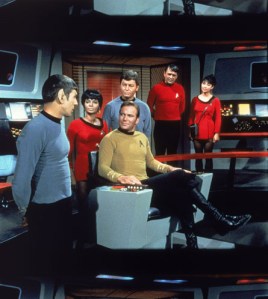
It’s kind of like the transporter dilemma on Star Trek. Where is the person/Vulcan/Klingon when their atoms are being disassociated in one location and reassembled in another? In the classic series, McCoy was never happy with the technology, and even today our doubts linger about what constitutes a person. The other day in a routine medical procedure, I underwent anesthesia. Lying there in the corridor, staring at the calmly themed over-head light colors (no, they actually were themed covers; the drip hadn’t started yet), I wondered where I was about to go. I’ve only had anesthesia once before that I can remember, and I recalled awaking suddenly from the most profound, dreamless sleep ever. It was very different from ordinary sleep. So where was my consciousness at the time?

We have no satisfactory answer to the question of what consciousness is, let alone where it is. Materialists would say, literally, it’s all in your head. Consciousness is a happy mixture of electro-chemical signals in a dull gray organ that’s busing churning out this illusion that Steve A. Wiggins is something more than, well, a mixture of electro-chemical signals. Those of us who’ve experienced enough to question such simple answers wonder a bit more deeply about it. What is consciousness? We’ve all had that feeling, I suppose, of awaking from a dream and being disoriented, even throughout the day at points, as to whether it was real or not. Or, alternatively, remembering something but not being sure if it “really happened” or might’ve been a dream. Ordinarily we recognize the difference between waking and dreaming consciousness, but sometimes the line is blurred.

My experience this time around was the same as last. One moment you’re talking to an anesthesiologist and the next you’re awaking from a completely blank state of mind, a little confused about where you are. You haven’t been in dreamland since there was nothing there. The exact mix of chemicals isn’t the same as when you fall asleep. For all intents and purposes, you are completely gone for that span of time. When I woke up I remembered the anesthesiologist and the watch he was wearing. His accent. His assuring me that the bubbles in the tube were okay. Between that moment and this, nothing. A complete blank. I went in hoping that I might explore alternate states of consciousness in those few disassociated moments, but that’s not how it happened. I think I’m ready to beam back aboard now, though. I trust my consciousness will follow my gray matter, even as I’m being beamed through the ether.


Self-Conscious

Cassini is no more. The Saturn-bound satellite was launched in 1997 when the earth was a very different place. As it’s four-year sell-by date passed, the little robot who could kept on snapping photos around the ringed giant and its moons. Remote controlled from three planets and an asteroid belt away, it was decided that the explorer had to be destroyed in Saturn’s thick atmosphere rather than contaminate one of the moons where life might someday be found. Yesterday the probe burned up on its way through Saturn’s perpetual cloud bank. This has led to many emotional tributes, even among scientists who believe Cassini was just a machine. It also shows us how little we really know about consciousness.

During the two decades that Cassini was in space, we’ve learned quite a bit about animal consciousness here on our own planet. Many are now finally becoming convinced that we share this strange quality we can’t even define with other biological entities. Well, at least the “higher” kind. And we can’t help but think that maybe our more intelligent machines possess it too. We treat them as if they’re alive and willful. That could be a case of our own consciousness projecting itself onto inanimate matter—that’s something consciousness is pretty good at too—but since we lack the ability to measure consciousness, we can’t know if it’s there or not. To hear the astronomers talk, we’re going to miss Cassini, a machine that outperformed expectations. Ironically, once we get machines off the earth they tend to do that, even without oil changes every 5000 miles.

Down here on earth we complicate consciousness with cash. Devising an elaborate economic system to demonstrate who can buy power in the White House and who can’t, we want to know who is more important than whom. It’s a simple metric. Bank accounts tell the truth, no matter what the level of consciousness—or even of sentience—that the account holder may have. And then we wonder why a nation that can send a satellite three planets away can’t even figure out that all races should be treated equally and fairly. Cassini was a collaborative effort. Different races, genders, and economic classes contributed to its remarkable voyage. Eyes around the country were moistened when its last image was projected to earth. We wisely decided to immolate our satellite before we could contaminate another world. Meanwhile on our own planet we’re barely conscious of what we continue to do.


Reason to Believe

Gods, the experts say, are on the way out. Have been for some time. The loudest voices in this arena are the New Atheists who suggest science alone explains everything. Problem is, the gods won’t let go. My wife recently sent me an article from BookRiot. (That’s a dangerous thing to do, in my case.) Nikki Vanry wrote a piece titled “Dallying with the Gods: 16 Books about Gods and Mythology.” Most of what she points out here is fiction, and that makes sense because gods and fiction go together like chocolate and peanut butter. The first book she lists is Neil Gaiman’s American Gods—a book I read years ago and which has subsequently become an American phenomenon. There’s even a television series based on it now. Like Angels in America, only more pagan.

What surprised me most about this list is the books I hadn’t read. Or even heard of. After American Gods, I got down to number 10—Christopher Moore’s Lamb—before reaching another I’d read. Then down to 16, Till We Have Faces, by C. S. Lewis. There are, as Vanry notes, many more. Our experience of the world, as human beings, suggests there’s more to it than what we see. Not everyone would call these things gods, nevertheless there certainly does seem to be intentionality to many coincidences. Things pile up. Then they topple down on you all at once. Seeing such things as the works of the gods makes for a good story. At least it helps explain the world.

Many materialists do not like to admit that humans believe. Call it the curse of consciousness, but the fact is we all believe in things. Even if that belief is as strange as thinking fiction only comes from electro-chemical reactions in a single organ in our heads. Gods often appear in fiction. Frequently they’re in the background. Sometimes they’re called heroes instead of deities. At other times they’re right there on the surface. Such books carry profound messages about believing. It doesn’t matter what the authors believe. Believe they do. And such books sell. As a culture, we may be in denial. What we sublimate comes out in our fiction. There are gods everywhere. Singular or plural. Female, male, or genderless. Almighty or just potent. Reading about them can be informative as well as entertaining. We’ve got to believe in something, so why not gods?


The Way, the Truth

It’s striking how similar world religions can be. Granted, the concept of “religion” as a separate sphere of life is a western one, but throughout the world thinkers have drawn similar conclusions. Until the World’s Congress of Religions of 1893 in Chicago, however, most Americans knew only of the monotheistic traditions. Jews and Muslims had been in this country almost as long as Christians. Nobody paid much mind to the indigenous religions of the original occupants. In any case, in 1893 other religions—those of eastern Asia—entered American consciousness. Buddhism and Hinduism were exotic, if pagan, belief systems. There wasn’t much of a conceptual foundation upon which to build, however, so early on people tended to focus on the differences between them rather than the commonalities.

For me, I first really learned about such traditions in a World Religions course in college. I’d never heard of Daoism (or Taoism) before. The Dao, or “way,” pervades ancient Chinese religious thought. There’s a sense of flow to it—one of the main ideas is not to resist the way, but to bring yourself in line with it. Doing so helps you to realize that you need not be rich to be happy. Sufficiency is, well, sufficient. Meanwhile in the west, Christianity mostly bought into greedy consumerism. Our happiness is measured by what we have. And having, we want more. I’ve been reading about Daoism recently, and it occurs to me perhaps there are some accidental Daoists here in the west. This reading made me think of my father.

I can’t speak much for who he was, since I barely knew him. I only saw him once as an adult, before he died. For a brief moment he took me into his apartment. He owned practically nothing. A television, a few things to sit on. A magazine or two. That was about it. Did he want to acquire more? I didn’t know him well enough to ask. He was raised as a Christian, and I do not know what his religious beliefs were, if any. Thinking back to that experience, however, was the result of reading about Daoism. Being content with little. Not all of us are cut out for monastic life, but my visits to such communities have always left me with the sense that having less is more than enough. I know I’m over-simplifying here. I’m not an expert on Daoism. I’m certainly not an expert on my father. I do believe, however, that things can weigh us down. And even Christianity, read in a certain light, agrees.


Zounds Like

Liberation from the confines of academia allows for the occasional indulgence in taboo subjects. I can’t remember when I first heard of stigmata. I didn’t grow up Catholic, and, like many Protestants, distrusted much of what came from Rome. Still, I was interested in the supernatural. When I learned that people in this modern day and age sometimes developed unexplained wounds corresponding to crucifixion, I was intrigued. Ted Harrison’s book, Stigmata: A Medieval Mystery in a Modern Age, is the first I’ve actually read on the subject. It has some fascinating observations to share. It was some time after seminary that I learned that Francis of Assisi (aka St. Francis) was the first stigmatic. I had admired Francis for turning down wealth to assist the poor and commune with nature—what’s not to like?—but I didn’t realize that he had initiated this rare, but real phenomenon.

Harrison considers the question of why it was only in the 13th century that the stigmata began to occur. They have occurred ever since, in very small numbers, primarily in Italy and primarily among women. But why then? He points out that the church, shortly before this time, began to emphasize the physical suffering of Jesus on the cross. We’re probably all familiar with some of the gruesome images that emerged from the church and its artists at that time. As such images proliferated, people were given a visual focus that directed their devotions. Every great once in a while, this led to stigmata. Why women? As Harrison points out, men with intense spiritual needs could become priests. Women could not. The church would not forbid personal devotion, and if such devotion led to stigmata, well, a person arguably had a direct line to the divine. That was something normally preserved for priests through the Eucharist.

Stigmata have to be understood in the context of mysticism. The more recent cases studied by Harrison include some non-Catholics and some other unexpected candidates for what is, after all, a very intense spiritual experience. What emerges is a thoughtful, one might dare say contemplative, approach to the issue. Some stigmata have been self-inflicted. Some have not. Medical personnel have witnessed and examined these improbable wounds and have not explained them away. Once, during a faculty meeting at the New College of Edinburgh University (I was post-graduate student representative) one faculty member groused after one of my advisors had presented a challenging idea: “you’ve dropped us in a mythological world. I want to get us out.” There it is in a nutshell. Some people can live in a world where stigmata occur. Others have to explain it away. The difference is all in the matter of perspective.


Surface Tension

Montclair, New Jersey, is distinguished by having two bookstores. On Saturdays when my wife has to work there, I sometimes come along. Apart from the pleasant company, it isn’t every day that one can visit two bookstores. By supporting such shops, I am protesting the ignorance rampant in this nation. One, the Montclair Book Center, specializes in used books. Not always competitively priced, I nevertheless seldom leave empty-handed. It’s a healthy walk from there to Watchung Booksellers, a compact indie up by the train station. For a small store they always have an intriguing selection and I’ve never seen it empty on a Saturday. As I was walking the distance between the two, I noticed that Montclair’s downtown (and I’m not picking on Montclair, which I love) focuses on appearances. This is true of almost all shopping malls as well. Salons, clothing stores, eating places, tattoo parlors, health clubs. Places you go to help hone your image. Where are the stores catering to the mind?

Don’t get me wrong, I also have a body. I like to keep healthy too. I jog when I can, and I’m a vegetarian of nearly twenty years. Yes, there are the necessary places like drug stores and specialty shops where you can get your vacuum cleaner repaired, but few places to go explicitly to encourage mental growth. Hot, I stopped into a coffee shop for a bottle of juice. Patrons were busy at their phones and laptops. I recalled how there was a time when intellectuals hung out and conversed in coffee shops, exchanging ideas over mugs long grown cold. Even those sitting outside on the sociable, colorful chairs were busy texting, Instagramming, or tweeting away their weekends. I closed my book and walked on. I felt a vague but pressing need for intellectual engagement. I headed to the second bookstore.

On the way home one of those industrial-sized lawn-care vendors cut us off on the highway. Lawn-care is big business around here. It’s all about appearances. What has happened to the life of the mind? Allow me my curmudgeonly years—I recall walking downtown as a child and seeing the office supply store with actual paper, smoke-shops with their abundant magazines and wire spinner racks full of questionable paperbacks, and even the Christian bookstore with its tracts and Bibles. I didn’t have the benefit of living in a university town, but people I saw were talking to one another. Exchanging ideas with someone actually present. Self-consciously I look down. I’ve had these cargo pants for many years. This shirt I’m wearing I purchased in Wisconsin in another decade. Even these shoes haven’t been replaced after all these miles. This hat on my head is almost older than my college-graduate child. I can’t be bothered with my appearance right now, though, because there’s another bookstore just ahead.


Creative Religion

If you ignore common sense and read this blog, you know that I try to be creative in my approach to the world. It’s bold, in my way of thinking, to claim the mantle of creativity since there are so many people out there that the world has already decided are creative enough, thank you. Who has time to visit all the world’s museums, read all the world’s novels, or watch all the world’s films? Why contribute to the clutter? The answer—in as far as there is an answer—is that creativity is a way of being. My wife sent me a piece by Maria Popova from Brain Pickings. It is about the creative life. I’m reluctant to claim the title for myself, but the essay does match the description of what I’d like life to be.

Writing about religion daily requires a certain amount of creativity. If you think about it, it does make sense. Religion deals with intangibles. “Things not seen.” It also delves into that deep place called meaning and wrestles with issues we all have to face in our lives. It’s really a shame when religion becomes ossified into a system with no creativity or humor. One might make the case that it ceases to be religion then. The other day I was recalling just how powerful a high mass can be. Even now, if the mood is right, the memory of my first experience of it can bring tears to my eyes. It is a pageant of mystery and power. And creativity. The colors, the sounds, the scent of incense, the pressure of the kneeler on your knees, the sharp bite of flame tokay. It may not be the worship the way the disciples did it, but it sure has a creative genius.

When, however, worship became a daily requirement—when the majesty became mandatory—something was lost. Creativity means being willing to try something different. As much as we creative types cherish our friends, we need time alone with our Muses. And when we come back together with those friends, it is all the more pleasant for having been away. Creative people do not control their creativity. It clearly works the other way around. We can’t stop being creative, even if—and I can’t imagine why—we’d ever want not to be. Religion, on the other hand, tends to get stuck in some awkward places. If only it could be brought together with an open creativity without becoming trite it might find a place in a world too busy to take time simply to be.


The Rights and Privileges

Bostonia is but one of several alumni magazines that makes its way to our humble apartment. Between my wife and I we have many colleges and universities begging us for money while offering us no jobs. Despite being a denied professor I have little time for magazines. I’ve always been a book man. If I’m going to put time into something I want an ISBN to claim at the end of the day. Still, the cover of the Bostonia asks a relevant question: “Should Chimps Have Human Rights?” I have long argued, based on books I’ve read and on personal experience, that animals are conscious beings, like we are. If consciousness evolved, it has to have its roots in other animals, otherwise scientists are positing “special creation,” call it what you will. If animals share consciousness, they should share rights.

People have used animals for as long as they could figure out how to do so. It may have been a two-way street at first, since we’re pretty good at protecting critters we find valuable and who doesn’t like a free lunch? They stick around us. The earliest domesticated animal seems to have been the wolf, which we made into a dog. Other common mammals joined the mule train after that. Humans: they treat you rough, but they’ll make getting food a snap. There’s a kind of consciousness involved already, don’t you think? If they can’t figure out that we’re not going to harm them (at least not yet) then they’re smart enough to keep their distance. Not all wolves became dogs.

Primates, however, are a special case. They sort of look like us. Chimpanzees, especially, act like us. They don’t get human rights because those are reserved for others of our own species. I mean, consider those in charge of the free world! They believe in the right to acquire as much of the world’s resources as they can for themselves. They guard the use of those resources so they can live in unutterable luxury and make everyone else pay through the nose for the very necessities of keeping alive. The masses pay taxes while those who have more than enough do not. We are a domesticated species, it seems to me. Don’t get me wrong—I do believe chimps should have human rights. Other animals too. We’re all connected. But the real question I have, looking at the headlines from Washington, DC, is turned the other way around: should humans have the rights of chimps? Don’t ask me; universities won’t hire my likes when others will bring them greater glory. They’ll gladly accept my money, however. It’s their right.


Water Bears

Since we should all be busy planning on alternatives to planet earth, my mind has turned to tardigrades. Known as “water bears” these very simple animals are amazingly complex. Don’t go looking for them in your drinking water, however. They’re microscopic. So why am I thinking about tardigrades at a time like this? Because they’re one of the few organisms that scientists believe could actually survive the destruction of the planet. Who knows? They might even be able to survive in Washington, DC. Maybe that’s why they’re in The Washington Post.

You have to look closely to see one.

Able to cling to life at the cusp of absolute zero, in conditions with no oxygen, and at doses of radiation that would leave the human race—among most other species—fried, these micro-organisms are truly remarkable. No wonder scientists are playing with thought-experiments as to how to wipe them out. Hey, scientists are only human after all. Don’t worry—nobody’s really trying to kill these little guys off. The question behind Ben Guarino’s story seems to be what makes these tiny creatures so amazingly resilient. It raises an issue that I often ponder. The will to survive. Evolution is, according to standard theory, without purpose. Natural selection works in a “logical” way: the most successful organism survives long enough to breed and its traits become standard options in the next generation. Nobody needs to want anything (except to mate) and chance takes care of the rest. But that doesn’t explain the will to survive. The “eye of the tiger,” if you will. I’m sure this wasn’t what the Washington Post was intending to trigger, but doesn’t it seem strange that even “non-conscious” micro-organisms “want” to survive?

The desire to exist is dangerous territory. It has a whiff of the divine about it. One of the characteristics of life, if my high school biology isn’t completely outdated, is the ability to reproduce. What it didn’t address, for fear of teenage snickers, I’m sure, is the desire to reproduce. Why does life insist on its own continuation? Is it truly just an eons’ long succession of one-night stands that results in creatures capable of even asking that question? Or is there something more to it? Tardigrades have segmented bodies, legs, and claws. All at less than 40,000 cells per individual. They lack a neocortex (which doesn’t necessarily disqualify an individual from being president). They can’t answer the questions we put to them. As individuals they are remarkably easy to kill. As a species, however, their resilience carries the answers to some very deep questions. If only we had the will to ask them.


No Place to Hyde

“I was driven to reflect deeply and inveterately on that hard law of life, which lies at the root of religion and is one of the most plentiful springs of distress.” These words occur near the beginning of Dr. Henry Jekyll’s confession, the very manuscript that closes Robert Louis Stevenson’s The Strange Case of Dr. Jekyll and Mr. Hyde. Upon reading the book, along with the preface and afterword clearly meant to pad out the thin volume, I realized that I was not alone in having known the story all my life but never having read it. Western culture is steeped in the idea like so much strong English tea. The story of the divided self. The eternal question of who I really am. Like Frankenstein’s creature, Jekyll and Hyde found immediate resonance in the pantheon of monsters. Here was something with which we could all identify, but which we all would deny. Or would we?

Jekyll notes that the root of religion—proper behavior, moral living—is a source of distress. And this before the era of Nones and non-believers. Religion has that reputation. “Be good or else!” Or fire insurance, as some call it. Religion, in the popular imagination, isn’t so much about sublimity any more. Or transcendence. Somewhere along the way it got fixated at about the level of our genitals and what we should never, ever do with them. Hyde’s sins, as commentators frequently note, are anything but explicit. He tramples a young girl and kills an old man. Beyond that we know nothing of his monstrosity. Is it so hard to believe the restraint concerns his sexuality? After all, his friend Utterson—well, Jekyll’s friend Utterson—enjoys his wine. Both respectable men seem to have hearty appetites. Apart from violence, what other dissipation is there?

Like many first-time readers I can’t recall how I first learned of the mad scientist and even madder thug that make up the namesake of this story. For some reason I never made—even remotely—a religious connection with it. It was a monster story, after all. Innocent fun for a Saturday afternoon. The experience of reading the book was a bit more jarring than that. Jekyll’s confession isn’t exactly easy to read. It is like going to the confessional with the curtain drawn and all the lights on. And yes, the implications are religious after all. It is a little book with a big point to make.