To the Flag

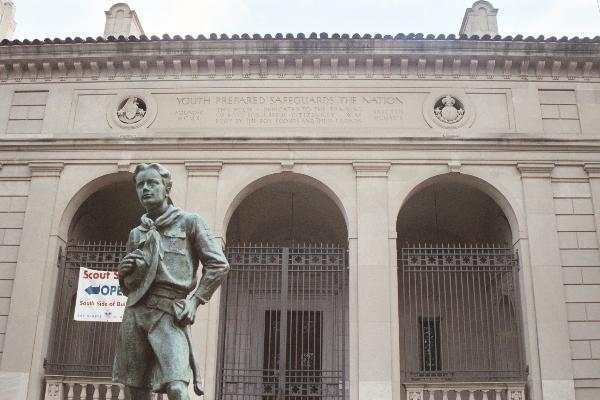
In the great witch hunt that began (or perhaps simply continued) with the Neo-con upsurge in which big business climbed into bed with theological conservatives, the pledge of allegiance became the acid test of true Americans. The Communists were now fading as a threat, and to be patriotic requires a clear and present enemy, so the un-Americans could be found among those who refused to pledge allegiance to a flag. In a recent CNN story, a case is going to court in Massachusetts to remove the words “under God” from the pledge. The dilemma is as simple as it is complex—children who do not believe in God may either recite what they don’t believe, or be ostracized for opting out. (Those of us who make a habit of opting out of things know the feeling well.) The argument goes that children are pledging loyalty to their country, not to a religion. Why should they be forced to say what they don’t believe?

The pledge has an interesting history. The original oath, a celebration of the now much-suspect Columbus Day, was intended as a quick credo of loyalty. No deity of any sort was invoked. Over time, additions started to creep into the pledge (the original version read “I pledge allegiance to my Flag and the Republic for which it stands, one nation indivisible, with liberty and justice for all”). It was not until after the tremendous horrors of World War II, when society was over-reacting to all kinds of threats, real and imaginary, that the words “under God” were added, in 1954. Godless Communists beware! Like the original pledge, this emended pledge celebrated a civil holiday—Flag Day.

IMG_0962

Nationalism could well be considered a form of religion. Customs differ in various parts of the world, and highlighting the differences allows for the conferring of unique advantages among the members. True capitalism cannot work in a culture of complete fair play or equality. Nations must be able to declare ownership and control of resources, including those known to every “human resources” officer in the universe as the most troublesome kind. To be useful to a nation, loyalty must be pledged. And children, who don’t have the experience or psychological development to make an informed choice about the Almighty, must say that they believe in “one nation, under God,” where “one nation indivisible” has itself been divided by God. Don’t get me wrong, I am glad to be an American—I can’t imagine being anything else. But I especially like the part about “liberty and justice for all.”


Chronic Religion

The Chronicle of Higher Education publishes a surprisingly large number of articles that touch on religion. I write “surprisingly” somewhat ironically here, since religion and higher education have been inextricably tangled from the very beginning of post-secondary education (and even before). A recent article by Donald L. Drakeman caught my attention because of the tag-line: “A venture capitalist with a doctorate in religion sees the value of a bear market in the disciplines.” In all honesty I have no idea what a venture capitalist is, but I do understand “doctorate in religion.” Dr. Drakeman’s article is entitled “The Highly Useful Crisis in the Humanities.” Drakeman points out that during times of economic hardship the number of students studying the humanities declines. During times of economic prosperity they rise. And he also points out that this can be interpreted in more than one way. Since I’m afraid of venture capitalists, I feared that religion, along with the rest of the humanities, was about to take another trip to the woodshed where it would come back again but might chose to stand rather than sit for a few days.

I was pleasantly surprised to find that Dr. Drakeman suggest that this disparity actually demonstrates the inherent value in the humanities. Tough times lead us to pare down those things that we value so that we might survive. Once a kind of stasis is reached, we try to climb once again. Humanities, in other words (speaking for myself and not Drakeman), represent the pinnacle towards which we strive. When money gets in the way, as it often does, we lose our focus and down comes baby, cradle and all. The humanities are what we live for; money represents pure survival. It is no surprise that those who lose their sense of human fellowship sometimes become survivalists—the individuals who can thrive with no other people around. But what about when the post-apocalyptic stock market recovers? Where will they be without the humanities?

Education, apart from simple survival skills, began as a means of ensuring that the religion that sustained our ancestors through hard times was passed on to the next generation. At times the more literal-minded suppose that means that the religion itself should never change—as if the religion were the point of it all. Although they may not have articulated it so, the ancestors, I believe, had a different goal in mind. Those who are parents already know what it is. We want our children to have it better than we do. If religion helped us, it should help them. It only becomes a problem when the religion itself is mistaken as the goal of the process. Everything evolves. A religion that changes with the needs of society is among the most vital aspects of the humanities, whether or not our forebears would even recognize it as religion at all.

IMG_0316


Disorganized Religion

In an Advice column in last week’s Chronicle of Higher Education, subtly pseudonymed Madalyn Dawkins contributed a piece entitled “Dodging the God Squad.” Dawkins, the wife of a senior college administrator, is an atheist and she shares anecdotally the woes of non-believing administrators everywhere. Even in state universities administrators must not reveal their lack of belief because powerful donors may withdraw their support or other administrators may bring them down. This leads Dawkins to posit a “God Squad” that silently polices university administrators, ensuring a kind of conventional belief structure. Of course, with any covert operation speculation must be involved. Dawkins notes that instructors may declare themselves non-believers with few consequences, but for administrators the game is much more political.

Doubtlessly covert religious groups exist; we discover them all the time. In this case, however, I wonder if Dawkins has wandered into that territory some of have written about for years but to which most academics are blind: the world is actually a very religious place. I sympathize with Dawkins. Those who are educated cannot unlearn what they’ve discovered on their academic journeys. What they often do, however, is suppose that others have kept apace. I see this all the time in the public posturing of the other Dawkins, Sir Richard, that is. Railing against belief as if it is a disease, he doesn’t seem to understand why the unwashed masses don’t get some kind of flu shot of the mind and destroy this pesky infection. What academics sometimes—often—forget is that religion serves many valuable functions in people’s lives. In a world where the privileges of an academic lifestyle are rare and becoming rarer, the disparity is only going to increase. There is no “God Squad.” There is society and there is academia.

I’ve been around the quad a time or two. I know that academic administrators often see no reason to study religion. Many of them are non-religious, as I’m sure many people know. Supposing that all others share their views, however, they cancel funds for the study of religion (one of the departments hardest hit by the “it doesn’t lead to a job squad”), as if silencing the rational voices in this discussion will make the phenomenon go away. Higher education exists for the sake of society. Those who are educated can help to educate others and slowly, slowly progress will ensue. Some of us have tried patiently to do just that over our years in the classroom. I never belittled a student’s religious belief. I did try to raise questions, and I tried to teach students to raise their own questions. My positions, however, were repeatedly cut out from under me by eager administrators. There is no God Squad. For the sake of us all, however, it would be best if administrators acted like this mythology is really true.

An early view of higher education.  Literally.

An early view of higher education. Literally.


Personal Dogma

Dogma is a movie that many seminarians discover at some point in their theological education. Smart, funny, and irreverently reverent, the film follows the exploits of a couple of misled angels trying to get back into Heaven and thereby negating all of existence. It is no surprise, given Kevin Smith’s origin myth, that the film opens and closes in New Jersey, but I often ponder the strange coincidence of places in the movie to places I’ve lived since my own seminary career began (and ended, rather like the massacre scene in Red Bank before God cleaned it all up). Nashotah House, where I discovered Dogma, is in Wisconsin. Wisconsin is the state to which Bartleby and Loki, the two angels, have been banished. The means of their escape from this upper-Midwest purgatory is a church in New Jersey. Along their way the angels pass through Illinois and Pittsburgh, before crossing into the very state where God is located throughout the movie (the Garden State, of course!). After having been summarily dismissed from my seminary post in Wisconsin (not for watching Dogma, I’m assured), I too headed for New Jersey. Before that I had lived for a while in Illinois (home of Bethany) and Pittsburgh (home of Moobie). Watching Dogma is in many ways a reflection of a journey that I’ve accidentally undertaken.

YEE.tif

Another kind of dogma seems to be at work in the Eagle Mountain International Church in Newark, Texas. The Associated Press announced that 21 cases of childhood measles had broken out in the church, particularly among the homeschooled and unvaccinated. Fears of inoculating against a pre-medieval faith have led many of those who trust their own knowledge above that of the collective specializations of educators, to put their children at risk for the sake of belief. The belief, perhaps unsurprisingly, is poorly informed. One of the pastors of EMIC (!) has been encouraging vaccination as biblically sanctioned. If not for the sake of your children, for the sake of the scriptures…

Vaccination, in various forms, was developed in both Christian and pagan contexts. The earliest examples come from Asia where the plagues sent by the devil were resisted with human ingenuity. It takes a paranoid twenty-first century, first-world faith to suppose saving our children is some kind of conspiracy. “Let the one without germs,” we can almost hear them say, “throw their tissues away first.” In my Pittsburgh days, I was very much a literalist. How surprised I was to see Lady Aberlin from Mister Roger’s Neighborhood playing an angst-ridden nun, derailed by an exegesis of “The Walrus and the Carpenter” in Dogma. Although the Neighborhood is “anytown” those of us locals knew that Fred Rogers was from Pittsburgh. Lady Betty Aberlin was the niece of King Friday XIII, and only those with no conspiratorial imagination would suggest it is merely coincidence that her cousin is named Kevin. With or without dogma.


Slippery Logic

Last week NBC reported on a baby in Tennessee. Babies in Tennessee, one might suppose, are pretty common. This one, however, was given a name stricken down by the courts. Child Support Magistrate Lu Ann Ballew declared that the baby could not be named “Messiah.” Apart from the statement that this is a title and not a name (don’t tell Judge Reinhold, please), the judge (not Reinhold) demonstrated her biblical illiteracy by stating that the title messiah has, “only been earned by one person and that one person is Jesus Christ.” Oh well, this is the Bible Belt, after all. Nevertheless, I would expect someone so deep in the Bible Belt to know the actual Bible a little better.

“Messiah” derives from a Hebrew word meaning “anointed one.” Its meaning is somewhat more literally along the lines of “smeared with oil,” for that is what anointing is. The title is used for several people in the Bible, not just one. Aaron, for one, was anointed. David was anointed as king, as were several other characters, including ill-fated Saul. And let’s not forget where Isaiah says clearly of Cyrus II, king of Persia, that he is “his anointed,” i.e., Yahweh’s anointed, in Hebrew, “his messiah.” Not Jewish, not Christian, Cyrus was a good old Zoroastrian. And he was just one in a long line of messiahs.

Where's your Messiah now? Oh, there he is.  (Photo by Persian Light.)

Where’s your Messiah now? Oh, there he is. (Photo by Persian Light.)

I’m not doubting Judge Ballew’s reasoning that it might be in the best interest of the child not to have such a controversial name. I do doubt, however, that it would be in the best interest of that child that he be raised being taught that evolution is a myth and special creation six thousand years ago is science. I do doubt that it is in his best interest to be taught that homosexuality is a sin and that it is something that only people have ever done because of their “fallen nature.” I do doubt that it is in the child’s best interest to be raised believing that if a woman is pregnant that a male-dominated government has the right to decide whether she carries the baby to term, no matter what. And once that baby is born, I do not believe it is the government’s right to decide on what his or her name shall be. And I expect that all the people named “Jesus” out there would agree. And Judge Reinhold.


Thar She Blows

Any survey of “armpits of America” will laughingly include New Jersey. Having lived here for nearly seven years now, I know the apocrine insults are undeserved—I actually knew that before moving here. New Jersey has the highest per capita Ph.D. concentration in the nation. It also has the highest number of college graduates, and, for what it’s worth, the highest per capita income. These first two points come especially to the fore regarding New Jersey governor Chris Christie’s recent speech, made in Boston—a city with some small higher education affiliations itself. Propping up his creds for a presidential run, Christie said, “I think that we have some folks that believe that our job is to be college professors. Now college professors are fine, I guess. You know, college professors basically spout out ideas that nobody ever does anything about. [Rim shot!] For our ideas to matter, we have to win because, if we don’t win, we don’t govern.” (This according to the New Jersey Star-Ledger.)

The United States, for many years now, has been falling behind in education because we won’t fund it adequately. I’m no jingoist, but I do believe that the principles upon which this country were founded were inspired. To thrive, we must be smart. Education has been the key to our improvement over the decades, and as the focus has shifted from education to capital, the hull has begun to leak. I know that I have felt it. With dismay I’ve watched as colleges and universities have hoisted the November Charlie and no vessel has come to their aid. Departments are jettisoned and we are still taking on water. And the governor of “the education state” guesses that “college professors are fine” but completely irrelevant. This man for president in 2016?

Meanwhile, yesterday, the unexpectedly happy news was announced that President Obama will be visiting my daughter’s university next week. Binghamton University is frequently overlooked by the monied special interests paid to the Harvards and Princetons of the green-lined ivies. It is, however, frequently cited as a “public ivy” for its quality education at state-school prices. Obama’s visit is for precisely that reason: good education can be affordable. Chris Christie went on to say, “For our ideas to matter we have to win because, if we don’t win, we don’t govern. And if we don’t govern, all we do is shout into the wind.” And if we don’t win we gather up our marbles and go home. Yes, I was a child once, too. And I grew up. Higher education does matter—far more than some politicians’ bluster would indicate. Do you agree, Dr. Einstein? I’m sorry, governor, I can’t hear you over the wind flapping the sails.

The_Loss_of_the_Romney_Man_of_War


Grand Delusion

Humphrey_Bogart_in_Casablanca_trailer

“The problems of three little people don’t amount to a hill of beans in this crazy world,” Rick memorably quoted in his once safe haven in Casablanca. Rick had fled his country for moral causes, only to become jaded and callus in an unfeeling universe. So it was with interest that I read the story of the Gastonguay family that my wife pointed out to me. The Gastonguays were stranded at sea when they took their kids and father-in-law and tried to sail away from a US rife with abortions, homosexuality, and “the state-controlled church.” Apart from sailing lessons, and perhaps a primer on US history, the little family had all they needed. They believed that their religion was sufficient to survive on Kiribati, their personal Xanadu, where there aren’t enough people to interfere with free religion. The Gastonguays, however, ran into a series of ocean storms after they set out from San Diego in May, eventually being rescued by a presumably Catholic Venezuelan fishing vessel. Their plane fare home is being footed by the godless government they fled.

Mrs. Gastonguay seems to be the family spokesperson. She notes how the Bible is pretty clear on social issues, according to the story on NBC. I couldn’t help, perhaps a bit naughtily, of thinking of the Bible as well, particularly Ecclesiastes 11.1. “Cast thy bread upon the waters: for thou shalt find it after many days.” That bread may be quite soggy, however, and the government you distrust might just have to bake you some new if you are to eat. I complain about government policies and shenanigans on this blog, but it is because I appreciate the ideals upon which this country was founded. Religious freedom is more or less a reality. Our government doesn’t force you to have abortions or marry a homosexual. School vouchers, which the Gastonguays may appreciate, are about the closest we come to a state-sponsored church.

Shifting genres a bit, I think of the hair band Styx’s hit, “Come Sail Away.” On that mythic journey the unnamed captain sees a gathering of angels swirling about his head. Of course, the angels are really aliens inviting him aboard their starship for an even more dramatic exit from a planet so full of troubles that any good Christian should have trouble sleeping. I can’t say that I don’t dream of escaping every once in a while. The ills that churn my stomach most are a pythonesque capitalism that just won’t let a poor soul breathe free without having to earn an extra greenback or two on the side. If it was up to me, however, I think I’d rather hang with Dennis DeYoung and await the unfolding of the grand illusion. That starship might just be the closest any of us will come to heaven on earth after all.


Misplaced Zealotry

zealotReza Aslan’s book Zealot: The Life and Times of Jesus of Nazareth has brought public interest back to the only begotten, and it’s not even Easter time. A confession: I’ve not read Aslan’s book, so my thoughts here are purely academic. (In a time-honored tradition, I will comment without benefit, or liability, of having actually read.) My interest is, to be frank, less on what Aslan has to say than with how people are reacting to him. Within days of publication, the internet began to swell with news stories about public reaction to Aslan’s treatment. My interest was raised by the Chronicle of Higher Education, where an article by Peter Monaghan quotes Lauren Green of Fox challenging Aslan, “You’re a Muslim, so why did you write a book about the founder of Christianity?” I know this is Fox, and that it is poor form to abuse the idiot, but I couldn’t help but to wonder at such a misguided question.

I would ask, honestly, how many Christians have read a book on Moses or David, or any Hebrew Bible figure, that was written by a Christian. Far fewer hands would be in the air if the same question were framed with the caveat, “written by a Jew.” Every supersessionist religion reserves the right to analyze what has gone before in the light of its own theology. We all know the Moses of Cecil B. DeMille, but how many know the Jeremiah of Abraham Heschel? Do we bother to read what the believer writes about his or her own hero? Would we need to? We already know what the conclusion is going to be. I, for one, am very curious how some Muslims perceive Jesus. That’s always a fascinating question, since Islam, in many parts of the world, superseded Christianity, and has, until recent times, often peacefully coexisted.

Is it not because the author is Muslim that the challenge was issued? How quickly we forget that western civilization (which began in the “Middle East”) owes much to Islam. While Christianity plunged Europe into the Dark Ages, Islamic scholars were rediscovering Aristotle and making genuine progress in science. And yet, we are suspicious of what is discovered by those of “alternative” cultural heritages. I would be more surprised should Muslims show no interest in Jesus. During the past presidential election, many non-Mormons flocked to bookstores (okay, that’s an exaggeration; nobody flocks to bookstores any more, now that Harry Potter is done), eager for books about Latter-Day Saints. Most of them written by non-Mormons. I don’t know what Aslan has to say about Jesus. I suspect some are disconcerted because he bears C. S. Lewis’ code-name for Jesus in the Narnia chronicles, but Aslan may well have something to teach us about ourselves. I, for one, welcome it. How can we ever learn tolerance if we’re unwilling to hear how we appear to others?


Wars and Holy Wars

An article by James P. Byrd, promoting his new book Sacred Scripture, Sacred War: The Bible and the American Revolution recently appeared in the Washington Post. Byrd asks a very relevant question in our era: “Was the American Revolution actually a holy war?” He suggests that perhaps it should be interpreted so. The reason is straightforward enough—our nation, our culture in the United States, is so deeply steeped in scripture that even our Deist founders knew their Bibles better than many preachers today do. Byrd suggests, in his article, that people who believed in the separation of church and state could still have a deep sense of divine mission, and a belief that their war for freedom was a divine cause. Early state leaders were not anti-religious, nor über-religious. It is a balance that we would benefit from regaining.

Declaration_independence

I guess I’ve seen enough political shenanigans to realize that such posturing as the Tea Party and the Religious Right or Moral Majority present are deeply cynical. The use religion as a platform to achieve political ends while conveniently slashing and burning huge swaths of biblical reasoning leaves many questions in its wake. Were such motives sincere, I would expect a lot more turning of the other cheek, and walking the second mile uncoerced. I suspect there would be fewer hungry people and even fewer living in positions of extreme wealth and power. In short, without the agenda of political religion, I suspect we would be a more Christian nation.

War is difficult to justify from a strong ethical stance, as most ethicists know. Our founders decided to go to war against what they believed was unfair oppression by a more powerful nation. This takes on the cast of a holy war because people were being oppressed. The pre-emptive strikes were throwing crates of tea into Boston Harbor, and yet the more advanced nation refused to lessen the pressure. In the Bible, Pharaoh declared the Israelites should make bricks without straw, and we all know where that got him. Or we would know, were we as literate as our forebears were. Freedom was considered a sacred trust. We live in a time when trust is at a premium. You can’t fly or surf the internet without being watched in intimate detail. There is no talk of holy wars, it seems, since the sacred has no place in a society that does not promote the concept of liberty with all the risks and benefits it entails.


Christian Rocks

ViolFemsSitting in traffic outside the Lincoln Tunnel, I see that the Violent Femmes are coming to town. The billboard sends my mind spiraling back to college, when the Violent Femmes had released their debut album. Not that I ever listened to it (then), but in the fervently evangelical atmosphere of Grove City College, many students rooted and grubbed for any whiff of esoteric Christianity in a culture on the—pardon the genre-switch—highway to Hell. Rumors abounded that the Femmes were covert Christians, just like another up-and-coming band called U2. Not only the Femmes were violent—reaction to such Christianizing assertions was as well. I remember one of the dorm-mates in my housing group getting into a shouting match that U2 was not a Christian group and slamming his door to sulk, literally for hours. This was important stuff. We were Christians in an underground world.

Of course, some of us knew that Gordon Gano clearly betrayed the influence of Larry Norman in his voicing. And there were rumors and rumors of rumors that the Violent Femmes were coming out with a Christian album, despite the popularity of “Blister in the Sun,” the homage to masturbation that raised the group to stardom. This rumor turned out to be partially true, as Hallowed Ground took on spiritual themes, a little bit country, a little bit soul. There was some tension in the group as Gano’s lyrics began to suggest something more overtly Christian. All of this was going on long before I discovered the Femmes. At Nashotah House I taught a guest lecture on Christian themes in rock music. I researched the Violent Femmes and found that I liked their sound. They made the cut for the lecture.

In a culture as deeply steeped in the Bible as ours, it is difficult to avoid Christian imagery altogether. The Femmes were from Milwaukee (not far from Nashotah House, as the raptor flies), the heartland where beats the pulse of unadulterated religiosity. Even Iron Maiden, after all, had released the platinum album The Number of the Beast. And David Buckna points out in a recent MuseMash post, that even Ozzy Osbourne has some religious aptitude. (I always thought there was more going on in “Iron Man” than meets the ear.) This may all be chalked up to cultural Christianity—there need not be too much conviction here. Those who feel oppressed, however, huddled together in their evangelical college dorms, will always suspect that there is something more beneath the surface that makes even the “Prince of Darkness” the bearer of light.


Free Freedom

A weary-looking TSA official asked me why I opted out of the full-body scanner at the airport recently. As always, I responded that it is against my religion. The haunting lyrics from a Larry Norman song waft through my head; “I was born and raised an orphan, in a land that once was free…” It used to be, when I was little, that you were innocent until proven guilty. As I stand in line at the airport, next to an eerily humming x-ray machine that is examining all my secrets, learning what I’m reading without ever having to read my blog, I watch fellow citizens step inside a sci-fi-inspired glass chamber while being bombarded with God-knows-what so that any unnatural contusions might be spotted and analyzed. They raise their hands above their heads like outlaws in the old west. We are all guilty now, until proven innocent. If you are Trayvon Martin, you pay for the assumption of guilt with your life. Don’t worry, Mr. Zimmerman, you’ll be acquitted.

IMG_0622

In my darker moments, I wonder who benefits from a government that keeps increasing amounts of data on its citizens while cutting programs to ensure their comfort and health. We have elected a police force, not officials of the people, by the people, for the people. Vigilantes can literally get away with murder, as long as the skin-tone algorithm is correct, but if you’re perverted enough to want to fly, you have nothing about which your government is not interested. Who is being protected here? Who is being kept safe? A stranger has his gloved hands on my crotch. I’m feeling a little more than vulnerable.

Protest is a sign of love in this troubled world. If I step inside that glass chamber and raise my arms, I am declaring that I am guilty. Let me prove my innocence to you. Technology has made our private lives so easy to scrutinize. I used to think the future envisioned by Jacques Ellul was just a touch paranoid. I’m now beginning to think he didn’t go far enough. This computer on my lap can be like a TSA official in my own home. My website visits may be traced and analyzed, and my self-publish words misconstrued. And if I go to the store at night, a stranger can follow and shoot me with the blessings of our legal system. Of what are we so afraid? Is it time to stand our ground yet?


Am I Famous Yet?

Sweat is running down my back and my chest.  The sun beating down on my head feels like a hammer of the gods.  East 42nd Street is clad with a wide, red carpet and drivers are honking in a way that assures you that they are seriously irritated.  I step out into Second Avenue when the little white person appears on the crosswalk sign; it is 93 degrees and I’m due back at work.  A motorcade stops me as three tour buses cascade by, and an NYPD officer waves mere pedestrians back to the baking pavement to wait another rotation of the lights.  Helicopters high overhead fail to stir this heavy, hot air.  Hazily I wonder if the president is in town, or royalty of some kind.  It’s clear that the plebeians are of less importance this afternoon in New York City.  Then I spy a banner-the All-Star Game.  I’m being broasted on this street corner for a bunch of baseball players, not one of whom I can name.  This is such a facile way to learn your place.

Chance often enters my thoughts.  There are those who become rich and famous because they are driven to it, but they happened to be in the right syzygy of circumstances to take advantage of that opportunity.  There are some who would say that attaining greatness is an act of God, and others who claim it is only fate, or luck.  The fact is, the only reason some people are more special than the rest of us is that they were offered an opportunity that opened a gate.  I’m not suggesting that hard work’s not involved, but hard word alone doesn’t suffice.  You need to have a leg up to get to ride in that air-conditioned luxury bus down Second Avenue while your fellow citizens, and not a few seriously sweating fans, step aside for you.

I’m sure it’s just sour grapes. Like most little boys I really enjoyed playing baseball. I never considered it a job, though. We were far too pedestrian in my neighborhood for that kind of thought. My goal was to be a janitor. It was only when I reached beyond this calling appropriate to my state that I ran into difficulties. The marionette dancing at the end of the strings of puppet-masters who had better opportunities than I. Sour grapes and hellish city streets—what wine will ferment from this alchemy? There go the All-Stars. In many parts of the world, as in my head, their names are unknown. Today, however, one of the busiest streets in Midtown Manhattan is stopped just for them. We’re all in the same oven, but some are in air-conditioned coaches while others are melting on the sidewalks. The red carpet is not for the likes of us.

1937_all_stars_crop_FINAL2


Before Twilight

Despite the summer with its long, languid days, The Telegraph reported on vampires last week. In an article entitled “Polish archaeologists unearth ‘vampire grave,’” Matthew Day narrates how archaeologists have uncovered skeletons buried with their heads—decapitated, obviously—on their legs. This was apparently a not uncommon medieval practice for ensuring that suspected vampires stayed safely in their graves. Interestingly enough, Day comments that the practice mainly began after the Christianization of the pagan cultures that had preceded them. Even pagans, he suggests, ran the risk of being accused of vampirism, a broadly defined threat in the Middle Ages. Of course, the Twilight series had not been written then so that the safe, Mormon cast of vampire was unknown.

Vampires represented a couple of concepts terrifying to people before the scientific revolution: they were a source of draining an individual of some life essence, and they were the problematic undead. The decapitation, in Tim Burton-Sleepy Hollow style, was intended to prevent the vampire from being able to locate its head after death. Unable to find the business end of its vampiristic corpus, the undead might remain just plain dead. Of course, staking works, if the tales of the Highgate vampire, near whose grave I recently stayed while in London, are to be believed.

The belief in vampires, or at least fascination with them, has been very hard to shake. One of the earliest horror films made was Nosferatu, a rip-off of Bram Stoker’s Dracula that was nearly obliterated because of copyright violations. Nosferatu continues to be ranked among the scariest of horror movies, and the Werner Herzog’s 1979 remake is a classic in its own right. The Shadow of the Vampire was an even more recent movie about the filming of the F. W. Murnau original. Among the earliest of the Universal monster movies was Tod Browning’s Dracula, which forever identified the face of Bela Lugosi with the infamous Count. No matter how deeply we bury them, the vampires keep coming back to stalk our nights and nightmares. When future archaeologists uncover the detritus of our civilization, no doubt they will conclude that we too, in a secularized world, feared the undead.

Bela_lugosi_dracula


Burning Faith

1528. February 29. St Andrews, Scotland. 24 year old Patrick Hamilton was burned to death for espousing the teachings of Martin Luther. St Andrews University is the oldest of Scotland’s four ancient centers of higher education. Heterodox religious teaching was considered a very dangerous thing in those days, especially in the halls of academe. Once infected with Lutheranism, like a zombie, you had to be burned so that the rest of the world could be safe, the virus contained. Only the problem in this case was an all too human one—difference of opinion regarding religion. The Thundering Scot, John Knox, would’ve been all of about 14 at the time, and reformation for the Catholic Scotland was still years in the future. Now, one of the largest European cathedrals, in St Andrews, lies in ruins because of that very reformation.

Religious bickering has a tendency to move beyond the ridiculous to the insane. Burning young men, after decades of burning hundreds of young and old women alike throughout Europe, was one of the most heinous symptoms of a horrid madness that had grown from religious fervor and fear. Religion itself is not to blame as much as the human tendency to use it as a weapon against those who are perceived as different. Some five centuries later and the physical stakes are gone but the fervor and fear are as strong as ever. As we hear politicians and televangelists lash out against those of whom God disapproves, the smoke still rises from the spot where Patrick Hamilton, late of the University of St Andrews, was sacrificed for his faith.

IMG_0729

Ironically, as I sat on the quiet morning train from Edinburgh to Leuchars, from the headphones on the young man behind me wafted AC/DC’s “Highway to Hell.” Was Patrick Hamilton aware that he was on a literal highway to hell as he returned home to Scotland? Did he have an inkling that his own people would torture him to death because he taught such dangerous ideas as salvation by faith alone and Scripture as the instruction for that salvation? Could anyone have guessed that the then teenaged John Knox would introduce what was to become an even less forgiving form of Christianity to Scotland by the time young Hamilton should’ve reached his dotage? Religion is funny that way. Even those who give their all to defend it easily become its victims. And a few yards down the road the Society of Biblical Literature meets in a university building dedicated to the sciences. History’s ironies never end.


Seems Reasonable

Florida is a state of contrasts. A news story from the Associated Press highlights that divergence. On the lawn of the Bradford County courthouse is a monument to the Ten Commandments that American Atheists sued, unsuccessfully, to have removed. In response to their legal defeat, they have placed their own monument to atheism alongside it. Well, what’ fair’s fair. Local reaction, according to the story, has been anything but positive. Nevertheless, I wonder what a monument to atheism must look like. The partial photographs reveal the atomic symbol-based American Atheists logo on top, and words on the sides. The monument, the story indicates, bears quotes from Thomas Jefferson, Benjamin Franklin, John Adams, and Madalyn Murray O’Hair, the last of whom was gruesomely murdered as an early martyr to the atheist cause. There are those who suggest that the atomism of Democritus in the fifth century BCE already tolled the death knell of the gods. Deities and very small particles, however, have continued to get along for the past 2500 years.

Ephesians_2,12_-_Greek_atheos

David Silverman, the current president of American Atheists, is quoted as saying the monument is an attack on Christian privilege, not Christianity. This may seem a fine point, but it is valid. Most reasonable atheists have no difficulty granting freedom of religious belief to anyone (only the more radical members of the atheist camp suggest religion ought to be stamped out). Does that mean governments should not display monuments to Moses’s magnum opus but not to, say, that of Lao Tzu? Or, perhaps in this instance, Lucretius? It might appear to be over-protesting, but what would a Hindu’s thoughts be, should s/he be ushered past the statutes of a foreign god on the way to court?

One of the most difficult things for a person to do is envision their normal as another person’s weird. Religions that seem perfectly logical to those raised within them have a way of seeming unbelievable to those who encounter them as a part of an exotic culture. To me it is difficult to suppose anyone would see American culture as “exotic.” I mean, we’re talking Wal-Mart and MacDonald’s here. It seems pretty ordinary to me. When I take a mental step back a little further, however, I begin to see a nation of widely varying traditions. Little pockets of true culture punch through the plastic here and there, and the light that shines through can be brilliant at times. And if you happen to run afoul of the law while visiting, you might end up in a courthouse that not only advertises the Ten Commandments, but also has a monument to humanistic spirit as well.