

Voices from the Third Estate
Discussions over the past week in that great wasteland we call state government have included talk of actually having millionaires taxed to shoulder a little of the state’s fiscal burden. Naturally there has been a strong backlash in this nation of deeply embedded plutocracy. Those who have their millions certainly feel little social responsibility, since the prosperity Gospel (or its analogs) comforts them with whispers that wealth is a sign of blessing. One of the most evil ironies of all is that many such folk have the chutzpah to cite the Bible as their backer. God loves the beautiful people.
Such virulent misreading of religion shrugs off millions of gallons of crude oil gushing into the Gulf. Petroleum companies breed some of the wealthiest individuals around, and if we wipe out the marine life of the southern coast, well, that’s a small price to pay for individual privilege. Somewhere along the line an unholy matrimony between religion and greed produced the great plague that will lead to the fall of western civilization. This may be seen clearly among the apes.
Frans de Waal, an author whom I’ve quoted before, notes that in ape society when an individual (or individuals) takes advantage of the system, the group eventually brings an end to his (or rarely her) reign. Primate society can only tolerate abuses that damage a community for so long before a collapse is immanent. Consider Rome, “the eternal empire.” Every day politicians posture in the media about how they have the best interests of society at heart. As members of the privileged classes, they have lost sight of what it feels like to live in the constant umbra of the supercilious wealthy while millions have no jobs, no health care, no future. Millionaires owe nothing to the society that allowed them to become rich, for the Bible tells them so. Nature, however, begs to differ.
Religious Democracy
An op-ed piece in yesterday’s paper raised some important issues concerning religion and the unfortunate fall of Mark Souder. The article, by E. J. Dionne, pointed out that Souder once said, “To ask me to check my Christian beliefs at the public door is to ask me to expel the Holy Spirit from my life when I serve as a congressman, and that I will not do.” This pointed affirmation of faith is precisely the dilemma of a democratic system that allows for freedom of religion. All religions (those that are serious attempts to deal with the supernatural, in any case) are defined by the conviction that their practices, their beliefs, their ethics, are correct. When a religious individual is elected, or even converted after election, in a democratic system their religion is given power. With their faith they vote on issues that cut across religious boundaries, binding those who do not agree to their personal faith stance by law.
Europe in the Middle Ages is perhaps the most obvious example of what might happen when one religious body (in that case, the Roman Catholic Church) gains excessive political power. Problem is, these days folks don’t agree on which is the right religion. America was not founded as a Christian nation, let alone an evangelical Neo-Con one. It has become, perhaps because of this fact, one of the most actively religious nations in the developed world. As befits a consumer mentality, religions are offered in a marketplace. Within Christianity alone there are aisles and aisles of churches from which to choose. When a public servant is elected and her or his religion dictates their votes, have we not just lost freedom of religion?
Teaching for many years in a seminary is a sure way of becoming aware of the limited training that religious leaders generally receive (if any). The short time they spend being educated does not equip them to think through all the implications of their convictions. They attain the pulpit and the congressional leaders who happen to be in their congregations receive an inchoate theology confused by their three years earning a “Master of Divinity” degree. Not all are equal to the task. Those religious leaders with promise, often because of internal church politics, end up in smaller venues, their voices effectively silenced. Those with the most strident voices reach larger congregations, often without the humility of admitting that the more you learn about theology they less you know. Their congregants, armed with faulty perceptions of their own religion, burst into their congressional chambers full of conviction based on problematic conceptions. It is a very serious dilemma.
Perhaps what is needed is an oath of office for politicians rather like the Hippocratic Oath for physicians. Perhaps they should swear to put their own religious outlooks in check while considering social issues on which their constituents vary widely. Perhaps their integrity in truly representing the population they govern would lessen the impact of their inevitable personal foibles. And naturally, this oath would not be superstitiously sworn with a hand on the Bible.
God Said “Let There Be Life”
The news has been buzzing with the human creation of the first synthetic cell. Religious leaders in the theologically litigious world of western religions are not quite sure what to make of this one. Is it life? If so, by definition, people could not have created it; only God creates life. Right?
Life is one of those hazy concepts that, although it may easily be described, is difficult to define. What exactly is a “life force”? Where does it come from? It seems to have arisen naturally on the primordial earth, and likely has developed elsewhere in the vast universe as well. Traditional theisitic approaches to religion claim that this is God’s trump card, the ace of spades in the game that is existence. Only God gives life, takes life, and gives it back again. Human efforts to replicate the process are bluffs.
No wonder religious leaders don’t know what to make of this development! This is the final gauntlet to be thrown down. Once life itself is explained, the god of the gaps may vanish forever. In the 1950s amino acids were created in a laboratory. Not quite sixty years later, cells have been replicated. There is still time for religious leaders to contemplate where all this is going. Of course, many stake their beliefs that 2012 may take care of all of this and life will forever remain in the provenance of the divine.

Amino acid or cosmic SOS?
Indiana Wants Me
The conservative evangelical Christian camp sometimes makes blogging on religion just too easy. The paper this morning reveals yet another evangelical, abstinence-only soap-boxer being caught with his boxers down. Indiana Representative Mark Souder is stepping down because of an extra-marital affair. To fill in the gaps on other such evangelical infidelities, I recommend Max Blumenthal’s Republican Gomorrah.
No, I do not rejoice in such revelations. The suffering of families brought on by such blatant hypocrisy cuts me deeply. The lesson we should all be learning from this is that self-righteousness is a sham. For all their faults, the more liberal factions of society are ready to admit that people are people and not cookie-cutter angels. They are inclined to admit that temptations exist, yet statistics demonstrate their marriages tend to be more secure and less plagued with infidelity. I tend to think it is because evangelical teaching has lost sight of what is truly important: people have always been, and still are, people. The belief that God has made one class of people better than others, and that saying sex doesn’t exist gives you the right to live in a pre-Edenic fantasy world, the Neo-Con is in very deep denial. No wonder many evangelicals distrust psychology!
I often ponder why this disconnect should exist at all. It seems that evangelicalism has been singularly poor at providing the tools to cope with reality. If temptation doesn’t exist for the blessed, then why bother developing strategies to deal with it? When the newspapers come out, it is easier to cast the first stone at the liberal media for airing dirty laundry than it is to examine your own hamper. Yet even the Bible itself has one important character criticizing the religious establishment as whitewashed tombs. No, I do not respond with glee to the sad outing of Mark Souder. I simply wish evangelicalism would truly advocate the honesty upon which it claims to be based.
Awaiting the Evolution
My daughter’s taking the mandatory New Jersey high school biology tests this week. Probably designed to ensure that basic health risks are factored and understood, it is one of the few bulwarks of the correct teaching of evolution in the United States. As anyone who follows my college Michael Zimmerman’s blog in the Huffington Post realizes, Creationism is a constant menace to our country. Although many simplistically assume that the threat is gone, it is, alas, sleeping but not dead. Perhaps quiescent under the administration of a moderate president, the Creationists have not gone away. I fear an imminent backlash along with popular apocalyptic hype for the year 2012. The Creationists are out there, just beyond the perimeter fence. I can feel it.
Having grown up under the umbra cast by the Creationists, I know their resiliency well. In a high school current events class, I participated in a Creationist-Evolution debate that classmates still remember some three decades later. It would be a situation laughable if it weren’t such a serious threat. While society has continued to evolve since Scopes, most Americans are still convinced that there is something insidiously evil about evolution, as if the devil generated the first simple cells and set the entire process running. In a society where Creationists daily benefit from the advances of science – as any search for evolution on the internet will demonstrate – they hold their feet firmly on the brakes nevertheless, awaiting a snow-white stallion at the parting of the literal clouds overhead.
I am not alone in foreseeing this whiplash that’s about to come. Many analysts who know the radical Evangelical camp share my fits of nerves and jitters. The educated elite suppose they’ve been eliminated, but those of us who know the world of the uneducated faithful tremble with a fear not inspired by the Maya. Sarah Palin is one of the most popular people in this country right now, and the Creationists, I assure you, are already staring at their watches and counting each passing tick.
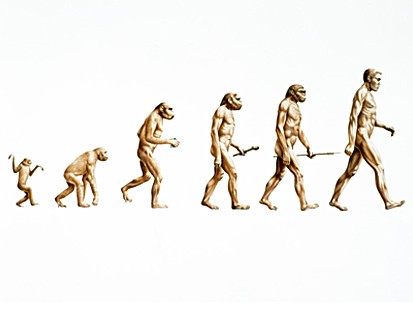
Neo-Cons marching straight to the polls
Giving Lilith Her Due
Lilith Fair has announced its 2010 tour dates and excited fans are already purchasing tickets. Lilith Fair is a collection of women artists who share a stage to showcase the female contribution to contemporary music and donate a considerable share to charity. The event name, of course, is taken from the mythological character of Lilith. Popularized as a rare example of “Hebrew myth,” Lilith is a character who likely derives from ancient Mesopotamia, although her origins are obscure. Best known as “Adam’s first wife,” her somewhat sexy story in Judaic tradition evolved into Lilith being the original woman. Unlike Eve she was created simultaneously with Adam. Things were fine until she wanted to be on top during intercourse – males were not made to be dominated, according to patriarchal old Adam, and Lilith ships out to shack up with Satan. She is demonized (literally and figuratively) and becomes the “night hag” that snatches babies and claims the first right of intercourse with every male (an etiology for nocturnal emissions). She becomes the mother of demons.
This story shows all the traits of a late development, but the idea of a strong female figure in Eden is an appealing one. Lilith has come to represent the empowered female, and the modern trend towards accepting her as an icon of feminine independence is apt. Long ago I was intrigued by the female side of the story. Perhaps because I was raised primarily in a single-parent family for my formative years, I have always wondered about the disparity in our “advanced” culture that still considers the male as the “default” model with the female as kind of an adjunct after-thought. This fascination led me to the study of goddesses in the first place, culminating in a doctorate on Asherah. In the Bible men have Adam, Noah, Moses, David, and countless other role-models – even God himself according to standard interpretation. Why not admit the goddess?
It is telling that when Lilith becomes too powerful she is presented as evil. Anthropological explanations have little to offer by way of adequate explanations for such a development. Not to blame biology (or to lay claim to an excuse), but Frans de Waal’s Inner Ape demonstrates that males are hopelessly paranoid about showing weakness. Female primates tend to express their power by group cohesiveness while males try to blunder their way to the top with brute individualism. Adam had nothing to fear from Lilith. To those who perform in Lilith Fair, I only have to say, “Rock on!”
Expect a Miracle
The Pope has been in Portugal. No visit to Portugal would be complete without a stop at the shrine of Fatima. Named for one of the most fascinating characters in Muslim history, Mohammed’s strong daughter Fatima, this small, centrally located town had no claims to fame until 1917. Suddenly three children declared that the Virgin Mary had appeared to them while tending their sheep. The story is about as eerie as the canonical photograph of the unsmiling youngsters. Their sincere proclamations were met with acceptance by many war-weary Europeans and predictions began to emerge from these visions. On October 13 that year some 70,000 pilgrims alleged that the sun itself danced, twirled, and took on new colors. Astronomers reported no solar anomalies at the time.

The events at Fatima have fascinated both religious and secular explorers of the supernatural. The religiously devout claim nothing shy of a miracle while those seeking more dramatic non-theistic explanations claim that aliens were behind the show. Whether or not a physical event transpired, something out of the ordinary occurred in Fatima that day. Now a permanent shrine graces the location. If the apparition appears again, she will be comfortably housed in doors, out of the elements. She might even see one of the bullets fired at Pope John Paul II during the famous assassination attempt. Many believe the Pope’s survival was itself a miracle.
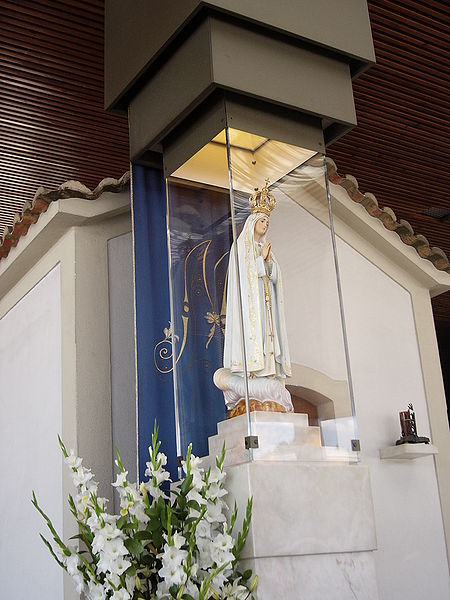
Gnu version of Virgin under Glass
Now Pope Benedict XVI has visited the shrine where heaven once touched earth. Afterwards he climbed into the Popemobile, the motorized bullet-proof reliquary that allows papal viewing by the faithful while protecting Rome’s most valued asset. The message is clear: it is wonderful to believe in miracles, but it is prudent never to trust in them. Two of the three children (Jacinta and Francisco) died before they reached twelve, felled by the famed Spanish Influenza. The miracle that could have preserved their young lives never occurred. Lucia alone survived to 97. Expect a miracle? The odds are hard to predict on that one.
And With Perfect Teeth
This week drug stores across the country will begin offering a testing product that will help assess genetic predispositions to various diseases and weaknesses. Potential parents might learn what debilitating illnesses could plague their children. Who wouldn’t want to eliminate needless suffering and create a world involving less pain and wasting away? Who wouldn’t want to know in advance? Ethicists are up in arms for such knowledge is surely a dangerous thing, just like an overcrowded lifeboat.
Ancient peoples had their own way of dealing with such dilemmas – blame the gods. Disease was not the result of genetic predisposition or even microbes. Illness, plague, pestilence and degeneration were the punishing weapons in the arsenal of ill-tempered deities who didn’t really understand what it was to be mortal. In Ugarit the archer-god Resheph was the divinity who brought pestilence. Shooting from afar with his fiery arrows he could topple cities and nations. Yet few prayers to him are recorded. Better to appeal to a higher power, an outranking deity who might overturn random suffering.
With the loss of many gods comes the loss of the right of appeal. Should the one God be the one who sends disease, to whom can prayers be offered? For many prayers to Jesus or even to Mary are made to circumvent the sad lot poured out upon a destitute humanity by an implacable father. People now recognize genetics and microbes, but still talk to the spirit world about woes and fears. Starting on Friday, however, there will be a product locally available that might provide relief in advance. Who’s willing to take on the gods and give Pathway Genomics a try?

What’s in a Name?
Two of my readers sent me an article yesterday about Lord Jesus Christ, the Massachusetts man who was hit by a car. Lord Jesus survived the brush with death this time. Clearly the angle on this story is the human interest aspect instead of the courtroom precedent or the political scope of its ramifications. In our minds, if we’re honest, we’ll admit that we’ve already come up with a profile for a man named “Lord Jesus Christ.” We’ve already judged him and determined his motives in legally taking such a name. This is a book to be judged by its cover.
From a purely semantic point of view, the victim’s name would probably have more impact with the definite article: The Lord Jesus Christ. As it is, the name differs only in degree from the thousands of Chrises out there, of either gender, or the many Hispanic men named Jesus, or those Anglos with the surname Lord. Not to mention all those Joshuas. Our names are the labels that others immediately use to prejudge us, although mostly our names come from our parents, or sometimes spouses. We are known through life by tags branded on us by parents who have no idea who we will become. As the non-adopted step-son of a second father I changed my name and I know the baggage that goes with such a change. The burden became so great that I reverted to my birth-name after college. I felt like I had been living a lie for much of my youth. What’s in a name?
Our injured man with the newsworthy name has not yet become the savior of the world. Some religious folk are offended by his appellation, yet most of us would be flattered by someone naming their child after us. Why not aim high when it comes to names? If we are to be judged by our verbal moniker, why not select one that states our point of view? With religiously motivated terrorism on the ascendant, however, it gives me pause to think about Lord Jesus Christ being run down. A man was injured here, while crossing the street. It could have been anyone. If it hadn’t been for his epithet, the story would not be national news. More than anything else, this may reveal the significance of the name.

A message from on high?
Not My Daddy!
They spy each other across a crowded room. He sure is big: barrel-chested and even a bit brutish. She’s cultured and refined, but there’s no denying that spark…
Today’s issue of Science announces the startling news that Neanderthals and Homo sapiens once interbred. The theological implications are enormous. I used to tell my students that the earliest evidence of religion falls not only among the artifacts of the Cro-Magnon branch of the hominid tree, but also among the remains of Neanderthals. If they had religion, and if they weren’t “human,” what happened to their souls when they died? I received a lot of puzzled looks from seminarians and more than one or two angry stares. The Bible, after all, claims that each was made according to its own kind. Seems like Adam and Eve might have been sleeping around with the non-Eden set. Looks like we’re in for another theological conundrum!
Neanderthals and Homo sapiens diverged once the human lineage left Africa, but once they met in a smoky Paleolithic bar, well, nature took over once again. And if these two hominid species interbred, who is to say what went on back in the days of Lucy? What happened in prehistory stays in prehistory, religions must needs proclaim. If we are honest with the evidence, our bonobo cousins share ancestors so do they share souls?
Some of the present human race, according to the DNA evidence, is walking around with Neanderthal blood, while others are not. I suppose gene sequencing might reveal which camp you are in. Will there be a Church of the Neanderthals? And will non-Neanderthals be allowed to share communion? And were the founders of the world’s great religions all Cro-Magnon or not? If they were of a slightly differences species, can I still join? Theologians, it is time to grab your pencils!
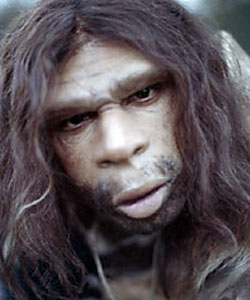
Maybe your dad, but not mine!
I See You, This Time
With the advent of Avatar on DVD, I finally had the opportunity to see the movie. This time there was no booming bass and overly active 3-D, and I didn’t end up feeling nauseous for days after. On a small screen it lacked the compelling sense of being in each scene that the first ten minutes of my theatrical experience of the movie had, before I had to seal my eyes tight for the rest of the film or be carried out on a stretcher. Nevertheless, I was able to follow the story this time.
I have posted several times on my affinity for old science fiction films; a large part of my boyhood was spent watching hours of improbable adventure on the black-and-white. Perhaps counter-intuitively, I ended up studying religion instead of science, or even literature. Religion, however, is deeply embedded in science fiction, probably because it is deeply embedded in people. And Avatar was no different. Early commentators noted the similarities of Pandora to Eden. Two trees in the garden (Hometree and the Tree of Souls) were easily borrowed from Genesis. The idea of nearly naked natives living in harmony with the world around them, the soft, graceful curves of the forest contrasted sharply with the angular, obtrusive construction vehicles intent on raping paradise. I’m a sucker for archetypes, I guess. The concept of Eywa as “All Mother,” a nurturing goddess rather than a frowning father deity, only enhanced the sense that Pardora’s box should not be violently wrenched open. Even the hideout of the protagonists was nestled among floating rocks called the Hallelujah Mountains – presumably the name given by earthlings.
Yes, the writing was at times trite, and the characters were caricatures of themselves, but in the tragic light of the Gulf of Mexico Oil Spill, Avatar’s world was pristine, uncomplicated by greed and corruption. The Na‘vi, like zealous Christians, are born twice; the metaphor of foolishly maintaining hope in the harsh light of uncaring entrepreneurs might lead to a limited salvation even for this tired old planet. I am an unrepentant tree-hugger. And if there is a film that, despite its limitations, says it is alright, even noble, to hug trees, then I say it is religious in the deepest possible sense.
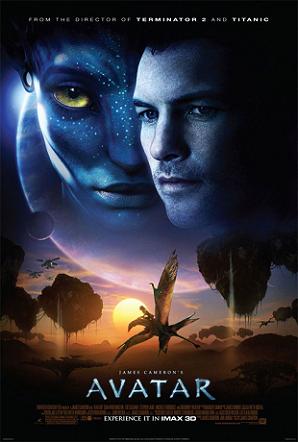
All Mother is watching
Weather Religion
Byline: Yazoo City, Mississippi. Event: major tornado. Suspects: God. In the face of any tragedy, whether it be killer tornadoes or Christie’s budget, God is always implicated. It is the white god’s burden of monotheism. I am the last person to make light of tornadoes. Many a nightmare and sleepless night in Wisconsin were haunted by the loud, roaring gusts and twisted detritus mangled by apparently willful winds. Erratic fluid dynamics of violently spinning vortices of air are often chalked up to the divine. No less so in Saturday’s tornado outbreak.
An Associate Press article begins, “One prayed to God under a communion table as his church was blown to pieces around him.” The article goes on to note that a ravaged hymnal lay open to the page with “Till the Storm Passes By,” as if there were a divine message inscribed on a chance event of nature. One of the hardest lessons to accept is that nature cares nothing special for our species and that we are offered no guarantees in life. This is one of the reason religion is so powerful: here the faithful find divine-bound guarantees of at least a peaceful afterlife if the present life is torn apart by storms both physical and metaphorical. It is hard to struggle without an assurance of final victory.
I have contended for years that the association of the divine with the weather is intimate and tenacious. The weather has eluded human control well into the space age, nuclear age, and technological revolution. We still can’t stop the rain on Sunday’s picnic or festival. And so we pass the weather on to the CEO in the spiritual chain of command. God controls the weather, while we crouch under rickety communion tables. There is a deeper lesson here, for those willing to sift through the rubble.
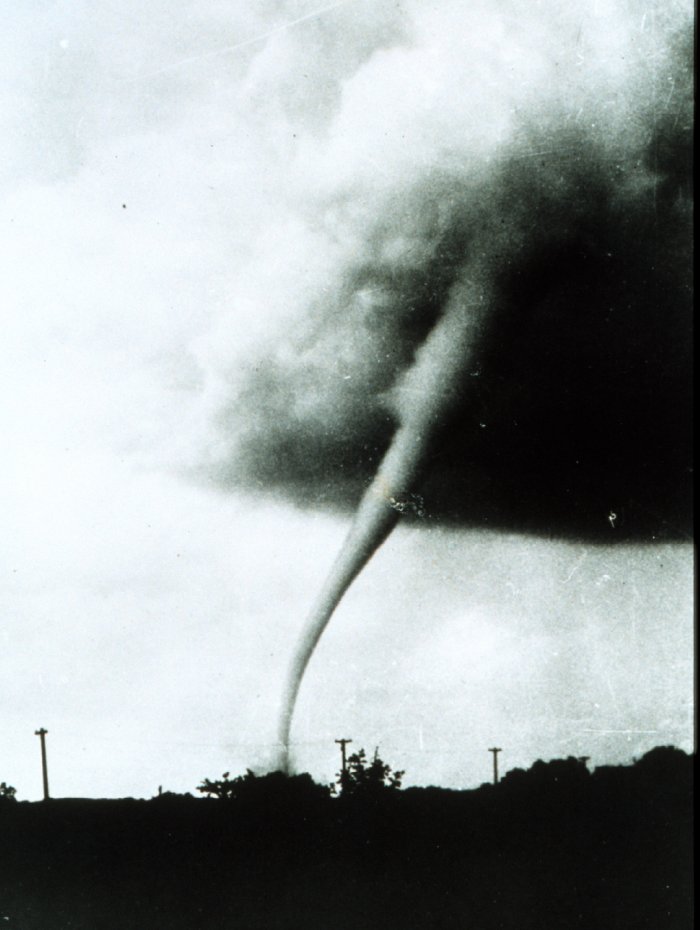
Nightmare on Church street
Militant Evangelists
It is not often that the military gets to rebuke an evangelical, no matter how much the evangelist may deserve it. In the world of Christian crusaders few come close to the stature of Billy Graham, a man who has had more than half a century of undue influence on American culture. At a library book sale a couple weekends ago a middle aged-couple hovering over the religion books (where I have professional obligations to hover) were discussing how they’d read all of Billy Graham’s books. When the family business passed to Franklin Graham, however, the scepter failed to be firmly grasped by the blushing co-regent. At the center of controversy since his comments about Islam beginning in 2001, Graham the younger was recently stricken from the (apparently) prestigious Pentagon prayer service roster.
I have to admit that I was surprised to learn that the Pentagon has a regular prayer service. My image of the military is one of beefy guys (and some gals) with ultimate confidence in their weapons and more than enough brashness to go around. They don’t project the down-on-your-knees-before-the-almighty image. “Guided by the beauty of our weapons,” as Leonard Cohen once sagaciously quipped, the military gets first crack at technological advances and heavy metals. The basic components of carnage and devastation. Yet they pray.
The old adage that there are no atheists in fox-holes glosses military service with a divine prerogative, so when these tough guys rebuff a famous evangelist there must be a story behind it. The military’s refusal to dis Islam displays a sensitivity uncharacteristic of most evangelical rhetoric and theology. The Religious Right’s revisionist claims that America was founded as a Christian nation are impotent without their WMD. Even so, the program should continue. “I don’t think it’s quite fair to condemn a whole program because of a single slip-up,” do you?

When Enola Gay comes to play
Mother’s Day and Earthquakes
It is Earth Day, a holiday that all the world should join hands to celebrate since it is secular and concerns all people. Except the religious. Theologies are inured to common celebration; any admission that others might be right is a chink in the implacable armor of conviction. So it was not such a great surprise when an Iranian cleric this week blamed Iran’s earthquakes on women. Fuming like Eyjafjallajokull, the imam cited immodesty on the part of women as leading men to temptation and the very earth whose day we celebrate shakes in rage. Why it is that the burden to prevent sexual temptation should fall on women alone is unfathomable. If men have such trouble controlling their urges perhaps they ought to explore real estate on Mars, although it is doubtful they would be happy there.
The earth, our common home, was conceived to be female by many ancient societies. The Greeks of the Classical era called her Gaia and gave her the honor of being the earliest deity to emerge from Chaos. In the Bible, desexed and depersonalized, the earth was constructed on the first three days before any living inhabitants cluttered its pristine surface. With the drive of Christian conviction that this unruly mother should be subdued under human dominion the industrial revolution began a process of disrobing and dismembering Gaia, an impersonal “it” to be exploited. The Bible could be cited as demanding such action; we were commanded to take control. And our religions provided the ethics to underscore our mandate.
If not for the second great awakening in the 1960s, Earth Day would never have found its fundamental expression. We would continue subduing and dominating, as per Genesis 1, until the great white man above would be forced to send his son on a great white horse to end it all. But the earth is our mother. The missing woman from the all-too masculine Trinity. Instead of blaming her daughters for the unstoppable lusts of her sons, and instead of repeatedly defiling her to keep up with the Republicans, we should take a moment today to honor her. She is the only such mother we have.
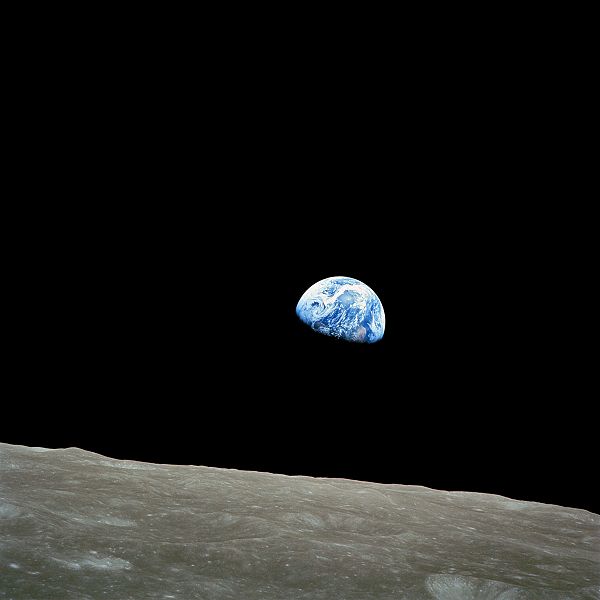
Son, behold thy mother.

