United, We Divide

I was a teenage Methodist.  Or, I should say, a teenage United Methodist.  My family had moved to a town where there were no Fundamentalist churches.  Indeed, the only Protestant church was the UMC.  Although very aware of religion, I hadn’t studied it deeply at that point—I’ve come to understand a bit better the marketplace of Christianties and how it works in a capitalist society.  The thing is, the more I learned about John Wesley and the Methodist movement, the more I saw how well it aligned with my own thinking and experience.  I became an Episcopalian largely because John Wesley never left that tradition and urged his followers in the same direction.  Of course, the “United” in United Methodism was due to mergers during the ecumenical period when Christians were learning to overlook differences and a strong base remained from which to draw.

The news has come out that the United Methodist Church has decided to split over the issue of homosexuality.  Most major Protestant denominations have made their peace, albeit uneasily, with the issue.  They recognized that while a source of guidance in spiritual matters the Bible’s a little outdated on its scientific understanding.  If God had revealed evolution to good old Moses things might’ve been a bit different.  We now know that homosexuality isn’t a “choice”—it is found in nature, and not rarely.  Homo sapiens (if I’m allowed to use that phrase) have developed in such a way that sexuality is a main preoccupation of religions.  Some animal species are monogamous and in our case many cultures adopted this as conducive to an ordered society.  Then it became codified in some sacred writings.

While homosexuality is mentioned in the Bible, every book of that Bible has a context.  Like it or not, close, serious study of Scripture raises questions you just don’t get if you read only authors who think the same way you do.  It is far easier to do that—who doesn’t like being right?—but thinking seldom gains credibility by never being challenged.  Iron sharpens iron, someone once said.  The emotion behind the issue, I suspect, is driven by a couple of things: fear of that which is different, and the inability to see the Bible as anything but “da rules.”  In those cases where the rules contradict one another you just have to choose.  At least in Christianity.  In Judaism they ended up with the Talmud.  In any case, we’re now seeing the fracturing of society based on party lines.  We could always use a few more choices, I guess, for competition is what spiritual capitalism is all about.


Droning On

According to the New York Times (I don’t have a link, but Google will bring it up), nighttime drone formations have been reported by law enforcement in the Midwest.  These obviously precision formations fly over small towns and prairies in Nebraska and Colorado.  Now, I write what I consider to be horror fiction, but this is downright scary.  We know our government is keeping tabs on us using all kinds of technology, and this could be a government program.  It could also, as the article points out, be the mapping project of some corporation (which can be scarier even than the government), seeking natural resources to exploit.  Twice this past year I’ve spotted mapping cars with their camera-stalks protruding from their roofs, multiple spider-eyes recording roads and their surroundings.  Smile—you’re on candid camera!

At least you could see this kind.

Please don’t think that I suppose myself important enough to be spied upon.  Heck, I can’t even get job interviews and my books don’t sell.  Still, I am concerned about surveillance.  I’ve seen articles suggesting that facial recognition software is now being used by some governments (notably China’s) for keeping track of “people of interest.”  I’m more a person of disinterest, but I thought nothing of pausing long enough for the camera at Heathrow customs to record my face and scan my passport as I entered the UK in June.  Coming back the same thing happened in Newark.  And people wonder why I won’t go into the full body scanners at the airport.  Some bits of personal information, particularly those down south, I’d like to keep out of government hands.

Watching the X-Files again has reawakened my suspicion that there are too many secrets.  Yes, I know the X-Files are fiction.  Still, we know black budgets are as real as the electronic money our banks tell us we have.  And some places aren’t even accepting cash any more.  I have no idea why fleets of drones may be flying over the Midwest, but the fact that it’s happening at night raises all kinds of worries.  The X-Files had us looking for UFOs, but drones come from a far more threatening species.  Technology has no controls built in.  Kids these days can run virtual circles (and very precise ones at that) around my generation.  Listening to them talk tech makes me think English might be a foreign language after all.  Nobody requires a permit to fly over your head and take a look.  While they’re up there, I wonder if I could convince them to take some pictures of my roof.  Those on Google maps don’t give enough resolution to tell the roofers where they should focus next.


Seaing 2020

It’s funny what sticks in your head.  As a ten-year-old 2020 seemed impossibly far in the future.  And it was very wet.  Not because of global warming, but because of a Saturday-morning cartoon called Sealab 2020.  Suffering from thalassophobia, the idea of living under the ocean was both intriguing and terrifying to me.  I recall that these underwater scientists had “aqua-gum” that they could chew so they’d be able to breathe and talk when not in the giant domes of the lab itself.  While checking out the series online, I was surprised to learn it only had 13 episodes and lasted but three months.  I’ve been thinking about it for over 40 years now, silently waiting to see if we would have such places as the deadline drew near.

This image is protected under copyright by the owner. It is reproduced here under the fair use doctrine, in low resolution. From Wikimedia Commons.

Instead in 2020 we have a record low of scientific projects being supported by a science-denying government.  Ironically the sea levels are rising because of global warming.  We haven’t done our homework and we’re pouting that things aren’t turning out the way we wanted them to.  Ours is no longer an evidence-based reality, but one where a tweet of “fake news” is all we need to make the truth a lie.  And as the water laps our ankles my thalassophobia starts to kick in.  The thing about Sealab is that they had kids there too.  Kid scientists.  Even more ironically, Richard Nixon was president.  His downfall was Watergate—coincidental?—and now we have a president caught red-handed (very Red-handed, even) in crimes while in office and Nixon’s beginning to look like a saint.  When did the water get up to my knees?

They wore wetsuits and swim fins quite a lot in the show.  Moving under water looked so natural—unlike my flailing when I attempted to swim.  It was all about not being able to breathe, in my case.  They showed us all kinds of strange animals under the water in Sealab 2020.  Animals that we could drive to extinction, it seems, if they got in the way of unbridled greed.  I have to admit that I’m a bit disappointed that Sealab misled me.  We were heading for an optimistic future back then, even with Nixon justifying the Vietnam War and spying on his political opponents.  People were still able to look forward four decades ago, in hopes of a better future.  For all these years I’ve been awaiting 2020 only to find the world back behind where it was in 1972.


The Truth Lies

I recently saw a Trump supporter claiming, unsurprisingly, that everyone’s lying except Trump.  Of course, I could be lying.  According to the Washington Post, Trump has made over 13,000 lying or deceitful statements since being in office.  For those who did their homework before he became the great protector of the unborn (ah, there’s one born every minute!) he was known as a crooked businessman to begin with.  With well over a thousand lawsuits against him even before being elected, we have no choice but to believe the entire legal system is lying, as well as anyone who’s had business dealings with him.  I’m just so glad that we have such a moral, upstanding paragon of Christ-like behavior in the Oval Office.  Never mind that all those witnesses in the impeachment case were speaking under oath—they all lie, but Trump.  Hey Donald, is that your real hair?

Ironically, some of the people making such claims hold the belief that divorce is not excused in the gospels (see Matthew 5:32, but Jesus could’ve been lying here—he’s not Donald Trump, after all).  It’s a matter of public record that Trump is twice divorced.  It’s a matter of sworn legal testimony that he paid hush-money to cover up affairs while married.  Well, that is if we believe this lying world rather than the one, solid, shining bastion of truth in the White House.  Someone once said (but he may have been lying) that it is easier for a camel to pass through an eye of a needle that for a rich man to get into heaven.  Just sayin’.

I have said before that all politicians lie.  It comes with the territory and only the most naive among us don’t accept that fact.  There is a difference, however, between the occasional mistruth and a lifetime, documented record of indiscriminate lying.  If it weren’t for the fact that all facts are lies (except those Trump makes up) we would see that the phenomenon of pathological lying is well known.  The presidency of the United States has never before tolerated a pathological liar.  But then again, they never had an incumbent more Christian than Jesus himself.  Now I think I remember who made that crack about rich guys.  He also said something about having no place to lay his head.  If he’d been born rich, though, you can bet the gospel message would’ve been very different.  Too bad the Bible lies.  If it didn’t such musings as this would hardly be necessary.  I could be lying, of course.  It is, after all, the new truth.


The Place of Temples

Gobeklitepe, or more properly, Göbekli Tepe, stunned the archaeological world a few years back.  This site in what is now Turkey contained what is apparently a sanctuary—purposefully buried—and advanced architecture for its age.  It was that age that was so shocking.  Gobeklitepe dated from around 11,000 years ago.  Now, in case ancient history’s not your thing—this will be painless—agriculture began, according to the standard chronology, about 10,000 years ago.  This led to surplus production that in turn led to the first cities, indeed, what we recognize as civilization itself.  While Gobeklitepe wasn’t permanently occupied, it was an example of a temple before agriculture, and according to the standard thinking, this should not be.  Consequently not too much has been published on the site because nobody likes a smart aleck, even if said aleck is an archaeological site.

Just within the last weeks, Anadolu Agency announced that an even older site was found in Turkey, near the city of Mardin.  Reports coming out of Boncuklu Tarla suggest that it is a millennium yet again older, dating from 12,000 years ago.  The article doesn’t include many photos, but suggests the site is similar to Gobeklitepe.  If this holds up, a new paradigm for human history will need to unfold.  What drew people together at first was not tilling the soil and reaping a surplus, but religion.  Even in the still standard paradigm, kings could only emerge with the backing of gods, so early cities had impressive temples.  What the evidence now suggests is that the temples came first and ancient people came together at sacred sites before they had a surplus to bring.  You can’t pick a sacrificial animal without having a heard or flock from which to take said victim.

We live in a technological era in which intelligent people are scratching their heads with their smart devices because religion just won’t go away.  I have suggested before that the reason it won’t is that it is deeply engrained in our biology.  We can try to reason the gods away, or abstract them to the point that we can call them laws or principles, but we can’t escape the fact that we’re held down by forces beyond our control.  Ancient people in Turkey, hunter-gatherers in our current paradigm, were gathering together and putting massive energy into building what look like temples before they had a secure and steady source of food.  Before, indeed, they had smart phones or even dial-up.  Millennia later we would rediscover them and wonder about things even as religion would be the deciding factor in elections in the most technically advanced cultures on the planet.

Photo credit Zhengan, via Wikimedia Commons.


Shortest Day

This is it.  It’s here.  Today marks the winter solstice, the longest night.  Those who campaign to keep Christ in Christmas prefer not to acknowledge that the date of said holiday was an attempt to displace Sol Invictus, the Roman (therefore pagan) celebration of the invincible sun.  The Romans, like other ancient peoples, celebrated the return of light, albeit slowly, from darkness.  While teaching at Nashotah House a colleague mentioned being “almost pagan” in the eagerness for the return of light.  You can strike the “almost.”  Deep down we all look for signs of hope in dark times, whether Christian, Muslim, or Hindu.  “The people who walked in darkness,” Isaiah rejoiced, have seen light.  Sometimes light comes from an unexpected quarter.

There are two high circulation Christian magazines: Christianity Today and The Christian Century.  The latter is more progressive and was launched as an answer to the former.  One of the founders of Christianity Today was Billy Graham and its readership is largely evangelical.  Just yesterday Christianity Today ran an editorial stating the opinion that Trump should be removed from office.  If I were a card-carrying member of the Republican Church, I’d be trembling.  Long touted as “Trump’s base” evangelical Christians have found themselves besieged by the flagrant and constant contradictions their party has thrown them.  Fear of divorce was enough to keep at least one woman I know in an abusive relationship for years.  Now a thrice-married, philandering man who pays hush money to keep his affairs secret is upheld as the new Messiah.  Many of us who grew up evangelical were certain that their old tribe simply wouldn’t cotton onto a straw man.  But  cotton they did.  They’ve become the very lint in his miserly pockets.

Those encrusted with hardcore hatred, of course, will not be swayed.  They’ve found a poster boy who says it’s okay to claim white male supremacy.  They can pick their political issues (usually having to do with protecting the unborn or the right to shoot those already born) and they can be certain that this protean protestant will have their posteriors.  Their leadership, however, has begun to show itself clearsighted.  Christianity Today is no friend of liberal Christianity.  The editorial makes it clear that Democrats had it in for Trump from the beginning.  There is, however, absolutely clear evidence of his crimes.  Even as southern senators state outright that they have no interest in seeing a fair trial, their base is speaking up.  Tonight is the longest night of the year.  Tomorrow it will be a little bit lighter than today.  At this time of year we fervently hope that the light will continue to grow.


All in This Together

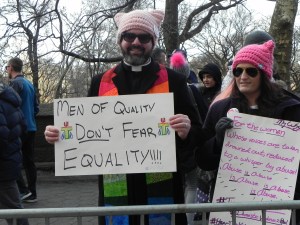
The rain falling from the dark sky is barely liquid.  The thermometer reads 33 as we step out into the early evening—this is not the kind of night I’d want to be outside, but this is important.  When we arrive in Bethlehem there are already maybe a couple hundred people lining Rose Garden Park with signs.  We park and join them.   Many of the signs are clever and to the point: “I shouldn’t have to miss Nixon,” and “Vichy Republicans—shame on you!”  This winter of discontent, crumbling democracy, we are here as warm bodies on a cold night to protest what has gone on far too long.  The impeachment vote is scheduled for today and across the country people have come out—supper hastily eaten or yet to be started when they get home—to say enough is enough.

Now Pennsylvania isn’t the bluest of states.  I wasn’t sure of what our reception would be on the busy corner of 8th Avenue and Union.  I was amazed.  Large numbers of cars, and even some commercial trucks, honked their horns in support as they drove by.  Thumbs up out windows in the cold air.  Long blasts on horns.  For sure, many drivers remained silent, but only three that I counted bothered to roll down their windows and shout support for Trump.  They were treated respectfully and cordially by the protesters, many of whom were considerably older than my wife and me.  I listened to snatches of conversations as my fingers and toes grew numb.  Vietnam vets, and even one from the Second World War.  Retirees who should be spending December nights in their warm homes.  We all had something important to do.  We had to stand and be counted.

Because of a childhood incident, I suffered mild frostbite on my fingers and toes.  It is excessively painful for me to be out in the cold to this day.  We could only stay for about an hour and a half.  It was a work night after all.  There were many stalwarts still holding signs and chanting as we headed back to our car.  Around a sign for the park where other, more temporary signs stood, a protester said, “Someday maybe we won’t have to do this anymore.”  A younger man corrected him.  This happened because we failed to be vigilant.  Vichy Republicans are a real thing and although the elections are about eleven months away, we need to get ready.  We need to get everyone out to vote.  If the signs of support we saw last night reflect the feelings of Americans, it’s time for us to become a democracy again.


New Religion

Republicanism, it seems to me, has become its own religion.  It started off when the GOP married evangelical Christianity, but the offspring of that unholy union has become a religion all on its own.  It certainly doesn’t adhere to classical Republican principles (tariffs?  Really?).  Nor does it adhere to Evangelical standards (turn the other cheek?  Love thy neighbor as thyself?).  Like most blendings, this new religion has some elements of each parent and it has no lack of fanatic supporters.  The traditional Evangelical, for example, considered the Devil “the father of lies”—one of his biblical titles.  The Republican, however, considers pathological lying to be signs of messiahood.  There’s a tiny disjunction here, but it proves that what we’ve got is the birth of a new religion.

Books and articles have begun to appear on how Evangelicalism has changed.  I don’t believe it’s so much a matter of Evangelicalism evolving as it is Republicanism fulfilling the need for intolerant religion.  In every culture there are those who want to go back to the day of Moses and golden calves and stoning those you hate.  It’s a little more difficult these days, what with secular laws that protect the rights of others, but the GOP has found a way.  My heart goes out to old fashioned Republicans, it really does.  Fiscal conservatives have found themselves in church with a bunch of people with whom they agree on very little.  They have no choice, for their political party has been sanctified.  And the only thing worse than an Evangelical is a bleeding-heart liberal.  Next thing you know the Democrats will start quoting the Bible at you.

The lying thing really takes some wrapping my head around, though.  I’ve always said nobody believes in a religion they know to be false.  This new development challenges that, if it doesn’t challenge the very idea of religion itself.  Republicanism is a religion based solidly on bearing false witness.  Self-aware of it, even.  You can’t tell me that these educated white men don’t know a criminal activity when they see one.  That they can’t read, and reason, and trust their intellect (although it takes the back seat to their overwrought emotions).  Sound like a religion to you?  It sure does to me.  It’s been coming a long time, but it took the last three years (the tradition length of Jesus’ ministry, it’s often said) for this to dawn on me.  The religion of the lying messiah.  I’ve got to wonder what kind of future it’s got.  I smell the fires rekindling in the burnt over district and wonder who’s for dinner.


What Remains?

As our government continues to pretend it has an interest in anything but enriching the individuals in Washington, a rather constant refrain of “broken system” has emerged.  It heard that phrase repeatedly in conversations in San Diego, on a variety of topics.  Now, I’m no stranger to buzzwords, but this strikes me as particularly apt to describe what we’re seeing.  A democracy within a republic builds safeguards to prevent the abuse of power, but when abuse of power occurs and one political party insists on enabling such abuse, the system is indeed broken.  Not only that, but there’s no will evident to fix it.  The GOP glories in it, feeling like it’s somehow winning the game as families and individuals suffer as a result of it.  In the past, it seems to me, there was a desire to repair what was an obvious problem.

Self-delusion, it seems, has become very common.  That, and some older politicians may not be aware how frequently they’re shown in their foibles on the internet.  Information that used to take weeks or months to filter out is now known instantaneously, and everybody’s overloaded and confused.  Politicians, instead of trying to show us the way in such a landscape are rather acting like my late stepfather in saying “Do as I say, not as I do.”  A fine bit of hypocrisy, that.  At least he tried to mend his ways, even if not successful in his efforts.  He would’ve known, however, that he had no business being president.  I reflect on this broken system quite a lot and I wonder what is next for us.  When trust in government is completely eroded, where do we turn?

Many have celebrated the decline of religion.  Let’s be more precise here and say organized religion.  Survey after survey reveals that we aren’t necessarily becoming less religious, but we’ve been watching prominent religious leaders throw their unstinting support behind a broken system.    Many of them continue to ignore the truth to support an incumbent who’s demonstrated that he’d just as soon turn on them as help their cause.  And for what?  Simply to prop up a tottering system, to squeeze out the last drops of what can be used to make things better for themselves before it all falls down.  As I was flying essentially coast to coast, it was evident from the air just how diverse a nation we are.  For nearly 250 years we’ve been able to make it work.  Now that it’s clearly broken, it seems the will to make it better has vanished.  And only politics remain.


Prophets and Precipitation

I have no idea how they name winter storms, or even if they should.  Weather-hype is yet another instance of click-bait, or watch-bait that requires constant upgrading to draw in increasingly jaded readers/watchers.  Winter storms are a fact of life, particularly in northern states.  If you name them, then you think you own them, as the saying goes.  In any case, beyond the fact that they go through the alphabet to draw their inspiration, I have no clue what criteria are used for giving names.  The storm that many of us were out in for much of the day yesterday was “Ezekiel.”  There are plenty of “E” names available, and I wondered at this biblical choice.  Ezekiel is often treated as a name for eccentrics, and I wondered if something about this storm was proto-apocalyptic or what.  Beyond the standard “snowpocalypse,” I mean.

The storm may have been considered of “biblical” proportions since it affected/is affecting much of the nation (as it is me, even as I write).  We tend to use the Bible for things that are of large scale, and, frequently, beyond our control.  Prophets often called for events on national level, and Ezekiel’s message had to do with a kind of ultimate redemption.  I suppose it’s the kind of message our nation could use right now, snow or not.  We could use good times sent from above, following the decidedly unbiblical evangelical administration we’ve put up with for three years now.  What would Ezekiel say?

Back in my teaching days, I had to cover Ezekiel in less time than the prophet deserved.  He pantomimed the coming destruction of Jerusalem, and, among the exiles, proclaimed their return to a better future.  Now I can’t say if winter storm Ezekiel will lead to a better future or not.  It will lead to some sidewalk shoveling, some travel headaches (as we experience firsthand yesterday), and the usual array of winter wonders.  I do know that claiming insanity to label a prophet is a cheap shot when it comes to explanations.  Ancient people recognized madness when they saw it, and prophecy, they knew deep down, was different.  None of this suggests this storm has been in any way predictable.  Yesterday with its accumulation of sleet and freezing rain, and today with its projected snow are all part of a typical December around these parts.  As people addicted to media stimulation, I guess we have to give it a name so that we can feel properly awed.


Steel and Snow

I sometimes feels I need to pause before launching back into my usual reflections.  Commercialism tells me the holiday season is here (I noticed while watching Macy’s Thanksgiving Day Parade that the real highlight is Santa and the official start of Christmas).  Please don’t misunderstand—I love the holiday season and look forward to it every year.  It’s not that I want to get things or spend lots of money.  For me the holidays are about rest and respite from the constant stream of work that never really gets done.  I need to retreat once in a while.  Ensconce myself in a quiet room and not have to worry about the next crisis facing me as an editor or the publishing industry as a whole.  I do love the holidays, but I often wonder about how we’ve let their symbols become the main point.

Now that we live near “the Christmas City,” we attend the Christkindlmarkt in Bethlehem while family is home.  One of the more stark symbols of this festival is the juxtaposition of a Christmas tree against the now silent and rusting steel stacks of what used to be Bethlehem Steel.  The evergreen, of course, was a Teutonic symbol of life continuing in the midst of the shutdown of the growth season.  Nature hasn’t really died, although it may appear to have done so, but we feel that difficult times with short days and cold temperatures will now dominate our existence.  Our industrial efforts participate in this slowdown too.  What once identified one of Pennsylvania’s two steel cities has ceased an Bethlehem has had to adapt.  We see the change and wonder.  I grew up just north of Pittsburgh when it was a very large industrial city.  When I was in high school it was the 16th most populous city in the country.  Currently it’s 66th, with Charlotte, North Carolina holding its former place.  We adjust to changing seasons.

Christkindlmarkt is a lively place with four large tents dedicated to symbols of the season.  Christmas merchandise is a large part of it, of course.  Small business vendors, however, take advantage of the fact that crowds throng in.  Food, naturally, comes to hold a place of some significance as your blood sugar drops after spending a few hours on your feet.  Music is in the air and people don’t seem to mind the masses of others who all had the same idea.  I never purchase much at the event, but I enjoy being among those inspired by it.  Some of us are the rusty towers in the background, and others are the lively, decorated tree that stands before them.  The season has begun, and the symbols are open for interpretation.


Thanks for the Giving


The wonderful thing about Thanksgiving isn’t the food.  I object, on more than one level, to calling it “Turkey Day.”  No, the wonderful thing about Thanksgiving isn’t the food, but rather the universal aspect of the holiday.  From Fundamentalist to atheist, everyone can be thankful and we all have things for which to be thankful.  The holiday may have begun in a Christian milieu, but you need not believe in a God in the sky to give thanks.  We can thank one another, we can thank the universe, we can thank whatever powers that be, or we can simply be thankful, no matter to whom.  As I write this in the early morning hours, I’m thankful for being home after spending several days on the west coast.  Hearing the November wind howling outside, I’m thankful for this warm cup of coffee.  I’m thankful for the ingathering of family.  There’s so much goodwill today.

Thankfulness leads to a kind of optimism.  Thankful people can perhaps see that we need not hate others to feel good about ourselves.  I think of Thanksgiving as a feeling of love and acceptance.  Perhaps more than any other holiday.  I’ve heard people of many religions and backgrounds wishing others a happy Thanksgiving.  Would that all holidays could be so accepting!  Of course, holidays themselves have their origins in religions.  Were it not for beliefs, one day would be the same as any other.  There are religions that refuse to celebrate holidays, but when critics become too harsh on religious beliefs I’m thankful to remind them that they have religion to thank for both holidays and weekends.  We could all use a break.

Thanksgiving comes at different times in different countries.  In some places no equivalent holiday exists.  There are secular holidays, of course.  The very concept, though, of a “holy day” comes from that great generator of calendars—religion.  As chronologically challenged as I am (I can’t figure out time changes or time zones or even what time it is anywhere non-local) I often think of the marking of time and how a religious impulse started our species doing so.  Sure, it may have been the urge to start planting, or the awareness that the herds of prey were moving on, but in those early days such things were infused with religious significance.  And when calendars became canonical, there were religious impulses present to drive it.  So, in a way, it is good to be thankful even for religions—as problematic as they can be—on this Thanksgiving.  


Focus on Religion

Publishers Weekly, or PW to those in the biz, is a great place to get information about, well, publishing.  I often spend AAR/SBL telling authors and prospective authors something that I wish I’d been told when teaching: time spent learning about publishing is never wasted.  PW every year has a “Religion and Spirituality Update” released in time for this meeting.  Despite the relatively small number of sales, religion is a discipline that loves its books.  I’ve only been quoted in PW’s special edition once, and it’s not been for a few years, nevertheless I always learn a thing or two from this free—yes, if you’re here in San Diego it’s free!—update.  It may seem odd to suggest that religion titles can be hot, but it is indeed possible.  Sexuality is hot.  I suppose that goes without saying.

A number of titles dealing with religion and sexuality appear every year.  What caught my attention, however was an observation from Jennifer Banks, from Yale University Press.  Noting the rancor that sexuality often introduces to discussions of religion, she observes that (and this is a quote from PW, not directly from Banks) “some Christians apparently need others to go to hell.”  (I can send the full citation, if you want to know.)  In an era when academics have been stressing inclusion, the retrenched religious world has been spinning in the opposite direction.  Instead of inviting everyone to Heaven, as might, say a Universalist, many conservative Christians consign fellow believes to Hell, and gleefully so.  It’s almost as if Christianity and capitalism have merged into a zero-sum game.  If some win, all the others have to lose.  They haven’t however, studied the history of Hell very well.

It’s kind of an insidious idea.  Given that we all want to justify ourselves, some go to the extremes of demonizing those who see things differently.  This form of religious thinking was original neither with Christianity nor the Judaism from which it grew.  There was no Hell in the Hebrew Bible.  The idea, when it did develop, wasn’t a place to torture your enemies, but rather a place demanded by justice.  Those who were utterly and unrepentantly wicked couldn’t hobnob in God’s country club with those who tried to be righteous.  In the modern evangelical narrative those who make certain medical decisions for basic human situations are among the utterly wicked.  Not surprisingly their sins are usually sexual.  If you want to see this in a wider context, pick up a PW when you pass by the stand.  “Anything free,” to quote another sage, “is worth saving up for.”  And who knows, it might keep you from Hell?


Wisdom of Trees

Stepping out of the airport the first thing I noticed was the palm trees.  I’ve traveled to this area enough times that I shouldn’t be surprised, but I always am.  And since we are creatures of the culture in which we’re raised, palm trees inevitably make me think of Gilligan’s Island.  We grasp for culture to help us make sense of this odd world of negotiating other people and, like many children born in the sixties, I was raised on television.  Gilligan’s Island (somehow appropriate training ground for attending AAR/SBL—it actually featured a professor) was as close to seeing a palm tree as I ever got, being raised in a very humble household.  To me, palm trees were as much creatures of fantasy as the monsters that populated the movies I watched on Saturday afternoon.

My first experience of a real palm tree was in Israel, 1987.  I’d signed on as a volunteer at Tel Dor, an archaeological dig near Haifa.  Then, as yesterday, I encountered palm trees—so alien and yet so natural—at the airport.  Welcome to Tel Aviv!  And so we think of palm trees as being part of paradise, a place where it’s always pleasantly warm and although well-watered it doesn’t rain too much.  Trees symbolize our culture.  Although back home in the northeast most of the leaves are down from the hardwoods, the region is also defined by its large plants.  Trees do that for us.  Spreading high over our heads, with dense cellular structure that makes them heavy, trees have always been attractive to our species.  And they can help us define, at a glance, where we are.  “Paradise” derives from a Persian word for “garden.”  Even in arid zones they value their trees.

Looking out my hotel window I see the bay.  In the bay stands a marina.  Back home most boats are shrink-wrapped by now and I’ve already seen smaller bodies of water start to freeze over.  Paradise has no ice.  For the castaways, being on the island was always a challenge, but never a terribly serious one.  Thurston Howell III used his money (useless where there’s nothing to buy) to try to assert his influence.  Everyone treated him with respect, always calling him “Mr. Howell.”  In that paradise, however, one of the two characters (who had names) referred to always by title, the professor—the skipper, of course, was the other one—was the person looked to for guidance.  If anyone would figure out a way to be rescued, it would be the academic.  I’ll be spending the next few days on an island with mostly professors.  And when it gets too intense I’ll look at the palm trees and remind myself that this is paradise.


Speedy Delivery (SD)

Ritual, no matter what scientists say, is deeply woven into the fabric of human psyches.  It may be either the warp or the weft, but it’s downright basic.  I was reminded of this on my hurried and slow trip to San Diego yesterday.  I always wear the same shirt when I fly to this conference.  This isn’t superstition, but rather it’s a case of sticking with something that works.  I don’t often wear turtlenecks, and one reason is that they seldom fit well.  More years ago than I care to admit (I’m wearing the shirt in the photo below, which was taken at Nashotah House nearly two decades in the past) I found a navy blue turtleneck from Land’s End (this is not a sponsored post, although it probably should be) that works perfectly.  Even today it fits snugly around the neck after hours of wear.  Maybe ten years back I bought a black turtleneck from the same company and after pulling it over my head, it gaps something awful.  I tend only to wear it around the house.  The original still does the job.

I was ready to drive myself to the airport yesterday and I grabbed a quick lunch at home.  Part of said lunch involved opening a ketchup bottle probably nearly as old as the shirt I was wearing.  (I’m sure you can see where this is going.)  I ended up looking like a murderer, which is not something you want to try to explain to a TSA agent.  I quick threw said ritual shirt into the washer and the drier buzzed at the same time as my phone did for when I had to leave for my two-hour-ahead check-in.  This remarkable shirt was dry and ready to serve.  Maybe you can see now why I’m so ritualistic about clothes.  I also opt-out of those Star Trek scanners at the airport.  This means I get lots of governmental pat-downs.  It feels more authentic when you have actual hands running down your body—at least it’s honest.

The TSA agent commented that you don’t see many turtlenecks these days.  I explained that it’s good for flying because I’m always cold on planes.  As this stranger’s hands were rubbing down my chest, I was wondering how many times this shirt has been felt up by the US government.  It has no pockets to pick, and besides, at airport screenings everything is stowed in my carry-on, including wallet.  At midnight San Diego time, I checked into my hotel.  East coast time said I’d been awake 24 hours because who can really sleep on a plane?  Once my patted-down body reaches 3 a.m., Eastern Time, it wakes up.  In these circumstances it’s good to know I can rely on that shirt in my drawer.  That’s what rituals are all about.